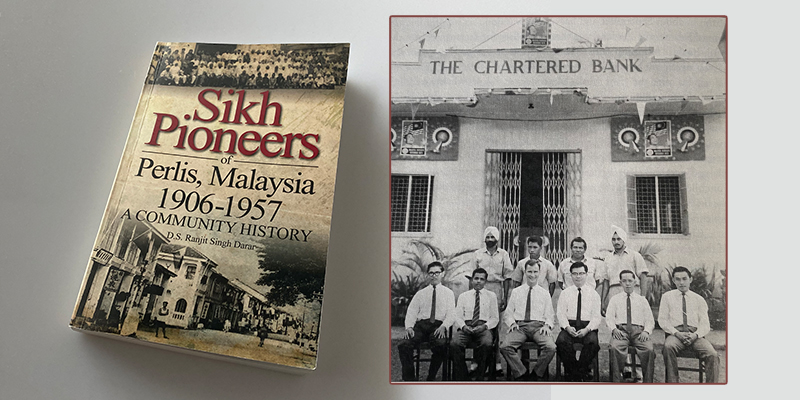
Staff of the Chartered Bank in Kangar, 1961 – Source: Book: Sikh Pioneers of Perlis, Malaysia 1906-1957: A Community History / Personal collection of author Ranjit Singh Darar
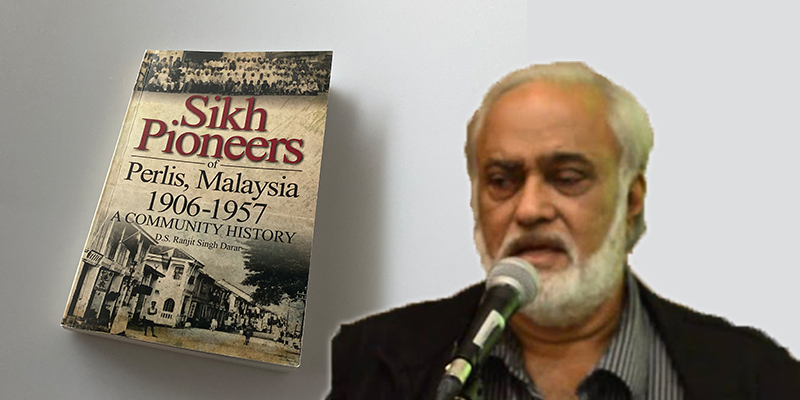
Book: Sikh Pioneers of Perlis, Malaysia 1906-1957: A Community History Author: D.S. Ranjit Singh Darar
By D.S. Ranjit Singh Darar | Book Extract |
Most of the second batch of Sikh pioneers started their livelihood as small-scale cloth and miniature vendors. In the early 1950s, these vendors used to sell their goods at an open-air centre in the middle of Kangar town called “Bai Bazar” (1). These vendors were: Joginder Singh (cloth); Abtar Singh (miniatures); Pritam Singh (cloth); Darshan Singh (cloth); Rattan Singh (miniatures); and Bachan Singh (miniatures).
On certain days of the week, some of these vendors, especially the cloth merchants, used to sell their wares at weekly or periodic markets held in different parts of the state on specific days. These markets, called pasar nat in Malay, were very popular. The largest ones were held in Simpang Empat (Tuesdays) and Kuala Perlis (Fridays) (2). All sorts of produce and goods were sold at these markets by farmers, middlemen and small traders. The items brought to these day markets included agricultural produce (corn, sugarcane, watermelon); poultry, sundry goods, miniatures, cloth, toys; Malay kueh (cakes), and many other items. Traditional medicine men attracted large crowds.
These markets were well patronised by the local population, and small traders like Pritam Singh and my father Darshan Singh, made it a point to attend these two large markets every week. Small-time traders from Kangar who wished to conduct business at these periodic or weekly day markets usually transported their wares by lorry in the early morning while they themselves would cycle there. Pritam Singh and my father did the same. It was hard work but quite rewarding.
To conduct their business, small traders had to obtain a pedlars and hawkers license from the government (3). Most of the cloth merchants obtained their supplies from an established Indian-owned shop in Kangar named Mydin Pitchay and Sons (no more in existence).
In the 1960s, some of the Sikh cloth vendors at “Bai Bazar” found that business was not so lucrative and started to peddle their cloth items to Malay kampungs. Pritam Singh and my father, Darshan Singh, were the earliest to switch to this mode. They would cycle each day to different villages to sell their cloth. Later on, when the Honda Cub made its appearance in the 1970s some of them bought these motorcycles to go on their rounds to the kampungs. The new mode of transport improved their earnings as they were able to cover longer distances on their trips.
In the early 1980s, another important change occurred in the lives of the “Bai Bazar” traders. The Hokkian Association of Kangar, which was located in the centre of the town, decided to build a new bazar consisting of a few rows of wooden stalls on their vacant land. Traders at the “Bai Bazar” and the back lanes of the shops were offered to purchase these stalls for purposes of relocation which the town council was insisting’ (4). Some of the traders, including Joginder Singh (and Abtar Singh), Rattan Singh and Bachan Singh acquired these stalls and started operating from the new premises. All four of them later upgraded themselves as shop owners.
Many of the Sikhs of the second batch also worked as security guards in addition to their main profession as small-time businessmen. Pricam Singh, Darshan Singh, and Bachan Singh, for example, worked as security guards in Chinese owned rice mills for some time. Beginning in 1960, most of them found better and more secure jobs as security guards in commercial banks. These were : Pritam Singh and Essar Singh (from Kulim) in Maybank, Kangar; and Darshan Singh, Jagathjit Singh (from Alor Star), Abtar Singh and Bachan Singh in the Chartered Bank, Kangar. Most of them retired in the 1970s (5).
(1) Interview with Vavinder Pal Singh Pritam Singh at Kangar, 16.02.2013 and author’s personal knowledge and experience. I used to help my father at this bazar in 1955-1956
(2) See uniquelyperlis.blogspot. These “pasar nat” are still held at three main places these days, at Simpang Empat, Kuala Perlis; and Arau. See Malay Mail, 20.01.2021.
(3) See a sample of a pedlars and hawkers license issued by the Government of Perlis under Enactment No. 7 of 1356 dated 13.07.1955 given to my father Darshan Singh in Figure 9.3.
(4) Based on notes written by Judvinder Singh Bachan Singh dated 04.09.2020.
(5) More details see Chapters 10 and 11. See also Plate 9.2
D.S. Ranjit Singh Darar author of ‘Sikh Pioneers of Perlis, Malaysia 1906-1957: A Community History’
(Extracted with permission from Sikh Pioneers of Perlis, Malaysia 1906-1957: A Community History)
ASIA SAMACHAR is an online newspaper for Sikhs / Punjabis in Southeast Asia and beyond. You can leave your comments at our website, Facebook, Twitter, and Instagram. We will delete comments we deem offensive or potentially libelous. You can reach us via WhatsApp +6017-335-1399 or email: asia.samachar@gmail.com. For obituary announcements, click here
ASIA SAMACHAR is an online newspaper for Sikhs / Punjabis in Southeast Asia and beyond. You can leave your comments at our website, Facebook, Twitter, and Instagram. We will delete comments we deem offensive or potentially libelous. You can reach us via WhatsApp +6017-335-1399 or email: asia.samachar@gmail.com. For obituary announcements, click here
ASIA SAMACHAR is an online newspaper for Sikhs / Punjabis in Southeast Asia and beyond. You can leave your comments at our website, Facebook, Twitter, and Instagram. We will delete comments we deem offensive or potentially libelous. You can reach us via WhatsApp +6017-335-1399 or email: asia.samachar@gmail.com. For obituary announcements, click here
Imagine that during one of his long journeys Guru Nanak Dev Ji passed through a beautiful pond, lush green, life giving, full of Fish, birds and insects attracted to the vegetation around it. There is no proper English word to describe it so I will stick to Punjabi word ‘Ramneek’ (= ਰਮਨੀਕ). The pond was nurturing lotuses in it, the surroundings were full of flowers and fruit bearing trees, attracting birds and insects with food and nectar. But something tragic happened to the pond, the water became fetid and murky, and all the vegetation died, even the fish in the pond did not survive. There were no flowers and fruit left on the trees. Even the bumble bees searching for nectar amongst the lotuses moved away, and the chirping of the birds replaced by silence. A total transformation, the attractive and a beautiful site has lost its allure, ambience has been transformed making it extremely desolate. Guru Ji happened to be there again, noticing the plight of the pond inquired with the pond about the transformation.
Guru Ji has used the simile of the lotus, but actually he is talking about us. He is trying to tell us that we were designed and destined to glow, be cheerful, full of aliveness, blissful, content, and epitome of divine virtues. What he encounters is a completely different picture – sullen, unhappy, miserable, complaining, and always wanting. Faded looks, gloomy faces, with a total lack of aliveness. In order to understand the dismal picture as painted by Guru Ji, let us try to understand Guru Ji’s words.
Transliteration: Pabar too(n) hareeaavalaa kavalaa ka(n)chan va(n)n. Kai dhokhaRai saRioh kaalee hoieeaa dhehuree naanak mai tan bha(n)g. Jaanaa paanee naa lahaa(n) jai setee meraa sa(n)g. Jit ddiThai tan parafuRai chaRai chavagan va(n)n. 30. (SGGS, Pg. No. 1412)
Translation: O pond! Your leaves (lotus + surroundings) were (lush) green, and your (lotus) blossoms were gold (hued). What pain has burnt you, and made your (beautiful) body black? (Pond’s response) O Nanak, my body is battered. (As) I have not received that (fresh) water which I love (and was my constant companion). Seeing it, my body blossomed forth, and I was blessed with a deep and four-fold beautiful color. ||30||
ਪਬਰ – Pabar – Pond full of lotuses – Glowing, nurturing, blossoming
ਹਰੀਆਵਲਾ – Hareeaavalaa – Green – Aliveness
ਕਵਲਾ – Kavalaa – Lotus – Beauty, rising above the mud and pond water
ਕੰਚਨ – Kanchan – Golden – Golden Divine Virtues/Qualities of Naam
ਵੰਨਿ – Va(n)n – Colored – Glow
Guru Ji’s Question
Guru Ji used the simile of pond, which was full of golden hued lotuses and lush green vegetation within and around it. Guru Ji was wondering about the transformation of a pond. Guru Ji asked the pond what happened to it? Earlier you were green (meaning full of zest) with aliveness, radiating divine virtues. Even your body which had a golden glow like with the golden virtues is looking pale and faded. What tragedy has caused you to become so rotten, and your body blackened? Let us see what the pond’s reply was.
Pond’s Response:
The pond replied back saying that I know the cause. The fresh water inflow, which was my companion, I have not received. I have been cut-off from that inflow. Just the sight of that water used to make my body blossom forth four-fold. Now without the fresh water inflow my body has become pale, and my beauty diminished.
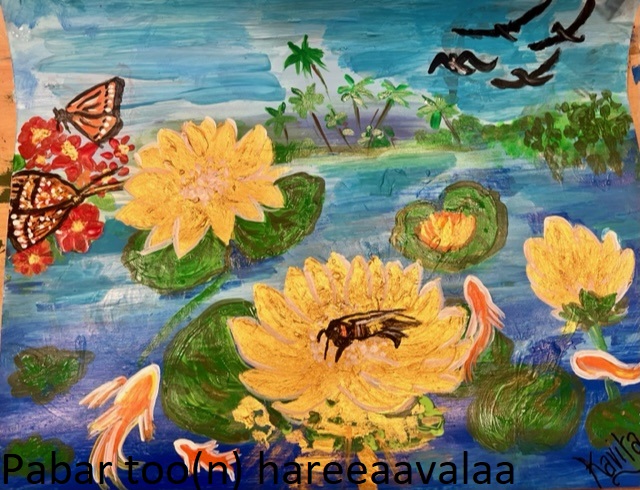
The pond – Kavita Tarneja
Guru Ji was talking about us in this conversation. We were designed to blossom with divine virtues. We were to be helpful in nurturing towards others including species, instead we have become a spent force. The life’s focus is I and me, my needs and identity. That is my ego, which defines me as the sum total of what I have, what I do, and my social status. Attachment with possessions and disconnection from the Source causes this energy depletion.
The transformation that has taken place in the body has been explained by Guru Ji Amardas as:
ਕਾਇਆ ਕਮਲੁ ਹੈ ਕੁਮਲਾਣਾ ॥
“Kaiaa kamal hai kumalaanaa.” (SGGS, Pg. No. 1051)
Translation: The lotus like human body is withering away.
The Naam, Amrit are within the body, but as we do not have any connection with it, withering away of the body is an expected natural phenomenon. Naam was going to charge our bodies to make them glow, glitter like gold and make us fully alive like plant greenery and we could be tasting Amrit within. But it is not happening, there is an inner quest for it. We are trying to fill the quest with material possessions, but the empty feeling persists. If the influence on the self is missing, how could we expect to have an influence over others? This is what Guru Ji has termed as the charred body. Our inner being realizes that something is amiss, and it is constantly searching for fulfillment. Guru Ji has described that yearning in these words:
Translation: O Lord, my thirst for the water of Your Naam will not go away. The fire of my thirst burns even more brightly in the water. 1. Pause.
Our thirst is for Naam, but unknowingly we chase the material world, in hopes of quenching that thirst. When the thirst is for water, it cannot be quenched with anything else – wealth, possessions, achievements etc. The net result is we feel empty, spent, depleted, and devoid of energy. In this conversation which Guru Ji has penned, the pond is symbolic of the human body and the lotuses in it symbolizes divine virtues within. The water of the pond is symbolic of Amrit, the ambrosial nectar. When the fresh inflow or connection was blocked, deterioration was bound to take place. Amrit of the Creator is in us, but it is being abused by our five sense organs. When we fail to connect with it which results in body weakness, feeling tiredness, exhaustion. The frustrations of unfulfilled desires, hopes, aspirations only multiply further adding frustrations, making us short tempered and angry. Guru Ji has identified the cause of this sad state in these words:
Translation: The self-willed munmukhs do not search within their own selves; they are deluded by their egotistical pride.
Wandering in (all) four directions, they grow weary, tormented by the (unfulfilled) burning desires within.
The birth of desires is always complemented with the birth of anxiety, and doubts about their fulfillment. Guru Ji has shared the relationship in these words:
ਜਬ ਆਸਾ ਅੰਦੇਸਾ ਤਬ ਹੀ ਕਿਉ ਕਰਿ ਏਕੁ ਕਹੈ ॥
“Jab assa anndesa ṯub hee kio kar ek kahai.” (SGGS, Pg. No. 877)
Translation: As long as there is hope, there is anxiety; so how can anyone speak of the One Lord?
Guru Ji is pointing to the root cause of tragedy, the outwards search. We are chasing the material world in hopes that it will provide not just us for our needs but also fulfillment, security, fame, and status. But fulfillment is ever uncertain, however when successful it only adds layers of pride in us. The very nature of the material world is to merely fuel more desires instead of providing satisfaction. Acquisition of material wealth only pumps up the ego, making us short tempered, plus anger also grows within. It is for this reason the term ‘deluded’ has been used by Guru Ji. It makes the person becomes more egocentric, who cannot take no for an answer, and who lacks patience. Guru Ji has clarified that all the desires of only very few are ever fulfilled:
Translation: The thirst of (desires) only a few is quenched. ||1||Pause||
Just as the lotus was alive and nurtured in a pond with fresh water circulation, same way the human being will be alive and glowing with Amrit when we connect with Naam on the daily basis. Where is the disconnection? It is in only being interested in the worldly possessions with no interest in the Amrit or the Naam. We are not in the element that we were designed for. That is where Guru Ji wants us to change our approach. Guru Ji wants to transform us from the desolation of empty feelings to a feeling of fulfillment and success. Guru Ji says you came to the world to drink the nectar in these words:
“Jis jal nidh kaaran tum jug aae so amrit gur paahee jeeau.: (SGGS, Pg. No. 598)
Translation: The treasure of the Naam, for which you have come into the world – that Ambrosial Nectar is with the Guru.
With that Naam, the golden glow along with green of aliveness will be reflected in our lives. The human body like the water body of pond will be charged, glowing, glittering, serving from the powerful connection. Guru Ji wants us to make that connection, which will make us alive on drinking the ambrosia. It is only with grace that this can happen, then words coming out of the mouth will be:
“Meraa ghar baniaa bun taal buniaa prabh parase har raiaa raam.” (SGGS, Pg. No. 781)
Translation: My (body) home is made, (replete with) the (dense) forest (full of greenery) and pond are made, when I touched the feet of Sovereign Lord God.
The feet here represents the Amrit Naam. Let us also try to construct a home within our body, which is as serene as per Guru Ji’s description. Guru Ji has portrayed a picture of our lives to point out unsatisfying qualities of the material world and how they wreak havoc in our lives. The Creator’s intrinsic design for us is to be alive and glowing in divine virtues. Guru Ji is trying to tell us to overcome that unsatisfying nature of the material world, and instead get inspired to see and connect with something worthwhile and everlasting. Let us make this journey and make our lives blossom forth. Guru Ji has provided us with the guidance of the role models in these words so that we can get inspired:
“Jin ddiThiaa mun rahaseeaai kiau paieeaai tin(h) su(n)g jeeau. Sant sajjan mun mitr sae laain prabh siau ru(n)g jeeau.” (SGGS, Pg. No. 760)
Translation: Gazing upon them, my mind is enraptured. How can I join them and be with them? They are Saints and friends, good friends of my mind, who inspire me and help me tune in to God’s Love. May we be inspired, get connected within and blossom forth.
Bhupinder ‘Bo’ Singh, Houston. Born in Bhamo, Myanmar, he now lives in Houston, US, where he runs a manufacturing company formed with his son. A mechanical engineer by training, he has authored a number of books, including Connecting with the Master – A collection of essays on topics related to Sikhism (2006) and In Bully’s Eyes – An Illustrated Children’s book on Bullying (2019).
ASIA SAMACHAR is an online newspaper for Sikhs / Punjabis in Southeast Asia and beyond. You can leave your comments at our website, Facebook, Twitter, and Instagram. We will delete comments we deem offensive or potentially libelous. You can reach us via WhatsApp +6017-335-1399 or email: asia.samachar@gmail.com. For obituary announcements, click here
ASIA SAMACHAR is an online newspaper for Sikhs / Punjabis in Southeast Asia and beyond. You can leave your comments at our website, Facebook, Twitter, and Instagram. We will delete comments we deem offensive or potentially libelous. You can reach us via WhatsApp +6017-335-1399 or email: asia.samachar@gmail.com. For obituary announcements, click here
Panjab NRI Affairs Minister Kuldeep Singh Dhaliwal is one of the eight Aam Aadmi Party (AAP) candidates named to contest for the impending Lok Sabha seats in the northern Indian state.
The first time state lawmaker was chosen to contest for the parliamentary seat along with four other state ministers, an incumbent MP, a former Congress MLA and a Punjabi artiste.
Kuldeep, a former NRI who returned to Punjab to pursue a political career, will contest in Amritsar.
The other state int he fray ministers are Health Minister Dr Balbir Singh (contesting in Patiala), Agriculture Minister Gurmeet Singh Khuddian (Bathinda), Sports Minister Gurmeet Singh Meet Hayer (Sangrur) and Transport Minister Laljit Singh Bhullar (Khadoor Sahib). If victorious, their departure to Delhi may trigger by-elections at the Panjab state assembly, known as the Vidhan Sabha.
Joining them are AAP MP from Jalandhar Sushil Kumar Rinku, former Congress MLA Gurpreet Singh GP and Punjabi actor-comedian Karamjit Anmol.
AAP revealed their names an event in Mohali on Thursday (March 14).
One political commentator described the list as highly conservative that will likely disappoint AAP ordinary workers and demonstrates Mann’s firm grip on the party in Punjab with people close to him like Gurmeet Khudian, Kuldeep Dhaliwal, Laljit Bhullar and Karamjit Anmol getting tickets.
“AAP is hoping to ride high on the popularity and image of Bhagwant Mann, division of opposition, free electricity and relentless advertisement to sweep Lok Sabha elections like it did in 2022 Vidhan Sabha,” commented Harjeshwar Pal Singh, an assistant professor at a Punjab college.
There are 13 Lok Sabha seats in Punjab with four seats reserved for scheduled caste (SC) candidates.
The AAP candidates will be up against Bharatiya Janata Party (BJP) led National Democratic Alliance (NDA), Congress and the Shiromani Akali Dal (SAD). Sukhbir Singh Badal-led SAD was part of the NDA until it left the alliance in September 2020 over the contentious farm laws introduced by the federal government led by Prime Minister Narenda Modi.
AAP and Congress have forged a seat-sharing in a number of states, but failed to achieve a deal for Punjab.
In the 2019 Lok Sabha polls in Punjab, Congress-led UPA alliance won eight seats and NDA cornered four seats.
Punjab Chief Minister Bhagwant Mann and APP leader Arvind Kejriwal at the party’s formal launch of its Lok Sabha election campaign in Mohali on 11 March 2024 – Photo: Bhagwant Mann Facebook
ASIA SAMACHAR is an online newspaper for Sikhs / Punjabis in Southeast Asia and beyond.Facebook | WhatsApp +6017-335-1399 | Email: editor@asiasamachar.com | Twitter | Instagram | Obituary announcements, click here |
Sukhjit Kaur takes a wefie with her twins – Sanam Kaur (left) and Roshan Singh during the first day of school at SMK Sultan Ismail, Johor. (Photo by Nur Aisyah Mazalah / New Straits Times, 10 March 2024).
ASIA SAMACHAR is an online newspaper for Sikhs / Punjabis in Southeast Asia and beyond. You can leave your comments at our website, Facebook, Twitter, and Instagram. We will delete comments we deem offensive or potentially libelous. You can reach us via WhatsApp +6017-335-1399 or email: asia.samachar@gmail.com. For obituary announcements, click here
Dear Family and Friends. With profound grief and sorrow, we are deeply saddened to announce the passing of our son / brother Harmeet Singh a/l Dr. Mehinder Singh (Alu) on 15th March 2024.
Parents: Dr Mehinder Singh s/o Pertap Singh & Dr Harinderjeet Kaur d/o Puran Singh
Brothers: Sanjit Singh & Harpreet Singh @ Pete
Sister in Law: Narinder Kaur d/o Gurbakhsh Singh
The remains will be brought home at 10.00am, 16th March 2024 (Saturday)
Residence: 64, Jalan Dato Sri Ahmad, Assam Kumbang, 34000, Taiping, Perak
2.00 pm: Sukhmani Sahib Path at Residence 3.45 pm: Cortege leaves residence 4.00 pm: Cremation at Prestavest Cremation Ground, Taiping
| Entry: 16 March 2024; Updated: 20 March 2024 | Source: Family
ASIA SAMACHAR is an online newspaper for Sikhs / Punjabis in Southeast Asia and beyond. You can leave your comments at our website, Facebook, Twitter, and Instagram. We will delete comments we deem offensive or potentially libelous. You can reach us via WhatsApp +6017-335-1399 or email: asia.samachar@gmail.com. For obituary announcements, click here
Nanak And His Philosophy, a book authored by a retired professor of microbiology with a keen interest in Sikhi, is now available in the market.
The 416-page book, authored by Dr Devinder Singh Chahal, contains 21 chapters, covering topics like ‘Who is Nanak’, ‘Mantra System’, Food Fads’ and ‘After Death: Heaven and Hell’. Asia Samachar was privileged to run an entire chapter – Sikh, Sikhi & Sikhism – ahead of the release of the book.
“When I look deeply into Sikhism, as it is being preached, I find it is promoted as a mystical, esoteric, enigmatic, and ritualistic religion,” writes the author in its preface. Here, he adds that book was a logically and scientifically revised and updated edition of the previous book, Nanakian Philosophy: Basics of Humanity.
Dr Devinder says he has applied the logic and current scientific knowledge to discover the originality and uniqueness of the philosophy of Nanak embodied in his Bani.
In one of the chapters, the author underlines the point that Guru Nanak was not only a philosopher ‘but at the top of the list of Natural Philosophers of the world.’ When tackling the topic ‘Hukm’, he shares that what is generally considered as the ‘Will of God’ is actually the Laws of Nature/Universe. He explains the distinction.
Relying on his long life as a Sikh, his training as a scientist and his love of the Guru, Prof Chahal has dedicated an enormous amount of energy trying to reform Sikhi by demonstrating the incorrect interpretations of the Aad Granth.
The book was published by the Institute for Understanding Sikhism (Quebec, Canada) and is distributed by the Amritsar-based Singh Brothers.
ASIA SAMACHAR is an online newspaper for Sikhs / Punjabis in Southeast Asia and beyond. You can leave your comments at our website, Facebook, Twitter, and Instagram. We will delete comments we deem offensive or potentially libelous. You can reach us via WhatsApp +6017-335-1399 or email: asia.samachar@gmail.com. For obituary announcements, click here
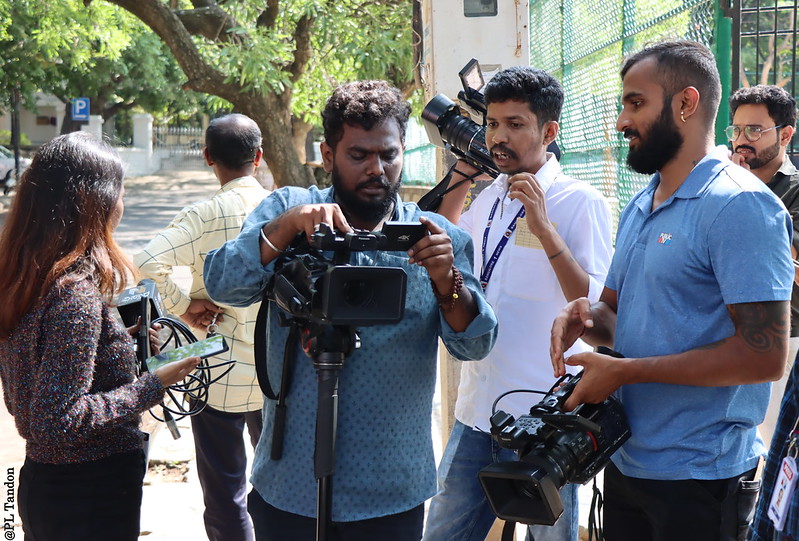
Videographers from different TV Channels covering Karnataka Assembly Election 2023 in Bengaluru on May 10 – Photo: P. L. Tandon (2013)
By Gurmukh Singh | Opinion |
People of Indian origin in the diaspora take a keen interest in the state of the Indian democracy. More so as the 2024 General Election approaches. At stake are the constitutional safeguards for minorities. There are legitimate diaspora Sikh concerns for the future of Des Panjab.
Regardless of the political party in power, India has been slipping in the world league table of democracies for some years when measured against some key democratic values such a rule of law, civil liberties, electoral processes, political participation, government functioning, equal rights of minorities and acceptance of diversity. Depending on surveys by different organisations, India ranks between 46th to 66th place amongst world democracies. Surprisingly, USA too is regarded as a flawed democracy and is placed at 30th place in one survey. Right wing nationalism is on the increase globally.
India has been described as a flawed democracy for some decades. Recently the system has been further downgraded to an electoral autocracy.
Scandals like lack of public openness about those who donated to Indian political parties through the Electoral Bonds Scheme continue to erode public trust in the system which can be manipulated by those in power. It is alleged that the State Bank of India is complicit in the cover up. According to the Centre for Media Studies at Delhi, electoral bonds have benefitted the party in power and are responsible for the soaring cost of elections making 2019 election costing US$8.6 billion, the most expensive in the world! According to critics, the Scheme distorts democracy and has been banned by the Supreme Court of India.
However, against all the negatives, there is a positive angle which shows the resilience of Indian intellectuals to safeguard the plural Indian society. Despite restrictions and risks, Indian intelligentsia and independent journalists are not silent about the slippery slope Indian democracy has been taking towards becoming an authoritarian regime regardless of ruling political parties. Sikhs will not forget that 1984 events took place when Congress was in power.
There are open and highly informative debates on the digital and electronic media about the ongoing protests (called andolans in Hindi) all over the country.
Of these, the current second protest by Indian farmers starting from Punjab and Haryana, is a good example. There is exposure of lack of a coherent farm policy over the decades on the part of the political parties in power at State and Central levels, and of the slow but certain takeover by the wealthy corporate sector pushing small farmers to suicides. We need to bear in mind that, although, farmers insist that their protest about farm prices is above politics, they, together with farm dependent sectors, do form the most influential voting bloc in India.
The widening rich-poor divide, increasing unemployment and falling incomes in real terms have become 2024 election issues.
It would be simplistic to assume that the protests for many different reasons and by different interest groups are just against the present BJP government. The protests are the result of cumulated grievances, most going back over the decades.
Experts doing the ranking of world democracies, blame the Indian administration for increased pressure on human rights groups, intimidation of journalists and activists, and a spate of attacks, especially against Muslims. This has led to a deterioration of political and civil liberties in the country. The topic is ongoing.
Gurmukh Singh OBE, a retired UK senior civil servant, chairs the Advisory Board of The Sikh Missionary Society UK. Email: sewauk2005@yahoo.co.uk. Click here for more details on the author.
* This is the opinion of the writer, organisation or publication and does not necessarily represent the views of Asia Samachar.
ASIA SAMACHAR is an online newspaper for Sikhs / Punjabis in Southeast Asia and beyond. You can leave your comments at our website, Facebook, Twitter, and Instagram. We will delete comments we deem offensive or potentially libelous. You can reach us via WhatsApp +6017-335-1399 or email: asia.samachar@gmail.com. For obituary announcements, click here