ASIA SAMACHAR is an online newspaper for Sikhs / Punjabis in Southeast Asia and beyond. You can leave your comments at our website, Facebook, Twitter, and Instagram. We will delete comments we deem offensive or potentially libelous. You can reach us via WhatsApp +6017-335-1399 or email: asia.samachar@gmail.com. For obituary announcements, click here
Taranjit Singh Sandhu joined the BJP at party headquarters in the presence of general secretaries Vinod Tawde and Tarun Chugh (Photo: @BJP)
By Asia Samachar | India |
Former US Ambassador Taranjit Singh Sandhu has joined the Bharatiya Janata Party (BJP) and is likely to be fielded by the party in Amritsar in the upcoming Lok Sabha elections 2024.
Sandhu, one of the most experienced Indian diplomats on US affairs, has been making his rounds in Amritsar lately, building up expectation of his move which eventually came on Tuesday (March 19).
“In the last 10 years, I have worked closely with PM Modi’s leadership, especially in relationship with the United States and Sri Lanka… PM Modi is development focussed… Development is very much needed today and… this development should reach Amritsar too. So, I thank the party president, the Prime Minister and the Home Minister who encouraged me for the new path of service to the nation that I am entering…,” he said.
Sandhu’s last two assignments were as ambassador to the US (February 2020 to January 2024) and High Commissioner of India to Sri Lanka (January 2017 to January 2020).
He was no stranger to the US having served as the deputy chief of mission at Washington from July 2013 to January 2017.
A 1988-batch IFS officer, he also has the experience of working at the United Nations. He was posted as Joint Secretary (UN) from March 2009 to August 2011. He was also at the Permanent Mission of India to the United Nations, New York, from July 2005 to February 2009.
Over the years, he has also served in the former Soviet Union (Russia), Ukraine and Germany.
Born on 23 Jan 1963, he studied at The Lawrence School, Sanawar, and graduated with History Honors from St. Stephens’ College, Delhi. He then took a post-graduate degree in International Relations at Jawaharlal Nehru University.
He is married to Reenat Sandhu, also an IFS officer, and has two children.
ASIA SAMACHAR is an online newspaper for Sikhs / Punjabis in Southeast Asia and beyond. You can leave your comments at our website, Facebook, Twitter, and Instagram. We will delete comments we deem offensive or potentially libelous. You can reach us via WhatsApp +6017-335-1399 or email: asia.samachar@gmail.com. For obituary announcements, click here
Samar Kohli received a call from ASIO officers requesting a meeting during a period of rising tensions between Sikh and Hindu communities last year.(Foreign Correspondent: Matt Henry)
By Avani Dias and Naomi Selvaratnam | ABC News | Australia |
It was early one morning, when Samar Kohli was at work in Sydney, that he got a call on his phone from an unknown number.
The man on the other end of the line said he was an officer from Australia’s intelligence agency ASIO and that he wanted to meet up.
The meeting took place at an inconspicuous café. Two ASIO officers attended, both dressed in plain clothes. Samar Kohli asked to see their badges.
“They had basic questions,” said Mr Kohli, a Sikh community leader in western Sydney who has been involved in the global movement to create a breakaway nation in northern India.
They wanted to know whether he had seen evidence of any “foreign interference” in Australia, which he understood to mean agents working for the Indian government.
“I said ‘yes’ and I could give examples,” he said.
Mr Kohli is one of two Sikh activists to reveal how ASIO agents were monitoring the safety of the Australian Sikh community around the time one of their religious counterparts was shot dead in Vancouver, a murder the Canadian prime minister Justin Trudeau spectacularly blamed on Indian government agents.
The men told Foreign Correspondent they were contacted by ASIO agents and invited to attend meetings with them on several occasions.
The meetings took place in the weeks before and after Sikh separatist Hardeep Singh Nijjar was killed by two hooded gunmen in his pick-up truck outside a Vancouver Sikh temple last June.
ASIA SAMACHAR is an online newspaper for Sikhs / Punjabis in Southeast Asia and beyond. You can leave your comments at our website, Facebook, Twitter, and Instagram. We will delete comments we deem offensive or potentially libelous. You can reach us via WhatsApp +6017-335-1399 or email: asia.samachar@gmail.com. For obituary announcements, click here
Vishal Sangu is the author of this online publication (dissertation) on Academia.edu. It has six chapters followed by an exhaustive bibliography. The young author displays a clear understanding of Sikh ethos, history, philosophy, and politics. He uses Sikhi in place of Sikhism to denote practice of Sikh religion which is a unique idea.
In introduction, “Understanding Sikhi” is the main theme for discussion. He goes on to elaborate his understanding of Sikhi: “Sikhi is a world-affirming tradition, meaning enlightenment can be achieved without renouncing the world, as the sacred text of Sikhi, the Guru Granth Sahib states: ‘the earth is placed, the place for the righteous action’ [1]. Implementing the teachings of Sikhi in a political and religious realm”. His argument underpins the concept of miri (political/temporal) and piri (spiritual/transcendent) of Sikhi.
The author tries to juxtapose Sikhi in comparison to other Indian religious traditions: “Sikhi does agree with Hinduism in terms of philosophical beliefs of karma and dharma and agrees with Islam through the belief in a monotheistic God. Guru Nanak emphasised a spiritual Sikhi, influenced by bhakti and Sufi traditions in Punjab. Guru Nanak emphasised questioning philosophy and questioning social life; with an emphasis on the self and not renouncing the world to achieve liberation”. He traces the roots of demand for a separate Sikh state in another concept of Sikhi: “Sikhi is a sant-sipahi (saint-soldier) tradition. This definition of Sikhi is important to understand the call for statehood, as this was the rhetoric used for the justification of Khalistan”.
Chapter 2 is a core chapter defining “Relationship between religion and ethnonationalism”. The author makes a bold political statement derived from the concept of Akal Takhat: “Punjab being considered a separate state from India is rooted firstly in the Akal Takht, a symbol of political sovereignty and where spiritual and political concerns of Sikh people can be addressed. This is demonstrated through the symbolism of two swords; ‘piri’ (spiritual authority) and ‘miri’ (temporal authority)”.
The author describes the need for creation of Khalsa by Guru Gobind Singh and its mission: “An army of baptised Sikhs, with an identity different to Hindu’s and Muslims in control of India. With Khalsa being an image of the Gurus, ‘the disciple of the Khalsa required them to remain armed, and with unshorn hair’. The Gurus Khalsa had to be armed to fight oppression and had a look which distinguished them from the Muslims and Hindus through keeping their hair. The efforts of the Khalsa through the leaderships of the Gurus led to the first Sikh empire (1799-1849)”.
The author premised that call for Khalistan is based on three historical facts: (1) The political oppression of Mughal rulers against the Sikhs; (2) Partition of India in 1947 based on two nation theory ignoring the claim of Sikhs for creation of Khalistan; (3) The present government’s move towards a ‘Hindu India’. The message of equality, fraternity, and freedom is inbuilt in Sikh psyche as preached by the Gurus in Guru Granth Sahib and in creation of the Khalsa. The author concludes: “The transition of the religious community to an ethnonationalist claim for statehood is one which is convoluted through history and the Partition of India neglecting the high majority of Sikhs in Punjab”.
Author defines Ethnonationalism as follows: “It is a form of nationalism where the nation is defined in terms of ethnicity, holding a shared heritage, common language, common faith and common ethnic ancestry. Rather than allegiance to common cultural traditions, ethnic nationalism emphasises narratives of common descent” [2]. The rise of nationalism in India was a result of the divide of religion in the British-Raj. Sikh identity remained religious throughout the history of Sikhi but after the calls for a sovereign state, it becomes an ethnonationalist identity. This new Sikhi identity poses a problematic situation: “The modern conception of a Sikh ethnonationalist identity in India is not possible due to the ‘readjustment of relations between central and state governments and the liberalization of the Indian economy’ [3]”.
Chapter 3 gives a bird’s eye view of “History of India” with focus on Mughal rule in India; Sikh Empire; and British rule. The author brings forth the idea of Sikh sovereignty in Punjab: “Banda Singh’s leadership was short lived, but the impact on Punjab was colossal. Establishing the Dal Khalsa and the capture of Sirhind showcased the political interests the Sikhs had developed. Through the leadership of Guru Gobind Singh and the Khalsa army with Banda Singh at the forefront demonstrated how the religious identity of Sikhs was becoming an ethnonationalist identity with the goal of attaining self-determination in Punjab”.
Chapter 4 describes the reasons for the violence and call of a Sikh state under 3 headings: Partition of India; Rise of Sikh Militancy; and Operation Blue Star. The author captures the mood of Sikhs in the opening para: “In the lead up to the Partition of India there were strong nationalistic surges from Hindus and Muslims, whilst the Sikh nationalistic claims were not as strong. Sikhs would have preferred a united country with a decentralised government, meaning an autonomous secular theocratic Punjab similar to the Sikh empire Ranjit Singh established. Only now being established within a secular pluralistic India”. The implication of the Sikhs being regarded as a separate nation were grave at the time of Partition: “In theory, if Sikhs were to be recognised as a religion separate from Hinduism, a separate Sikh state may be legally entitled due to the Partition being scoped on religious basis”.
Rise of Sikh militancy (1970-80): The implications on a lack of religious tolerance shown towards Sikhs in Punjab led to a shift in identity from religious to political. A common assumption about Sikh militancy is that it is a religiously violent due to language used by and to describe Sikh political figures post-Partition. The author refers to the rise of Sikh militancy in Punjab and the Anandpur Sahib resolution which was misconstrued by the ruling Congress: “In 1973, the Akali Dal, the Sikh political party in Punjab put together the Anandpur Sahib Resolution. The document calls for more autonomy in Punjab, with the example of power being spread from central to state governments being the main agenda. Due to language used by the Akali Dal, the Anandpur resolution was labelled as religious and was thought to have seceded from the Union of India”.
I agree with the views of author: “The labelling of the movement towards Khalistan as solely a religious movement and the Anandpur Resolution alongside of the rise of Bhindranwale is a grave miscalculation and misconception by Congress. Eventually leading to the brutal events of 1984, starting with Operation Blue Star. The government’s aim was to squash followers of Bhindranwale. However, the destruction of the Akal Takht and texts of Guru Granth Sahib and the civilian numbers being disputed led to Sikhs demonstrating an identity of ethnonationalism just as strong prior to the Operation Blue Star”.
Author tries to justify the use of arms by Jarnail Singh Bhindranwale taking recourse to Sikh history: “The Akal Takht was made into an armoury and headquarters. This is an unusual occurrence, but it could be believed that Bhindranwale was upholding the beliefs of Guru Hargobind Singh. The use of arms is justified when looking at Guru Hargobind and the Guru Gobind Singh using arms to protect the defenceless [4]. The idea of using arms is also upheld in scripture, ‘he, who wields the sword in his hand, he is the remover of millions of sins’ (Sri Dasam Granth, 102). Symbolism of the use of a sword as justice plays into the rhetoric of Bhindranwale and his followers, with a belief of freedom”.
In Chapter 5, the author traces the transformation of Sikh religion into the identity of ethnonationalism. The anti-Sikh riots after the assassination of Indira Gandhi, the then Prime Minister of India, became the turning point in Sikh history and creating a sense of alienation among the Sikhs in India and in diaspora. This massacre of innocent Sikhs in many states of India has been termed as the ghallughara, translated to genocide or holocaust, and its use is restricted to the wars between Sikhs and Afghans during 1746 and 1762, retrospectively.
The author highlights the role of Sikh diaspora in the fight for a separate Sikh state: “Recently, from my own observations I have seen an influx of pro-Khalistani music. Many Sikhs or Punjabis are happy with their settlements abroad, whilst affirming the situation in Punjab must be addressed. Whereas, some demonstrate strong nationalistic calls for statehood, evoking the language of Khalistan or Khalsa Raj (rule of the Khalsa)”. He is also aware of the fight going on in the UK to get an ethnic tag for the Sikhs: “Many Sikhs cannot reconcile with Punjab as a nationality or even India as their homeland due to diaspora and migration. These events and problems have led to a recognition of Sikhi, or Sikh as an ‘ethnic tick box’ in the British census, using ‘the 1983 House of Lords ruling in the Manda v Dowell-Lee… which used ethnicity to protect Sikhs under the 1976 Race Relations Act’ as precedent” [5].
The author concludes this chapter with his observation: “Political independence of Punjab as a country is unlikely, due to India and Pakistan both being nuclear powerhouses and the boundaries of Partition making it difficult to reconcile Punjab as a nation state. The calls for statehood, independence and reconciliation for not only 1984 but Empire and Partition have been ignored. Identity of the Sikhs has been controlled and suppressed by the Mughals, British and now Indian Congress and government”.
In Chapter 6, the author sums up his conclusions. His objective of study was to understand why a religious community would make a political claim towards statehood? Vishal Sangu concludes his Dissertation with the remarks: “Sikh calls for nationhood do not come from religious belief, it comes from a history of injustices and oppression throughout Empire, Partition and the events of 1984. The Sikh calls for nationhood are solely political. With religious language and religious rhetoric being adopted for Sikhs to express ideas of nationhood. Political means were not the only avenue for Sikhs to express ideas of identity and nationhood, shown through the definition of a Sikh provided by the SGPC at levels of both the individual and the collective (panth) [6]. The individual and collective affairs of the Sikh community encompass political aspirations considering religious/spiritual identity”.
The author of this Dissertation has done full justice to the topic under discussion. He has consulted all relevant resources to justify his conclusions in this short document of 45 pages. I am of the opinion that the author has adopted an unbiased approach to deal with this complex problem agitating the minds of the Sikhs since their Khalsa Raj of Maharaja Ranjit Singh was annexed by the British in 1859.
(The article was a dissertation submitted in fulfilment on undergraduate degree in Theology and Religious Studies, Department of Theology and Religious Studies, University of Chester, England, UK)
References
ਤਿਸੁ ਵਿਚਿ ਧਰਤੀ ਥਾਪਿ ਰਖੀ ਧਰਮ ਸਾਲ ॥ Ŧis vicẖ ḏẖarṯī thāp rakẖī ḏẖaram sāl. He established the earth as a home for Dharma. (GGS, Japuji, Pauri 34, P. 7)
Muller, J.Z. (2008). Us and Them. Current issue, 501 Mar/Apr, pp. 9-14.
Shani, Giorgio. (2006). Beyond Khalistan? Sikh diasporic identity and critical international theory. Sikh Formations: Religion, Culture, Theory, 1/1, pp. 57-74.
Cole, O.W & Sambhi, S.P. (1978). The Sikhs: Their Religious Beliefs and Practices. London: Routledge & Kegan Paul LTD.
Jhutti-Johal, J. (2019). Sikh Ethnic Tick Box in the 2021 Census and a Question About Research and Methodology. Birmingham: University of Birmingham Perspectives.
Judge, S. P. (2004). Politics of Sikh Identity and its Fundamentalist Assertion. Economic and Political Weekly, 39/5, pp. 3947-3954.
Scholar and scientist Hardev Singh Virk retired from Amritsar-based Guru Nanak Dev University in 2002 after serving as Founder Head Physics Department and Dean Academics. He was re-employed as Director Research in DAVIET, Jalandhar (2008-11); Adjunct Professor in Eternal university, Baru Sahib (HP); Visiting Professor in SGGS World University, Fatehgarh Sahib (2013-17); and Professor of Eminence, Punjabi University, Patiala (Punjab), India (2017-2019).
ASIA SAMACHAR is an online newspaper for Sikhs / Punjabis in Southeast Asia and beyond.Facebook | WhatsApp +6017-335-1399 | Email: editor@asiasamachar.com | Twitter | Instagram | Obituary announcements, click here
Vaisakhi is both a cultural and religious celebration in the Punjab and amongst Sikhs world-wide. Vaisakhi falls on the 14 of April, the beginning of the second month in the Mool Nanaksahi Calendar. Socially and culturally, it is a harvest festival but to Sikhs it is celebrated as the birthday of the founder of the faith Guru Nanak Sahib Ji in 1469. Another important event in Sikh history that receives the most attention was the Vaisakhi of 1699 when the 10th Guru, Guru Gobind Singh ji, introduced a specific initiation ceremony and transformed the Sikh identity.
In line with the teachings of Guru Nanak Sahib and the eight Gurus before him, Guru Gobind Singh ji required the Sikhs to openly practice principles of humanity by treating everyone equally. All barriers of religious orientation, ethnicity, race, color, economic status, language and geographical location of human being were to be removed and all human beings were equal as the Creator lived in all. The objective was to create the Khalsa, pure in thought and deeds acting as humble servants of the Creator.
Guru Nanak Sahib stated that through ritualistic practices conducted in blind faith spiritual enlightenment cannot be attained. Only by accepting and living within the Will of the Creator (Hukum) does one get spiritual enlightenment. Accepting the Creator’s gift, the body as given at birth till death, one takes the first step on the journey of enlightenment. The practice of preserving bodily hair was witnessed, as all Gurus had unshorn hair. Kesh or Unshorn hair, the first article of faith in Sikhism signifies readiness to accept the Hukum of the Creator.
The body is driven by the mind and the thoughts that are formed within. Keeping the mind on the journey of enlightenment requires control, focus and direction. The second article of faith the Kanga or comb signifies the constant need to keep a positive mental discipline that acts as a motivator of good deeds and actions. The Sikh mind is to be intellectually creative and guides living in a sphere of knowledge-based actions.
Righteous action is walking the belief with conviction and commitment which the third article of faith called the KARA, a stainless iron bangle worn on the dominant hand that controls all action signifies. The KARA signifies humility while being involved in economic activities, earning income through honest endeavor and hard work, and being ready to share the fruits with the needy.
Moral behavior is highly regarded as it ensures a just and progressive community. The fourth article of faith is the KESHERA an undergarment, which is significant in promoting respect for all irrespective of gender. It is a reminder that respect of others is the foundation of love and care and self-discipline is achieved through restrain and control.
Protecting this value system requires courage and a motivator for the individual is the KIRPAN the fifth article of faith, which translates as provision of mercy and honor to all who need it. Despite looking like a dagger, it is a principle of peace promoting standing up and with the weak and oppressed as well as to provide protection and a voice against oppression, corruption and injustice.
A turban is the crown of the Sikh and the uniform of the servants of the Creator the KHALSA. Their greeting is the Khalsa belongs to the Creator and Victory to the Creator and the Sikh prayer is Goodwill to all mankind.
Vasakhi is the celebration of blessings, love and spiritual upliftment.
Mankind experiences the unity in the Creators wonderful creation.
Paguman Singh, a retired senior official of a Malaysian-based social security organisation, has been involved in Sikhi parchaar for more than three decades. He now resides in New Zealand.
* This is the opinion of the writer, organisation or publication and does not necessarily represent the views of Asia Samachar.
ASIA SAMACHAR is an online newspaper for Sikhs / Punjabis in Southeast Asia and beyond. You can leave your comments at our website, Facebook, Twitter, and Instagram. We will delete comments we deem offensive or potentially libelous. You can reach us via WhatsApp +6017-335-1399 or email: asia.samachar@gmail.com. For obituary announcements, click here
The chai was piping hot, just off the stove. Local Punjabi tea leaves boiled with fresh milk, milked only the day before. There’s only one way to enjoy chai like that; tiny mini sips, slurped in the crisp spring morning air temperature still in its teens. How hot liquid travelling to the stomach soothes the coldness on our skins, is the simplest of joys.
I’ve been blessed beyond what I deserved, to be able to make trips to Punjab every couple of years or so, ever since being a teenager. Having distant relatives certainly helped quite a bit. The Desis or locals, be it relatives or friends, have always been utterly generous with sharing the joys of Punjab with me and even with my family.
I continue sipping as my better half smiles wistfully while enjoying every morsel of her prontay and fresh curd. Our hosts were sewadars of an ashram deep in Punjab, the best cooks of vegetarian Punjabi delicacies in my books.
Since my first trip alone when I was about 17 years of age, I’ve always regarded Punjab as home. Not so much the home where one grows up in, and of which siblings and family form the lion’s share of our background and our upbringing. But more a spiritual home. Even though everything seems a little alien to me, the culture, the language, the people, it still felt like I was coming home. It felt right.
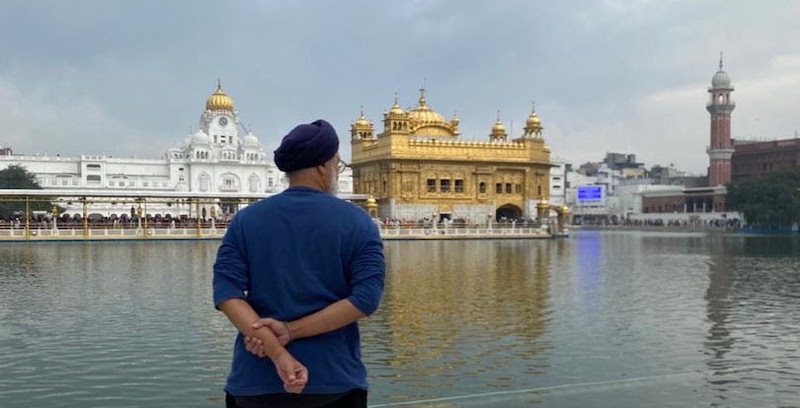
Visiting Harmandir Sahib in the bustling city of Amritsar will always evoke both the joys and the awe simultaneously in me. Splendour doesn’t even hint at how the Gurudwara in the middle of the man-made lake looks. My emotions would be of happiness while admiring the beauty with both my auditory and visual senses, would be of peacefulness, and just feeling right.
Even visiting my relatives, who tend to get quite overwhelming with generosity, can feel right at home for me. Of course the ashram is where it feels like how a glove fits in snugly. No inhibitions are detected, and we just chill out consciously as the minutes go by. When it gets dull, a trip to the town for some food never fails to give us a story to tell when we’re back home.
In my opinion, homes are never about a particular building or house, nor is it about a place and its inhabitants. Homes can be all of the above, but how you feel intrinsically when you get there will tell you if you’re back home. Home should feel right. It takes years to build a home of our own, as the inhabitants bestowed upon us grow, the home grows as well.
Don’t get me wrong. I love the home that my family has grown in, with abundant memories piled up ever since we’ve lived our lives here. But this spiritual home I call Punjab is a little different. It’s more of a comforting distant feeling of dejavu from a past life. Its sights and sounds feel recognisable even though there’s no evidence that says I should recognise at least some of it. I’m convinced of reincarnation because of this.
Now, let me get back to this hot chai. It feels absolutely right.
Jagdesh Singh, a Kuala Lumpur-based executive with a US multinational company, is a father of three girls who are as opinionated as their mother
* This is the opinion of the writer, organisation or publication and does not necessarily represent the views of Asia Samachar.
ASIA SAMACHAR is an online newspaper for Sikhs / Punjabis in Southeast Asia and beyond. You can leave your comments at our website, Facebook, Twitter, and Instagram. We will delete comments we deem offensive or potentially libelous. You can reach us via WhatsApp +6017-335-1399 or email: asia.samachar@gmail.com. For obituary announcements, click here
Preton Singh (standing, middle), flanked by Karminder Singh Dhillon (right), handing a copy of newly launched book Nanak And His Philosophy to Subang gurdwara president Balvinder Singh (left) after its launch on March 17, 2024
By Asia Samachar | Malaysia |
Nanak And His Philosophy, a newly released book authored by a Canada-based retired scientist, has been launched at the sidelines of a Sikh seminar in Malaysia.
The 416-page book, authored by Dr Devinder Singh Chahal, takes a deep dive into the teachings of Guru Nanak, the first Sikh Guru, with references to his writings that are available in the Sikh scripture Guru Granth Sahib (GGS).
“What Chahal has done effectively in this book is a systematic study of fundamental questions pertaining to existence, reason, knowledge, values and mind as expressed through the writings of Guru Nanak,” Karminder wrote in the foreword to the book.
In his speech, he said: “I believe Chahal’s work is a great service to the study of Guru Nanak, Sikhi and Gurbani. This is because once we look at all these three areas as clustered under the overarching term “Nanakian Philosophy” we will have no choice other than to get to the wisdom and messages of Guru Nanak. For this alone, Prof Chahal’s work as presented in this book is worthy of our attention.”
The seminar series organiser Sardar Preton Singh handed a copy of the book to Subang gurdwara committee president Balvinder Singh. Prof Chahal, who turns 92 this year and was disabled after a surgery, joined the launch via a recorded video speech.
The book contains 21 chapters, covering topics like ‘Who is Nanak’, ‘Mantra System’, Food Fads’ and ‘After Death: Heaven and Hell’. Asia Samachar was privileged to run an entire chapter – Sikh, Sikhi & Sikhism – ahead of the release of the book.
Among the crux of his arguments are that Sikhi is a logical and scientific philosophy and that Guru Nanak’s philosophy is valid in the Science Age of the 21st century.
Prof Dr Devinder retired in 1996 from the position of Professor of Applied Microbiology from the Institute of Armand-Frappier in Quebec, Canada.
Prior to that, he was a professor and department head at the Punjabi Agricultural University in Ludhiana, a Fullbright Fellow at MIT in Massachusetts, US and visiting scientist and professor at University of Waterloo in Ontario, Canada.
Prof Devinder had established the Institute for Understanding Sikhism in 1999 and founded the Understanding Sikh: The Research Journal.
He has published seven books and about a hundred articles based on logical and scientific interpretations of Bani in the GGS.
The book is distributed by the Amritsar-based Singh Brothers.
ASIA SAMACHAR is an online newspaper for Sikhs / Punjabis in Southeast Asia and beyond. You can leave your comments at our website, Facebook, Twitter, and Instagram. We will delete comments we deem offensive or potentially libelous. You can reach us via WhatsApp +6017-335-1399 or email: asia.samachar@gmail.com. For obituary announcements, click here
In Malaysia, non-communicable diseases (NCDs) contribute to 73% of all deaths, with diabetes, hypertension, and hypercholesterolemia on the rise.
Studies have shown that Panjabis exhibit a heightened prevalence of cardiovascular diseases and diabetes risk factors compared to other ethnic groups, with an alarmingly high prevalence of hypertension of as high as 40%.
Are you aware? What preventive measures can we take?
You may want to attend this one-day event at Gurdwara Sahib Subang on March 28, 2024 (Thursday), a public holiday in Malaysia.
The event — titled Sehat Saath-Saath which means “health together” in the Panjabi language – aims to foster a healthier Malaysian Panjabi community by increasing their awareness of NCDs and educating them on preventive measures.
Organised by students of the Bachelor’s in Nutrition in Wellness of UCSI University, the event intends to raise awareness of diabetes, hypertension, and hypercholesterolemia among the Punjabi community; as well as equip the community with skills to prevent diabetes, hypertension, and hypercholesterolemia.
Participants can join a health screening (10am to 1pm) that will asses body weight, height, waist circumference; body composition, blood glucose, blood pressure and blood cholesterol.
There will be an exhibition and interactive booths on diabetes, hypertension and hypercholesterolemia.
Sehat Saath-Saath will also present bhangra aerobic fitness session between 3pm to 4pm.
From 4pm to 6pm, join a cooking demonstration on ways to prepare chole chaat and panjiri in a healthier manner.
Asia Samachar is a media partner of the event.
For more details, call Xin Ying (012-7272688) or Brandon Ho (012-5419280) or click here.
ASIA SAMACHAR is an online newspaper for Sikhs / Punjabis in Southeast Asia and beyond. You can leave your comments at our website, Facebook, Twitter, and Instagram. We will delete comments we deem offensive or potentially libelous. You can reach us via WhatsApp +6017-335-1399 or email: asia.samachar@gmail.com. For obituary announcements, click here
ASIA SAMACHAR is an online newspaper for Sikhs / Punjabis in Southeast Asia and beyond. You can leave your comments at our website, Facebook, Twitter, and Instagram. We will delete comments we deem offensive or potentially libelous. You can reach us via WhatsApp +6017-335-1399 or email: asia.samachar@gmail.com. For obituary announcements, click here
ASIA SAMACHAR is an online newspaper for Sikhs / Punjabis in Southeast Asia and beyond. You can leave your comments at our website, Facebook, Twitter, and Instagram. We will delete comments we deem offensive or potentially libelous. You can reach us via WhatsApp +6017-335-1399 or email: asia.samachar@gmail.com. For obituary announcements, click here