Here are 10 things you can do to be a happier person.
Ditch negative self-talk. We are often our own critics, doubting our abilities and potential. Make use of positive affirmations.
Let go of perfectionism. Perfectionism can cause stress and rob us of joy. Accept own mistakes and flaws. Just strive for own excellence.
Say no to over-commitment. When there is too much to handle, too much responsibility taking too much time and energy, it leads to stress, burnout, unhappiness.
Cut down on digital overload. Too many notifications, emails, WhatsApp messages, social media, updates. These can waste your time and energy. Set only a limited, specific time for them.
Break free from unhealthy relationships. They cause stress and drag you down. Accept only people who respect and value you.
Rid yourself of the comparison game. Don’t compare yourself to others. There will always be someone better off or luckier and more successful. So let it be.
Reduce caffeine intake. Can cause sleep disturbances and anxiety.
Let go of past regrets. Forget past mistakes. They cast a shadow on happiness.
Don’t ignore self-care for your physical, mental and emotional well-being. Have enough exercise, be positive, try to be happy whatever the situation.
ASIA SAMACHAR is an online newspaper for Sikhs / Punjabis in Southeast Asia and beyond. You can leave your comments at our website, Facebook, Twitter, and Instagram. We will delete comments we deem offensive or potentially libelous. You can reach us via WhatsApp +6017-335-1399 or email: asia.samachar@gmail.com. For obituary announcements, click here
Daughter of Late Sardar Magar Singh Sandhu & Late Sardarni Thakur Kaur (Village: Sarhali Kalan; District: Amritsar)
Wife of Late Sardar Harnam Singh Sidhu (Village: Chander; District: Amritsar)
Passed away peacefully on Saturday, 13th January 2024
“A beautiful lady with an even more beautiful soul, loving mother, grandmother and great grandmother”
Leaving behind
Children / Spouse: Soran Kaur Sidhu Late Sardar Tolork Singh Sidhu / Dr. Narinderjit Kaur BK Sidhu Prof. Dr. Jatswan Singh Sidhu / Paramjit Kaur
Grandchildren / Spouse: Dr. Rizal Zamani Idris / Irayanie Mansur (Kota Kinabalu) Dr. Rafiq Idris / Dr. Siti Fatmah Suahid (Kota Kinabalu) Dr. Simran Kaur Sidhu Devinder Singh Sidhu/ Ashwinder Kaur Gill (Qatar) Tarlochan Singh Sidhu/ Beljit Kaur Dr. Manjeet Singh Sidhu/ Dr. Hasreen Deep Kaur Kabir Singh Bhatti Ajit Singh Sidhu Jasleen Kaur Sidhu
Great Grandchildren: Shariff Raftar Emira Elmedina Fatmah Azzehra
Cortège departs from No. 7, Jalan SS3/59C, Petaling Jaya at 1pm on Sunday, 14th January 2024 for cremation at Nirvana Memorial Park (Shah Alam), Taman Perkuburan, Jalan Pusaka 21/1, Off Persiaran Jubli Perak, Section 21, 40300 Shah Alam.
Sri Akhand Path Sahib will commence at 12pm on 15th January 2024 (Monday) followed by Antim Ardaas at 11am on 17th January 2024 (Wednesday) at Gurdwara Sahib Petaling Jaya (GSPJ). Guru Ka Langgar (Vegetarian Meals) will be served throughout the program.
Contact: Prof. Dr. Jatswan 016 222 3681 BK Sidhu 012 202 8088 Paramjit Kaur 016 209 3462 Tarlochan 011 1853 2586
ASIA SAMACHAR is an online newspaper for Sikhs / Punjabis in Southeast Asia and beyond. You can leave your comments at our website, Facebook, Twitter, and Instagram. We will delete comments we deem offensive or potentially libelous. You can reach us via WhatsApp +6017-335-1399 or email: asia.samachar@gmail.com. For obituary announcements, click here
ASIA SAMACHAR is an online newspaper for Sikhs / Punjabis in Southeast Asia and beyond. You can leave your comments at our website, Facebook, Twitter, and Instagram. We will delete comments we deem offensive or potentially libelous. You can reach us via WhatsApp +6017-335-1399 or email: asia.samachar@gmail.com. For obituary announcements, click here
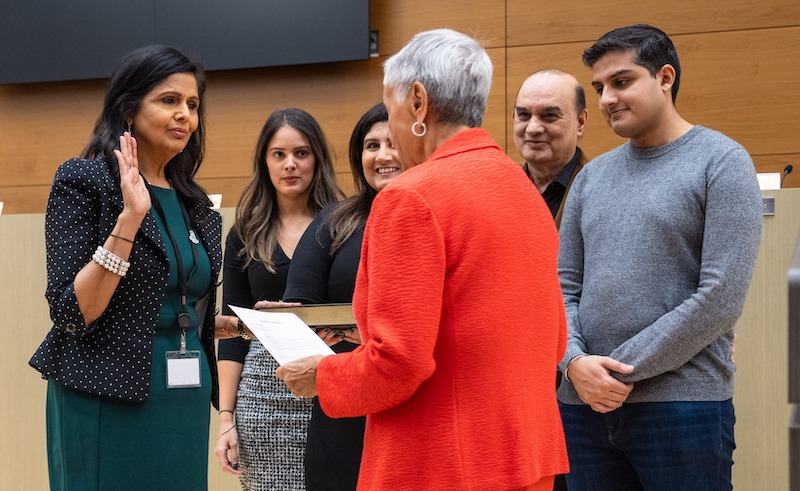
Neena Singh takes oath of office as the Mayor of New Jersey
By Asia Samachar | United States |
Neena Singh is officially the first Sikh and Indian American woman mayor in New Jersey.
Mayor Singh is the first elected Sikh and Indian-American woman serving as mayor in New Jersey, and Deputy Mayor Barragan is the first Latinx deputy mayor in the township, according to details shared at the Montgomery Township NJ Facebook page.
Neena, a resident of Montgomery for 24 years — and its previous deputy mayor — was sworn in during the Montgomery Township Reorganization Meeting last week. She won the election after being unanimously voted by fellow township committee members.
She takes over from outgoing Mayor Devra Keenan.
ASIA SAMACHAR is an online newspaper for Sikhs / Punjabis in Southeast Asia and beyond. You can leave your comments at our website, Facebook, Twitter, and Instagram. We will delete comments we deem offensive or potentially libelous. You can reach us via WhatsApp +6017-335-1399 or email: asia.samachar@gmail.com. For obituary announcements, click here
She was a pillar of strength and a source of boundless love. She leaves behind a legacy of warmth and wisdom. Her nurturing presence will be profoundly missed, but her spirit will forever guide and inspire us. Our hearts are heavy with grief, yet filled with gratitude for the precious moments we shared. May she find eternal peace, and may the memories we hold dear bring comfort to our grieving hearts.
| Entry: 12 Jan 2024 | Source: Family
ASIA SAMACHAR is an online newspaper for Sikhs / Punjabis in Southeast Asia and beyond. You can leave your comments at our website, Facebook, Twitter, and Instagram. We will delete comments we deem offensive or potentially libelous. You can reach us via WhatsApp +6017-335-1399 or email: asia.samachar@gmail.com. For obituary announcements, click here
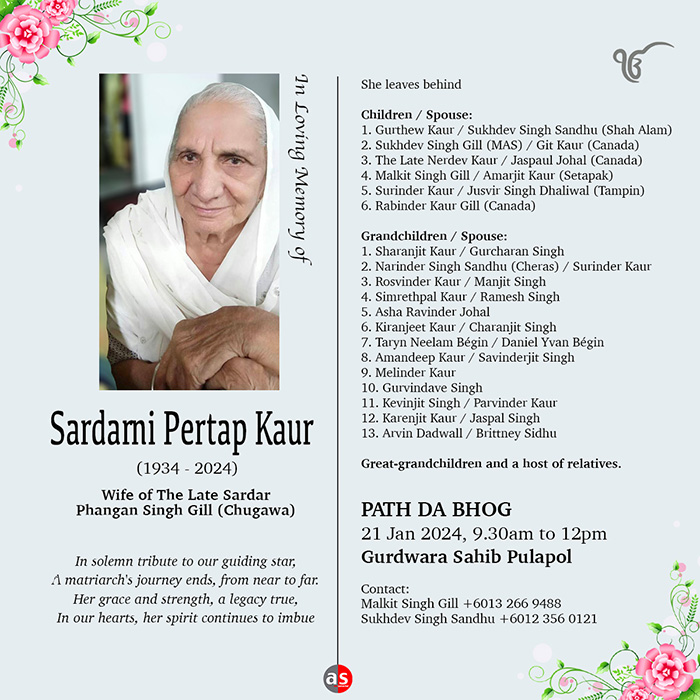
Wife of The Late Sardar Phangan Singh Gill (Chugawa)
In solemn tribute to our guiding star, A matriarch’s journey ends, from near to far. Her grace and strength, a legacy true, In our hearts, her spirit continues to imbue.
She leaves behind
Children / Spouse:
Gurthew Kaur / Sukhdev Singh Sandhu (Shah Alam)
Sukhdev Singh Gill (MAS) / Git Kaur (Canada)
The Late Nerdev Kaur / Jaspaul Johal (Canada)
Malkit Singh Gill / Amarjit Kaur (Setapak)
Surinder Kaur / Jusvir Singh Dhaliwal (Tampin)
Rabinder Kaur Gill (Canada)
Grandchildren / Spouse:
Sharanjit Kaur / Gurcharan Singh
Narinder Singh Sandhu (Cheras) / Surinder Kaur
Rosvinder Kaur / Manjit Singh
Simrethpal Kaur / Ramesh Singh
Asha Ravinder Johal
Kiranjeet Kaur / Charanjit Singh
Taryn Neelam Bégin / Daniel Yvan Bégin
Amandeep Kaur / Savinderjit Singh
Melinder Kaur
Gurvindave Singh
Kevinjit Singh / Parvinder Kaur
Karenjit Kaur / Jaspal Singh
Arvin Dadwall / Brittney Sidhu
Great-grandchildren and a host of relatives.
PATH DA BHOG 21 Jan 2024, 9.30am to 12pm Gurdwara Sahib Pulapol
| Entry: 12 Jan 2024; Updated: 13 Jan 2024; Updated: 15 Jan 2024 | Source: Family
ASIA SAMACHAR is an online newspaper for Sikhs / Punjabis in Southeast Asia and beyond. You can leave your comments at our website, Facebook, Twitter, and Instagram. We will delete comments we deem offensive or potentially libelous. You can reach us via WhatsApp +6017-335-1399 or email: asia.samachar@gmail.com. For obituary announcements, click here
Virandeep Singh (standing, 6th from left) and team when leaving for Sri Lanka in preparation for the upcoming Hong Kong One Day Series & the ICC CWC Challenge League Playoff, which will be held in Hong Kong and Malaysia from Jan 29 to Feb 12, 2024 and Feb 20 to March 3, respectively – Photo: Malaysian Cricket Association
By Asia Samachar | Malaysia |
Virandeep Singh has taken over the captaincy of the Malaysian cricket team from Ahmad Faiz Mohammad Noor who served as the skipper since 2013.
“The time is right for the baton to be passed on and I am indeed honoured to hand over the reign to Virandeep Singh,” he said in a statement released by the Malaysian Cricket Association (MCA).
Known as “Captain Marvel” Faiz to the local fans and cricket fratemity, one of Faiz’s memorable events was the 2017 SEA Games, where the team clinched Gold in the T20i Format and Silver in the 50 Overs Category. His consistency and even temperament are some of his best attributes as a player and a captain that glued the team together, leading the Malaysia team to be in the top 25 ICC World Ranking, the statement added.
MCA president Mohammed Iqbal Ali bin Kassim Ali said he was confident of Virandeep’s capabilities both as a player and a leader.
Viran takes over as captain commencing from the prep-tour to Sri Lanka and Hong Kong from Jan 10 to Feb 10, 2024, in preparation for the upcoming ICC CWC Challenge League Playoff, which is a 50 Over format, while the role of vice captain will be handed over to yet another talented player, Syed Aziz Syed Mubarak who also has his list of achievements to his name.
Viran is currently positioned 83 under the Men’s T201 All Rounder Ranking.
In 2019, Virandeep made history as the first Malaysian cricket player to make it into the professional league when he joined Chitwan Tigers for the 4th Edition of the Everest Premier League 2021, Nepal’s biggest T20 cricket tourney.
In September 2023, Virandeep became the fastest associate player and the 6th fastest player to achieve the incredible feat of scoring 2,000 runs in the T20i format.
ASIA SAMACHAR is an online newspaper for Sikhs / Punjabis in Southeast Asia and beyond. You can leave your comments at our website, Facebook, Twitter, and Instagram. We will delete comments we deem offensive or potentially libelous. You can reach us via WhatsApp +6017-335-1399 or email: asia.samachar@gmail.com. For obituary announcements, click here
Live kirtan at Darbar Sahib, Amritsar on Jan 10, 2024 – Photograb from SGPC Live video
By Asia Samachar | Panjab |
The SGPC has implemented a dress code for ‘granthis’ and ‘raagis’ deputed in the sanctum sanctorum of the Golden Temple and other gurdwaras.
The Shiromani Gurdwara Parbandhak Committee (SGPC) directive, issued to the managements of around 80 gurdwaras, is to ensure that they should wear only traditional white ‘churidaar kurta, pyjamas’, navy blue turban and keep flowing beard during their duty hours.
During the winter season, they have been advised to go in for jackets, sweaters, coats or shawl but avoid flashy colours.
SGPC chief Harjinder Singh Dhami said all gurdwara managements had been directed to ensure compliance of these orders, meant for those who would be deputed to perform kirtan or other rituals inside the gurdwaras, reports TNS.
“The dress code is set for simplicity. It is as per the Sikh rehat maryada set by the Gurus. Particularly, the ‘granthis’ and ‘raagis’ who perform their duties in the presence of Guru Granth Sahib will have to follow it strictly.
“A new trend was witnessed among the ‘granthis’ and ‘raagis’ who have been modifying the traditional ‘churidaar kurta, pyjama’ into western style clothing on their own,” he said.
The ‘granthis’ act as ceremonial reader of Guru Granth Sahib while the ‘raagis’ play hymns (shabads) in different ragas as prescribed in Guru Granth Sahib.
ASIA SAMACHAR is an online newspaper for Sikhs / Punjabis in Southeast Asia and beyond. You can leave your comments at our website, Facebook, Twitter, and Instagram. We will delete comments we deem offensive or potentially libelous. You can reach us via WhatsApp +6017-335-1399 or email: asia.samachar@gmail.com. For obituary announcements, click here
This article explores the meaning, significance and context of the proclamation of Halemi Raj in Gurbani and in Gur-Ithhaas (Guru history).
The prompt for this article came from Sikh Youth Australia running their annual Family Camp from 10 January 2024. Halemi Raj is the main theme of the Camp.
In view of that, I have digressed slightly at places to explain certain Sikhi concepts with pointers to further study and discussion. Some repetition under different headings is intentional.
In His Ardas (supplication) in a Shabad (SGGS, Ang 74), Guru Arjan adds a certain urgency which comes through in the following Panktis:
ਦੇ ਕੰਨੁ ਸੁਣਹੁ ਅਰਦਾਸਿ ਜੀਉ॥
Turn your ear towards me and hear my prayer, O Lord……
The Ardas is heard and the Guru is given Divine assurance which He conveys to the humanity:
ਹੁਣਿ ਹੁਕਮੁ ਹੋਆ ਮਿਹਰਵਾਣ ਦਾ॥
Now, the Merciful Lord has issued His Command…………
ਪੈ ਕੋਇ ਨ ਕਿਸੈ ਰਞਾਣਦਾ॥
Let no one attack and inflict suffering on anyone else…….
In His vision, the Guru sees coming of Halemi Raj:
ਸਭ ਸੁਖਾਲੀ ਵੁਠੀਆ ਇਹੁ ਹੋਆ ਹਲੇਮੀ ਰਾਜੁ ਜੀਉ॥
Now all abide in harmonious peace, and this is the regime of co-existence in humility.
This Shabad also reminds us of Guru Nanak Sahib’s Babar Vani.
In Gurbani, the Guru talks directly to the Creator Being. At times, the language reminds one of child-parent relationship. The child complaints about or asks for something. In Babar Vani, Guru Nanak complained about the mass slaughter and cruelty that followed Babar’s invasion of “Hindostan”.
APPROACH TO THE INTERPRETATION OF GURBANI
The topic of Halemi Raj is central to Sikh ideology and activism. It is the Sikh miri-piri (temporal-spiritual) goal and requires a holistic approach in the mode:
ਇਕਾਬਾਣੀਇਕੁਗੁਰੁਇਕੋਸਬਦੁਵੀਚਾਰਿ॥
There is One Bani; there is One Guru; there is one Shabad to contemplate. (SGGS, 646)
Bani is Guru and Guru is Bani (SGGS, 982) .
Despite apparently many authors, there is only one Message of One Guru in Sri Guru Granth Sahib (SGGS). It makes no difference if the author is a Guru-person or a Bhagat given a place of honour in SGGS, because the Same Jot-Jugat (Guiding Light and the way i.e. methodology) pervades the whole Guru period and now resides in SGGS.
ਸਭੁ ਇਕੋ ਸਬਦੁ ਵਰਤਦਾ ਜੋ ਕਰੇ ਸੁ ਹੋਈ ॥
There is only One all-pervasive Shabad and whatever IT Wills/Commands, it comes to pass. (SGGS, 654)
Yet, the topic of Halemi Raj needs discussion from different religious, social, economic and political perspectives. Some of these are covered in this article.
CHARACTERISTICS OF HALEMI RAJ IN SRI GURU GRANTH SAHIB
Guru Arjan Sahib (Guruship 1581-1606) proclaims with some urgency that it is nowthe Divine Command (Hun Hukam hoa) of the Merciful Lord Whom all serve, that the human society shall evolve towards a just and gentle regime. In that regime (such will be the total environment – raj ) that no-one will cause pain or suffering to another and all will live in peace at individual and societal levels.
Here, inner peace of the human mind is as important as external peace. Also, as someone said, absence of war does not mean peace.
Some characteristics of Halemi Raj, envisioned in some detail under Begumpura (city without sorrow) Shabad by Bhagat Ravidas (SGGS, 345), are as follows:
There are no societal divisions of caste or class. There are no worries about taxes or property there. There is no fear, blemish or downfall there. There is lasting peace and safety there because those who live there are contented. There is stable and eternal Kingdom of God there. There is no competition and all are equal. All are free to go wherever they please because they know that in the Lord’s presence, no one can restrict their movement.
Perhaps there is also a pointer to no property and no need for traditional government.
The above bullet points become relevant when we look at the Sikh institutions evolved over the Guru period (see below).
This is a topic for life-time learning through lived-Sikhi experience. Some introductory clarification of key concepts would help in understanding the Guru’s ideal of Halemi Raj.
Like the prophetic mind, Gurbani is multidimensional while the human mind is capable of linear thought process only. Prophetic revelations encompass all history and events in the past, present and future. Prophetic vision does not always seem coherent in human language. Scholars should have the humility to accept that prophetic thought and expression are untranslatable in linear mode.
According to Prof Arthur J Arberry writing the introduction to his interpretation of the Holy Koran, all truth is simultaneously present within the Prophet’s enraptured soul.The reader of the scriptures must strive to attain the same all-embracing apprehension.The sudden fluctuations of theme and mood will then no longer present such difficulties as have bewildered critics ambitious to measure the ocean of prophetic eloquence with the thimble of pedestrian analysis.
Thus, for the Sikhs, the whole SGGS should be recognised as a single revelation., self-consistent to the highest degree. What Arthur J Arberry says about the Holy Koran can be said about Gurbani: that It is a miracle of speech which it would be blasphemous to attempt to imitate. It is necessary to study the intricate and richly varied rhythms. This very characteristic feature – that inimitable symphony the very sounds of which move people to tears and ecstasy. Translation sounds dull and flat in comparison with the splendidly decorated original.
Ultimately, consciousness is universal. As a philosopher said, it was already there before brains existed, like an all-pervasive ether. The Guru is that Universal Consciousness.
TIME AND PLACE OF GURU ARJAN DEV JI’S ARDAS
The period in Guru Ithhas (Guru history), halfway through the person-Guru succession is important. This Shabad, as a Divine Edict added further clarity to the theo-political objective and activism of Guru Nanak’s Sikhi movement, the establishment of Guru Raj envisioned by Guru Nanak:
ਨਾਨਕਿ ਰਾਜੁ ਚਲਾਇਆ ਸਚੁ ਕੋਟੁ ਸਤਾਣੀ ਨੀਵ ਦੈ ॥
Nanak started His kingdom by building the fortress of Truth on the strongest foundations.
[Pointer to the foundation of the kingdom of truth on everlasting egalitarian institutions.]
The Sikhi edifice was being built on the deep foundation laid by Guru Nanak Sahib.
This pre-Guru Hargobind period, (1581-1606), when Guru Arjan proclaimed Halemi Raj, having completed the Sikhi foundational projects and institutions at Amritsar, the Aad Granth, the Sarovar and Darbar Sahib, and the city-state of Amritsar, was not a turning point or “Transformation of Sikhism” as misinterpreted by those like Gokal Chand Narang. The timing was chosen by Guru Arjan to remind the Sikh movement of Guru Nanak’s theo-social and political revolution and final objective. The Guru felt that this was necessary in view of the condition of the human society and the challenges ahead for the Sikhi movement.
Thus, Halemi Raj is a central objective of Sikhi activism. It deals with the state of human affairs and affairs of state (raj), from a Sikhi perspective.
The scene was set for a confrontation between the oppressive Mughal rule and the Panth of Guru Nanak. The Wording of the Command from the Merciful Lord was certain. The time for change from authoritarian rule to people’s self-rule in which all were free from fear, had come. The approaching time for change in human socio-political affairs had also been envisioned by Bhagat Ravidas in his “Begumpura” Shabad in Sri Guru Granth Sahib.
By the time of the Guru Arjan’s martyrdom (1606) Sikh institutions had been well established on firm foundations and the Mughal rulers and their advisors were well informed and aware of these developments. Time was also approaching for the first Guru martyrdom and the next phase in Guru Nanak’s mission leading up to the high point in Sikhi tradition – Vaisakhi 1699 and the emergence of the Khalsa.
RELIGIOUS, SOCIAL, ECONOMIC AND ADMINISTRATIVE CONDITIONS OF THE TIMES
The religious, social, economic and administrative conditions of the times were described by Guru Nanak Sahib in detail in fairly robust language (and even to the beat of the war-drum in Asa-ki-Vaar) which people would understand.
He had toured the known world and studied the pitiful human condition.
Bhai Gurdas recorded in his Vaaran:
ਬਾਬਾ ਦੇਖੇ ਧਿਆਨ ਧਰਿ, ਜਲਤੀ ਸਭਿ ਪ੍ਰਿਥਵੀ ਦਿਸਿ ਆਈ।
In His meditation Baba [Guru Nanak] saw the whole world burning i.e. suffering.
ਚੜਿਆ ਸੋਧਣਿ ਧਰਤਿ ਲੁਕਾਈ।
Guru Nanak started his reformation Mission to create a just society. [Halemi Raj].
Medieval corrupt and lavish life style of the Muslim and Hindu rulers resulted in oppressively high taxes on the poor people. People were left defenceless against cruel invaders who took back India’s wealth and Indian slaves to the Middle-Eastern countries. There is much mention of all this in Gurbani.
The crushing tax burden fell on mainly poor farmers central to the economy. It is no surprise that the jats – to be read as the whole farming community and not as a caste – spear-headed the revolutionary Khalsa movement. Also, as even today, farmers numbered the most.
The farmers’ protest in 2020-21 was led by Sikh ideology and sustained by Langars. The farming community of Panjab forced a Modi u-turn regarding unjust farm laws.
CHALLENGES TO FOLLOWERS OF THE SIKHI PATH FORESEEN BY GURU NANAK SAHIB
Guru Nanak set out to create a benign regime of love, humility and justice, in which no one inflicted pain on another. It was foreseen by the Guru that the sacrifice demanded for treading the path of God-love and truthful conduct was to accept death while living. That meant complete surrender of ego-centric self.
ਜਉ ਤਉ ਪ੍ਰੇਮ ਖੇਲਣ ਕਾ ਚਾਉ ॥
If you desire to play this game of love with Me,
[= If you love the Guru]
ਸਿਰੁ ਧਰਿ ਤਲੀ ਗਲੀ ਮੇਰੀ ਆਉ ॥
Then step onto My Path with your head in hand. (SGGS, 1412)
Guru Nanak’s Path, Vision and socio-spiritual Mission was known. The Guru Vision of Halemi Raj is the same whether described earlier by Bhagat Ravidas, later by Guru Arjan Sahib or which can be constructed with reference to Gurbani.
The theo-political challenges for followers of the path of Sikhi were clear. For example, when Babar put Guru Nanak in prison for speaking the truth, the latter could have been the first Guru Martyr except that Babar was aware, or became aware later, that for the Muslims too, He was PirBaba Nanak.
The Sikh institutions gained maturity under the earlier Guru-persons, especially Guru Amardas at Goindwal: These included the system of a nationwide network of Guru Nanak’s Sangats, the establishment of the Manjis and periodical daswandh (tithe) donations to the Guru for central institutions and parchar.
Guru Arjan completed the first part of Guru mission with the completion of the Amritsar Sarovar and the institution of Aad Granth. Including the prosperous Sikh city-state of Amritsar, this was too much for the Mughal Raj. It was a challenge which could not be ignored.
The Guru had already planned ahead and raised a Saint-Soldier son, Hargobind, who would raise “Khalsa Akal Purakh ki Fauj”. Guru Hargobind first used the “khalsa” word in the Sikh sense in His Hukamnamas (Commands).
Bhagat Kabir had used the same expression “Khalsa” for those linked to the Creator Being.
Living the final chapter of Guru Nanak’s mission, Guru Gobind Singh also made His theo-political mission clear as a benevolent regime in which the saintly will not be oppressed and the evil will be uprooted.
SIKHI INSTITUTIONS
Just to name a few institutional developments towards Halemi Raj. There would be others. Each of these should be discussed as building blocks of Halemi Raj.
Some of these institutions are as follows:
Sangat, Pangat (universal Lanagar)
Naam, Kirat and Wand shakna.
Sarbat dha bhalaa
Miri-Piri whole life approach.
Gender and caste equality added vast numbers to Sikh civil and military organisation.
[For example, think of the role of Singania in the peoples freedom movement led by the Khalsa.]
Sewa
Sangats and Manjis;
Daswandh: tithe: one tenth of annual produce or earnings for supporting central Sikh sewa initiatives and institutions including Khalsa Akal Purakh ki Fauj.
Degh, Tegh, Fateh of the Khalsa.
The Cauldron – representing the sharing way of Sikhi life – defended by the Sword of the Khalsa ensuring ultimate Victory of a just way of life, -Halemi Raj?
Sikh Ardaas – A powerful uniting institution. A continual summary, update and reminder of Sikh history.
The institutional tools and the inbuilt processes which allow response to socio-political circumstances and challenges, have ensured the survival of Sikhi movement against all odds. Thus, Sikh-Khalsa movement survived to topple unjust Mughal and colonial regimes.
Some recent examples include, the Indian Farmers’ protests led by Panjabi Sikh farmers – the whole ethos was Sikhi based, free Langars etc. PM Modi, fully conversant with Sikh ideology and history, was forced to retreat.
History also tells us that guided instinctively by the underlying egalitarian Sikh ideology and supported by Sikh institutions, apparently leaderless Sikhs can fight to win wars! (Ref: Confused Ahmed Shah Abdali asking : “Who is their leader? Where do they live? etc – A maddening problem for authoritarian dictators!
LOOKING AHEAD
There is much negativity about the state of the Panth today. Yet, I recall a time when there were hardly any Amritdhari Singhs in the villages of Panjab. Malwa had huka-smoking Sikhs and Doaba was no better. Yet, these areas produced Sikhs who were always at the forefront of great Morchas which broke the back of colonial rule.
Appearances can deceive regarding Sikhi spirit because Guru Nanak’s message is simple, universal and touches all hearts. No other saint/bhagat/philosopher provided the above tools for survival and dedication to the just cause/objective of Halemi Raj.
In Sikhi, here and now is as important as hereafter. Only service in this world earns a place of respect in the hereafter. Thus “Wich duniya sev kamayiay, tan dargeh baisan paayiay.” Active life of service must go side by side with Naam meditation.
Halemi Raj is not the Utopia of Western philosophers but a future reality made possible by egalitarian Sikhi ideology and institutions.
The spiritual and societal goals of human life need to converge in the concept of Halemi Raj as a spiritual-temporal objective.
That is the purpose of Miri-Piri whole-life Sikhi living.
According to Gurmat ideology, the concept of Halemi Raj or Begampura fully expresses legitimate Sikh theo-political goal. It has been confirmed by legal experts that the Indian Constitution also gives every Sikh the right to carry out this struggle peacefully at the political level within a democratic structure and to move forward with it for its fulfilment.
Further reading:
Many relevant topics are covered in my “Sikh View” short published articles written over many years. These were first made available on the Sikh Missionary Society UK Website.
(See under “Articles” – Articles on Sikh Ideology and Identity)
Gurmukh Singh OBE, a retired UK senior civil servant, chairs the Advisory Board of The Sikh Missionary Society UK. Email: sewauk2005@yahoo.co.uk. Click here for more details on the author.
* This is the opinion of the writer, organisation or publication and does not necessarily represent the views of Asia Samachar.
ASIA SAMACHAR is an online newspaper for Sikhs / Punjabis in Southeast Asia and beyond. You can leave your comments at our website, Facebook, Twitter, and Instagram. We will delete comments we deem offensive or potentially libelous. You can reach us via WhatsApp +6017-335-1399 or email: asia.samachar@gmail.com. For obituary announcements, click here
In 2022, we attended a wedding reception, where the groom’s father talked about how family relationships were very important to them. Suddenly my mind was flooded by the news of another incident from a few years back when an NBA basketball player missed a game to be with his wife during her delivery. He was criticized for missing work (game), to be with his wife for the delivery. The player’s response was “My family’s very important to me.” But then other thoughts were coming like a hurricane. Incidents like when a father transferred his property to his son’s name, only to find himself on the streets after being kicked out of his own house. Another incident that I remember was when the groom had not invited his parents to his wedding. Seeing the wide spectrum of family dynamics being played out on the world stage made me wonder about Guru Ji’s take on the family dynamics.
My thoughts went back to Guru Tegh Bahadur Ji who was in Dacca at the time of his only child Gobind Rai’s birth in Patna in December 1666. Guru Tegh Bahadur Ji was 45 years old then and this was his only child after 22 years of marriage. Still Guru Ji decided to carry on with his program and mission uninterrupted. In fact, when Guru Ji left Patna, Guru Ji was well aware that his wife Mata Gujri was on her family way. Guru Ji had designated Kirpal Chand, Mata Gujri’s brother, to take care of her during his absence. With that responsibility on his shoulders, Kirpal Chand was not part of Guru Ji’s team that moved further east. From Patna, Guru Ji toured many cities in Bengal before proceeding to Dhubri in Assam. After some time in Dhubri, Guru Ji toured Cooch Bihar before returning back to Patna. When Guru Ji returned back to Patna and saw his son Gobind Rai for the first time he was 4 years old.
So, when we look from Guru Ji’s perspective, there was a higher mission, a calling that took precedent, priority over his family. Still thinking further about the issue on what could be a higher priority over his family, I reached back into the times of Guru Nanak Dev Ji. Guru Nanak was about 34 years of age when he embarked on his first long journey in 1500, leaving his two sons behind with their mother and sister’s family. From the perspective of ‘family being important’, a father’s presence is considered important during the children’s formative years, yet Guru Ji was absent during that crucial period. Because for Guru Jis the highest priority was their mission, which was to bring correct awareness in life. Guru Ji challenged the business practices of hypocrite priest class in name of religion, and the ruler’s unconcern for their subjects. Guru Ji led a purpose driven life, where life’s mission was the highest priority. Guru Ji did not shrink from his family responsibilities but would not let it impede upon on their purpose of life. Making sure that their family was taken care of during their absence, he embarked on his mission unhindered. In the words of Puratan Janamsakhi, Guru Nanak was assigned by Almighty in Sultanpur to spread His Naam in these words:
Translation: You go back and meditate on my Naam (literal meaning Name). Tell others to meditate as well and remain detached (from the material world).
The whole of Sri Guru Granth Sahib (SGGS) is an exposition of Naam, covering different aspects and facets. Here let us explore only one – family aspect, a lesser explored area. We will explore it with few quotes from SGGS as under:
“Jan pisar padhar biraadharaa(n) kas nes dhasata(n)geer. Aakhir biafatam kas na dhaaradh choo(n) savadh takabeer. 2.” (SGGS, 721)
Translation: Spouse, children, parents, and siblings – none of them will be there to hold your hand. And when at last I fall, and the time of my last prayer has come, there shall be no one to rescue me. ||2||
These are words of Guru Nanak, and its essential import is undeniable, a stark reality of life. So, even if we expend all our energy, efforts, money on these relationships, still at the time of our departure from this world none can be of any support or help. Additionally, more quotes from Gurbani are being shared without the translation and transliteration as the essence has already been shared above. The idea of sharing additional quotes is to put to rest any remaining doubts on this aspect.
Guru Ji is pointing out the stark reality of these close family relationships. Even if we think about these relationships being blissful, the reality is far from it. From the protagonists of importance of family relationships viewpoints, these words sound very harsh. Still Guru Ji has shared these for our benefit. Guru Ji has pointed out that these relationships have become all-consuming, an end in themselves. The person becoming deeply involved in them gets gripped by it, so blinded that one cannot see beyond. Gurbani portrays the picture of its grip in these words:
ਕਬੀਰ ਗਹਗਚਿ ਪਰਿਓ ਕੁਟੰਬ ਕੈ ਕਾਂਠੈ ਰਹਿ ਗਇਓ ਰਾਮੁ ॥
ਆਇ ਪਰੇ ਧਰਮ ਰਾਇ ਕੇ ਬੀਚਹਿ ਧੂਮਾ ਧਾਮ ॥੧੪੨॥
“Kabir gahagach pario kuTa(n)b kai kaa(n)Thai reh gio raam.
Aai pare dharam rai ke beecheh dhoomaa dhaam. 142.” (SGGS, 1372)
Translation: Kabir, the mortal has fallen firmly into the grip of family life, and the Lord has been set aside (out of mind).
In the midst of all his pomp, show and celebration the messengers of the Righteous Judge of Dharma descend upon the mortal. ||142||
What is being cautioned here is that life is not just family celebrations alone but it is for remembrance of Creator. Guru Ji says that if life is perishable, then these relationships are also perishable – not any different. With each birth these relationships have been created and destroyed numerous times in the past. Even the present existing relationship dynamics are subject to change. Guru Ji is questioning which of these relationships either from past or present are true in these words:
Translation: Who is the mother, and who is the father? Who is the son, and what is the pleasure of marriage?
Guru Ji is saying that these relations being experienced today are results of karmas from the previous lives. These words of Guru Ji’s act as a reminder of this reality:
“Maat pitaa banitaa sut ba(n)dhap isaT meet ar bhaiee. Poorab janam ke mile sa(n)jogee a(n)teh ko na sahaiee. 1.” (SGGS, 700)
Translation: Mother, father, spouse, children, relatives, lovers, friends, and siblings meet, having been associated in previous lives; but none of them will be your companion and support in the end. ||1||
These relationships are relations of convenience, functionality, utility, and are mere scenarios for life experiences. Even the birth of the child is a result of copulation of the parents, making the parents an entry point for the child after birth. Neither the child taking birth realize this fact nor do the parents. Parents become a child’s support physically, financially, emotionally as well as at the time of crisis. These relationships are cemented by wants, needs, expectations, insecurity, social status, convenience, support, and dependency. If these needs are obliterated, even these relationships can get docked. These relationships become meaningful as long as they function to fulfill needs and wants. These relationships start flailing if any of those needs and wants are unfulfilled or neglected in any respect. If anyone becomes a burden for the other members of the family, he can experience relationships being severed unhesitatingly. Guru Ji has painted picture of this aspect of relationships in these words:
Translation: Wives, friends, children, and relatives – all are looking towards the wealth of the person. When they see an impoverished, they all shun his company and run away. ||1||
“Mai baap poot hit bhraataa un ghar ghar melio dhooaa. Kis hee vaadh ghaaT kis hee peh sagale lar lar mooaa. 3.” (SGGS, 673)
Translation: In each and every home, she (Maya – the attachment and wealth) has implanted the sense of duality in mother, father, children, friends, and siblings. Some may have more, and some may have less; (becoming bone of contention and) they fight and fight, till the death. ||3||
Guru Ji has laid bare the basic human psyche’s working in everyone. All the human folks can have conflicts with others because of their financial needs, circumstances, greed, selfish interests, traits, habits, nature, viewpoint, ego etc. Many a times, this inner turmoil may not be apparent on the surface, yet it could be simmering within. Outwardly we may present the facade of calm, as we see compromises being worked out, controlling situations from turning ugly. Occasionally we may also encounter a full-blown yelling, shuffles, fights etc. At other times it could be more discreet, like a calm before a storm. But the reality is, the vested parties are at loggerheads with each other, and even willing to fight to finish.
Guru Ji is not condemning these family relations, but just laying out their bare truth. The reality is nobody is a support for others, yet everyone is looking for props, who can be their support in need. The reality is this worldly relationship is driven by wants and needs, possessions, expectations, self-interest, and nothing beyond it, that is its stark reality. The reality is that all our close relations are also co-travelers with us in our life’s journey. Here everyone is on their own unique journey, with paths crossing through interactions within these family relationships. This association is for a limited time frame only. We do not know what happens to them after this life’s journey ends. Still Guru Ji wants us to live our life with these co-travelers lovingly and be a support and help to others. But the relationship should not become a relationship of attachment, convenience, possession, grip, or ownership. If we are glued together by those glues as attachment then our evolution will get stunted. There is a heavy price to be paid for getting entangled in those traits and not using this human life for the soul’s evolution. That should have been set aside as irrelevant in life’s journey. Guru Ji has described our full engrossment in the family and in pleasures in these words:
Translation: Man is deeply engrossed in family play; placing his hopes in transitory material things, he ravishes in celebrations and pleasures.
Khalil Zibran achieved this clarity on family grip or trap, and his words express it precisely:
“Your children are not your children. They are the sons and daughters of Life’s longing for itself. They came through you but not from you and though they are with you, yet they belong not to you.”
It is from this perspective alone that Guru Ji has expressed disdain for family relationships in these words:
ਧ੍ਰਿਗੰਤ ਮਾਤ ਪਿਤਾ ਸਨੇਹੰ ਧ੍ਰਿਗ ਸਨੇਹੰ ਭ੍ਰਾਤ ਬਾਂਧਵਹ ॥
“Dhiraga(n)t maat pitaa saneha(n) dhirag saneha(n) bhraat baa(n)dhaveh.” (SGGS, 1354)
Translation: Cursed is loving attachment to one’s mother and father; cursed is loving attachment to one’s siblings and relatives.
Guru Ji is pointing out that these relationship’s bonding get only deeper with the passage of time. At the time of death when one has to sever all these worldly bonds, they become very painful and agonizing. Guru Ji says its pain may be unimaginable, but its consequences are disastrous:
ਹੇਤ ਕੇ ਬੰਧਨ ਤੋੜਿ ਨ ਸਾਕਹਿ ਤਾ ਜਮੁ ਕਰੇ ਖੁਆਰੀ ਜੀਉ ॥੫॥
“Het kae bandhan toR na saakeh taa jam kare khuaaree jeeau. 5.” (SGGS, 993)
Translation: (When) You cannot break free from the bondage of loving attachment, and so the Messenger of Death will disgrace you. ||5||
The outcome is that the soul is disgraced by the messengers of death. It is for this reason that Guru Ji has said that these familial bonds are selfish in nature. The family with which these bonds were the tightest, are the ones who can’t keep the body in the house even a moment after death. Thus, the most intimate familial relations get snapped in an instant at the time of death. Guru Ji has shared:
“Tun tae praan hot jub niaare Terat pret pukaar. Aadh gharee kouoo neh raakhai ghar te dhet nikaar. 1. ” (SGGS, 536)
Translation: When the soul is separated from the body, then they will cry out, calling you a ghost. No one will let you stay for even half an hour; they drive you out of the house. ||1|
If these biological familial relationships prized all over the world are not the optimal relations to be nurtured, then which relationship needs to be nurtured? Guru Ji provides the road map for another type of family relationship which can be our true family for eternity:
Translation: Only a loving attachment to the Saadh Sangat, the Company of the Holy, is True. Nanak dwells there in peace. ||2||
Those who dwell there, they are the ones who ultimately become attached to the Creator of this game of life. They merge with Him and come out the cycles of reincarnation. Guru Ji has shared that experience in these words:
Translation: Within the home of your own inner being, you shall obtain the Mansion of the Lord’s Presence with intuitive ease. You shall not be consigned again to the wheel of reincarnation. ||3||
Then they have an experience of oneness. Their merger is like that of water merging with water becoming indistinguishable and inseparable. Guru Ji has expressed about that merger in these words:
ਭੇਦੁ ਨ ਜਾਣਹੁ ਮੂਲਿ ਸਾਂਈ ਜੇਹਿਆ ॥੧॥
“Bhedh na jaanahu mool saa(n)iee jehiaa. 1.” (SGGS, 397)
Translation: Know that there is absolutely no difference; they are exactly like the Lord. ||1||
CONCLUSION
That status of being inseparable from God is only achieved by making some hard choices in life. There is a realization that family relationships should be congenial and good but should not tether the soul’s evolution. This is the level of consciousness that the Guru wants a Sikh to achieve. This is the state of mind above the worldly, and Guru Ji has set this as the bar for the Sikhs. That is an achievement of one, who has elevated his soul above the world which is revered by the worldly folks for generations to come.
References:
Singh, Bhai Vir. Sri Guru Nanak Chamatkar, Poorbarth (Volume 1) (1992). Bhai Vir Singh Sahit Sadan.
www.Sikhitothemax.com
Bhupinder ‘Bo’ Singh, Houston. Born in Bhamo, Myanmar, he now lives in Houston, US, where he runs a manufacturing company formed with his son. A mechanical engineer by training, he has authored a number of books, including Connecting with the Master – A collection of essays on topics related to Sikhism (2006) and In Bully’s Eyes – An Illustrated Children’s book on Bullying (2019).
ASIA SAMACHAR is an online newspaper for Sikhs / Punjabis in Southeast Asia and beyond. You can leave your comments at our website, Facebook, Twitter, and Instagram. We will delete comments we deem offensive or potentially libelous. You can reach us via WhatsApp +6017-335-1399 or email: asia.samachar@gmail.com. For obituary announcements, click here