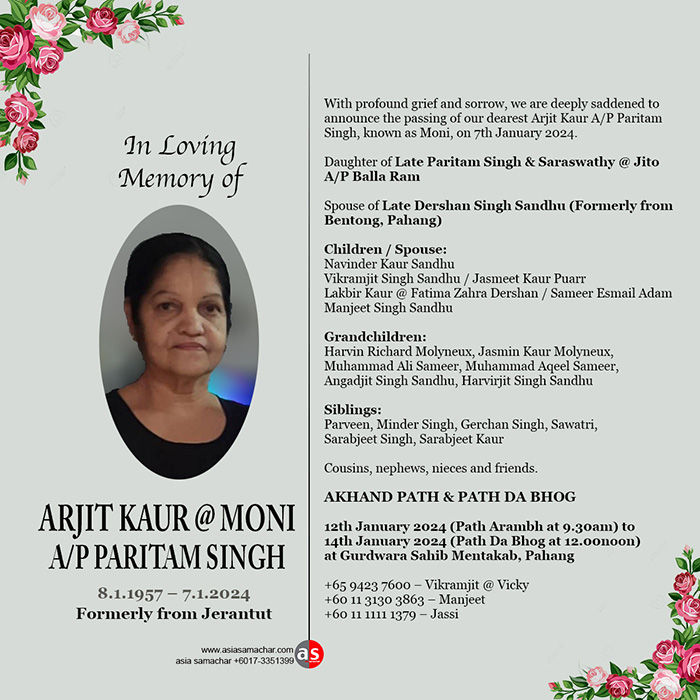
With profound grief and sorrow, we are deeply saddened to announce the passing of our dearest Arjit Kaur A/P Paritam Singh known as Moni, on 7th January 2024.
Daughter of Late Paritam Singh & Saraswathy @ Jito A/P Balla Ram
Spouse of Late Dershan Singh Sandhu (Formerly from Bentong, Pahang)
Grandchildren: Harvin Richard Molyneux, Jasmin Kaur Molyneux, Muhammad Ali Sameer, Muhammad Aqeel Sameer, Angadjit Singh Sandhu, Harvirjit Singh Sandhu
| Entry: 8 Jan 2024; Updated: 11 Jan 2024 | Source: Family
ASIA SAMACHAR is an online newspaper for Sikhs / Punjabis in Southeast Asia and beyond. You can leave your comments at our website, Facebook, Twitter, and Instagram. We will delete comments we deem offensive or potentially libelous. You can reach us via WhatsApp +6017-335-1399 or email: asia.samachar@gmail.com. For obituary announcements, click here
Mr Baladev Singh @ Debbo s/o Late Jawala Singh (ex-TNB) passed away peacefully on 7th January 2024.
Last respects on 9th January (Tuesday), from 11.00 am to 2.00 pm, at their residence (No 14, Lorong Temenggung 39F/KS7, Taman Sejahtera, 41200 Klang Selangor)
Cortege leaves at 2.30pm for cremation at Crematorium Simpang Lima at 3.30 pm.
ASIA SAMACHAR is an online newspaper for Sikhs / Punjabis in Southeast Asia and beyond. You can leave your comments at our website, Facebook, Twitter, and Instagram. We will delete comments we deem offensive or potentially libelous. You can reach us via WhatsApp +6017-335-1399 or email: asia.samachar@gmail.com. For obituary announcements, click here
“Daughter of a the one who cooks God’s offering is in a place where meat is cooked!..How will I face our Lord Ranga?..If you wish to become a chef you must learn how to cook meat. But even to stand in such a place is an unforgivable sin.”
Those are the words of Annapoorani’s father who serves as the priest of the Srirangam temple. The ever supportive father is conflicted with his daughter’s dreams of becoming a top notch chef in India. It boils down to religious beliefs, deeply held convictions.
Sikhs, too, has their fair share of the to-eat or not-to-eat meat. In that light, some may be interested to watch Annapoorani: The Goddess of Food.
This plot is converted into promoting meat eating, and it projects the message that to be chef you need to eat meat, noted one reviewer.
Of course, this newly released Tamil-language culinary drama film (available on Netflix) is more than just a discussion about diet.
Raised in an orthodox Brahmin family with her priest father, Annapoorani’s vegetarian upbringing becomes a significant hurdle in pursuing her culinary passion. Her journey unfolds as an extraordinary tale of life, filled with challenges and triumphs.
Main actress Nayanthara, who plays Annapoorani, delivers on her acting. Hailed as the Lady Superstar of Tamil cinema, she made a debut in Hindi cinema with the Shah Rukh Khan in Jawan.
Of course, they would be parts where you would make you cringe. But on the whole, it’s a movie you can sit back and watch. To those who got caught up with the to-eat or not-to-eat meat question earlier, relax.
ASIA SAMACHAR is an online newspaper for Sikhs / Punjabis in Southeast Asia and beyond. You can leave your comments at our website, Facebook, Twitter, and Instagram. We will delete comments we deem offensive or potentially libelous. You can reach us via WhatsApp +6017-335-1399 or email: asia.samachar@gmail.com. For obituary announcements, click here
(L-R) Sarjit Kaur (youngest of the Tara siblings), Pola (writer), Karina Kaur (Pola’s wife), Maji – Ram Kaur, Harban, Tara Singh (Pola’s Dad), Kulwant Kaur & Inderjit Singh. Photo taken in 1976.
By Pola Singh | Malaysia |
Maji, our beloved Ram Kaur, was truly a woman of substance. Her life, woven with threads of strength, resilience, and unwavering love, serves as an inspiration to all who knew her. Born as Chan Yoke Lin, she faced the challenges of abject poverty, cultural shocks, and societal non-acceptance in a mixed-race marriage. As her ten siblings, we share her remarkable journey, urging Malaysians not to take their parents for granted.
From the very beginning, Maji encountered life’s adversities. Born tiny and forced to leave school early due to poverty, she defied the odds, growing into one of Malacca’s highly respected mothers. Marrying at 13 and becoming a mother at 15, her journey demanded relentless determination.
Maji’s commitment to her Punjabi roots was unwavering, despite her Chinese heritage. This fusion of cultures became apparent when our two elder sisters got married. She strictly adhered to Sikh wedding rituals, impressing the Malacca Punjabi community and showcasing her dedication to preserving cultural traditions.
To supplement the meagre household income, Maji ventured into businesses such as selling nasi lemak and kuih. However, her lack of entrepreneurship qualities and business acumen posed challenges to her ventures.
Despite the hardships, Maji sought solace in simple pleasures. The only form of entertainment for this hardworking lady was to watch a Hindi or Tamil movie at the Lido or Capitol cinema with the whole family once a month, even though the outing caused a dent in her pocket.
Maji’s life exemplified the resilience of a mother who, despite financial constraints, ensured there was always food on the table. Her determination and hard work were reflected in her daily routine, waking up at 5am and tirelessly going about her day until 9pm.
Her legacy extends beyond the challenges she faced. Two of her children, Pola and Jaib, became the first from Kampung Air Leleh to graduate from the University of Malaya in the early 70s, breaking new ground and paving the way for other kampung children to aspire to go to university. This achievement marked a significant milestone, reflecting Maji’s commitment to education as a means of overcoming societal biases and poverty.
Pola’s wedding held at the Gurdwara Sahib Melaka. From left: Ram Kaur, Karina Kaur (Pola’s wife), Dr Pola and Tara Singh (Pola’s dad)
As we reflect on the blessings we enjoy today, we acknowledge the sacrifices and prudent ways of our beloved Maji. She was indeed a woman of substance, turning challenges into opportunities and shaping her children with positivity and steadfastness.
We, the 10 siblings – the late Ajaib Kaur, Piaro Didi, Jaib, Pola, Heera, Harban, Iswander, Kulwant, Inderjit, and Sarjit Kaur – collectively send our love to our Maji, Ram Kaur. Her legacy will forever remain etched in our hearts. Through this tribute, we hope to remind everyone to be appreciative and grateful to their parents for the sacrifices that shape who they are today.
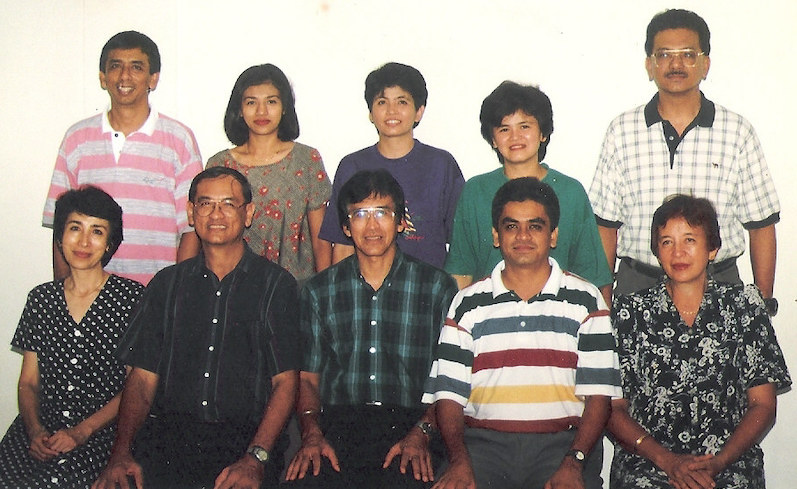
The 10 Tara siblings. From left (seated) – Piaro Didi, Jaib, Pola, Inderjit & the late Ajaib Kaur. From left (standing) – Heera, Sarjit, Iswander, Kulwant & Harban
Dr Pola Singh, fourth of the ten siblings, retired as Maritime Institute of Malaysia director-general in 2011 and authored ‘Uphill — The Journey of a Sikh-Chinese Kampung Boy’
ASIA SAMACHAR is an online newspaper for Sikhs / Punjabis in Southeast Asia and beyond. You can leave your comments at our website, Facebook, Twitter, and Instagram. We will delete comments we deem offensive or potentially libelous. You can reach us via WhatsApp +6017-335-1399 or email: asia.samachar@gmail.com. For obituary announcements, click here
L-R: Sportman Avtar Singh, Malaysia hockey Olympian Avtar Singh Gill, Kenyan hockey Olympian Avtar Singh Sohal and Malaysian former national athlete Pall Singh
By Prabhjot Singh | Opinion |
Sikhs, like Sindhis and Gujjus, are universal communities, as they, like potatoes, are found everywhere in the world. Of them, the Sikhs are one of the most adjustable and hospitable communities and their Gurdwaras worldwide have not only been serving as spiritual centers for the community but also provide free board and lodging facilities to visitors and strangers alike. They also serve as community centres where various social functions, including weddings, are solemnised.
When a galaxy of hockey stars of Kenya and Malaysia met at a brief, solemn and rarest of rare reunion ceremonies in Kuala Lumpur in mid-December, the venue was the sacred premises of one of the oldest Sikh gurdwaras in Klang Valley (comprising of Kuala Lumpur and its neighbouring areas) Gurdwara Sahib Petaling Jaya (GSPJ).
The management of the gurdwara organised a felicitation ceremony for six-time Olympian Avtar Singh Sohal, besides his one-time colleague, Harvinder Singh Sibia, and other members of the visiting Sikh Union Hockey Club.
The felicitation ceremony was organised at the instance of former Malaysian skipper Sarjit Singh. Sarjit Singh had in May taken two Malaysian teams, including one of veterans, to Nairobi in Kenya, to play in the Vaisakhi Hockey Tournament.
I his endeavour, Sarjit Singh had the support of his former colleagues and Olympians Avtar Singh Gill and Maninderjit Singh besides Junior World Cupper Surinder Singh. Also felicitated was Kenyan World Cupper Narinder Singh Nindi.
The gathering at Gurdwara Sahib Petaling Jaya in December 2023 when four-time Olympian Avtar Singh Sohal brought Kenyan young hockey players to Malaysia – Photo: Prabhjot Singh
The Kenyan hockey delegation chose to pay a return visit that coincided with the 13th FIH Hockey World Cup for Junior Team held in Kuala Lumpur from December 3 to 16. Also, a part of the delegation was junior hockey team of Sikh Union Club are members of the junior team of the Club.
Avtar Singh, President of the gurdwara management committee, and other office-bearers, presented “siropas” to Olympian Avtar Singh, Harvinder Singh Sibia, Del Mudher, Narinder Singh Nindi, Manjit Singh Jhite, and Daljit Singh. GSPJ also runs a Punjabi school.
The visitors also made some donations for the recently renovated kitchen of the temple. The felicitation ceremony was preceded by recitation of some slokas followed by the Ardas.
Almost all members of the visiting Sikh Union Club were turban wearing boys with 12-year-old Harwinder Singh as the youngest while two members of the Kenyan team that played in the Junior World Cup qualifier are also accompanying the delegation.
MALAYSIAN JOURNALIST
Aftar Singh is a Sikh journalist. Born and brought up in Seremban, the state capital of Negri Sembilan, he prides himself to be a Malaysian.
“My father Sukhdev Singh was in Army, and he also wore a turban. My mother Gurmit Kaur was a housewife,” he says recalling that his grand and great grandparents were Sikhs and Malaysians.
“Our last three generations have been Malaysian,” he asserts but maintains that he loves his roots. “We still have land in our ancestral village in Punjab. And I am proud of my rich cultural and religious heritage.
My maternal grandfather was Bachan Singh. He was in Singapore police. I still have many maternal relatives in Singapore. I have never faced any identity crisis. Outside Malaysia, I am invariably identified as a Sikh, a Punjabi and an Indian,” reveals Aftar Singh.
He is not an isolated case of his type. There are hundreds of thousands of expatriates like him who have been born and brought up in countries other than India. There are many people like him who have either never been to India or have visited the motherland of their grandparents may be once or twice.
KENYAN SIKHS
Same is the story with hundreds of Kenyan Sikhs who have never been to India, but their physical appearance makes their instant identity as “Indians”.
I had an opportunity to interact with many of them, not only in Malaysia or Kenya but elsewhere, including Canada, USA, England, Australia, and Chile.
“Identity crisis is an issue facing some of us as we are at times get confused about our roots, our heritage, religious backgrounds and social bearings,” said a young Central American who is born in Trinidad and his grandparents came from Uttar Pradesh.
He has “Singh” appended to his name for identifying his Indian roots.
Kenyan hockey Olympian Avtar Singh Sohal at GSPJ gathering with Malaysian former hockey greats – Photo: Prabhjot Singh
“I want to go to India to see the land to which my great grant parents belonged,” says Tarrel Singh, a national hockey player of Trinidad. His grandfather, Satya Narayan Singh, moved to Trinidad in late 90s.
There are many expatriates who rue being labelled as “terrorists” or “militants”. “We are peaceful and hardworking people and have made immense contributions to the development of nations that we have made our new homes,” says Mr Jasbir Phlora of Nairobi in Kenya.
GURDIAL SINGH
Tan Sri Gurdial Singh Gill wanted to be a doctor. When the World War II broke out, he was taking exams of a medical school. His studies were disrupted. The family, that had moved from Dhamot village in Ludhiana to Malaysia in the early 20th century, was suddenly hit by poverty.
Milhan Singh, father of Gurdial Singh Gill, was a farmer and a freedom fighter. He was greatly influenced by the Ghaddar movement that started in the USA. He wanted to be part of it. The purpose of his trip to the US as to buy and bring back some arms and ammunition to fight the British.
His journey by ship to the US was disrupted. He had no choice but to make Malaysia his home and started farming there.
Because of World War II, returns from farm earning fell considerably as people lost their purchase power. These affected studies of Gurdial Singh Gill.
After Gurdial failed to get into medical school, he took to sports. He was very keen on tennis, golf, and cycling. He set up a sports goods business in late 40s and is credited for German sports brand, Adidas, not only in Malaysia but also adjoining countries like Indonesia, Singapore, and Thailand.
As a successful businessman, he started sponsoring sports and became active in sports association. Initially, he got into athletics and held key positions in the Malaysian Athletic Association.
His passion was reflected in his phenomenal rise as a key man in the Asian Cycling Association. Besides cycling, he was a regular sponsor of Malaysian women hockey since 2000.
In 2009, his contribution was recognised. The title of “Tan Sri” was conferred upon him in 2009.
Since Gurdial Singh was a family man and he had only two daughters, he built a 10-storey building and named it after his wife Wiswa Harwant.
I had an opportunity to visit GS Gill Sports and Wiswa Harwant and met Harvey Sidhu, a grandson of late Tan Sri Dato G S Gill.
SInce Golf and tennis were also very dear to him, he started his own brand names – McGill and Eider – and created a huge market for them. Soon he parted ways with Adidas.
“To commemorate memory of our grandfather, Tan Sri Dato GS Gill, we plan to start a local level hockey tournament next year,” says Harvey Sidhu, who like his grandfather, is Malaysian by birth.
The family is maintaining its Punjab connections. “I have some relatives, including my aunties in India. I keep visiting them though my last visit was about four years ago when I went to get my wedding dress as well as that of my wife from India,” recalls Harvey Sidhu, who did his master’s in business from a British School.
THE AVTARS
Besides Sikhism, hockey has been another strong connection between Punjabi Diaspora and countries like Kenya and Malaysia.
If Indian hockey is synonymous with Balbirs, so is Malaysian hockey with Avtars. The just concluded FIH Hockey World Cup for Junior Men was an occasion when I learnt about various Avtar Singhs who have remained integral part of Malaysian hockey.
Of course, six-time Olympian Avtar Singh Sohal of Kenya stands tallest of them all.
There was a time when three Balbirs represented India in an international tournament.
Interestingly, Avtars enjoy the same status as Balbirs enjoy in Indian hockey. Other than senior sports journalist Aftar Singh, who has been covering sports in general and hockey in particular for nearly three decades, I had an opportunity to meet or see at least three other players – all Avtars – who represented Malaysia in international hockey at different levels.
Interestingly several Avtar Singhs have remained associated with Malaysian hockey, both as players and officials.
When the GSPJ management invited visiting Kenyan Sikh Union Club for felicitation, one of the Avtars of Malaysian hockey turned up. He was Avtar Singh Gill who claims to have represented Malaysia men in international hockey for almost a decade from 1976 till 1984. He said he used to be the only winger belonging to Punjabi community who represented Malaysia in Olympic games.
He rued he missed 1980 Moscow Olympic games because of the boycott but went on to play in the 1984 Los Angeles Olympic Games.
Interestingly, the GSPJ function brought together Avtars of Kenyan hockey and Malaysian hockey. Avtar Singh of Kenya s perhaps the only Sikh to have gone to six Olympic Games – four times as a player, once as a coach of Kenyan team and sixth time as a judge. He would have been to eight Olympic games but boycotts of 1976 and 1980 deprived him of this distinction.
Other day I was told about another Avtar Singh, a deep defender, who played for Malaysia in various international tournaments. He is Avtar Singh Pandya. He represented security forces in domestic hockey. He had come to witness some of the matches of the Junior World Cup at Bukit Jalil National Hockey Stadium.
The third Avtar Singh of Malaysian hockey played in Junior World Cup. His association with the sport continues unabated as he represented Malaysia veterans in various international tournaments. He also played as a forward.
He told me that because of shrinking job market, youngsters in Punjabi community on Malaysia, are now focussed more on studies than sports.
“Kirandeep, the first Sikh girl to play for Malaysia, both juniors and seniors, is now a student of medicine. She wants to be a doctor. Her brother, Pawandeep, too is a good hockey player and was chosen to represent Malaysia. Their father, too, plays hockey. But when they think of their career, they prefer studies than continuing with sports,” adds Avtar Singh.
PALL SINGH
After attending a historic reunion of Sikh hockey Olympians of Malaysia and Kenya, a brief encounter with Pall Singh, a former national athlete of Malaysia, was like icing on cake.
Pall Singh, like many other eminent Sikhs, including Olympians, is a Malaysian born. He got a chance to visit the motherland of his forefathers in May this year.
“I am 60 now and went to India for the first time. My ancestors came from Baba Bakala. My father told me about our village in Majha. All he remembers is that our house in the village is close to the Sikh Gurdwara. And every time there is some programme, we would come to know of it through the loudspeaker.
“And believe me, when I went there this May, I could hear the morning and evening programmes at the Gurdwara Sahib through its loudspeaker. Some people in the village did recall some great moments with my ancestors. Overall, it was a good rewarding trip to our ancestral home,” recalls Pall Singh, who recently retired from security forces. Now he is in the transport business.
Things have changed drastically in Malaysia, he says.
“Sikhs have been in Malaysia for more than 100 years. Their numbers are decreasing now as many families have already migrated to North America, Australia, UK, and New Zealand. Some have even chosen Singapore for their relocation.
“Job avenues are shrinking. Earlier, many Sikhs would get into security forces, including police. But now, the rules and recruitment policies have changed,” he says.
While talking about Sikhs in Malaysia, Pall Singh mentions Ipoh as one of nerve centres. “Of 120-odd Gurdwaras in Malaysia, more than 40 of them are in Ipoh alone. But since the job avenues have dried up in Ipoh, most of Sikh families have either moved to Kuala Lumpur or even to Singapore. The Sikh population is now less than a lakh in Malaysia,” he adds.
Most of the Sikh families are maintaining their traditions and they follow “Rehyat Maryada” and follow all religious ceremonies besides celebrating Sikh festivals.
“I represented Malaysia in various international sporting events. My favourite event was 20 km walk. I met Brig Kuldip Singh Chandpuri during international athletic meets. I knew him as an official of the Amateur Athletic Federation of India,” he recalls.
He, however, has no memories of any other Indian athlete or walker. “Most of Punjabi or Sikh walkers like Zora Singh and Kuldip Singh Lall were perhaps much senior to me. So, I did not get a chance to compete with them. I was the only Sikh walker who represented Malaysia,” concludes Pall Singh.
(Prabhjot Singh is a veteran journalist with over three decades of experience of 14 years with Reuters News and 30 years with The Tribune Group, covering a wide spectrum of subjects and stories. He has covered Punjab and Sikh affairs for more than three decades besides covering seven Olympics and several major sporting events and hosting TV shows.)
ASIA SAMACHAR is an online newspaper for Sikhs / Punjabis in Southeast Asia and beyond. You can leave your comments at our website, Facebook, Twitter, and Instagram. We will delete comments we deem offensive or potentially libelous. You can reach us via WhatsApp +6017-335-1399 or email: asia.samachar@gmail.com. For obituary announcements, click here
When a group of masked gunmen shot and killed a Sikh leader in the parking lot outside his Canadian gurdwara in June, Sikhs throughout North America knew instantly the brazen murder of the gurdwara president and activist was no random drive-by shooting.
Many, including his own family, suspected Hardeep Singh Nijjar’s killers had been hired to carry out an extrajudicial execution by the Indian state. Three months later, when Canadian Prime Minister Justin Trudeau announced “credible allegations” of a “potential link” between “agents of the government of India” and Nijjar’s murder, there was a sense of relief — and a frisson of fear.
“For all these years, we were telling all these governments where we live that we are facing transnational repression in their countries,” says Swaranjit Singh Khalsa, a Sikh community leader and local city council member in Norwich, Connecticut. “And nobody would listen to us. And now it has come to the point that a young man died.”
Evidence is mounting that the Indian government is orchestrating a widespread, coordinated assassination campaign against Sikh activists on foreign soil. Human Rights Watch warns these latest developments suggest “a new and notorious leap in extrajudicial killings” by India’s right-wing Hindu nationalist government, which has labeled Nijjar and other Sikh activists as terrorists over their criticisms of the state and their advocacy for the creation of a separate Sikh state in Punjab, India, known as Khalistan.
“Even if you don’t have any connection to those people, it’s traumatizing because all they were doing is talking about the rights of the Sikhs,” Khalsa says. “They all wanted to work within the premises of law. It’s hard to digest some of these things. They will leave a deep wound to the community.”
ASIA SAMACHAR is an online newspaper for Sikhs / Punjabis in Southeast Asia and beyond. You can leave your comments at our website, Facebook, Twitter, and Instagram. We will delete comments we deem offensive or potentially libelous. You can reach us via WhatsApp +6017-335-1399 or email: asia.samachar@gmail.com. For obituary announcements, click here
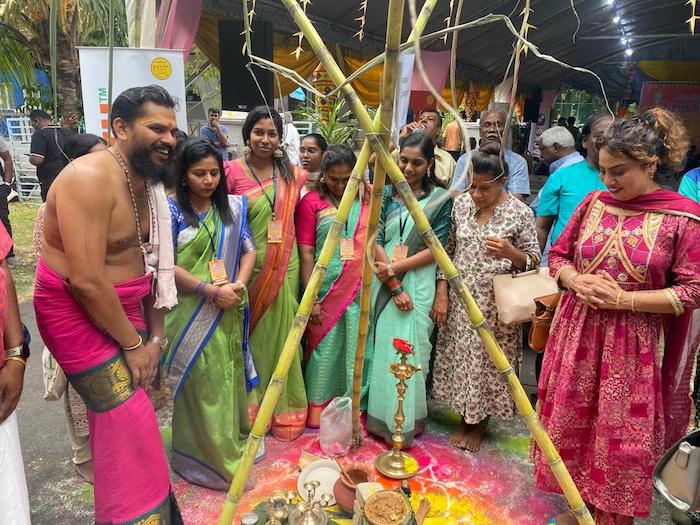
Penang Ponggol 2023 – Photo: Penang Hindu Endownment Board website
By Asia Samachar | Malaysia |
The Penang Hindu Endowments Board, formerly supervised by the state government, will now come under the national unity ministry.
The move is part of a reshuffling of agencies carried out by the prime minister, said Malaysian unity minister Aaron Ago Dagang, with the board and the Malaysian Indian Transformation Unit were moved to the ministry as part of a restructuring exercise, reported FMT (Jan 5).
Aaron said the two agencies would have “a positive impact in the long- term for the development and improvement of Indians in the country”.
The ministry will continue to aid low-income people in the Indian community and help raise their standing in terms of education, the economy and society, he said.
The board is a statutory organisation first formed under a 1906 enactment by the colonial government of the Straits Settlements comprising Singapore, Penang and Melaka. The enactment later became federal law as the Hindu Endowments Act.
The board administers five endowments, property, and 13 temples in Penang island and the mainland. It also organises the annual Thaipusam and Ponggal festivals in Penang. The board is headed by a chairman and vice-chairman and 11 commissioners, all appointed by the Penang governor on the advice of the state government, the report added.
Its current chairman is RSN Rayer of DAP, the MP for Jelutong, and the vice-chairman is a senator from Penang, Dr Lingeshwaran R Arunasalam. Among the commissioners are state executive councillor S Sundarajoo; MIC leader J Dhinagaran; and Bagan Dalam assemblyman K Kumaran of DAP.
ASIA SAMACHAR is an online newspaper for Sikhs / Punjabis in Southeast Asia and beyond. You can leave your comments at our website, Facebook, Twitter, and Instagram. We will delete comments we deem offensive or potentially libelous. You can reach us via WhatsApp +6017-335-1399 or email: asia.samachar@gmail.com. For obituary announcements, click here
South Australia Police recruitment poster featuring a Sikh – Photo: Dya Singh
By Asia Samachar | Australia |
A Sikh man was featured in a recruitment drive poster of the South Australia Police. Asia Samachar columnist Dya Singh reader caught the photo in Adelaide a few days ago.
At SA Police, we care about our officers and value the diverse backgrounds and experiences that they bring to their job, according to its website. Go here to apply.
ASIA SAMACHAR is an online newspaper for Sikhs / Punjabis in Southeast Asia and beyond. You can leave your comments at our website, Facebook, Twitter, and Instagram. We will delete comments we deem offensive or potentially libelous. You can reach us via WhatsApp +6017-335-1399 or email: asia.samachar@gmail.com. For obituary announcements, click here
Discovering the facts about the life of Guru Gobind Singh and his contributions to evolving a ‘Nation for Justice’ is like finding a lost ring in murky water. More than hundreds of thousands of rupees have been spent to celebrate his 350th Birthday in January 2017 at Patna Sahib, Bihar, India; it is still not apparent how much truth about his above mission has been revealed to humanity. Nevertheless, this short article discusses how his life and his mission have been misrepresented in Bachitar Nantak, called Dasam Granth, Sikh history, and literature. It also discusses the plight of Hindus in India during 350 years of Muslim rule and the association of Guru Gobind Singh with Muslim society. This was the time when Guru Nanak appeared to promulgate a universally acceptable philosophy, termed ‘Nanakian Philosophy’. About 197 years after Guru Nanak, Guru Gobind Singh appeared on the scene to evolve a ‘Nation for Justice’ based on Nanakian Philosophy. It is ironic that he met great opposition to his mission by his own brethren, the Hindus, Brahmins (priestly class), and the Hindu Rajas. Misrepresentations in the writings of Bhai Gurdas II, Bachittar Natak (Dasam Granth), and Sikh literature have been exposed by comparing the facts embodied in the bani (word) in the Aad Guru Granth Sahib. It is hoped that this short research article will prove a stepping stone for further study to bring out the facts about the mission of Guru Gobind Singh.
INTRODUCTION
The life of Guru Gobind Singh and his contributions have been linked to ancient mythology with the intent‑of making Sikhism a sect of Hinduism. This starts right from his birth until his departure to the heavenly abode. According to Daulat Rai [1], there was no such comprehensive book on Guru Gobind Singh dealing with his mission of evolving a “Nation for Justice” in its right perspective. The overzealous writers of many Janam Sakhis and that of current literature have been so carried away by their devotion and zeal that the readers find it difficult to sift the facts from the fallacies. Such writers have done grave injustice and failed to portray his mission in its true colours.
Most of the work on the life and contributions of Guru Gobind Singh is based on the literature; “Bachitar Natik”, now called “Dasam Granth”, is supposed to be composed by Guru Gobind Singh. At Takht Patna Sahib and Takht Hazoor Sohib the Dasam Granth is installed beside the Aad Guru Granth Sahib (AGGS). [2] There are many controversies about the authenticity of a number of bani (words) in Dasam Granth. Khandare [3] has also pointed out that: “By considering the limitations of the research papers about Dasam Granth, it is not possible to search out the critical analysis of the Guru’s poetry (Dasam Granth). But there is no doubt that the very important and truthful findings will come out a.er the scientific research and critical analysis of the Guru’s literature (Dasam Granth).”
Daulat Rai [1] further writes that the majority of unscrupulous people have tried to gain their selfish ends by saying many wrong and undesirable things about the Guru, his life, and his teachings. Such writers, out of sheer ignorance or colored by their personal views and prejudices, had tried to belittle and denigrate the mission of the Guru by misinterpreting his words (bani) and saying.
MISSION OF GURU GOBIND SINGH
Cunningham [4] (p -34) compared the contributions of early reformers, Ramanand, Gorakh, Chaitan, and Kabir of Hinduism with that of Guru Nanak and Guru Gobind Singh:
“They, Hindu reformers, aimed chiefly at emancipation from priestcraft or from the grossness of idolatry and polytheism. They formed pious associations of contented Quietists, or they gave themselves up to the contemplation of futurity in the hope of approaching bliss rather than calling upon their fellow creatures to throw aside every social as well as religious trammel and to arise a new people free from the debasing corruption of ages. They perfected forms of dissent rather than planted the germs of nations, and their sects remain to this day as they let hem. It was reserved for Nanak to perceive the true principles of reform and to lay that broad foundation that enabled his successor Gobind to fire the minds of his countrymen with a new nationality and to give practical effect to the doctrine that lowest is equal with the highest, in race as in creed, in political rights as in religious hopes.”
The orderliness of nation-building totally depends upon the socio-cultural development of the people. Moreover, sociocultural development depends upon the integrity of ethical retention of life. Therefore, creating human values like unity, equity, and fraternity in the people is very important in building a nation. Hence, every national personality tries to create and inculcate the human values in the society, for this one must conduct research in religion and culture.
Khandare [3] says that Guru Gobind Singh worked for nation-building on these lines. Nevertheless, he has to face a strong opposition from his own fellow citizens, especially the Hill Rajas and the priestly class – Brahmans according to Rai [1].
The Sikh Gurus had to fight against Muslim rulers and Hindu fundamentalists. It is because Vedic Hindus strongly opposed the Sikh’s attitude of reformation. Ganda Singh has given one example – “At the eleventh-anniversary meeting of the Punjab branch of Arya Samaj, the speaker again chose to make derogatory references to Sikhism. Prof Guru Dutta said, ‘If the Swami had wished to become a general, he would have shown himself several thousand times better than Bonapart…. yes, Kshev Chander (Sen) and Guru Gobind Singh were not even one hundred parts of our Swami Dayanand Sarswatiji. The Sikhs might have some religion in them. However, their Guru had no learning whatever…. If Swami Dayanand Saraswati ji Maharaj has called Guru Nanak a dambhi (a hypocrite, an impostor), then what is wrong therein? He (the Swami) had the son of Veda in his hands ….He was not the person to be suppressed by anyone.’ It is clear that Vedic Arya was far against the Sikhism.” (Khandare [3] quoted from Ganda Singh: History of the Khalsa College, p.8.).
In spite of opposition by the Brahmans (priestly class of the Hindus), Hindu Rajas, and Muslim rulers, as well as a degrading social system, Guru Gobind Singh’s work to build a “Nation for Justice”stood out as a very important and valuable mission.
Guru Gobind Singh and Muslim Society
Habib [5] has recently summarised the association of Muslim society with Guru Gobind Singh in the establishment of ‘Nation for Justice’:
Habib’s study of events reflects that Muslim supporters and devotees of Guru Gobind Singh were not only among Muslim masses but there were among Muslim elite and governing classes also. In this context, the change of Muslim mind of the Punjab towards Guru Gobind Singh is quite apparent in the incidence of dissention of Nawab Shah Mohammed Khan of Malerkotla from Subedar of Sirhind – the spearhead of government action against the Guru. However, Sher Khan was a bitter enemy of the Guru in earlier battles and wanted to take revenge on the Guru for killing his brother in a battle. When the Subedar of Sirhind announced the capital punishment to the very young age children of Guru Gobind Singh, known as ‘Sahibzadas’ of the Guru, he openly denounced the order of the Subedar as an unlawful and irreligious act which is known as ‘Ha da Nahra’ (cry of sigh).
Habib further says that after the fight at Anandpur Sahib and Chamkor Sahib Guru Gobind Singh was taking refuge in the forest of Machiwara near Samrala, Ludhiana that was confined by the imperial force. During this critical movement, the two Muslim brothers of the Pathan clan known as Nabi Khan and Gani Khan, rescued the Guru in disguise as “Uch da Peer” (Uch is a city in Bahawalpur, now in Pakistan).
Such kinds of examples show the harmonious relations of Gurus and the Panth with the contemporary Muslim society of the Punjab.
Later, the movement came into conflict with the Mogul establishment due to some administrative reasons, but instead of a distinctive feature, it remains in emotional and ideological association with Islam and contemporary Muslim society.
Finally, Habib summarised that to the contemporary Muslim folk of the Punjab Guru Gobind Singh was understood as liberator of the people and the oppressed ones.
Plight of Hindus
Daulat Rai [1] has described the real plight of Hinduism at the time of birth of Guru Gobind Singh in such a detail that I have not come across such a description by any Sikh writer while writing about the life and achievements of Guru Gobind Singh. The plight of Hindus has been summarized from the observations of Rai [1] as follows:
The Hindus were controlled by Brahmins by shackling them in various codes of conduct and performance of various rituals. Brahmins advocated that worldly possessions are untrue. Therefore, the Hindus should offer their worldly possessions to Brahmins and they will look after their spiritual welfare in return. They worshipped various gods and goddesses. For example, in one Hindu family, one is a worshipper of Ganesh, the second prays to the Sun, the third is a devotee of Shivji, the fourth is a votary of Vishnu, the fifth is the follower of Rama, the sixth is devoted to Bhairo, seventh worshipped Hanuman, the eighth admires Krishan Leela, the next is a Vedanti.
I have noticed that some are devotees of many goddesses and Shivlinga and now many Shivlingas are appearing not only in temples but also anywhere on roadside, in any garden or under any tree in the Punjab.
Rai [1] continues to say: There is no common language for Hindus in India; religious books are different for different sects, no unanimity on any religious issue, no feeling of oneness, no mutual sympathy and no patriotic feeling. Under such circumstances, the Hindus became morally, intellectually, and physically weak. Hindu girls were taken away as slaves and sold in Ghazni. Rajputs and Rajas offered their daughters to Mughal Kings, princes and other rich Muslims. Some Brahmans convert to Islam – called Sayyads. They even became preachers of Islam.
The Hindu India was under Muslim rules for 350 years when Guru Nanak (1469-1539) founded Sikhi (anglicized as Sikhism). Before the onslaught of Islam, Buddhism had already made inroads in Hindu India to liberate the people from the shackles of Brahmins. Buddhism, besides being simple, had rejected the caste system. The lower castes embraced it in great numbers and overnight gained equality with the high castes. Buddhism gained eminence over Brahmanism until it was overthrown by the armed might of the Rajputs (of Agni Dynasty) adding firepower to the intellectual gun of Shankaracharya and his followers. These followers were mainly Brahmans and they exerted themselves extensively to restore the supremacy of the Brahmin, tighten the stranglehold of the invidious caste-system and keep the common person ignorant and illiterate. Shankaracharya was a follower of Shiva. The devotees of Krishna were largely responsible for this moral degeneration.
In order to cheat the common person of his worldly possessions and money, the Brahmin advocated that this world of phenomena with its worldly possessions, is untrue and the only true entity is Brahm. Therefore, the common person should offer his worldly possessions to him, considering them untrue and worthless. He would look after their spiritual welfare in return. After Buddhism, people of India again fell into the clutches of Brahmans.
Thereafter, Muslim rulers destroyed the last vestiges of Hindu power and completely enslaved the people. They tried their level best to belittle the Hindus, rob them of their wealth and women, and reduce them to a servile and spineless people. In short, they owned Hindus as thoroughly as a man owns his cattle.
Large number of the two lower castes of Hindus embraced Islam either under duress or willingly to escape the stigma of untouchability and slavery of Brahmans. The high caste Hindus felt relieved that the rotten limbs of the body of Hinduism had fallen off. “A good riddance,” they mused. Nevertheless, these high caste Hindus could not envisage that this limb was going to be rejuvenated and would turn into their master. The neo-converts were more zealous than the invading Muslims who inflicted unspeakable horrors on their erstwhile masters and co-religionists.
The Hindu women in thousands were not only molested and taken into individual harems but were auctioned for the petty consideration of two dinars in the bazaars of Ghazni and other cities. Their pride, glory and manhood were ground to such a low that they offer their daughters in marriage to the Muslim princes and nobles. Those Brahmans who embraced Islam were flatteringly called “Sayyads.”
Rai [1] also summed up briefly efforts of Guru Nanak saving the raft of Hinduism, which was about to be sunk when it was steered clear of the dangerous shallows of sloth, superstition and ritualism and utter despondency by an able seaman no less than Guru Nanak. He preached the oneness of man and the oneness of God and denounced the caste system and its offshoots untouchability, idol worship and cankerous ritualism. He preached that the Eternal Entity (God) is above birth and death. With disarming sweetness, he used honeyed words, which had the cutting edge of highly honed steel. The Brahmans felt the steel in his words but were powerless to fulminate against him. Guru Nanak assuaged to some extent the rancour between the Muslims and the Hindus.”
The Brahmans infiltrated into Sikhism to weaken its spread message of Guru Nanak by misinterpreting the philosophy in his bani and tilting towards Vedatic philosophy. Therefore, the Hindu India, which became Buddhist and Nanak Panthi, was brought back to old fallen Hinduism as mentioned earlier even during the time of next eight Gurus who succeeded to the “House of Nanak”.
Now the time had come for the annihilation of the Hindus, Aurangzeb celebrated his victories by weighing heaps of the sacred threads of the Hindus, killed in the battle. The heavier the weight the greater the victory was. All great Hindu kingdoms had vanished from the Indian scene. The days of the Lunar Dynasty were over; the Yadav kings were a thing of the past. The scions of remnants of the Solar Dynasty like the King of Mewar were hiding in the jungles and hill nooks. The proud Rajputs of the Agni Dynasty were busy offering their winsome daughters to the Muslim rulers. The pride of the Hindus was trampled upon, and they lay inert under the Muslim heel. Even Guru Arjun and Guru Teg Bahadur were martyred for preaching philosophy of Guru Nanak, hereafter called ‘Nanakian Philosophy’. [6]
In this predicament, piercing the mists of despondency there emerged a figure of hope. This personage took the boat out of the clutches of the ravaging tempest and steered it to the haven of the shore. He was like beneficial rain for the withered and drooping garden of the Hindu Dharma. Like a true friend, he alleviated the sufferings of the Hindus. Who was he? No other than Guru Gobind Singh, known the world over. The sapling, which was planted by Guru Nanak, was watered by the blood of Guru Arjun and Guru Hargobind and fertilized by their bones. Guru Teg Bahadur quickened its growth by injecting into its veins the vital fluid flowing out of his beheaded body. Guru Gobind Singh helped it mature into a full- fledged tree with the blood of his five beloved disciples, four sons and thousands of his followers. At last, this tree bore fruit. Its fruit was nationalism, brotherhood, love, and monotheism. [1]
Conversion to Islam
According to Bilal Javed [7] the ancestry of the majority of people living in the present day Punjab were initially all non-religious. They became Pagan, then came Hinduism/Jainism, then Buddhism, then Islam, then Sikhism, then Christianity (although the actual timeline of these religions being introduced in this region may vary, he was talking about the major wave of these religions coming to Punjab). That is the reason that among Hindus, Muslims and Sikhs in the Punjab are Khokhars, Dhillon, Basra, Chauhan, Cheema, Bajwa, Gujar, Gondal, etc.
Audrey Truschke [8] reported that Aurangzeb, the sixth Mughal Emperor (r. 1658-1707), is perhaps the most despised of India’s medieval Muslim rulers. People cite various alleged facts about Aurangzeb’s reign to support their contemporary condemnation, few of which are true. For instance, contrary to widespread belief, Aurangzeb did not destroy thousands of Hindu temples. He did not perpetrate anything approximating a genocide of Hindus. He did not instigate a large-scale conversion program that offered millions of Hindus, the choice of Islam or the sword.
Audrey Truschke [8] further said thatAurangzeb, for instance, acted in ways that are rarely adequately explained by religious bigotry. For example, he ordered the destruction of selected Hindu temples (perhaps a few dozen, at most, over his 49-year reign) but not because he despised Hindus. Rather, Aurangzeb generally ordered temples demolishing to check political rebellions or to forestall future uprisings. Highlighting this causality does not serve to vindicate Aurangzeb or justify his actions but rather to explain why he targeted select temples while leaving most untouched. Moreover, Aurangzeb also issued numerous orders protecting Hindu temples and communities from harassment, and he incorporated more Hindus into his imperial administration than any Mughal ruler before him by a fair margin. These actions collectively make sense if we understand Aurangzeb’s actions within the context of state interests, rather than by ascribing suspiciously modern-sounding religious biases to him.
Aurangzeb in Sikh History
Aurangzeb was ruler during whole life of Guru Gobind Singh (1666-1708).
Guru Nanak came when Islam was in India for about 350 years. He started to liberate the Hindus from the clutched of Brahmanism. However, expansion of his philosophy was also facing the same problem met by Buddhism, which was against the Brahmanism. Shankaracharya with the help of Brahmins and Rajput eliminated Buddhism from India. Sikhism continued to face opposition from Brahmans and Rajput kings from the time of Guru Nanak (1469-1539) to Guru Gobind Singh (1666-1708). Even today, Sikhism is being misrepresented.
Could the Sikhs re-discover the real Guru Gobind Singh and his real contributions for creating “Nation for Justice”?
Birth of Guru Gobind Singh
Let us start with reference to Dasam Granth, supposed to be composed by Guru Gobind Singh. The author says, “During his stay at Allahabad, by the Will of God, the spirit and light of Guru Gobind Singh descended and manifested itself in his mother’s womb. Mata Gujri had conceived this great son of God, namely Guru Gobind Singh. It happened so because the Ninth Guru had spent some days performing rituals and worships at Tribeni, Allahabad; the Almighty was pleased, and “I” was conceived.” This has been reported in Bachitar Natak as follows:
ਮੁਰ ਪਿਤ ਪੂਰਬ ਕੀਯਸਿ ਪਯਾਨਾ ॥
ਭਾਂਤਿ ਭਾਂਤਿ ਕੇ ਤੀਰਥਿ ਨਾਨਾ ॥
Mur pit poorab keeyas(i) payaanaa|; Bhaant(i) bhaant(i) ke teerath(i) nhaanaa||
My father proceeded east and bathed at several places of pilgrimage.
ਜਬ ਹੀ ਜਾਤ ਤ੍ਰਿਬੇਣੀ ਭਏ ॥
ਪੁੰਨ ਦਾਨ ਦਿਨ ਕਰਤ ਬਿਤਏ ॥੧॥
Jab hee jaat tribaanee bhae|| Punn daan din karat bitaey||1||
When he went to Triveni (Allahabad), he spent his days in virtuous acts like charities. 1.
However, Rawel Singh interpreted the above phrases in detail as follows:
Chaupai: My father (Guru Tegh Bahadur) proceeded to the Eastern parts of India and bathed in the pilgrim places en route. When he reached Tri-veni (the confluence of three rivers Ganges, Jamuna and Sarsvati) now called Prayag (Allahabad). He stayed there in bestowing charity for many days ||1||
There (in Allahabad) I was conceived (in March-April 1666 A.D.). Later, I took birth at Patna (on 22nd December 1666 A.D.) I was brought (from Patna) to the Punjab province. Where various nurses nurtured me with their caresses ||2||
I was given physical protection in all possible ways. And was provided various kinds of training and education. When I began to participate in the management of the religious affairs of the estate, Then, my father departed for the abode of the Supreme Being ||3| | (Personal discussion with S Rawel Singh, India).
Is it not strange that Guru Gobind Singh would compose such a composition, which would contradict the philosophy of his father, Guru Teg Bahadur and that of Guru Nanak? For example, Guru Teg Bahadur himself is against such practices:
ਤੀਰਥ ਕਰੈ ਬ੍ਰਤ ਫੁਨਿ ਰਾਖੈ
ਨਹ ਮਨੂਆ ਬਸਿ ਜਾ ਕੋ ॥
Ŧirath karai baraṯ fun rākẖai nah manū▫ā bas jā ko.
If your mind is not in your control, I speak the truth for your sake that a religion, which recommends pilgrimage to and bathing at sacred shrines and observing fast to get certain wishes granted, is of no use.
(Rawel Singh GLZ # 137857 Discussion Group)
It is evident from the above phrase that Guru Teg Bahadur was following Nanakian Philosophy. Because Guru Nanak strongly criticizes performing pilgrimage to sacred places for any spiritual benefits, washing out of sins or granting of any wish, especially, for begetting a son. For example:
ਤੀਰਥੁ ਤਪੁ ਦਇਆ ਦਤੁ ਦਾਨੁ ॥
ਜੇ ਕੋ ਪਾਵੈ ਤਿਲ ਕਾ ਮਾਨੁ ॥
Ŧirath ṯap ḏa▫i▫ā ḏaṯ ḏān. Je ko pāvai ṯil kā mān.
AGGS, Jap 21, p 4.
People practice pilgrimage, penance/austerity, compassion, and charity for various wishes to be granted.
Nevertheless, Guru Nanak says that:
If there is any reward for such activities then, it is equivalent to a sesame seed (means an insignificant achievement).
By practicing recitation1, austerity2 and self-discipline3, people have grown weary4;
Even after stubbornly5 practicing these rituals, they still have not been able6 to realize7 the Eternal Entity (God).
The Eternal Entity (God)10 can only be realized9 steadily8 through the method12 explained13 by the True Guru11.
AGGS, M 1, p 436.
Although the Institute for Understanding Sikhism (IUS), does not want to involve in discussion on controversies surrounding Dasam Granth but some of its references are necessary to resolve certain issues to know the truth based on philosophy of Guru Nanak, the Founder of Sikhi(sm). The above phrase from Bachitar Natak is clearly contradicting Nanakian Philosophy.
Let us ignore the above story as recorded in Bacittar Natak. Nevertheless, a son was born to Mata Gujri at Patna, Bihar in 1666. He was named, Gobind Rai. When his father, Guru Teg Bahadur, returned from Assam after completing the preaching program in Eastern India decided to move to Anandpur (known as Chack Nanaki) in 1672 [9]. Only six years of childhood of Gobind Rai was spent at Patna. Here at Anandpur another story is related to child Gobind Rai when he was about nine years-old:
Prof Dewan Singh wrote in the Forward to Daulat Rai’s book, Saheb-e-Kamal Guru Gobind Singh [1]: “A lad of nine called upon suddenly to lead a rising and developing nation, not only to save and preserve it from the clutches of a cruel and fanatic foreign ruler, but to reform, reshape and ensteel (steeled)* it into a strong fighting instrument of great potentiality. This is certainly a matter for constant rumination and discussion—a great historical fact to enthrall and electrify people around for centuries to come — a rare example for the comity of nations to emulate and furbish — a fertile subject for historians to cogitate and ponder!”
(Note: There is no such word, ensteel, therefore, it needs to be replaced with “steeled”.)
Another verse from Dasam Granth, to protect tilk (sacred mark on the forehead and Janeu (a sacred thread around the neck) is connected to the purpose of Guru Gobin Singh which contradicts Nanakian Philosophy:
ਤਿਲਕ ਜੰਵੂ ਰਾਖਾ ਪ੍ਰਭ ਤਾ ਕਾ ॥
ਕੀਨੋ ਬਡੋ ਕਲੂ ਮਹਿ ਸਾਕਾ ॥ He protected the forehead mark and sacred thread (of the Hindus) which marked a great event in the Iron age. ਸਾਧਨ ਹੇਤਿ ਇਤੀ ਜਿਨਿ ਕਰੀ ॥
ਸੀਸੁ ਦੀਆ ਪਰ ਸੀ ਨ ਉਚਰੀ ॥੧੩॥ For the sake of saints, he laid down his head without even a sign.13. ਧਰਮ ਹੇਤਿ ਸਾਕਾ ਜਿਨਿ ਕੀਆ ॥ ਸੀਸੁ ਦੀਆ ਪਰ ਸਿਰਰੁ ਨ ਦੀਆ ॥ For the sake of Dharma, he sacrificed himself. He laid down his head but not his creed. ਨਾਟਕ ਚੇਟਕ ਕੀਏ ਕੁਕਾਜਾ ॥
ਪ੍ਰਭ ਲੋਗਨ ਕਹ ਆਵਤ ਲਾਜਾ ॥੧੪॥ The saints of the Lord abhor the performance of miracles and malpractices. 14.
[10] (Dasam Granth, p 54)
The above stanza from Dasam Granth clearly says that Guru Teg Bahadur laid his life to protect tilak (sacred mark on the forehead) and janeu (sacred thread) of Hindus on the request of Kashmiri Pundits, who visited him at Anadpur Sahib. However, Banerjee [11] say that protection of tilak and janeu of the Hindus meant the protection of the rights of everyone to practise his religion unhindered. Banerjee also says that Guru Teg Bahadur was kept in jail for three month and was tortured until he would accept Islam. Finally, he was decapitated in public in Chandni Chowk on November 11, 1675.
On the other hand, Guru Nanak is advising the Brahmans that it does not help to attain successful life by wearing sacred thread (janeu). It is achieved only by developing compassion, contentment, continence, and truth in the mind.
ਦਇਆ ਕਪਾਹ ਸੰਤੋਖੁ ਸੂਤੁ ਜਤੁ ਗੰਢੀ ਸਤੁ ਵਟੁ ॥
Ḏa▫i▫ā kapāh sanṯokẖ sūṯ jaṯ gandẖī saṯ vat.
ਏਹੁ ਜਨੇਊ ਜੀਅ ਕਾ ਹਈ ਤ ਪਾਡੇ ਘਤੁ ॥
Ėhu jane▫ū jī▫a kā ha▫ī ṯa pāde gẖaṯ.
ਨਾ ਏਹੁ ਤੁਟੈ ਨ ਮਲੁ ਲਗੈ ਨਾ ਏਹੁ ਜਲੈ ਨ ਜਾਇ ॥
Nā ehu ṯutai nā mal lagai nā ehu jalai na jā▫e.
ਧੰਨੁ ਸੁ ਮਾਣਸ ਨਾਨਕਾ ਜੋ ਗਲਿ ਚਲੇ ਪਾਇ ॥
Ḏẖan so māṇas nānkā jo gal cẖale pā▫e.
ਚਉਕੜਿ ਮੁਲਿ ਅਣਾਇਆ ਬਹਿ ਚਉਕੈ ਪਾਇਆ ॥
Cẖa▫ukaṛ mul aṇā▫i▫ā bahi cẖa▫ukai pā▫i▫ā.
ਸਿਖਾ ਕੰਨਿ ਚੜਾਈਆ ਗੁਰੁ ਬ੍ਰਾਹਮਣੁ ਥਿਆ ॥
Sikẖā kann cẖaṛā▫ī▫ā gur barāhmaṇ thi▫ā.
ਓਹੁ ਮੁਆ ਓਹੁ ਝੜਿ ਪਇਆ ਵੇਤਗਾ ਗਇਆ ॥੧॥
Oh mu▫ā oh jẖaṛ pa▫i▫ā veṯgā ga▫i▫ā. ||1||
ਅਗਗਸ, ਮ: 1, ਪੰਨਾ 471.
“Make the sacred thread of compassion as the cotton, contentment as the thread, continence as the knot and truth as the twist.
O Brahmin! If you have this type of thread then, put it on me.
(That type of thread) neither breaks, soils with filth, burns nor is lost.
Nanak Says:
Blessed are those who wear such thread in their minds.
Brahmin! You buy a thread for four shells (a little money),
While sitting in an enclosure puts it on people.
Then you, the Brahmin, whisper religious instructions into the ears of the wearer.
This type of thread is left behind when the soul departs on death.”
AGGS, M 1, p 471.
The main message is that it does not help to attain successful life by wearing Brahman’s type of thread (janeu). It is achieved only by developing compassion, contentment, continence, and truth in the mind. Guru Nanak further emphasised that wearing sacred thread (janeu) and putting on sacred mark on forehead (tilak) do not purify the mind:
ਪਤਿ ਵਿਣੁ ਪੂਜਾ ਸਤ ਵਿਣੁ ਸੰਜਮੁ ਜਤ ਵਿਣੁ ਕਾਹੇ ਜਨੇਊ ॥
ਨਾਵਹੁ ਧੋਵਹੁ ਤਿਲਕੁ ਚੜਾਵਹੁ ਸੁਚ ਵਿਣੁ ਸੋਚ ਨ ਹੋਈ ॥੬॥
Paṯ viṇ pūjā saṯ viṇ sanjam jaṯ viṇ kāhe jane▫ū.
Nāvhu ḏẖovahu ṯilak cẖaṛāvahu sucẖ viṇ socẖ na ho▫ī. ||6||
ਅਗਗਸ, ਮ: 1, ਪੰਨਾ 903.
What is the use of wearing janeu (sacred thread) by forgetting the Eternal Entity and worshiping gods, self-discipline without truthful living, and without practising chastity?
Bathing to cleanse the body and putting on sacred mark (tilak) on forehead do not purify mind without practising truthful life.
AGGS, M 1, 903.
INITIATION OF KHALSA OR CONGREGATION DECLARED AS KHALSA
ਸੰਗਤਿ ਕੀਨੀ ਖਾਲਸਾ (Sangat Kini Khalsa)
Many Sikh writers quote the following phrase of Bhai Gurdas II in Var I to support the process of initiation of Khalsa:
ਪੀਵਹੁ ਪਾਹੁਲ ਖੰਡੇਧਾਰ ਹੁਏ ਜਨਮ ਸੁਹੇਲਾ ।
ਗੁਰ ਸੰਗਤ ਕੀਨੀ ਖਾਲਸਾ ਮਨਮੁਖੀਂ ਧੁਹੇਲਾ ।
The above phrase of Bhai Gurdas II is being exploited by some writers as an evidence that Guru Gobind Singh administered Khandai da Amrit to Panj Payaras (Five Beloved) (ਪੀਵਹੁ ਪਾਹੁਲ ਖੰਡੇਧਾਰ – Pioo pahul khnadaydhar) to create Khalsa (ਗੁਰ ਸੰਗਤ ਕੀਨੀ ਖਾਲਸਾ – Gur sangat kini Khlasa).
On the other hand, Sainapat was a close associate of Guru Gobind Singh who wrote, Sri Gur Sobha, in 1711 just about three years after Guru Gobind Singh left for heavenly abode. Therefore, information in it could be quite authentic. In Sri Gur Sobha there is no information about ‘Creation/Initiation of Khalsa as is found in current literature of Sikhism. There is nothing about the selection of Panj Pyaras (Five Beloved Ones) and beheading them, preparation of Amrit (holy water) by reciting a number of bani (words) and administering Amrit to the Panj Payaras to initiate them as Khalsa. [12] Moreover, there is also no information about this system of creation of Khalsa in the Dasam Granth, supposed to be composed by Guru Gobind Singh. According Ganda Singh’s interpretation of ਸੰਗਤਿ ਕੀਨੀ ਖਾਲਸਾ (Sangat Kini Khalsa) means “Congregation was declared Khalsa” rather “initiation of Khalsa” as found in current Sikh literature based upon the above phrase of Bhai Gurdas II. [12]
In spite of the above fact, Ganda Singh goes on to write: “The full description of initiation of Khalsa (preparation of Amrit (holy water) by reciting some bani, demanding five persons, who can sacrifice their lives and initiating them as Panj Pyiara (Five Beloved Ones) was given by various writers. For example, in Gur-parnalian by Kesar Singh; Gur-parnalian by Gulab Singh; Panth Parkash by Giani Gian Singh; Kiaaf Te Guru Gobind Singh and Beaan Khandaan Bedian by Munshi Sant Singh and Mahan Kosh by Bhai Kahn Singh.” [12]
However, Sainapat describes this happening quite differently as follows:
ਚੇਤ ਮਾਸ ਬੀਤਿਉ ਸਕਲ ਮੇਲਾ ਭਯੋ ਅਪਾਰ ।
ਭੈਸਾਖੀ ਕੇ ਦਰਸ ਪੈ ਸਤਿਗੁਰ ਕ੍ਰੀਯੋ ਬਿਚਾਰ ॥ 5.2.118.
ਸੰਗਤ ਦਰਸ਼ਨ ਕਰਤੁ ਸਬ ਨਗਰ ਬਿਸਥਾਰ ।
ਹੁਐ ਦਇਆਲ ਦਰਸ਼ਨ ਦੀਓ ਕਰਨਹਾਰ ਕਤਾਰ ॥ 3.119.
ਗੋਬਿੰਦ ਸਿੰਘ ਕਰੀ ਖੁਸ਼ੀ ਸੰਗਤਿ ਕਰੀ ਨਿਹਾਲ ।
ਕੀਓ ਪ੍ਰਗਟ ਤਬ ਖਾਲਸਾ ਚੁਕਿਓ ਸਗਲ ਜੰਜਾਲ ॥ 4. 120.
ਸਬ ਸਮੂਹ ਸੰਗਤਿ ਮਿਲੀ ਸ਼ੁਬ ਸਤਿਲੁਦ੍ਰ ਕੇ ਤੀਰ ।
ਕੇਤਕ ਸੁਨ ਭਏ ਖਾਲਸਾ ਕੇਤਕ ਭਏ ਅਧੀਰ ॥ 5.121.
ਤਜ ਮਸੰਦ ਪ੍ਰਬ ਏਕ ਜਪ ਯਹ ਬਿਬੇਕ ਤਹਾਂ ਕੀਨ ।
ਸਤਿਗੁਰ ਸੋ ਸੇਵਕ ਮਿਲੇ ਨੀਰ ਮਹਿ ਜੋ ਮੀਨ ॥ 6. 122.
During the month of Chait (no year is given) gathering (ਮੇਲਾ – mela – fair/festival) which was in full swing on Vaisakhi day. On that day Guru Gobind Singh issued an edict which liberated the Sikhs from the control of Masands (persons appointed as preachers of Sikhi) as is indicated in phrase, 122 (ਤਜ ਮਸੰਦ ਪ੍ਰਬ ਏਕ ਜਪ ਯਹ ਬਿਬੇਕ ਤਹਾਂ ਕਿਨ ।). Thereafter,Guru Gobind Singh declared the whole gathering of thousands as his Khalsa (ਕੀਓ ਪ੍ਰਗਟ ਤਬ ਖਾਲਸਾ ਚੁਕਿਓ ਸਗਲ ਜੰਜਾਲ). There is no mention of any preparation of Amrit, and call of five persons to be sacrificed and thereafter initiating them as KHALSA through Khadai ki Pahul as mentioned by Bhai Gurdas II.
Before this episode, Guru Hargobind had also addressed his sangat (congregation) as, “ਪੂਰਬ ਦੀ ਸੰਗਤ ਗੁਰੂ ਦਾ ‘ਖਾਲਸਾ ਹੈਇ’ (the congregation of the East is ‘Khalsa’ of the Guru, Hargobind). Similarly, Guru Teg Bahadur had also addressed his sangat as “ਪਟਣ ਦੀ ਸੰਗਤ ਸ੍ਰੀ ਗੁਰੂ ਜੀ ਦਾ ਖਾਲਸਾ ਹੈ” (the congregation of Patna is the Khalsa of Sri Guru, Teg Bahadur) in Hukamnamas # 3 and 8, respectively. In Hukmnamas # 46, 47, 61, 63-65 Guru Gobind Singh also declared as, ਸੰਗਤ ਮੇਰਾ ਖਾਲਸਾ ਹੈ (the congregation is my Khalsa). This sangat (congregation) was composed of people belonging to various religions. [13]
‘Khalsa’, as used by Bhai Gurdas II, Ganda Singh and by many Sikh writers,is a corrupt Arabic word of (خالصہKhalseh) since there is no such word, Khalsa, in the Urdu to Urdu Dictionary [14].
According to this dictionary (خالصہKhalseh) means ‘Pure’, clean’’; that land or property, not owned by anybody, belongs to the King and all the revenue from that land and property comes to the King. [14] Therefore, there is no such word, Khalsa, in Arabic language. It is an interpolated form of (خالصہKhalseh).
Bhagat Kabir has used the right Arabic word, (خالصہKhalseh) in the following phrase:
The meanings of the word ਖਾਲਸੇ (Khalseh) used by Bhagat Kabir is quite different from that of “Khalsa”:
ਪਰਿਓ ਕਾਲੁ ਸਭੈ ਜਗ ਊਪਰ ਮਾਹਿ ਲਿਖੇ ਭ੍ਰਮ ਗਿਆਨੀ ॥
Pari▫o kāl sabẖai jag ūpar māhi likẖe bẖaram gi▫ānī.
ਕਹੁ ਕਬੀਰ ਜਨ ਭਏ ਖਾਲਸੇ ਪ੍ਰੇਮ ਭਗਤਿ ਜਿਹ ਜਾਨੀ ॥੪॥੩॥
Kaho Kabīr jan bẖa▫e kẖālse parem bẖagaṯ jih jānī. ||4||3||
AGGS, Bhagat Kabir, pp 654-655.
Interpreted by Sant Singh Khalsa [15]:
Death has fallen on the whole world; the doubting religious scholars in doubt are also listed on the Register of Death.
Says Kabeer, those humble people become pure – they become Khalsa – who know the Lord’s loving devotional worship. ||4||3||
Nevertheless, Sant Singh Khalsa interprets ਖਾਲਸੇ (Khalseh) as ‘pure’ but adds that it means ‘Khalsa’.
In fact, if we look into this phrase critically then it can be interpreted as follows:
The superstitious scholars write that the whole world is under superstitions and fear of death.
Those, who understand the Eternal Entity, are liberated from superstitions and fear of death. 4. 3.
Here ਖਾਲਸੇ (Khalseh) means, “liberated” from superstitions and fear of death or became ‘pure’ being free from superstitions but not initiated as ‘Khalsa’.
Khandai ki pahul (ਖਾਂਡੇ ਕੀ ਪਾਹਿਲ)
There is also mention of Khandai ki pahul (ਖਾਂਡੇ ਕੀ ਪਾਹਿਲ) in Sri Gur Subha by Sainapat as follows:
ਖਾਂਡੇ ਕੀ ਪਾਹਿਲ ਦਈ ਕਰਨਹਾਰ ਪ੍ਰਭ ਸੋਈ ।
ਕੀਉ ਦਸੋਂ ਦਿਸ ਖਾਲਸਾ ਤਾਂ ਬਿਨ ਅਵਰ ਨ ਕੋਈ ॥ 33 ॥ 148 ॥
What does ਖਾਂਡੇ ਕੀ ਪਾਹਿਲ (Khanda ki Pahul) mean?
Khandai or Khanda (ਖਾਂਡੇ / ਖਾਂਡਾ) or Kharag (ਖੜਗੁ) means double-edged sword. However, in Nanakian Philosophy “Kharag” means “sword of wisdom” explained as follows:
Gur gi▫ān kẖaṛag hath ḏẖāri▫ā jam māri▫aṛā jamkāl. ||7||
AGGS, M 4, p 235.
Guru Ramdas is advising people:
Take up4Kharag (double-edged sword)3 of enlightening1 wisdom2 in your hand and kill the fear5 of difficulties of future time6.
It is evident that double-edged sword, Kharag (ਖੜਗੁ) or Khandai/ Khanda (ਖਾਂਡੇ / ਖਾਂਡਾ) means wisdom. The Kharag (ਖੜਗੁ) is the most powerful sharp weapon to overcome your enemies according to Nanakian Philosophy.
ਪਾਹੁਲ (pahul): According to Bhai Kahn Singh’s Mahan Kosh it means ਪਾਣ (paan – to temper) and a holy water prepared religiously. In fact, it is foot wash of a Guru to initiate a follower in ancient philosophy. Now it is expressed as holy water prepared by stirring it with khanda (double-edged sword) and reciting some mantras. Bhai Kahn Singh says it is a wrong interpretation:
However, if ਪਾਹੁਲ (pahul) according to Bhai Kahn Singh’s Mahan Kosh means ਪਾਣ (paan – to temper) then ‘Temper’ has many meanings in dictionary.com, particularly:
1. A particular state of mind or feelings.
2. Habit of mind, especially with respect to irritability or patience, outbursts of anger, or the like; disposition:
3. A substance added to something to modify its properties or qualities.
4. In Metallurgy: The degree of hardness and strength imparted to a metal, as by quenching, heat treatment, or cold working.
It appears that in Sikhi ਪਾਹੁਲ (pahul) means to temper the mind of a person by instilling intellectual qualities and imparting hardness and strength to the body.
Note: The word ਖਾਲਸ (Khalis) has been interpolated to ਖਾਲਸਾ(Khalsa) in the above phrase of Sainapat.
According to Laws of Nature3 of the Eternal Entity4 (God,) the minds of the Sikhs from all the ten sides5 of the world were tempered2 with the sword of wisdom1 and nobody was left out.
However, at other places ਖਾਲਸ (Khalis) is found rightly spelled as ਖਾਲਸ (Khalis) in Sri Gur Subha of Sainapat as follows:
ਏਕ ਦਿਵਸ ਕਾਰਨ ਤੇ ਆਗੇ ।
ਮਿਲਿ ਕੇ ਸਿੰਘ ਪੂਛਨੇ ਲਾਗੇ ।
ਕਵਲ ਰੂਪ ਆਪਨ ਪ੍ਰਭ ਕੀਨੋ ।
ਤਿਨ ਕੈ ਜੁਆਬ ਭਾਤਿ ਇ ਦੀਨੋ । 40. 805.
One day the Sikhs gathered and asked (Guru Gobind Singh).
What would be your image in the future?
He answered them as follows: 40.805
ਤਾਹ ਸਮੇ ਗੁਰ ਬੈਨ ਸੁਨਾਯੌ ।
ਖਾਲਸ ਆਪਨੋ ਰੂਪ ਬਤਾਯੌ ।
ਬਖਸ਼ ਕੀਉ ਖਾਲਸ ਕੋ ਜਾਮਾ । 41. 806.
At that time, he issued a statement.
I give my image to the Khalis (pure ones). 41.806
ਖਾਲਸ ਮੇਰੇ ਰੂਪ ਹੈ ਹੌਂ ਖਾਲਸ ਕੇ ਪਾਸਿ ।
ਆਦਿ ਅੰਤਿ ਹੀ ਹੋਤ ਹੈ ਖਾਲਸ ਮੈ ਪ੍ਰਗਾਸ ॥ 42. 807
Khalis (purity) is particularly my special image.
It will be so, Khalis (pure,) during all the times to come. 42.807.
Now he (Guru Gobind Singh) explains the Khalis as follows:
Khalis (pure) is that who has no superstitions in his/her mind.
That Khalis (pure), who remains free from superstitions and religious garb, is my Satguru (True Guru).
Guru Gobind Singh has elevated the Khalis to the status of Satguru. Now a new question comes up:
Who is Satguru?
The word ਸਤਿਗੁਰੂ (Satguru) is also used for the Eternal Entity (God) in the Aad Guru Granth Sahib but Guru Arjun has defined this word also as True Guru:
ਸਤਿ1 ਪੁਰਖੁ2 ਜਿਨਿ ਜਾਨਿਆ ਸਤਿ3 ਗੁਰੁ4 ਤਿਸ ਕਾ ਨਾਉ ॥
Saṯ purakẖ jin jāni▫ā saṯgur ṯis kā nā▫o.
The one, who understood the Eternal Entity1, God2, is called the True3 Guru4 (Satgur).
ਤਿਸ ਕੈ ਸੰਗਿ ਸਿਖੁ ਉਧਰੈ5 ਨਾਨਕ ਹਰਿ ਗੁਨ ਗਾਉ ॥੧॥AGGS, M 5, p 286.
Ŧis kai sang sikẖ uḏẖrai Nānak har gun gā▫o. ||1||
In the company of that Satgur, the life of the Sikh is improved5.
Let us sing (understand) about the Eternal Entity (the God) from the company of that Satgur. ||1||
Guru Ram Das has described Satguru as follows:
ਜਿਸੁ ਮਿਲਿਐ ਮਨਿ ਹੋਇ ਅਨੰਦੁ ਸੋ ਸਤਿਗੁਰੁ ਕਹੀਐ ॥
jis mili-ai man ho-ay anand so satgur kahee-ai.
ਮਨ ਕੀ ਦੁਬਿਧਾ ਬਿਨਸਿ ਜਾਇ ਹਰਿ ਪਰਮ ਪਦੁ ਲਹੀਐ ॥੧॥
man kee dubiDhaa binas jaa-ay har param pad lahee-ai. ||1||
By meeting whom, one achieves tranquility,duality is eliminated and understands about the Eternal Entity (the God,) that person is called Satgur (True Guru).
AGGS, M 4, p 168.
Khalis in Dasam Granth
In Dasam Granth the word Khalis (ਖਾਲਸ) has been used as “pure”.
ਪੂਰਨ ਜੋਤ ਜਗੈ ਘਟ ਮੈ ਤਬ ਖਾਲਸ ਤਿਹਿ ਨਖਾਲਸ ਜਾਨੈ ॥
Those, who have been enlightened about the Eternal Entity (the God) are Khalis (pure) and identified from impure who are following demi gods.
This phrase makes it clear that ਖਾਲਸ (Khalis) and ਨਖਾਲਸ (Nakhalis) mean ‘pure’ and ‘impure’, respectively. Therefore, Guru Gobind Singh declared the Sikhs as KHALIS (not Khalsa), meaning those who are free from superstitions and religious garb as discussed later.
(خالصہ Khalseh) vs ( خالص Khalis)
It is evident from the above discussion that “Khalseh” means property of King or the congregation owned by Guru Gobind Singh and as ‘pure’. Whereas “Khalis” means “pure” enlightened about the Eternal Entity. ‘Khalsa’ is interpolated form of (خالصہ Khalseh) and ( خالص Khalis).
BESTOWING GURU-SHIP ONTO HOLY GRANTH
A controversy on the declaration of Granth as Guru was started by Mcleod [16]. Since the ‘Granth Guru’ had become an established fact in the old Sikh literature, Prof Madanjit Kaur wrote a detailed article entitled, “The Guru-ship and Succession of Guru Granth” [17] to justify that Granth is Guru and Guru-ship was bestowed by Guru Gobind Singh in 1708. This article was written by her to refute the following statement of McLeod:
“…tradition which conferred his (Guru Gobind Singh’s) personal authority upon the sacred scripture and the corporate Panth may perhaps be a retrospective interpretation, a tradition which owes its origin not to an actual pronouncement of the Guru but to an insistent need for maintaining the Panth’s cohesion during the later period.”
Grewal [18] had also pointed out about the contention of McLeod as follows:
“He (Justice Gurdev Singh) thinks it is unfair on McLeod to suggest that Granth Sahib was installed as Guru to serve as a cohesive force for the leaderless community after the execution of Banda Bahadur and not because of injunction of Guru Gobind Singh.”
In both contentions, it appears that McLeod [16] refused to accept that Guru Gobind Singh declared the Granth as Guru in 1708. He believes that it was a later addition after the execution of Banda Bahadur the Granth was declared as Guru as a cohesive force for the leaderless community.
In response to the above contentions of McLeod, Justice Gurdev Singh, Harbans Singh and Ganda Singh cited from reference [18] and Madanjit Kaur [17] and Ganda Singh [19] have proven historically that it was Guru Gobind Singh, who bestowed Guru-ship to the Granth in 1708 at the time of his demise.
Prof Piara Singh Padam [20] (p 24) also supported that it is an historical fact that Guru-ship was bestowed onto the Granth by Guru Gobind Singh, not by Singh Sabha as is heard from some mischievous persons.
Nevertheless, when I examined the information (data) given in Sri Gur Sobha [12], Gurbilas Patshahi 6 [21], Rahit Namay [22], historical evidence, and Gurbani a new picture appeared that originally ‘Sabd’ was accepted as ‘Guru’ but later ‘Sabd Guru’ was changed to ‘Granth Guru’ and then bestowing of Guru-ship to the Granth was ritualized steadily and stealthily. [23, 24]
Ganda Singh [12] (p 52) quoted a part of the following phrase from Sainapat’s Sri Gur Sobha to justify that Guru-ship was bestowed onto the Holy Granth [12] (p 54):
Madanjit Kaur [17] followed Ganda Singh’s interpretation to support her thesis or bestowing Guru-ship onto the Granth. Moreover, a critical analysis of this phrase shows that Ganda Singh has not paid any attention to the previous stanzas of the above phrase to interpret it properly. If we look into the previous stanza of the above phrase # 808 then real interpretation will emerge. The previous stanza is as follows:
Khalis (pure) is that who has no superstitions in his/her mind.
That Khalis, who remains free from superstitions and religious garb, is my Satguru (True Guru).
This indicates that the ‘Khalis’, who is free from superstitions and religious garbs, was declared as the ‘Satguru’, and there is nothing about the bestowing of Guru-ship onto the Holy Granth.
Therefore, real interpretation that phrase,
ਸਤਿਗਰੂ ਹਮਾਰਾ ਅਪਰ ਅਪਾਰਾ ਸ਼ਬਦਿ ਬਿਚਾਰਾ ਅਜਰ ਜਰੰ ।
ਹਿਰਦੇ ਧਰ ਧਿਆਨੀ ਉਚਰੀ ਬਾਨੀ ਪਦ ਨਿਰਬਾਨੀ ਅਪਰ ਪਰੰ । …43.808, is as follows:
The Satguru (Khalis, the pure one free from superstitions and religious garbs as discussed above) is above all limits (ਅਪਰ ਅਪਾਰਾ), who contemplates/deliberates on the Sabd (ਸ਼ਬਦਿ ਬਿਚਾਰਾ), and who can bear (face) the unbearable difficulties (ਅਜਰ ਜਰੰ)”.
“Khalis is that who imbibes the Bani in the mind and recites the Bani with full concentration, consequently, he attains the status (of that Satguru), which cannot be described.”
Here in this phrase, it is clear that the ‘Khalis’ (pure one) is the ‘Satguru’, who contemplates on Sabd. There is nothing that supports that ‘Granth is Guru’ in above phrase # 808 as interpreted by Ganda Singh [12] and supported by Madanjit Kaur [17]. The word is “Khalis” not “Khalsa” as discussed earlier under the Stanzas # 805-808 in Sri Gur Sobha [12] , and in the Dasam Granth. “Satguru” has been explained in the Aad Guru Granth Sahib by Guru Ramdas and Guru Arjan. Misinterpretation of Gurbani and misrepresentation of Sikhism in Sikh literature are very common among the Sikh scholars to support their own concepts and views. [25]
Although Ganda Singh failed to interpret phrase # 808 completely and properly, still one can easily find out from Sainapat’s phrase # 808 a very important message of Guru Nanak that has been ignored by many scholars:
It is the “Khalis” (not Khalsa), who is free from superstitions and religious garb and when he/she contemplates/deliberates on Sabd becomes Satguru , True Guru/ perfect teacher, fit for further dissemination of Nanakian Philosophy.
The other important message is that:
It is the Sabd that is to be contemplated/deliberated by the “Khalis” to become Satguru as explained earlier.
In spite of strong opposition from Brahmins (priestly class), Hindu Rajas and Mughal Empire Guru Gobind Singh succeeded to inculcate the spirit in the Sikhs for creating a “Nation for Justice”. Banda Singh Bhahadur (1670-17160) was initiated as ( خالصہਖਾਲਸੇ – Khalseh) by tempering (pahul) his mind with wisdom and body with strength when he met him at the bank of Gudavari River. In 1708, Guru Gobind Singh entrusted the task to establish the Sikh Raj of justice. During the short period of 1708 to 1716, Banda Singh Bahadur raised an army of Sant Sapahi (Saint-soldiers) and its strength increased every day. He conquered Khanda, Sonipat, Kathl, Samana, Sirhind, Rahon, Malerkotla, Nahan, Chhapper Chiri, area from Sutlaj to Jamuna and regions of Jalandhar, Amritsar and up to Lahore, thereafter, he also captured Saharanpur, Jalalabad and Muzafarnagar parts of Uttar Pradesh. He declared his capital at a village, Mukhlisgarh, renamed as Lohgarh (Fortress of steel) where he minted his own coin with a phrase, “Struck in the City of Peace”. His unique and biggest contribution was abolishing of Land Lord System and replaced it with the system of “Land to the Tiller”. [26]
Although the Sikh Raj established by Banda Singh Bahadur was for a short period, however, he paved very strong path for capturing Delhi in 1783 by Baghel Singh and subsequently from 1799 to 1849, a well stable Kingdom for Justice was established by Maharaja Ranjit Singh (1780-1839).
CONCLUSIONS
Plight of Hindus during Muslim Rule:
The Hindus were controlled by Brahmans by shackling them in various Codes of Conduct, various rituals and superstitions.
The Hindus were treated as second-class citizens during the Muslim rule. Many of them embraced Islam and many Raja and rich Hindus offered their daughters in marriage to kings, princes and sons of other rich Muslims.
Guru Nanak (1469-1539) appeared during the Muslim Kingdom when he promulgated universally acceptable philosophy to raise the moral and self-respect of the people.
Thereafter, Guru Gobind Singh (1666-1708) appeared and tried to evolve a ‘Nation for Justice’.
In spite of that fact, Guru Gobind Singh met great opposition to his mission by his own brethren, the Hindus, Brahmans (priestly class) and the Hindu Rajas.
ਸੰਗਤਿ ਕੀਨੀ ਖਾਲਸਾ(Sangat Kini Khalsa):
The word, ‘Khalsa’, as used by Bhai Gurdas II, Ganda Singh and by many Sikh writers, is an interpolated form of Arabic word of ( خالصہ ਖਾਲਸੇ – Khalseh). It means ‘Pure’, clean’’ and that land or property which belongs to the king and all the revenue from that land and property comes to the King. There is another Arabic word, ( خالصKhalis) means ‘pure’.
Therefore, that phrase, ਸੰਗਤਿ ਕੀਨੀ ਖਾਲਸਾ(Sangat Kini Khalsa), should be read as ਸੰਗਤਿ ਕੀਨੀ ਖਾਲਸੇ (Sangat Kini Khaleh). Thus, Guru Gobind Singh eliminated the Masand System and declared his entire congregation (sangat – followers) his ( خالصہਖਾਲਸੇ – Khalseh), that means all his followers were owned by him and all the donations would come directly to the Guru instead to the Masands.
It is the word, ਖਾਲਸ (Khalis), meaning pure, free from superstitions, which has been used by Sainapat in Sri Gur Sobha and in Dasam Granth.
ਖਾਂਡੇ ਕੀ ਪਾਹਿਲ (Khanda ki Pahul):
Khandai or Khanda (ਖਾਂਡੇ / ਖਾਂਡਾ) or Kharag (ਖੜਗੁ) means double-edged sword. However, in Nanakian Philosophy “Kharag” means “sword of wisdom”.
ਪਾਹੁਲ (pahul) means to temper. Therefore, ਖਾਂਡੇ ਕੀ ਪਾਹਿਲ (Khanda ki Pahul) means to temper the mind of a person by instilling intellectual qualities and imparting hardness and strength to the body.
Banda Singh Bhahadur (1670-1716) was initiated as ( خالصہਖਾਲਸੇ – Khalseh) by tempering (pahul) his mind by instilling intellectual qualities and imparting hardness and strength to his body when Guru Gobind met him at the bank of Godavari River in Nadad. In 1708, Guru Gobind Singh entrusted him the task to establish the Sikh Raj.
Although the Sikh Raj established by Banda Singh Bahadur was for a short period, however, he paved very strong path for capturing Delhi in 1783 by Baghel Singh and subsequently from 1799 to 1849, a well stable Kingdom for Justice was established by Maharaja Ranjit Singh (1780-1839).
Misrepresentations and Misinterpretations:
Some misrepresentations and misinterpretations of phrases in Sri Gur Sobha, Dasam Granth, and Bhai Gurdas II’s Vaars were exposed by the use of touchstone of Nanakian Philosophy, logic and science.
ACKNOWLEDGMENTS
The Gurmukhi font of Gurbani and its transliteration in Roman script have been reproduced from www.srigranth.org with permission from Dr Kulbir Singh Thind. I am highly thankful to him. The author is grateful to Dr Sheena Sidhu for editing the article.
REFERENCES
1. Rai, D. (1988 (2011)) Sahibe Kamal Guru Gobind Singh (Abridged) by Surinderjit Singh (Amritsar, Gurmat Sahit Charitable Trust ).
2. AGGS (1983) Aad Guru Granth Sahib (Amritsar, Punjab, India, Shiromani Gurdwara Parbandhak Committee). (M = Mahla, i.e., succession number of the Sikh Gurus to the House of Nanak, M is replaced with the name of Bhagat/ Bhatt for their Bani, p = Page of the AGGS).
8. TRUSCHKE, A. (2016) It is High Time to Discard the Pernicious Myth of India’s Medieval Muslim ‘Villains’ The Wire (New Delhi). HTTPS://THEWIRE.IN/18919/IT-IS-HIGH-TIME-TO-DISCARD-THE-PERNICIOUS-MYTH-OF-INDIAS-MEDIEVAL-MUSLIM-VILLAINS/
9. Singh, G. (1996) Gobind Singh, Guru, in: Singh, H. (Ed.) The Encyclopaedia of Sikhism, p. 88 (Patiala, Punjabi University).
16. McLeod, W. H. (1975) The Evolution of the Sikh Community (New Delhi, Oxford University Press).
17. Kaur, M. (1988) The Guruship and Succession of Guru Granth Sahib, in: Mann, J. S. a. S., H. S. (Ed.) Advanced Studies in Sikhism (Irvine, CA, Sikh Community of N America).
18. Grewal, J. S. (1998) Contesting Interpretation of the Sikh Tradition (New Delhi, Manohar).
19. Singh, G. (1986) Guru Gobind Singh designated Guru Granth Sahib to be the Guru, in: Singh, G. (Ed.) Perspectives on the Sikh Tradition (Patiala, Sidharth Publication for Academy of the Sikh Religion and Culture).
20. Padam, P. S. (1997) Bansawalinama Dasan Patshaahian ka (Punjabi) By Kesar Singh Chhibber (1769) (Amritsar, Singh Brothers).
21. Vedanti, J. S. & Singh, A. (1998) Gur Bilas Patshahi 6 (in Punjabi) (Amritsar, Dharam Parchar Committee, Shiromani Gurdwara Parbandhak Committee).
22. Padam, P. S. (1984) Rehit Namai (Punjabi) (Patiala, Kalam Manda).
23. Chahal, D. S. (2004) Sabd Guru to Granth Guru – An in Depth Study (Laval, Quebec, Institute for Understanding Sikhism).
* Reproduced from Understanding Sikhism Res. J. Vol. 19. No. 1. pp 5-16, 2017.
Devinder Singh Chahal, PhD, a retired Professor of Microbiology, is the president of the Canada-based Institute for Understanding Sikhism. Relying on his long life as a Sikh, his training as a scientist and his love of the Guru, Prof Chahal has dedicated an enormous amount of energy trying to reform Sikhi by demonstrating the incorrect interpretations of the Aad Granth. Click here for his work. His most recent book is NANAK and His Philosophy.
ASIA SAMACHAR is an online newspaper for Sikhs / Punjabis in Southeast Asia and beyond. You can leave your comments at our website, Facebook, Twitter, and Instagram. We will delete comments we deem offensive or potentially libelous. You can reach us via WhatsApp +6017-335-1399 or email: asia.samachar@gmail.com. For obituary announcements, click here
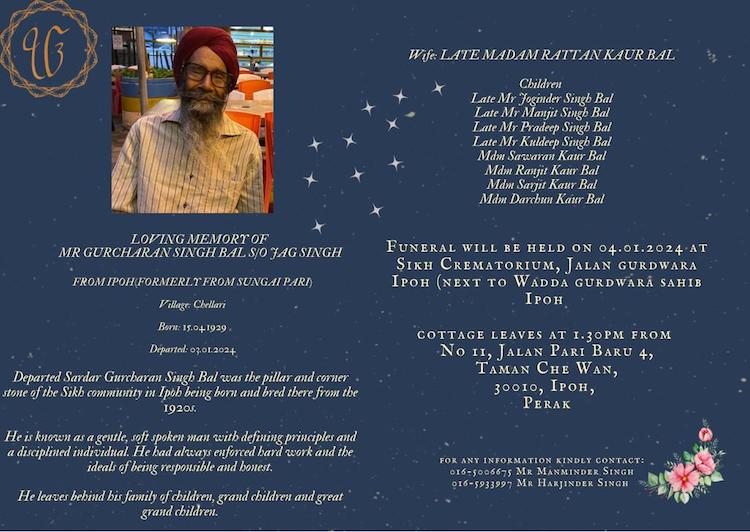
Departed Sardar Gurcharan Singh Bal was the pillar and cornerstone of the Sikh community in Ipoh being born and bred there from the 1920s.
He is known as a gentle, soft spoken man with defining principles and a disciplined individual. He had always enforced hard work and the ideals of being responsible and honest.
He leaves behind his family of children, grandchildren and great grandchildren.
Wife: LATE MADAM RATTAN KAUR BAL
Children Late Mr Joginder Singh Bal Late Mr Manjit Singh Bal Late Mr Pradeep Singh Bal Late Mr Kuldeep Singh Bal Mdm Sawaran Kaur Bal Mdm Ranjit Kaur Bal Mdm Sarjit Kaur Bal Mdm Darchun Kaur Bal
Funeral will be held on 4 January 2024 (Thursday) at Sikh Crematorium, Jalan Gurdwara Ipoh (Next to Wadda Gurdwara Sahib Ipoh)
Cortege leaves at 1.30pm from No 11, Jalan Pari Baru 4, Taman Che Wan, 30100, Ipoh, Perak
ASIA SAMACHAR is an online newspaper for Sikhs / Punjabis in Southeast Asia and beyond. You can leave your comments at our website, Facebook, Twitter, and Instagram. We will delete comments we deem offensive or potentially libelous. You can reach us via WhatsApp +6017-335-1399 or email: asia.samachar@gmail.com. For obituary announcements, click here