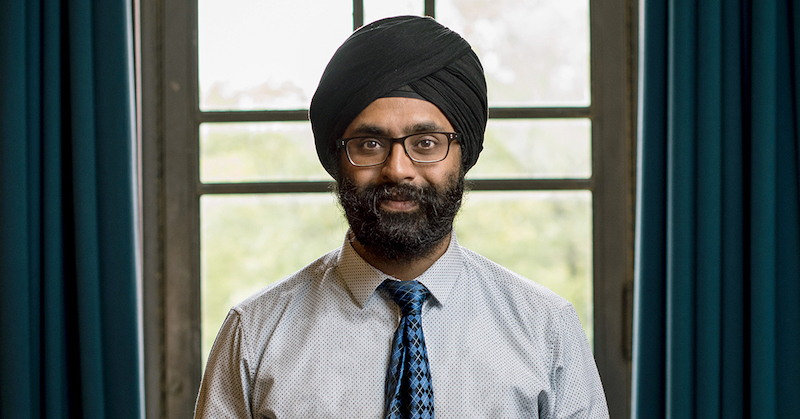
Viu, a regional over-the-top (OTT) video service provider, has appointed Sukhbir Singh Sidhu as its advertising head.
In his new role, Sukhbir will be responsible for driving growth and revenue for Viu’s advertising business in Malaysia.
Prior to this, Sukhbir was the head of sales for Malaysia at Chinese video streaming giant subsidiary iQiyi International for close to three years.
Sukhbir brings with him over 18 years of experience in the media and advertising industry with stints at TGV Cinemas, Star Radio Group and Astro Radio.
“Sukhbir is an exceptional leader with a profound understanding of the media and advertising landscape in Malaysia. His experience, expertise, and passion for the industry will be invaluable as we continue to expand our advertising business and deliver even greater value to our partners,” said Viu Malaysia Country Manager Kingsley Warner in a statement.
“Media sales runs in my blood,” Sukhbir writes at his LinkedIn page.
ASIA SAMACHAR is an online newspaper for Sikhs / Punjabis in Southeast Asia and beyond. You can leave your comments at our website, Facebook, Twitter, and Instagram. We will delete comments we deem offensive or potentially libelous. You can reach us via WhatsApp +6017-335-1399 or email: asia.samachar@gmail.com. For obituary announcements, click here
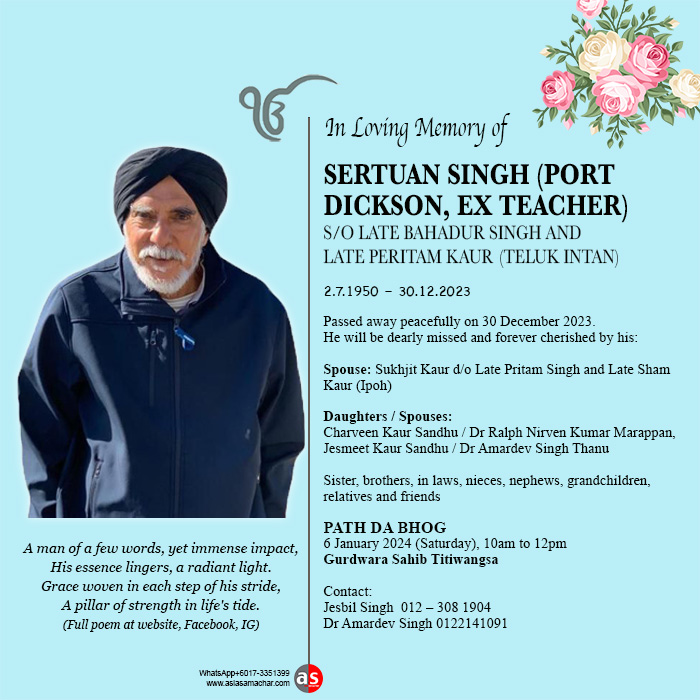
SERTUAN SINGH (PORT DICKSON, EX TEACHER) S/O LATE BAHADUR SINGH AND LATE PERITAM KAUR (TELUK INTAN)
2.7.1950 – 30.12.2023
Passed away peacefully on 30 December 2023.
He will be dearly missed and forever cherished by:
Spouse: Sukhjit Kaur d/o Late Pritam Singh and Late Sham Kaur (Ipoh)
Daughters / Spouses: Charveen Kaur Sandhu / Dr Ralph Nirven Kumar Marappan,
Jesmeet Kaur Sandhu / Dr Amardev Singh Thanu
Sister, brothers, in laws, nieces, nephews, grandchildren, relatives and friends
PATH DA BHOG 6 January 2024 (Saturday), 10am to 12pm Gurudwara Sahib Titiwangsa
Jesbil Singh 012 – 308 1904 Dr Amardev Singh 0122141091
Legacy of Light: A Tribute to a Remarkable Soul, Sertuan Nanaji
A man of a few words, yet immense impact, His essence lingers, a radiant light. Grace woven in each step of his stride, A pillar of strength in life’s tide.
Observant eyes, twinkling with mirth, In the vast galaxy, he’s a cherished birth. Intellect and intelligence intertwined, A star that forever in our hearts will shine.
Patience, a virtue stiched in his quilt, Endurance and determination, the cloak of his spirit. Generous, resolute, and caring, A heart of gold, legacy worth sharing.
Spiritual threads weave through his soul, An innate humour, making his spirit whole. Independent being a gem so true A precious heart, like morning dew.
In the tapestry of memories, he’s alive, A true gem, a legacy that’s everlasting.
We have our very own angel watching over us.
Missed and loved.
Forever treasured in our hearts.
~ Thaneeisha Kaur
| Entry: 3 Jan 2024 | Source: Family
ASIA SAMACHAR is an online newspaper for Sikhs / Punjabis in Southeast Asia and beyond. You can leave your comments at our website, Facebook, Twitter, and Instagram. We will delete comments we deem offensive or potentially libelous. You can reach us via WhatsApp +6017-335-1399 or email: asia.samachar@gmail.com. For obituary announcements, click here
SASKAR /CREMATION Shamshan Bhoomi Hall (Jalan Loke Yew Crematorium, Kuala Lumpur) Wednesday, 3 January 2024 10.30am: Sukhmani Sahib followed by Kirtan 12noon: Saskar / Cremation
PATH DA BHOG Saturday, 20 JAN 2024 10am to 12pm Gurudwara Sahib Petaling Jaya Jalan Utara & Lorong Utara B, 46860 Petaling Jaya, Selangor
Please treat and accept this as a personal invitation from our family.
ASIA SAMACHAR is an online newspaper for Sikhs / Punjabis in Southeast Asia and beyond. You can leave your comments at our website, Facebook, Twitter, and Instagram. We will delete comments we deem offensive or potentially libelous. You can reach us via WhatsApp +6017-335-1399 or email: asia.samachar@gmail.com. For obituary announcements, click here
In the almost infinite complexity of human thought, binary thinking and duality have long been employed as cognitive and philosophical paradigms to make sense of the paradox of existence. While many thought traditions caution against the pitfalls of these constructs, they also paradoxically utilize them to navigate the intricate web of existence. In this article, I argue that Sikhi offers a distinct perspective that enables us to move beyond binary thinking and duality.
BINARY THINKING
Binary thinking is a process that involves perceiving and categorizing concepts, ideas, people, or phenomena in terms of oppositional pairs or dichotomies, such as ‘East and West’, ‘intelligent and stupid, or ‘believer and non-believer’, ‘human and animal’. In essence, binary thinking is a cognitive framework that simplifies the world by framing it in terms of opposing pairs. While it offers clarity and simplicity, the danger is that it can oversimplify complex realities and may not adequately capture the richness of diverse experiences and ideas.
DUALITY
Like binary thinking, ‘duality’, seeks to provide a simplification of the complex nature of the universe and existence by distilling them into fundamental opposites but most critically, it encourages a deeper exploration of the intricate relationships between these elements. Interestingly, whilst warning of the dangers of binary thinking and duality, philosophers and theologians often deploy these concepts to navigate or explain the complexities and contradictions of existence. Whether one is looking at the faith or secular traditions, binary thinking and dualism seem to be quite pervasive, though there are also important nuances.
Abrahamic traditions, for instance, share a common theme of grappling with dualistic forces, framing the moral and spiritual journey as a continuous struggle between opposing principles. Specifically in Christianity, duality is often interpreted as the perpetual struggle between good and evil. This perspective is heavily influenced by the biblical narrative recounting the fall of Adam and Eve. Within Christian theology, the concept of duality manifests through the dichotomy of God and Satan, representing a fundamental dualistic force. The overarching objective is to overcome the forces of evil through unwavering faith in God and adherence to moral principles.
Similarly, Islam acknowledges a dualistic struggle within the framework of submission to Allah and the rejection of divine guidance, wherein the forces of good and evil come into play. The Quran underscores the significance of free will and moral choices, emphasizing the individual’s responsibility in navigating the dualities of right and wrong. In Judaism, recognition of moral dualities is intrinsic to the faith, accompanied by an ongoing struggle to adhere to God’s commandments. Central to this struggle is the concept of free will, wherein individuals are called upon to make choices aligned with ethical principles and moral duties.
The concept of duality in Eastern religious traditions broadly refers to the recognition of opposing forces or principles that coexist in harmony. It is often expressed through the idea of yin and yang in Chinese philosophy, where contrasting elements such as light and dark, hot and cold, or masculine and feminine are interconnected and interdependent. In Hinduism, the concept is evident in the juxtaposition of complementary forces like Shiva and Shakti, representing the male and female aspects of the divine. The underlying philosophy suggests that these dualities are not in conflict but rather essential components of a unified and balanced whole, emphasizing the interconnected nature of existence.
If we turn to secular traditions, rooted in a non-religious or non-spiritual framework, we find that duality takes on a different form. Whilst rejecting metaphysical concepts like the traditional Eastern idea of duality, or the Abrahamic take on ‘good and evil’, the secular worldviews focus on the promotion of reason and evidence-based thinking in making ethical judgements. Accordingly, in contrast to spiritual or metaphysical notions of interconnected opposites, secular traditions tend to prioritize a more empirical and rational understanding of the world.
Whilst secular world views reject the body/spirit dualism, most Western philosophers and scientists continue to grapple with Cartesian or the mind/body dualism. Attributed to the 17th-century French philosopher René Descartes, mind-body dualism posits that the mind and the body are two distinct substances that exist independently of each other. According to Descartes, the mind is a non-material, thinking substance, while the body is a material, non-thinking substance. This separation implies that mental processes, such as consciousness and thought, are fundamentally different from physical processes occurring in the body.
SIKH VIEW
If we turn to Sikhi, we can see elements of all the above world views, but there is also a unique and original contribution as well. In some senses, in Sikhi one can identify a clear attempt to bridge the divide between dualisms that separate the realms of existence reflected in the faith traditions and the mind/body dualism of secular empirical worldviews.Sikhi recognizes an inherent duality within the created universe, which is characterized by the dual nature of Maya. Maya embodies the transient and illusory aspects of the world, in stark contrast to the eternal, unchanging, and spiritual reality known as hukam. Sikhi advocates for transcending this duality, merging the material and immaterial realms, aspiring for ‘Jeevan mukti,’ or liberation while living in the world.
Moving from the material to the mind, two related concepts in Sikhi broadly relate to the idea of duality, there are davait and dubida/duvida. Both concepts have Sanskrit roots. Davait refers to “duality, dualism”, two principles (truths) or realities are posited to exist simultaneously and independently. Dubida/duvida, on the other hand, denotes a state of mind, a dilemma, in two minds, twofold. Whilst often truths or realities are presented as binary oppositions, there is no reason to position them as thus. And indeed, it is this combining of opposites that characterises the Sikh take on duality.
To illustrate this point, consider for example the binary of Manmukh (facing towards the mind, the i/me/mine self, ignorant) and Gurmukh (facing towards the Guru, you/yours, enlightened). As Nikky-Guninder Kaur Singh argues, ‘centring one’s consciousness on the “I,” “me,” and “mine,” the individual is wrenched from his/her universal root and reduced to a narrow self-centred personality. Just as a wall erects barriers so does the selfish obsession with pride and arrogance (haumai, literally “I-ness”). In this inauthentic state, the individual is divided from their divine core, and duality (dubida) dominates every phase of existence’. The key point here is not to deny the existence of competing ‘truths’ or more accurately ‘realities’ but to find a means to break through or traverse the wall of ignorance or ego state to a deeper realisation of truth.
The transformative journey from duality to non-duality, or from ego-centered to guru-centered consciousness, ought not to be perceived as a negation of the self; rather, it signifies a profound development and refinement of it. To illustrate this transformative process, one can draw a parallel with the artistry of a sculptor shaping a raw block of stone into a magnificent statue. In the same vein, the spiritual journey of a Sikh can be likened to the meticulous carving of one’s being to reveal the inherent divinity within. Like the sculptor, the individual engaged in the pursuit of spiritual growth works diligently to shed layers of ego and dualistic thinking. This process is not a denial of the self but rather a conscious and purposeful refinement of it resulting in an unveiling of the authentic or divinity within that lies beneath the superficial layers. The transformation from duality to non-duality or from ego-centered to guru-centered consciousness represents a conscientious development and refinement of the self.
‘O my mind, you are the embodiment of the Divine Light – recognize your origin. O my mind, the divine is with you; through the Guru’s Teachings, enjoy His Love.’
Sikhi, therefore, addresses duality through the recognition of the ‘reality’ and functionality of both material and non-material realms of existence. While secularists dismiss metaphysical dualities in favour of empirical evidence and reason, Sikhi offers a unique perspective, transcending dualities through devotion, selflessness, and self-realisation. In Sikhi, the concept of duality is multifaceted; It can signify doubt, confusion, or lack of conviction, but it also plays a crucial role in understanding the universe and the spiritual journey of individuals.
The concept of ‘Miri-Piri,‘ representing the duality between temporal (Miri) and spiritual (Piri) aspects of life, underscores the symbiotic relationship between these two dimensions. Rather than opposing forces, they are complementary elements, encouraging Sikhs to engage with worldly responsibilities while maintaining a deep spiritual connection.
Sikhi strongly advocates for the rejection of social, caste, race, and gender-based dualities, emphasizing the oneness of all existence. The central principle of “Ik Onkar” or ‘all is one’ underscores the fundamental unity of people, things, places and consciousness. This commitment to equality and non-duality aligns with the Sikh goal of transcending all kinds of divisions and recognizing the inherent unity within diversity.
Binary thinking and duality within the Sikh tradition can be characterised as necessary evils; that is to say, they form a component of our existence and the way we see reality. The challenge then is to move beyond the surface of simplistic binaries to uncover the hidden complexities and beauties of existence. This requires the deployment and development of both reason and devotion, which constitutes Sikh pedagogy or method of learning and development. Sikhi therefore encourages individuals to navigate the dualities of existence through a life marked by devotion, selflessness, and meditation on the divine. The metaphor of the lotus plant encapsulates this idea, rooted in muddy waters yet floating above the surface. By recognizing unity within duality, Sikhs strive for spiritual enlightenment and union with the divine.
In a world defined by dualities, Sikhi offers a profound philosophy that harmonizes the spiritual and material dimensions of existence. Through a commitment to equality, the rejection of divisive notions, and a holistic approach to life, Sikhi guides individuals toward a transcendent understanding of unity within duality. In this way, Sikhi stands as a beacon of wisdom, inviting individuals to navigate life’s complexities while maintaining a deep connection with the divine.
Gurnam Singh is an academic activist dedicated to human rights, liberty, equality, social and environmental justice. He is an Associate Professor of Sociology at University of Warwick, UK. He can be contacted at Gurnam.singh.1@warwick.ac.uk
* This is the opinion of the writer and does not necessarily represent the views of Asia Samachar.
ASIA SAMACHAR is an online newspaper for Sikhs / Punjabis in Southeast Asia and beyond. You can leave your comments at our website, Facebook, Twitter, and Instagram. We will delete comments we deem offensive or potentially libelous. You can reach us via WhatsApp +6017-335-1399 or email: asia.samachar@gmail.com. For obituary announcements, click here
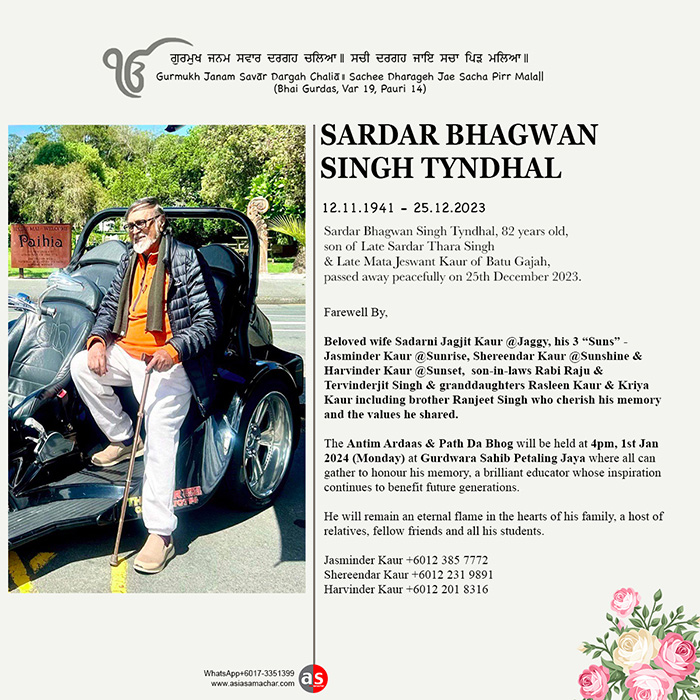
Sardar Bhagwan Singh Tyndhal, 82 years old, son of Late Sardar Thara Singh & Late Mata Jeswant Kaur of Batu Gajah, passed away peacefully on 25th December 2023.
Beloved wife Sadarni Jagjit Kaur @Jaggy, his 3 “Suns” – Jasminder Kaur @Sunrise, Shereendar Kaur @Sunshine & Harvinder Kaur @Sunset, son-in-laws Rabi Raju & Tervinderjit Singh & granddaughters Rasleen Kaur & Kriya Kaur including brother Ranjeet Singh who cherish his memory and the values he shared.
The Antim Ardaas & Path Da Bhog will be held at 4pm, 1st Jan 2024 (Monday) at Gurdwara Sahib Petaling Jaya where all can gather to honour his memory, a brilliant educator whose inspiration continues to benefit future generations.
He will remain an eternal flame in the hearts of his family, a host of relatives, fellow friends and all his students.
ASIA SAMACHAR is an online newspaper for Sikhs / Punjabis in Southeast Asia and beyond. You can leave your comments at our website, Facebook, Twitter, and Instagram. We will delete comments we deem offensive or potentially libelous. You can reach us via WhatsApp +6017-335-1399 or email: asia.samachar@gmail.com. For obituary announcements, click here
Brigadier General Jagjit Singh and wife Kiranjeet Kaur after his promotion on Dec 30, 2023
By Asia Samachar | Malaysia |
Colonel Jagjit Singh was promoted to a Brigadier General today (Dec 30), making him the senior most ranking serving Sikh in the Malaysian armed forces.
Born on 17 April 1967 in Batu Arang, Selangor, he was raised in Batang Berjuntai, now called Bestari Jaya. Jagjit’s father, Indar Singh worked as a tin miner and his mother was a homemaker to a family of 5 sons and a daughter.
From these humble beginnings, Jagjit has risen through the ranks in the armed forces. He joined the Malaysian Armed Forces on 1st October 1985 and was commissioned to the 2nd Royal Ranger Regiment.
Throughout his career, Jagjit was given opportunity to hold various key appointments. The notable ones include Directing Staff at Army School of Management, Train the Trainer at Malaysian Army Wargame Centre, Operational and Training Staff Officer at 4th Division Headquarters, Staff Officer for the Bilateral and Multilateral Exercise at Army Field Command Headquarters, Deputy Commander of Regiment 510 Territorial Army, Logistics Staff Officer at 4th Division Headquarters, Chief of Staff at the 7th Infantry Brigade Headquarters and Chief of Staff at the Army Training and Doctrine Command Headquarters.
His academic achievements are also impressive. He graduated from the Malaysian Armed Forces National Resilience College in 2023, has two Masters degrees, graduating with distinction from the Malaysian Armed Forces Defence College with a Master of Social Science (Defence Studies) in 2018 from National University of Malaysia and a Master in Management in 2005 from Universiti Malaya.
Brigadier General Jagjit Singh and wife Kiranjeet Kaur and children in a recent photo
He holds a Diploma in Psychology (Counselling) from the National University of Malaysia, a Diploma in Strategic and Defence Studies from University Malaya and an Advanced Diploma in Business and Management from University of Wales, United Kingdom.
He is also a Fellow Scholar at the National Defence University of Malaysia. He also holds various personal and service awards for his achievements.Jagjit is married to Kiranjeet Kaur, a former leading stewardess with Malaysia Airlines. Jagjit and Kiran are blessed with two sons, Harveer and Rajveer, who are both pursuing their undergraduate studies in business and law, respectively.
From amongst Sikhs serving the Malaysian army, Brigadier General Inderjit Singh was the last one-star general when he was promoted in April 2021. After his promotion, he took over as the commandant of the Army Senior Officers Institute (INSPEKA) based in Port Dickson, Negeri Sembilan. He has since retired from service.
ASIA SAMACHAR is an online newspaper for Sikhs / Punjabis in Southeast Asia and beyond. You can leave your comments at our website, Facebook, Twitter, and Instagram. We will delete comments we deem offensive or potentially libelous. You can reach us via WhatsApp +6017-335-1399 or email: asia.samachar@gmail.com. For obituary announcements, click here
Karandeep Singh appointed as Chief Health AI Officer at UC San Diego Health effective Dec 29, 2023
By Asia Samachar | Malaysia |
Karandeep Singh has been recruited as the Joan and Irwin Jacobs Endowed Chair in Digital Health Innovation at University of California San Diego School of Medicine and named as the inaugural chief health artificial intelligence (AI) officer at UC San Diego Health, a newly developed position for the region’s only academic medical center.
He began his role on Dec 29, 2023.
Karandeep will focus on implementing change that advances safety and health outcomes in acute and ambulatory settings. His contributions will be pivotal in bringing innovation to the bedside, connecting the science and discovery that arise from academic and industry partners.
He will lead organizational approaches that integrate AI into clinical workflows, reduce documentation time, improve efficiencies and patient experience, while ensuring the appropriate structure and governance are in place for successful, accountable AI deployment in health care, according to a statement at UC San Diego Health website.
“I’m thrilled to take on this new role and help build out an AI strategy that will improve the experiences of the people receiving and delivering care within our health system,” Karandeep said in the same statement.
Appointing the first chief health AI officer for UC San Diego Health enhances the Joan and Irwin Jacobs Center for Health Innovation’s (JCHI) vision to develop sophisticated and advanced solutions in health care.
“Having worked with Dr. Singh previously in our careers, I have witnessed his impressive track record and deep expertise in health care technology firsthand,” said UC San Diego vice chancellor for health sciences John M. Carethers.
“He has become a national leader in the evaluation of proprietary AI technologies, a specialist in AI governance and has actively engaged in influencing AI policy with considerable experience and impact.”
Jacobs Center for Health Innovation executive director Christopher Longhurst noted that Karandeep’s expertise and reputation for being nationally recognized in the application of AI and digital health in the clinical setting will have a strong impact in the direction of JCHI and beyond.
“He is a dedicated trailblazer, who is uniquely qualified for this new role that will meaningfully bridge the gap between human expertise and technological advancements to improve lives,” said Longhurst who is also the chief medical officer and chief digital officer at UC San Diego Health.
Founded in September 2021, JCHI was launched as a model of the University Health Network’s (UHN) Techna Institute to integrate best practices for patient and health care research. Their mission is to use AI to enhance human health and sustainability in ways that are responsible, inclusive and to empower the individuals it serves.
In early 2023, philanthropists Joan and Irwin Jacobs’ generous $22 million gift to JCHI propelled the reality of the mission control center, an AI-fueled hyper-connected hub that will use leading-edge analysis to provide the highest quality of care.
On his new appointment, Karandeep said that his focus will also include driving innovation beyond the hospital walls and expanding the health system’s reach to entire communities, industries and stretching as far as the national level.
“My goal is for UC San Diego Health to have greater representation on the national stage where AI policies are being actively shaped, and to ensure that groundbreaking research happening in AI has a path towards being implemented and evaluated with the goal of improving people’s lives and experiences.”
As a nephrologist, Karandeep also holds a master’s degree in biomedical informatics from Harvard Medical School. He achieved his medical education at the University of Michigan Medical School and completed his internal medicine residency at UCLA Medical Center.
Karandeep brings the same pioneering drive from preceding positions as associate professor of learning health sciences, internal medicine, urology, and information at the University of Michigan. He has also served as the associate chief medical information officer of artificial intelligence at Michigan Medicine.
In 2022, he participated in the first invite-only Google Health Bioethics Summit, an exclusive conference of national experts encouraged to assist Google Health develop policies and principles related to AI use in health care. He used this opportunity to advocate for transparency in Google’s approach.
His research has been cited in several policy documents, including the White House’s Blueprint for an Artificial Intelligence Bill of Rights, U.S. Department of Health and Human Services, U.S. Government Accountability Office, National Academy of Medicine, the UK Government Regulatory Horizons Council, New Zealand Ministry of Health, and in New York City’s Artificial Intelligence Strategy.
Additionally, he has published several high-impact evaluations highlighting key issues in the use of proprietary AI models.
By adding this position, UC San Diego Health joins UCSF Health and UC Davis Health, which incorporated the chief health AI officer role in their health systems in 2023.
ASIA SAMACHAR is an online newspaper for Sikhs / Punjabis in Southeast Asia and beyond. You can leave your comments at our website, Facebook, Twitter, and Instagram. We will delete comments we deem offensive or potentially libelous. You can reach us via WhatsApp +6017-335-1399 or email: asia.samachar@gmail.com. For obituary announcements, click here
525,865 people identifying as Sikh in the UK, marking a significant rise of 100,000 from the 2011 Census – Graphic: National Secular Society
By Gurnam Singh | Opinion |
In a landmark move to capture the evolving tapestry of the United Kingdom’s population, the 2021 Census has revealed intriguing insights into the Sikh community, sparking discussions on identity, representation, and future implications. The Sikh Think Tank Show on Punjab Broadcasting (Channel UK SKY775) recently delved into the outcome of the census, shedding light on the shifts within the Sikh population and addressing pertinent questions about identity.
The UK census, conducted every decade since 1801, has adapted over the years to reflect societal changes and technological advancements. Serving as a cornerstone for government planning, policy formulation, and resource allocation, the census covers a spectrum of topics, providing a detailed snapshot of the population’s composition, characteristics, and needs.
The 2021 census, embracing modern methodologies like online data collection, presented a comprehensive overview of the UK’s Sikh population. The Office of National Statistics’ data, released on December 15th for England and Wales, reported a notable increase, with 525,865 people identifying as Sikh, marking a significant rise of 100,000 from the 2011 Census.
Punjab Broadcasting Channel brought together a distinguished panel to delve deeper into the census findings:
Dr Jasdev Singh Rai: A medical doctor, human rights activist, writer, and founder of the Sikh Human Rights Group.
Bhai Jagdev Singh Virdee, MBE: Editor of the Sikh Report and a statistician with extensive experience in policy development.
Dabinderjit Singh, OBE: Spokesman for the SFUK and former Cabinet Office employee.
Jagdev Singh offered his expert review of the data, which he confirmed provided a pretty accurate picture. He highlighted that 426,230 identified as Sikh through the religion question alone, while 1,725 chose the ethnic group question, and 97,910 responded to both questions (religion and ethnicity).
Sikhs exhibited higher home ownership rates, with 30% living in multi-family or multi-generational households, compared to the national average of 11%. Marriage rates were higher among Sikhs, with 61% married compared to the national average of 44.4% and 63.9% of Panjabi speakers identified as Sikh.
CHALLENGES AND ADVOCACY: THE SIKH IDENTITY QUESTION
The discussion addressed the challenges faced by the Sikh community in the census, particularly regarding the campaign for a separate Sikh ethnicity box. Dabinderjit Singh highlighted concerns that the lack of a distinct box may have resulted in a significant undercount of Sikhs, potentially as much as 400,000.
Dr. Jasdev Singh Rai advocated for a novel approach, introducing the concept of “Qaum” – a non-territorial community distinct from nation or nation-state identity. Drawing from the UN World Conference against Racism in 2001, the proposal aimed to ensure recognition of distinct cultural identities without implying a right to nationhood.
The expert panel discussed the potential implications of the census data for the Sikh community, emphasizing the need for accurate representation in policy formulation. Dabinderjit Singh argued that the methodology massively undercounts the Sikh population. He also highlighted the importance of ensuring all Sikhs are counted and the role of the census in addressing the needs and concerns of Sikhs, particularly in terms of public services and support.
FUTURE CHALLENGES: SECULARISM AND COUNTING SIKHS IN 2031
Show host Gurnam Singh directed questions towards the future, considering secular trends and the challenge of counting Sikhs in 2031. The panel engaged in thoughtful discussions on ensuring the accurate representation of Sikhs beyond religious categorizations.
In summary, the discussion provided a platform for a nuanced exploration of the census data, identity challenges, and the path forward for the Sikh community in the UK. As the Sikh nation evolves, the insights gained from the 2021 census serve as a crucial guide for policymakers and advocates alike.
Gurnam Singh is an academic activist dedicated to human rights, liberty, equality, social and environmental justice. He is an Associate Professor of Sociology at University of Warwick, UK. He can be contacted at Gurnam.singh.1@warwick.ac.uk
* This is the opinion of the writer and does not necessarily represent the views of Asia Samachar.
ASIA SAMACHAR is an online newspaper for Sikhs / Punjabis in Southeast Asia and beyond. You can leave your comments at our website, Facebook, Twitter, and Instagram. We will delete comments we deem offensive or potentially libelous. You can reach us via WhatsApp +6017-335-1399 or email: asia.samachar@gmail.com. For obituary announcements, click here
Guru Gobind Singh Ji embarked on his journey from Anandpur Sahib with approximately 400 Sikhs in tow. Let us picture this: they were accompanied by livestock, horses, provisions, tents, and clothing. Their destination was Chamkaur, a town south of Ropar district, off present-day Chandigarh, situated on the other side of the Sarsa River, where Guru Ji had a well-to-do associate. This associate had constructed a mud fort atop elevated terrain.
Guru Ji faced a treacherous assault from the unfaithful Mughals and Hill Rajas, involving around 1,000 highly trained soldiers. The aftermath of this attack brought unimaginable pain to Guru Ji, as it led to the heartbreaking separation of his family and dwindled the once-thriving community of beloved Sikhs to just a handful. Despite putting up a valiant resistance, even Guru Ji’s close associates who were his generals, lost their lives in the tragic encounter. Two strong henchmen of Guru Ji were Udai Singh and Bachittar Singh.
In this very month of December in 1704, the followers of Guru Ji faced a tragic disorientation as they crossed the 400-meter-wide River Sarsa, leading to a breakdown in communication. In the midst of chaos, there arose a crucial necessity to protect precious materials and manuscripts during the intense warfare, which unfortunately got washed away. Complicating matters, the turbulent river, usually dry, was further challenged by heavy rainfall in the hills, creating a stormy, thunderous, pitch-dark environment on the other side. This situation presented the most severe imaginable circumstances, requiring unparalleled resilience and survival instincts from our Sikh forefathers.
Upon reaching the opposite bank, Guru Ji found himself accompanied by his two elder sons, Ajit Singh and Jujhar Singh, the initial five beloved ones (5 Pyare) who were the first initiated by Guru Ji, and an additional thirty-five Sikhs, totaling 43 individuals out of the original group of about 400.
Bhai Bachittar Singh, a devotee and a skilled General of Guru Ji who hailed from Multan (now in Pakistan), sustained severe injuries defending at Sarsa. This prompted Guru Ji to instruct Sahibzada Ajit Singh to take him to Ropar, some 23km away, where the Guru Ji family’s close associate Nihang Khan, a Muslim, resided. Later, Guru Ji made a brief visit to bless Bachittar Singh and asked Nihang Khan to care for his injured companion. News reached Guru ji that approximately a thousand Mughal troops were advancing from Sirhind, with another troop contingent crossing the River Sarsa. Their sole intentions were to capture and eliminate Guru Gobind Singh, our 10th Master Guru. It’s worth noting how Guru Ji formed close bonds with Muslim families, while on the other side, the Mughals plotting his demise were also Muslims. Readers will find a clearer depiction in my upcoming article.
Setting out at midnight, Guru Ji united with his Sikhs, instructed to head towards Chamkaur, around 16 kilometers from Nihang Khan’s residence. Tragically, Bhai Bachittar Singh passed away shortly after Guru Ji’s departure.
Despite having devoted followers, Guru Ji also faced the challenge of paid informers of the Mughals, divulging his whereabouts.
Under the rule of the Mughal Empire, Wazir Khan, the governor of Sirhind, presided over the region stretching from the Sutlej in eastern Punjab to the Yamuna rivers, the second-largest tributary of the Ganges by discharge and the longest tributary in India located in Uttar Pradesh. The Mughals, under Wazir Khan’s leadership, steadfastly worked to locate Guru Ji.
The bloody battle of Chamkaur, December 22, 1704
Realizing his precarious situation, Guru Gobind Singh found himself surrounded by enemies both in front and behind, with opposition from hill states to his left. Hastily, they moved towards Chamkaur. There was an imminent threat of the enemy’s proximity.
Opting for a mud-built, double-storeyed house with a spacious compound, provided by his devotee, the Guru and his followers quickly sought refuge. This event transpired on the evening of December 21, 1704, while the enemy commenced their siege on the morning of December 22, 1704.
Guru Ji found himself encircled by a formidable cavalry, complete with artillery. Although the house faced the looming danger of destruction, being made of mud, the enemy’s foremost goal was to seize the Guru alive. Their intentions mirrored historical incidents like the fate of Shivaji’s son Shambhuji earlier or Banda Bahadur’s 11 years later, both subjected to a brutal demise with a limb severed each day. This exemplifies the ruthless nature of the Mughals at their core.
Guru Ji, with an extraordinary divine intellectual assembly, engaged in discussions with his approximately 40 Sikhs, encouraging them to resist and confront the adversary despite the clear awareness of an impending defeat. Utilizing his divine abilities, Guru Ji metaphorically transformed each accompanying Sikh, endowing them with powers equivalent to 125,000 individuals (Sawa Lakh in Punjabi).
Guru Ji’s eldest son, Sahibzada Ajit Singh, aged 18 at the time, sought permission and received blessings from Guru Ji to leave the mud house and confront the enemy. Despite knowing that his son might not return from the battlefield, Guru Ji embraced him and bestowed his blessings. At that moment, every Sikh with Guru Ji became like his own children.
Guru Ji, employing strategic planning, dispatched five of his men simultaneously. The powerful and coordinated exit from the mud base of these five warriors resulted in the swift encounter bringing hundreds of enemy forces to ground. They fought with unparalleled ferocity and bravery. They defended relentlessly until exhaustion took a toll on them physically and mentally, yet their emotional charge endured until they fell, never to rise again.
Guru Ji on the other hand, maneuvered skillfully the bow and arrow with delicate orchestration and precision, with controlled strength of movements. He released each arrow in a practiced finesse, combining accuracy, timing, and a nuanced understanding of the projectile’s trajectory who were bent to capture him.
It is worth noting that each of Guru Ji’s arrows had a tip crafted from gold. In the unfortunate event of the enemy succumbing to the arrow’s strike, the kin could potentially sustain themselves by selling the gold piece.
In this fashion, five were dispatched each time. Witnessing his elder brother succumbing to death, Sahibzada Zorawar Singh, 13 years old, stood up to seek his father’s blessings. Guru Ji, once again, bestowed his blessings, embraced him, and sent him on his way to battlefield. He, too, like his elder brother, brought hundreds to ground till he was killed. Despite the formidable Mughal forces, comprised mostly of Afghan Muslims and locals with modest wages, Guru Ji found himself with only five remaining Sikhs.
These disciples — Daya Singh, Dharam Singh, Man Singh, Sangat Singh, and Sant Singh — gathered, discussing a plan reminiscent of Anandpur’s past events. Interrupting Guru Ji’s contemplation on destiny’s twists, they asserted themselves as the Gurus, designating him a Khalsa. They ordered his escape for the Panth’s sake. Daya Singh, Dharam Singh (remaining 2 of the 5 Pyare), and Man Singh would accompany him, while Sant Singh and Sangat Singh remained to continue the fight. Sant Singh, resembling the Guru, took his place.
Adhering to the wartime tradition of at sunset all warfare would cease. The soldiers were resting and having their meals and after the camp fire was set off, Guru Ji and his companions, disguised as Mughal soldiers, left the mud fortress under the cover of peach darkness. While escaping, Guru Ji, clapping and declaring, “Come catch me, I am Gobind Singh,” managed to elude pursuit, leaving Chamkor with a heavy heart.
Sangat Singh and sant Singh were killed and the report of Guru ji’s escape was sent to Wazir Khan. This engered him and he caused tremendous torture to Guru ji’s younger two Sahibzadas and ultimately killing them. Please go to The Sikh December Blues.
Story to continue… ● What happens to Guru Ji after 22nd Dec? ● Where did Guru ji’s wife went to? ● How and why Guru Gobind Singh had close association with Muslim who helped him while the Moguls were themselves Muslims?
Reference:
Guru ji’s writing to Aurengzeb translated: The battle was fought on December 22, 1704.
Guru Gobind Singh has referred this event in Chamkor by himself in his first letter addressed later to Aurangzeb called Zafarnama. Quotes are from line 19-41)
“What could forty hungry men do when attacked by a numerous horde unawares? The oath-breakers suddenly attacked us with swords, arrows and muskets. I was forced to engage in the combat and 1 fought with arrows and muskets. When an affair passes beyond all remedy, it is lawful to resort to the sword . . . Clad in black like a fly, they made a sudden charge. Every soldier who advanced from behind the wall, was struck by an arrow and fell deluged in blood. Those who did not leave the wall, received no injuries and suffered no loss. When I saw that Nahar had come out to fight, I instantly struck him with an arrow. Instead of fighting he fled away. Many other Khans eschewed their idle boast. Then another Afghan appeared in the field like a strong current and in the manner of an arrow or a bullet. A number of them made a valorous assault, some with care and others in madness. Many of attackers were wounded, and two of them lay dead. The despicable Khwaja had not the courage to leave the shelter of the wall and come into the open. Alas, had I seen his face, I would have unhesitatingly bestowed an arrow on him. On both sides many lost their lives and sustained wounds by arrows and muskets. Arrows and bullets were discharged like fireworks, and the earth turned red like tulip. Heads and legs lay in heaps as if the playground was littered with balls and sticks. The arrows whizzed, and the bows twanged, and great tumult rose in the world. The great noise was so frightful that even the mightiest warrior lost his wits. But how could forty even of the bravest succeed when opposed by a countless body?”
ASIA SAMACHAR is an online newspaper for Sikhs / Punjabis in Southeast Asia and beyond. You can leave your comments at our website, Facebook, Twitter, and Instagram. We will delete comments we deem offensive or potentially libelous. You can reach us via WhatsApp +6017-335-1399 or email: asia.samachar@gmail.com. For obituary announcements, click here
Sadden to inform the passing of Tarlachon Singh s/o Lall Singh
Parents: Late Lall Singh & Late Sarjeet Kaur
Wife: Late Deb Kaur
Son: Balraaj Singh
Daughter-in-Law: Dharam Preet Kaur
Grandsons: Anish Singh, Jaidave Singh Thind
PATH DA BHOG 6 January 2024 (Saturday), 10 am to 12pm
Contact: Balraaj Singh 019 555 5564
| Entry: 27 Dec 2023 | Source: Family
ASIA SAMACHAR is an online newspaper for Sikhs / Punjabis in Southeast Asia and beyond. You can leave your comments at our website, Facebook, Twitter, and Instagram. We will delete comments we deem offensive or potentially libelous. You can reach us via WhatsApp +6017-335-1399 or email: asia.samachar@gmail.com. For obituary announcements, click here