Satwinder Kaur (left) and Sharn Shoker joins the Kent City Council leadership on jan 6, 2026, after winning in the council elections in November 2025 – Photo: Kent City Council
By Asia Samachar | United States |
Sharn Shoker and Satwinder Kaur marked a new chapter in Kent City Council leadership as they were sworn in as councilmember and council president respectively, alongside the start of a new term for Mayor Dana Ralph.
The swearing-in ceremony was held on Jan 6, following the city council elections conducted in November 2025.
Kent, the fourth-most populous city in the greater Seattle area, recorded a population of 136,588 in the 2020 census and remains a key urban centre within the Seattle metropolitan region.
Shoker, who grew up in Kent and continues to raise her family in the city, described the moment as deeply personal.
“Kent has always been home to me,” she shared, noting her commitment to giving back to the community that shaped her.
She holds a master’s degree in policy studies from the University of Washington and brings experience in nonprofit leadership and public policy to the council. Shoker currently serves on the boards of the Randhawa Foundation and the Kent Schools Foundation.
“I support policies that uplift working families, strengthen small businesses, protect our environment, and invest in public safety and community well-being,” she said on a note on the council website.
Council president Satwinder Kaur, whose current term runs until Dec 31, 2029, is a lifelong Kent resident and a graduate of Kentridge High School. She and her husband are raising their four children, including a newborn, in the city.
First elected to the Kent City Council in 2018, Satwinder was chosen by her peers to serve as council president in 2024 and has now been reaffirmed in the leadership role. She holds associate’s, bachelor’s and MBA degrees from the University of Washington, is certified in Six Sigma and Lean Management, and works in the IT sector.
ASIA SAMACHAR is an online newspaper for Sikhs / Punjabis in Southeast Asia and beyond. You can leave your comments at our website, Facebook, Twitter, and Instagram. We will delete comments we deem offensive or potentially libelous. You can reach us via WhatsApp +6017-335-1399 or email: asia.samachar@gmail.com. For obituary announcements, click here
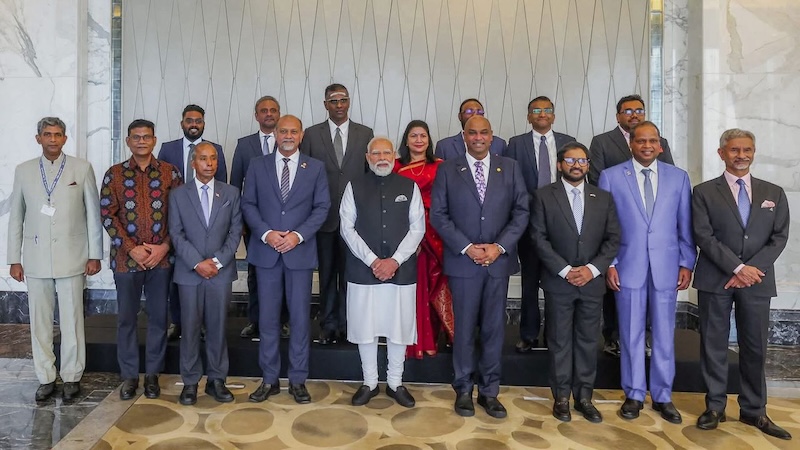
PM Narendra Modi (middle) flanked by Malaysian federal ministers Gobind Singh Deo (4th from left) and R Ramanan (4th from right) at a closed door meeting – Photo: Gobind Singh Deo Facebook
The engagement underscored the close ties between India and Malaysia, as well as the enduring people-to-people connections rooted in shared heritage.
Malaysian federal minister Gobind Singh Deo described the meeting as a meaningful exchange, noting that it reflected the strength of bilateral relations and the pride of common roots.
“A meaningful reminder of how our shared heritage and collaboration continue to strengthen bilateral relations and deepen people-to-people bonds,” he shared on his social media.
Those present included federal minister Ramanan Ramakrishnan, deputy minister M Kulasegaran, Batu MP Prabakaran Parameswaran and Senator Saraswathy Kandasami.
On the Indian side, External Affairs Minister S Jaishankar and India’s High Commissioner to Malaysia B N Reddy also participated in the meeting.
ASIA SAMACHAR is an online newspaper for Sikhs / Punjabis in Southeast Asia and beyond. You can leave your comments at our website, Facebook, Twitter, and Instagram. We will delete comments we deem offensive or potentially libelous. You can reach us via WhatsApp +6017-335-1399 or email: asia.samachar@gmail.com. For obituary announcements, click here
ASIA SAMACHAR is an online newspaper for Sikhs / Punjabis in Southeast Asia and beyond. You can leave your comments at our website, Facebook, Twitter, and Instagram. We will delete comments we deem offensive or potentially libelous. You can reach us via WhatsApp +6017-335-1399 or email: asia.samachar@gmail.com. For obituary announcements, click here
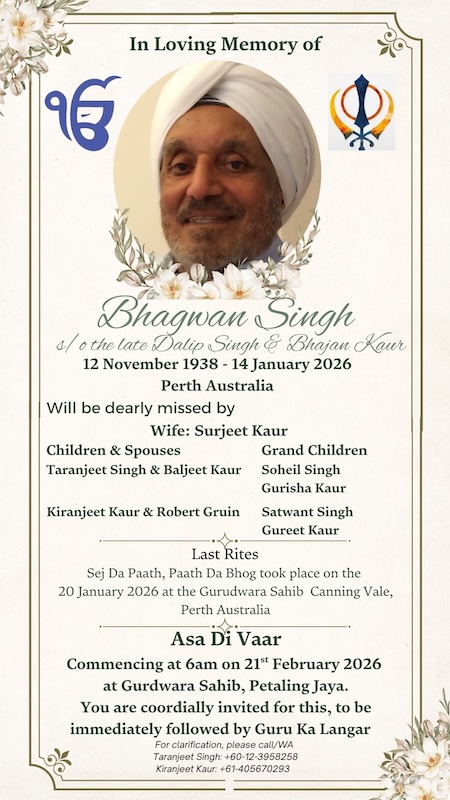
Children: Late Ishvinderjit Kaur Ashvinderjit Kaur Keshvinderjit Singh
FUNERAL SERVICE: February 17, 2026 | at 11:45am West Chapel, Fremantle Cemetery, Carrington St
PATH DA BHOG & ANTIM ARDAS: February 17, 2026 | at 2:00pm Sikh association of Western Australia, Canningvale Gurdwara Guru ka langar (vegetarian meal) will be served after the prayers
For directions please call Avvhi at +61 452 418 320
| Entry: 8 February 2026; Updated 11 February 2026 | Source: Family
ASIA SAMACHAR is an online newspaper for Sikhs / Punjabis in Southeast Asia and beyond. You can leave your comments at our website, Facebook, Twitter, and Instagram. We will delete comments we deem offensive or potentially libelous. You can reach us via WhatsApp +6017-335-1399 or email: asia.samachar@gmail.com. For obituary announcements, click here
Negeri Sembilan will host the Maspore Games 2026 from Aug 13 to 15, with the tournament set to take place in Sendayan.
The three-day Sikh inter-club games will be hosted by the N9 Sikhs Sports Club.
A scene from Maspore 2024
The sporting event that brings together Sikh sports clubs from Malaysia and Singapore, serving as a platform to promote sportsmanship, unity and youth engagement within the Sikh community.
The tournament has grown significantly since its inception in 2014 in Ipoh, Perak, where it began with just a single sport. This year, it will feature 13 sports, its largest lineup to date.
In the 2025 edition, the games were held over three days and saw seven clubs competing across a wide range of sports, including football, hockey, badminton, netball, pool, darts, bowling, pickleball and volleyball.
ASIA SAMACHAR is an online newspaper for Sikhs / Punjabis in Southeast Asia and beyond. You can leave your comments at our website, Facebook, Twitter, and Instagram. We will delete comments we deem offensive or potentially libelous. You can reach us via WhatsApp +6017-335-1399 or email: asia.samachar@gmail.com. For obituary announcements, click here
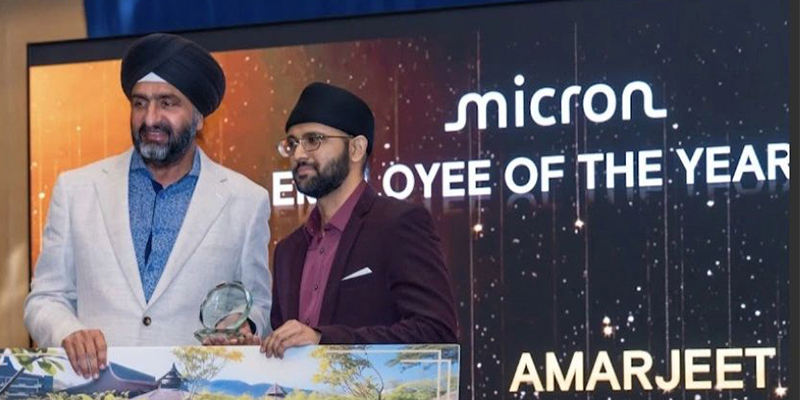
Amarjeet Singh Dhillon (right) receiving Employee of the Year 2025 prize from Micron Technology country manager Amarjit Singh Sandhu – Photo: Personal LinkedIn
By Asia Samachar | Malaysia |
“It is truly an honor to stand here today as Micron’s Employee of the Year. I accept this recognition with deep gratitude. My journey with Micron began in 2020 as a new college graduate, at a time when many of us walked into an empty production floor as part of the site start-up team. Together, we transformed that empty space into the world-class operation it is today. This achievement reflects not just growth in scale, but growth in people, capability, and shared purpose.” – Amarjeet Singh Dhillon, the lead senior test equipment engineer at Micron Technology. He received the award from company’s corporate vice president and country manager for Malaysia Amarjit Singh Sandhu (left).
(This is a random selection from LinkedIn updates, highlighting the wide range of activities, initiatives, and projects undertaken by Sikhs across their professional, community and personal pursuits. If you see something worth highlighting, please drop us a note on our LinkedIn)
ASIA SAMACHAR is an online newspaper for Sikhs / Punjabis in Southeast Asia and beyond. You can leave your comments at our website, Facebook, Twitter, and Instagram. We will delete comments we deem offensive or potentially libelous. You can reach us via WhatsApp +6017-335-1399 or email: asia.samachar@gmail.com. For obituary announcements, click here
ASIA SAMACHAR is an online newspaper for Sikhs / Punjabis in Southeast Asia and beyond. You can leave your comments at our website, Facebook, Twitter, and Instagram. We will delete comments we deem offensive or potentially libelous. You can reach us via WhatsApp +6017-335-1399 or email: asia.samachar@gmail.com. For obituary announcements, click here
Abhishek Banerjee in ‘Ankahi Kahaniya’. Photo courtesy Netflix
By Raag & Reel | Movie Review |
Ankahi Kahaniya (2021) is an anthology of three short films that explore unconventional love stories: a man who falls in love with a mannequin, a romance unfolding in the era of single-screen cinemas, and the strained relationship of an urban couple on the brink of collapse.
I begin with the story that touched me most. Directed by Ashwiny Iyer Tiwari, it follows a lonely man in Mumbai. His life is repetitive, his emotions bottled. He finds solace in a mannequin. Strange at first, but deeply human. I felt his isolation, his quiet desperation. The tale justified that a human will always find a way to express his emotions, even if the outlet seems unusual. It was tender, unsettling, and honest. I saw how silence can become a companion. For me, this was the strongest of the three.
The second story, directed by Abhishek Chaubey, carried me into the 1980s. Two young adults meet in a cinema hall. They are stuck in lives that feel too small, yet they dream of something bigger. Their bond grows in stolen moments, in shared glances, in whispered hopes. I admired the period detail, the posters, the atmosphere, the innocence of their connection. It felt nostalgic, yet raw. I recognised their longing, their hunger for freedom. This tale was the second strongest, a bittersweet reminder of how dreams can collide with reality.
The third story, directed by Saket Chaudhary, explored adultery. A husband and wife, both dissatisfied, both searching outside their marriage. It raised questions of fidelity, honesty, and the cost of betrayal. Yet it felt more like a moral lesson than a lived experience. I watched the characters, but I did not feel them. The emotions seemed distant, the resolution too neat. Compared to the other two, it lacked depth.
Together, these three tales form Ankahi Kahaniya. Uneven, yes, but still worth watching. I walked away thinking of loneliness, dreams, and choices. The anthology reminded me that silence often hides the loudest truths.
ASIA SAMACHAR is an online newspaper for Sikhs / Punjabis in Southeast Asia and beyond. You can leave your comments at our website, Facebook, Twitter, and Instagram. We will delete comments we deem offensive or potentially libelous. You can reach us via WhatsApp +6017-335-1399 or email: asia.samachar@gmail.com. For obituary announcements, click here
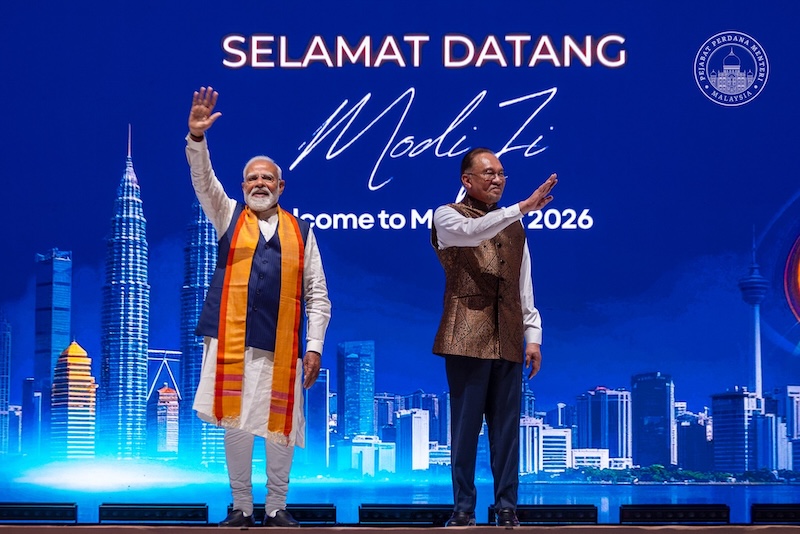
Anwar and Modi at a community event at the at the Mines International Exhibition & Convention Centre in Kuala Lumpur on February 7, 2026, during the Indian PM’s two-day visit to Malaysia – Photo: JPM
By Asia Samachar | Malaysia |
From teh tarik to roti canai, the everyday sights and tastes familiar to Malaysians became a centrepiece of Indian Prime Minister Narendra Modi’s message on deep-rooted people-to-people ties during a Malaysian Indian community event on Saturday night (Feb 7).
Addressing more than 10,000 people at the Mines International Exhibition and Convention Centre, Modi highlighted how centuries of interaction across the Indian Ocean had woven Indian culture into Malaysia’s social fabric.
In a light-hearted moment that drew laughter and applause, he pointed to shared culinary traditions.
“You have connected the roti canai with the Malabar parotha. Coconut, spices, and, of course, the tarik. The flavor feels so familiar, whether it is in Kuala Lumpur or Kochin. We understand each other so well. It must be due to the large number of common words between our languages and Malay,” he said.
Modi made mention of the various races from came from the Indian subcontinent to Malaysia, including the Sikhs.
“We also deeply cherish the cultural connections with our Sikh brothers who live here. We have carried the teachings off Guru Nanak Dev ji by promoting Naam Japo, Kirat Karo, Wand chakko,” he said.
On Tamil, he said: “Tamil literature is eternal, Tamil culture is global.”
Modi also referred to the diverse communities from the Indian subcontinent that had made Malaysia their home, including the Sikhs.
“We also deeply cherish the cultural connections with our Sikh brothers who live here. We have carried the teachings off Guru Nanak Dev ji by promoting Naam Japo, Kirat Karo, Wand chakko,” he said.
Speaking on the Tamil heritage, Modi said: “Tamil literature is eternal, and Tamil culture is global.”
Modi also joked about Malaysian PM Anwar Ibrahim’s fondness for Indian music, recalling how videos of Anwar singing Hindi songs during an earlier visit to India went viral, while also acknowledging the Malaysian leader’s appreciation for Tamil classics. The exchange underscored the informal warmth between the two leaders, alongside the formal agenda of the visit.
Describing Malaysia as a close and trusted partner, Modi said bilateral relations were scaling new heights each year, driven by strong people-to-people ties and expanding strategic cooperation. He described Malaysia’s Indian-origin community — the world’s second-largest — as a “living bridge” linking the histories, traditions and aspirations of both nations.
“You are a living bridge that links us,” he said, praising the community for preserving its languages, customs and values over generations through schools, religious institutions and cultural celebrations. These efforts, he added, strengthened the foundation for diplomatic and economic relations.
Anwar, in his remarks, reflected on growing up alongside Malaysians of Indian heritage — neighbours, teachers and colleagues — and described the community as an inseparable part of Malaysia’s national story.
He said nations were built not only through policies, but through shared lives in classrooms and workplaces, noting Indian influences on Malaysian cinema, cuisine and festivals such as Deepavali and Thaipusam.
Modi arrived earlier on Saturday for a two-day official visit, his first since Malaysia and India elevated ties to a Comprehensive Strategic Partnership. The two leaders are expected to hold bilateral talks on Sunday covering trade, investment, defence, education, tourism and regional issues, with several agreements anticipated.
ASIA SAMACHAR is an online newspaper for Sikhs / Punjabis in Southeast Asia and beyond. You can leave your comments at our website, Facebook, Twitter, and Instagram. We will delete comments we deem offensive or potentially libelous. You can reach us via WhatsApp +6017-335-1399 or email: asia.samachar@gmail.com. For obituary announcements, click here
In this piece I want to explore some of the similarities and differences between Sikhi, Vedanta and Sufism, which are often subtle yet profound. While cultural expressions, such as dress, diet, language, ritual, and social practices, can make these traditions appear distinct, such differences frequently emerge from history and culture rather than theology or philosophy. At the same time, some cultural practices do indeed have theological origins, as seen for example in ritual sacrifice within Islamic and Sanātan traditions and rituals that Sikhi explicitly rejects, despite their continued presence in certain sects that self-identify as Sikh.
There is no doubt that concepts from both Vedantic thought and Sufi Islam appear in Sikh writings. This is unsurprising, given the context in which Sikhi emerged in the 15th century, where the languages available to the Gurus, as well as those used by the Bhagats, reflected these diverse and dominant traditions. However, this does not imply, as is often suggested in many texts appearing in the 20th Century, that Sikhi is merely a blend of Hinduism and Islam. Considering that both of these great traditions encompass numerous internal divisions in doctrine and theology, such a claim is not only inaccurate but also deeply misleading.
Comparative Analysis
Today, partly in response to the misrepresentation of Sikhi, both in terms of its teachings and even in the labelling of it as a religion called “Sikhism”, there is a growing trend among young Sikh scholars to engage in philosophical discussions about Sikhi in an open, informed, and thoughtful manner. There are multiple ways to study a belief tradition such as Sikhi. Some choose to make deep dives into Sikh scripture and literature whilst others prefer to take a broader approach by situating Sikhi within time and space. One approach is to examine its internal dynamics and logic, exploring its teachings, practices, and values on their own terms. This allows us to understand how its concepts, such as meditation, ethical living, and devotion to Waheguru, fit together coherently and guide the lives of its adherents.
Another approach is comparative: analysing the tradition in relation to other religions or philosophies to identify similarities, differences, and historical influences. Such comparisons can reveal what is distinctive about Sikhi, how it has interacted with broader cultural and religious currents, and how its ethical and spiritual ideals resonate with or diverge from those of other traditions. Both approaches are complementary: internal study illuminates the tradition from within, while comparative study situates it within a wider landscape, together providing a richer, multidimensional understanding.
In engaging in a comparative examination of Sikhi in relation to Vedanta and Sufism, what becomes clear is that each of these traditions is vast and deeply complex. Though all the great spiritual traditions share common concerns of love, devotion, humility, and the yearning for the Divine, one needs to go below the surface to understand the deeper differences in how these principles are understood and embodied in spiritual life, ethics, and community.
Sikhi and Vedanta
It is here that Sikhi stands apart, sometimes radically so. Unlike Vedanta, most critically, Sikhi affirms the physical world, or Kudrat, as both real and spiritually significant. This is precisely what Guru Nanak argues in the following Shabad:
ਸਲੋਕੁ ਮਃ ੧ ॥ Shalok, First Mehla:
ਸਚੇ ਤੇਰੇ ਖੰਡ ਸਚੇ ਬ੍ਰਹਮੰਡ ॥ਸਚੇ ਤੇਰੇ ਲੋਅ ਸਚੇ ਆਕਾਰ ॥ True are Your worlds, True are Your solar Systems. True are Your realms, True is Your creation.
ਸਚੇ ਤੇਰੇ ਕਰਣੇ ਸਰਬ ਬੀਚਾਰ ॥ਸਚਾ ਤੇਰਾ ਅਮਰੁ ਸਚਾ ਦੀਬਾਣੁ ॥ True are Your actions, and all Your deliberations. True is Your Command, and True is Your Court.
ਸਚਾ ਤੇਰਾ ਹੁਕਮੁ ਸਚਾ ਫੁਰਮਾਣੁ ॥ਸਚਾ ਤੇਰਾ ਕਰਮੁ ਸਚਾ ਨੀਸਾਣੁ ॥ True is the Command of Your Will, True is Your Order. True is Your Mercy, True is Your Insignia.
ਸਚੇ ਤੁਧੁ ਆਖਹਿ ਲਖ ਕਰੋੜਿ ॥ਸਚੈ ਸਭਿ ਤਾਣਿ ਸਚੈ ਸਭਿ ਜੋਰਿ ॥ Hundreds of thousands and millions call You True. In the True Lord is all power, in the True Lord is all might.
ਸਚੀ ਤੇਰੀ ਸਿਫਤਿ ਸਚੀ ਸਾਲਾਹ ॥ਸਚੀ ਤੇਰੀ ਕੁਦਰਤਿ ਸਚੇ ਪਾਤਿਸਾਹ ॥ True is Your Praise, True is Your Adoration. True is Your creation, True King.
ਨਾਨਕ ਸਚੁ ਧਿਆਇਨਿ ਸਚੁ ॥ਜੋ ਮਰਿ ਜੰਮੇ ਸੁ ਕਚੁ ਨਿਕਚੁ ॥੧॥ O Nanak, true are those who meditate on the True One. Those who are subject to birth and death are totally false. ||1||
From this shabad, it follows that enlightenment or liberation is not something to be found by escaping the world; it is something to be realised within it. The world is not an illusion, nor is it a distraction from the Divine. It is the sargun manifestation of Kartar, the Creative Being, and the very arena in which spiritual life must be lived and expressed.
One way to grasp the theological difference is in a simple turn of phrase. Vedanta teaches that the soul realises it was always God. Sikhi, by contrast, teaches that the soul realises it belongs to God. As Guru Nanak states:
ਸਾਗਰ ਮਹਿ ਬੂੰਦ ਬੂੰਦ ਮਹਿ ਸਾਗਰੁ ਕਵਣੁ ਬੁਝੈ ਬਿਧਿ ਜਾਣੈ ॥ “The drop is in the ocean, and the ocean is in the drop. Who understands this? Who knows the way?”
There are many interpretations of this line, but for me Nanak is saying, just like a drop taken from the ocean, the soul shares the essence of the Divine, but it retains its own distinct identity, shape and properties. – both are the same, but both have their own nature. This distinction might seem subtle, but it transforms everything our ethics, our worship, our humility, and the way we live in community and ultimately the path to liberation.
Historically, this distinction shaped the vision of the Sikh Gurus. They rejected world-denying asceticism and abstract metaphysical speculation. Instead, they built enduring institutions like the Langar, the Sangat, and organised forms of Seva. Sikh scripture sometimes critiques yogis and renunciants, not because they lacked sincerity, but because non-dual metaphysics, if misunderstood, can quietly erode the moral urgency of engaged spiritual life. For the Sikh Gurus, spirituality was inseparable from ethical action and social responsibility.
One of the methods for liberation according to Vedanta’s, is Yoga, which literally means ‘connection’. Sikhi largely rejects the many/most ritualistic aspects of Yoga and presents the true ‘Yogi’ as someone that has managed to remain detracted whilst living in ‘grist jeevan’, i.e. a social family and community orientated life. There is a beautiful shabad from Guru Nanak that perfectly captures this key aspect of Sikhi.
ਸੂਹੀ ਮਹਲਾ ੧ ਘਰੁ ੭ ੴ ਸਤਿਗੁਰ ਪ੍ਰਸਾਦਿ ॥ Soohee, First Mehla, Seventh House: One Universal Creator God. By The Grace Of The True Guru:
ਜੋਗੁ ਨ ਖਿੰਥਾ ਜੋਗੁ ਨ ਡੰਡੈ ਜੋਗੁ ਨ ਭਸਮ ਚੜਾਈਐ ॥ਜੋਗੁ ਨ ਮੁੰਦੀ ਮੂੰਡਿ ਮੁਡਾਇਐ ਜੋਗੁ ਨ ਸਿੰਙੀ ਵਾਈਐ ॥ Yoga is not the patched coat, Yoga is not the walking stick. Yoga is not smearing the body with ashes. Yoga is not the ear-rings, and not the shaven head. Yoga is not the blowing of the horn.
ਅੰਜਨ ਮਾਹਿ ਨਿਰੰਜਨਿ ਰਹੀਐ ਜੋਗ ਜੁਗਤਿ ਇਵ ਪਾਈਐ ॥੧॥ਗਲੀ ਜੋਗੁ ਨ ਹੋਈ ॥ਏਕ ਦ੍ਰਿਸਟਿ ਕਰਿ ਸਮਸਰਿ ਜਾਣੈ ਜੋਗੀ ਕਹੀਐ ਸੋਈ ॥੧॥ ਰਹਾਉ ॥ Remaining unblemished in the midst of the filth of the world – this is the way to attain Yoga. ||1|| By mere words, Yoga is not attained. One who looks upon all with a single eye and knows them to be one and the same – he alone is known as a Yogi. ||1||Pause||
ਜੋਗੁ ਨ ਬਾਹਰਿ ਮੜੀ ਮਸਾਣੀ ਜੋਗੁ ਨ ਤਾੜੀ ਲਾਈਐ ॥ਜੋਗੁ ਨ ਦੇਸਿ ਦਿਸੰਤਰਿ ਭਵਿਐ ਜੋਗੁ ਨ ਤੀਰਥਿ ਨਾਈਐ ॥ਅੰਜਨ ਮਾਹਿ ਨਿਰੰਜਨਿ ਰਹੀਐ ਜੋਗ ਜੁਗਤਿ ਇਵ ਪਾਈਐ ॥੨॥ Yoga is not wandering to the tombs of the dead; Yoga is not sitting in trances. Yoga is not wandering through foreign lands; Yoga is not bathing at sacred shrines of pilgrimage. Remaining unblemished in the midst of the filth of the world – this is the way to attain Yoga. ||2||
ਸਤਿਗੁਰੁ ਭੇਟੈ ਤਾ ਸਹਸਾ ਤੂਟੈ ਧਾਵਤੁ ਵਰਜਿ ਰਹਾਈਐ ॥ਨਿਝਰੁ ਝਰੈ ਸਹਜ ਧੁਨਿ ਲਾਗੈ ਘਰ ਹੀ ਪਰਚਾ ਪਾਈਐ ॥ਅੰਜਨ ਮਾਹਿ ਨਿਰੰਜਨਿ ਰਹੀਐ ਜੋਗ ਜੁਗਤਿ ਇਵ ਪਾਈਐ ॥੩॥ Meeting with the True Guru, doubt is dispelled, and the wandering mind is restrained. Nectar rains down, celestial music resounds, and deep within, wisdom is obtained. Remaining unblemished in the midst of the filth of the world – this is the way to attain Yoga. ||3||
ਨਾਨਕ ਜੀਵਤਿਆ ਮਰਿ ਰਹੀਐ ਐਸਾ ਜੋਗੁ ਕਮਾਈਐ ॥ਵਾਜੇ ਬਾਝਹੁ ਸਿੰਙੀ ਵਾਜੈ ਤਉ ਨਿਰਭਉ ਪਦੁ ਪਾਈਐ ॥ਅੰਜਨ ਮਾਹਿ ਨਿਰੰਜਨਿ ਰਹੀਐ ਜੋਗ ਜੁਗਤਿ ਤਉ ਪਾਈਐ ॥੪॥੧॥੮॥ O Nanak, remain dead while yet alive – practice such a Yoga. When the horn is blown without being blown, then you shall attain the state of fearless dignity. Remaining unblemished in the midst of the filth of the world – this is the way to attain Yoga. ||4||1||8||
Sikhi and Sufism
The comparison with Sufism is also illuminating. Here, too, there is overlap, especially in the shared emphasis on universal love, devotion, and music, as expressed in qawwali. Yet Sufism is grounded in Islamic frameworks, with its own metaphysical and eschatological assumptions. The Sufi goal is fanāʾ, the dissolution of the self in God, followed by baqāʾ, subsistence in God. The language is one of intoxication, union, and loss: “I am He whom I love, and He whom I love is I.” The self merges completely with the Beloved.
Sikhi, in contrast, seeks union not in identity but in alignment. The self is transformed and humbled, but it never becomes God. Living in hakam, the divine order, and embracing humility are central. The Guru Granth Sahib captures this beautifully: “He alone is Himself; all others belong to Him.” Whereas Sufism allows poetic language of ontological union, Sikhi carefully preserves the distinction between the soul and the Divine.
This distinction extends to the very conception of God. In Sufism, as with the wider Abrahamic tradition, God is separate and transcendent, and any closeness is poetic or mystical. In Sikhi, however, Ik Onkar is both transcendent and immanent and hence the rejection of ‘Heaven’ and ‘Hell’ and the idea that liberation occurs in a day of judgement when our physical bodies perish. For Sikhs God is Akaal Purkah or the timeless invite entity, for whome by definition, the past, present and future exist at once. That is why God in Sikhi is ever present and can be located throughout time and space without being reduced to it. The world is real, sacred, and purposeful, and withdrawal from it is rejected. Engagement, service, and ethical action are not optional; they are the path itself.
Even authority is treated differently. Sufism often emphasises the central role of a Pir or Shaykh, with spiritual knowledge transmitted through established lineages. Though sadly we have not been able to totally escape from the clutches of self-appointed God Men, by embracing the idea of ‘Shabada Guru’ and ‘Gian Guru’ , Sikhi rejects human intermediaries. Authority rests in the Guru Granth Sahib and the Guru Panth, emphasising equality within the community and rejecting hierarchy.
The Contemporary Context
In the past religious affiliation was very much determined by family and community connections and lineage. It wasn’t a question ion belief as much as it was about holding onto certain traditions. Everybody sort of knew where they belonged and questions of theology were not of much concern of rat common person who saw their religion as being about performing certain different rituals.
But in today’s world, especially with the easy availability of information and therefore misinformation, traditional allegiances to faith can no longer be taken for granted. Whereas in the past, conversions were often forced, either through threats to life and liberty, or through material inducements (money, free health care and education). Some of this still takes place, especially in relation to poor Sikhs being enticed by all kinds of false promised by the so called ‘Christian missionaries’ in the Majha belt of Panjab.
Also, today, young people are educated and are not afraid to question the beliefs and practices that have been handed down to them by their elders. And especially so in Western countries where atheism is very widespread, especially amongst younger generations, who, due to misinformation or lack of insight into Sikhi, are simply abandoning Sikhi in favour of a more secular lifestyle.
In the end, today’s youth will make their own choices based on what information they can access. It is therefore important that, following the teachings of tolerance that is central to Sikhi, we must reject all forms of religious hate. That said, we must also provide our youth and ourselves with the opportunity to realise the true essence of Sikhi, for this is sadly not happening in our Gurdwaras and jathebandhis, who are most trapped in identity politics.
Conclusion
While Sikhi, Vedanta, and Sufism all share similar concepts and a language of devotion, love, and transcendence, they diverge sharply in the way spirituality is lived in the world. Sikhi insists that liberation is not found by fleeing the world, dissolving the self, or retreating into mystical interiority. It is found by living truthfully, serving others, and fully engaging with life as it is. That is what makes Sikhi both radical and enduring, deeply ethical, and profoundly human. We should both seek to apply these teachings in our lives and to take pride in sharing these beautiful life affirming teachings with others, Sikh and non-Sikhs.
Gurnam Singh is an academic activist dedicated to human rights, liberty, equality, social and environmental justice. He is a Professor of Sociology at University of Warwick, UK. He can be contacted at Gurnam.singh.1@warwick.ac.uk
* This is the opinion of the writer and does not necessarily represent the views of Asia Samachar.
ASIA SAMACHAR is an online newspaper for Sikhs / Punjabis in Southeast Asia and beyond. You can leave your comments at our website, Facebook, Twitter, and Instagram. We will delete comments we deem offensive or potentially libelous. You can reach us via WhatsApp +6017-335-1399 or email: asia.samachar@gmail.com. For obituary announcements, click here