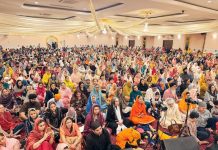
Santana Riderz flag-off at Gurdwara Sahib Kota Kinabalu on 2 July 2023 for the 8 gurdwara tour in Sabah and Sarawak – Photo: Supplied
By Asia Samachar | Malaysia |
A group of Sikh bikers today began a journey that will take them to eight gurdwaras in Sabah and Sarawak, covering some 2,200 kilometers.
The bikers from the Kuala Lumpur-based Santana Riderz, accompanied by some local riders from the two regions of Malaysia, have a mission on hand. They want to raise funds for the Malayan Sikh Education Aid Fund (MSEAF).
They also want to raise the awareness of the fund which provides interest-free loans to needy Sikh students studying at local universities or colleges.
“The fund supports deserving children in their pursuit of education. We also want to encourage young Sikh parent to start saving for the education of their children,” one of the riders told Asia Samachar.
The bikers were flagged off at Gurdwara Sahib Kota Kinabalu today. They will visit gurdwaras in Sandakan, Lahat Datu, Tawau, Labuan, Miri, Sibu and Kuching.
The journey from Kota Kinabalu to Tawau, via Sandakan and Lahad Datu, covers about 660km. Its then another 510km from Tawau to Labuan. Here, they would be hopping onto a ferry to get onto the Labuan island. It’s then about 200km to Miri. Then, they will ride another 800 to Sibu and then Kuching. On paper, that’s about 2,200km.
In 2019, Santana Bikerz undertook a five-nation cancer charity ride that saw them riding some 16,800km covering Malaysia, Thailand, Myanmar, India and Pakistan. They had raised funds for National Cancer Society Malaysia (NCSM).
Santana Riderz flag-off at Gurdwara Sahib Kota Kinabalu on 2 July 2023 for the 8 gurdwara tour in Sabah and Sarawak – Photo: Supplied
The biker’s itinerary:
2/7- Gurdwara Sahib KK 3/7- Gurdwara Sahib Sandakan 4/7- Gurdwara Sahib Lahat Datu 5/7 – Gurdwara Sahib Tawau 8/7 – Gurdwara Sahib Labuan 9/7 – Gurdwara Sahib Miri 10/7- Gurdwara Sahib Sibu 11/7- Gurdwara Sahib Kuching
Santana Riderz flag-off at Gurdwara Sahib Kota Kinabalu on 2 July 2023 for the 8 gurdwara tour in Sabah and Sarawak – Photo: Supplied
ASIA SAMACHAR is an online newspaper for Sikhs / Punjabis in Southeast Asia and beyond. When you leave a comment at the bottom of this article, it takes time to appear as it is moderated by human being. Unless it is offensive or libelous, it should appear. You can also comment at Facebook, Twitter, and Instagram. You can reach us via WhatsApp +6017-335-1399 or email: asia.samachar@gmail.com. For obituary announcements, click here
She treasured the precious moments she spent with her family, leaving behind a lasting impact. Her absence will be deeply felt, but her spirit and strength will live on within us and in the lives she touched with her love, strength, and wisdom. Goodbye to a wonderful woman and a beautiful mother, amazing grandmother, and a lovely great grandmother.
Passed away peacefully surrounded by family on 2nd July 2023
Husband: Late Sardar Mitt Singh s/o Jairam Singh
Loving Children and Spouses : Hardial Singh (ex EPF) & Inderjit Kaur Harbans Kaur & Navtej Singh (USA) Jasbir Kaur & Manjit Singh Dr. Bhovindar Kaur & Dr. Amar Jeet Singh Shinder Kaur & Ranbir Singh (USA)
Deeply missed & lovingly remembered by her grandchildren and great grandchild.
Sehj Path da Bhog will be held on 9th of July 2023 (Sunday), from 10.00am to 12.00pm, at Gurdwara Sahib Sungai Besi (Shapa)
Location links to Gurdwara Sahib Sungai Besi (Shapa): Waze: https://ul.waze.com/ul?preview_venue_id=66650143.666566967.4920879&navigate=yes&utm_campaign=default&utm_source=waze_website&utm_medium=lm_share_location
| Entry: 2 June 2023: Updated: 6 July 2023 | Source: Family
ASIA SAMACHAR is an online newspaper for Sikhs / Punjabis in Southeast Asia and beyond. When you leave a comment at the bottom of this article, it takes time to appear as it is moderated by human being. Unless it is offensive or libelous, it should appear. You can also comment at Facebook, Twitter, and Instagram. You can reach us via WhatsApp +6017-335-1399 or email: asia.samachar@gmail.com. For obituary announcements, click here
From installing the first computer and air conditioner in his Tis Hazari Court chamber as a lawyer to holding court through WhatsApp to providing digital copies of a chargesheet for the first time, Justice Talwant Singh has seen and done a lot.
Justice Singh, who recently retired as judge of the Delhi High Court, hails from a village in Hoshiarpur, Punjab. He started law practice in 1986 and became an additional district judge in the year 2000. He was appointed as a judge of the Delhi High Court in 2019.
In his career as a judge spanning nearly four decades, Justice Singh has been credited with the computerisation of Delhi’s district courts. He was also known as one of the calmest judges of the High Court.
In this interview with Bar & Bench’s Prashant Jha, Justice Singh speaks about his experience as a district court judge, the challenges that he and other judges faced while trying to digitise India’s judiciary and why he is eager to return to law practice.
Edited excerpts follow.
Prashant Jha (PJ): You have been a district court and High Court judge for nearly 23 years. How has the journey been?
Justice Talwant Singh: It was quite enjoyable. I was a lawyer for 14 years and then at the age of 39 years, I became an additional district judge. I was essentially a civil lawyer and then the first assignment was also on the civil side at Central District, Tis Hazari for three years.
After that, I was transferred to a criminal court in Patiala House, so it took me some time to understand its functioning. But then I picked up quickly and started enjoying the criminal bench more than the civil bench.
PJ: You said you will move back to practice. What are your plans?
Justice Singh: There were offers for joining some commissions and tribunals. It is normal for retired high court judges to opt for these post-retirement postings, but I had made up my mind two years ago that I will not accept any of that. I was very clear that I will not go for any of these postings or post-retirement sops. My plan was to practice only as a lawyer and I am looking forward to that day.
My plan is to start my own law practice from the day the Supreme Court reopens after the summer vacations. I am in the process of establishing a law firm and we are recruiting qualified lawyers in every field of law.
Our motto is to work for the poor and the downtrodden who cannot afford lawyers. I am especially perturbed by the people languishing in jails for years facing endless trials Many of them are over 75 years old. Some of them are suffering from serious ailments. It pinches your conscience that these people are still behind bars awaiting the outcome of cases against them.
Read the full story, entitled ‘Not taking up any post-retirement sop; starting my own law firm to work for the poor: Justice Talwant Singh’, here.
ASIA SAMACHAR is an online newspaper for Sikhs / Punjabis in Southeast Asia and beyond. When you leave a comment at the bottom of this article, it takes time to appear as it is moderated by human being. Unless it is offensive or libelous, it should appear. You can also comment at Facebook, Twitter, and Instagram. You can reach us via WhatsApp +6017-335-1399 or email: asia.samachar@gmail.com. For obituary announcements, click here
Deeply missed by brother, sisters, sisters-in-law, brothers-in-law, uncles, aunts, nieces, nephews and grandchildren.
Sehaj Path da Bhog: Date: 16 July 2023 (Sunday) Time: 10am to 12pm Venue: Gurdwara Sahib Petaling Jaya.
For further information, please contact: Surjit – 012 2020589
| Entry: 1 July 2023; Updated: 8 July 2023 | Source: Family
ASIA SAMACHAR is an online newspaper for Sikhs / Punjabis in Southeast Asia and beyond. When you leave a comment at the bottom of this article, it takes time to appear as it is moderated by human being. Unless it is offensive or libelous, it should appear. You can also comment at Facebook, Twitter, and Instagram. You can reach us via WhatsApp +6017-335-1399 or email: asia.samachar@gmail.com. For obituary announcements, click here
Punjabi is one of the most developed languages in the world. However, some individuals deliberately promote Punjabi as a language spoken only by underdeveloped and illiterate people. We must be aware of this misconception.
The Punjabi language holds a special place among the most developed languages worldwide.
It’s the 10th most-spoken language in the world, the 3rd most-spoken language in England, and the most-spoken language in Pakistan. About 150 million people around the world speak Punjabi, and it (obviously) remains a very important and vibrant language in the world today. From a technical standpoint, it ranks very high. Additionally, it ranks fifth in Canada and third in England. In the Upper Punjab region, Punjabi is written in the Gurmukhi script, while in Lower Punjab, the Shahmukhi script is used. Out of the total 7,100 languages in the world, Punjabi holds the 10th position, making it the 10th most spoken language globally. Each and every one of them make the world a diverse and beautiful place.
The language a child learns from their mother’s lap is referred to as their mother tongue. Mother tongue emerges from our deepest thoughts and is crucial for a child’s development. When a child is introduced or taught in a new language within an unfamiliar environment, of which they have limited awareness, the child may feel alienated, leading to a decreased interest in learning. Even today, many children in primary classes refuse to attend school due to the disparity between the language spoken at home and the language used in school. Prioritizing languages other than Punjabi as the mother tongue hinders the complete mental development of children.
Teaching and learning in English-medium schools has become quite chaotic today. There is nothing wrong with reading and learning English or other languages; in fact, it is beneficial to learn as many languages as possible. However, it is not right to do so at the expense of Punjabi. If children are penalized for speaking Punjabi in schools, this trend is dangerous and should be stopped.
In the modern computer age, it may seem that the future of children is secure only in English rather than their mother tongue, Punjabi. But when we look at the developed countries of the world, the reality is different. In Europe, countries like Germany, France, and Russia have made significant technological advancements in their mother tongues. Similarly, in Asia, countries like Japan, China, and Korea have adopted computer technology in their native languages. Countries such as China, Germany, France, and Arab nations do not teach English to children from nursery school onwards. There should be no ban on learning English, and it should not be imposed on children in their early years. In Germany, for example, a six-year-old child goes to school and learns only in German until the third grade. Similarly, if we conduct the first four to five years of education solely in Punjabi, other languages can be easily taught thereafter. This way, Punjabi will be preserved.
Let us embrace the learning of various languages, but let us not lose our love for Punjabi. The language in which Sikh Gurus, Baba Farid, Waris Shah, Sultan Bahu, Bulleh Shah, Bhai Vir Singh, Shah Muhammad, and many others have written cannot be considered the language of the illiterate.
Guru Angad Dev Ji made significant efforts to promote the spread of Punjabi and Gurmukhi in Khadur Sahib. The progress and intelligence of a nation can be determined by the extent to which its people are connected to their mother tongue. When we are connected to our language, we can establish a deeper connection with our heritage, and only through such a connection can we truly understand our origins. Wise individuals believe that when a civilization abandons its language, the decline of that civilization begins. Let us take pride in speaking and writing Punjabi. We should encourage the use of Punjabi in various aspects of life, such as name plaques outside houses, shop name boards, milestones, and road signs. Furthermore, we should proactively enforce laws to make the teaching of Punjabi compulsory in schools and ensure that official work is conducted in Punjabi. Punjabi is our mother tongue, and it deserves our utmost respect and preservation.
Dr Jasbir Singh Sarna, a native Kashmiri, is a retired Indian agriculture officer. He has authored more than four dozen books, including Sikhs in Kashmir and The Sikh Shrines in Jammu and Kashmir. He can contacted at Jbsingh.801@gmail.com
ASIA SAMACHAR is an online newspaper for Sikhs / Punjabis in Southeast Asia and beyond. When you leave a comment at the bottom of this article, it takes time to appear as it is moderated by human being. Unless it is offensive or libelous, it should appear. You can also comment at Facebook, Twitter, and Instagram. You can reach us via WhatsApp +6017-335-1399 or email: asia.samachar@gmail.com. For obituary announcements, click here.
Ace author Paul J Loosley (left) and Ham’s sister Varinder (middle) at the book signing
By Asia Samachar | Malaysia |
Our readers would have heard about Harmandar Singh or Ham. Now, here’s a chance to get to know him better. Out last week was The Book of Ham, a biography of Ham’s first 30 years, penned by ace film director and award-winning writer Prof Paul J Loosley.
Asia Samachar has written about Ham and his adventures before, but this book opens a new view into his life.
Imagine: you are born into a village in remote Terengganu where 99% of the population is Malay. Forget the surprised look on the faces of Ham’s mining townspeople when they saw a turbaned Sikh boy running along the laterite streets; think about the fact that Ham’s first visit to a Sikh temple was at the age of 8.
It all began in Bukit Besi, a mining town where Ham’s dad was an Electrical Chargeman, also a tubanned gentleman. There were only three Sikh families there, and the nearest town was Dungun, 18 miles away on the Terengganu coastline.
When Ham was born, Bukit Besi finally had 5 male Sikhs (Panj Pyare) and Ham’s mother brought Guru Granth Sahib Ji into his home and started her daily love, care and devotion to Guru Ji.
It was not easy, but Ham’s mum who gave birth to him when she was 18, persevered amidst the sometimes hostile environment and ensured Ham kept his turban and long hair.
When they moved to Rawang and Ham’s dad got a job at the Associated Pan Malaysia Cement (APMC) cement factory, it was like walking into new bliss.
“Freedom, here I come!” recalled an exalted Ham who says “Rawang was a land of milk and honey, and had enough Sikh families to start a little war for no reason.” His silent sarcasm was already evident then.
But then his mum passed away soon after at the age of 32. Ham was 14.
“She steadfastly maintained my turban during my growing years, and I wear a turban to this day as a testament to her will and dedication to the faith.”
The book also journeys through Ham’s early years in the advertising business and how he was hired in a case of mistaken identity, where the turban certainly helped. The story of how they mistook him for his best friend Malkeet Singh is truly enjoyable. Malkeet Singh ended up running his own very successful ad agency called Bloomingdale, while Ham went on to travel the world in his quest for advertising fame.
Biographer Paul did an amazing job and the narrative is riveting across almost 250 pages.
Ham and his sister Baljit in Bukit Besi, circa 1960s
Paul and Ham are buddies and they travelled to Terengganu to do research for the book, while getting suitably inebriated with his childhood friends at the dilapidated but fascinating Kuantan Club. Subsequently, the book was written from recordings of countless lunch conversations with Ham because Paul loves Indian cuisine.
After six years, the book got made.
The book serves as an inspiring read for all, especially young Sikhs who are keen on the advertising and marketing industry. It is funny, witty of course, and chronicles Ham’s struggles before making a name for himself.
“My minds has always been restless and I just can’t stop it from ticking. Advertising knows how to sugar coat or dramatise life in the pursuit of getting the brand top of mind. I must say that in this book, Paul does not sugar coat anything but in fact lays bare the truths we love to hide,” says Ham.
True to form, author Paul Loosley did very comprehensive research into the Sikh faith for the book. He shares that the journey itself was an enlightenment of sorts into the Sikh psyche.
“At the book launch, I was impressed with Paul’s speech about Sikhism and much of that magic can be felt in his writing as he quotes sayings from our Gurus in the beginning and end,” adds Ham. “Paul was already an advertising celebrity even before I got into the business.”
Ham (middle) with Star Media Group CEO Alex Yeow Wai Siaw (left) and the effervescent Karamjit Singh of DNA
Interestingly, Ham, Malkeet and Paul worked on the Proton Satria TVC done during its launch eons back. Paul was the film director, Ham saved the idea from the trash can, and Malkeet sold it to the client.
Concept credit goes to Suhaimi Saadun.
The book also captures some of Ham’s recent work for #RasuahBusters and times when working for McCann-Erickson in London. The stories are about trials, tribulations and hard-earned success. Which you may say is not unusual in real life, but it is Paul’s writing that really steals the light!
Ham still writes about 15,000 words a week and has his free weekly magazine on Fridays called
MARKETING Weekender, read by advertising and marketing purists.
ASIA SAMACHAR is an online newspaper for Sikhs / Punjabis in Southeast Asia and beyond. When you leave a comment at the bottom of this article, it takes time to appear as it is moderated by human being. Unless it is offensive or libelous, it should appear. You can also comment at Facebook, Twitter, and Instagram. You can reach us via WhatsApp +6017-335-1399 or email: asia.samachar@gmail.com. For obituary announcements, click here
| Entry: 30 June 2023; Updated: 5 July 2023 | Source: Family
ASIA SAMACHAR is an online newspaper for Sikhs / Punjabis in Southeast Asia and beyond. When you leave a comment at the bottom of this article, it takes time to appear as it is moderated by human being. Unless it is offensive or libelous, it should appear. You can also comment at Facebook, Twitter, and Instagram. You can reach us via WhatsApp +6017-335-1399 or email: asia.samachar@gmail.com. For obituary announcements, click here
Kirtan and Path Da Bhog: 15 July 2023, from 10am to 12pm, at Gurdwara Sahib Johor Bahru
Contact: Manjit Singh 012 797 7030
We sincerely thank everyone for their condolences, prayers, assistance, love and support during this difficult time.
PLEASE TREAT THIS AS A PERSONAL INVITATION FROM THE FAMILY
| Entry: 28 June 2023; Updated:30 June 2023 | Source: Family
ASIA SAMACHAR is an online newspaper for Sikhs / Punjabis in Southeast Asia and beyond. When you leave a comment at the bottom of this article, it takes time to appear as it is moderated by human being. Unless it is offensive or libelous, it should appear. You can also comment at Facebook, Twitter, and Instagram. You can reach us via WhatsApp +6017-335-1399 or email: asia.samachar@gmail.com. For obituary announcements, click here
“We will not be silenced,” chanted several hundred protesters outside the Indian consulate in Vancouver on Saturday, waving signs with the face of murdered B.C. Sikh temple president Hardeep Singh Nijjar and calling him a martyr for advocating for the right to self-determination for his people.
Protesters mostly wore orange turbans, a colour representing rebirth and sacrifice, and carried large yellow flags displaying the word “Khalistan,” as many stepped on an Indian flag they brought to the demonstration.
Nijjar was alone in his truck when he was shot the evening of June 18 while leaving his temple, Guru Nanak Sikh Gurdwara, where he served as president in the populous Metro Vancouver city of Surrey. Two masked assailants fled the scene, and although investigators have not established a motive, many in the Sikh community think the Indian government may have been involved.
Over the weekend, Sikhs travelled from all over the country and as far away as New York to attend the protest, with thousands more following Nijjar’s funeral procession in Surrey on Sunday.
“I came from Sacramento, California to pay tribute to our Sikh leader and martyr who advocated for Khalistan,” protester Bobby Singh told the Star.
“A Sikh community leader being assassinated in broad daylight put fears into public. But our (belief) is that you can kill a revolutionary but you can’t kill the revolution,” he said.
While police have acknowledged that there is fear and speculation stemming from the attack, investigators told media they have not linked the shooting to foreign interference and there is no reason to believe the Sikh community in Canada is at risk.
The fact that so many think the Indian state could be responsible for the killing of a Canadian religious leader and plumber reflects the extent to which some in the Sikh international diaspora feel they are being unfairly vilified by the Indian government, amid worsening human rights conditions for religious minorities in the country, observers say.
ASIA SAMACHAR is an online newspaper for Sikhs / Punjabis in Southeast Asia and beyond. When you leave a comment at the bottom of this article, it takes time to appear as it is moderated by human being. Unless it is offensive or libelous, it should appear. You can also comment at Facebook, Twitter, and Instagram. You can reach us via WhatsApp +6017-335-1399 or email: asia.samachar@gmail.com. For obituary announcements, click here
The book “Kalapani: Punjabis’ Role in Freedom Struggle”, authored by Jagtar Singh (left) and Gurdarshan Singh Bahia
By Asia Samachar | Panjab |
A newly published book aims to set right the prevalent thinking when one considers the role of the Punjabis in the freedom struggle movement in India.
‘Kalapani: Punjabis’ Role in Freedom Struggle’, released on June 10, calls for due recognition of the role of Punjabis.
The book, written by journalist and author Jagtar Singh and researcher Gurdarshan Singh Bahia, also carries what is said to be the first-ever comprehensive list of Punjabi freedom fighters who were sentenced to transportation (Kalapani) and detained in Andaman suffering brutal torture that came to be known as the Living Hell.
“This is about changing prevalent narrative,” tweets co-author Jagtar about the book published by the Shiromani Gurdwara Parbandhak Committee (SGPC).
In background information shared at the SGPC social media platforms, it is noted that the number of Punjabi political prisoners in Cellular Jail on this penal settlement was not only the highest at one stage, but these Babas from the Ghadr Party successfully struggled hard to end the tortuous hard labour that this jail was notorious for. Baba Chattar Singh was confined to a cage in his cell for more than three years. Several other freedom fighters died in this struggle in jail.
The book points out that while the Sepoy Mutiny of 1857 is treated as the First War of Independence, it was Bhai Maharaj Singh who was the first to confront the colonial rulers in 1849 itself when the Sikh Empire was annexed after the Second Anglo-Sikh War.
A number of Punjabi soldiers rebelled against the British Raj from time to time till 1940 and several of them were hanged. The book demands that they must be declared as freedom fighters and their valiant struggle for freedom must be recorded in the annals of their regiments for the posterity to draw inspiration from them. It has been pointed out that while the contribution of these freedom fighters remains neglected, the loyalty to defend the British Raj symbolized by the highest bravery award that is Victoria Cross is hailed.
Ghadr Party was the first to give a call for complete freedom in 1913, years before the Congress. The flag of the Ghadr party was the first to flutter on Indian soil. Hundreds of Ghadr Party activists had returned to Punjab from abroad to organise a rebellion. It was the Ghadr Party activists who changed the narrative of the notorious Cellular Jail in Andaman. Rather than Congress, the credit for raising the slogan of complete freedom should go to the Ghadr Party.
The Cellular Jail narrative is an example of how the contribution of Punjab has been overlooked. The focus even in the light and sound program staged in the jail premises every evening is on Hindutva ideologue V D Savarkar whose cell is the only one that has been earmarked despite the fact that he wrote several apology letters to the colonial rulers from there. The issue is not focused on Savarkar but lack of due recognition of the struggle by the Punjabi freedom fighters.
Master Chattar Singh being kept in a cage in his cell for more than three years was unprecedented in the history of this jail. That cell must be earmarked in case that block exists. The struggle of the Ghadrites in Cellular Jail must be highlighted.
There is another horror story. The atrocities during the Japanese occupation must be probed. The administration of these islands was with the Azad Hind Government headed by Netaji Subhash Chandra Bose after December 1943, although formally from a few days later. Dr. Diwan Singh Kalepani attained martyrdom on January 14, 1944 days after the unfurling of tricolour at Port Blair by Netaji on December 30. He was the first martyr after Andaman and Nicobar was declared the first free Indian territory after an occupation by the Japanese and handed over to Azad Hind Government.
So far as the role of Punjab in the freedom struggle in the context of Cellular Jail is concerned, the history of that period must be rewritten as the contribution of the Punjabis is not some myth but supported by hard facts. This glorious role of Punjab must be recognised at the national level.
At least one island needs to be named after Dr. Diwan Singh Kalepani, according to a call made in the write-up shared at the SGPC portal. Similarly, it added that some roads must be named after freedom fighters from Punjab in Cellular Jail. Baba Sohan Singh Bhakna was president of the Ghadr Party. One of the roads in Port Blair should be named as Bhakna Marg.
It also said that the script of the Light and Sound program should be rewritten to balance the narrative. The history of this valiant struggle by the Punjabis must be included in textbooks at various levels to make the younger generation aware of this glorious chapter of Punjab during colonial rule.
ASIA SAMACHAR is an online newspaper for Sikhs / Punjabis in Southeast Asia and beyond. When you leave a comment at the bottom of this article, it takes time to appear as it is moderated by human being. Unless it is offensive or libelous, it should appear. You can also comment at Facebook, Twitter, and Instagram. You can reach us via WhatsApp +6017-335-1399 or email: asia.samachar@gmail.com. For obituary announcements, click here