That’s the question being asked in India, where a controversy has been raging for weeks over what children are taught in school after reports about the deletion of some topics in their textbooks.
The textbooks are not new – they were published earlier this year by the National Council of Educational Research and Training (NCERT) and are already being used in more than 20,000 schools. The NCERT, an autonomous organisation under the federal education ministry, oversees syllabus changes and textbook content for children taking exams under the government-run Central Board of Secondary Education.
Among dropped topics are paragraphs on attempts by extreme Hindu nationalists to assassinate Mahatma Gandhi and chapters on federalism and diversity.
The NCERT has also dropped content related to the 2002 Gujarat riots; removed a chapter on Mughal rulers in India; and moved portions on the periodic table and theory of evolution in science books to higher grades, sparking criticism.
The council had said earlier that the changes, which were first announced last year as part of a syllabus “rationalisation” exercise, wouldn’t affect knowledge but instead reduce the load on children after the Covid-19 pandemic.
But now some academics who were part of committees that helped design and develop the older textbooks say they don’t want to be associated with the new curriculum.
India history debate after chapter on Mughals dropped On 8 June, political scientists Suhas Palshikar and Yogendra Yadav – who were advisers for political science books originally published in 2006 for classes 9 to 12 – wrote to NCERT, asking it to remove their names from the print and digital editions of the books.
The academics said they objected to the “innumerable and irrational cuts and large deletions” as they failed to see “any pedagogic rationale” behind the changes.
ASIA SAMACHAR is an online newspaper for Sikhs / Punjabis in Southeast Asia and beyond. When you leave a comment at the bottom of this article, it takes time to appear as it is moderated by human being. Unless it is offensive or libelous, it should appear. You can also comment at Facebook, Twitter, and Instagram. You can reach us via WhatsApp +6017-335-1399 or email: asia.samachar@gmail.com. For obituary announcements, click here.
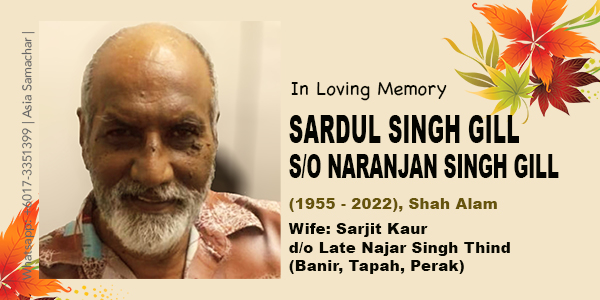
Brothers, Nephews, Nieces, And a Host Of Relatives and Friends.
Deeply Loved and Forever Cherished In Our Hearts.
Please join us for the Jodh Mela and Sehaj Path Da Bhog
25 Jun 2023 (Sunday), from 9:30am to 12noon, at Gurdwara Sahib Guru Nanak Shah Alam
Kindly treat this as a personal invitation.
For further details, please contact Sarjit Kaur (017 652 1615)
In Loving Memory of My Dear Husband It’s hard to believe, you’re no longer here. Words cannot describe how this makes me feel… You’ve passed on to the other side, though I wish you could still be here with me… You were a remarkable man ~ Dependable, loving and caring… You were the centre of my world. You were one in a million to me… You made me laugh, you made me smile ~ You were my companion and dear friend… You were a wonderful husband from beginning to end. Forever will you live on, in my heart and mind. Forever will you live in my thoughts and never die. With love always, I remember you, With fond memories, O think of you… I’m grateful for the times we had together ~ I’ll cherish my memories of you forever.
| Entry: 20 June 2023 | Source: Family
ASIA SAMACHAR is an online newspaper for Sikhs / Punjabis in Southeast Asia and beyond. When you leave a comment at the bottom of this article, it takes time to appear as it is moderated by human being. Unless it is offensive or libelous, it should appear. You can also comment at Facebook, Twitter, and Instagram. You can reach us via WhatsApp +6017-335-1399 or email: asia.samachar@gmail.com. For obituary announcements, click here
ASIA SAMACHAR is an online newspaper for Sikhs / Punjabis in Southeast Asia and beyond. When you leave a comment at the bottom of this article, it takes time to appear as it is moderated by human being. Unless it is offensive or libelous, it should appear. You can also comment at Facebook, Twitter, and Instagram. You can reach us via WhatsApp +6017-335-1399 or email: asia.samachar@gmail.com. For obituary announcements, click here
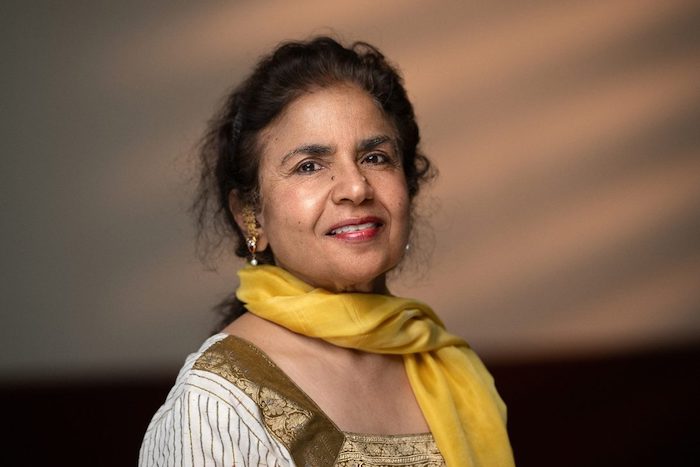
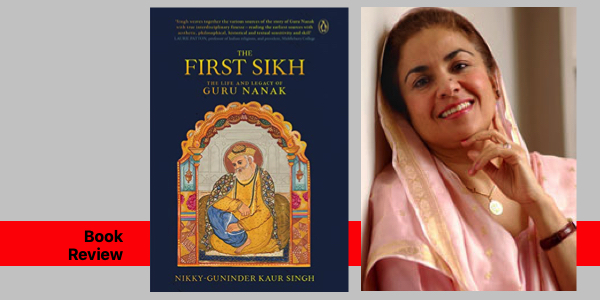
Crawford Family Professor of Religion Nikky Singh – Photo: Brian Fitzgerald
By Claire Sykes | Colby News | United States |
Nikky-Guninder Kaur Singh, the Crawford Family Professor of Religion and chair of the Department of Religious Studies at Colby, always wanted to be a teacher. Her father, Professor Harbans Singh, was chair of the religious studies department at Punjabi University in India, where she grew up.
As a teenager, Singh happily left for a girls’ preparatory school in Virginia. There, homesickness and discovering Walt Whitman’s A Passage to India strengthened her Sikh roots, setting her on a lifelong path of scholarship in Sikhism and other Asian religions and in Punjabi literary translation.
Among the top scholars in her field, Singh joined Colby in 1986 and has published 14 books and more than 100 articles and book chapters—focusing on sacred poetry and feminist issues—and has received several awards for her work.
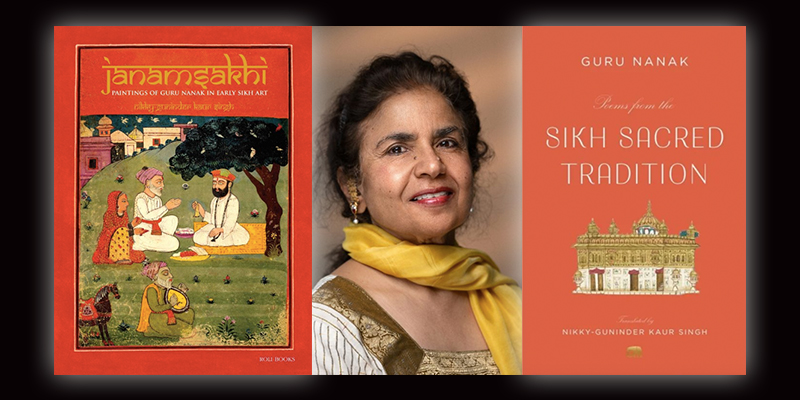
In January India’s Jaipur Literature Festival featured Singh and Navtej Sarna, the former Indian Ambassador to the United States, in discussion about her book Guru Nanak: Poems from the Sikh Sacred Tradition (Harvard University Press, 2023). During that trip, she was honored at the Bhai Vir Singh Literary Center in New Delhi for her book Janamsakhi: Paintings of Guru Nanak in Early Sikh Art(Roli Books, 2023), which she dedicated to Jay Holman ’13 and Molly Rogers ’13.
Singh recently spoke about her work. The interview has been edited for space and clarity.
Your latest book is what’s known as a janamsakhi. It’s one of numerous oral, literary, and/or visual legendary biographies of Guru Nanak [1469-1539], founder of the Sikh religion and its first guru. In your volume, 57 iconotexts with paintings by Alam Chand Raj, created in 1733, are paired with your interpretations of each. Why did you take on this book project and dedicate it to Holman and Rogers?
I had already studied some of these early Sikh paintings, held at the British Library in London. They’re from one of the earliest manuscripts that bears the date and names of the artist, scribe, and patron who commissioned it. It’s about Guru Nanak’s travels by foot up mountains and through jungles to mosques, shrines, Hindu temples, and meditation sites. Jay, a religious studies student and avid hiker, wanted to do his honors thesis on Guru Nanak’s spiritual experiences as “journeys,” which got me excited about the narratives and their illustrations. The book was my “pandemic project.” Stuck at home, I got to travel with Guru Nanak and revisit the stories I had heard in the lap of my grandmother. So, I dedicated the book to Jay and Molly, who asked me to officiate their wedding, which was such an honor. Past and present came together beautifully for me.
How do your janamsakhi interpretations differ from others?
Rather than as miracles performed by Guru Nanak, my interpretations tell of the extraordinary power of life in the world here and now. The artist did a great job of conveying Guru Nanak’s progressive ideas. It amazes me how his premodern images raise critical matters of religion, gender, and sexuality challenging us today. In my narrative titled “Enchantresses are Enchanted,” a king’s slave girls are sent to test Guru Nanak. Instead of being tempted, he recites his verses about women’s spirituality, and they become empowered by way of the divine manifested in their bodies. In Chand’s other paintings, we see a cross-gendered saint and multi-religious reciprocity. I never heard these interpretations growing up, and I wanted to bring them to the collective memory of the Sikhs and open them to the general readership. These stories are as much about Guru Nanak’s worldview and poetry as they are our capacity to be transformed.
Your book Guru Nanak: Poems from the Sikh Sacred Tradition is a translation of your selection from his 974 hymns. How do you approach translating from Punjabi to English?
It’s quite a creative process. How to echo the intrinsic sound and sense of the original Punjabi? How to transmit the taste from one tongue to another? I find most translations marred with colonial and Biblical diction. Guru Nanak’s all-inclusive singular transcendent is converted into a monotheistic masculine god. The term “lord” appears frequently, distancing the divine that is no different from you and me. And the term “soul” is latched onto women figures, distorting lovely three-dimensional humans into ghostly metaphors.
I aspire to make transparent what is already there in the original: elemental simplicity, beauty, unicity, intimacy, and gender inclusivity. Of course, to reproduce the elemental simplicity, sharpness, and musicality of Guru Nanak’s lyrics is terribly challenging. How to rebound his beautiful alliterations, assonance, and rhymes? He utilizes numerous words for borderless love, but English has only one word for love. I try to feel the Punjabi lyrics viscerally, which makes me receptive to their newness and uniqueness. Once we flush out old, intellectual habits and clichés, unexpected equivalents appear. Punjabi and English ultimately embrace each other.
Guru Arjan [1563-1606], the fifth of Sikhism’s Gurus, compiled the religious scripture, called the Guru Granth Sahib (also commonly referred to as the GGS). What does your book Poems from the Guru Granth Sahib tell us about this centuries-old text that remains central to Sikhism? And what do you want readers to experience?
Since Guru Nanak’s works are foundational for the GGS, my book serves as a blueprint for the unity of the divine and the equality of humanity, all expressed in sensuous poetry across the GGS. This huge scriptural text is a chorus of Sikh, Hindu, and Muslim voices, including even those from the lowest castes. But as it stipulates, this platter of true knowledge must be savored, taken inside the body. So, I want my readers to enjoy its pluralistic ingredients. My book upholds Guru Nanak’s vision that these poems composed in the language of infinite love belong to us all, equally, and that they not be merely eaten (khavai) but savored intensely (bhuncai). His pluriversal and timeless poetry invites us to bring our particular cultural perspectives to it, engage sensuously with it, delight in it, and let it navigate our personal worldview.
What’s next, and what are your hopes?
I’m completing a book on Guru Nanak’s transcendent aesthetics and moving on to paintings by Sikh women artists. The scholarly spotlight has been on the first Sikh Guru’s doctrinal contributions, and the aniconic Sikh tradition has overlooked the visuals. I want the neglected literary and artistic expressions to reach wide audiences.
Aesthetics is not some external embellishment of Guru Nanak’s poetics, but the very medium of his body-sanctifying textures resonant with love for the transcendent one, for fellow beings, and for the environment. Sikh artists are articulating this in the language of colors. Experiencing the transcendent through our senses breaks the wall between the sacred and the secular, expanding our intellectual, emotional, imaginative, and spiritual repertoire. Racism, casteism, classism, sexism, and religious fundamentalism also break down, so we can build mutuality and reciprocity with each other. Poetry and art should nourish us. With this nourishment, we can act and create beauty for ourselves—and a better world for all.
The article was first published at Colby News. Click here for the original entry.
ASIA SAMACHAR is an online newspaper for Sikhs / Punjabis in Southeast Asia and beyond. When you leave a comment at the bottom of this article, it takes time to appear as it is moderated by human being. Unless it is offensive or libelous, it should appear. You can also comment at Facebook, Twitter, and Instagram. You can reach us via WhatsApp +6017-335-1399 or email: asia.samachar@gmail.com. For obituary announcements, click here.
Film producer and cartoonist Vishavjit Singh and Director Ryan Westra talk about the new animated short film “American Sikh” and representation at Tribeca Film Festival.
ASIA SAMACHAR is an online newspaper for Sikhs / Punjabis in Southeast Asia and beyond. When you leave a comment at the bottom of this article, it takes time to appear as it is moderated by human being. Unless it is offensive or libelous, it should appear. You can also comment at Facebook, Twitter, and Instagram. You can reach us via WhatsApp +6017-335-1399 or email: asia.samachar@gmail.com. For obituary announcements, click here.
LATE SERGEANT (RTD.) BALWANT SINGH GILL S/O GURDIT SINGH GILL
26.9.1960 – 17.8.2022
Loving Husband, Son, Son-in-Law, Brother, Brother-in-Law and Uncle will be fondly remembered for all the lives he has touched with his generosity, kindness and charm.
Leaving behind:
Wife: Manjeet Kaur d/o Bachan Singh
Nephews, Nieces, Relatives and loved ones.
Path da Bhog: 16 July 2023 (Sunday), from 10am to 12pm, at Wadda Gurdwara Sahib Ipoh, Perak followed by Guru Ka Langgar
ASIA SAMACHAR is an online newspaper for Sikhs / Punjabis in Southeast Asia and beyond. When you leave a comment at the bottom of this article, it takes time to appear as it is moderated by human being. Unless it is offensive or libelous, it should appear. You can also comment at Facebook, Twitter, and Instagram. You can reach us via WhatsApp +6017-335-1399 or email: asia.samachar@gmail.com. For obituary announcements, click here
Inderraj Singh Dhillon sets new world record for the 120-kilogram weight class at the 2023 IPF World Classic Open Powerlifting Championships in Valletta, Malta, on June 17, 2023 – Photo: TheIPF Instgram video grab
By Asia Samachar | Britain |
Army veteran Inderraj Singh Dhillon showed why they call him the ‘British Warrior’ when he locked out a humongous weight to set a new world record for the deadlift.
On Saturday (June 17), the British representative stepped forward for the 120-kilogram weight class at the 2023 IPF World Classic Open Powerlifting Championships in Valletta, Malta.
The Bristol-based contestant gathered his inner strength to lock out a humongous deadlift of 386 kilograms (851 pounds) to set a new IPF world record for Raw Deadlift.
Inderraj competed in the raw division, so he was only able to use a lifting belt and some chalk to aid him in the lift. After properly preparing for his attempt, Inderraj approached the barbell and placed his feet in a conventional stance. He then utilized a mixed grip to grab the bar loaded with 386 kilograms (851 pounds) and started pulling. The weight moved easily off the ground, but Inderraj almost got stuck after passing the knees. However, after some shaking and grinding it out, Inderraj locked out the humongous weight, reports Fitness Volt.
In June 2022, Inderraj Singh broke the British record deadlift at 375kg in the U120kg class at the All England Championships 2022 in Manchester.
ASIA SAMACHAR is an online newspaper for Sikhs / Punjabis in Southeast Asia and beyond. When you leave a comment at the bottom of this article, it takes time to appear as it is moderated by human being. Unless it is offensive or libelous, it should appear. You can also comment at Facebook, Twitter, and Instagram. You can reach us via WhatsApp +6017-335-1399 or email: asia.samachar@gmail.com. For obituary announcements, click here.
Path da Bhog: 24th June 2023 (Saturday), from 6PM to 8PM, at Gurdwara Sahib Petaling Jaya.
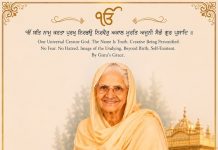
In loving memory of our dear mother, grandmother and great grandmother who peacefully passed away at the grand age of 96 on her husband’s 50th memorial anniversary. Born in Bara Pind, Jalandhar, she embarked on a journey to Malaysia at the age of 18, where she dedicated her early years in Cameron Highlands to raising her young family. A dedicated and supportive wife, she encouraged her husband to pursue his dreams of becoming a doctor at the age of 45, ultimately inspiring future generations. Her legacy lives on through her three children, who all followed in his footsteps, becoming doctors themselves. She cherished the precious moments spent with her family, leaving behind a lasting impact. Her presence will be deeply missed, but her memory will forever remain in our hearts.
Passed away peacefully among family on 18 June 2023.
Children Bhupindar Kaur Dhaliwal Amarjit Singh Dhaliwal Narjit Singh Dhaliwal
Grandchildren and great grandchildren will miss her dearly.
Please contact 012 209 7781 (Dr. Bhupindar), 012 297 3610 (Dr. Narjit) or 012 232 8497 (Dr. Amarjit) via Whatsapp to find out more details.
| Entry: 18 June 2023; Updated: 21 June 2023 | Source: Family
ASIA SAMACHAR is an online newspaper for Sikhs / Punjabis in Southeast Asia and beyond. When you leave a comment at the bottom of this article, it takes time to appear as it is moderated by human being. Unless it is offensive or libelous, it should appear. You can also comment at Facebook, Twitter, and Instagram. You can reach us via WhatsApp +6017-335-1399 or email: asia.samachar@gmail.com. For obituary announcements, click here
ASIA SAMACHAR is an online newspaper for Sikhs / Punjabis in Southeast Asia and beyond. When you leave a comment at the bottom of this article, it takes time to appear as it is moderated by human being. Unless it is offensive or libelous, it should appear. You can also comment at Facebook, Twitter, and Instagram. You can reach us via WhatsApp +6017-335-1399 or email: asia.samachar@gmail.com. For obituary announcements, click here
New immigrants have contributed in a big way to help Canada achieve yet another milestone as its population touched 40 million-mark on Thursday.
According to data released by Statistics Canada, the country’s population is currently growing at a record-setting pace. In 2022, the number of Canadians rose by 1,050,110. This marks the first time in Canadian history that its population grew by over 1 million people in a single year, and the highest annual population growth rate (+2.7%) on record since 1957 (+3.3%).
While that previous record is mostly attributed to the high number of births during the post-war baby boom, international migration accounted for nearly all growth recorded in 2022 (96%).
If this rate of population growth was to stay constant in the years to come, the Canadian population could double in about 26 years, Statistics Canada said.
In 2021, more than 8.3 million people, or almost one quarter (23%) of the population, were, or had ever been, a landed immigrant or permanent resident in Canada. This was the largest proportion since Confederation, topping the previous 1921 record of 22.3%, and the highest among the G7.
This growth is reflected across Canada. In 2022, every single province and territory recorded a growing population, except for the Northwest Territories.
Sikh stock images made available by WSO Canada
Canada’s population clock uses a real-time model based on Statistics Canada’s quarterly demographic estimates. The numbers for Canada and for each province and territory are updated in real time based on the most recent birth, death and migration data.
The clock also shows the time it takes for a demographic event (birth, death or migration component) to occur in Canada. However, the clock does not reflect when the events themselves actually occur. Rather, it shows the average pace of Canada’s population renewal in real time.
The census of population is conducted every five years. It provides a snapshot of Canada at a specific point in time and also provides counts for small regions and characteristics of the population according to various variables. Statistics Canada complements this data with ongoing population estimates that track demographic shifts between censuses.
Canada is by far leading the G7 countries for population growth. This was certainly true in 2022 and has been the case for the last two decades.
In 2021, more than 8.3 million people, or almost one quarter (23%) of the population, were, or had ever been, a landed immigrant or permanent resident in Canada. This was the largest proportion since Confederation, topping the previous 1921 record of 22.3%, and the highest among the G7.
Canada’s Indigenous population continues to grow much faster than the national average. It increased by 9.4% from 2016 to 2021, surpassing the growth of the non-Indigenous population over the same period (+5.3%).
The 2021 Census counted 1.8 million Indigenous people, accounting for 5% of Canada’s total population, up from 4.9% in 2016.
Statistics Canada has been tracking the growth of Canada’s population since the very first national census, conducted in 1871.
Canada has known several important waves of immigration. One of the biggest was at the very beginning of the 20th century, which saw many immigrants settling the Prairies. In 1913, Canada welcomed over 400 000 immigrants. A record that was only surpassed in 2021 (and again in 2022).
The period after the Second World War (1946-1965) also saw very high rates of population growth, mostly because of the baby boom. The average number of children per woman at that time peaked at 3.94 in 1959, compared to 1.4 in 2020.
The fertility rate started declining after the 1960s. By 1995, immigration overtook natural increase (births minus deaths) as the main source of population growth.
In 2015, there were more Canadians aged 65 and older than between 0 and 14 for the first time in Canada’s history.
Canada’s immigration targets have been increasing since 2016, in an effort to address labour shortages and an aging population. In 2020-2021 population growth slowed due to border restrictions put in place to curb the spread of COVID-19. But as recent numbers show, it quickly bounced back.
(Prabhjot Singh is a veteran journalist with over three decades of experience of 14 years with Reuters News and 30 years with The Tribune Group, covering a wide spectrum of subjects and stories. He has covered Punjab and Sikh affairs for more than three decades besides covering seven Olympics and several major sporting events and hosting TV shows.)
ASIA SAMACHAR is an online newspaper for Sikhs / Punjabis in Southeast Asia and beyond. When you leave a comment at the bottom of this article, it takes time to appear as it is moderated by human being. Unless it is offensive or libelous, it should appear. You can also comment at Facebook, Twitter, and Instagram. You can reach us via WhatsApp +6017-335-1399 or email: asia.samachar@gmail.com. For obituary announcements, click here.