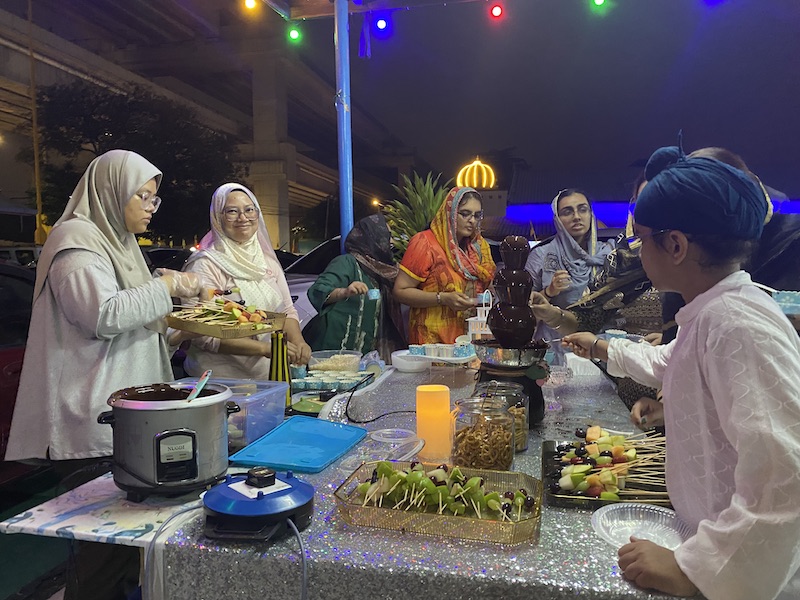
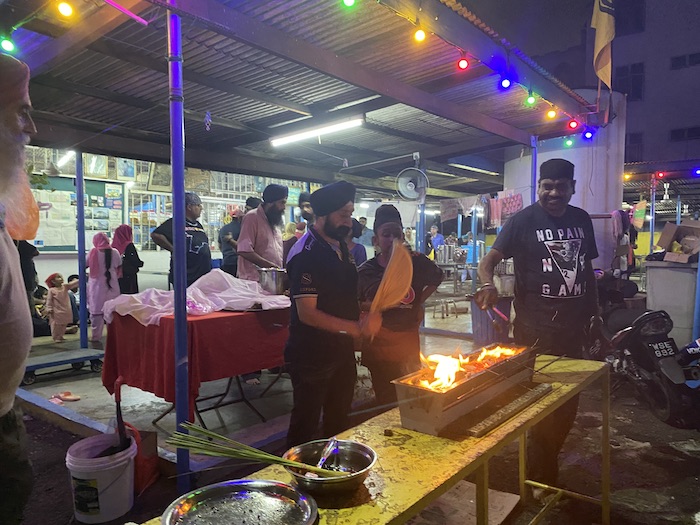
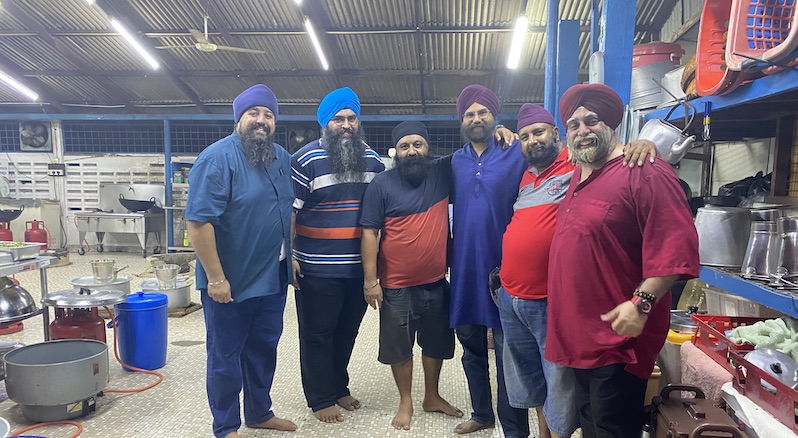
A chocolate fountain and so much more for the Vaisakhi 2023 celebration at the Wadda Gurdwara Sahib Kampung Pandan, Kuala Lumpur – Photo: Asia Samachar
ByJagdesh Singh | Opinion |
The smell of vegetarian rendang chicken wafted ever so gently, my nostrils sensitive to how my stomach would greedily accept the rendang along with scented rice and peanuts. Clutching a With a full plate, I walked to the Langgar table with my good friend already swallowing his second bite, oblivious to his good manners of waiting for me. I didn’t blame him one bit.
Wadda Gurudwara Sahib Kampung Pandan is sort of an enigma. It has a certain small town feel to it, with the infrastructure seemingly aged from the 60s, yet the modern landscape of Kuala Lumpur city as its background is so hard to ignore. I mean, the Twin Towers are literally there, right in front of you. My early dinner of vegetarian chicken rendang with my good friend was at this Gurdwara, snugged right in the centre of busy KL City.
The other noticeable trait of the Gurdwara, apart from the fantastic meal and metropolitan background, was the palpable energy that we could physically feel from the many activities going on at the same time. It was exuberant and gave me a subtle jolt increasing my own energy levels. I’m normally sedentary at around dinner time, but I had this energetic feeling while chatting with some of the regulars in the Gurdwara.
Everything happening around us while we conversed nonchalantly seemed typical. But it wasn’t typical to me, my last time being there was probably before the pandemic. The hustle and bustle, the noise of delighted kids, the clanking of things being moved from the kitchen to the dining area, would be something I’d expect from the Samelan gurmat camps that Sikh Naujawan Sabha would organise every year, not on a weekly basis, at least for me. When asked of the frequency of what I was witnessing, I was told that this Gurdwara would be brimming with activity every Saturdays and Sundays since pandemic restrictions eased.
Vegetarian satay for the Vaisakhi 2023 celebration at the Wadda Gurdwara Sahib Kampung Pandan, Kuala Lumpur – Photo: Asia Samachar
I know, for a fact, that Wadda Gurudwara Kampung Pandan isn’t an exception or anomaly. There are more Gurdwaras that are very active across our country, with prayers and keertan events organised on large scales, attracting large crowds, spreading the interest on our Guru’s teachings and messages. But the reason why I found this Gurdwara to be a little bit special is that it isn’t really just a place of worship specifically. It’s more a place of education and activity for the youth.
I was requested to give a small lecture to the older secondary students attending classes in the Punjabi Education Center in the Gurdwara that weekend. That’s how destiny landed me there, in the first place. Both me and my friend were pleasantly surprised to be in a room filled with these kids that didn’t seem tired from their long day of Punjabi classes. We both were invited as guest speakers to teach or lecture on anything Sikhi, the topic was upon our choosing. The Gurdwara organises these lectures on top of the Punjabi classes and Keertan sessions.
It’s interesting and so very encouraging for me to witness a Gurdwara that emphasises on the education and nurturing of their youth, balancing between being a place of worship with being a centre of activity for their youth to grow and learn while imbuing Sikh values and principles. I’ve always believed that this was the true design of Gurdwaras from the very beginning. Gurdwaras were the centre of everything for that society. I would imagine the Granthi or Gyani to be practical advisors or even leaders of villages across Punjab from during the time of our Gurus, advising villagers on educational matters, organising societal and cultural celebrations in lieu of any medium of entertainment like we have today.
I would imagine, exhausted from a day of farming, villagers would converge at this centre of the village to partake in keertan, in prayers, sharing of food, learning to read and write, soliciting advice on family or household matters. Basically do everything together daily, across the four seasons.
With modern development, the role of Gurdwaras has also evolved. Nowadays, especially in the metropolitan areas or cities, the Gurdwaras are only busy during the weekends. The Granthi or Gyani normally dispenses his or her duty on prayers and keertan, perform ardaas for those in need of, and that’s pretty much it. So much so we import them from our Motherland, just to play this small role.
So, Gurdwaras such as Wadda Gurdwara Kampung Pandan and Gurdwara Shah Alam are like a breadth of fresh air, with their emphasis on youth, even sports and education. The coming generation of Sikhs, nurtured by Gurdwaras like these two, are really in good hands, and give great encouraging signs to our generation that our society and our values will be around for a few more generations. I’m pretty sure I’m missing out on many more Gurdwaras with the same vision and passion, so feel free to drop me a note or comment, and tell us about your Gurdwara and your youth. Vegetarian Rrendang chicken isn’t a hard requirement, but it helps.
Jagdesh Singh, a Kuala Lumpur-based executive with a US multinational company, is a father of three girls who are as opinionated as their mother
* This is the opinion of the writer, organisation or publication and does not necessarily represent the views of Asia Samachar.
ASIA SAMACHAR is an online newspaper for Sikhs / Punjabis in Southeast Asia and beyond. When you leave a comment at the bottom of this article, it takes time to appear as it is moderated by human being. Unless it is offensive or libelous, it should appear. You can also comment at Facebook, Twitter, and Instagram. You can reach us via WhatsApp +6017-335-1399 or email: asia.samachar@gmail.com. For obituary announcements, click here.
The underlying reason behind the sacrilegious activities on the Sri Guru Granth Sahib (SGGS) occurring more and more frequently in Punjab is that the main focus of Gurbani in SGGS is the One Creator, Akal Purakh. This focus is very unsettling to the thousands of Godmen run institutions in Punjab. It’s a commonly known fact that Punjab has 12,000 villages but over 50,000 deras or establishments run by godmen or babas who strive to acquire more and more followers who are in turn the vote bank of all politicians/governments.
Gurbani soundly condemns these Godmen as pakhandees and frauds who are pretenders to the position of the Creator Akal Purakh. These persons cannot ever become the Creator and Gurbani exposes them stark naked. Thus there is a conflict of interests. The more the Sikhs become aware of this fraud, the more the godmen feel they have to show their powers and “expose” the SGGS as a powerless ordinary book.
These godmen are also very supportive of various other books and writings that are not as per SGGS Gurbani – but which serve their mission to undermine the truths in SGGS. These godmen are believers in the Kaal diety and actively promote those granths and books that promote this diety as opposed to the Truth in SGGS about the Creator Akaal Purakh. This Kaal Diety is the fountain head of all devtas, godmen, and humans pretending to be agents of God on earth.
The other arm of this unholy trinity are the politicians and the governments. These people need the vote banks of these godmen, deras, etc. They will never act to expose the real culprits and hidden hands master minds behind the attacks and sacrileges of the SGGS.
Big Business and the religious clergy are the third arm of this unholy trinity as they have vested interests in promoting snake oil as the cure all in all religious activities instead the hard truths in SGGS which actively promotes hard work, honest labour and good social habits and the building of an equitable happy healthy society Kirt Karo, Waand Chhako and Naam Jappo are the foundation of Begampura Society.
The solution towards stopping sacrilege of SGGS is not solely via active violence towards the culprits (who are actually paid pawns in this vile activity) but the spread of education to control and finally put a stop to the derawaad culture, dehdharee gurudoms, godmen run institutions and a return to the root teachings of SGGS in practise by Sikhs.
It’s an undeniable fact that each and every dera and godman run institution in Punjab is NOT a friend of the Sikhs but an enemy – even if some indeed have a parkash of SGGS to fool ordinary Sikhs. Any one who promotes the reading of SGGS yourself, understanding Gurbani and practising it daily to change ones life is a true Sikh while those who hide behind screens like simran, sampat paaths, various ways and methods to read Gurbani shbads for particular cures of physical and mental diseases, etc, are frauds out to stifle the Sikh Mind and put it in stupor like state which can be led by the nose.
Just beating up and even killing or jailing of culprits won’t stop these sacrilege attacks – each and every Sikh will have to be vigilant and become a Parcharak to spread the genuine teachings of SGGS and practise them. We don’t need “martyrs” but we do need to stop martyrdoms via education and living life in the 21st century. Our strength would be those Sikhs who are in Government, walk the corridors of power, decision makers, movers shakers …but sadly Sikhs are lacking in this aspect of “power”. Why are Sikhs having less and less IAS, top civil servants? It is because our educational and religious institutions have failed us – deras are producing vast numbers of “religious zealots” but economically unemployable and thus good for the “next world” but useless in this except to make money out of “religious activities like prayers, paaths, ardasses etc. When the Ordinary Sikh begins to read Gurbani, understand Gurbani and run his life based on Gurbani, he will become a good strong Sikh and the weak ones will either disappear or retreat and sacrileges will automatically stop.
Derawaad is the prime supporter of EXTRANEOUS GRANTHS that rival/undermine the SGGS. Deras produce Granthis that promote these granths as “Gurbani”. These are the breeding grounds of innocent youth led astray. We must not be fooled by the presence of SGGS in some of these deras – its just a smokescreen to fool the sangat. After gaining a substantial following these godmen are quick to discard the SGGS – examples Dera Beas, Dera Sirsa, etc. Naamdharees have a Living Guru and also use SGGS Gurbani!
In the latest case in Morinda, a historical Gurdwara was chosen for the sacrilege during an ongoing Akhand Paath with the sangat present. The culprit was caught red handed, beaten up, and mysteriously died in Police custody while in hospital undergoing treatment for stomach pains. His untimely death successfully covered up any hidden hands or the mastermind behind him. Earlier pictures of him with prominent politicians had begun to make the rounds of the Social Media – could be the reason for his swift end.
(Jarnail Singh Arshi is a freelance content creator on Gurbani, Gurmat Sikh History and Punjabi Language. The retired Malaysian government teacher and Giani in Punjabi Language contributes to various discussion groups, including the International Journal of Sikh Affairs (INJSA) and www.sikhphilosophy.net. He is also the webmaster of the Sikhi Vichar Forum website. He can be contacted at jsgyani@gmail.com)
ASIA SAMACHAR is an online newspaper for Sikhs / Punjabis in Southeast Asia and beyond. When you leave a comment at the bottom of this article, it takes time to appear as it is moderated by human being. Unless it is offensive or libelous, it should appear. You can also comment at Facebook, Twitter, and Instagram. You can reach us via WhatsApp +6017-335-1399 or email: asia.samachar@gmail.com. For obituary announcements, click here.
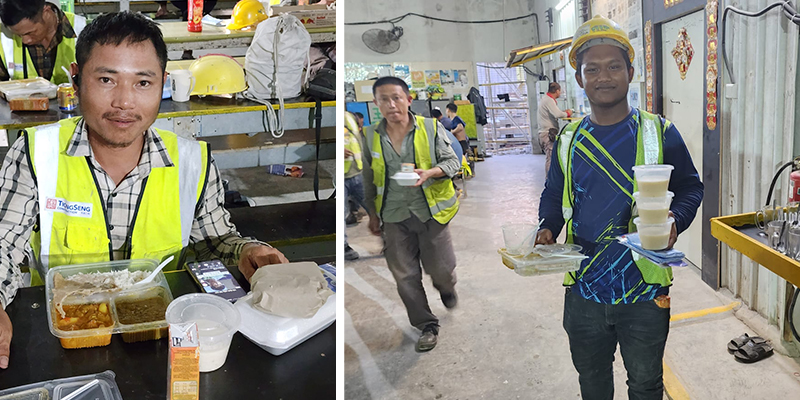
Ride 2 Serve distributed vegetarian meals to 400 migrant workers in Singapore in conjunction with Vaisakhi
By Asia Samachar | Singapore |
Ride 2 Serve, a Sikh cyclist group which conducts an annual cycling event from Malacca to Singapore to raise funds for Sikh Welfare Council (SIWEC), brought Vaiskahi cheer to some 400 foreign workers on Saturday.
The outfit cooked and distributed vegetarian meals to the migrant workers in Singapore.They were from multi-nationality and ethnicity including Tamils, Bangladeshis, Chinese, Burmese and Vietnamese.
“In conjunction with Vaisakhi 2023, our team of volunteers started preparing dinner at Yishun Sikh Temple at as early as 2pm. Pure vegetarian meals with both ‘capatis’ and flavoured rice plus ‘dhaal’ and mixed veg curry accompanied by “Kheer” (desert) and packet drinks brightened up the otherwise monotonous routine diets of the construction workers; they enjoyed our donated meals during their break in between strenuous hours of overtime work on a Saturday evening with a Big Smile!,” the outfit said in a social media entry.
ASIA SAMACHAR is an online newspaper for Sikhs / Punjabis in Southeast Asia and beyond. When you leave a comment at the bottom of this article, it takes time to appear as it is moderated by human being. Unless it is offensive or libelous, it should appear. You can also comment at Facebook, Twitter, and Instagram. You can reach us via WhatsApp +6017-335-1399 or email: asia.samachar@gmail.com. For obituary announcements, click here.
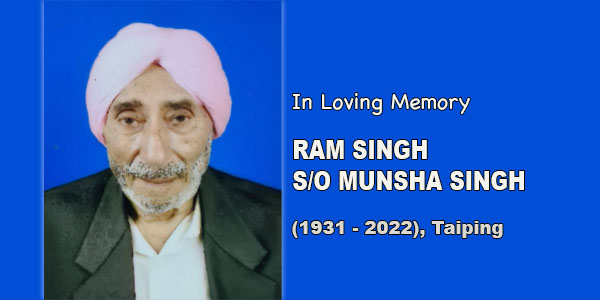
Kindly treat this as a personal invitation from the family.
| Entry: 10 May 2023 | Source: Family
ASIA SAMACHAR is an online newspaper for Sikhs / Punjabis in Southeast Asia and beyond. When you leave a comment at the bottom of this article, it takes time to appear as it is moderated by human being. Unless it is offensive or libelous, it should appear. You can also comment at Facebook, Twitter, and Instagram. You can reach us via WhatsApp +6017-335-1399 or email: asia.samachar@gmail.com. For obituary announcements, click here
British twin Sikh brothers Jarnail Singh Gill and Jabarjang Singh Gill at Muay Thai Boxing Championship in Bangaluru in May 2023
By Asia Samachar | India |
British twin Sikh brothers Jarnail Singh Gill and Jabarjang Singh Gill have once again emerged champions in their respective categories at the World Boxing Council (WBC) Muay Thai Boxing Championship.
The brothers from Leeds, England, known as the Twin Stallions, won in style at the fight at Bangaluru on Saturday (May 6).
Jarnail knocked out his opponent in the second round in the u-16 super-welterweight fight while Jabarjang KO’d his opponent in first round fight under the u-16 super-lightweight category.
In 2022, Jarnail was crowned new International Boxing Federation (IBF) sanctioned u-16 Muay Thai Boxing Champion in the lightweight category while Jabarjang won in the u-16 bantamweight.
ASIA SAMACHAR is an online newspaper for Sikhs / Punjabis in Southeast Asia and beyond. When you leave a comment at the bottom of this article, it takes time to appear as it is moderated by human being. Unless it is offensive or libelous, it should appear. You can also comment at Facebook, Twitter, and Instagram. You can reach us via WhatsApp +6017-335-1399 or email: asia.samachar@gmail.com. For obituary announcements, click here.
I believe the love of learning does not just open doors to unknown knowledge but also to unknown possibilities and undiscovered capabilities.
I’m Rajinder Kaur and I work as a software engineer. I was never set to become a software engineer. In fact, if you had asked my younger self, she wouldn’t even know what it meant. My journey to becoming a software engineer has indeed led me to the above belief.
I was born in Punjab and grew up partly in West Bengal and Punjab. I was a high achiever in school and loved learning. I stopped studying at the age of eighteen after I got married. Marriage at an early age was quite normal at that time. The mindset of investing in girls’ education mainly to increase the chances of achieving a good marriage was also quite common for when and where I grew up. I’m glad to see this change over the years and it fills me with joy when I see young girls from back home who are full of dreams and have big career aspirations. I lacked such exposure and role models to be career oriented, nevertheless, my love of learning motivated me to seek ways to continue my education after marriage.
With some plans scrapped at ideation, my first concrete attempt was to work towards a correspondence degree while I was still in India. I decided to study Psychology as I found it most interesting out of the limited options that were available. However, I wasn’t able to sit the in-person examinations due to some personal circumstances so I had to discontinue the course after only a year.
A few years later, when I was living in the UK, I came to know of the Open University, a distance learning university. It had been six years since I’d left school but I still had the desire to study further. My husband and I were running a small retail business at that time and had a toddler daughter therefore, remote learning seemed like an ideal option. By this time, I also felt I had a responsibility to be a good role model to my daughter. I wanted her to watch me take action to achieve my goals and learn not to give up on one’s dreams.
A nice problem to have this time was that there were so many options to choose from. Having recently heard of some big IT companies and some interest in computing, I decided to register for a BSc in Computing and IT to increase my prospects of getting a good job in the tech industry, although I didn’t have much of a sector insight.
The next few years were a difficult journey of juggling my time between family, business and studying, especially because it was during a phase when we were trying to settle in a new country and grow both our business and our family. It meant that I had to take some gaps in studying, however, I would always return to it as soon the circumstances were favourable. I would often register for two (once even braved three!) modules to make up for the lost time.
So, attaining the degree required a lot of hard work, resilience, and tenacity. I attracted both positive and negative opinions from the people around me. Whilst some were inspired by my perseverance, others believed there is no reason for me to study and some even questioned my commitment to our business and family.
Millions of opinions, hundreds of late-nights, eight years, two additional businesses and one more child later, I finally completed my degree with first class honours. My family was extremely proud of me and I was filled with confidence and gratification, however, I didn’t know the work was not yet done.
I had enjoyed the few coding modules I did during the degree, and I had got interested in becoming a software developer. Since I met all the requirements listed on the entry level job descriptions, I felt certain and confident that I’ll be able to secure a job soon. Unfortunately, that confidence was shattered piece by piece with every job rejection, or by what happened most of the time – no response at all.
Unlike some people I can’t give you the exact number of applications I made before I got my first job, but it was far too many to count back. Nevertheless, it took me over a year of rejections to understand that as an immigrant brown female looking to break into the tech industry, I was not going to be hired on potential – I needed more specific skills.
For that reason, I joined a 12-week software developer coding bootcamp. This journey was difficult for me in the literal sense as the commute to the place was 4-5 hours on a good day, which was a struggle on top of the intense nature of the course. However, it was worth it as I got my first software developer role within weeks of completing the bootcamp!
I have since worked in different roles as a software developer and being in a profession where continuous learning is essential keeps me motivated. I’ve picked up so many qualities and skills on my journey so far as a positive side effect of managing business, education and family simultaneously. I’m looking forward to all the more learnings I’ll gain from my career and I’m excited to see the new possibilities and capabilities I’m yet to discover.
(Leeds-based Rajinder Kaur was a TechWomen 100 Award 2021 winner and a panelist at the Reframe Women In Tech Conference 2023)
ASIA SAMACHAR is an online newspaper for Sikhs / Punjabis in Southeast Asia and beyond. When you leave a comment at the bottom of this article, it takes time to appear as it is moderated by human being. Unless it is offensive or libelous, it should appear. You can also comment at Facebook, Twitter, and Instagram. You can reach us via WhatsApp +6017-335-1399 or email: asia.samachar@gmail.com. For obituary announcements, click here.
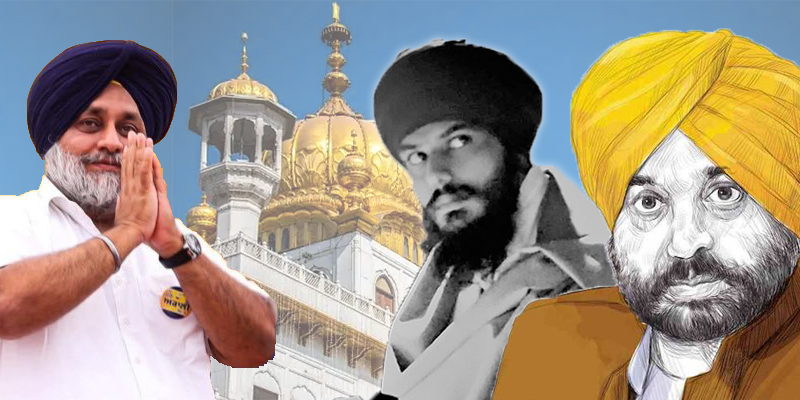
L-R: Sukhbir Singh Badal, Amritpal Singh and Bhagwant Singh Mann. Insert is Akal Takht
By Karminder Singh Dhillon | The Sikh Bulletin |
The 20th of February 2022 was a day that changed the political landscape of Punjab’s politics. The two powerful and long standing parties that took turns ruling Punjab for as long as one can remember – The Akali Dal and Congress – and their traditional allies – were trashed by the people in a way unheard of. The once powerful Akalis and Congress were decimated – leaving them with 4 and 18 seats respectively within the 117-member Assembly. The new kid on the block – Aaam Admi Party (AAP) led by Bhagwant Singh Maan won a thumping 78% of the seats – securing 92 seats.
In any other democracy, life would have gone on with a sense of normalcy that can be surely accorded by a party that has a comfortable 4/5ths majority. But not in Punjab. The losers that are the Akalis were not happy that they had only won 4 seats and that all their leaders had lost. Most importantly, they were not prepared to wait another 5 years to try their luck again. They believed that ruling the Sikh-majority Punjab was their God-given right and theirs alone and that they had to do something to reverse their fate.
Doing something obviously meant doing what they had mastered for decades and become instinctively good at – morchas, dharnas, agitations, mass protests or anything that meant calling on Sikhs to take to the streets to demand whatever the Akalis wanted for themselves – naked power in the name of the Panth and Sikhi. They were masters at wrapping their power designs around the false flags of Sikh dignity, Sikh demands, Sikh rights, Punjab’s Interests, discrimination, and what have you. Sometimes it worked, and sometimes it backfired. But the Akalis knew of no other way – even if their ways took a toll on Punjab’s wellbeing and the State’s stability; and came with a heavy price on those who heeded their calls for morchas and dharnas and ended up in jails or hospitals.
The “taking to the streets politics” of the Akalis also came with a heavy price to the state’s fiscal and developmental health. Funds meant for the development, health and education sectors etc got diverted to restoring law and order. The confidence level of investors plummeted – fresh investment did not want to come in, and existing investors started to relocate to other peaceful states. The outcome is for all to see – the accumulated debt owed by Punjab to the centre at end of 2022 stood at Rs3.3 thousand crore, and virtually every Sikh youth is lined up outside the gates of a ‘Foreign Visa Agent.’
But the Akalis do not know anything other than ugly politics. So why would they try anything different to bring down the government of Bhagwant Maan? So what if there wasn’t anything to protest about, to do a morcha against, or rally people into the streets? The Akalis – with the help of their beneficiary groups across Punjab would create that pretext, generate that ruse, manufacture the ploy, and then point to their self-created stunt and demand that the people of Punjab take to the streets to demand that the AAP government resign on account of that subterfuge.
This is where Amritpal Singh came in. It is difficult to perceive that a previously unknown individual leading an equally unknown mosquito party can do all that he managed to in a short span of time – rally support on the claim that he was a reincarnate of Bhindranwala, lead thousands to attack the Ajnala Police Station to free his jailed comrades, and declare himself as the defacto leader of Sikhs and call for a separate state – without the support of the major established powers of Punjab. That the dera of Bhindranwala embraced and threw their support behind him, that the Akalis came out in full force to condemn the Maan government for their inability to prevent the disturbance that was Amritpal, that the Akaal Takhat came out in support of him, and that he had managed to stage a drama of escape, eluding arrest and then staging his surrender – all point to the fact that Amritpal was not acting alone in the disorder that he and his Vaheer was bent on creating.
When The Akal Takhat Gets Politicized.
The Jathedar of Akal Takhat issued a statement with a list of demands to the Maan government and instructions to Sikhs in Punjab. He called for the release of “our youth in 24 hours and the abandonment of NSA.” He called on SGPC and Delhi Committee to file court cases against those who damaged police cars, and against TV channels who spread anti-Sikh hatred. He called on the government to lift all media restrictions, and for He called on Sikhs to fly the Khalsa Flag on their homes. He announced that the AT would arrange a Vaheer.
CM Maan in his response hammered home the point of politicization. He wrote: Jathedar Sri Akal Takat ji. Everyone knows that you and SGPC are mouth pieces of the Badals. Look at the past to see how Jathedars were used by the Badals to serve their own ends. Would have been better had you issued an ultimatum during the episode of the Missing Saroops and Disrespectful Incidences of the SGGS and not to instigate the happily residing residents of Punjab.
Bhagwant Singh Mann swearing in ceremony as 18th chief minister of Punjab on 16 March 2022 – Photo: Bhagwant Mann Facebook page
He issued a statement that was carried by the local newspapers. One such report reads: “The decision on who is innocent or guilty will be made by the law and courts of the country. The government will not change its decisions based on the call by a Gurdwara Sahib Granthi. The laws of the country are the same for all and no one has the right to interfere in the workings of the government. Those who do so will be severely dealt with. Punjab is part of India, and action will be taken against any person, be it Amritpal or anyone else them who indulges in talk to secede the state from India. If the Jathedar of AT were to give statements against the interest of India, then lawful action can be taken against him.”
The CM has exposed the fact that the strategies of the AT – Vaheer and flag especially – are meant to rile up Punjab to bring down his government at the behest of the Badals who cannot wait for the next cycle of elections to get back in power. The Badals were expecting the AT to continue where Amritpal left off. Politics will always be politics – but at the end of the day, what matters is that the position of the AT has gone down yet another notch. For whatever it is worth, the Jathedar did respond: “Bhagwant Maan ji. I represent the Sikhs just as you do Punjab. I have a right to speak on behalf of the innocent youth of my community as much as the responsibility. You have rightly said that innocent religious people often get used by politicians, but I am fully aware in this regard. But you need to pay attention that in the process of making political hay, politicians such as you don’t get used by politicians by turning Punjab into a cauldron of fire. Let’s discuss politics later. First let’s come together to save Punjab, return innocent jailed youth to their mothers awaiting them in their homes and get their blessings.”
The fact remains that asking Sikhs to fly a flag that is not the legal flag of India and not the Nishan of the Khalsa is wrong, illegal, and anti-nationalistic. Most of all – it is an unnecessary and unwise call. What can possibly be achieved from such a call other than proving fodder to the anti-Sikh elements who will say “see, these are the seeds of separationist tendencies being planted by AT.” Instead of de-escalating the situation, such a call is adding fuel.
As for calling the Vaheer to be initiated from AT – this is clearly political as the AT is allowing itself to be used by all the Anti AAP and Maan groups – the Badals, Dhummas and BJP. The Vaheer has no purpose other than attempting to show that large swaths of people are anti AAP and Bhagwant Maan government. A Vaheer getting out of hand and out control is a real possibility – with or without provocateur agents. The Vaheer was the root of the problem with Amritpal. And now AT wants to take over this law and disorder movement?
If the AT goes ahead with the above two hukms – the outcome will be 1) a worsened law and order situation caused by the Vaheer and 2) more arrests. The police will be arresting those who fly the flag on charges of activities against the state or other related offenses.
One does not have to be a rocket scientist to know that these are the two issues the anti-Sikh media is going to harp on.
How a meeting called to resolve the Sikh Panth’s most pressing challenge of the day succeeds in coming up with a list of shaky resolutions within a couple of hours can only happen if (a) the list of resolutions were prepared by some other party and handed over to the AT Jathedar to read out; (b) the job description of the invited attendees is to let out Jaikaras at the end of every sentence and (c) there was no debate, discussion, deliberation on the resolutions with the exception of speeches by some invited speakers.
The most telling sign was that the Jathedar did not have his heart and soul into the resolutions. He did not even understand them. For example, when demanding that the social media accounts of Sikh youth be restored in 24 hours, he said “new ones will be set up if they are not.”
It is obvious the resolutions were drafted by the Badals. They want their social media accounts restored. They are interested in freeing Amritpal’s gang. And the Vaheer is a Badal vehicle to rile up Sikhs, cause disorder and bring down the government. The Badals want the AT to call for and lead the Vaheer in order to continue where Amritpal left off.
The duly elected government of Punjab under CM Maan should be allowed to serve its full term – even if only to honor the decision of the people of Punjab to put this government in power. The Akalis, Badals, Congress and BJP must wait till the next elections to see if the people want to give them a chance again or re-elect the AAM government. All acts to destabilize the state government must be stopped by the authorities. The Nattak of Democracy in Punjab must end.
Sikh thinker, writer and parcharak Karminder Singh Dhillon, PhD (Boston), is a retired Malaysian civil servant. He is the joint-editor of The Sikh Bulletin and author of The Hijacking of Sikhi. This article appeared as the editorial of the The Sikh Bulletin – 2022 Issue 3 (April-June 2023). Click here to retrieve archived copies of the bulletin. The author can be contacted at dhillon99@gmail.com.
ASIA SAMACHAR is an online newspaper for Sikhs / Punjabis in Southeast Asia and beyond.Facebook | WhatsApp +6017-335-1399 | Email: editor@asiasamachar.com | Twitter | Instagram | Obituary announcements, click here
One of the main reasons why people are drawn to fake Godmen is the prospect of all kinds of miracle cures for any range of physical, psychological, financial and family problems. At best these men, through a listening ear, can provide counselling and perhaps even raise your spirits, and at worst, they may fleece you for whatever financial security you have and perhaps even subject you to all kinds of sexual abuse (see my article in Asia Samachar for more detailed expositions on such individuals, ‘Time to declare Jihad on criminal Godmen’, June 23, 2022, and ‘Miracles and Godmen’, July 31, 2020 ).
I know that in what some term the post-enlightenment period, it has become fashionable to denigrate science and promote new age fads, I would like to warn against ‘throwing the baby out with the bath water’. Like any other field, science and medicine progress through getting things wrong, learning from those mistakes, and gradually improving their knowledge. This can be a slow process but it is the best way we have for moving forward as a species. But that does not mean that science can or should seek to answer all questions. For example, whilst a scientist may answer how our body works, or if you like, how we exist, they will not see their role to answer why we exist. Such questions, rightly so, should be left to poets, philosophers, theologians and you and I!
Scientific methodology is based on a materialist or mechanistic view of the world. That is to say, scientists are not interested in metaphysical explanations for the way ‘things’, ranging from single cells in the body to black holes across the cosmos, operate. For sure the field of quantum physics has opened up all kinds of new challenges and possibilities that will require us to revise our conception of ‘the physical’, but it is the case that most scientists, especially in the medical field, do not operate at the quantum level; their main concern is how to treat sickness and how to improve physical and mental wellbeing.
Whilst there is still a big problem with the overprescription of drugs, over the past few years we have seen a shift in medicine towards what is termed ‘social prescribing’. Social prescribing is an approach that involves linking patients with non-medical resources and support, often within their local community. Rather than relying solely on medication or traditional medical treatments, social prescribing encourages healthcare providers to work with patients to identify and address the underlying social, economic, or environmental factors that may be contributing to their health concerns. This can include connecting patients with community-based organizations, support groups, exercise programs, mental health services, or other resources that may improve their quality of life and reduce their reliance on medical interventions. The goal of social prescribing is to promote a more holistic and personalized approach to healthcare that addresses the multiple factors that influence a person’s health and well-being.
Another field within medicine that is making significant inroads into improving physical and mental health is to see the connection between the two. Quite literally the way we feel about our health can have real physical impacts. For centuries, we have known about the placebo effect, a phenomenon in which a person experiences a positive response to a treatment that has no therapeutic effect on its own. The placebo effect is not a trick or a fraud, but rather a genuine and complex psychological and physiological response that is still not fully understood. It is thought to be influenced by a range of factors, including the person’s expectations and beliefs about the treatment, the context in which the treatment is administered, and how it is administered, including, such things as the colour of pills and the dress and demeanour of the practitioner, as well as the condition being treated. Indeed, a key influencing factor is the confidence and authority of the healthcare provider, and the level of attention and care given to the patient. One might speculate that where remedies involving ritualism are provided by Godmen, fake or genuine, any positive outcomes are less likely to be due to some divine intervention and more so a combination of the placebo effect combined with the body’s own internal mechanism for repair and recovery. It is a fact that, because of the amazing self-healing properties of the human body, most ailments, do cure themselves over time.
One of the great concerns about poor health, especially in the developed West where, due to car ownership and online communications, people are increasingly engaging in sedentary activities, rather than being active or exercising. Well before modern medical discoveries, the ancients had accrued all kinds of knowledge and wisdom about herbal remedies, the self-healing power of the human body and the importance of physical movement and exercise. However, given the emphasis on manual work, and the need to hunt and gather food, there was no separate concept of exercise; it was just something that was done as a matter of routine and survival.
One of the most interesting new findings about health research is to discover exactly how and why exercise makes us feel good. Research shows at a cellular level when muscles contract, they secrete chemicals into the bloodstream called myokines, which have been referred to as “hope molecules”. These travel to the brain and act as an antidepressant. They do this by improving our mood, and ability to learn and protect the brain from the negative effects of ageing.
The challenge for us all with these discoveries is not to reject science or faith, but to see the physical and mental as part of a whole. When Guru Nanak talked about the divine existing within the human mind and body, perhaps this is precisely what he was getting at!
Gurnam Singh is an academic activist dedicated to human rights, liberty, equality, social and environmental justice. He is an Associate Professor of Sociology at University of Warwick, UK. He can be contacted at Gurnam.singh.1@warwick.ac.uk
* This is the opinion of the writer and does not necessarily represent the views of Asia Samachar.
ASIA SAMACHAR is an online newspaper for Sikhs / Punjabis in Southeast Asia and beyond. When you leave a comment at the bottom of this article, it takes time to appear as it is moderated by human being. Unless it is offensive or libelous, it should appear. You can also comment at Facebook, Twitter, and Instagram. You can reach us via WhatsApp +6017-335-1399 or email: asia.samachar@gmail.com. For obituary announcements, click here.
On the 28th of March, BJP leader Tejinderpal Singh Bagga issued a tweet about the make-up of the word Vaheguru. This is what he wrote.
Wa – meaning the first syllable stands for Vishnu Vasudev from Satyug. The second syllable ‘Hey’ comes from Hri Karishna from Dwapar. The third syllable ‘ Gu ‘ depicts Guru Govind from Kalyug. And the final syllable ‘Ru’ represents Ram from Treta.
His point was that the word Vaheguru was actually constructed from the names of Hindu Devi devatas. And that this was true if the individual letters of the word – the W, the H, the G and the R, were taken into consideration. The root of the word Vaheguru was Snatan. That was, in essence, Bagga’s point.
The next day, the Delhi Minorities Commission (DMC) sent a letter to Shiromani Gurdwara Parbandhak Committee (SGPC). The letter reads, in essence:
Sir, the minorities commission has taken notice of the tweet of Tejinderpal Singh Bagga in which his definition of Waheguru appears to be objectionable, and not as per Sikhsim or Sikh maryada.
I am directed to request you to kindly clarify the meaning of Waheguru as per Sikhism or Sikh maryada. If it is contrary to the tweet of Tejinderpal Singh Bagga, the Minorities Commission will initiate action against Mr Tejinderpal Singh Bagga as per law.
The local newspapers carried the report of the incident. The Rozana Spokesman titled its report: Controversy Through A Tweet Over Vaheguru. Minorities Commission asks SGPC to clarify the meaning of the word Vaheguru.
The SGPC was given two days to respond. It did, and issued a tweet to indicate so. It reads: SGPC was asked to shed light on Sikh principles by the Delhi Minorities Commission after it took offence of a social media post by BJP leader Tajinderpal Singh Bagga within which he compared the word Vaheguru to Hindu Devi Devtas. Information has been sent.
Now, for whatever reason, the SGPC did not reveal the nature or substance of the information it sent. So we won’t know what SGPC said about the definition of the word Vaheguru – until they decide to tell us.
The gist of the essay is that Sikh literature – especially what we mistakenly call “classical sikh literature” is full of untruths about Sikhi. Some 35 primary granths that make up this so called classical sikh literature are overflowing with false assertions and distortions about Sikhi. These 35 primary granths have been composed by Benares trained and benares based nirmlas for the purposes of corrupting, distorting and hijacking Sikhi. Their main objective was to deprive Sikhi of its unique principles, to hollow out Sikhi from within, and to take Sikhi back to 1468 – meaning to take it back to the belief systems that existed prior to the birth of Guru Nanak in 1469. The root objective is to re-instate and re-install, on the pedestal of Sikhi and Gurmat – beliefs that were rejected by Guru Nanak. These so called classical granths – the Janam Sakhis, the Suraj Parkash, the Bansavlinama, Bhagat Maal, Gurbilas Patshahi 6, Sarab Loh – and the whole gamut of it – were written in the 135 year period of 1765 till 1900 – when nirmlas were in control of Sikh gurdwaras and institutions. The Sikh Reform Movement of the 1920s – the Singh Sabha Leher had alerted the Sikh world towards the need to discard, clean out, and rewrite these granths. The argument of the Singh Sabha was that if the Sikh Panth did not do exactly that, these lies, fabrications, concoctions and untruths will become the truths of Sikhi, and worse – they will become the truths of the anti-Sikh elements. Instead of doing what the Sikh Reform Movement asked, the Sikh world – especially our clergy – have accepted these 35 granths as true depictions of Sikhi. The Sikh world has already paid half the price – wherein the lies, fabrications, concoctions and untruths of the so called classical granths have become rooted as the truths of Sikhi. Now we are beginning to pay the greater price where these lies are becoming the truths of anti-Sikh elements.
This essay (and video) seeks to explain the tweet the BJP leader – and the letter of the Minorities Commission – within the context of the lies, the distortions, and the fabrications pertaining to the word “Vaheguru” that are contained within these so called classical texts. Both the tweet and the DMC’s will be examined within the parameters of the lies, distortions and fabrications that are contained within our texts – that have now begun to become the truths of others like this BJP leader Tejinderpal Singh Bagga and the DMC.
IT’S EVERYWHERE
Now, if we ask the Sikh world as to what the name of God that was given to us by Guru Nanak or by Gurbani within the Sri Guru Granth Sahib (SGGS) ji is; a full 100 percent of Sikhs will say the word is Vaheguru. You will agree that this word is everywhere in Sikhi. It is sung, it is chanted. It is recited. It is printed, framed and hung. It is tattooed. It is everywhere and in every thing. Every Sikh accepts the word Vaheguru as given to us by our Guru, by Gurbani, by the SGGS ji – as the name of God.
Our clergy – our ragis, kirtanias, granthis, parcharaks, dhadees, our writers, thinkers, poets etc have presented us evidence of this. Here is one piece of the evidence.
ਸਾਰ ਮੰਤਰ ਚਾਰੌ ਕਾ ਚਾਰ। ਵਾਹਿਗੁਰੂ ਮੰਤਰ ਨਿਰਧਾਰ॥ ਕਲਪ ਕਲਪ ਪ੍ਰਤ ਅਖਛਰ ਕਹੀ। ਸਰੀ ਗੁਰੂ ਨਾਨਕ ਜਪਾਯੋ ਸਹੀ। Sar Mantar Charon Ka Char. Vaheguru Mantar Nirdhar. Kalap Kalap Prat Akchar Kahi. Sri Guru Nanak Japayeo Sahi. The translation: The supreme mantar for the four ages. Vaheguru mantar is the savior. Contemplation upon contemplations resulted in the putting together of its alphabets. Guru Nanak put the alphabets together and Guru Nanak caused it to be chanted. Meaning that it was Guru Nanak who gave us the word Vaheguru as the name of God and gave it to the world for chanting. Very convincing indeed. What we call solid proof. Indisputable evidence.
There is, however one major problem with this evidence. The problem is that these “verses” are not Gurbani. They do not exist within the SGGS. They are taken from one of the 35 granths of our so called classical Sikh literature I mentioned above. The name of the granth which contains these verses is Sarab Loh Granth – literally, the Complete Iron Granth. The message of these verses from within this “Complete Iron Granth” contradict the messages of Gurbani. Why do I say that?
YET, IT’S NOWHERE
Well, Guru Nanak has 947 shabds comprising some 5,600 verses in the SGGS. How many times do you think he used the word Vaheguru in these shabds and verses. The answer is zero times. Not at all. Not once.
So if Guru Nanak did NOT use the word “Vaheguru” even once in his entire bani – not for God, not for anything at all, how could he have undertaken “contemplation upon contemplations that resulted in the putting together of its alphabets?” ਕਲਪ ਕਲਪ ਪ੍ਰਤ ਅਖਛਰ ਕਹੀ। Kalap Kalap Prat Akchar Kahi. If Guru Nanak did not use the word “Vaheguru” even once in his entire bani how could he have “caused it to be chanted” as is the claim in the Sarab Loh Granth? ਸਰੀ ਗੁਰੂ ਨਾਨਕ ਜਪਾਯੋ ਸਹੀ। Sri Guru Nanak Japayeo Sahi.
So the assertions of the so called classical granth – that Vaheguru was the supreme mantar for the four ages; that Vaheguru was the savior mantar; that contemplation upon contemplations resulted in the putting together of its alphabets; that Guru Nanak put the alphabets together and that Guru Nanak caused it to be rightly chanted is fake, is an untruth, is a concoction, a distortion. It sounds painful, but that is perhaps why the adage exists that the truth hurts.
So Guru Nanak did not use it even once in his entire bani within the SGGS. What about Guru Angad ji. The second Guru has 63 Saloks comprising some 250 verses. He, too, did not use the word “Vaheguru” even once in his entire bani – not for God, not for anything at all.
Guru Amardas ji has 869 shabds comprising some 5,100 verses in the SGGS. He did not use the word Vaheguru even once.
The fourth Guru Ramdas ji has 638 shabds comprising 3,800 verses. He, too, did not use the word “Vaheguru” even once in his entire bani – not for God, not for anything at all.
The fifth Guru Arjun ji has the most voluminous bani in the SGGS – 2313 shabds comprising some 13,900 verses. He did not use the word “Vaheguru” even once
The ninth Guru Tegh Bahadur ji has 115 shabds comprising some 690 Verses. He, too, did not use the word “Vaheguru” even once in his entire bani.
All 15 Bhagats combined have 788 shabds comprising some 4,000 Verses. Three Sikhs have 11 shabds comprising about 100 Verses. None of them used the word “Vaheguru” even once in their entire bani – not for God, not for anything at all.
So the total for Gurus, Bhagats and Sikhs is 5714 shabds comprising some 30,000 Verses – within which the word “Vaheguru” does not appear even once.
CLASSICAL GRANTHS
But All the 35 so called Classical Granths – all composed by nirmlas from Benares – but now accepted as Sikh Classical Literature – tell us that the name of God within Sikhi is Vaheguru. And then they tell us about the greatness of the word Vaheguru. Nirmla Kavi Santokh Singh tells us of the greatness in his granth – the Sooraj Parkash. The Sooraj Parkash Granth is the most massive and most voluminous granth that covers the life of all 10 Gurus – and is a collosal, enormous source of distortion, corruption and false hoods about Sikhi. Its author, Nirmla Santokh Singh has the following composition in his Sooraj Parkash Granth telling us that the word Vaheguru is composed from alphabets taken from the names of Hindu gods. He writes:
ਵੱਵਾ ਵਾਸਦੇਵ ਸੇ ਲੀਨੋ। Vava Vasdev Say Lino. Meaning: The letter “Vava” was taken from Vasdev. ਹਰੀ ਬਿਸਨ ਤੇ ਹਾਹਾ ਚੀਨੋ। Hari Bisen Tay Haha Chino. The letter “Haha” from Hari Vishnu. ਗੱਗਾ ਗੋਬਿੰਦ ਤੇ ਲੇ ਜਾਨੋ। Gagga Gobind Tay Lay Jano. Gobind provided the letter “Gagga”. ਰਾਰਾ ਰਾਮਚੰਦ ਮਨ ਮਾਨੋ । ੬੬। Rara Ramchand Mun Mano. and “Rara” came from Ramchand.
The next couplet advocates the benefits of doing such an act. ਚਤੁਰ ਬਰਨ ਕੋ ਏਕ ਬਨਾਯਾ। Chatur Barun Ko Eyk Bnaya. Meaning: The four letters (Vava, Haha, Rara and Gagga) were put together to create the word (Vaheguru). ਫਲਦਾਇਕ ਇਹ ਅਧਕ ਸੁਹਾਇਆ। ੬੬। Fuldayek Eh Adhuk Suhaya. Meaning: It is an extremely useful, productive and beautiful word. ਚਤਰ ਨਾਮ ਸਿਮਰਨ ਕਯ ਏਕੂ। Chatur Nam Simran Kaiy Eyku. Meaning: Chanting this one word allows for the chanting of four names – Vishnu, Krishen, Ramchander and Govind.ਉਰਧਾਰੇ ਜਿਸ ਹੋਤ ਬਿਬੇਕੂ। Meaning: Urdharey Jis Hoat Bibeku. One who chants with focus will obtain wisdom.
The nirmlas did more than just writing scores of granths that distorted, corrupted and adulterated Sikhi concepts. They also corrupted other non-nirmla Sikh literature by fraudulently adding their own stuff to writings such as Rehatnamas and the writings of Bhai Gurdas ji. They could do all of this with impunity because they controlled our Gurdwaras, our institutions, our history, our literature and by extension the Sikh psyche for 250 years.
BHAI GURDAS
For example, lets take a look at the first Vaar of Bhai Gurdas ji.
The Sikhi related subject matter of Vaar 1 for instance, as can be expected – begins with the coming of Guru Nanak from para 23 onwards: ਗੁਰ ਨਾਨਕ ਜਗ ਮਾਹਿੰ ਪਠਾਯਾ॥ Guru Nanak Jug Mahe Pthaya. Meaning: The Advent of Guru Nanak. The next 25 paras outline the life and travels of Guru Nanak – both within India and outside. The next three paras talk about the succession of Guruship from Guru Nanak to Gurus Angad, Amardas, Ramdas, Arjun and Hargobind.
The final para then – pauree number 49 – out of nowhere – suddenly brings in Vishnu, Krishen and Ramchander. One wonders if Bhai Gurdas’ writing style is so disjointed that he parachutes these unrelated entities into his first Vaar. It is clear that this final para is added on by someone. It is smuggled into his writing by some one. Anyway the full final para is reproduced below:
Sikhs are expected to believe that this is Bhai Gurdas – the Sikh luminary and Sikh philosopher explaining the makeup of the word ਵਾਹਿਗੁਰੂ Vaheguru by breaking it down to the letters ਵ, ਹ, ਗ, ਰ or V, H, G and R.
V came from: The Satguru of Satyug Vasdev Vishnu. H from: The Satguru of Duapur – Hri Krishen. R from: The Satguru of Treyta – Ramchander. G from: Gobind of Kaljug.
We are further expected to accept that Bhai Gurdas then declares that Guru Nanak combined the four letters into Vaheguru and caused the mantar of Vaheguru to be chanted by the world: Charon Achur Ek Kar Vaheguru Jup Mantar Jpavey. Meaning: The four letters were combined into Vaheguru and caused to be chanted.
The degree of anti-Sikhi, anti-Gurmat and anti-Gurbani content of this one para is staggering. The more pertinent mind-boggling questions are as follows:
1) Would the real Bhai Gurdas ever refer to Vishnu, Krishen and Ramchander as “Satguru”? Were these three the Satugurs of Bhai Gurdas ji? Who else but a benares trained and benares based nirmla could infiltrate such a claim into the writings of Bhai ji?
2) Would the real Bhai Gurdas ever decide to NOT use the word “Satguru” for Guru Nanak and Guru Gobind? Everyone else is Satguru, but when it comes to Guru Nanak – its just ਕਲਿਜੁਗ ਨਾਨਕ Kaljug Nanak. Is this characteristic of Bhai Gurdas?
3) The letter H comes from Krishen? Really? How did a name that begins with K – Krishen – end up producing a Haha – a H. Surely Bhai Gurdas ji would do no such ridicolous thing.
4) How did the real Bhai Gurdas know that Guru Gobind Singh ji would be the final Guru in the Nanak lineage? He says ਕਲਿਜੁਗ ਨਾਨਕ ਗੁਰ ਗੋਬਿੰਦ ਗਗਾ ਗੋਵਿੰਦ ਨਾਮ ਜਪਾਵੈ॥ Kaljug Nanak Gur Gobind Gaga Govind Nam Jpavey. Bhai Gurdas passed on during the era of the sixth Guru. This is evidence that this para was composed and added on after the era of Guru Gobind Singh ji.
5) Why would the real Bhai Gurdas write a lie under his name that “Guru Nanak caused the mantar of Vaheguru to be chanted“? ਚਾਰੋਂ ਅਛਰ ਇਕ ਕਰ ਵਾਹਿਗੁਰੂ ਜਪ ਮੰਤ੍ਰ ਜਪਾਵੈ॥ Charon Achur Ek Kar Vaheguru Jup Mantar Jpavey. He knew that Guru Nanak did not use the word Vaheguru even once in his entire bani in the SGGS. Neither did Gurus Angad, Amardas, Ramdas and Arjun. Neither did any of the 15 bhagats. (Even Guru Teg Bahadur ji did not use it even once).
6) Bhai Gurdas ji knew that our Gurus had rubbished the notion of satjug, duapur, treyta and kaljug as being periods of times or eras. So why is he mentioning them in every verse of this final pauree? Bhai ji was aware that Guru Nanak had critiqued such a notion in Asa di Vaar.
All the above six points are dead give-aways that this final pauree – pauree number 49 – is added on much later by the nirmlas in their attempt to adulterate and corrupt Sikhi. The real Bhai Gurdas could not be the author of such deeply problematic verses. He could not have authored this paurri. The other point worth noting is that this paurri is found in nirmla literature – especially the Suraj Parkash of Nirmla Santokh Singh – albeit with minor differences.
There is plenty of distortion and corruption of the other 39 Vaars of Bhai Gurdas ji as well. A large portion of the subject matter of his vaars is contrary to Gurmat and Gurbani. This is a matter for Sikh writers, intellectuals and researchers to take up.
GOD’S NAME IN SIKHI
Then, there is the issue of God’s name in Sikhi. The foundational principle regarding God’s name is found in this verse on page 1,083 of the SGGS.
ਕਿਰਤਮ ਨਾਮ ਕਥੇ ਤੇਰੇ ਜਿਹਬਾ ॥ ਸਤਿ ਨਾਮੁ ਤੇਰਾ ਪਰਾ ਪੂਰਬਲਾ ॥ Kirtem Nam Kthay Tayray Jehba. Sat Nam Tera Pra Poorbla.
Meaning: All the names that I utter (ਕਥੇ ਤੇਰੇ ਜਿਹਬਾ Kthay Tayray Jehba) are descriptive of your virtues (ਕਿਰਤਮ ਨਾਮ Kirtem Nam ). Your foundational (ਪਰਾ ਪੂਰਬਲਾ Pra Poorbla) virtue (ਨਾਮੁ Nam) is that you are eternal and permanent (ਸਤਿ Sat ) .
So we can derive the following 9 foundational principles pertaining to the name of God.
1. He has no proper name.
2. His names are given by his children (Bhagats).
3. All His names are “Kirtem” – desciptions of His perceived virtues (adjectives).
4. ALL such perceived virtues are acceptable.
5. One Virtue cannot be superior than the other.
6. His primary virtue within Gurbani is ਸਤਿ Sat from the Sanskrit ਸਤਯ Satya – meaning: permanently in existence. The GGS thus begins with ੴ ਸਤਿ ਨਾਮੁ. ੴ Sat Nam. This virtue is considered primary because if we don’t accept that He is indeed in existance, then the other virtues become irrelevant.
7. The debate of His “one” name is futile & Rejected. Because we humans created all His names.
8. All names are acceptable.
9. All names are used in the GGS. From the Puratan tradition we have Har, Raam. From the Muslim tradition Allah, Raheem and Khuda are used. From the Yogi tradition we can find Alakh and Niranjan. From the Bhagti tradition we have Beethal and Raiya. And from the personal tradition we can find, amongst others – Pita, Mata, Pritam, Priya, etc.
We have, on page 727 of the SGGS, a composition that uses a variety of names for God within just one shabd.
Mein Andhley Kee Tek Tera Nam Khundkara. Mein Gareeb Mein Maskeen Tera Naam Hai Adhara. Rahao. Kareema Raheema Allah Tu Ganee. Hazra Hazoor Dar Pesh Tu Mnee. Dariyao Tu Dihend Tu Bisiar Tu Dhnee. Deh Leh Ek Tu Digar Ko Nahi. Tu Dana Tu Bneena Mein Bichar Kya Karee. Namey Chey Suami Bhakshand Tu Hari.
There are many other such shabds. But the 35 so called classical texts first, and now our clergy who are schooled in these so called classical texts, and our deras and taksals – which are steeped in nirmla thought and who train and produce our clery based on these nirmla texts – insist that in the Sikh world, Vaheguru is the name for God.
SHABDS OF THE BHATTS
These clergy point to 4 shabds of the Bhatts who use the phrase Vah Guru and Vahe Guru. So who are the Bhatts? Here are the basics about the Bhatts. The word Bhat translates as bards, songsters, lyricists, poets. There were 10 of them who were followers of Krishen ji before they came before Guru Arjun ji in search of their spiritual objectives. They are said to have stayed in the sangat of the Guru for 2 years. They composed Bhatan dee Banee – 123 Saveaye (paragraphs) in total, across 20 pages. All of their bani is in praise of the Guru (Shabd). The phrase Vahe-guru & Vah-guru used in 4 of the 123 paras.
Here is one. ਵਾਹਿਗੁਰੂ ਵਾਹਿਗੁਰੂ ਵਾਹਿਗੁਰੂ ਵਾਹਿ ਜੀਉ ॥ Vaheguru Vaheguru Vaheguru Vahe Jio. The meaning of it is: O Guru ! Wondrous Guru ! Magnificient Guru ! Wow !
Sat Sach Sri Niwas Ad Purakh Sada Tuhi Vaheguru Vaheguru Vaheguru Vahe Jio. SGGS 1402.
Meaning: The Creator Whose Existance is Permanent Resides Within You, O Guru ! Wondrous Guru ! Magnificient Guru ! Wow!
Vah means – Great ! Magnificient! Vahe means – O Great ! O Magnificient. Great Guru! Magnificient Guru! Wow Guru!
The phrase Vah Guru is actually a combination of two words from two distinctly different languages; making it improbable to be combined as a proper name. Vah – Persian. Guru – Sanskrit. More importantly, Vah is exclamation !!!!! Its utterance is in-voluntary. So the Bhatts are expressing their wonder at the Guru by saying Vah Guru. To a Sikh, therefore, the word Vah Guru would mean O Guru, O Wondrous Guru.
But the 35 so called classical texts and our clergy who are schooled in these nirmla texts insist that in the Sikh world Waheguru is the name for God.
But the same 10 Bhatts also used “Sri Guru” 9 times, “Sat Guru” 25 times and “Guru Guru” 15 times.
Here are the relevant paragraphs. ਸਿਰੀ ਗੁਰੂ ਸਿਰੀ ਗੁਰੂ ਸਿਰੀ ਗੁਰੂ ਸਤਿ ਜੀਉ ॥ …ਨਾਮੁ ਸਾਰੁ ਹੀਏ ਧਾਰੁ ਤਜੁ ਬਿਕਾਰੁ ਮਨ ਗਯੰਦ ਸਿਰੀ ਗੁਰੂ ਸਿਰੀ ਗੁਰੂ ਸਿਰੀ ਗੁਰੂ ਸਤਿ ਜੀਉ ॥ ੫ ॥ Sri Guru Sri Guru Sri Guru Guru Sat Jio…Naam Sar Heeye Dhar Tuj Bikar Mun Gayand Sri Guru Sri Guru Sri Guru Guru Sat Jio.
And ਸਤਿਗੁਰੂ ਸਤਿਗੁਰੂ ਸਤਿਗੁਰੁ ਗੁਬਿੰਦ ਜੀਉ ॥ …ਨਾਮੁ ਸਾਰੁ ਹੀਏ ਧਾਰੁ ਤਜੁ ਬਿਕਾਰੁ ਮਨ ਗਯੰਦ ਸਤਿਗੁਰੂ ਸਤਿਗੁਰੂ ਸਤਿਗੁਰ ਗੁਬਿੰਦ ਜੀਉ ॥ ੪ ॥ Satguru Satguru Satguru Gobind Jio…Naam Saar Heeay Dhaar Tuj Bikar Mun Gyund Satguru Satguru Satguru Gobind Jio.
In essence then, when the Bhatts use Vaheguru, Satguru, and Sriguru in their bani they are using these phrases to call out or refer to Guruji. They are using these phrases to express Greatness, Magnificence, Awe, Amazement of Guruji.
And when the Bhatts talk of God, they do not use Vaheguru, Satguru or Sri Guru – all of which refer to the Guru. This is what they use when they talk of God: ਅਗਮੁ ਅਨੰਤੁ ਅਨਾਦਿ ਆਦਿ ਜਿਸੁ ਕੋਇ ਨ ਜਾਣੈ ॥… ਨਿਰੰਕਾਰੁ ਨਿਰਵੈਰੁ ਅਵਰੁ ਨਹੀ ਦੂਸਰ ਕੋਈ ॥… ਸ੍ਰੀ ਸਤਿ ਨਾਮੁ ਕਰਤਾ ਪੁਰਖੁ ਗੁਰ ਰਾਮਦਾਸ ਚਿਤਹ ਬਸੈ ॥ ੧ ॥ Agum Anant Anad Aad Jis Koe Na Janey… Nirangkar Nirvair Avan Nahi Dusar Koe….Sri Sat Nam Karta Puirakh Gur Ramdas Chithey Basey.
They refer to God as Nirangkar, Nirvair, as Satnam, and Karta Purakh. These are the same names, descriptive names (Kirtem Naam) that Guru Nanak uses in the Commencing verse of the SGGS.
THE BIG QUESTION
So the question for the writers of the 35 so called classical texts and our clergy is this. If we are going to let the Bhatts decide what the proper name of God is – then why is Sri Guru not the name of God? Why is Satguru not the name of God? Why Vaheguru? After all, ass these three – Sri Guru, Satguru, and Vaheguru are used by the Bhatts on the same one page of the SGGS – all in paragraphs one after another – to refer to the Guru.
For the Benares based nirmlas, it could not be Sri Guru – because it did not have the Vava for Vishnu, and the Haha for Har Krishen. It could not be Satguru either – because it too did not have the Vava for Vishnu and the Haha for Har Krishen. They wanted to infiltrate the Vishu, Krishen and Ram into the psyche of Sikhi at all costs. So it had to be Vaheguru – and they wrote that into their classical texts in ther form of concocted stuff such as that Vaheguru was the supreme mantar for the four ages; that deep contemplation resulted in the putting together of its alphabets and that Guru Nanak caused it to be rightly chanted. This putting together of the alphabets part is the dead give away. The nirmlas were interested in the alphabets – the Vava and the Haha – and in putting them squarely within the parameters of Sikhi.
And they adulterated the first Vaar of Bhai Gurdas ji by adding the final – out of context – paurre that corroborated their own texts.
ANOTHER CONCOCTION
And these hijackers of Sikhi concocted another non-Gurbani term namely “Gurmantar.” They quote a verse from Bhai Gurdas ji (Var 13) which reads: ਵਾਹਿ ਗੁਰੂ ਗੁਰੂ ਮੰਤ੍ਰ ਹੈ ਜਪ ਹਉਮੈਂ ਖੋਈ॥ Wahe Guru Guru Mantar Hai, Jup Haumai Khoee. And mis-interpret to mean: The word Vaheguru Is A Gurmantar. Chant it to eliminate your ego.
This is not the correct translation. The correct interpretation of this verse is: O Wondrous Guru (Vaheguru), You (Guru) are my Mantar, Realizing You (Jup) I have Eliminated My Ego.
There are TWO separate words here: Guru and Mantar. Only if one wrongly considered it as a one word would one come up with – Gurmantar or Gurumantar.
WHEN THEY ACCEPT OUR LIES
I want to conclude by reverting to the tweet by BJP leader Tejinderpal Singh Bagga in which he defines the make up or construction of the word Vaheguru. You will agree with me that he has accepted our lies as his truths. The lies within our Suraj Parkash, within our Sarab Loh and 33 other granths have become Bagga’s truths. In other words, Tejinderpal Singh Bagga has accepted – as his truths – the distortions, corruption and concoctions that are contained within our so called nirmla composed classical granths. And that is because we Sikhs allowed these distortions, corruption and concoctions to stand. We, Sikhs, accepted these so called classical granths, made them into our textbooks, wrapped them in rumalas, carried them on our heads, put them under palkees and chananees (canopies), and did their katha in our gurdwaras. In other words, we, Sikhs, sanctioned the lies of the benarasi nirmlas. We put a stamp of approval on these lies.
What about the letter by the Delhi Minorities Commission to SGPC? Is this letter really what it appears to be – genuinely giving SGPC and Sikhs a chance to explain the word Vaheguru? Or is it asking Sikhs to admit that the lies and fabrications contained within their classical texts have caught up with the rest of the world? Is the letter really wanting evidence to take action against Bagga of BJP or wanting to validate Bagga by getting us Sikhs to admit that what Bagga tweeted is according to the Suraj Parkash granth – the one that is carried on the head and discoursed in the Darbar Sahib Complex in Gurdwara Manji Sahib on a daily basis?
There are thousands of anti Sikhs tweets and posts daily. But to take one tweet and within 24 hours ask SGPC to respond in 48 hours is the display of concern and efficiency than cannot possibly be to the benefit of Sikhs.
Finally, what Tejinderpal Singh Bagga of BJP has exposed is just one lie that is found in Sikh classical literature granths – all of which are written by the Benarsi nirmlas. By my own count there are tens of thousands more such lies waiting to be exposed and flung at us Sikhs to challenge the notions that Sikhi is unique indeed. The Sikhi of the SGGS is unique indeed. It is unadulterated by the pre 1469 belief systems. But the Sikhi of our classical granths – the Sikhi of Suraj parkash, Sarab Loh, Gurbilas Patshahi 6, etc, is distorted, corrupted and adulterated. The choice is ours if we want to adopt the Sikhi of the SGGS or that of Suraj parkash. It is our choice if we want to adopt the Sikhi of Guru Nanak or that of the Benarsi nirmlas.
ASIA SAMACHAR is an online newspaper for Sikhs / Punjabis in Southeast Asia and beyond. When you leave a comment at the bottom of this article, it takes time to appear as it is moderated by human being. Unless it is offensive or libelous, it should appear. You can also comment at Facebook, Twitter, and Instagram. You can reach us via WhatsApp +6017-335-1399 or email: asia.samachar@gmail.com. For obituary announcements, click here.
SPM Punjabi examination seminar in Ipoh on 28 April 2023 organised by Khalsa Diwan Malaysia – Photo: KDM
By Santokh Singh Randhawa | Malaysia |
The PT3 examination has been dropped since 2020. As a result, the Punjabi paper is only available at SPM level.
There has been a drastic change in the format and syllabus of the Punjabi paper, for example the translation question of Punjabi to Malay and from Malay to Punjabi has been dropped. Besides the Punjabi paper has been reformatted to align with other Languages.
We are proud to note that in the past, our Punjabi Language results, both at PT3 & SPM levels have always been above other Languages and in some years even reached 100% passes.
To upgrade the Punjabi students, Khalsa Diwan Malaysia held two seminars, one for the North Zone at Wadda Gurdwara Sahib, Ipoh on 28th April 2023 and for the South Zone at Club Aman K.L on 29th April 2023.
More than 200 students, attended the said seminars. The teachers teaching the students also attended the said course.
Our experienced and dedicated experts in the relevant fields shared the information and thought the students on answering the questions.
Khalsa Diwan Malaysia is making all out efforts to keep the mother tongue alive and encourage the students to sit for the SPM Punjabi Language examination.
In our efforts, we solicit the support and encouragement from the Sikh Community at large. Lets together make efforts to keep our beloved “Boli” alive.
In the Service of Panth.
(Santokh Singh Randhawa is the president of the Ipoh-based Khalsa Diwan Malaysia)
SPM Punjabi examination seminar in Kuala Lumpur on 29 April 2023 organised by Khalsa Diwan Malaysia – Photo: KDM
ASIA SAMACHAR is an online newspaper for Sikhs / Punjabis in Southeast Asia and beyond. When you leave a comment at the bottom of this article, it takes time to appear as it is moderated by human being. Unless it is offensive or libelous, it should appear. You can also comment at Facebook, Twitter, and Instagram. You can reach us via WhatsApp +6017-335-1399 or email: asia.samachar@gmail.com. For obituary announcements, click here.