Indian shooters Sarabjot Singh and Sift Kaur Samra
By Asia Samachar | India |
Farmer’s son Sarabjot Singh and Faridkot medical college student Sift Kaur Samra were two of the Indian stars at the recent International Shooting Sport Federation (ISSF) World Cup in Rifle/Pistol.
They won a gold and bronze, respectively, to help Indian shooters to finish the tourney with one gold, one silver and five bronze medals.
Sarabjot was on target to win the men’s 10m air pistol gold on the opening day of the tournament in Bhopal, Madhya Pradesh on March 22. The 21-year-old shooter was the 2021 Junior World Champion.
Samra won a bronze medal in women’s 50m rifle 3 positions on the final day of the event, her first senior international medal in an individual event.
The 21-year-old Sift Kaur Samra, who won gold at the ISSF Junior Cup last year, scored 102.2 in kneeling, 103.4 in prone and 198.3 in standing for a combined total of 403.9 points in the ranking round to finish third.
The promising rifle shooter is pursuing MBBS at the GGS Medical College in Faridkot, Punjab.
But she’s having a challenging time managing the demands of the medical studies and shooting.
“Manage nahi ho pa raha (unable to manage),” she told The Times of India. “The college (GGS Medical College, Faridkot) is not supportive. I asked them to let me take the exam separately, but they said no, we can’t allow that. So they asking me to repeat my first year of MBBS again.”
ASIA SAMACHAR is an online newspaper for Sikhs / Punjabis in Southeast Asia and beyond. When you leave a comment at the bottom of this article, it takes time to appear as it is moderated by human being. Unless it is offensive or libelous, it should appear. You can also comment at Facebook, Twitter, and Instagram. You can reach us via WhatsApp +6017-335-1399 or email: asia.samachar@gmail.com. For obituary announcements, click here.
Anubis attending Sennedjem’s mummy, c.1292-1187 BC. Ancient Egypt is commonly believed to have been a society enthralled by the notion of eternal life. – Photo: Bridgeman Images
By Gurnam Singh | Opinion |
INTRODUCTION
In today’s fast-paced world, where social media has distinctly compressed our sense of time and space, many of us prioritize the present moment and focus on short-term goals rather than considering the future. In terms of work or study, simply engaging in one task per day has become a relic of some romantic past. Despite the glossy ads extolling the liberatory potential of modern information-based technologies, it seems like our lives have become more controlled and cluttered than ever before.
There is a growing body of evidence that suggests that in our social media-driven world, human happiness is on the decline. Today, armed with smartphones, we have become addicted to the psychology of hyper-connectivity and hostages to the cult of ‘living in the present’. From dawn till dusk, and sometimes even throughout the night, we are engaged in multi-tasking! A seamless connectivity between devices means we almost live our lives in virtual space. It’s not that we don’t care about tomorrow; the problem is we seem to have no time to think beyond the next task.
If as suggested here some people have become entrapped in the here and now, in the other extreme, some are entirely motivated by the prospect of an afterlife. Often driven by strong religious beliefs, the people view life as a test or game, the consequences of which will be determined after physical death.
Ultimately, how we view death and the afterlife, can have a profound impact on our perspectives on existence. It can shape our beliefs about what is important in life, how we choose to live our lives, and how we approach the inevitable reality of our mortality. Whether we choose to live a carefree life or become preoccupied with death, it is ultimately up to us to determine what kind of life we want.
CULTURE OF SHORT-TERMISM
Living in the present can have both positive and negative connotations. Some argue that focusing on the here and now and enjoying life is the highest good and proper aim of human life. Sometimes referred to as Hedonism, this view argues the purpose of life is to be happy. This kind of carefree has great appeal, especially to youth who, because of their relatively young age may see no purpose in thinking about later life. This kind of pleasure-seeking behaviour seems quite innocent, and almost playful, but the consequences of such short-termism can be devastating.
Indeed, the lack of concern for others or the future or the planet is arguably the primary reason why humanity appears to be conspiring to destroy the very ecosystems that all life, human and non-human, depend upon. Indeed, one of the many criticisms of our political systems and policymakers is their tendency towards short-term planning that fits the 4/5 years electoral cycle. As Kofi Annan, former Secretary General of the United Nations once said, “We have to choose between a global market driven only by calculations of short-term profit, and one which has a human face.”
If the culture of short-termism and instant gratification poses a threat to world peace and development, it also has serious consequences for human physical and mental health. The obsession with living for the ‘here and now’ is leading to all kinds of social, psychological and health problems. For example, in an age of hyper-connectivity, through social media, humanity appears to have succumbed to the addiction to immediate gratification.
Though, like other addictions, most live in a state of denial, in truth many have become hostages to what is known as the ‘like culture.’ This is a perpetual state of anticipation of affirmation where Descartes’s, famous dictum, “cogito, ergo sum”, or “I think, therefore I am” has been supplanted by “I get social media likes, therefore I am”! It is as if in the ‘like’ culture, our sense of being and purpose has been reduced to a constant desire for external validation. While research on the specific phenomenon of ‘like culture’ is limited, there is a growing body of evidence showing a correlation between excessive social media use and mental health problems such as anxiety, depression, and low self-esteem.
The obvious solution to short-term thinking is for us to look longer and deeper, both into our pasts and most critically into our future. Looking forward and planning for the future is not an easy task. On a personal and family level, we all know death is the most certain thing in life. Nobody can escape death and sooner or later, it will determine our future existence, but perhaps it is the fear of death results in a culture of denial. Kabir in one of his discourses on death talks about the ‘whole world one day being dead’, so death isn’t the issue. What matters is how one should die, so that ‘one may never need to die again’. Using a form of reverse psychology, what Kabir is not talking about death but life and how one should live.
LIFE AFTER DEATH
The question of life after death is central to all the major world faith systems, with each offering its unique perspective. Historically, there has been a dividing line between faith-based beliefs in an afterlife and scientific accounts suggesting such beliefs were irrational and without any conclusive evidence. Studies have been conducted on near-death experiences, typically described as a feeling of detachment from the body, the sensation of travelling through a tunnel and encountering a bright light or a being of light. Whilst religious people see such accounts as proof of the transmigration of the soul, of an afterlife, of God and Heaven, most researchers suggest they can be explained by physiological and psychological factors such as lack of oxygen, the release of endorphins, and the brain’s response to stress.
Another method for ‘proving’ life after death is through claims of communication with the spirits of the deceased. Such claims tend to be made through intermediaries or mediums, who claim to have special powers to connect with the ‘other side’. However, such claims, whether they originate from everyday accounts or experimental set-ups, tend not to stand up to scientific scrutiny and/or simply expose charlatans and fraudsters that prey on the hopes and desires of the living.
DIFFERENT CONCEPTIONS OF DEATH?
Despite the lack of scientific evidence, many people still believe in an afterlife. One possible explanation for this belief is that the mind, consciousness, or psyche, may not be produced by the brain, and there might be another layer of reality beyond what we know of the brain that determines our reality. Many serious neuroscientists and philosophers who are focussing on consciousness suggest that this may be an undiscovered entity that cannot be reduced to synaptic activity in the brain but requires a totally new way of understanding the mind.
Advances in resuscitation science and critical care medicine have also challenged assumptions about the finality of death. Indeed, death is no longer considered a singular or irreversible event, as cells inside the body, including the brain, can take hours or even days to irreversibly die after the heart stops beating. Indeed, people who have experienced (near) death report unique cognitive experiences, such as seeing their bodies and the doctors trying to revive them, feeling peaceful while observing, and realizing that they may have died.
For some individuals, this focus on what may happen in the afterlife can lead to a sense of detachment from the present moment. Whilst in a positive sense this could free them from the kinds of short-termism mentioned earlier, a negative effect could be a life that is blighted by fear and an unhealthy obsession with living a perfectly moral life. However, for others, this focus on the afterlife can be a source of comfort and inspiration, providing them with a sense of purpose and direction that can guide their actions in the present. It can also serve as a reminder of the fleeting nature of life, motivating them to make the most of the time they have.
RELIGIOUS BELIEFS AND THE AFTERLIFE.
Though the belief in life after death, for the reasons outlined above, is not confined to religious belief, there is no doubt that religions have and continue to play a significant role in shaping the way many see, understand and imagine the afterlife. It is important to note that religious beliefs about the afterlife are complex and vary widely within each religion depending on different interpretations.
Different religions have varying beliefs and perspectives on life after death. In Abrahamic faiths, though there are important nuanced differences about their nature, there is broad unity on the concept of the afterlife, Heaven and Hell. In Christianity, for example, the belief is that those who accept Jesus Christ as their saviour and allow him into their hearts will be rewarded with eternal life in heaven, while those who do not will experience eternal separation from God in Hell. In Islam, there is a belief in ‘Yawm ad-Din’ or the Day of Judgment where souls will be judged by Allah and rewarded or punished accordingly in either Paradise or Hell. In Judaism, the belief is that there is a resurrection of the dead in the Messianic era or ‘Olam ha-ba’, meaning ‘the world to come’. In this future world, the righteous will be resurrected to enjoy the rewards of the afterlife, while the wicked will be punished. This will be a time of peace with a total absence of war and hatred where God will be accepted by everyone, and Judaism will be known as the one true religion.
In many Indigenous religions, there is a belief in a spirit world where the soul goes after death, but continues to exist in a different form, often in nature, both in animate (living) and inanimate (static) form. But most critically, within these traditions, as is the case with many folk traditions across the ages, there is a belief that in certain conditions, circumstances and places, the living can connect with and even seek counsel from departed spirits that reside in some border state between life and death.
Amongst the Indic belief traditions, notwithstanding important nuances, there is a broad consensus on the notion of the transmigration of the soul. In Hinduism, this is captured in the concept of ‘samsara’ or reincarnation, where, based on karma and past actions, the soul is reborn into another body after death. In Buddhism, there is belief in the cycle of rebirth or reincarnation, but the ultimate goal is to achieve ‘Nirvana’, or a state of perfect peace, joy, enlightenment and liberation from the cycle of rebirth.
In Sikhi, though the scriptures refer to various Vedic concepts associated with the transmigration of the soul, such as karma, reincarnation, the cycle of birth, death, and rebirth, the meaning of life after death is rather distinct. Indeed, given that the central purpose in life according to Sikhi is to realise in thought and action that divinity resides within every being and to merge with the divine. Most critically this goal of ‘Jeevan Mukti, liberation achieved whilst being alive. The challenge for achieving this liberation is to dissolve the ego and realize the true divine nature of all existence. Liberation here is also related to the ‘sat’ or ‘timeless existence’. When one achieves this realisation, then there is no preoccupation with the future. This does not mean that one stops caring about the future, but realising the unity of past and future in the present elevates human life and responsibility to the highest possible. The purpose of existence is then to create heaven or if you like nirvana on Earth. In this regard, the idea of ‘sat’ resolves the problem of cause and effect, for in a state of timeless consciousness, cause and effect or if you like Karma itself becomes part of the present.
CONCLUSION
The idea of life after death surprisingly continues to intrigue both believers of faith in seeking to make sense of the spiritual realm and rationalists whose prime focus is on the world of material existence. However, by discovering the relative nature of space/time, modern cosmology has raised the real possibility of bridging the two world views associated with faith and reason, or if you like, subjective and objective experience. That is to say, though we all perceive time, the way we perceive it is personal, namely, it does not exist independently of human consciousness.
Gurnam Singh is an academic activist dedicated to human rights, liberty, equality, social and environmental justice. He is an Associate Professor of Sociology at University of Warwick, UK. He can be contacted at Gurnam.singh.1@warwick.ac.uk
* This is the opinion of the writer and does not necessarily represent the views of Asia Samachar.
ASIA SAMACHAR is an online newspaper for Sikhs / Punjabis in Southeast Asia and beyond. When you leave a comment at the bottom of this article, it takes time to appear as it is moderated by human being. Unless it is offensive or libelous, it should appear. You can also comment at Facebook, Twitter, and Instagram. You can reach us via WhatsApp +6017-335-1399 or email: asia.samachar@gmail.com. For obituary announcements, click here.
Path da Bhog: 8 April 2023 (Saturday), from 10am to 12pm, at Wadda Gudwara Sahib Ipoh
Contact: 016 – 223 0663
| Entry: 27 March 2023; Update: 30 March 2023 | Source: Family
ASIA SAMACHAR is an online newspaper for Sikhs / Punjabis in Southeast Asia and beyond. When you leave a comment at the bottom of this article, it takes time to appear as it is moderated by human being. Unless it is offensive or libelous, it should appear. You can also comment at Facebook, Twitter, and Instagram. You can reach us via WhatsApp +6017-335-1399 or email: asia.samachar@gmail.com. For obituary announcements, click here.
Ik Oangkar logo from the cover of the Mehram magazine (2019)
By Dr. B.S. Bains | Opinion|
What happened to Guru Nanak’s iconic symbol, Ek Onkar (ੴ)? And why has the Khanda ☬ symbol gained more prominence among Sikhs?
Today it’s so evident that the true meaning and significance of Guru Nanak’s iconic symbol, Ek Onkar (ੴ), has been overshadowed by the Khanda symbol in modern times. Despite the clear-cut explanation of Ek Oang Kar, given by Guru Nanak himself, it appears to have been neglected by many writers and followers of Sikhism.
As a result, there is confusion and lack of understanding about what Sikhism truly represents. It is essential to reflect on when and where we went wrong in overlooking the significance of Ek Onkar (ੴ) and giving more prominence to the Khanda symbol.
How can we better understand the true essence of Guru Nanak’s iconic symbol, Ek Oang kar (ੴ), and why it should hold such significant importance in Sikhism?
I feel it is crucial to revisit the teachings and principles of Guru Nanak and understand the deeper meaning of the symbol, which represents the oneness of God and the unity of all creation. By doing so, we can better appreciate the essence of Sikhism and uphold its core values, with the iconic symbol as a focus point.
It is essential to remember that the true essence of Sikhism lies in its teachings and principles rather than in any created symbol or outward representation by unknown. While symbols like the Khanda may hold significance for some Sikhs, it is crucial to understand that it is not the core of Sikhism’s beliefs and values.
To better understand the significance of Ek Oang kar (ੴ), we must delve deeper into its meaning and the message that Guru Nanak intended to convey through it. The symbol represents the oneness of God and the unity of all creation, emphasizing the idea that there is only one divine being who exists in all things.
As followers of Guru Nanak, it is crucial that we reflect on whether we truly comprehend the symbol’s significance and what it represents. By doing so, we can connect with the message that Guru Nanak aimed to impart to his followers and uphold the true spirit of Sikhism.
In conclusion, rather than placing undue emphasis on symbols or outward representations, we should focus on understanding the teachings and principles of Sikhism. By doing so, we can better appreciate the significance of Guru Nanak’s iconic symbol, Ek Oang kar (ੴ), and uphold the true essence of Sikhism.
It is my belief that having a weapon’s illustration of our khanda into a spiritual context, makes it difficult to justify for individuals outside of our community, and even for me.
Since it was Guru Ji himself who designed this iconic symbol for us Sikhs, representing spirituality within his teachings, this symbol (ੴ) is what we should adhere to.
Therefore, all Sikhs must unite and choose “Ek Oang Kaar* as a symbol that represents our faith. It is essential to move away from a militant outlook and come to a consensus on making ‘ੴ’ the primary symbol of Sikhism.
This resolution should be adopted by the Sikh Panth as a whole during this Vaisakhi of 2023. The Khanda can still be used as a secondary symbol, but it should have no religious representation and association.
Let us all as Sikhs shift our perspectives and embrace ੴ (Ek Oang Kaar) as a symbol that represents every Sikh. This could involve altering the main logos of our Gurdwaras, brochures, turban pins, patkas, and symbol on our Nishan Sahib. Removing all weaponry displayed in front of Guru Granth Sahib to a wall for display only, but, not to revere it especially when we pay our respect before SGGS in our Gurdwaras.
The following references are to justify what khanda represents and the truth about it’s origin. I’ll advise all Sikhs to give to these references below a read with an open mind.
ASIA SAMACHAR is an online newspaper for Sikhs / Punjabis in Southeast Asia and beyond. When you leave a comment at the bottom of this article, it takes time to appear as it is moderated by human being. Unless it is offensive or libelous, it should appear. You can also comment at Facebook, Twitter, and Instagram. You can reach us via WhatsApp +6017-335-1399 or email: asia.samachar@gmail.com. For obituary announcements, click here.
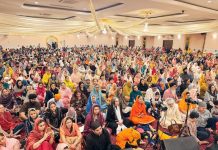
Nagar kirtan at the Gurdwara Sahib Bradshaw in Sacramento – Photo: Manni S Pawar
By Asia Samachar | United States |
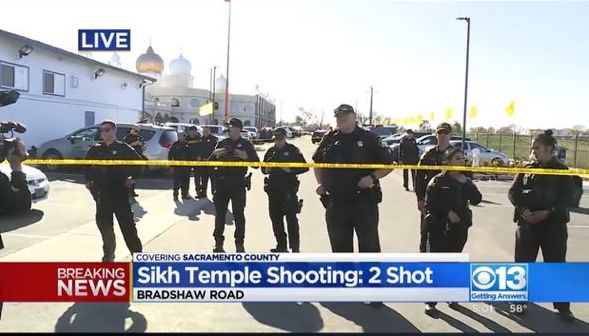
Two men were wounded in a shooting incident at a Sacremento gurdwara at the sidelines of a large and peaceful nagar kirtan yesterday (Sunday).
But the thousands of participants of the Sikh procession did not allow the incident to derail their celebration, with even the evening Raheras prayer programme taking place as usual hours after the incident at the Bradshaw Road gurdwara in Sacramento County.
“It puts a small stain on this peaceful, very joyous day,” Sacramento County Sheriff’s Office spokesman Sgt Amar Gandhi was quoted by the local newspaper Sacremento Bee.
Gandhi said a fistfight had broken out between two men on the gurdwara grounds. One of the men shot a friend of the other combatant. The second man involved in the fight then fired upon the first man and ran off. Gandhi said just after 8:30 p.m. that the man was in custody, according to the report.
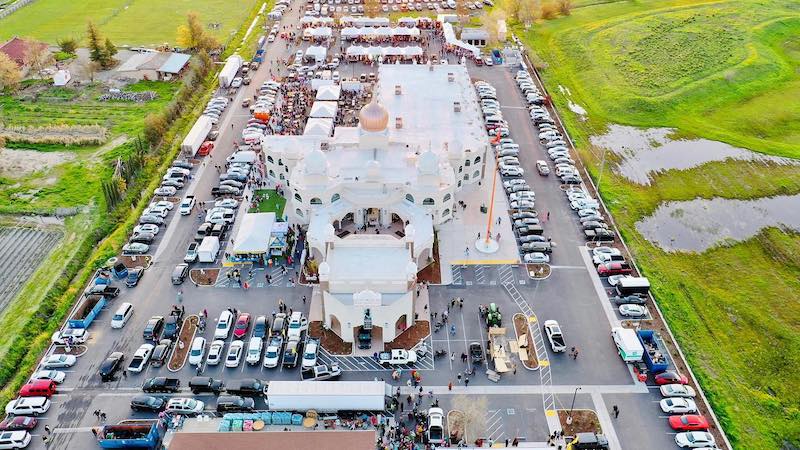
Gurdwara Sahib Bradshaw, Sacramento darbar sahib on Friday, 24 March 2023 – Photo: Gurdwara Facebook
In a statement at its Facebook page, the gurdwara said: “The Bradshaw Sikh Society hosted its first Sikh Parade with thousands of congregants from the region. The parade was peaceful and a celebration of faith. It is unfortunate that a few misguided people tried to ruin a cultural and religious event. A shooting occurred at the Gurdwara while the parade was in procession. We hope the culprit(s) is punished to the fullest extent of the law. They were not a part of the parade and showed up after the parade left hours earlier. These displays of violence go against our Sikh faith. We regret any inconvenience and fear this may have caused. We are strong and resilient together.”
In another statement three hours later, it added: “The gurudwara sahib Bradshaw road is open and sangat is welcome to join for Rehras Sahib.”
The gurdwara had organised a huge firework display the night before the nagar kirtan.
Gurdwara Sahib Bradshaw Sacramento – Photo: Gurdwara Facebook
ASIA SAMACHAR is an online newspaper for Sikhs / Punjabis in Southeast Asia and beyond. When you leave a comment at the bottom of this article, it takes time to appear as it is moderated by human being. Unless it is offensive or libelous, it should appear. You can also comment at Facebook, Twitter, and Instagram. You can reach us via WhatsApp +6017-335-1399 or email: asia.samachar@gmail.com. For obituary announcements, click here.
Growing up in Taiping, a small town in the northern Malaysian state of Perak, Sukhwin’s first job was when she was only 21, with an outdoor billboard company that also published magazines and directories.
At that time, she was studying at Universiti Teknologi Malaysia (UTM) in Johor, where she would eventually earn a degree in Civil Engineering.
“That was when I fell in love with the advertising world,” said Sukhwin, dressed casually in jeans, a blue blouse, and a jacket when met at her office in Plaza Damas, Kuala Lumpur, recently.
“I knew then that this was what I wanted to do. I stayed with the company for seven years and learnt all I could. However, I felt something was missing – I wanted to start a business and be part of decision makings.
“But my partner advised me to learn more about business or risk losing money quickly!”
She then joined an investment company for 2 years where she learnt how to evaluate audit reports, how to read a company, and understand assets, operational expenditure, equity, and everything related to business.
An introvert by nature, Sukhwin always took a backseat, preferring to manage from behind the scenes, until she found an opportunity that was too good to resist.
Always wanting to expand her horizons, Sukhwin took the plunge at the end of 2018 to take over KLIATV, which had not made a profit since 2011.
ASIA SAMACHAR is an online newspaper for Sikhs / Punjabis in Southeast Asia and beyond. When you leave a comment at the bottom of this article, it takes time to appear as it is moderated by human being. Unless it is offensive or libelous, it should appear. You can also comment at Facebook, Twitter, and Instagram. You can reach us via WhatsApp +6017-335-1399 or email: asia.samachar@gmail.com. For obituary announcements, click here.
The head of Waris Punjab De – Amritpal Singh became a practising Sikh only recently and has been campaigning stridently for Khalistan. Some of his followers attacked a police station where one of their associates was being held.
Indeed, freedom of speech or discussion should be a fundamental right, but if he or any of his followers have broken the law, then the Indian authorities are within their rights to pursue and investigate them for alleged criminal behaviour.
However, instead learning from Indira Gandhi’s action against Sikhs to boost her standing with a bigoted majority, the government has cynically ordered the clamp down against all Sikhs in Punjab. Indian authorities have been arresting and raiding the homes of human rights activists, with internet blackouts, social media crackdowns, and misinformation being spread across national news by pro-Modi media. Twitter accounts of prominent Sikhs overseas (including politicians in Canada) highlighting India’s record of human rights violations as well as the state’s current clampdown have been censored in India. Respected Indian journalists have also been censored, with the Asia Desk of the Committee to Protect Journalists raising their plight, and journalists overseas have been sent threatening messages for daring to talk about what’s happening.
The state has invoked Section 144 of the Indian Code of Criminal Procedure to reduce gatherings in parts of Punjab, of four or more people and threatening its citizens with charges of rioting if this code is broken. These are draconian measures, which only serve to tarnish India’s reputation as the ‘world’s largest democracy’. Needless to say there have been mass arrests.
No reason has been given for why these draconian measures have been implemented, whilst concerns are of course amplified by India’s reputation of conducting torture, extrajudicial killings, and fake encounters. The collective memory of ‘Operation Woodrose’ post 1984, which targeted many thousands of innocent youth and civilians in Punjab under the pretext of quelling Sikh ‘militancy’ is etched in the psyche of Sikhs worldwide. We only have to look in the rear-view mirror of history to understand why Sikhs are fearful.
Many Sikhs abroad have family and friends in Punjab and fear for their safety and wellbeing. The suspension of civil liberties in a nation which prides itself on being a democracy, isn’t just a threat to the people of Punjab, but to democracy itself.
In the beginning of 1984, the Congress government was trailing badly in the opinion polls, yet went on to win a record majority as a result of its appeal to majority bigotry. The BJP is hoping that it will reap a similar dividend in next year’s election.
A word on Khalistan
Why would Sikhs living peacefully in India want a separate state? The issue did not arise until the increasing discrimination against Sikhs culminating in the genocide of 1984.
In 1984, we all shouted Khalistan, as a shorthand way of saying, ‘we hate the action of the Indian government’. Today some are saying it again following recent action in Punjab. The reality is that a separate religious state, like Pakistan, giving Sikhs controlling power, is not only geographically impossible but also against the teachings of the Gurus who taught equal rights for all. Khalistan is a place where Sikh values of equal treatment for all human beings – justice, compassion, and selfless service prevail.
The Khalistan we must strive for is the spread of these values throughout India and further afield.
The article was first published at the Network of Sikh Organisations website
RELATED STORY:
(Asia Samachar, x 2023)
ASIA SAMACHAR is an online newspaper for Sikhs / Punjabis in Southeast Asia and beyond. When you leave a comment at the bottom of this article, it takes time to appear as it is moderated by human being. Unless it is offensive or libelous, it should appear. You can also comment at Facebook, Twitter, and Instagram. You can reach us via WhatsApp +6017-335-1399 or email: asia.samachar@gmail.com. For obituary announcements, click here.
Born: 25 July 1977 Muar Departed: 04 April 2022 Subang Jaya
Father: The late Dr. Harbhajan Singh Sandhu Mother: Indra Rahpal
Sister: Maneeka Sandhu (Stephen Decker) Brother: Dr. Vikram Singh Sandhu
Path da Bhog: 1 April 2023 (Saturday) at Darbar Sri Guru Granth Sahib Ji, Malaysia (Address: 10, Lorong 51a/227b, Section 51A, 46100 Petaling Jaya, Selangor)
Program: 5:00 pm to 6:30 pm Path Da Bhog 6:30 pm to 7:00 pm Rehraas 7:00 pm to 8:00 pm Kirtan Dinner served after Ardas
Her life was a blessing, her memory a precious treasure, Kiran is loved beyond words, missed beyond measure, forever dancing in our hearts.
Kiran was renowned for her lack of patience, not holding back her opinion and a knack for telling it like it is. We miss her wit, her charm and her big heart. The heart that served her so well in this world ultimately failed her at far too young an age.
We ask that in memory of Kiran and her one year anniversary that you do something for someone less fortunate than yourself. Feed the hungry, help an animal or simply admire something in nature.
Under a soft blanket of fallen leaves, safe in the hush of the whispering trees I have come home. My time here on earth is now done, all the noise and the clamour, the joy and the pain, the powerful life force that drove me onwards has slipped away into the quiet of eternity, and I am at peace. From now on, I will dance through your memories threading thoughts of love through your heart. The pain of loss will gradually ease, and the sadness will lift. The days will be lighter, and the nights not so long, for I am still here. When you walk through this place, you will feel me in the gentle touch of the breeze on your face, in the sunlight dappling the forest floor, in the murmur of the branches high above you, I am all around. I have returned to the place from whence I came, to the elements that created me. The earth that gave me the life I so loved has now welcomed me back to her, to be at one with all her beauty.
Here, under my blanket of fallen leaves I have found my resting place. I have come home.
Fran Hall
ASIA SAMACHAR is an online newspaper for Sikhs / Punjabis in Southeast Asia and beyond. When you leave a comment at the bottom of this article, it takes time to appear as it is moderated by human being. Unless it is offensive or libelous, it should appear. You can also comment at Facebook, Twitter, and Instagram. You can reach us via WhatsApp +6017-335-1399 or email: asia.samachar@gmail.com. For obituary announcements, click here.
Amritpal Singh (left). Right: Jarnail SIngh Bhindranwale (in white) at the Harmandir Sahib, Amritsar.
By Jassa Singh Sidhu | Opinion |
The phenomenal rise of Amritpal Singh did not happen in a void. There was a political vacuum for the young people of Punjab and it was ripe to be led because there is a serious amount of anger and hurt in how the Sikhs and the state of Punjab had been treated by successive “Union of India” governments.
“The emperor has no clothes” is what Amritpal Singh is saying. Amritpal Singh is speaking of the reality of the situation in Punjab, but he is being muffled by the Indian “Deep State”.
Khalistan is an ideology that cannot be removed from the conscience of many Sikhs in Punjab, which the Union of India has tried to demonize by denying and suppressing the free expression of the idea of “Khalistan”. The pictures of Jathedar Jarnail Singh Bhindranwale are everywhere in the Punjab countryside and occasionally seen in Delhi. To say that there is no appeal for Khalistan has been the constant drum roll from the Indian State. The other drum roll is that Inter-Services Intelligence (ISI) of Pakistan is sponsoring Khalistan. The only people being fooled are the Indians outside of Punjab state in India.
The “Union of India” prides itself as an inheritor of a civilization and is a civilized nation. Civilization also references ethos. However, the Union of India has not displayed its human rights angle and the ability of its people to speak freely. The reality in India is the overwhelming emphasis on centralisation from New Delhi and the concept of Hindu, Hindi and Hindustan at the expense of the states in Southern India and in Northeastern India.
FEDERAL EXPERIENCE
Many Sikhs have given up that they will ever get justice under the Union of India umbrella, hence the embers of demand have resurfaced for an independent Punjab free of the shackles of the Union of India. The Union of India should ask itself why many Sikhs want self-determination. Even though the Indian national media keeps drumming “that only a small portion of Sikhs want Khalistan”, yet the reality is different on the ground and elections can get effected due to the perception if the Sikh candidate has conservative leanings.
Across the spectrum for many Sikhs, the experience in being a part of the Union of India has been a disaster with many unpleasant experiences of discrimination and pogroms. We should not forget that the “Union of India” was supposed to be a Federal System because it is a subcontinent of many diverse races, cultures and languages. However, instead of being a true Federal System, it has retained a colonial framework with a Governor to implement the Union of India’s colonialism. Every state has a Chief Minister and a Governor. The Governor acts in the capacity of a colonial framework.
The Union of India does not reflect as a true “Union of India” with equality and fraternity for all its citizens. The Union of India is not benign. It has engineered a coup to absorb Sikkim and run roughshod to incorporate the states in Northeastern India; Assam, Meghalaya, Tripura, Arunachal Pradesh, Nagaland, Mizoram, Manipur and Sikkim where the inhabitants are people with East Asian phenotypes and these people did not want to be a part of the Union of India but forced at gunpoint. The British ran out of India abandoning these states to the mercy of the “Union of India” without checking if the inhabitants of the Northeast wanted to be a part of the Union of India. The constant rhetoric of Hindu, Hindi, Hindustan is damaging to the very fabric in the Union of India.
DEEP STATE
The concern by many Sikhs across India is that the “Deep State” in the Union of India is working hard to fabricate and manufacture evidence to create a narrative that will play into the politics to create the binary of “Khalistan” and “Hindustan”, to further victimise and hurt Sikhs with the aim of the elections of 2024.
This Deep State was also at work during the Congress control of India.
It is important to contextualise with history why this pain and suffering of the Sikhs happened. The beginning of this problem was the post 1947 treatment of Sikhs by the Union of India. In the past the Hindus of Punjab harassed Sikhs with the slogans; “Kach, Kera, Kirpan enko bhaejo Pakistan, biri ciggarette peekae shaan say jeewange.”
The Punjabi Hindu fanatics destroyed Guru Ram Das picture at the Amritsar train station. Lala Jagat Narayan, a Punjabi Hindu leader, was against the formation of a Punjabi language state even though he was a Punjabi. Lala Jagat Narayan also wrote articles against the Sikh religion and Sikh Gurus (Prophets) and betrayed Punjabi mother tongue.
The Punjabi Hindus created the schism with Punjabi Sikhs by communalising the Punjabi language as a language of Sikhs instead of all Punjabis. Lala Jagat Narayan betrayed and urged Punjabi Hindus to declare Hindi as their mother tongue a total betrayal of “Punjabiat“, this blatant communalism destroyed the fraternity of Punjabis. He further alienated the Sikhs by attacking the Sikh prophets that are revered by many Hindus as well.
During the 1970s, the Congress party wanted to win elections by scapegoating the Sikhs as anti-nationals to win the Hindu vote by dividing the Punjabi community into religious factions. This situation was let to fester with the storming of the Golden Temple in 1984. For many Sikhs this was when the “Rubicon” was crossed in June of 1984 when India’s military engaged in domestic political issues and attacked Sri Darbar Sahib the center of the Sikh religion and destroyed the structure of Akal Takht, with the result in thousands of Sikhs being killed and prisoned in its aftermath. Countless eyewitness saw Sikh pilgrims irrespective of age and gender murdered in cold blood by the Indian Army.
Because of this repression, the Sikhs held a global Sikh gathering at Amritsar, Punjab at the Akal Takht in 1986. At the “Sarbat Khalsa” the call for a Sikh nation was established in 1986, this declaration is non-negotiable according to Sikh ethos, the only way this can be reversed is by having another “Sarbat Khalsa” that reconvenes to declare that the 1986 declaration is reversed. In this historical context, Amritpal Singh is providing leadership and vision and his communication and articulate expressions based on political economy and sovereignty attracted many young men and women to his banner.
Jassa Singh Sidhu is an Asia Samachar reader concerned with the on-going developments in Punjab
ASIA SAMACHAR is an online newspaper for Sikhs / Punjabis in Southeast Asia and beyond. When you leave a comment at the bottom of this article, it takes time to appear as it is moderated by human being. Unless it is offensive or libelous, it should appear. You can also comment at Facebook, Twitter, and Instagram. You can reach us via WhatsApp +6017-335-1399 or email: asia.samachar@gmail.com. For obituary announcements, click here.
My 10-year-old son came to bed excitedly, all set to tell me a story that his Nana Ji had just told him for bed time. So, I’m about to hear his remake of the story.
It was about Guru Nanak’s encounter with the supposed low caste carpentar Bhai Lalo and the mighty government officer Malik Bhago. The story is replete with milk and blood. A sakhi familiar to gurdwara going Sikhs, probably heard in younger days.
The incident was supposed to have taken place in Saidpur, presently known as Eminabad in Pakistan. Guru Nanak and his travel companion Bhai Mardana stayed in the home of Bhai Lalo. Lalo is poor in wealth, but rich at heart. What he had, came on the back of honest labour. Malik Bhago is the exact opposite – rich, haughty and a slave driver.
Guru Nanak happily ate food cooked at Lalo’s house, but was reluctant at Bhago’s place. Why? When pressed for an answer, he held in one hand a bread from Lalo’s home, and in the other a sweet pancake from Bhago’s kitchen. Guru Nanak squeezes them. Lo and behold! Blood drips from Bhago’s pancake, milk flows from Lalo’s dry chapati. What a dramatic moment.
So, what’s the lesson, I asked.
“Don’t scam people. The rich man had scammed all these poor people. They work hard but he pay them so little….Take the milk, don’t take the blood,” he said. “Guru Nanak then taught him [Bhago] prayer…Ik Oangkaar, Satnaam….”
Not bad for a 10-year-old. And a sakhi well presented by the Nana Ji.
What role does such sakhis play? Are they real life accounts? We will come to that shortly.
LIFE CHANGING
For a kid, such a story can be life changing.
I have my own sakhi that made an imprint on my life. When I was about my son’s age now, my Nana Ji told me the story of Guru Gobind Singh and his horse and the tobacco fields.
The story goes like this. Guru Gobind Singh was on his horse, galloping to some mission (now, guys, it has to be a mission. We want to make the story dramatic. That’s the blood part of this story, I guess). As they reach a field, the horse comes to a screeching stop. The Guru, of course, was fine. (He’s the hero, remember).
“What happened?,” I must have asked. Even if I didn’t, the expression on my face would have said it all. I can picture my eyes wide open, and my jaw dropping.
Once all primed up, Nana Ji throws the punchline.
“It was a tobacco field. You make cigarettes from tobacco. Guru Ji’s horse didn’t want to touch the tobacco,” he explained. “You see, we Sikhs don’t smoke cigarettes. Cigarettes are made from tobacco.”
The story penetrated deep into my consciousness. It instructed me not to consume drugs or cigarettes. When I around 12, some classmates were trying out cigarettes. I declined. I was not tempted. I think the lessons from the story earlier had something to do with it.
MIRACLES
Of course, as you grow up, you no longer believe the milk and blood story, literally. You no longer believe that Guru Gobind Singh’s horse actually came to a screeching halt at a tobacco field. But the lessons underpinning the stories stay.
For some, denying the story is to deny the miracles of the Guru. It’s as if we’re saying that Gurus are not capable of miracles.
Well, here’s a news break. Guru Nanak and Bhai Mardana travelled thousands of miles on foot, and not on a magic carpet. And not on some flying horse, either. Definitely not the Tesla.
Guru Nanak’s miracles, if you want miracles, is changing the way we think. He went around and gave the people a new worldview, one that allowed them to overcome fear of superstitions. It’s a worldview that gave them strength to walk the good life – hukam rajaai chalnaa.
As we grow, we need to learn to move in to the essence, and to let go of the make belief stories. I’m not asking you to discard them. There’s a time and place for them. What my son picked up from his Nana Ji was invaluable and instructive. He has instilled in him the value of honest labour and why we should not exploit others. Those are good values to drive into a young mind, with the hope that he will grow up looking at the world with a sympathetic and loving eye.
NOW, SHABAD INSTRUCTS
Many centuries ago, sakhis played a critical role in imparting knowledge or entertainment to the masses. You didn’t have cinemas and the handheld devices were still way into the distant future. So, story telling was the way to go. You embellish the stories to make them exciting. You turn your heroes into giants, and villains into monsters.
As you grow, you now know that the details in those stories may not be all true. In fact, some of the stories may have been cooked up from thin air, or copied from the other prevailing traditions. But by then, you start learning Sikh values from shabads embedded in the Guru Granth Sahib.
The values derived from the Shabad affirmed my decision not to smoke cigarette, as it is harmful to the body. So, I continue not smoking cigarettes or cigars or what have you.
At some point of time, a Sikh should move on from living life instructed by stories to living life instructed by the Shabad. The Shabad, as captured in the Guru Granth, is the real deal.
In the coming month of Vaisakh, we will celebrate the establishment of the Khalsa by Guru Gobind Singh Ji. The Khalsa provides a discipline to disciples who want to embrace the drill, governed by the Shabad. And the story of the Shabad begins with Guru Nanak Sahib Ji.
So, it was no coincidence that Guru Gobind Singh unveiled the Khalsa on Guru Nanak’s birthday. So, when we celebrate the Khalsa on April 14, we are actually also celebrating Guru Nanak’s birthday. To unwrap this, you may have to grow out of a story or two that you grew up on. I certainly had to do it.
Be mindful of allowing stories alone to define your Sikhi. The stories may have served a purpose as you were growing up. Now that you’re all grown up, with a fully functioning mind, it’s time to REFINE your understanding aided and guided by the Shabad. As a grown up, it’s the values taught in the Guru Granth that will make a difference.
In the process, if the stories hinder living a life instructed by the Guru Granth, then the stories must make way.
Hb Singh is a Kuala Lumpur-based journalist with some experience in dealing with Sikh organisations, both from within and outside.
* This is the opinion of the writer, organisation or publication and does not necessarily represent the views of Asia Samachar.
ASIA SAMACHAR is an online newspaper for Sikhs / Punjabis in Southeast Asia and beyond. When you leave a comment at the bottom of this article, it takes time to appear as it is moderated by human being. Unless it is offensive or libelous, it should appear. You can also comment at Facebook, Twitter, and Instagram. You can reach us via WhatsApp +6017-335-1399 or email: asia.samachar@gmail.com. For obituary announcements, click here.