Press Release | March 30, 2023 |American Sikh Council |
The American Sikh Council (ASC) is extremely concerned over the continuous targeting and illegal detention of young Sikh men across Panjab since March 18, 2023. Hundreds of Sikhs have been detained under the pretext of being Bhai Amritpal Singh’s sympathizers or simply labeled terrorists at their whim.
With over 80,000 Indian paramilitary forces put into action in Panjab overnight to apparently apprehend one man, Bhai Amritpal Singh who apparently escaped while everyone else has been arrested is entirely fake and it portrays a very nefarious political drama.
Based on the standard BJP/RSS playbook, it is clear that the Indian authorities want to malign and portray Sikhs as terrorists. While the current regime is portraying themselves as the great saviors of Hindus of Panjab and saving ‘Bharat Mata’ from breaking up! The Indian authorities are playing out their true and tried nefarious game of beating up on the Sikhs to take full advantage of the current situation for the upcoming national elections in April/May 2024 in order to win all the Hindu votes and form a BJP/RSS government nationally as well as in Panjab.
The Indian regime shut down the entire internet across the state of Panjab for 48 hours just to allegedly arrest one Sikh man, namely Amritpal Singh. In a much-touted democracy to do a carte blanche media blackout is a clear sign of authoritarianism, front and center. While the same Indian authorities are using every social platform to spin their own news portraying their version as accurate news, when it is lopsided and very biased, especially when the entire narrative is against a tiny minority which has been hounded by the state authorities for decades. Similar but longer media blackouts were done during India’s attack on the holy Darbar Sahib in June 1984 and several more statewide oppressive operations during the 1980s and 1990s.
The BJP/RSS government has a large well-funded IT cell which has finessed its social media spin tactics to an art form and uses it to the hilt for spewing venom on any minority it chooses. The BJP/RSS government has threatened US major tech companies which run Facebook, Instagram, Twitter, WhatsApp, etc., which have kowtowed and many times completely blocked Sikhs from the global echo chamber. Sikhs have been at the receiving end of this massive hate campaign not only within India but across the globe, which portrays Sikhs negatively on so many levels. The favorite word that has been weaponized by the Indian regime and their Hindutva minions is, Khalistan, in order to coerce and cower the Sikhs into submission permanently!
Even some of the major news channels and media platforms in the US and Canada who are somewhat balanced, have not touched on the fundamental long-term simmering issues of the Sikhs of Panjab. Whenever any Sikh regardless of their political ideology bring up the issue of critical demands of Panjab which have been purposely ignored and have been festering, while the frustration of the common people is rising, then that individual is labeled a ‘Khalistani’, ‘anti-national’ or a ‘terrorist’ and either shut down or arrested. No minority can be treated like second class citizens with limited rights forever.
The upper caste Hindu coterie rules India, regardless of the ruling party in power. Why is the upper-caste Hindu government creating a fear psychosis in the Indian citizenry, when there are at least forty-five Hindus for every one Sikh. Sikhs have repeatedly voiced their grievances peacefully over the last 40-50 years but everything has fallen on deaf ears. The rulers of India refuse to even acknowledge the complaints of Panjab, yet continue to weaponize anything and everything remotely connected with any protests or good work which rouses the Sikh populace about their rights.
India needs to wake up to its own major mishandling of various issues surrounding Sikhs and other minorities and deal with them directly, before labelling Sikhs with their choice epithets. India has still refused to even acknowledge the decade and a half old ‘Sustained Sikh Genocide’ (1984 – 1998) which resulted in the state sponsored mass murder of several hundred thousand Sikhs in the killing fields of rural Panjab. This Genocide against the Sikhs was carried out to quell any uprising in favor of rights as citizens of Panjab, all in the name of stamping out terrorism when the harsh truth is, that Sikhs simply wanted equal rights on all fronts as Indian citizens and an equal say at the table.
To continuously cow down an entire ethnoreligious minority through various reprehensible methods, all easily available for the state apparatus, is the height of cruelty and ineptness of its own political acumen, all simply due to an inherent hate and bias. This on and off witch hunting of Sikhs must stop! It interesting to note in the Indian context, “When Sikhs save Hindus, they are angels, when Sikhs fight various wars on behalf of Hindus, they are heroes, but when Sikhs fight for their own rights, they are labelled terrorists”!
The current BJP/RSS leadership in power since 2014 has been steadily building up the narrative to eventually install and run a completely unitary ‘Hindu Rashtra’ (Hindu Country), yet no one is arrested for being an anti-national or a terrorist. This dangerous buildup may become a reality when the current Prime Minister is reelected in 2024, for the third time. All vocal minorities, Sikhs, Muslims and others are harassed and told to toe the line of Hindutva/Hindu Rashtra or else face dire consequences. This hypocrisy must not only be called out but needs to stop immediately. The vast majority of the supposed independent media in India has been coopted or shut down by the authoritarian regime, therefore honest critical reporting has gone underground, while anyone attempting to tell the truth is threatened and/or arrested.
The Indian regime needs to straighten out its own ethical moorings and stop persecuting a tiny ethno-religious minority by constantly maligning and degrading them, rather resolve a laundry list of critical issues which impact everyone who lives in Panjab, not just Sikhs, but Hindus, Christians, Jains, Buddhists, Dalits, etc. The overdue problems of Panjab need to be tackled without delay as the common man is so frustrated that they will reach out to anyone who will solve their long-standing woes.
The American Sikh Council (ASC) requests the US State Department, USCRIF, Human Rights Watch, Amnesty international and others to take many of the ongoing violations against Sikhs in India seriously and take appropriate action, as previous similar situations have led to Genocide.
ASIA SAMACHAR is an online newspaper for Sikhs / Punjabis in Southeast Asia and beyond. When you leave a comment at the bottom of this article, it takes time to appear as it is moderated by human being. Unless it is offensive or libelous, it should appear. You can also comment at Facebook, Twitter, and Instagram. You can reach us via WhatsApp +6017-335-1399 or email: asia.samachar@gmail.com. For obituary announcements, click here.
Gopal Singh s/o Sohan Singh passed away peacefully on March 31, 2023 at Hospital Selayang, Selangor.
He will be dearly missed by his fellow residents at Senior Citizens Retreat Centre, Ulu Yam, and members of Pertubuhan Pembangunan Kemasyarakatan Sikh Malaysia (PPKSM).
Sehaj Path Da Bhog prayers will be held at Gurdwara Sahib Baba Vir Singh, Hulu Yam Bharu on April 9, 2023 from 10am to noon. Guru Ka Langgar will be served thereafter.
Please treat this as a personal invitation.
Contact:
Master Daljit Singh (013-350 8686)
Gurphajan Singh (012-689 8022)
ASIA SAMACHAR is an online newspaper for Sikhs / Punjabis in Southeast Asia and beyond. When you leave a comment at the bottom of this article, it takes time to appear as it is moderated by human being. Unless it is offensive or libelous, it should appear. You can also comment at Facebook, Twitter, and Instagram. You can reach us via WhatsApp +6017-335-1399 or email: asia.samachar@gmail.com. For obituary announcements, click here.
A farmer in Ludhiana, Panjab, India. | Source: Climate Change, Agriculture and Food Security, Flickr
By Tridivesh Singh Maini | Panjab |
There is something common between the right-wing national media and strategic commentariat, a miniscule section of the Sikh ‘diaspora’, and certain political outfits, especially the ruling Aam Aadmi Party and the Bharatiya Janata Party that is attempting to find political space in Punjab.
All of them like to paint a picture of Panjab’s social fabric and reinforce stereotypes. They are then supported by doomsday analyses, which focus only on Panjab’s problems.
There is not an iota of doubt that there are a myriad of challenges that afflict Panjab today – from the economic to the political. Yet, it would be a bit of a stretch to argue that things are irretrievable.
THREE KEY CHALLENGES
If one were to look at the challenges, the first would be the redressal of the legitimate economic demands of Panjab. This primarily includes the growing water shortage issue. Panjab already shares large amounts of water with the neighbouring states of Haryana and Rajasthan, which compounds the scarcity. This issue is often relegated to the sidelines, but is a genuine concern of Panjab and can not be shoved under the carpet.
The second long standing issue has been the fact that Panjab has no capital of it’s own. Chandigarh, which was meant to be the state’s capital, is a Union Territory and the capital of Haryana.
The third is the state’s average governance over the past two decades or so and numerous socio-political challenges spurred by that. Among them, the drug problem remains of particular concern.
SOME SOCIOECONOMIC SUCCESS
In terms of many economic indicators, Panjab is no longer where it was a few years ago. The state’s debt has steadily risen, crossing Rs 3 lakh crore in 2023.
Yet, even a cursory glance at the figures mentioned in the Economic Survey of India (ESI) 2022-23 reveals that Panjab is not in the abyss, as is often projected, merely to push a particular agenda.
For instance, Panjab’s unemployment rate is 6.8% as against the national unemployment rate of 8.6%. This figure can certainly be better. Industries have moved out of Panjab in recent years, not only due to ‘security reasons’, but also because neighbouring states, such as Himachal Pradesh, have provided special incentives. Those who simplistically link the growing sense of frustration or outward migration from Panjab to the level of unemployment are being reductive. There are obviously other factors.
In terms of average life expectancy at birth, according to the Survey, Punjab has improved from 71.6 (2010-2014) to 72.7 (2014-2018). The drug situation is a serious challenge, sure. But, due to excessive use of fertilizers, there has also been a rise in cancer cases in the Malwa belt. While there are other such health concerns that need to be addressed, it is not in the doldrums as is often perceived. For instance, before the COVID-19 hit India, it was one of the best performing states in the State Health Index.
In spite of all the myth-making that some other states are doing better than Punjab in agriculture, the state still fits in the top three in food grain production. It produced 28.21 million tonnes of food grains in 2020-2021, while having only 1.5% of the land share of the country. Many in the national media question Panjab’s exceptionalism in agriculture, but the state is likely to play an important role in the country’s food security in the imminent future.
It is a different issue that for ensuring that agriculture is sustainable and to check the ever declining ground water levels, Punjab needs to diversify and look at other commodities and think of a more sustainable model of agriculture.
In terms of school education too, while there has been talk about the Delhi model of education, Punjab got the first rank in the National Achievement Survey conducted by the Ministry of Education in 2021. NAS assesses the learning outcomes of students through tests conducted for students of classes 3, 5, 8 and 10. In the NAS, Panjab students fared well in Mathematics and English.
Moreover, there’s always much chatter around the increasing immigration to the West, especially Canada, in recent years from Panjab. Yes, there is a growing concern on the state’s demography and the fact that many individuals are not migrating for better opportunities, but out of hopelessness and the drug problem.
As mentioned above, while it is true that Panjab needs a new economic paradigm, some of its problems are exaggerated by individuals from different ideological prisms to push their agenda.
DE-HYPHENATING THE ISSUES
There is no doubt that some genuine legitimate grievances – river distribution with other states, the lack of a state capital, and a number of issues pertaining to the traumatic phase of ‘militancy’ between 1978-1993 – need to be addressed.
This also includes the release of ‘Bandi Singhs’ – Sikh prisoners convicted in connection with alleged involvement in militant activities. The Indian government had announced the release of these Sikh prisoners in 2019, and while some individuals have been getting parole, there is a growing clamour for their release. The mainstream parties, including the Congress, have advocated for their release.
ne of the stereotypes about Panjab is viewing all protests from the lens of ‘Khalistan’ or more generally, a communal lens. What is conveniently forgotten is that a number of protests in recent years – most prominently the farmers’ protest in 2021 – centred on bread and butter issues have been peaceful and disciplined. There has generally been a growing awareness on economic and environmental issues.
Protests such as the Mattewara morcha, which compelled the Panjab government to scrap a textile project at Mattewara Park in Ludhiana, and others against factories causing pollution have been able to draw support from a cross-section of society. More recently, the issue of Punjab’s water sharing has begun to draw attention and there have been a number of peaceful protests to raise awareness on the issue.
Hence, there is a growing realisation that such issues need to be articulated through the language of economic and environmental, rather than expressly political, concerns.
WHY PANJAB NEEDS INWARD INTROSPECTION
If Panjab has fallen below its potential, it is important to not pin all the blame on the central government, as is often done. There is a need for serious introspection not just within the political parties, but the problematic discourse of the state on certain important issues.
While Panjab is an agrarian state, it cannot neglect the industry and afford to be insular in a globalised world. Of late, industrialisation has been opposed due to demographic and environmental concerns. But, it is important not to throw the baby out with the bathwater. A road map is required for a kind of industrialisation that is suitable for the state.
Panjab needs to put the expertise of the diaspora to good use. This means looking beyond the diaspora only in western nations, and looking to those living in countries like Malaysia and Kenya. It also means focusing on how Panjabis who have achieved success in the spheres of business, innovation and research can contribute towards the growth of the state.
Another area where the state needs to focus is greater global air connectivity – with the west of course, but also Central Asian countries, the Gulf and Iran. Most importantly, it is important to ensure that protests are peaceful and can enlist support from different communities and economic groups.
Commentators from outside the state tend to exaggerate not just Panjab’s security challenges, but also, to some extent, its overall economic landscape, which remains far below potential, but hasn’t yet collapsed. It is also important to not view all problems of the state from a security prism and in the process, repeat the mistakes of the past.
Over the past few days, the aftermath of the crackdown on Amritpal Singh, the recently-anointed chief of Waris Punjab De, has been a throwback to the past. Targeted action against elements perceived to be a threat to law and order could have been done without the alarm and hype. The suspension of internet accounts of journalists and activists only made things worse.
The fact that the state has been largely peaceful, despite the mainstream media narrative, is a perfect reiteration that even in the face of all the challenges, the people of Panjab want to get on with their lives.
ASIA SAMACHAR is an online newspaper for Sikhs / Punjabis in Southeast Asia and beyond. When you leave a comment at the bottom of this article, it takes time to appear as it is moderated by human being. Unless it is offensive or libelous, it should appear. You can also comment at Facebook, Twitter, and Instagram. You can reach us via WhatsApp +6017-335-1399 or email: asia.samachar@gmail.com. For obituary announcements, click here.
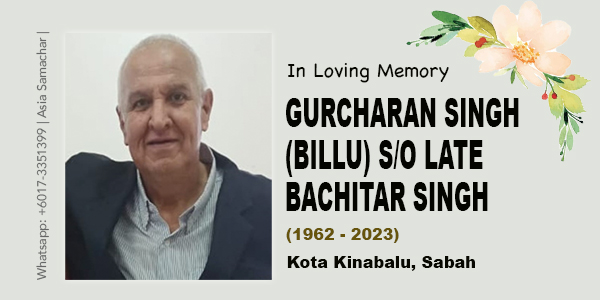
Sehaj Path da Bhog will be held on 08th April 2023 (Saturday) from 5.00pm -7.00pm followed by Antim Ardas at Gurdwara Sahib Guru Nanak Darbar Shah Alam, Selangor.
Deeply missed and forever cherished by family, relatives and friends.
The family would like to extend our sincere appreciation to all relatives and friends who have given their undivided support during these trying times.
Our heartfelt gratitude to the Kinabalu Singh Sabha Association Committee Members, Kota Kinabalu, who went out of their way in assisting the family during the funeral.
ASIA SAMACHAR is an online newspaper for Sikhs / Punjabis in Southeast Asia and beyond. When you leave a comment at the bottom of this article, it takes time to appear as it is moderated by human being. Unless it is offensive or libelous, it should appear. You can also comment at Facebook, Twitter, and Instagram. You can reach us via WhatsApp +6017-335-1399 or email: asia.samachar@gmail.com. For obituary announcements, click here.
“Our third generation, Dane Gulati, tied the knot recently. Many of you have known Dane as a young lad and seen him grow up. He’s a good Ambassador for Raja’s!…Peep his signature style for one of his pre-wedding photoshoot looks!” – Bobby Gulati, director of Bangkok-based Rajas Fashions, a recent LinkedIn entry.
ASIA SAMACHAR is an online newspaper for Sikhs / Punjabis in Southeast Asia and beyond. When you leave a comment at the bottom of this article, it takes time to appear as it is moderated by human being. Unless it is offensive or libelous, it should appear. You can also comment at Facebook, Twitter, and Instagram. You can reach us via WhatsApp +6017-335-1399 or email: asia.samachar@gmail.com. For obituary announcements, click here.
What is the thinking behind the US nominee for World Bank president Ajay Singh Banga?
The former CEO of MasterCard has given multiple interviews, available online. Blogger Evan Carmichael has put together what he thinks are the top 10 ‘rules’ shared by the man who may soon help the steer the international financial institution.
The son of an Indian army general has been a regular face at FinTech events and various leadership conferences.
Last month, U.S. President Joe Biden nominated the 63-year old India-born executive, now a US citizen, to the 77-year-old institution. US is the largest shareholder of World Bank.
ASIA SAMACHAR is an online newspaper for Sikhs / Punjabis in Southeast Asia and beyond. When you leave a comment at the bottom of this article, it takes time to appear as it is moderated by human being. Unless it is offensive or libelous, it should appear. You can also comment at Facebook, Twitter, and Instagram. You can reach us via WhatsApp +6017-335-1399 or email: asia.samachar@gmail.com. For obituary announcements, click here.
Sehaj Paath da Bhog will be held on 2nd April (Sunday) 2023 at Gurdwara Sahib Selayang from 10am to 12 noon thereafter followed by Guru Ka Langgar
Deeply missed and forever cherished by family, relatives and friends.
The family would like to extend our sincere appreciation to all family, relatives and friends who have given their undivided support throughout these trying times.
Contact :
Inder Paul 019 3351154
Jazvina 016 264 4488
ASIA SAMACHAR is an online newspaper for Sikhs / Punjabis in Southeast Asia and beyond. When you leave a comment at the bottom of this article, it takes time to appear as it is moderated by human being. Unless it is offensive or libelous, it should appear. You can also comment at Facebook, Twitter, and Instagram. You can reach us via WhatsApp +6017-335-1399 or email: asia.samachar@gmail.com. For obituary announcements, click here.
Guru Nanak’s birthday as we know it in our lifetimes has always been celebrated sometime in October or November, with no fixed date, as it depends on the day of Kathik Puranmasi determined by the Bikrami Calendar.
In recent years, segments of the Sikh community have started celebrating the birthday during the period when we usually celebrate Vaisakhi. What’s going on here? That’s the mystery to be solved. When is the actual day of birth of Guru Nanak, the amazing poet, traveler, liberator of the downtrodden, reformist and transformer of worldviews?
Why the different dates for Guru Nanak’s date of birth?
The actual date of Guru Nanak’s birth in accordance with authentic historical records is the 1st of Vaisakh. It was observed as such during earlier times till the time of Maharaja Ranjit Singh. That’s when it was changed to Kathik (October/November) after Sant Singh, a Nirmala in charge of Harmandir Sahib, convinced Maharaja Ranjit Singh. (More on Nirmalas here)
2. What is the evidence available that Guru Nanak was born in Vaisakh and not Katak?
Bhai Gurdas, who was chosen by Guru Arjan to script Guru Granth Sahib Ji, provides the evidence when he writes about the advent of Guru Nanak. In Paurri 27 of his first vaar he writes:
Satgur Nanak Pargateya Mitee Dhund Jug Chanan Hoa. Jion Kar Suraj Nikleya Tarey Chapey Abdher Paloa.
Meaning: The Advent of Guru Nanak Was the Lifting of the Fog of Spiritual Unenlightenment. His Coming was the Rising of the Sun, meaning, it was the Dawn of Enlightenment that led to the Removal of Inner Darkness.
One couplet later, he writes
ਘਰਘਰਅੰਦਰਧਰਮਸਾਲਹੋਵੈਕੀਰਤਨਸਦਾਵਿਸੋਆ॥
Ghar Ghar Ander Dharamsaal Hoveiy Kirtan Sda Vasoa.
Bhai Kahn Singh Nabha defines Vasoa in his Mahan Kosh – the Encyclopedia of Sikhism – as the 1st day of the month of Vaisakh. Vasoa is what we call Vaisakhi these days.
Two other documents that were composed in 1570 and 1597 during the era of the third and fourth Guru, prior to the writings of Bhai Gurdas – namely the Sakhi Mehlay Pehla Ki by Sheehan Upal and Janam Patri Babey Ki by Bhai Boola Pandhay – say that Guru Nanak was born on Vaisakhi (also spelt: Vesakh).
Five of the six Janam Sakhis – namely the Meharban Vali Janam Sakhi, Bhai Mani Singh Vali Janam Sakhi, B-40 Janam Sakhi, Puratan Janam Sakhi, and the Pathar Day Chapay Vali Janam Sakhi say that Guru Nanak was born in Vaisakh. Only one Janam Sakhi – the Bala Janam Sakhi – which is not only fraudulent, but highly blasphemous – says that Guru Nanak was born in Kathik. Janam Sakhis are largely imaginary hagiographies of the life of Gurus, full of miracles and travels, built on a Sikh oral tradition and some historical facts.
All seven prominent Sikh and non-Sikh historians have through research established that Guru Nanak was born in Vaisakh. They are historian Karam Singh, Mahan Kosh author Bhai Kahn Singh Nabha, Dr. Ganda Singh, Principal Satbir Singh, Prof Sahib Singh, Dr. Hari Ram Gupta and The Sikh Religion author Max Arthur Macauliffe.
Pal Singh Purewal, the inventor of the Nanakshahi solar-based calendar, has calculated the dates scientifically. He arrived at 1st of Vaisakh 1469 as the date of birth of Guru Nanak. This date corresponds with the 27th of March 1469.
The imaginary sketch of the supposed meeting between Guru Arjun and Sri Chand
3. Why have we been celebrating it around October / November all these years?
During a period of some 62 years after the defeat of Banda Singh Bahadur genuine Sikhs lived in hiding as the authorities had placed a hefty price on their heads. The Gurdwaras came under the control of Udasis – followers of Baba Sri Chand – the eldest but disowned son of Guru Nanak. After this, the Nirmalas – brahmins who descended into Punjab beginning the 1760s – controlled the Gurdwaras, institutions and by extension the Sikh psyche for an additional 150 years.
The BalaJanam Sakhi was the first text to distort the birth date of Guru Nanak from Vaisakh to Kathik. It was written 120 years after the demise of Guru Nanak by the anti-Sikh and heretic Bidhi Chand Handal – a masand of Jandiala. The Bala Janam Sakhi was distributed widely to Nirmala controlled gurdwaras where it was propagated extensively by the Nirmalas to become the most prominent of the six Janam Sakhis. Based on this Janam Sakhi, the Sikhs were led astray to believe the birth of Guru Nanak was in Kathik.
4. Did anyone try to correct such an error?
A British historian M.A. McAuliffe has said that the Sikh world had the date of Guru Nanak’s birth correct till 1816 – during the reign Maharaja Ranjit Singh, with Nirmala Gyani Sant Singh as head granthi of Darbar Sahib. The Nirmala–bent religious leader convinced the Maharaja to use his office to have Nankana Sahib celebrate Guru Nanak’s birthday in Kathik – (October or November) – for the first time in 1816. It would take another hundred years before the Kathik date would become acceptable to the Sikh world at large.
So that’s 200 years of celebrating it on the wrong date after 346 years of celebrating it on the correct date.
5. Didn’t Sikhs know about the actual date before this? How did they miss such a major marker in their own history?
Apart from having their Gurdwaras and institutions controlled by others (Udasis and Nirmalas) Sikhs have had their history written by the Nirmalas. The Nirmalas wrote 35 voluminous texts that are unthinkingly referred to by the Panth as “Sikh Classical Texts” and scores of other sub-texts. These writings highly corrupted, distorted and tainted the history and character of our Gurus. With such distortions repeated over long periods of time, facts and truth take a back seat and the falsehoods appear as “facts.”
The distortion of Guru Nanak’s birthday from Vaisakh to Kathik is an example that followed this path. For 62 years when the Udasis controlled our Gurdwaras – they started celebrating the Sikhi founder Guru’s birthday on Kathik Di Puranmasi – which was the birthday of Sri Chand – the son of Guru Nanak and the Guru of the Udasi sect. Then the Nirmalas recorded this distorted date in their numerous texts as the birthday of Guru Nanak. In addition, since the Nirmalas contolled our Gurdwaras during the reign of Maharaja Ranjit Singh – they were able to have the date changed officially. Kartika Purnima is a Hindu festival celebrated on Purnima (full moon day), the 15th (or 30th) lunar day of the month of Kartika or Kathik.
6. In the past, Sikhs have been following the Bikrami calendar. What are the shortfalls of this Hindu-based calendar for the Sikh faith?
In the past, Sikhs used the Bikrami calendar. In the Bikrami calendar, some gurpurabs (the day when Sikhs commemorate certain events) came twice in a year, and some gurpurabs did not come even once a year. The Bikrami calendar contains a complex set of rules to determine the dates for annual festivals and days of observance.
7. What are some of the issues with this calendar?
First, being a lunar based calendar, it laid emphasis on the belief in sacred days and other festivals related to the Hindu faith, a philosophical base different from the universal and open ideology of Sikhi.
Second, historical dates related to Sikh faith were determined by astrological calculations by a specific group of pandits, which meant that Sikhs were not independent to determine their own gurpurab days annually.
Third, the lag in the lunar calendar when aligned to the solar calendar would over a period make the Barah Maha of Guru Nanak Sahib and Guru Arjan being inaccurate in the description of the natural phenomena.
Fourth, if the Nanaksahi calendar is not de-linked from the Bikrami calendar, in 13,000 years Vaisakhi will occur in mid-October. The seasons will be opposite to those mentioned in the Barah Maha Maajh and Tukhari Banis (two sets of compositions in the Guru Granth Sahib).
8. Since we have been celebrating Guru Nanak’s birthday in October / November all these years, why not just carry on – business as usual?
Carrying on as usual is the easy thing to do but is it the right one? It is the wrong thing to do – especially when the Sikh Panth has been made aware of the error for the past 100 years by historian Karam Singh’s well researched and documented text Kathik Kay Vaisakh.
Carrying on as usual conveys a message that the Sikh Panth is powerless to right even one of its most important wrong. At the spiritual level, when we gather in large numbers to celebrate Guru Nanak’s birthday on the wrong day (Kathik Di Puranmasi) and stand before the Sri Guru Granth Sahib to proclaim it as a Gurpurab related to Guru Nanak in Ardas – we are guilty of a hypocrisy that is beyond measure. We are equally guilty of hypocrisy when we gather in large numbers on the correct date (Vaisakhi) and fail to mention or otherwise celebrate the birthday of our founder Guru.
Carrying on as usual further sends the wrong message to our next generation. What kind of values, ethics and principles are we teaching them? That it is fine to get our founder Guru’s birthday wrong, keep celebrating it on the wrong date even after we know of the error, and that none of this matters?
Carrying on as usual also continues to raise the following two questions: Is there any community in the world – other than ours – that is ignorant enough to have got the birthdate of its founder wrong? It may be excusable if the founder was born 2,000 years ago when records were not kept, but Guru Nanak is just slightly more than 550 years ago. Is there any community in the world – other than ours – whose collective conscience is so dead – that despite being told and given authentic proof that the date is wrong – carries on celebrating the wrong date? Carrying on as usual is easy because we have to do nothing. The Sikh character is built on making changes and challenging any wrong so we have to do something. At the most basic level, making the change is Sikhi because it is the right thing to do.
9. Is it okay to change the date of celebration now? Won’t it cause confusion?
The change should have been made in 1930 when Historian Karam Singh exposed the conspiracy. Every year after that expose’ that we continue to celebrate Guru Nanak’s Parkash Diharra in Kathik is one more year of dishonor for the Sikh Panth. It is one more year of disgrace for our institutions which appear paralyzed to act. It is one more year of ignominy for those of us who call ourselves Sikhs of Guru Nanak.
Change is always uncomfortable to face. It can be unsettling, too, and there will be those who will oppose it. But change we must because it will bring inner closure to the Sikh world. The satisfaction, contentment and joy that follows will come from our ability to have finally got the date and celebration of our father Guru correct.
10. Why don’t we raise this issue with Akal Takht and await guidance?
The Akal Takht has been aware of this matter for close to a decade now but has chosen to bury its head in the proverbial sand.
The reality of Akal Takht is much more painful than that. Over the past 100 years, the Sikh Panth has had innumerable issues – beginning with Ragmala in 1925 to the Nanakshahi Calendar in 2016 and hundreds in between – but the Akal Takht has not resolved a single one of them.
The Akal Takht does not have a current history of resolving any of Sikhi’s religious issues. This is because the Akal Takhat has become a tool of the political forces of Punjab – to be used for political gain and no more. At the religious level it is controlled by people with derawadi and taksali tendencies. In the last 50 years, all of Akal Takht leaders – with just one exception of Jathedar Manjit Singh – have come from the dera and taksali outfits. These outfits are aligned to the Nirmala belief system. So the real question is whether the Akal Takht – given their defacto Nirmala leanings – has a genuine interest in wanting to resolve this issue.
An ineffective Akal Takhat means the top down approach towards resolving this issue will have to be replaced by a grassroots level up approach. Individual Sikhs through their local sangats and Gurdwaras will have to take it upon themselves to start celebrating Guru Nanak’s birthday on Vaisakhi Day – together with Khalsa Sirjna Diwas – and stop celebrating it on Kathik Di Puranmasi (October / November).
Once critical mass is reached – meaning once sufficient sangats and Gurdwaras have awakened, realised and taken action to do the right thing – hopefully the Akal Takht will have no choice but to sit up and listen or risk becoming irrelevant altogether.
Akal Takht, Amritsar
11. My parents / grandparents were learned Sikhs. They were well-versed with the Guru Granth Sahib. They celebrated Guru Nanak’s birthday in the October / November (Katak) period. Are you saying they were ignorant Sikhs?
They most probably did not have access to the historical information to have a proper understanding of the issue of the actual date of Guru Nanak’s birthday. It was not widely discussed back then. And most of the information available originated from dubious sources. So you cannot blame them as they may not have had all the information at their disposal to make an informed decision. But it does not make them any lesser of a Sikh. In our eyes, they will forever remain as model Gursikhs, people who turn to the Guru Granth Sahib for knowledge and wisdom. They have surely got that sorted: drawing inspiration from the Shabad to instruct their worldview.
12. Do you intend to stop people from celebrating Guru Nanak’s birthday in the October / November period?
No. You go ahead. As cliche as it may sound, a Sikh can celebrate Guru Nanak’s birthday every day.
At the same time, don’t hinder Sikhs who desire to celebrate Guru Nanak’s birthday on 14 April, the actual day of birth measured scientifically. So, in essence, the Vaisakhi celebration is a combination of two important markers for the Sikhs: the birthday of Guru Nanak and the establishment of the Khalsa by Guru Gobind Singh. From Guru Nanak to Guru Gobind Singh, the cycle is completed.
Snapshot of the Nanakshashi calendar for 2015 printed by Khalsa Diwan Malaysia – Asia Samachar Photo
13. What is the correct thing to do?
i) Bring back the Mool Nanaksahi Calendar without any compromises and celebrate all Sikh religious events annually as determined scientifically and in accordance with Gurbani our Guru.
ii) Guru Nanak Sahib’s birth falls on 1st Vaisakh (14 April) each year and should be celebrated on that day. As mentioned earlier, all historical Janamsakhis state that Guru Nanak Sahib was born in Vaisakh and all senior researchers and historians and professors accept that Guru Nanak Sahib’s birth was in Vaisakh.
iii) Guru Gobind Singh Ji’s choice of Guru Nanak Sahib’s birthday to introduce the external identity signifying the qualities of a Gursikh in 1699 is an important fact to be kept in mind. They are connected!
ASIA SAMACHAR is an online newspaper for Sikhs / Punjabis in Southeast Asia and beyond. When you leave a comment at the bottom of this article, it takes time to appear as it is moderated by human being. Unless it is offensive or libelous, it should appear. You can also comment at Facebook, Twitter, and Instagram. You can reach us via WhatsApp +6017-335-1399 or email: asia.samachar@gmail.com. For obituary announcements, click here.
The statue of an Unknown Sikh Soldier was unveiled at the Sikh Anzac War Memorial on March 26. It was dedicated to the memories of the Sikh soldiers who fought alongside the Anzac’s Gallipoli and at various theatres of war at the world wars. The event, organised by the Fateh Foundation, was attended by NSW Governor Margaret Beazley.
ASIA SAMACHAR is an online newspaper for Sikhs / Punjabis in Southeast Asia and beyond. When you leave a comment at the bottom of this article, it takes time to appear as it is moderated by human being. Unless it is offensive or libelous, it should appear. You can also comment at Facebook, Twitter, and Instagram. You can reach us via WhatsApp +6017-335-1399 or email: asia.samachar@gmail.com. For obituary announcements, click here.
Bhagwant Mann (left) and Arjin Kejriwal in a photo in a tweet by Kejriwal as early results started showing AAP’s big sweep in Punjab
By Jassa Singh Sidhu | Opinion |
The need of the hour for Punjab is for Bhagwant Mann, the Chief Minister of Punjab, to act as a Statesman. Mr. Mann is neglecting his duty to the people of Punjab. Some are speculating maybe this is due to his political immaturity but the need of the hour is for him to grow up quickly. He seems to have lost control of Punjab to the Union of India government that has given him marching orders.
Bhagwant Mann should have shown more steel and to show that he is in control and that he can manage the situation in Punjab without the need for paramilitary forces. Mr. Mann needs to be a self-respecting leader of Punjab and not be subservient to Kejriwal or the Union of India government. There was no need to request paramilitary forces from the central government, this shows that Mann is afraid from the reaction of the people of Punjab. The optics do not look good for Bhagwant Mann. Mann should remember he lost the Sangrur election. The people are not with him.
Mr. Mann had promised in his political campaigns that the people of Punjab would not need to have demonstrations because he will be efficient to manage challenges. However, the reality is that there are several demonstrations across the state in Punjab, which shows that Mr. Mann is not able to meet the challenges of the people and be able to address their concerns.
Mr. Mann seems to be tone deaf. It took him a few days to speak after the action was taken to arrest Amritpal Singh and his associates. Finally, when Mr. Mann addressed the people, it was not addressed to the people of Punjab who were most affected but he was speaking in Hindi. This indirectly seems a strategic mistake and shows disrespect by Mr. Mann to the people of Punjab. The people he should have addressed were the people of Punjab.
I hope peace prevails in Punjab as is there is a lot at stake. Many are being picked up and abused with draconian punishments meted to anyone who has association with Mr. Amritpal Singh. My heart bleeds for the people of Punjab, it has been through decades of repression and hopefully it does not fall back into a civil war as the people will not endure another round of repression, the times have changed.
ASIA SAMACHAR is an online newspaper for Sikhs / Punjabis in Southeast Asia and beyond. When you leave a comment at the bottom of this article, it takes time to appear as it is moderated by human being. Unless it is offensive or libelous, it should appear. You can also comment at Facebook, Twitter, and Instagram. You can reach us via WhatsApp +6017-335-1399 or email: asia.samachar@gmail.com. For obituary announcements, click here.