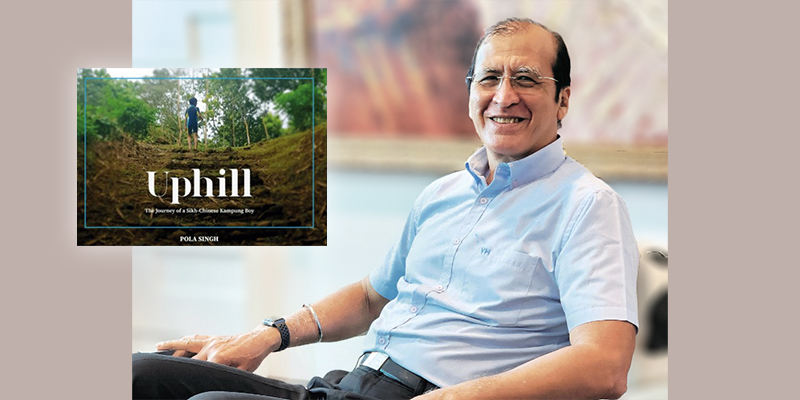
Pola Singh and his newly released book ‘Uphill — The Journey of a Sikh-Chinese Kampung Boy’ – Photo: Anandhi Gopinath / The Edge
By Tan Gim Ean | The Edge | Malaysia |
“What for you want to sell milk if you can go to university?” Pola Singh’s neighbours in Melaka might not have said this out loud, but they could see a better future for him and his older brother when the pair got places at University of Malaya.
Going to university was a game changer for his family as well as Kampung Ayer Leleh, where Pola and his nine siblings were born and raised. He and Jaib, the first person from their village to win a state scholarship, “broke the taboo” of impoverished kids having no chance to pursue tertiary education. Suddenly, the villagers — for whom even filling up a form was susah — saw that anyone could do it, if they worked hard.
University changed the course of this young man’s life. “I shed my inferiority complex and made new friends. I realised I was no longer the Pola Singh from Melaka. I was a new person with talent and brains.”
Pola, whose name denotes “a good man”, has certainly made good. He shares how his family made do with what they had in Uphill — The Journey of a Sikh-Chinese Kampung Boy and the brood inheriting values and a belief system from two worlds.
“My father tackled my mother because both of them knew Hokkien. But he told mum that at home, we must only speak Punjabi or Malay. My cowherd parents went for my convocation and could not understand what was going on. But they shed tears of joy.”
NOTE: POLA SINGH WILL TALK ABOUT HIS BOOK ON 14 MARCH 2023 AT GURDWARA SAHIB PETALING JAYA. Book priced at RM40, all proceeds from the sale will go to GSPJ. To attend, please RSVP to Sarjit Kaur (012 213 9005) by March 7, 2023. Seats limited to first 40.
The Movement Control Orders imposed in 2020 allowed Pola to reflect on his humble beginnings and write this book, after his first, My Reflections of Life (2016), a compilation of articles published in newspapers, periodicals and news websites.
He also wanted to leave a legacy for the younger generation so they will never forget how Tara Singh and Ram Kaur raised five girls and five boys through sweat and sacrifice but did not leave them a single sen. “So we didn’t quarrel. We had enough.”
In 1992, he joined the Economic Planning Unit in the Prime Minister’s Department, where he served for more than seven years. The job gave him an in-depth working knowledge of economic and social development issues that affected the nation.
After 27 years in the civil service and just before turning 50, Pola opted to retire. He then did consultancy work for a Danish energy company before joining the Initiative for Asean Integration, established in 2000 to bridge the development gap within the association and enhance its competitiveness as a region. But flying to and from the Asean secretariat in Jakarta took a toll on his back. So, after four years, he decided to take a break from work.
In 2009, just as his back improved, he was offered the post of director-general of the Maritime Institute of Malaysia, a policy institute parked under the Transport Ministry. The role involved removing deadwood and shaking up a few others in the name of change. Resistance to those measures caused him to lose sleep and he did not renew his contract in 2011.
ASIA SAMACHAR is an online newspaper for Sikhs / Punjabis in Southeast Asia and beyond. When you leave a comment at the bottom of this article, it takes time to appear as it is moderated by human being. Unless it is offensive or libelous, it should appear. You can also comment at Facebook, Twitter, and Instagram. You can reach us via WhatsApp +6017-335-1399 or email: asia.samachar@gmail.com. For obituary announcements, click here.
An event by Ankur Narula Ministries event in Jalandhar, as shared by the church at its Facebook page
By Asia Samachar | Panjab, India |
“Baari barsi khatan gaya si, roohan khat ke leaeya, sannu Yesu ne, de ke khoon bachaya.”
The ‘boli’ can be heard in almost every house around the Church of Signs and Wonders at Khambra where villagers follow their “young and charismatic” pastor Ankur Yoseph Narula, according to a recent report by the Tribune News Service.
While big churches were a rarity in villages a decade or two ago, the report has suggested that the lucrative and successful ministeries of Doaba’s new age prophets and apostles have led to many villages’ skyline dotted with new church spires. Their roaring success has inspired many to become self-styled pastors.
On December 20, 2022, thousands of followers joined a huge procession taken out through the city on a call by the church. Narula termed it the “biggest Christmas rally” so far. It was just an indication about how people from all religious dispensations in Doaba embracing the Christianity, the report added.
It said among the most popular ministeries in Jalandhar are Narula’s church, the Open Door Church at Khojewal, run by pastor Harpreet Deol and the Church of Glory and Wisdom at Tajpur, run by Bajinder Singh.
The Church of Signs and Wonders at Khambra, which was started only in 2008, has 12 branches in Gurdaspur, Ludhiana, Patiala, Kapurthala, Ferozepur, Hoshiarpur, Amritsar, Nadala, Barnala, Bathinda, Moga and New Chandigarh. The church also has branches in West Bengal, Bihar, UP and weekly services are held in London, Toronto, New York, Germany, Birmingham, New Zealand, Dubai, California, Sydney, Melbourne and Surrey. Narula has 1.34 million subscribers on YouTube and 1,11,000 followers on Instagram and Deol has 30.6k followers on Instagram, according to the report.
A controversy erupted at the Tajpur church in September last year when a four-year-old suffering from cancer died during a healing session. The case came to the fore when the girl’s family levelled allegations, according to the TNS report published by The Tribune on Jan 31, 2023.
ASIA SAMACHAR is an online newspaper for Sikhs / Punjabis in Southeast Asia and beyond. When you leave a comment at the bottom of this article, it takes time to appear as it is moderated by human being. Unless it is offensive or libelous, it should appear. You can also comment at Facebook, Twitter, and Instagram. You can reach us via WhatsApp +6017-335-1399 or email: asia.samachar@gmail.com. For obituary announcements, click here.
Connecting Amritsar to North America may not be a priority for Indian air carriers – Air India and Indigo – but foreign airlines are taking it as a great business opportunity.
After Qatar Airways, Italian private airliner Neos has decided to airlink the Panjab city with Toronto with once-a-week service starting from April 6.
Just a week before the Panjabis celebrate Vaisakhi, their Khalsa Sirjana Divas and harvesting festival, Neos has a great gift wrapped for them with direct connectivity between Amrisar and Toronto.
Neos, which has already been operating a weekly Amritsar-Milan service, has now decided to extend its wings for Panjabi Diaspora by facilitating their direct flight to their choicest destination, Toronto. Insiders say that it has already got licenses to connect Amritsar with Vancouver (British Columbia) and Calgary (Alberta) but will start operating to the remaining Canadian destinations after success of Amritsar-Toronto-Amritsar flight.
Though foreign airlines have started operations out of Amritsar, the international airport named after the fourth Sikh Guru, however, is not adequately equipped. It does not have lounges for passengers. It also needs to upgrade other facilities for the air travellers.
(Prabhjot Singh is a veteran journalist with over three decades of experience of 14 years with Reuters News and 30 years with The Tribune Group, covering a wide spectrum of subjects and stories. He has covered Punjab and Sikh affairs for more than three decades besides covering seven Olympics and several major sporting events and hosting TV shows.)
ASIA SAMACHAR is an online newspaper for Sikhs / Punjabis in Southeast Asia and beyond. When you leave a comment at the bottom of this article, it takes time to appear as it is moderated by human being. Unless it is offensive or libelous, it should appear. You can also comment at Facebook, Twitter, and Instagram. You can reach us via WhatsApp +6017-335-1399 or email: asia.samachar@gmail.com. For obituary announcements, click here.
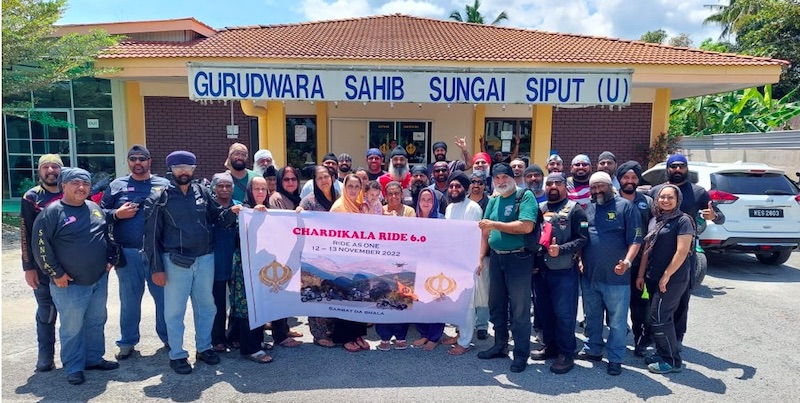
Chardikala Ride 6.0 bikers posing for a photo with the Sanggat of Gurdwara Sahib Sungai Siput in February 2023 – Photo: Supplied
By Asia Samachar | Malaysia |
Some 40 bikers from a number of Sikh bikers clubs came together last month to visit a number of gurdwaras with a small Sikh population in Perak and Cameron Highlands .
The Chardikala Ride 6.0 on Feb 11-12 visited gurdwaras in Kuala Kangsar, Sungai Siput, Chemor, Tanjung Rambutan, Bercham, Tambun and Gunong Rapat. The bikers also visited Victory Bridge in Kuala Kangsar.
They then continued their journey to Cameron Highlands to visit Gurdwara Sahib Brinchang and Gurdwara Sahib Tanah Rata where they stayed for a night.
The bikers come from groups like the Malaysian Punjabi Bikers, Ranggi Bikers and Santana Bikers.
The kicked off their travel from Gurdwara Sahib Subang in Selangor.
Their next ride, tentatively planned for before Vaisakhi, will cover gurdwaras in Negeri Sembilan. They are also mulling a ride to cover gurdwaras in Kedah and Hatyai, Thailand, towards the middle of this year.
ASIA SAMACHAR is an online newspaper for Sikhs / Punjabis in Southeast Asia and beyond. When you leave a comment at the bottom of this article, it takes time to appear as it is moderated by human being. Unless it is offensive or libelous, it should appear. You can also comment at Facebook, Twitter, and Instagram. You can reach us via WhatsApp +6017-335-1399 or email: asia.samachar@gmail.com. For obituary announcements, click here.
Former New Straits Times journalist Jaspal Singh and a Sikh activist died yesterday. He was 52.
He was admitted to the Raja Permaisuri Bainun Hospital in Ipoh, Perak, on Monday after complaining of chest pain and breathing difficulties.
Jaspal, who could read and write fluently in his tongue Panjabi as well as in English and Malay, was also one of the volunteers at Asia Samachar. Among others, he had written some of its editorials.
He held a first class honours in Malay Literature from Universiti Sains Malaysia (USM).
Jaspal worked with Kuala Lumpur-based Business Times as a sub-editor in 1997. He then joined Malaysia’s national English newspaper NST in 2002. In 2015, he became the Perak bureau chief for the Malay Mail before leaving journalism in 2016.
In 2020, Jaspal had his leg amputated following diabetes.
On the Sikh community front, Jaspal was a trustee of United Perak Sikh Organisations (UPSO Foundation) and an advisor to the Sikh Single Mothers Association Ipoh, known as SikhMai.
“I think he deserves mention as a fine journalist that had carved the first ever budgeted allocation for the Sikh community of Perak,” Ipoh-based businessman and fellow Sikh activist Dheer Singh told Asia Samachar.
Dheer, who is also a trustee of UPSO Foundation along with Dr Sarjeet Singh Sidhu, said Jaspal was part of the team that requested the Perak state government to allocate a yearly budget directly to the Sikhs. This led to the Perak state government under Menteri Besar Dr Zambry and state executive councillor Dr Mah Hang Soon carving out Sikhs a RM500,000 allocation. See here.
He said Jaspal was also involved when a team made presentations to then Prime Minister Abdullah Ahmad Badawi to assist the community’s self-effort to teaching of the Panjabi language.
Jaspal was married to Daljeed Kaur, 46, and the couple have nine-year-old twins Gurjeevan Singh and Gursamrath Kaur.
His remains will be cremated today (3 March, Friday) at the Sikh Crematorium of Wadda Gurdwara Sahib Ipoh at 2pm. The cortege will leave from his residence at No. 30, Jalan Suria 1, Taman Suria (Sunland Residence) in Ipoh.
ASIA SAMACHAR is an online newspaper for Sikhs / Punjabis in Southeast Asia and beyond. When you leave a comment at the bottom of this article, it takes time to appear as it is moderated by human being. Unless it is offensive or libelous, it should appear. You can also comment at Facebook, Twitter, and Instagram. You can reach us via WhatsApp +6017-335-1399 or email: asia.samachar@gmail.com. For obituary announcements, click here.
Saskaar / Cremation: 3.00pm, 3 March 2023 (Friday), at Jalan Loke Yew Crematorium, Kuala Lumpur
Last Respects: 1pm to 3.00 pm at Jalan Loke Yew Crematorium, Kuala Lumpur
Akhand Paath: Starting on 3th March 2023 (Friday) at 4pm at Gurdwara Sahib Sungai Besi (Shaapan) Akhand Paath Da Bhog on 5th March 2023 (Sunday) at 4pm (Guru Ka Langgar will be served all through)
Hardave Singh Madi (Deba) 019-3325431
| Entry: 2 March 2023 | Source: Family
ASIA SAMACHAR is an online newspaper for Sikhs / Punjabis in Southeast Asia and beyond. When you leave a comment at the bottom of this article, it takes time to appear as it is moderated by human being. Unless it is offensive or libelous, it should appear. You can also comment at Facebook, Twitter, and Instagram. You can reach us via WhatsApp +6017-335-1399 or email: asia.samachar@gmail.com. For obituary announcements, click here.
Have you ever felt that some philosophical writing is simply too difficult and is written in such a dense manner that it makes you feel intellectually inadequate, or even stupid? If yes, no need to worry, the problem is not with you but the writer.
Born in in 1788 the European philosopher Arthur Schopenhauer argued that saying six things at once, in long, jargon-laden sentences was simply wrong. He criticised philosophers who wrote in such a ways, where the obscurity implied the writer was saying specially something important. Schopenhauer felt that clarity and simplicity by saying one thing at a time, was the key to good writing and he always wrote to be understood.
Another unique feature that made him stand out from other European philosophers of the enlightenment was his embrace of Indian philosophy in relation to such matters as asceticism, the self, and the notion of the world-as-appearance of illusion.
Though Schopenhauer accepted the empirical reality of an external world, he believed our knowledge and experience of the world is always indirect. That is to say, that everything we perceive about the world through our senses exists simply as an object in relation to a subject—i.e. a ‘representation’ to a subject. It follows that everything that is part of the world is ‘subject-dependent’.
To illustrate this idea, he uses the example of a cube and a the sensations in the hand of a man born blind. On touching an object of cubic shape, it appears quite uniform and the same on all sides and in every direction. The edges, it is true, press upon a smaller portion of his hand, still nothing at all like a cube is contained in these sensations. However, through the resistance felt whilst touching the object, he paints a picture in his mind of the cubic shape.
Here Schopenhauer is showing how the senses furnish the raw material, but it is the intellect that produces the world as representation. His ideas went on to inform the development of theories related to perception and understanding the inner world.
Perhaps the reason why he isn’t a particularly well known or celebrated philosopher was his pessimism and negative view of existence and humanity. He felt advanced cognitive abilities of human beings simply server an illogical, directionless, ceaseless striving that condemns the human individual to a life of suffering.
The influence of Indian philosophy, especially Buddhism with its emphasis on suffering, can be clearly seen in his work on the human will. Salvation from a life condemned to suffering for Schopenhauer can only be achieved through the will’s or ego’s being neutralised. And this can only be done through metaphysical insights that reveals the self to be merely an illusion. He felt the Saints had intuitively recognised how one is caught up in vain strivings, inner conflict and perpetual suffering.
Though Schopenhauer did not believe in a soul in the religious sense, he was able to show how every living thing is possessed by a ‘will’ and that inner suffering was a universal phenomena. All the main religious traditions accept the universality of suffering but each has its own unique perspectives on its precise nature and how it can be overcome.
SUFFERING IN OTHER FAITHS
In Christianity, suffering is seen as a consequence of human sin and disobedience to God. However, through faith in Jesus Christ, Christians believe they can be forgiven for their sins and overcome suffering by trusting in God’s plan for their lives.
In Islam, suffering is seen as a test from God to strengthen one’s faith and trust in Him. Muslims believe that through prayer, submission to God’s will, and good deeds, they can overcome suffering and achieve paradise in the afterlife.
In Hinduism, suffering is seen as a result of karma, the consequences of one’s past actions. Hindus believe that by living a righteous life and performing good deeds, they can improve their karma and reduce their suffering in this life and the next.
In Judaism, suffering is seen as a challenge that can bring one closer to God and deepen one’s faith. Jews believe in the importance of prayer, study of the Torah, and good deeds as a means of overcoming suffering and living a meaningful life.
In Taoism, suffering is seen as a result of the imbalance and disharmony in the universe. Taoists believe in the importance of living in harmony with the natural order of things, cultivating inner peace, and letting go of attachment to external things as a means of overcoming suffering.
SIKHI ON SUFFERING
In Sikhi, and the teachings of Guru Nanak, suffering is real, necessary but not permanent. In the following lines Guru Nanak, unlike Schopenhauer’s pessimism, indicates there is an escape from the pain of the ego or will and that is ‘Naam’.
“ਨਾਨਕ ਦੁਖੀਆ ਸਭੁ ਸੰਸਾਰੁ ॥ ਮੰਨੇ ਨਾਉ ਸੋਈ ਜਿਣਿ ਜਾਇ ॥
O Nanak, the whole world is suffering. He alone is victorious, who believes in the divine Name’ (GGS p954).
Here, belief in the Naam refers to the immense power of spiritual power, which can be harnessed through realising the divinity of all existence. The realisation comes through developing discerning intellect and to focus one mind to reach beyond our biologically programmes desires on higher divine ideals.
According to Nanak, suffering is an inevitable part of the natural divine order and therefore something to embrace and learn from. As he states in Jap Bani, “ਹੁਕਮਿ ਲਿਖਿ ਦੁਖ ਸੁਖ ਪਾਈਅਹਿ ॥ By the Divine Written Command, pain and pleasure are obtained.” (GGS p1)
According to Gurbani there is a symbiotic relationship between suffering (dukh) and pleasure (sukh), which are both integral to the divine command manifested in the laws of nature. The example of this unity of suffering and pleasure is most powerfully seen in the process of a woman giving birth where she goes from one extreme feelings of pain to feelings of intense happiness.
Sikhi specifically recognises this universality and unstable nature of suffering and pleasure. However, Sikhi rejects the Hindu and the concept of karma, which suggests that suffering is the result of past actions alone.
According to Sikh teaching, though cause and effect in the Karmic sense is not rejected, specifically for human beings, suffering arises from the universal human condition of egoism, attachment to worldly possessions, and ignorance of the true nature of reality.
Instead, Sikhs believe that suffering is a natural means to reduce one’s ego and attachment to material possessions, and to promote humility and empathy towards others. In that one could even argue suffering is a good feeling.
In Sikhism, the concept of chardi kala, or “ever-rising spirit,” is central to the idea that one can overcome suffering through a positive attitude and unwavering faith in the transcendent divine.
There is also a social dimension to understanding suffering as a result of material circumstances. Hence, Sikhi advocates a life of seva, or selfless service, to others. It is through collective and individual acts of care that one can contribute to a more just and equitable society and reduce suffering in the world.
Gurnam Singh is an academic activist dedicated to human rights, liberty, equality, social and environmental justice. He is an Associate Professor of Sociology at University of Warwick, UK. He can be contacted at Gurnam.singh.1@warwick.ac.uk
* This is the opinion of the writer and does not necessarily represent the views of Asia Samachar.
ASIA SAMACHAR is an online newspaper for Sikhs / Punjabis in Southeast Asia and beyond. When you leave a comment at the bottom of this article, it takes time to appear as it is moderated by human being. Unless it is offensive or libelous, it should appear. You can also comment at Facebook, Twitter, and Instagram. You can reach us via WhatsApp +6017-335-1399 or email: asia.samachar@gmail.com. For obituary announcements, click here.
Club members untie their turbans before donning the helmets they must wear to ride. – Photo: The Age / Enrique Ascui
By Carolyn Webb | The Age | Australia |
Nine years ago, Parampreet Singh Rajput realised he was living life as though he were a machine. He worked more than 16 hours a day, seven days a week. As a young migrant, he sought to do well.
“I realised I was losing the real taste of life,” said the chartered accountant, who runs his own business. “It was ‘work, work, work’ and nothing else.”
The 40-year-old, from Lyndhurst in Melbourne’s south-east, started spending more time with his wife and two daughters. And he sought a hobby.
He remembered how, in Amritsar, his home city in northern India, he used to love riding a motorcycle up into the hills with friends.
He bought a second-hand motorcycle and, in October 2014, rode from Geelong to Lorne along the Great Ocean Road with two friends. They had a great time.
So began the Sikh Motorcycle Club Australia – made up mostly of Sikh men from the Punjab region of India – which now has more than 120 members.
They wear black jackets and many ride sleek Harley-Davidson machines. Club rules include no alcohol or drugs, no overtaking each other and no speeding.
Rajput once counselled a young man who rode too fast on his sports bike, warning him “either you leave the club or be more disciplined”. The man no longer speeds and is an accepted club member.
According to the Australian Bureau of Statistics, the number of Sikhs in Australia has soared, from 12,000 in 1996 to 210,400 in 2021.
The motorcycle club has thrived and destinations for their monthly Sunday rides have included Hanging Rock, Ballarat and Healesville. There have been longer trips to Canberra and Phillip Island. Sometimes they stop to pray at temples.
“I feel like a bird, I have wings. I’m flying,” Rajput says of the freedom of the road.
ASIA SAMACHAR is an online newspaper for Sikhs / Punjabis in Southeast Asia and beyond. When you leave a comment at the bottom of this article, it takes time to appear as it is moderated by human being. Unless it is offensive or libelous, it should appear. You can also comment at Facebook, Twitter, and Instagram. You can reach us via WhatsApp +6017-335-1399 or email: asia.samachar@gmail.com. For obituary announcements, click here.
The Global Sikh Council is deeply concerned over the pattern of disturbing religious and political developments that are emerging in Punjab. The Ajnala Incident epitomizes the ugliness of these developments and serves as a stark signal to the authorities of Punjab and India to take appropriate measures to ensure peace and stability remains secure.
The visuals that emerged from Ajnala show a group of Sikhs led by Amritpal Singh storming police barricades and taking over the police station. While the act of taking the law into one’s hands is to be condemned, the police and authorities deserve condemnation for precipitating the incident and not doing enough to have prevented it.
The Global Sikh Council wishes to remind the Sikhs of Punjab that they have successfully stood up for their rights in peaceful morchas and andolans such as the kisaan andolan, mattewara forest, and the Zira moorcha etc’ and that they have done so peacefully – which is the Sikh way for conveying their narratives and highlighting the injustices that they have endured.
In this light then, the hooliganism that has become evident from the viralled videos of the Ajnala Incident must be condemned for what it is. This is not the Sikh way. It should never be the Sikh way for Sikhs who live in a democracy.
The Global Sikh Council calls on the Punjab and Indian authorities to act professionally and fairly towards Sikhs of Punjab and stop from inflicting any sort of injustices on them. The authorities must always refrain from implementing unjust policies, anti-Sikh decisions, high-handed acts and other anti-democratic behaviour that can cause, trigger, or elicit the kind of response that was seen in the Ajnala Incident.
The consequences of not heeding this call can be destructive to the people of Punjab. The violent, vicious, and massive loss of life causing incidents of the 1978 – 84 era that culminated in the Indian Army’s storming of Darbar Sahib and numerous other Gurdwaras; as well as the assassination of a Prime Minister and the ensuring anti-Sikh murderous riots in Delhi must not be allowed a repeat ever.
The Global Sikh Council reiterates that what Punjab needs above all are employment opportunities for its youth – a vast majority of whom have set their eyes on migration to create a better life for themselves. Such job creation in Punjab needs vast amounts of Foreign Direct Investment in a variety of sectors. Incidences of violence and the resulting break down in law and order are bound to scare investors away and mire Punjab deeper into its social and economic problems.
The Global Sikh Council calls upon the citizens of Punjab and its democratically elected government to work together to create an atmosphere that would be conducive towards peace, prosperity, and development.
Signed by GSC president Lady Singh Kanwaljit Kaur, GSC religious affairs committee chair Dr Karminder Singh and GSC legal affairs committee chair Jagir Singh
ASIA SAMACHAR is an online newspaper for Sikhs / Punjabis in Southeast Asia and beyond. When you leave a comment at the bottom of this article, it takes time to appear as it is moderated by human being. Unless it is offensive or libelous, it should appear. You can also comment at Facebook, Twitter, and Instagram. You can reach us via WhatsApp +6017-335-1399 or email: asia.samachar@gmail.com. For obituary announcements, click here.
It is with deepest sorrow that we announce the passing of Mata Balwant Kaur Gurney [Daughter of Late Hardam Singh Gurney/ Late Mata Harnik Kaur] and wife of Late Toki Peritam Singh Dhaliwal [son of Toki Pertab Singh Dhaliwal and Mata Rajh Kaur Chel
Mata Balwant Kaur left this world for her heavely abode on 22 February 2023, leaving behind
Children: Late Jagjit Singh Dhaliwal – Son Dr Jasjit Kaur Dhaliwal – Daughter Harjit Singh Dhaliwal – Son Keiranjit Kaur Dhaliwal – Daughter Late Bhagetjit Singh Dhaliwal – Son
Siblings/ Spouses: Mata Sarjit Kaur Gurney / Toki Bose Singh Dhaliwal Sdr Mahinder Singh Gurney and Family
In Laws: Late Madam Gurcharan Kaur Dhaliwal and Family
And Nephews, Nieces and family members who will mourn their loss….
Path Da Bhog will be held on Sunday, 12th 2023 March [10 am – 12 noon] at Gurudwara Sahib Perai, Penang
Please treat this as a personal invitation. Your presence will be appreciated.
Contact: Dr Jasjit Kaur +6013 – 2048790 Mr Victor Raj +6019 – 4499111 Ms Keiranjit Kaur +6016 – 9787921
| Entry: 28 Feb 2023 | Source: Family
ASIA SAMACHAR is an online newspaper for Sikhs / Punjabis in Southeast Asia and beyond. When you leave a comment at the bottom of this article, it takes time to appear as it is moderated by human being. Unless it is offensive or libelous, it should appear. You can also comment at Facebook, Twitter, and Instagram. You can reach us via WhatsApp +6017-335-1399 or email: asia.samachar@gmail.com. For obituary announcements, click here.