Manjit Kaur leading kirtan a week after her wedding in 1995 – Photo: Supplied
By Manjit Kaur (UK) | OPINION |
Growing up as a child in the UK, kirtan was always a part of my life. It was a time when I felt calm and relaxed, and nothing else mattered. I even learned to play the harmonium and sing a few shabads myself, which was a truly amazing experience. The picture above was taken a week after my wedding in 1985 at my brother Sarabjit Singh’s house; he is pictured in the middle. My husband Gurnam Singh can be seen playing the table. Even now, as an adult, kirtan remains an important part of my life. It lifts me up and makes me feel alive and connected. In this short piece, I want to explore the place of kirtan in Sikhi as well as my own personal life.
At the core of Sikhi is the belief in unity and oneness and the importance of spiritual practice to connect with the divine. There are two key ways in Sikhi to do this: Gurbani Kirtan and meditation.
Gurbani Kirtan, also known as Shabad Kirtan, is the singing of devotional poems from the Sikh holy scripture, the Sri Guru Granth Sahib (SGGS). The uniqueness of SGGS is that virtually all the shabads are written to specific notes (ragas) and rhythms (naad) and it is the convergence of the poem, with the raga and naad that produces the deep spiritual effects. When the shabad is sung with love and devotion, as I have personally experienced, one is able to connect with the divine and achieve a state of spiritual bliss, which we call ‘rasa’.
Meditation, or simran, is another key practice in Sikhi. It involves the repetition of the the name of the divine, which is captured in the expression ‘waheguru’! The goal is to silence the mind and focus on the divine. Meditation is seen as a way to connect and merge with universal being, which we call Akaal Purakh.
Together, Gurbani Kirtan and meditation are powerful tools for physical health and spiritual growth. The kirtan is sung in gurdwaras across the world but in reality you can listen to Kirtan and do simian meditation anywhere. For me the goal is to stay focussed 24 hours a day, wherever you are and whatever you are doing.
One of the many benefits of kirtan and meditation is that they can help reduce conflict and stress and promote a sense of peace, both within yourself, but also within the sangat or congregation. The music and chanting can be soothing and calming, while meditation can help balance the mind and reduce anxiety. Another benefit of Gurbani Kirtan and meditation is that they can help develop a deeper understanding of Sikhi.
As I sit down to listen to Gurbani Kirtan I am transported to a place where I feel at peace and at one with everything around me. It’s hard to put into words, but listening to Kirtan feels like a merging of myself with the divine. Even when I am in situations where I am a stranger, perhaps in a different country, I never feel alone, as through Gurbani I feel my Guru is always present within me.
When I am present at a kirtan programme, I try to keep my focus on the Gurbani and avoid looking around. Though I am aware of the sangat, by focussing on the kirtan I feel totally connected with the words and sounds which wash over me. The beauty of Kirtan in the sangat is that it brings people together in a way that is not bound by hate or discrimination. In the sangat are all equal, whatever our skin colour, gender, age, caste or even religion; we come together as one to sing the praises of the divine. There is a sense of unity and love that fills the air, and it is truly a beautiful thing.
As someone who loves music, I appreciate the different instruments that are used in kirtan. From traditional instruments to the guitar, each one adds its own unique flavour to the music. When the singer performs in a calm and gentle manner, without force or shouting, it truly is a pleasure to listen to. It’s as if the talent of the performer is merging with the beauty of the Gurbani, creating a sense of peace and harmony.
When the words “Waheguru” are sung in a calm and relaxing way, it has a powerful effect on my mind and body. I feel a sense of empowerment and control, and I am compelled to join in and feel the meaning of the words for myself. It’s amazing how something as simple as a word can have such a profound impact on the body and mind.
In a world where people are often consumed by things like fame and money, kirtan is a reminder that there is something more important, more precious than material possessions. It is a reminder that there is something greater than ourselves, and that we are all connected to it. For me, kirtan will always be a source of strength, compassion and love, and I will continue to cherish it for the rest of my life.
Manjit Kaur, a UK-based therapist and counsellor, is a presenter of the 1 Show on Akaal Channel. She can be contacted via email at manjitkaur1show@gmail.com
ASIA SAMACHAR is an online newspaper for Sikhs / Punjabis in Southeast Asia and beyond.Facebook | WhatsApp +6017-335-1399 | Email: editor@asiasamachar.com | Twitter | Instagram | Obituary announcements, click here |
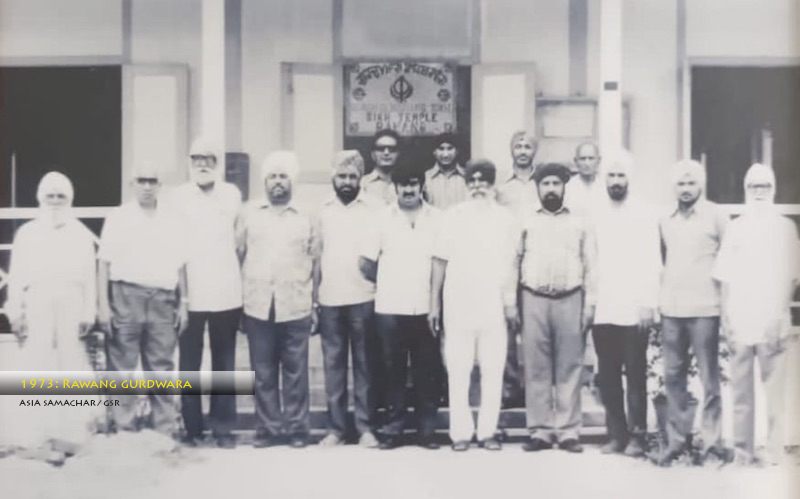
The 1973 Rawang gurdwara committee standing in front of the old wooden structure – Photo: GSR
By Harmendar Singh Khosa | Malaysia |
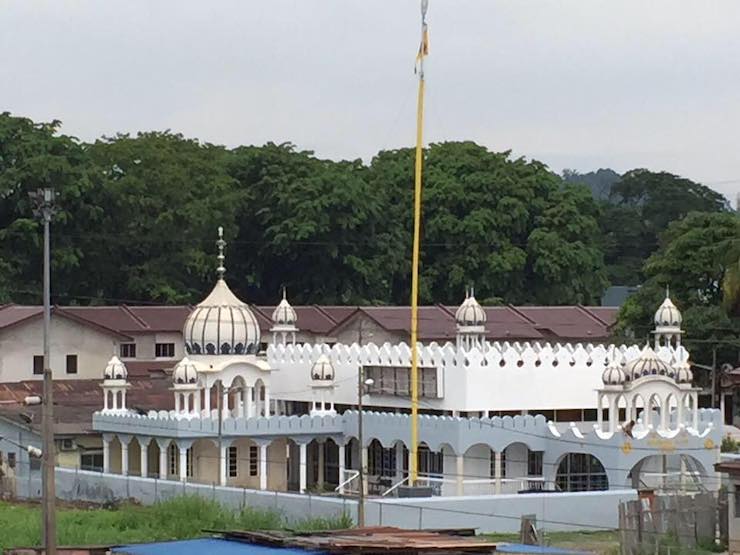
On behalf of the Parbandhak & Building Committee, I would like to say a big welcome to everyone present here today. We are gathered to celebrate a monumental event that we have awaited for a very long time. Before I move on further, I would like to take everyone on a reflection of our journey thus far.
This idea for Gurdwara renovation and upgrading was mooted almost 20 years ago. And I dare say that there was much effort from the Gurdwara Parbandhak Committees from that time onwards to make this dream come true. I remember when I was serving as the Punjabi School Manager in 2006, the ideas were being discussed at the Committee meetings.
The President at that time was our Late Sardar Mahinder Singh Sidhu from Sidhu Brothers. Then followed by Late Sardar Lakhbir Singh, followed by Sardar Kartar Singh Jassal, Sardar Dr Nirmal Singh, and now under the auspices of Sardar Amarjit Singh Jassal.
I daresay that every committee had laboriously worked towards bringing this dream to a fruition, laid the foundation, ranging from finding the actual size of the Gurdwara plot from Pejabat Tanah (Land office), getting the correct title, raised money to purchase the current assets, developed the concept for rebuilding, had many discussions with the architect, and many many more actions.
What every committee has done since then, together with the Sanggat, is to lay the foundation, brick by brick, to bring us towards getting all the paperwork in order, in obtaining all the approvals from all the relevant depts. Eventually. All this was done as wonderful sewa by all members. I won’t mention who you are, as there are too many of you wonderful Rawang Sikhs who have contributed to these efforts. You know, and Waheguru knows, what you have contributed and may you be blessed by Waheguru for this Sewa.
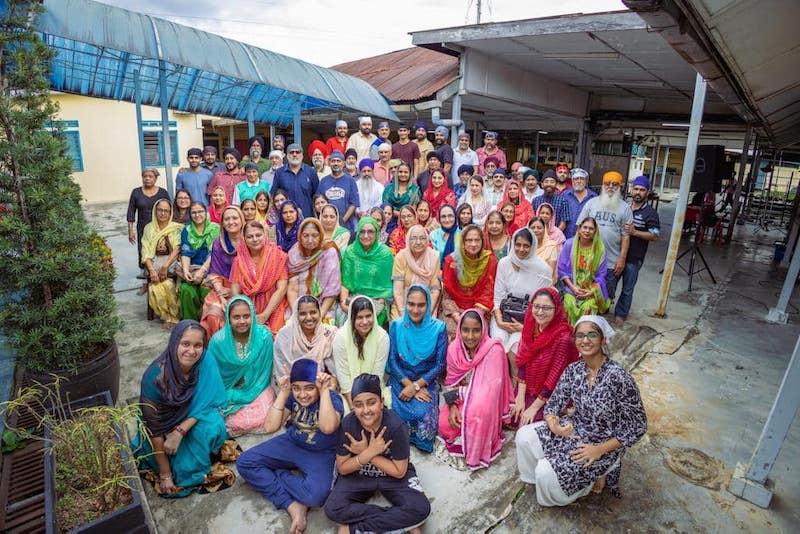
IN FULL FORCE: Attendees at the hi tea on renovation plans for the Rawang gurdwara complex on Jan 29, 2023. You can view the old structure on the right – Photo: GSR
Our elders took the challenge to built this Gurdwara in 1938. The late Babu Bachan Singh, father of our Sanggat member, Sardar Baldave Singh, was the Mining Overseer for the Rawang Tin Mines at that time. There were many Sikhs working in the dredging mines then, and Babu Bachan Singh one of the few learned Sikhs in Rawang. Together with the Sanggat, he managed to convince the Rawang Mines Manager, Mr McCormick to allocate a piece of land for the construction of the Gurdwara. That piece of land is the very same one where we are standing on today. Babu Bachan Singh did the Secretary and Treasurer Sewa from then until the early 80s.
The first structure of the Gurdwara was a wooden one, and the current concrete Darbar Sahib sits atop very same foundation, at that same very height. The concrete base foundation has never been touched since.
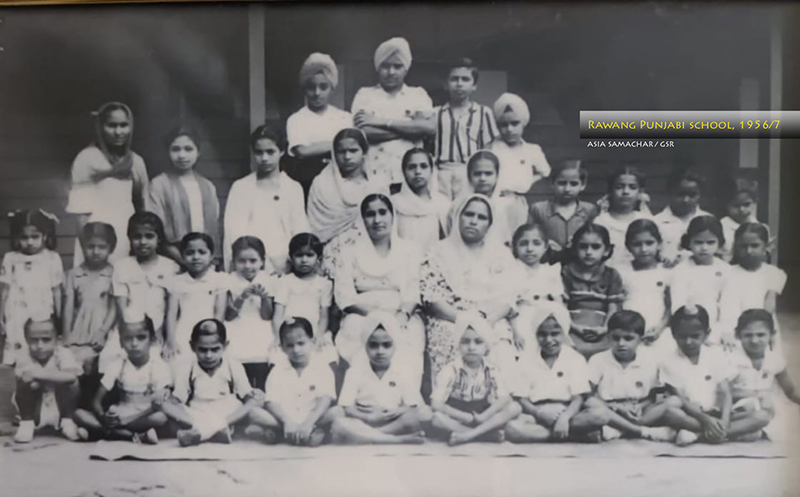
Rawang Punjabi school, circa 1956/7. Seated seventh from left is Mata Isher Kaur, the first Punjabi school teacher. – Photo: GSR
The Punjabi School was then started, with one teacher, Sardarni Isher Kaur, who went on to serve as Teacher until the late 60s. Her former students might be sitting here with us today.
In 1974, the wooden structure was replaced by a concrete one. As the older folks of Rawang might remember, the President at that time was Sardar Resham Singh, who was the General Manager of Len Bus Co. He stayed on a president for almost 20 years.
Now it has been almost 50 years since the last major renovation. I believe we all can emulate the sewa of these very fine Sikh pioneers who gave their man, tan and dhan so that the sanggat of today can enjoy this wonderful venue.
THE NEXT PHASE
And the time is ripe for us, to continue the good work of our pioneers so that the next generation of Sikhs in Rawang can continue to pray, socialize and do good in tandem with the times.
As time passes, there are always new needs and upgrading, as we upgrade our own lifestyle and homes, and we also continuously renovate our homes to suit ourselves. Our new structure includes a two storey multi purpose building comprising Granthi and Pathi residences, langgar hall, a modern kitchen, storerooms, toilets, chota darbar (small prayer room), classrooms and office. It should be able to cater to the growing Sanggat needs, as we can host Kirtan Darbars, wedding parties, Samelan and other Sikhi based events.
We would like to thank each and every one who has continuously made our Gurdwara not only a place of worship, but a very important part of the social life of Rawang Sikhs. Special thanks to all our Dhesi veer, and sisters, who have always stood by our side in sewa and in carrying all our activities actively.
This is our Gurdwara, where we have celebrated Gurpurbs, weddings, birthdays, deaths, amrit sanchaar, kirtan, samelan, Hola Mohalla and Vaisakhi games, and not forgetting Punjabi school. We have always stood together, old and new Sanggat side by side in this together, and now we invite everyone to take this huge big giant step to do it better, again, together.
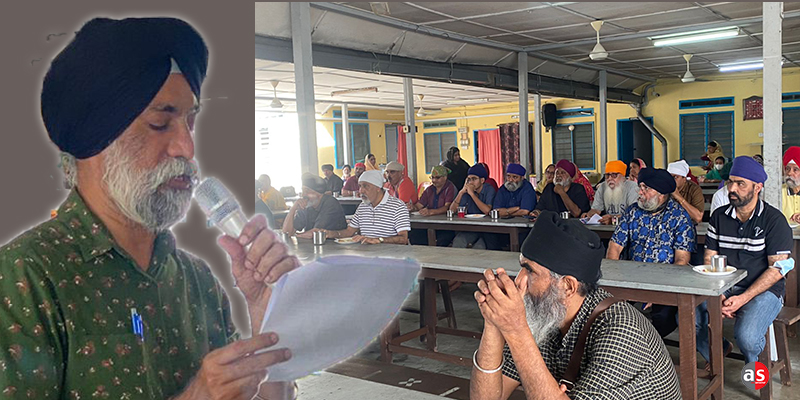
Harmendar Singh Khosa (left) briefing hi tea attendees on renovation plans for the Rawang gurdwara complex on Jan 29, 2023 – Photo: GSR
My dear brothers and sisters, children, and elders, the time has come now for us to take up this challenge do sewa, as you have always done. We need as much as much dhann, as we can to make this Amarat that can be utilized efficiently for the next 50 years. What we are building today, will be much used by us, and more so by our children, and their children in the future. We already have a very beautiful Darbar Sahib, and all other social activities and the new langgar hall will complement of whole Gurdwara complex. The generations to come will appreciate what we have done, as we appreciate our elders for what they did in 1938, and then in 1974.
Although the Covid had stalled our plans for a couple of years, we are today back on track. Our cost of construction has escalated from a price of RM2.6 million to RM3.4 million, up by 30%, due to the higher cost of materials and labour. We have in our coffers today about RM650,000. We must raise RM2.7 million to make this dream come true. And we are starting the ball rolling today.
We have about 150 Sikh and shardalu families here in Rawang. We are confident that the Rawang Sanggat will rise to the occasion and raise the bulk of the funds. We shall also be coming to your homes, like how our elders did in 1938 and again in 1974, so that we can achieve our target. Of which I have no doubt that we can!
Waheguru jika Khalsa , Waheguru ji ki Fateh!
The Gurdwara Sahib Rawang darbar sahib, renovated in 1974, will not be touched. – Photo: GSR Facebook
HOW YOU CAN HELP? You can contact Harmendar Singh Khosa at +6016-6685900 for more details. Cheques can be made to GSR Building Fund (Account No: 8008 600 827, Bank: CIMB Bank).
ASIA SAMACHAR is an online newspaper for Sikhs / Punjabis in Southeast Asia and beyond. When you leave a comment at the bottom of this article, it takes time to appear as it is moderated by human being. Unless it is offensive or libelous, it should appear. You can also comment at Facebook, Twitter, and Instagram. You can reach us via WhatsApp +6017-335-1399 or email: asia.samachar@gmail.com. For obituary announcements, click here.
Please treat this as personal invitation. Your presence will be appreciated.
| Entry: 26 Feb 2023 | Source: Family
ASIA SAMACHAR is an online newspaper for Sikhs / Punjabis in Southeast Asia and beyond. When you leave a comment at the bottom of this article, it takes time to appear as it is moderated by human being. Unless it is offensive or libelous, it should appear. You can also comment at Facebook, Twitter, and Instagram. You can reach us via WhatsApp +6017-335-1399 or email: asia.samachar@gmail.com. For obituary announcements, click here.
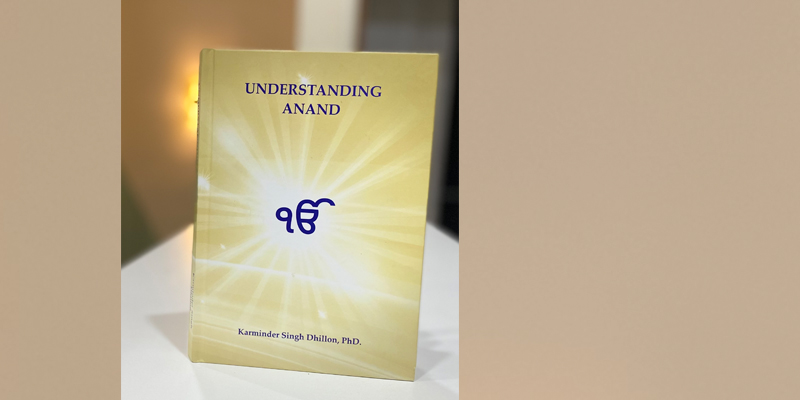
Book: Understanding Anand | Author: Karminder Singh Dhillon, Ph.D.,Director, Sikhi Vichar Forum, Malaysia| Publisher: Karminder Singh Dhillon, Ph. D, Kuala Lumpur, Malaysia | Year of Publication: 2020 | Price : NA | Pages:162 | ISBN: 978-967-18161-4-1
By Dr. Devinder Pal Singh| Book Review |
Dr. Karminder Singh Dhillon is a much-acclaimed theologian, a renowned civil servant, a prolific writer and a profound scholar of comparative religious studies. Born in 1960 at Teluk Anson, Perak, Malaysia, he retired after 32 years long professional career in the Malaysian Civil Service. His incisive articles on Sikh theology have been regularly published in various international journals. Currently serving as Joint Editor for the Sikh Bulletin, USA, he, with his exceptional writing style, has established himself as an eminent exponent of the Sikh doctrines. In addition, he has published about one dozen books on various aspects of Sikhi.
Dr. Dhillon’s book ‘Understanding Anand‘ explores the Spirituality of Bliss as outlined in ‘Anand,’ acomposition by Guru Amar Das, the third Sikh Guru, and enshrined in Sri Guru Granth Sahib (SGGS) on pages 917-922, in Ramkali Raag. He emphasizes that Gurbani advocates a spirituality of Fearlessness and Contentment leading to Anand (bliss and Joy). He laments that our clergy is intent on promoting the Spirituality of Fear and the Spirituality of Asking, which is the antithesis of what Gurbani stands for. He enunciates that Gurbani’s spiritually brilliant and divinely genius messages lead to Vigaas, the Spirituality of Bliss and Joy (Anand).
In ‘Foreword’ of the book, Gyani Jarnail Singh Arshi points out that the translation methodology adopted by the author makes the messages of Anand hymns free from literal translation trends as well as snatan, vedic and yogic slants. The book includes three ‘Introductory Essays,’ i.e. (i)The Spirituality of Anand, (ii) The Methodology of This Book, and (iii) How to Read This Book. The book’s last section elaborates on the Anand composition.
In the essay ‘The Spirituality of Anand,’ the author articulates that Contentment is the starting point of Sikh Spirituality. It starts with an internal testimony that the Creator is within oneself, leading to fearlessness and desirelessness. The author emphasizes that the rightful emotion of the Creator within oneself is Love, Reverence and Realization. On such a realization, the person’s only prayer is one of Thanks, Appreciation and Gratitude in Contentment. Dr. Dhillon laments that our clergy have twisted the Gurbani meanings to promote the feeling of fear and an attitude of constant asking, begging and pleading with God.
The author emphasizes that the Spirituality of Asking reduces Spirituality to a barter transaction leading to the “hedging” of wants or the “future trading” in wants and needs. Such a spirituality negates the Creator’s Hukm (Command or Will). Using appropriate quotes from Gurbani, the author emphasizes that if one must ask for something, then the person must ask for the Realization of the Creator within oneself. The only Asking accepted in Sikhi is to Ask that Asking to be eliminated. It is pointed out that while the Spirituality of Asking seeks desired outcomes, irrespective of the individual’s choices, the Spirituality of Sikhi is about making the right choices to achieve the desired results. The Spirituality of Asking is about wanting a denial or change of Hukm. However, the Spirituality of Sikhi is relational, devotional, and about accepting Hukm. The author asserts that the Spirituality of Anand comprises three components: (i) the Love of the Creator, (ii) acceptance of Hukm and (iii) Contentment. Anand composition describes the Spirituality of Bliss brought about by the realization of the Shabd Guru.
In the essay “The Methodology of This Book – The Gurbani Framework,” the author delineates the process he adopted in interpreting Gurbani. He points out that the objective and focus of the messages of Gurbani are to bring about a realization of the creator within the human conscience. In our everyday usage, the default mode for interpreting the messages of Gurbani is literal. But the messages within the verses cannot be ascertained from this default mode. Therefore, the discovery of Gurbani’s messages requires us to cross over from the literal to the domain of spiritual messages. Although the task is arduous and challenging, the composers of Gurbani provided adequate milestones and sign boards along our spiritual journeys to ensure we get to the intended destination of the envisioned messages. The author enunciates that the Rahao verse or its equivalent is critical in interpreting and understanding Gurbani. Firstly, as each Shabd in SGGS has a poetic rendition, Rahao is the title verse. Secondly, each Shabd is composed in a particular raag, so it has a musical component. Herein Rahao is the asthai verse. Thirdly, each Shabd contains a spiritual message, so herein, the Rahao verse represents the core message of the Shabd. Therefore, the author asserts that Rahao acts as a guide, signboard or milestone for getting to the real messages. Thus, the Rahao or its equivalent verse must be understood to interpret Gurbani compositions. And it should be used as an anchor and base for the interpretation of the remaining verses.
In elucidating the context within a composition, the author asserts that it is provided by any or all the following four entities (i) The Rahao verse or its equivalent, (ii) the previous verse, (iii) the succeeding verse and (iv) the preceding Shabd or sub-section. Elaborating on the inner rationality of Gurbani, the author points out that this concept ties in with the Principle of Context and Gurbani Grammer. He emphasizes that the explanations and concepts used in Gurbani must be defined from Gurbani. Also, the meanings of words and pre-existing concepts deployed within Gurbani are redefined – often in a new and revolutionary way. These redefined and recalibrated meanings are always found within the SGGS, never outside. Using appropriate examples from diverse interpretations of Gurbani, the author successfully illustrated the perils of ignoring Gurbani’s inner rationality and context during its interpretation.
Karminder Singh Dhillon and his first set of five books on Sikhi, anchored by The Hijacking of Sikhi – Photo: Asia Samachar
Moreover, Inner Rationality leads to Conceptual Consistency. The author emphasizes that if the Conceptual Consistency of SGGS is ignored, it leads to the search for conceptual context outside the SGGS, for instance, Vedantic, Brahmanical or yogic concepts and contexts. Dr. Dhillon states that Gurbani is primarily composed in first-person terms, so it is a narrative of the writers’ experiences, processes, choices, consequences and outcomes. Furthermore, it is an experiential narrative from the spiritual depths of their inner experiences. The author asserts that the norm is true that Gurbani is, for me, about me and addressed to me as a guide to my spiritual journey.
Deliberating on the Spirituality of the Shabd, Dr. Dhillon emphasizes that the definitive, decisive and ultimate answer regarding Shabd Guru comes from within the pages of Gurbani, in that the Shabd has been the Guru from the point of conception of Sikhi. Within the Spirituality of Sikhi, the Shabd is the essence. Thereby, the entirety of Sikhi is pivoted on the Shabd.
Explaining the Spirituality of realizing the Creator within, the author reports that the voice of one’s consciousness is the Creator’s voice within. The practical meaning of “Realizing the Creator Within” comes in Guru Nanak categorizing the Creator Within as a conglomeration of divine virtues. The ultimate realization of the Creator Within is to realize and become divine virtues, thereby becoming divine. In this way, Spirituality becomes a choice and a journey for the here and now. It is to be lived within the confines of one’s human life from birth to death and never beyond. It replaces the Spirituality of Fear, the Spirituality of Asking and the pre-eminence of life after death.
Reporting on the Spirituality of Self, the author articulates that Guru Nanak’s message that the Creator is Within oneself implies the elimination of the clergy or other third party as intermediaries in one’s spiritual discoveries. Guru Nanak’s Spirituality was a spirituality of the self, for the self, by the self. It was a spirituality undertaken by the self, transversed by the self, and conducted within the self. It was a spirituality whose outcomes were borne by the self and goals achieved by the self. It is pointed out that human responsibility, human choices and human intellect are the basic premises of Gurbani,Gurmat and Sikhi.
Enunciating the concept ‘Using Gurbani to understand Gurbani,‘ the author pronounces that SGGS uses spiritual concepts, beliefs, idioms, metaphors, similes etc., (that were already in use and within the psyche of spiritual seekers of the time) with new meanings and understandings. So the redefining of these concepts are to be found within SGGS, not outside. For example, he reports that Amrit Vela is defined as a period of life that is imbued with the messages as contained within the Shabd, rather than an ambrosial hour, dawn etc., as is traditionally thought in various Indian religious practices, rituals and dogmas. According to Gurbani, there is no such thing as an auspicious or inauspicious time. Time is good or bad depending on what we do during a particular time.
Another example he provides is that of Chaar Padarath (Four blessings). These have been traditionally explained as Dharm, Arth, Kaam and Moksha. However, the Gurbani-based redefined interpretation of Chaar Padarath is the Spiritual Bliss (Elimination of Spiritual Sorrow), Spiritual Dignity attainment, Spiritual Courage (Elimination of the primal fears of death after birth), and Enlightenment (Realization of the Creator). The author has used this methodology throughout the book and termed it ‘The Gurbani Framework”.
In the essay “How to Read This Book,” the author explains the style he followed in the book to interpret Gurbani’s verses. Though the starting point of any translation is the literal, context is given its due place within the interpretations. The purpose of using the context is to get the intended meaning of the individual verses by examining them within the composition’s complete and holistic narrative. As the methodology applied in the book makes the translations and interpretations starkly different from the commonly propagated/preached versions, the author has provided ample notes within sections or verses to explain why the commonly accepted translations are defective and need to be rejected.
The book’s last section provides the translation and interpretation of the Ananad (Spiritual Bliss) Bani composed by Guru Amar Das. It is pointed out that this Baniis a song of spiritual love, bliss and a conversation of spiritual attainment. As Gurbani is not person specific but universal, its messages are for all of us. The author enunciates that the primary message of the composition is that once we realize the Creator Within, our mind (Ghar) becomes the abode of the Creator; the mind has it all and desires no more. Gurbani and Gurmat postulate that the need for the mind is to become the master of our senses and not the other way around.
Dr. Dhillon reports that Kachi Bani is a composition that is not Creator connecting. The command that a Sikh connects only and solely to Sachi Bani (i.e., Creator connecting Bani as enshrined in SGGS) is crystal clear in Gurbani. The author points out that Spirituality is the process of lining up one’s senses, mind, and conscience into congruence; into a state where they complement each other; and into a hierarchy where the Conscience reigns supreme and the mind is subservient to one’s conscience, but master of one’s senses and one’s senses following the dictates of a Gurbani imbued mind. Only such a state leads one to spiritual bliss (Anand).
Karminder Singh Dhillon’s second set of five books on Sikhi, anchored by Selected SIkhi Concepts and Selected Gurbani Shabds – Photo: Asia Samachar
Dr. Karminder Singh Dhillon has done a momentous work in projecting the divine thoughts of Guru Amar Das, particularly and other Sikh Gurus, in general, to the modern world through this book. After making a splendid in-depth study of various religions, along with the life and teachings of Sikh Gurus, the author has successfully attempted to project the dynamic vision of the Great Masters in the context of the contemporary socio-political milieu. The book offers an exciting bridge between the empirical and applied aspects of the great Gurus’ teachings in developing Sikhism. Appropriate references and quotes from Sri Guru Granth Sahib strongly supplement Dr. Dhillon’s thesis. Though there has been some repetition of Gurbani quotes and textual material in the book, it does not take the reader astray; instead, it helps clarify things. Each article is complete in itself and is a treat to read. The younger generation will likely gain much literary and spiritual knowledge from this treatise on Sikh philosophy. It is one of the best books ever authored on this topic. This book should be on all library shelves and distributed by all Gurudwaras. The Sikh youth of today must be encouraged to read works of this nature.
In conclusion, I would like to add that “Understanding Anand” has the potential to inspire countless readers/learners around the world and gives them a unique insight into the concept of Spiritual Bliss as outlined in SGGS. It is a timeless book to be rightly treasured by all learners and truth seekers. Dr. Karminder Singh Dhillon deserves the credit and appreciation of the Sikh community for diligently, painstakingly, and untiringly working to make this excellent book a reality.
(To purchase the books for delivery in Malaysia, drop a WhatsApp to Bhai Pritam Singh at +6016-216 2474. For dispatching to other countries, click here)
Dr. D. P. Singh, M.Sc., Ph.D. is Director, Center for Understanding Sikhism, Mississauga, Ontario, Canada. He is a physicist by training, a teacher by profession and a writer by choice. He specializes in writing on Science, Religion and Environmental topics. Currently, he is working as Director, CanBridge Learning & Educational Consultant to various educational institutions in Canada. Email: drdpsn@gmail.com
ASIA SAMACHAR is an online newspaper for Sikhs / Punjabis in Southeast Asia and beyond. When you leave a comment at the bottom of this article, it takes time to appear as it is moderated by human being. Unless it is offensive or libelous, it should appear. You can also comment at Facebook, Twitter, and Instagram. You can reach us via WhatsApp +6017-335-1399 or email: asia.samachar@gmail.com. For obituary announcements, click here.
If your son or daughter is studying abroad, here is something that will interest or even scare you. The Union Government of India in its Budget has decided to increase the tax on foreign remittances or transfer of foreign exchange from 5% to 20%. This means that if you are sending $10,000 to your ward, you will have to dole out at least $2,500 more as tax.
Intriguingly not much noise has been made against this steep increase in tax on transferring funds abroad for any purpose, including education. Though the tax is only 20% but when any transfer will be made on or after April 1 this year, it will also invite 4-6% bank charges, 0.5% to 3% as foreign exchange mark up and another 1% as brokerage. The additional charges will work out at more than 5% in addition to the tax of 20%.
This will be a big blow to parents of students studying or planning to go abroad for higher studies. Since most of the overseas educational institutions want transfer of funds through recognized banks, use of other channels, including “hawala”, may not be of any help.
Of late, there has been a gradual increase in transfer of funds overseas for various reasons, including investments. Besides, Indians are spending a lot on foreign travel.
A recent report suggested that in the first nine months of the current year, nearly $10 billion was spent on foreign travel. This has been more than any total travel spending in a year in the past. In 2020 at the peak of Covid, this spending on foreign travel was $7 billion.
If the data and figures released by the Reserve Bank of India are any indication, this year Indians have spent almost the same amount in the first nine months of the current fiscal year as what they spent in the entire year last year. The RBI report says that foreign exchange spent on education, maintenance of relatives (especially sons and daughters), gifts and investments, Indians spent $19,354 million. And in the past fiscal, this total foreign exchange spent stood at $19,610 million, which was a record.
Until 2018, total remittances used to be less than half a billion but now it has gone up to $2 billion. While spending on international travel is on the rise, spending on maintenance has shown a downward trend. Investments in securities and equities have almost remained constant at about $10 billion a year, there has been a slight dip in educational remittances. Experts, however, feel that educational remittances will peak when fourth and last quarter fees and other charges are paid.
The increase in tax on overseas remittances will directly hit the education sector. While other remittances are for pleasure or profit, education is an area for career building and clubbing different heads together for the purpose of taxation has come for severe criticism from parents and others whose wards are already or planning to study abroad. They want that education remittances should be charged at old rates of 5% that work out at a total of around 7%. But under the proposed rates, the tax component will go up by more than 300%, from 7% to 24-25%. It will be a big blow for parents whose wards are already studying abroad or those students who have already secured admissions and are required to make remittances after April 1 when the new tax regime becomes operational.
Affected parents are resentful at the silence of various political parties and their leaders on this sad blow to the future of their wards. Punjab will be one of the worst hits by this increase in tax on remittances overseas. Any takers!!!
(Prabhjot Singh is a veteran journalist with over three decades of experience of 14 years with Reuters News and 30 years with The Tribune Group, covering a wide spectrum of subjects and stories. He has covered Punjab and Sikh affairs for more than three decades besides covering seven Olympics and several major sporting events and hosting TV shows.)
ASIA SAMACHAR is an online newspaper for Sikhs / Punjabis in Southeast Asia and beyond. When you leave a comment at the bottom of this article, it takes time to appear as it is moderated by human being. Unless it is offensive or libelous, it should appear. You can also comment at Facebook, Twitter, and Instagram. You can reach us via WhatsApp +6017-335-1399 or email: asia.samachar@gmail.com. For obituary announcements, click here.
Fresh from a disastrous handling of an incident where a passenger urinated on a fellow lady passenger, Air India is tightening the screws on consumption of alcohol on flights.
The crew of the Tata-owned airliner may now be given more leeway on refusing to serve to customers who may already be drunk, though the exact wording of the policy is still unclear, according to reports.
The revised policy states that guests should not be permitted to drink alcohol unless served by the cabin crew and that the cabin crew be attentive to identifying guests that might be consuming their own alcohol, reported the PTI.
“Service of alcoholic beverages must be carried out in a reasonable and safe manner. This includes tactfully refusing to (further) serve a guest alcohol,” as per the policy, according to the report.
In a statement, an Air India spokesperson said the airline has reviewed its existing in-flight alcohol service policy, taking reference from other carriers’ practice and input from the US National Restaurants Association’s guidelines.
“These were largely in line with Air India’s existing practice, though some adjustments have been made for better clarity, and NRA’s Traffic Light system included to help crew recognise and manage possible cases of intoxication.
“The new policy has now been promulgated to crew and included in training curricula. Air India remains committed to the safety and well-being of our passengers and cabin crew, including but not limited to the responsible service of alcohol,” the spokesperson said.
Air India said it has adjusted its in-flight alcohol service policy in the wake of a mid-air urination scandal that has cost the carrier over US$40,000 in fines, reports AFP.
The incident, in which a drunk senior US bank executive was accused of urinating on a 72-year-old woman seated in business class on a flight last year from New York to New Delhi, has been dubbed “peegate” by local media.
The airline has faced severe criticism for its handling of the woman’s complaint and for allowing the banker, Indian national Shankar Mishra, to disembark as normal when the aircraft landed.
But Air India defended itself in a statement on Tuesday, saying “in the judgement of the crew, the alleged perpetrator posed no risk to flight safety at any time”.
“The alleged perpetrator was calm, co-operative and professed ignorance of the allegation. He had not been served excessive alcohol by crew and did not appear intoxicated to the crew,” the statement added.
The airline did acknowledge, however, its failure to report the incident, which took place on November 26, as required by the Indian aviation regulator.
The Indian Directorate General of Civil Aviation (DGCA) last week fined Air India three million rupees (US$37,000), and the airline’s director of in-flight services an additional 300,000 rupees. The flight’s pilot also had his licence suspended for three months for “failing to discharge his duties” to ensure safety and discipline. The airline has since called the penalty “excessive” and vowed to help its staff mount an appeal, the report added.
ASIA SAMACHAR is an online newspaper for Sikhs / Punjabis in Southeast Asia and beyond. When you leave a comment at the bottom of this article, it takes time to appear as it is moderated by human being. Unless it is offensive or libelous, it should appear. You can also comment at Facebook, Twitter, and Instagram. You can reach us via WhatsApp +6017-335-1399 or email: asia.samachar@gmail.com. For obituary announcements, click here.
An early morning view of the Kuala Lumpur skyline, with Menara 118 in the centre – Photo: Asia Samachar
By Amarjit S. Gulati | Opinon |
What is ‘Amrit Vela’? When is ‘Amrit Vela’? What does Gurmat say about ‘Amrit Vela’?
Most practicing Sikhs (Amritdharees) and even the Sikh clergy will tell you that ‘Amrit Vela’ is a special auspicious time of the day in the early wee hours of the morning before dawn. There are contradicting answers, depending on whom you ask.
AMRIT VELA INTERPRETED BY SGPC & AKAAL TAKHAT
According to Sikh Rehat Maryada (SRM), it is written as such: an act to arise 3-hours before dawn, shower and meditate on the divine Naam (through Simran and Naam Japna). They have defined Amrit Vela as “three hours before dawn”, which is supposedly 3am.
In fact, the entire line “….shower and meditate on the divine Naam (through Simran and Naam Japna)”, is in the gray. What if one is unable to take a shower or how if one is unwell and bed-ridden or how if we’re in a plane crossing the equator? Secondly, what do they mean by ‘meditate’? How exactly does a Sikh of the Guru Granth Sahib meditate? There is NO detailed explanation about these concepts in the SRM either.
Then, they’ve made it even more confusing by using the words Simran and Naam Japna. What do these words actually mean? According to Gurmat, these two are NOT a physical action. Simran is to remember. It’s a conscious effort of the mind to be aware of the Creator (Hukm, Laws of Nature). Simran is not a continuous repetition of a single or multiple words.
Naam Japna has also been misinterpreted. Naam means Divine virtues. Japna comes from the word Jap, meaning to know, to realize, to become aware. It does NOT mean ‘chanting’, as most Gurbani-English translator have acclaimed.
It’s okay if you wish to wake up early, it’s a great feeling – you’ll be able to do more in a day (more time to spend) compared to others who don’t wake up as early as you. But to put it as a religious fact, that is wishful thinking!
According to Gurmat, there is NO spiritual significance or benefit whatsoever if one wakes up at 3am in the morning. Gurbani does NOT accept an auspicious time of the day or a special time to remember the Creator.
Meaning: That time (anytime, all times) is considered special, when I think, contemplate, afix my mind towards the Creator’s laws and divine virtues.
Many will even argue, saying that Guru Nanak has placed importance of ‘Amrit Vela’ because He mentioned it in Jup bani. True! Guru Nanak mentioned it, but we got the interpretation wrong!
Here is another MAJOR problem. Almost every Gurbani app translates the above line as such: In the Amrit Vaylaa, the ambrosial hours before dawn, chant the True Name, and contemplate His Glorious Greatness.
I copy pasted the above translation from a desktop app. You’ll find similar translations in almost all Gurbani apps out there.
GURBANI-ENGLISH TRANSLATIONS
Actually, what I’m about to suggest can be difficult for many but I would strongly urge everyone to STOP referring to Gurbani-English translations in phone apps.
Why? Because, 90-95% of the translations are wrong as they are not only direct literal translations, they’re also NOT in-line with Gurmat and Guru Granth Sahib’s ideology. The translations have a strong Brahmanical influence.
It’s a long story, but briefly, in 1880, the Fareedkot rulers gathered a group of Nirmala Hindu priests and created the very first Gurbani translation. They called it Fareedkoti Teeka.
THIS TALK IS CONNECTED TO THE ISSUE OF AMRIT VELA. CLICK HERE. (Starts at 33:00)
They knew there was no way they could make any changes, additions of even a single word or line within Sri Guru Granth Sahib. So, the only way to infiltrate and penetrate the minds of the Sikhs was by placing their own Brahmanical concepts and ideas to explain Gurbani.
In short, ALL Gurbani-English translations in the world today derive from this very first translation work and the irony is, it wasn’t even prepared by Sikhs! They presented it, and the authorities accepted it.
Ok. So coming back to what ‘Amrit Vela’ means according to Gurmat.
IT’S VELA NOT VELEY
Guru Nanak Used the Word ‘Vela’ and not ‘Veley’. Guru Nanak said ‘Amrit Vela Sach Nau’.
The word ‘Vela’ is a redefined Gurmat concept. It means period in time, which can mean anytime throughout the day, month or year. It does not specifically mean an auspicious time of the day based on ‘pehers’ (8 cycles of night and day).
‘Veley’ on the other hand can be referred to as a particular time of the day. For example, 3am.
In the next part of the same line, Guru Nanak says, “…Sach Nau, Vedeayii Vichaar”.
“Nau” (comes from the word Naam) – meaning Divine virtues. “Vedeayii Vichaar” – to ponder upon, to contemplate, to discuss the Creators greatness (literal); (Metaphor: to live ones life virtuously).
So, the correct translation of this verse would then be: That moment, is the greatest moment when one ponders upon, discusses, contemplates and lives their lifes based on the Creator’s Divine virtues.
Guru Nanak or even the entire Guru Granth Sahib does NOT mention anything about dawn, wee hours of the morning, ambrosial hours, Naam Japna, etc. So, where did these ideas come from? You know where from now. Don’t you think if a special auspicious time was important for Sikhs, our Gurus would have mentioned it at least once in SGGS?
DON’T FEEL GUILTY
Now that you know what is the Gurmat meaning of ‘Amrit Vela’, you don’t need to feel guilty if you’re unable to wake up at 3am. Remember! Amrit Vela can happen anytime throughout the day and not necessarily at 3am. If you feel like waking up at 3am, go ahead! If you don’t or can’t, its OK too!
About the Author: Amarjit Singh Gulati, who runs a Malaysian-based blockchain academy and manages a software solutions company, blogs on Sikhiat JeevanJach.com.This is an abridged version of the original article entitled What Is Amrit Vela According To Gurmat?
ASIA SAMACHAR is an online newspaper for Sikhs / Punjabis in Southeast Asia and beyond. When you leave a comment at the bottom of this article, it takes time to appear as it is moderated by human being. Unless it is offensive or libelous, it should appear. You can also comment at Facebook, Twitter, and Instagram. You can reach us via WhatsApp +6017-335-1399 or email: asia.samachar@gmail.com. For obituary announcements, click here.
ASIA SAMACHAR is an online newspaper for Sikhs / Punjabis in Southeast Asia and beyond. When you leave a comment at the bottom of this article, it takes time to appear as it is moderated by human being. Unless it is offensive or libelous, it should appear. You can also comment at Facebook, Twitter, and Instagram. You can reach us via WhatsApp +6017-335-1399 or email: asia.samachar@gmail.com. For obituary announcements, click here.
U.S. President Joe Biden nominated former Mastercard Inc CEO Ajay Singh Banga to lead the World Bank, betting the India-born executive’s ties to the private sector and emerging markets will jump-start the 77-year-old institution’s overhaul to better address climate change.
Biden’s nomination on Thursday of Banga, 63, now a U.S. citizen, all but assures he will assume a job that oversees billions of dollars of funding, as it races to help developing countries address climate change, reports the New York Times.
The World Bank (WB) on Wednesday said it expects to select a new president by early May to replace David Malpass, who announced his resignation last week after months of controversy sparked by his initial refusal to say if he accepted the scientific consensus on climate change, and pressure by Treasury Secretary Janet Yellen for him to adopt “bolder” reforms.
“I think the speed of the nomination, less than 48 hours after the WB board launched the process, reflects a desire to discourage any challengers and wrap it up quickly,” the newspaper quoted said Scott Morris, a senior fellow at the Center for Global Development and a former U.S. Treasury official.
Biden noted Banga’s decades of experience building global companies and public-private partnerships to fund responses to climate change and migration and said he had a proven track record working with global leaders.
“Ajay is uniquely equipped to lead the World Bank at this critical moment in history,” Biden said in a statement, hailing the business executive’s Indian roots and knowledge of the challenges facing developing countries and ability to mobilize private capital to tackle big problems.
The report added that India was expected to support Banga’s candidacy, according to Krishnamurthy Subramanian, the former top economic adviser to the Indian government who now serves as India’s executive director at the International Monetary Fund. “It’s an elegant solution.”
In 2015, US President Barack Obama appointed Ajay Banga as a member of the Advisory Committee for Trade Policy and Negotiations, deemed a ‘key administration’ post.
Ajay is President and CEO of MasterCard, positions he has held since 2009. Prior to joining MasterCard, he held various senior management roles with Citigroup between 1996 and his departure in 2009, when he served as CEO of Citigroup Asia Pacific, according to the statement. He retired in December 2021 after 12 years at the helm of Mastercard.
Ajay, who studied in India, began his career at Nestlé India, where he served in various sales and management roles from 1981 to 1994.
Ajaypal Banga was born in Khadki, a small town near Pune, Maharashtra to a Sikh family in 1960. His mother was Jaswant Kaur and his father was Harbhajan Singh Banga, his father served in the Indian army as an officer.
Jalandhar is the native place of the Banga family but due to the nature of his father’s profession he had to travel a lot and he spent most of his young age in army bases in many parts of India, and due to this there was not a particular school where he studied, he was transferred in various schools starting from Secunderabad, Jalandhar, Delhi, Hyderabad and eventually he completed his schooling in Shimla, according to this blog entry.
ASIA SAMACHAR is an online newspaper for Sikhs / Punjabis in Southeast Asia and beyond. When you leave a comment at the bottom of this article, it takes time to appear as it is moderated by human being. Unless it is offensive or libelous, it should appear. You can also comment at Facebook, Twitter, and Instagram. You can reach us via WhatsApp +6017-335-1399 or email: asia.samachar@gmail.com. For obituary announcements, click here.
Simran Jeet Singh, an American educator, writer and activist, has found himself a unique role as an ambassador of the Sikhs. He offers comment and analysis on religion, racism, and justice. He is a columnist for the Religion News Service and host of the podcast ‘Spirited’ and a lecturer at Union Theological Seminary. At this juncture, Simran Jeet is the executive director for the Aspen Institute’s Religion & Society Program. Asia Samachar columnist Bhupinder ‘Bo’ Singh knew Simran since he was a middle schooler as he used to attend the Sikh Camps oganised from 1992. He speaks to the author of a recent new book.
By: Bhupinder ‘Bo’ Singh | Interview | United States |
First congratulations to you on your new book “The Light We Give: How Sikh Wisdom Can Transform Your Life”, which has been very well received in the market. It is really a major first for a Sikh Religious author to be accepted by mainstream print media book publishers. Your earlier illustrated children’s book “Fauja Singh Keeps Running” in 2020 had a similar great reception in the market place. So, congratulations on your achievements and for opening the door for upcoming Sikh writers.
Q: Share with us a little bit about your 2 books and their reception in the market place?
A: Thank you for your kind words. It really means a lot coming from someone who used to be one of my gurmat teachers while I was growing up in Texas. The response to the books has been incredibly positive, and I feel so grateful about that. Both books were published by Penguin Random House, which is the world’s largest publisher. There have been thousands of copies distributed around the globe. And what I love most about it is that the books are being read and enjoyed by people of all backgrounds, from people who know and love Sikhi to people who have never heard of it before.
Q: The events of 9/11 bombing of World Trade Center, followed by 2012 shooting by a White Supremist into the Sikh place of worship in Wisconsin, USA spurred you to take pen and engage in social activism. Can you share with us about your feeling and how these events shaped your thinking to choose this path?
A: There were very few Sikhs where I grew up, and most Americans had no idea who we were or what we were about. For the most part, this was fine. The ignorance led to moments of racism and difficulty, but for the most part, we were able to manage. As I grew into my own maturity, I began to see how the ignorance could have violent consequences for our community and others, and I saw firsthand how hatred could ruin the lives of innocent people. It was this experience that helped me see that education was a vehicle for love and justice, and this observation helped to put me on this path.
Q: This was a very bold decision, as you did not have path blazers to follow. So, you had to create your own path, knocks at the doors of media moguls and create openings for sharing that perspective. Tell us about your hurdles and success on this path?
A: It’s true that not many people in our community had walked this precise path before. But it’s also true that so many people before me helped carve the way for me – my parents, grandparents, and so many people in our community who took risks to ensure that we had the opportunity to live freely. I don’t take any of that lightly, and I feel so grateful that we get to live a life of seva.
That said, there were and continue to be many obstacles to bringing these messages forward, many of which have to do with people’s ignorance, biases, and false assumptions. Many people told me that no publisher would be interested in a book about Sikhi, and many said Americans wouldn’t find Sikh characters relatable. The best advice I received was to continue holding confidence in our stories and our humanity, and to not let people’s assumptions get in the way of my own commitments.
Q: Tell us how cultural ignorance fuels hatred and how active engagement can change the perception and help combat it?
A: In our world today, we’ve become so good at closing ourselves off to one another. We don’t listen to people we don’t like, and we don’t even learn about people who seem different from us. We see them, judge them, and then move on with our lives. The problem is that each time we do this, it makes it more and more difficult to see one another’s humanity.
What I’ve learned from Sikh philosophy is that we find true compassion by starting from a place of oneness, seeing our interconnections with the people around us, seeing their inner light. This is what the gurus did as they met people of all backgrounds and of all traditions. They listened to them and spoke their languages – and they treated them all with the dignity and respect they deserved. This is what we can be doing, too, and doing so would change the way we see ourselves and one another.
Q: From your writings and other social engagement efforts what have you learned that can inspire others to blaze their own trails?
A: I think the greatest lesson I’ve learned is in the importance of authenticity. Writing and advocating from a place of conviction is the most powerful way to share my messages. It’s what enables a clear voice and what allows for personal integrity. This has been a very important lesson for me.
Q: Based on your own experience as a child growing up in San Antonio, and now raising your own children, what advice you have for the youngers?
A: One lesson that feels valuable to me is one that I draw from Sikh teachings. You can do anything in life, and you can go anywhere. So long as you ground your work in seva, you will find happiness and contentment. Don’t only focus on yourself. Connect with people around you and focus on how you can help them, too. Finding balance between these two is tricky, but it helps to create a good life.
Q: Based on my own children’s experience of being bullied, I can imagine that you and your brothers had to undergo that experience as well. So, can you share some details and how was it handled?
A: We had some instances of bullying here and there, but I wouldn’t say it was a daily experience. For the most part, our lives were fairly comfortable. When it did happen, I felt fortunate to have brothers who understood what it was like and who would support me through it. I also felt lucky to have friends who cared and stood up for us, too. Having community around us reminded us that we weren’t alone and that there are so many good people out there who care.
Q: Now how about the parents, what will be your advice to them for bulling and raising Sikh kids?
A: As a parent of young children, there’s nothing I care about more than their safety and happiness. Knowing that bullying could cause them mental anguish worries me, and I think a lot about how to prepare them for those moments. My wife and I have been working hard to instill in them a lesson that we take from Sikh values. Don’t worry so much about how people perceive you, or even if everyone likes you. As long as you see your own inherent divinity and the divinity in everyone else, then no one can take that away from you.
Q: How can parents motivate their children to inculcate love of Sikhi?
A: Part of what my parents did to help me see the value of Sikhi is to help us understand how it applies to our everyday lives. Religion can often feel so theoretical, and history can feel so far in the past. Taking an approach that helps connect the messages of Sikhi to create more happiness in our daily lives is what helped me learn to appreciate Sikhi.
Q: I know your Tayaji was an avid book reader and a book lover. Did it have any influence on you or stimulate you to become a book reader and writer?
A: Yes, my Tayaji, Pritam Uncle, loved books, and he shared that love with us. Pritam Uncle lived with us for years when we were growing up. He helped create a small library of Sikh books in our home, and he also sat with us every evening to discuss and learn everything, from Sikh history to learning how to read Gurmukhi.
Q: It is my own personal observation that generally Sikhs are not book readers. How this habit and mindset can be changed?
A: It always surprises me that our community does not read more. We have such a rich tradition of writing and literature. Perhaps one way for us to reawaken this within ourselves is to remember that we are meant to be students, learners, and that books are often the best vehicles for that.
Q: What is the next project that you are working on, or it is on your mind?
A: Lots of projects! I’m working on the next books, for kids and for adults. I’m also working on a movie and a documentary, as well as a new podcast. It’s all very fun, and I’m excited to share these all with the world.
Q: Any message for our readers?
A: Enjoy life! Have fun with it. Thank you for reading this and go read some more!
Thanks for your time to address these questions. Wishing you a best of luck and hope that we will have more opportunities to visit with you in future.
ASIA SAMACHAR is an online newspaper for Sikhs / Punjabis in Southeast Asia and beyond. When you leave a comment at the bottom of this article, it takes time to appear as it is moderated by human being. Unless it is offensive or libelous, it should appear. You can also comment at Facebook, Twitter, and Instagram. You can reach us via WhatsApp +6017-335-1399 or email: asia.samachar@gmail.com. For obituary announcements, click here.