Tina Singh says she knew how important it was to have a well-fitting bicycle helmet for her sons, but couldn’t find one that fit right. So she designed her own that her sons Jora Jhajj, left, and Kabir Jhajj, right, can now wear comfortably. (Talia Ricci/CBC)
By CBC News | Canada |
When Tina Singh’s boys started learning to ride bikes, it was obvious they’d need helmets. There was just one problem: Singh couldn’t find a single helmet on the market to accommodate her sons’ turbans.
“My kids keep their hair, so anytime I went to go put a bike helmet when they were going out to ride … nothing fit them properly,” the Toronto mom of three told CBC Toronto.
Not having a turban-appropriate helmet meant Singh had resort to things like getting larger helmets that didn’t fit right, scooping out the foam inside one to accommodate her children’s hair or not putting a helmet on her kids at all.
None were safe options.
An occupational therapist who has worked with patients with acquired brain injuries, Singh says she knew how important it was to have a well-fitting bicycle helmet.
“I was frustrated that there wasn’t a safe option in sports helmets for my kids,” she said.
So, she set out to create her own.
‘Big learning curve’
Now, the Ontario mom has designed what she says is the first safety certified multisport helmet specifically for kids like hers.
For over two years, Singh says she has worked on and tested different versions of the helmet. Now, she says it’s in production and certified for use with bicycles, inline skates, kick scooters and skateboarding for kids over the age of five.
For over two years, Singh worked on and tested different versions of the helmet. Now, she says the helmet is in production and certified for use with bicycles, inline skates, kick scooters and skateboarding for kids over the age of five.
“This is a big learning curve for me, it’s not something I’ve ever done before,” she said.
What makes her model unique is it has a domed portion on top to accommodate a child’s hair, while still fitting the way a helmet should: two finger spaces above the eyebrow, creating a “v” shape around the ear and one finger space between the chinstrap and the ear.
This past December, the helmet received a passing grade from the international testing company SGS.
‘A welcome step’
While Singh’s helmets are for children, the issue of whether to exempt turban-wearing Sikhs motorcyclists from having to wear helmets has made headlines in recent years.
In 2018, Ontario’s Progressive Conservative government moved to join Alberta, B.C. and Manitoba in allowing Sikhs to ride motorcycles without helmets after calls by Sikh motorcycling groups and federal NDP Leader Jagmeet Singh.
For over two years, Singh worked on and tested different versions of the helmet. Now, she says the helmet is in production and certified for use with bicycles, inline skates, kick scooters and skateboarding for kids over the age of five. (Paul Borkwood/CBC)
The previous provincial government, under Premier Kathleen Wynne, refused those calls, saying the move would pose a road safety risk.
In a 2008 court case, a judge ruled against a human rights challenge to Ontario’s law after a Sikh motorcyclist refused to pay a fine for not wearing a helmet over his turban, saying it was against his religion to do so.
Speaking to CBC Toronto, Balpreet Singh, legal counsel for the World Sikh Organization of Canada said the helmet is “welcome step.”
“There are some Sikhs that do wear helmets and also many Sikhs that choose not to wear helmets because they don’t feel anything should cover the turban. So I think this is definitely one more option that Sikh families can consider and definitely long overdue.”
ASIA SAMACHAR is an online newspaper for Sikhs / Punjabis in Southeast Asia and beyond. When you leave a comment at the bottom of this article, it takes time to appear as it is moderated by human being. Unless it is offensive or libelous, it should appear. You can also comment at Facebook, Twitter, and Instagram. You can reach us via WhatsApp +6017-335-1399 or email: asia.samachar@gmail.com. For obituary announcements, click here.
Sarbjot Johal is chairman of a company called Sarb Capital, a private equity firm. Photograph: Vitanic Holdings/The Guardian
By Ben Fisher | The Guardian | Britain |
Morecambe are on the verge of a takeover with a 20-year-old entrepreneur believed to be close to striking a deal to buy the League One club.
Sarbjot Johal, who was in the directors’ box for Morecambe’s 5-0 home win against Burton on Saturday, on Wednesday shared reports of his imminent takeover on social media.
Johal is listed as chairman of a company called Sarb Capital, a private equity firm, since January 2022. On Companies House Johal is recorded as a director of Vitanic Limited, a company incorporated as Vitanic Group in May 2019.
Morecambe were taken over by London-based Bond Group Investments in 2018. Financial uncertainty heightened at the club when the co-owners’ Colin Goldring’s and Jason Whittingham’s rugby union side Worcester Warriors entered administration in September.
In October the world heavyweight boxing champion Tyson Fury, who is based in Morecambe, said he was offered a deal to purchase the club. “I’m thinking about buying Morecambe football club, they’re in League One at the moment,” Fury said. “So I was thinking I invest X amount of millions in them. I own all the training facilities and the training gym, so who knows?”
Morecambe declined to comment on reports of a sale. “At this point, we are not in a position to comment as it would be inappropriate to do so,” a club statement read on Wednesday. “Should any sale be completed, we will share this with supporters at the right time.”
There have been other instances of clubs falling into the ownership of young entrepreneurs. In 2021, a then 23-year-old Kyril Louis-Dreyfus became a major stakeholder in Sunderland and installed himself as the youngest chairman in English football. Louis-Dreyfus’s late father, Robert, previously owned Marseille until his death in 2009.
In 1990, a 19-year-old Spencer Trethewy saved Aldershot, then playing in the Football League, after agreeing a £200,000 signed affidavit. Trethewy remained on the board for three months before it became clear that he could not repay the money he had borrowed to honour the affidavit in the agreed timeline.
Read the full story, entitled ‘Entrepreneur Sarbjot Johal, 20, believed to be close to takeover of Morecambe’, here.
ASIA SAMACHAR is an online newspaper for Sikhs / Punjabis in Southeast Asia and beyond. When you leave a comment at the bottom of this article, it takes time to appear as it is moderated by human being. Unless it is offensive or libelous, it should appear. You can also comment at Facebook, Twitter, and Instagram. You can reach us via WhatsApp +6017-335-1399 or email: asia.samachar@gmail.com. For obituary announcements, click here.
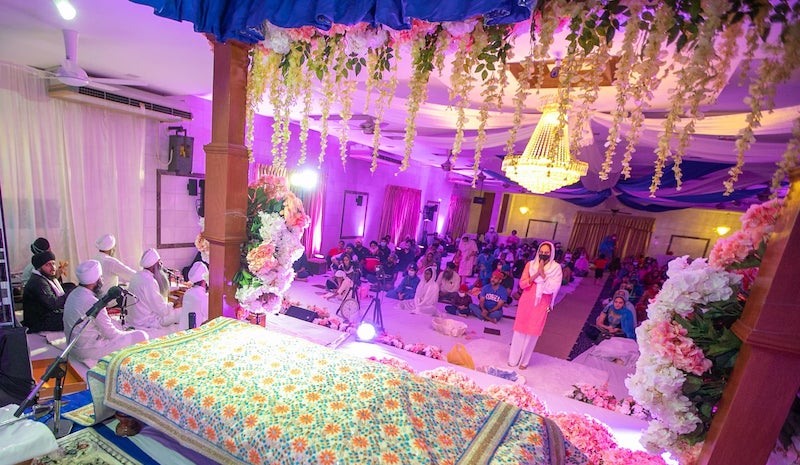
Dasmesh Pita Semagam in progress – Photo: DPS Facebook
By Asia Samachar | Malaysia |
Dasmesh Pita Semagam, an annual programme in Kampar, Perak, to celebrate the birth of Guru Gobind Singh, turns 10 this year. This year, the kirtan and katha programme for run for 10 consecutive days from Jan 6 to Jan 15.
Among the events lined up are kirtan darbar, rehansbhai, kirtan and katha, akhand path, jaap, kids day and baalak kirtan. #dps202 [Full details at Asia Samachar Facebook and Instagram]
ASIA SAMACHAR is an online newspaper for Sikhs / Punjabis in Southeast Asia and beyond. When you leave a comment at the bottom of this article, it takes time to appear as it is moderated by human being. Unless it is offensive or libelous, it should appear. You can also comment at Facebook, Twitter, and Instagram. You can reach us via WhatsApp +6017-335-1399 or email: asia.samachar@gmail.com. For obituary announcements, click here.
British group Nirvair Khalsa Jatha (NKJ) will be touring Indonesia, Thailand and Malaysia for a forthnight starting with a programme in Medan, Indonesia, tomorrow (Jan 6).
The jatha, leb by Harinder Singh Khalsa, had full house programmes at the centennial celebration of Gurdwara Sahib Kajang in Malaysia in November.
The group will be having programmes at Medan (Jan 6-8, 2023), Jakarta (Jan 9-10), Pattaya & Bangkok (Jan 12-17) and Johor Bahru (Jan 19-21)
ASIA SAMACHAR is an online newspaper for Sikhs / Punjabis in Southeast Asia and beyond. When you leave a comment at the bottom of this article, it takes time to appear as it is moderated by human being. Unless it is offensive or libelous, it should appear. You can also comment at Facebook, Twitter, and Instagram. You can reach us via WhatsApp +6017-335-1399 or email: asia.samachar@gmail.com. For obituary announcements, click here.
One of the appeals of religious priests and Godmen is the belief that, equipped with divine power, they can help to ward off evil spirits and ghosts. Because ghosts and spirits are a logical impossibility, if somebody believes they are possessed, then, the best way to deal with ghostly possessions is a good dose of science and logic. Failing this, I would recommend a good psychiatrist.
Let me explain. Even though we live in an age where religion is rapidly on the decline, belief in ghosts seems to be pretty widespread. Across the world the existence of spirits and an alternative realm is normal. The obsession with the supernatural more generally is evident in the huge number of movies that we can see on multiple platforms, such as Netflix and Amazon Prime. So what’s going on? How can such irrational beliefs in ghosts and spirits, where the evidence is almost non-existent, continue to occupy so much our time?
Belief in ghosts is deeply embedded in human culture and is part of a wider set of related paranormal phenomena, which paradoxically both terrorises and comforts people. So, if the spirits are ‘good’ we love them, but if they are ’bad’ we become frightened, leading to all kinds of psychological disorders.
One of the reasons why ghostly myths survive is their obscure nature, which can range from creaking doors, to missing items, a cold area in a house, hearing voices, through to objects flying across a room and to visions of people, often dressed in white robes!
The fact that human beings have the capacity for reasoning is no guarantee that we will utilise this ability; we are evidently also ‘unreasonable’ beings. So how can we get rid of ghosts by deploying reason, logic and science?
First, one needs to identify the many contradictions that are inherent in ideas about ghosts and spirits. The most powerful one being, if ghosts are material, then they cannot be ghosts, and if they are metaphysical, then there is no way for us to register their presence; that is other than in myth and belief. One could also pose the question, if ghosts are human souls, why do they appear clothed and within animate objects, such as weapons, musical instruments, clothes etc? But perhaps the most powerful scientific argument is, if ghosts and spirits are so prevalent, then why is there no serious scientific proof of their actual existence? But if it were scientifically proven that such entities exist, I would be the first to change my view.
One counter argument that could be made from a Sikh perspective is, how one accounts for the various references in Gurbani to Jamdhooths and Ghosts. Discussing theology is a complex area and beyond the scope of this short piece. However, the starting point would be that Gurbani is in part telling us of a different truth than science. Gurbani is poetry that mobilises all kinds of linguistic tropes and is not intended to serve as a scientific or factual reference. It reveals an inner truth about our human consciousness, ethics, spirituality, etc. In this regard, one can totally see how myths associated with magic and spiritual tropes can provide valuable insights into the human condition. In this regard, it is beyond question that gurbani reveals truths that science and logic will never do. The key point is not not to mix the two.
So, one can conclude ghosts, spirits and the various myths that are associated with them exist in the mind and the realm belief and fiction. So as long as we can continue to hold onto this understanding, then there is no way for them to trouble you and hence no need for priests and god-men. So my advice is to save your money and invest your savings in proper critical education.
Gurnam Singh is an academic activist dedicated to human rights, liberty, equality, social and environmental justice. He is an Associate Professor of Sociology at University of Warwick, UK. He can be contacted at Gurnam.singh.1@warwick.ac.uk
* This is the opinion of the writer and does not necessarily represent the views of Asia Samachar.
ASIA SAMACHAR is an online newspaper for Sikhs / Punjabis in Southeast Asia and beyond. When you leave a comment at the bottom of this article, it takes time to appear as it is moderated by human being. Unless it is offensive or libelous, it should appear. You can also comment at Facebook, Twitter, and Instagram. You can reach us via WhatsApp +6017-335-1399 or email: asia.samachar@gmail.com. For obituary announcements, click here.
Bhupinder Singh Gill (right). Insert: With fellow match officials from the family
Bhupinder Singh Gill will become the first Sikh-Punjabi heritage match official in Premier League history when he serves as an assistant referee in Wednesday’s high-stakes relegation clash between Southampton and Nottingham Forest, reports The Telegraph.
The 37-year-old is the latest in his family’s well-established tradition of match officials – he is the son of former referee Jarnail Singh, who in 2004 was the first Sikh referee to take charge of an English Football League [EFL] game, and to do so wearing the traditional turban.
Bhupinder is the brother of Sunny Singh Gill, who earlier this season became the first South Asian heritage British referee to take charge of an EFL game, since the brothers’ father last did so in 2010, the report added.
“Its recognition for him as an individual,” chief refereeing officer Howard Webb told Sky Sports, adding that Bhupinder deserves his opportunity as he prepares to become the first Sikh-Punjabi assistant referee in Premier League history tomorrow.
Webb, who took over at the referees’ organisation Professional Game Match Officials (PGMOL) on Dec 1, has included Bhupinder — a PE teacher who has been a referee since he was a teenager — as part of the new fast-track development system for referees, reported the Telegraph.
It added that Jarnail Singh, a Metropolitan Police community support officer, was a hugely significant figure in British refereeing and took charge of around 150 games between 2004 and 2010 in the EFL. Sunny Singh Gill was promoted into the EFL this season and has become a regular in League Two.
“This has to be the proudest and most exciting moment in my refereeing journey so far, but I’m not getting carried away as it is just another step in the direction to where I want to get to,” Bhupinder told the newspaper. “My family is also really proud and excited for me. I wouldn’t be in this situation if it wasn’t for my dad, who has supported me throughout my journey and been a role model for me. He’s taken leave from work to make sure he attends the game alongside my wife and son. It’ll be special to have them there.”
ASIA SAMACHAR is an online newspaper for Sikhs / Punjabis in Southeast Asia and beyond. When you leave a comment at the bottom of this article, it takes time to appear as it is moderated by human being. Unless it is offensive or libelous, it should appear. You can also comment at Facebook, Twitter, and Instagram. You can reach us via WhatsApp +6017-335-1399 or email: asia.samachar@gmail.com. For obituary announcements, click here.
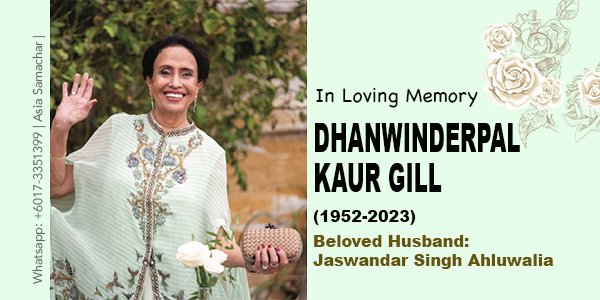
Viewing: 12.00pm to 2.30pm on the 6th of January 2023 at N1 Diamond Hall Nirvana Centre KL (Nirvana 2), 16, Jalan Dewan Bahasa, Bukit Seputih, 50460, Kuala Lumpur
Cremation (Saskar & Ardas): 2.30pm on the 7th of January 2023 at Nirvana Memorial Park (Shah Alam), Taman Perkuburan, Jalan Pusaka 21/1 Persiaran Jubli Perak Seksyen 21, 40300 Shah Alam
Path Da Bhog: 10.00am to 12.00pm on the 13th of January 2023 at Gurdwara Sahib Petaling Jaya
| Entry: 4 Jan 2023 | Source: Family
ASIA SAMACHAR is an online newspaper for Sikhs / Punjabis in Southeast Asia and beyond. When you leave a comment at the bottom of this article, it takes time to appear as it is moderated by human being. Unless it is offensive or libelous, it should appear. You can also comment at Facebook, Twitter, and Instagram. You can reach us via WhatsApp +6017-335-1399 or email: asia.samachar@gmail.com. For obituary announcements, click here.
Rehras & Kirtan: 6th January 2023 (Friday), from 6pm to 8pm, at 16 Jalan Suria 3, Taman Suria, Johor Bahru followed by Guru Ka Langgar
Path da Bhog: 7th January 2023 (Saturday), from 10.00am to 12.00pm, at Gurdwara Sahib Johor Bahru followed by Guru Ka Langgar
Humbly accept this as our personal invitation
Contact: Raj 012 3028001 Kash 016 7502893
| Entry: 3 Jan 2023 | Source: Family
ASIA SAMACHAR is an online newspaper for Sikhs / Punjabis in Southeast Asia and beyond. When you leave a comment at the bottom of this article, it takes time to appear as it is moderated by human being. Unless it is offensive or libelous, it should appear. You can also comment at Facebook, Twitter, and Instagram. You can reach us via WhatsApp +6017-335-1399 or email: asia.samachar@gmail.com. For obituary announcements, click here.
Mention the word ‘rebel’ and alarm bells start ringing. In most societies, those labelled as rebels are seen as a threat, as disruptive dangerous people who have no respect for the law or authority. And for this reason, often those who choose the path of being a rebel end up suffering; they may become insulted, imprisoned and, in some cases, executed by those in power.
Put in simple terms, to be a rebel is to be seen as a bad person, and because of this most people reject the path, though thankfully not all! Ironically, though people fear rebels, without rebels and rebel thinking, society cannot change and develop. If one looks at any society, nation, faith or even family, it is often those who were labelled as rebels that leave their mark and are sometime even remembered as heroes.
If we think about Sikh history, no other than the founder, Guru Nanak Ji was seen as a rebel of his times. Guru Nanak’s rejection of many aspects of the dominant social order, of the caste system, of religious hate, of ritual worship, of gender discrimination, of all kinds of superstitious beliefs, meant that he too was labelled as a dangerous rebel. As he records in his own words, “Some speak of poor Nanak as a ghost; some say he is a demon. Some call him a mere mortal; searching for the divine King, Nanak has gone insane. But I know of none other than the divine soul. Pause. He alone is known to be insane, when he goes insane with the Fear of the One supreme entity. He alone is known to be insane, if he works for the only the One” (Maroo Mehla First, SGGS P991)
When you think of Guru Nanak, what comes to mind? A priest, a musician, a singer, a poet, a holy man, a traveller! Yes, Guru Nanak was all these things, but how often do we think of him as a rebel? Though rebels are presented in negative terms, they are also people who call and fight for social change. In other words, rebels are those people who challenge traditional thinking, practices and power in any one society. And if you look at Guru Nanak’s life and teachings, perhaps above all, he was indeed a rebel in the truest sense.
For me to be a rebel is not to be a ‘sheep’ but to be a courageous person who speaks truth to power. But how many of us can truly and honestly claim to be following the path of Guru Nanak? How many of us are prepared to speak out and challenge those in power today, be that in our families, community or society? For many years, I learnt to keep quiet, to not question, and to please others. At the time, I thought this was the right way to behave, that a good person was somebody who simply obeyed the orders given by others. Yes, people should think about their behaviour, yes, we should be polite and civil, and yes, we should take advise from others, but not at the point where we lose own sense of power and self.
Looking back to those early days, from childhood to my late teens, I felt that I was a non-person, that I had nothing to contribute to this world. And in my lowest moments, I felt my life was pointless and I was simply just drifting along in other people’s shadows. I was going to the Gurdwara, I was listening to Gurbani, and I was going to Kirtan programmes across the country, so I guess I was a ‘good’ girl. But on reflection, I realise I was simply behaving like a sheep, like a non-person who was too frightened to step out of line. But something happened in my life that enabled me to begin to see myself differently and it was then that I realised I was a rebel, or at least, this was what others thought.
Life is difficult for all women, but especially for those, like me, growing up in traditional Punjab families, where there was a lot of gender discrimination. But even in those early years, perhaps because I was born in the UK and so was exposed to the wider culture, I was always challenging my parents, and as a result became labelled as the ‘difficult one, as the ‘black sheep’ in the family. I can recall my father often saying that “I was a hard one to handle.”
LIFE AFTER MARRIAGE
But things really began to change after my marriage. Thankfully, I was able to challenge the practice of forced arranged marriage, which was normal for my parents. Though there was plenty of emotional pressure put on me, I managed to have a say in my marriage partner. I didn’t have a love marriage, but I did exercise the right to decide who I wanted to marry. And after rejecting quite a few potential husbands over a 2-year period, I eventually settled with Gurnam Singh, from Bradford. I didn’t know him at the time, other than what I had heard, and a brief family get-together. It was only once the marriage was confirmed that we really got to know each other. Amazingly, it was after our marriage that I realised the person I had married, though different in many ways, was also like me, a rebel who fought to make his own choices in life. However, because he was a boy, as he readily acknowledges, confronting traditional attitudes was much easier for him.
An interesting question for me is, was I born to be a rebel or was this something I became in my adult life? Though I had never planned to be a rebel, as far back as I can remember, I know I had a personality where, even if it was only in my mind, I was somebody who questioned everything.
FAMILY LIFE
But as the youngest sibling of four in quite a traditional family, speaking out was a dangerous thing to do, particularly in those days where one had little support outside of the family. My relationship with my parents, especially my father, was one of being told how to be. My father never explained anything to me; he just told me to do things and I had to obey, for he was seen as the head of the household. As for my Mum, though she looked after me with love and care, like many others of her generation, she also came across as a passive housewife, so wasn’t really a role model for me. Sadly, I know my Mum was/is proud of my achievements; it’s just that she never really managed to communicate this to me.
On the outside, my family came across as open, progressive, educated and successful. We had a business, we spoke at home in Punjabi and English, we had relative wealth and we had, as far as the community was concerned, a modern lifestyle. But beneath the surface, like many other similar Punjab families, traditional attitudes still existed. There were clear gender roles, restrictions on what I could wear, who I could meet and where I could go.
But if I am honest, though I had to follow the rules, I did not accept them, and in my own small way I would question and rebel against them. When I got older and more powerful, the conflict became more intense and I became labelled as the ‘black sheep’ of the family. I don’t want to suggest that my childhood or adult family life has been all negative, but as a girl and then woman, I have had to struggle against gender oppression, and in doing so, being lambed a ‘black sheep’ was natural.
Being a rebel, because of the reaction of the majority, might sound like not very good thing, but for me it’s not a matter of choice; I believe it was my destiny. Being a rebel does not mean I don’t care about anything or anyone. This is far from the truth and my motivation for challenging traditional attitudes and oppression against women and girls, is inspired by love and compassion for others. Indeed, as a follower of Guru Nanak, I take much strength and learning to challenge and support others, to see the importance of not standing still, but of growing and developing, both as an individual, but also a member of society.
MOMENT OF CHANGE
Though I was always resisting in subtle ways daily, sometimes, like most families, there were moments in my life that changed everything. One such moment was around the age of 16 years, when I decided to wear a dastar, which in those days was not normal, even for Amritdhari Sikh girls. Given I was brought up in a strict Amridhari family, where all the women wore keski (small turbans on a head knot) this might seem ironic, but I was told to remove it because they thought it was masculine and therefore would affect my prospects of marriage. I am pleased to say I resisted and though my dad didn’t speak to me for two weeks, I won the right to wear a dastar.
In some sense I took strength from this victory as it further confirmed my belief that without challenge, without making a demand, nothing changes. Here I am reminded of the words of African America anti-slavery freedom fighter Frederik Douglas who said “If there is no struggle, there is no progress …Power concedes nothing without a demand. It never did and it never will.” One of the most important lessons I have learnt being a rebel is that this is not a part-time thing. Ones whole life become a struggle with and against power, and for this reason, you may not be that popular, though you will be respected.
A few years after the dastar incident, when I turned 20, my family became active in looking for a suitable marriage partner. My mum would show me pictures of people from both the UK and India, often with impressive credentials, but being the person I was, and with the growing confidence to exercise my own judgement, I resisted all their attempts to ‘arrange’ my marriage. To their frustration and sometimes anger, I would go along to please them, but then later disagree. This emphasis on personal choice, contradicted the traditional idea of an arranged marriage, where the feelings and wishes of the extended family were almost of more importance than the bride and groom. In an age and system where this was a normal expectation, perhaps it worked, but in today’s global society and human rights culture, forced marriages are simply not acceptable!
GENDER STEREOTYPES
As well as being a successful businessman, great Gursikh who did a lot for Sikhi and charity in Punjab, in some senses my dad was a perfect role model for me. However, because of his own upbringing, he did carry deep-rooted gender attitudes which, even after my marriage, were always a source of tension. I can remember of one occasion visiting my parents dressed in trousers but was told by my dad to change my clothes, which made me very sad and angry resulting in me breaking contact for a brief period, until my mum persuaded me to visit them. Eventually, my dad began to open-up and I did confront him about my feelings of mistreatment. To my pleasant surprise, he did apologise and from then on, we became very close, and our relationship was transformed; from seeing me as a rebel black sheep, he came to respect me for who I was and for my achievements.
While there can be no excuse for the oppressive attitudes from men I experienced growing up and still do, I think there is a general pattern of misogyny, especially amongst Punjabi men that needs understanding. Most, but thankfully not all, traditional Punjabi men will have experienced strict parenting, which would have included emotional and physical violence, and socialisation where they will have been exposed to stereotypes about a ‘proper man’ being somebody who is tough, who does not express their emotions. I know life for my dad was hard and I rarely saw him express his emotions, other than anger! So, for him to open-up to me and admit his failings must have been a great challenge and I suspect relief for him.
Though there has been massive change, sadly, and especially within the Punjab community, I feel gender stereotypes are still quite strong and a cause of much conflict within families. Being a rebel for me means constantly fighting for the rights and freedoms of individuals, even if this means going against cultural norms and traditions. After all, isn’t this the path that Guru Nanak travelled? The long walk to freedom is a journey of a lifetime and so the struggle for rebels like me becomes a way of life. Now that I am a mother and grandmother, I am having to think deeply about how I treat and teach my children, and what their expectations of me are. And let’s not forget my partner, who I must admit still holds onto some old-fashioned Punjabi male attitudes, though I must say, he is much changed.
For all societies and communities to progress, outdated and oppressive attitudes and rules will need to be broken. But there is no perfect arrangement or end point to the struggle for equality and justice. Being a free person does not mean that others should think and behave like you. Our humanity is based on our uniqueness and our similarities. This means we need to appreciate each other’s strengths and weaknesses, dreams and fears, and through a combination of love, kindness and determination, we can help each other to reach our full potential.
Every generation has its challenges, my parents had theirs; I had mine, and our children and grandchildren have theirs. The way forward is to make little changes, but occasionally also to make big changes that require radical action. Being labelled a ‘rebel’ is meant to be an insult, but history tells us otherwise. In truth, without rebels there would be no progress. And as for Sikhs and Sikhi, the lives and teachings of our great Gurus, saints and warriors are the embodiment of rebel thinking and acting. I must end by thanking Guru Granth Sahib ji who has been the greatest source of strength and guidance for me through my life, in good times and bad.
Manjit Kaur, a UK-based therapist and counsellor, is a presenter of the 1 Show on Akaal Channel. She can be contacted via email at manjitkaur1show@gmail.com
ASIA SAMACHAR is an online newspaper for Sikhs / Punjabis in Southeast Asia and beyond.Facebook | WhatsApp +6017-335-1399 | Email: editor@asiasamachar.com | Twitter | Instagram | Obituary announcements, click here |
A Houston-born experienced trial attorney and daughter of an Indian immigrant is set to become the latest judge in the state of Texas.
Manpreet Kaur Monica Singh takes the seat today (Jan 1, 2023) as judge of the Harris County Civil County Court at Law No 4.
She announced her candidacy in November 2021, tweeting: “As a native Houstonian, it is my hope to represent my community that prizes diversity and servant leadership.” That dream became a reality when she won the race in November 2022.
“Say hi to your new judge-elect of Harris County Civil Court at Law no. 4 ??⚖️ and also the first Sikh female judge in the US,” she tweeted after her victory.
Monica hails from the same county who’s first Sikh deputy, Sandeep Singh Dhaliwal, fell in the line of duty in 2019 when shot multiple times while conducting a traffic stop. In 2015, Deputy Dhaliwal was approved to wear his Sikh religion turban and beard while on duty with the Harris County Sheriff’s Office (HSCO). His final farewell was described almost as ‘royal-like’ by some, with the outpouring of grief and love from across the section. Monica spoke one of the persons who spoke at the funeral.
Born and raised in Houston, M. Monica Singh is a proud Texan and fierce advocate for her hometown, according to her campaign website.
As the daughter of immigrants from India, she learned the value of hard work, the American dream, and service from an early age. These ideals helped mold her into the honest and humble person that she is today and cemented her strong respect for the law and pursuit of justice, it says.
Her father, introduced only as AJ, immigrated to the US as an architect in the early 1970s after being issued a green card following the Immigration Act of 1965. As a young, turbaned Sikh and a then bachelor, he followed work wherever regardless of where it would take him. He found himself in Miami, New Jersey, Atlanta, and Dallas before finally putting down roots in Houston.
“Although he faced blatant discrimination time and time again, AJ and his wife of 46 years, Hardeep, remained focused on their ultimate goal of achieving the American dream. They owned and operated a successful small business (a print shop) and it flourished with the help of sweat equity from their two children. This doggedness and grit were inherited by Monica – and they are attributes that she will bring to the bench. Being a woman of color, she is all too familiar with systems of inequality and she is empathetic to the hardships that the average American faces while trying to achieve their own dreams,” according to the website.
Monica grew up in Northwest Houston and attended Klein Forest High School, the University of Texas at Austin, and finally the South Texas College of Law.
In addition to practicing law for 20 years and having tried over 100 cases, it said Monica was heavily involved in numerous civil rights organizations at a local, state, and national level. Currently, she is on the board of directors of the ACLU of Texas, the Texas Lyceum, and the Sikh Coalition (also serving as a trustee).
She has been married to Mandeep Singh for 19 years and they live in Bellaire with their two boys.
ASIA SAMACHAR is an online newspaper for Sikhs / Punjabis in Southeast Asia and beyond. When you leave a comment at the bottom of this article, it takes time to appear as it is moderated by human being. Unless it is offensive or libelous, it should appear. You can also comment at Facebook, Twitter, and Instagram. You can reach us via WhatsApp +6017-335-1399 or email: asia.samachar@gmail.com. For obituary announcements, click here.