| Entry: 18 Dec 2022; Updated: 31 Dec 2022 | Source: Family
ASIA SAMACHAR is an online newspaper for Sikhs / Punjabis in Southeast Asia and beyond. When you leave a comment at the bottom of this article, it takes time to appear as it is moderated by human being. Unless it is offensive or libelous, it should appear. You can also comment at Facebook, Twitter, and Instagram. You can reach us via WhatsApp +6017-335-1399 or email: asia.samachar@gmail.com. For obituary announcements, click here.
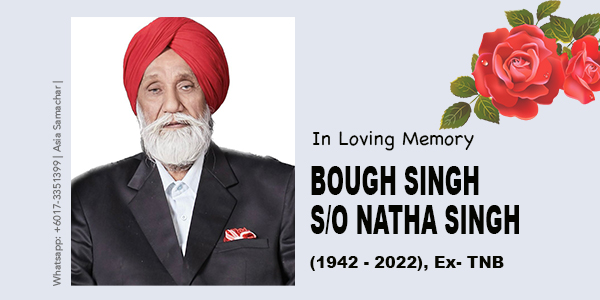
Saskar / Cremation: 4pm, 18 December 2022 (Sunday) at Simpang Lima Crematorium Klang
Cortege leaves at 3pm from the residence at No.113, Jalan 8, Pandamaran Jaya, 42000 Port Klang
Path da Bhog: 25th December 2022 (Sunday), from 5pm to 7pm, at Gurdwara Sahib Klang, followed by Guru ka Langgar.
For any info please contact: Alvinder Singh 017-2070565 Sandeep Singh 014-2283968 Rashvinder Singh 016-3430205 Ajvinder Singh 014-6347325 Manvir Singh 016-3315716
GONE TOO SOON. HE WILL BE GREATLY MISSED AND FONDLY REMEMBERED.
| Entry: 17 Dec 2022 | Source: Family
ASIA SAMACHAR is an online newspaper for Sikhs / Punjabis in Southeast Asia and beyond. When you leave a comment at the bottom of this article, it takes time to appear as it is moderated by human being. Unless it is offensive or libelous, it should appear. You can also comment at Facebook, Twitter, and Instagram. You can reach us via WhatsApp +6017-335-1399 or email: asia.samachar@gmail.com. For obituary announcements, click here.
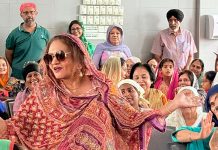
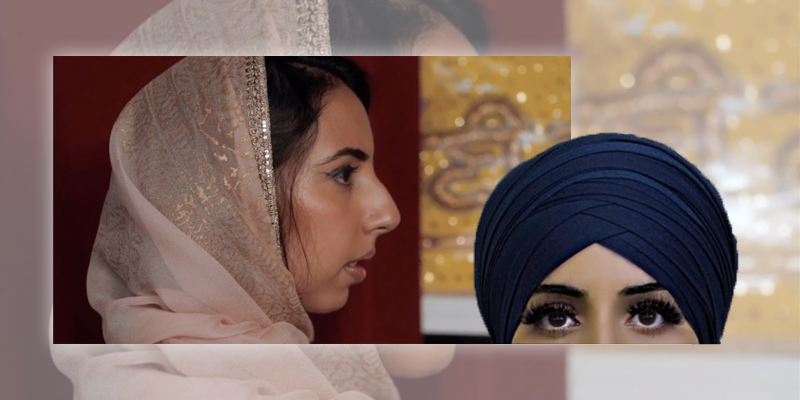
What happens when a British Sikh girl decides to wear a turban for the first time against her fathers wishes? That’s the theme explored in a new drama ‘Kaur’ now showing at film festivals.
Film maker Dr Parvinder Shergill is very clear in what she wants to achieve. The actor and medical doctor hopes to bring stories told by Asian women to a more mainstream audience.
“I find, as woman of colour, especially in the Asian community, we had one film with a female lead role, Bend it Like Becham, and that was 20 years ago. It was really out of frustrations….half my family is baptised, they wear turban, even the women. Yes, so many people don’t even know that woman can also wear turban.I really want to tackle the stigma,” she told Britain’s Channel 4 News when talking about Kaur.
Kaur, a South Asian girl, makes a decision that will change the course of her life, which in turn affects her parents and how they view themselves. Avani, decides to wear a turban for the first time, which brings up trauma for her father, Gurnam, whilst her mother, Lakhwinder, tries to be the light in a difficult conversation.
ASIA SAMACHAR is an online newspaper for Sikhs / Punjabis in Southeast Asia and beyond. When you leave a comment at the bottom of this article, it takes time to appear as it is moderated by human being. Unless it is offensive or libelous, it should appear. You can also comment at Facebook, Twitter, and Instagram. You can reach us via WhatsApp +6017-335-1399 or email: asia.samachar@gmail.com. For obituary announcements, click here.
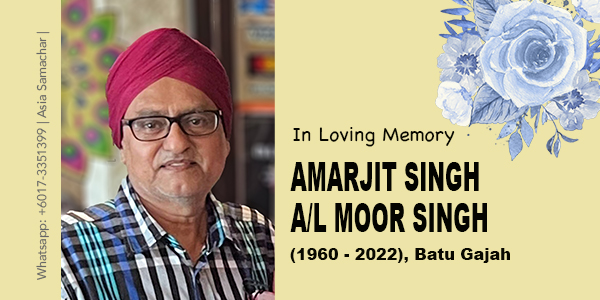
Experience: Both with experienced and fresh graduates can apply.
Contact: 012-2207262
ASIA SAMACHAR is an online newspaper for Sikhs / Punjabis in Southeast Asia and beyond. When you leave a comment at the bottom of this article, it takes time to appear as it is moderated by human being. Unless it is offensive or libelous, it should appear. You can also comment at Facebook, Twitter, and Instagram. You can reach us via WhatsApp +6017-335-1399 or email: asia.samachar@gmail.com. For obituary announcements, click here.
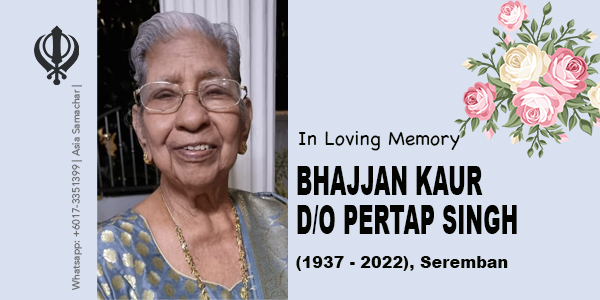
Passed away peacefully on 16th December 2022, surrounded by her family.
Village: Singhanwala, Punjab, India
Husband: Late Harban Singh s/o Nika Singh (Malayan Railways, Seremban)
Children: Late Noor Firdaus Diljit Manmohan Singh Hullon / Gurit Kaur Bhagwant Kaur / Chandran Mani Ranjit Kaur / N. Chandran Nor Fairuz Sarjit / Ahmad Junaidi Said Harjit Singh / Charanjeet Kaur
Grandchildren: Dr. Pradeep Chand / Vivi Vyanie Dr. Praveena Chand / Dr. Tan Yoong Han Late Nur Ain Atikah Dr. Prameela Chand Leena Sonia Kaur / Daljit Singh Taranum Nisha / Ahmed Khan Nur Ain Sakinah / Mohd Zabawi Belle Hullon Tabassum Nisha / Mohamed Rafiq Krishna Singh Dilraaj Singh Hullon Maanroshan Singh Hullon
Great Grandchildren: Mohd Rehan Khan Chloe Amara Pradeep Mohd Farhan Khan Nur Sarah Aisyah
Path da Bhog: 31st Dec 2022 (Saturday), from 9.30am to 11.30am, at Gurdwara Sahib Seremban
For further details please contact: Manmohan 012 3061157 Harjit 012 3515443
We, the family of the Late Mataji Bhajjan Kaur would like to thank all relatives and friends for their kind presence, condolences and prayers during our bereavement.
A big thank you also to all doctors, nurses and staff at Ipoh General Hospital and Seremban General Hospital for your dedication, care and support for our dear mother.
| Entry: 16 Dec 2022; Updated: 23 Dec 2022 | Source: Family
ASIA SAMACHAR is an online newspaper for Sikhs / Punjabis in Southeast Asia and beyond. When you leave a comment at the bottom of this article, it takes time to appear as it is moderated by human being. Unless it is offensive or libelous, it should appear. You can also comment at Facebook, Twitter, and Instagram. You can reach us via WhatsApp +6017-335-1399 or email: asia.samachar@gmail.com. For obituary announcements, click here.
Punjabi is the latest language to be made available in Western Australian schools for the pre-primary to Year 12 students.
State education and training minister Sue Ellery recently announced that a Punjabi curriculum will be developed and made available to schools in the state.
“I am pleased to see the ongoing expansion of languages curriculum for WA students, and the development of Punjabi curriculum is particularly fitting given it could support students in key future employment opportunities,” she said in a statement released on Dec 13.
In the process to fully develop the language, curriculum writers will develop syllabuses and support materials for schools.
In Western Australia, languages education becomes compulsory from Year 3. The pre-primary to Year 10 syllabuses will be available to schools from 2024. It is anticipated that the Year 11 courses will be available to students in 2024, with the first ATAR Course Examination to be set in 2025, the statement noted.
This follows the announcement in 2021 of the development of syllabuses for Hindi, Korean and Tamil, which will be introduced to schools next year.
“With more than 190 languages spoken throughout Western Australia, linguistic diversity is a great strength of our State and provides a range of social, cultural and economic benefits. It is also important that we develop courses that suit the needs of our young people,” she said.
Earlier this year, Ellery said the WA Government led the state’s largest ever business delegation to India amid a broader strengthening of our engagement with the country.
ASIA SAMACHAR is an online newspaper for Sikhs / Punjabis in Southeast Asia and beyond. When you leave a comment at the bottom of this article, it takes time to appear as it is moderated by human being. Unless it is offensive or libelous, it should appear. You can also comment at Facebook, Twitter, and Instagram. You can reach us via WhatsApp +6017-335-1399 or email: asia.samachar@gmail.com. For obituary announcements, click here.
Battle of Chamkaur – Artist: Gurpreet Singh Sembhi
By Gurnam Singh | Opinion |
On 6th December 1704, a battle was fought between the Khalsa, led by Guru Gobind Singh ji, and the coalition forces of the Mughals led by Wazir Khan and the Hindu hill chiefs in the town of Chamkaur Sahib in the Northern Indian State of Punjab. Sikhs across the world are commemorating this important and painful chapter in their history by the usual panoply of Akhand Paths, Nagar Kirtans, and most interestingly open-air kirtan darbars where, in powerful acts of solidarity and remembering of the suffering of the two younger Sahibzada’s, Zorawar Singh and Fateh Singh and their grandmother, Mata Gujar Kaur, the sangat sit outside in freezing cold.
Whilst Sikhs are well practiced in celebrating and commemorating Gurpurabs and festivals, perhaps we are less clear about the importance of remembering key chapters in our amazing history! The English writer George Orwell noted that “The most effective way to destroy people is to deny and obliterate their own understanding of their history.” Similarly, the Black Pan-Africanist Marcus Garvey noted that, “A people without knowledge of their past history, origin and culture is like a tree without roots”. Put another way, to destroy a nation is to erase or corrupt their historical narrative. A good example of this is Prime Minister Narendra Modi declaration almost one year ago that to pay homage to the courage of the “Sahibzades”, or four sons of Guru Gobind Singh ji, the last Sikh Guru in December 26 shall henceforth in India be marked as a “Veer Baal Diwas”
Memorialising war and battles, such as the Battle of Chamkaur, has a particular significance for a nation.
Memory has a strong effect on personal identity and helps to construe and reaffirm collective identities. In war, fighters who are killed on the battlefield are seen by society as “heroes”, or ‘shaheeds’ and their stories may be romanticized or even mythologized. Milan Kundera – Czech novelist, short-story writer, playwright, essayist, and poet, notes: “The first step in liquidating a people is to erase its memory. Destroy its books, its culture, its history. Then have somebody write new books, manufacture a new culture, invent a new history. Before long that nation will begin to forget what it is and what it was… The struggle of man against power is the struggle of memory against forgetting.”
Long after hostilities have concluded, the memories remain and can have a profound impact on the population, including most significantly on women and children at the time of the conflict. And in this regard, the Battle of Chamkaur has special significance for Sikhs. Perhaps because we tend to render women and children as most vulnerable during war, the suffering and the feats of courage displayed by the young sons of Guru Gobind Singh and their Grandmother in resisting the oppression and brutality of the Mogul ruler’s, takes on a wholly different meaning.
One can draw parallels here with the mythological story of the battle between Goliath, who is a character in the Book of Samuel and is described as a giant, and the young boy David. This phrase “David and Goliath” has become quite universal and has taken on a secular meaning, denoting a contest where a smaller, weaker opponent faces a much bigger, powerful adversary, where if successful, the underdog may win in an unusual or surprising way. In some this way, though the Sahibzada’s lost their lives, it was they in their defiance against forced conversion, and not the more powerful Mughal Governor Wazir Khan, who secured the moral victory; and arguably, in dong so, they make a significant dent in the Mogul Empire, which crumbled soon after.
Tragically, Sikh history has been mostly written by the Hindus, Muslims and British, and therefore generally speaking the collective memories of Sikhs have been erased, distorted, misrepresented or appropriated, which is one of the reasons Sikhs are so divided and conflicted in relation to our history. Today, there is a real danger that the Battle of Chamkaur is, too, being appropriated by the Hindutva rulers who prefer to present is as an Indian Nationalist epic. This follows from a rendering of Guru Gobind Singh Sahib as ‘Desh Bhagat’ or Indian Patriot, by Mr Modi during the 350 Birth commemoration in 2017 in his birthplace, Patna Sahib, Bihar. And more recently, during the 400th Birth Anniversary of Guru Tegh Bhadur ji, Mr Modi characterised Guru Sahib as ‘Hind ki Chadar’ or ‘Shield of India’.
There can be no dispute that Guru Sahib responded to a direct plea from the Kashmiri Pandits in their hour of need in the face of an existential threat at the hands of the oppressive Mogul Emperor Aurangzeb and his policy of forced conversion to Islam. Whilst Guru Sahib’s sentiments may well have been with the Kashmiri Pandits, according to his own writings contained in Guru Granth Sahib ji, his motivation to confront Aurangzeb was based on a much wider belief in the universal right to freedom of belief. For example, in Salok Mahala 9, (GGS, 1427) Guru Sahib proclaims, “One who does not give threats, and who resists threats from others. Nanak says, listen, O mind, he alone is wise and knowledgable.”
In this regard, Guru Tegh Bhadur Ji is more accurately characterised not as the protector of the ‘Hindu faith’, but, as noted by the Poet Senapati in his Sri Gur Sobha, Guru Sahib ‘Sriti di Chadar’ or ‘The Shield of the whole of creation.’ Similarly, in Sri Gur Panth Prakash, Sikh historian Rattan Singh Bangoo, notes that Guru Sahib ‘gave his life for the protection of other’s human rights’.
Some may argue that making such distinctions about differing versions of history is splitting hairs and that questioning the motives of the rulers is not wise. There is no doubt that this perspective is prevalent amongst some Sikhs. For example, the so-called ‘Sant Smajh’ or ‘Society of Saints’, along with prominent political figures, such as former President of the Delhi Sikh Gurdwara Management Committee (DSGMC), Manjinder Singh Sirsa, have heaped praise on Narendra Modi and the BJP for their commitment to Sikhs. However, this begs the question, by providing legitimation for the violent Hindutva project, and by rendering the sacrifice of the 4 Sahibzadas, and indeed, the whole family of Guru Gobind Singh, in the cause of Hindu Nationalism, in what way are you honouring their supreme sacrifice!
Can you imagine Muslims or Christians, or Hindus, or Jews, or Europeans, or Americans or anybody allowing others to narrate their histories? Well, tragically this appears to be the norm for Sikhs, but still it is not too late. So the moral is, yes, let’s commemorate our history, let’s not forget the supremes sacrifices of our countless Shaheeds, but it must be told on our terms. And that means Sikhs producing an official history rather than relying others to tell us who and what we are!
Gurnam Singh is an academic activist dedicated to human rights, liberty, equality, social and environmental justice. He is an Associate Professor of Sociology at University of Warwick, UK. He can be contacted at Gurnam.singh.1@warwick.ac.uk
* This is the opinion of the writer and does not necessarily represent the views of Asia Samachar.
ASIA SAMACHAR is an online newspaper for Sikhs / Punjabis in Southeast Asia and beyond.Facebook | WhatsApp +6017-335-1399 | Email: editor@asiasamachar.com | Twitter | Instagram | Obituary announcements, click here |
ASIA SAMACHAR is an online newspaper for Sikhs / Punjabis in Southeast Asia and beyond. When you leave a comment at the bottom of this article, it takes time to appear as it is moderated by human being. Unless it is offensive or libelous, it should appear. You can also comment at Facebook, Twitter, and Instagram. You can reach us via WhatsApp +6017-335-1399 or email: asia.samachar@gmail.com. For obituary announcements, click here.
World Cup Grand Masters hockey in Tokyo in September 2022 – Photo: Supplied
By Asia Samachar | Malaysia |
Malaysia’s men hockey above 60, half of them Sikhs, bagged the bronze medal in the World Cup Grand Masters hockey in Tokyo in September 2022, with Australia emerging as champions and England as runners-up.
The podium finish is the highest achievement by any Malaysian hockey team in all international age groups and categories.
Former national hockey captain Sarjit Singh has been coaching the team for the last two years prior to this tournament.
Sultan Ahmad Shah Hockey (SAS) vide president Surindar Singh was the team captain, assisted by Col Dr Inderjit Singh.
The tournament, held once every two years, is getting more challenging as more European teams take their training and preparation seriously, said a hockey official.
Ten of the 18 players of the team are Sikhs. They are Surindar Singh, Sarjit Singh, Inderjit Singh, Minder Singh, Harmohan Singh, Harjit Singh, Manjinder Singh, Krishan Singh, Supt (R) Avtar Singh Pandher and Shyam Singh Parmar.
“We often reminisce the past glory of our Sikh hockey players in the national team and today we have a team of fit Sikh players albeit in their 60s, still playing and winning for Malaysia,” said a hockey player.
The other players representing the Malaysian 60s team are former international Raymond Marks Tio, Chin Sow Ten, Hooi Ka Choy (Casey), Mohd Nasir bin Abdul Aziz, Azman Shah Aziz, John Stephenson (goalkeeper), Collin Lawrence Sequerah and V Chandrasegar.
ASIA SAMACHAR is an online newspaper for Sikhs / Punjabis in Southeast Asia and beyond. When you leave a comment at the bottom of this article, it takes time to appear as it is moderated by human being. Unless it is offensive or libelous, it should appear. You can also comment at Facebook, Twitter, and Instagram. You can reach us via WhatsApp +6017-335-1399 or email: asia.samachar@gmail.com. For obituary announcements, click here.
Before I discuss this topic, let us define few terms.
BRAIN. A physical soft whitish mass of cells in the human scull, that is the center of nervous system.
MIND. Centre of thoughts, memories, intellect power, and opinions.
MIND has two faculties. Conscious mind and subconscious mind.
CONSCIOUS MIND. Part of mind that observe outside events, all of the things you are currently aware of and are thinking about. Awareness of your-self and the world around you presently. Conscious mind is objective or thinking mind. It has no memories and can hold one thought at a time. Conscious mind has two functions. One, identify upcoming information through sight, sound, smell, taste, touch and feeling. Second, observe and categorizing what is going around. It accepts or reject data, making choices and decisions. In GURBANI terms SURAT, MATT, MANN, BUDH are used. In my understanding MATT and MANN refer to conscious mind and SURAT and BUDH refer to subconscious mind.
SUBCONSCIOUS MIND. It is the reservoir of feelings, thoughts, beliefs, memories, concepts. We can call it collection of SANSKARS. Main function of subconscious mind is to store and retrieve data. Its job is to ensure that you respond to situation exactly the way you are programmed. Our subconscious mind is subjective. It does not think or reason independently. It merely obeys the commands received from conscious mind. We can use our conscious mind to shape our subconscious mind by overriding it.
These are the products of our own mind.
CONSCIOUSNESS. This is not product of our mind. It is the VOICE OF GOD, DIVINE WISDOM within all of us. The moral compass.
In this context I need to understand who this SELF is. Let me call it I or ME. I believe that I am my body and mind, this is who am I. I experience life through ME. This ME is a separate identity from the SOURCE, GOD with in me. I live everyday life from ME, self- perspective, not the DIVINE perspective. The ME is conditioned and identified exclusively with material objects, power, and status. I am living under the illusion that acquisition of worldly comforts supposedly provides inner happiness. Self is the demanding force that is never satisfied. GURU says Haumai Deerag Rog Hai(SGGS, Page 466) meaning the ME identification is chronic disease of mind that causes worries, anxiety, stress, depression, suicides and violence in the society. GURU says this INESS, MENESS is the natural part of the society, we are born into the EGO environment. This is part of the play of life, THE HUKM.
This ME, I is the sum-total of my choices I make while growing in the society.
In BANI PEHRE (SGGS, 74) AND MAJH KEE VAR (SGGS, 137), GURU NANAK beautifully explains phases of life, how as a human create self- identity, separate from the SATGURU.
GURU says Kaho Nanak Prannee Pehle Pehre Hukm Piya Garwas, meaning you came into this world in the HUKM, DIVINE LAW of the CREATOR. You were true reflection of the SATGURU with pure consciousness. You were part of the ONE, THE SOURCE OF LIFE.
Kaho Nanak Prannee Dooje Pehre Wisar Giya Dhian. GURU says first you became attached to your mother and father, siblings. Toys and your friends were attraction of your childhood. You learn the sense mine and yours, the sense of discrimination. You begin to forget who you are, your true self and began to identify with objects. This was start of individuality and separation from THE CREATOR.
Kaho Nanak Prannee Teeje Pehre Dhan Joban Sio Chit.GURU says in your adulthood craving for material wealth, power, status became priorities of life. Self- pride of physical appearance and relationships were the drivers of your daily life. Your main focus centered around external purposes, never looking inward to speak to the CREATOR within. You become captivated by the illusion of finding peace and happiness from material acquisitions. Ideas in your head are all centered around EGO. The inner peace and happiness never arrived.
GURU says in your old age anger, resentment, hopelessness takes control of life. Athwai Krodh Hoa Tan Nass meaning anger destroys you mentally and physically as well. GURU says you have waisted the most precious gift of God.
Bajh Guru Dooba Sansar(SGGS, 138) meaning without realizing the DIVINE WITHIN we all leave this world empty.
This is the story of I, ME. The story of stress, depression, worsening mental health, suicide, wars and destruction. GURU says Kartoot Pashu Kee Manas Jaat(SGGS, 267) meaning in behavior we are animals in human skin. GURU says, ME spends great deal of time and energy dwelling on the past and future, living entire life the way others say. This ME is the biggest obstacles in realizing GOD within and being SACHIARA. Modern society has this myth that temporal intelligence is all we need for success, be able to solve complex problems. GURU says without realizing the divine wisdom of the GURU, godly virtues, we see mental hospitals have too many such scholars. True barometer of intelligence is an effective inner peace, happiness and bliss. GURU says you make yourself unhappy or happy because of the thoughts in your mind.
BHAGAT KABIRJI says Jab Hum Hote Tab Tu Nahee Ab Tum Ho Hum Nahee (SGGS, 339) meaning this I, ME must disappear before becoming you. I believe it does not matter what meditation method you use, in reality the journey of living beyond self is transformation from egoistic self- perspective of life to GURU, GOD perspective of life.
Harbans Singh Kandola. Born in Ludhiana, Punjab, he read Ph.D. in Agriculture from Punjab Agriculture University in 1972. He moved to Canada in 1973 and retired as senior bank manager in 2005. He reads Gurbani passionately to understand its spiritual message and how it matters in his daily life. He read Prof Sahib Singh’s ‘Sri Guru Granth Sahib Darpan’ (SGGS translation) in five years, with complete notes. In the past two decades, Harbans has engaged in Gurbani discussion in radio and television programmes, as well as newspapers and the Sikh Bulletin. He believes that we now have literature with the true and real message of Gurbani which has to be presented to Sikhs and non-Sikhs. This article is from his unpublished book ‘Renaissance of Sikhi’.
ASIA SAMACHAR is an online newspaper for Sikhs / Punjabis in Southeast Asia and beyond. When you leave a comment at the bottom of this article, it takes time to appear as it is moderated by human being. Unless it is offensive or libelous, it should appear. You can also find us atFacebook, Twitter and Instagram. You can reach us via WhatsApp +6017-335-1399 or email: editor@asiasamachar.com. Forobituary announcements, click here.