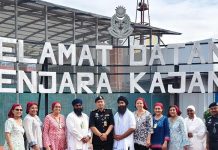
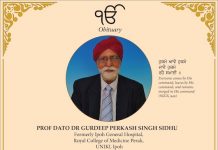
Path da Bhog and Antim Ardaas: 31 August 2022 (Wednesday), from 10am to 12pm, at Gurdwara Sahib Port Klang.
Details: 10.00am: Kirtan by Granthi Ji 10.30am: Kirtan by Bhai Baldev Singh Leo 11.30am: Path da bhog and antim ardaas
Contact:
Ragbir Singh 012 – 272 1197
Surindar Singh 017 – 605 2350
Harbajan Singh 019 – 392 5143
Jagjit Singh 012 – 203 2657
Harjit Kaur 016-626 4889
| Entry: 19 Aug 2022: Updated: 24 Aug 2022 | Source: Family
ASIA SAMACHAR is an online newspaper for Sikhs / Punjabis in Southeast Asia and beyond.Facebook | WhatsApp +6017-335-1399 | Email: asia.samachar@gmail.com | Twfffitter | Instagram | Obituary announcements, click here
For further information, please contact: Sunny (Son) 010-3011850; Simran (Daughter) 016-2840148
| Entry: 18 Aug 2022 | Source: Family
ASIA SAMACHAR is an online newspaper for Sikhs / Punjabis in Southeast Asia and beyond.Facebook | WhatsApp +6017-335-1399 | Email: asia.samachar@gmail.com | Twfffitter | Instagram | Obituary announcements, click here
Punjabi is one of the most widely spoken languages in Canada. This is one of the findings of the fourth set of Census results released by Canada Statistics on Wednesday. The census deals with mother tongue, languages spoken at home and languages known by Canadians.
The report says that besides English and French, Mandarin and Punjabi were the country’s most widely spoken languages. In 2021, more than half a million Canadians spoke predominantly Mandarin at home and more than half a million spoke Punjabi.
In 2021, one in four Canadians had at least one mother tongue other than English or French, and one in eight Canadians spoke predominantly a language other than English or French at home—both the highest proportions on record.
The number of Canadians who spoke predominantly a South Asian language such as Gujarati, Punjabi, Hindi or Malayalam at home grew significantly from 2016 to 2021, an increase fuelled by immigration.
In fact, the growth rate of the population speaking one of these languages was at least eight times larger than that of the overall Canadian population during this period, the report said.
In contrast, there was a decline in the number of Canadians who spoke predominantly certain European languages at home, such as Italian, Polish and Greek.
To understand Canada’s linguistic profile, it is essential to analyse its census data on languages. This data helps to understand how Canada’s linguistic profile has changed. It is also helpful for developing and improving programs and services for all Canadians. They are also used in the development, application and administration of various federal and provincial laws, such as the federal Official Languages Act and the Indigenous Languages Act besides other provincial Acts.
The report said that despite the impact the COVID-19 pandemic has had on arrivals to the country, immigration has continued to enrich Canada’s linguistic diversity.
English and French remain by far the most commonly spoken languages in Canada. More than 9 in 10 Canadians speak one of the two official languages at home at least on a regular basis.
The 2021 Census also found that 4.6 million Canadians speak predominantly a language other than English or French at home. This means they speak this language most often at home, without speaking other languages equally often.
These individuals represent 12.7% of the Canadian population, a proportion that has been increasing for 30 years. By comparison, the proportion was 7.7% in 1991, when immigration levels were rising.
In addition, one in four Canadians in 2021—or 9 million people—had a mother tongue other than English or French. This is a record high since the 1901 Census, when a question on mother tongue was first added.
Canada has a rich linguistic diversity. The languages known and spoken here are closely linked to the identity and culture of Canadians and to their relationship with their community. Languages are an integral part of the everyday lives of Canadians—be it in early childhood, at home, at school or at work—and extend beyond the country’s borders into broader cultural and historical contexts.
A recent report estimated that 321 million people around the world spoke French, with half living in Africa.
The vast majority of the Canadian population commonly uses English and French, Canada’s official languages, to communicate and access services. Although both are spoken throughout the country, English is a minority language in Quebec, while French is a minority language in the other provinces and territories, as well as in Canada as a whole.
Indigenous languages existed long before Canada was formed. As the International Decade of Indigenous Languages kicks off, the preservation, vitality and growth of the more than 70 distinct Indigenous languages spoken in the country remain as relevant and important as ever.
Some of the important findings of the report say that English is the first official language spoken by just over three in four Canadians. This proportion increased from 74.8% in 2016 to 75.5% in 2021.
French is the first official language spoken by an increasing number of Canadians, but the proportion fell from 22.2% in 2016 to 21.4% in 2021.
From 2016 to 2021, the number of Canadians who spoke predominantly French at home rose in Quebec, British Columbia and Yukon, but decreased in the other provinces and territories.
The proportion of Canadians who spoke predominantly French at home decreased in all the provinces and territories, except Yukon.
For the first time in the census, the number of people in Quebec whose first official language spoken is English topped 1 million and their proportion of the population rose from 12.0% in 2016 to 13.0% in 2021.
Seven in 10 English speakers lived on Montréal Island or in Montérégie.
The proportion of bilingual English-French Canadians (18.0%) remained virtually unchanged from 2016.
From 2016 to 2021, the increase in the bilingualism rate in Quebec (from 44.5% to 46.4%) offset the decrease observed outside Quebec (from 9.8% to 9.5%).
In Canada, 4 in 10 people could conduct a conversation in more than one language. This proportion rose from 39.0% in 2016 to 41.2% in 2021. In addition, 1 in 11 could speak three or more languages.
In 2021, one in four Canadians had at least one mother tongue other than English or French, and one in eight Canadians spoke predominantly a language other than English or French at home—both the highest proportions on record.
Among Canadians whose mother tongue is neither English nor French, 7 in 10 spoke an official language at home at least on a regular basis.
In 2021, 189,000 people reported having at least one Indigenous mother tongue and 183,000 reported speaking an Indigenous language at home at least on a regular basis. Cree languages and Inuktitut are the main Indigenous languages spoken in Canada.
Among individuals with an Indigenous mother tongue, four out of five spoke that language at home at least on a regular basis, and half spoke it predominantly.
Prabhjot Singh is a veteran journalist with over three decades of experience covering a wide spectrum of subjects and stories. He has covered Punjab and Sikh affairs for more than three decades besides covering seven Olympics and several major sporting events and hosting TV shows. For more in-depth analysis please visit probingeye.com or follow him on Twitter.com/probingeye
ASIA SAMACHAR is an online newspaper for Sikhs / Punjabis in Southeast Asia and beyond.Facebook | WhatsApp +6017-335-1399 | Email: editor@asiasamachar.com | Twitter | Instagram | Obituary announcements, click here
A Sikh wedding by the Sea Portugal – Photo: Lisbon Wedding Planner
ByJagdesh Singh | Opinion |
The last time I wrote about our Sikh weddings, I got into trouble stepping on someone’s toes. It was unintended but that’s the risk of writing and sharing one’s opinion in today’s age of hyper social media. I lost friends I respected at that time. So, I’ve got to be really careful here with my scar tissue still not hardened as I would’ve hoped. I’m going to share my opinion again, without having any authoritative knowledge on our Sikh religion nor our Punjabi cultural historical backgrounds. I’m going to share my opinion as an observer with no judgement whatsoever. You, the reader, are free to rubbish this opinion at your will, and we can still remain amicable friends. How does that sound?
Caveat out of the way, allow me to proceed.
Very recently, I’ve come across some loud and verbose conversations about an Anand Karaj solemnized at a local beach. My initial knee jerk reaction was mild amazement. More because I simply love the beach, and an open air gathering does seem quite prudent in these days where closed air-conditioned halls are perfect breeding grounds for viruses transmitted via droplets circulating in the air from our mouths and noses as we speak. It’s not an alien concept because Hollywood movies have been romanticizing these sort of wedding gatherings all over the western hemisphere. Why wouldn’t a young couple, having grown up with these images, aspire to have something as if it was from a romantic Hollywood movie?
Then it slowly dawns upon me. The logistical challenges to having a Sikh Anand Karaj ceremony maybe entirely different from a Christian wedding typically depicted in the movies. For one, not only would we need to worry about our loved attendees getting wet from a freak rainstorm, God forbid, but we would need to worry more about the most important guest at the wedding. The living embodiment of our Gurus, Sri Guru Granth Sahib ji, is indeed the guest of honor in our Sikh tradition. This is fundamental. Our Guru is no book like the Bible, that can be held in the casual hands of the granthi or priest when solemnizing the marriage. I hold this belief in my core.
This distinction is quite often lost in translation, even amongst ourselves. Some of us still view the Adi Granth as scriptures to ponder on, even if the dos and don’ts aren’t as prescriptive as the ‘Thou-Shall-Not’s in the Bible. And some of us believe our spiritual Guru speaks to us personally, sitting on His throne in His Darbar, through the fateful and faithful process of reading out loud passages from the scriptures. Both these distinct sets of us quite often are mutually exclusive. A gray area overlap is possible however, where we can view the scriptures in the Adi Granth as an ocean of spiritual knowledge to consume with no merit demerit system of sins enforced, and as also our spiritual guide on every personal level, Who speaks to us directly in all times of need.
I’m in camp ‘Living Embodiment of our Guru’, and have always sought His blessings and Guidance personally in the many Gurudwaras that I walk into freely. This then makes me think that having our Guru at some wedding outside of the Gurudwara, like the beach with every risk of rainstorm, or close to forbidden alcohol or cigarettes within the same premises, isn’t really a good idea. You might say our Guru is all-knowing and all-powerful, above and beyond being offended or insulted by such petty thinking. I would disagree because I really believe our Guru’s sanctity must be protected and not be tarnished in any way possible. My imagination of how a real life Guru in human form, stemming from the stories I’ve heard and read from my childhood, drives how I would want to treat Him as our guest of honor. Standing by our traditions and our so called ‘protocols’ that were put in place with this imagination would make more sense to me.
I’m still attracted to the notion of celebrating a wedding at the beach. Away from the loud deafening bhangra music, for a change, would be most welcomed. Perhaps we can solemnize the marriage in the nearby Gurudwara, according to our convenience because there isn’t any shortage of Gurudwaras in our towns and cities. Then, we can move the party to the beach, free to socialize as comfortably as we would want. Win-win situation for me, in my humble opinion. Which is all there is to it, an opinion.
Jagdesh Singh, a Kuala Lumpur-based executive with a US multinational company, is a father of three girls who are as opinionated as their mother
* This is the opinion of the writer, organisation or publication and does not necessarily represent the views of Asia Samachar.
ASIA SAMACHAR is an online newspaper for Sikhs / Punjabis in Southeast Asia and beyond.Facebook | WhatsApp +6017-335-1399 | Email: editor@asiasamachar.com | Twitter | Instagram | Obituary announcements, click here |
Grammy winner and Pakistani singer Arooj Aftab said she has been a fan of qawwali maestro Nusrat Fateh Ali Khan’s music since she was eight years old, as her parents would blast Khan’s songs in the car when she was living in Saudi Arabia.
“I can never forget those versions of Nusrat’s qawwalis, and how they resonated in my little body,” the 37-year-old Brooklyn-based artist told Al Jazeera via email.
Qawwali, which means “utterance”, is a form of Sufi devotional music with lyrics largely focusing on praising God, and the Muslim Prophet Muhammad and his son-in-law Imam Ali ibn Abi Talib.
Primarily sung in Urdu and Punjabi, and occasionally in Farsi, the genre dates back to the 13th century in the Indian subcontinent.
Salman Ahmad of Sufi rock band Junoon said the singing of the “Shahenshah-e-Qawwali” [King of Kings of Qawwali] “transported the listener to higher dimensions of mystical ecstasy and a yearning for the divine”.
“His Pavarotti-like vocal range of low to high would just give me goosebumps … his impeccable rhythm, pitch and the emotional tenor of his voice … it was soul stirring,” the 58-year-old Ahmad told Al Jazeera from the Pakistani capital, Islamabad.
Ahmad said Khan had great stamina and could go into the small hours of the night performing without compromising the quality of his singing.
See the full story. ‘Nusrat Fateh Ali Khan: Pakistan’s ‘fearless’ musical icon’ (Al Jazeera, 16 Aug 2022), here.
ASIA SAMACHAR is an online newspaper for Sikhs / Punjabis in Southeast Asia and beyond.Facebook | WhatsApp +6017-335-1399 | Email: asia.samachar@gmail.com | Twitter | Instagram | Obituary announcements, click here
Investment banker Paramjit Singh Gill is the new chief investment officer (CIO) at Malaysia Venture Capital Management Bhd (MAVCAP), the nation’s largest venture capital (VC) firm.
Paramjit has more than 13 years experience in regional corporate investment banking, structured finance and private equity.
In a statement, MAVCAP chairman Tunku Alizakri Alias announced the appointments of Paramjit and Noor Amy Ismail as its chief operating officer (COO).
“We are fortunate to have individuals of Noor [Amy]’s and Paramjit’s calibre and expertise to spearhead MAVCAP’s impact investment, based on sustainability measurements and digital transformation, under the leadership of our chief executive officer Shahril Anas Hassan Aziz,” he said.
Paramjit began his career as an investment banking analyst at Maybank Investment Bank Bhd before joining OCBC Bank Bhd in March 2013. He left the Singapore headquartered bank as a director and the country head of Malaysia for the mezzanine capital unit.
ASIA SAMACHAR is an online newspaper for Sikhs / Punjabis in Southeast Asia and beyond.Facebook | WhatsApp +6017-335-1399 | Email: asia.samachar@gmail.com | Twitter | Instagram | Obituary announcements, click here
Also deeply missed, forever cherished and fondly remembered by Grandchildren, Great grandchildren, Relatives and Friends
Saskaar / Cremation: 3pm, 18 Aug 2022 (Thursday), at Nirvana Memorial Park (Shah Alam)
Cortège leaves from No 186, Jalan Tun Sambathan, Taman Sri Andalas, 41200 Klang, Selangor at 2pm
Path da Bhog: 28 August 2022 (Sunday), from 10am to 12pm, at Gurdwara Sahib Guru Nanak Shah Alam, Selangor
Contact:
Jasvinder Singh @ Rocky 017-2849080
Jaspal Singh 012-2393127
Kuljit Singh 016-5519638
| Entry: 16 Aug 2022 | Source: Family
ASIA SAMACHAR is an online newspaper for Sikhs / Punjabis in Southeast Asia and beyond.Facebook | WhatsApp +6017-335-1399 | Email: asia.samachar@gmail.com | Twfffitter | Instagram | Obituary announcements, click here
The Singapore Khalsa Association (SKA), consisting of largely young hockey players, has officially emerged as the champions of the SHF National Division League Two 2022 league. And they ended their run unbeaten!
On Sunday (Aug 14), they drew 2-2 against Team HI in their final match.
It is a sweet ending to a turbulent start when the team saw the exit of its coach and an exodus of players.
“Seven players held on to the belief that they could rebuild from ground zero,” a team member told Asia Samachar.
The rebuilding of the team began with players coming from diverse backgrounds and races.
A key turning point was the arrival of coach Bakri Marfi.
“He came like a cruising tanker. He instilled a strong sense of discipline in the team. Following that, he identified the weak points in our play and began to address them one by one. He beat us into shape slowly. After many hours of training and strong commitment by the players, we began to improve,” he said.
Now, the team that started with little to show have emerged champs.
ASIA SAMACHAR is an online newspaper for Sikhs / Punjabis in Southeast Asia and beyond.Facebook | WhatsApp +6017-335-1399 | Email: asia.samachar@gmail.com | Twitter | Instagram | Obituary announcements, click here
1st Barsi: Paath da Bhog 21 Aug 2022 (Sunday), 10.30am
DATUK DR. JAGJIT SINGH SAMBHI
Departed 18th August 2021
Datin Margaret Sambhi
Together with Kashe & Claire Robin & Mari Genevieve & Paul Steffen, Naomi, Isabella & Alexander
Invite you to join us at Gurdwara Sahib Ampang, Jalan Ulu Klang
Guru Ka Langgar will be served
| Entry: 15 Aug 2022 | Source: Family
ASIA SAMACHAR is an online newspaper for Sikhs / Punjabis in Southeast Asia and beyond.Facebook | WhatsApp +6017-335-1399 | Email: asia.samachar@gmail.com | Twfffitter | Instagram | Obituary announcements, click here
Rakhi has been celebrated across the Indian continent for centuries on the full Moon day in the month of Sawan (August).
Just as, at the turn of this last century, symbolic celebrations were rooted out as Father’s Day, Mother’s Day, Valentine day, Doctor’s Day, Nurses Day and so on. Similarly, the Indian continent has had this kind of celebration centuries since. Today, in the modern pretext, it can be termed as Brother’s Day, which is popular under the name of Rakhi Bandhan Day (Rakhi Bonding). Rakhi is thus a name given to a thread that is symbolic, tied to the brother’s hand or his closest possession; in a form of a knot that symbolizes strong bonding, relationship and togetherness.
In the past brothers were the next family support after their fathers. They would be the one who would be the source of bread and butter to the family. They were always looked up upon by sisters. In the past girls would marry young and having to start up a life away from home. Brothers would travel long distances to meet them and comfort them and this brought about a strong sense of security to the sisters.
There were no known birthday celebrations centuries ago as the mass public had no access to calendars in the Indian continent. Calendars were astronomical in its form and the clergies of the temples would know the auspicious days of the month and it was their duty to announce such days to their respective communities. Most of the festives were connected to astronomic readings based on the sun’s and the moon’s positioning. These facts were related to religion and associated with prayers. Infact, every home had no reach to music even, so the temples were the center of epitome to all happenings including Schooling (“Patshallas”). Similarly Rakhi, however, was thus associated with the religion of those times, which was predominantly Hinduism. Because such festives were related to the religion of those times, today the clergies of the younger religions like Sikhism, Jainism, Buddhism, Islamism and Christianity are not condoning to such festives. The respective clergies are creating guilt feeling amongst their faith community not to celebrate such events. As a matter of fact these celebrations have nothing to do with religion. Since, we have further divided human status into social and culture today, Rakhi Bandan, thus, should fall under these norms. It is only then these celebrations will see further development into every social set up, especially among the Indian Diaspora across the globe.
Rakhi is a day dedicated to the brothers, a celebration initiated by sisters. On this day, sisters would visit their brothers or in some families, brothers would get together to visit their sister’s home. For those women who do not have biological brothers, they may have somebody who would have stood by them in times of distress and may consider them as brothers; hence qualifying them for Rakhi.
Traditionally, the sisters would make special preparations, especially food liked by their brothers. A symbolic thread will be tied by the sisters on their brother’s wrist to show their love, affection and prayers for their good health and prosperity. In return the brothers will present them with gifts; either in the form of clothing, money or ornament.
This special day is a day of bonding, love, affection and a day to unify families.
Rakhi celebration is now getting urbanized, where various families from different ethnic and religious backgrounds celebrate this day with their respective method of prayers for the wellbeing of the brothers-sister bonding. Today, this festive could be called “Rakhi Bandan – A Brother-Sisters Day”. This will then give no room for the modern days argument as to why should it be necessary to thank the brothers to protect their sisters as it is automatically there throughout.
I personally feel that this day needs to be kept alive as it’s all about spelling out the love and care of a sister to their brothers and vice versa. This gives opportunities for the siblings to express the love among each other. These moments of joy are to stay. Keep it alive by way of Rakhi.
ASIA SAMACHAR is an online newspaper for Sikhs / Punjabis in Southeast Asia and beyond.Facebook | WhatsApp +6017-335-1399 | Email: editor@asiasamachar.com | Twitter | Instagram | Obituary announcements, click here |