
















UA-56202873-1
Page 291

Politics: Will AAP MPs act as voice of Punjab?

0
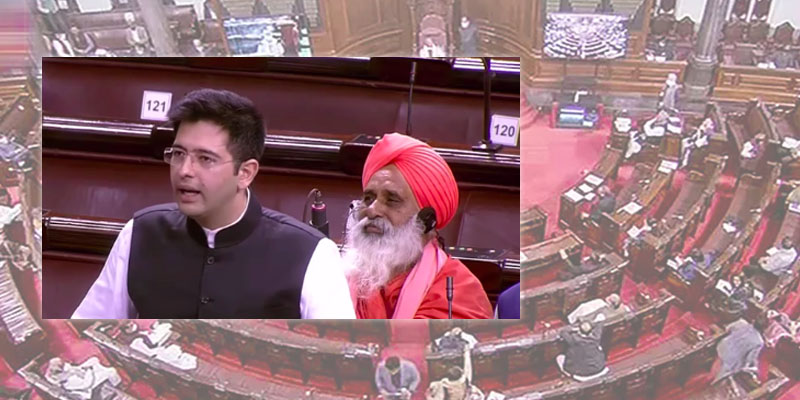
Raghav Chadha (left) raising an issue at Rajya Sabha. Behind him is Sant Balbir Singh Seechewal – Photo: News videograb

By Prabhjot Singh | Opinion |

Will Punjab get its voice back in Rajya Sabha? Seven representatives of the State in the upper House of Parliament are rookies with little or no experience of parliamentary affairs. Needless to reiterate, it is time for them to go through a trial by fire especially as they enter the House or rise to make a point on the floor of the House with high expectations.

After a controversial induction into the political stream, the new Punjab MPs, have quickly come to grips with the Parliamentary procedures, as issues concerning Punjab, its people, farmers, pollution, Sikh affairs, and others were raised and got considerable attention. Intriguingly, all seven Rajya Sabha members representing Punjab, had identical and unique obstacles in addition to the existing challenges facing them before they made their parliamentary debut.

They have cleared the first step well.

Their hurdles include a lack of social contact with senior MPs as they are a new and varied breed coming from different streams of life. None of them had any political career.

Growing pressure from their constituency, which in their case happens to be the trouble-torn Punjab, and allegations against some of them that they are “outsiders” and are “ignorant about issues facing the State,” they faced a heightened climate of hostility.

They face an onerous task of dispelling impressions that shroud their backgrounds. Of new MPs, some of them have already made a start which has been acknowledged by none other than the Rajya Sabha chairman M Venkaiah Naidu, who incidentally will be relinquishing his office on August 10. He while allowing one of new Punjab MPs, Sant Balbir Singh Seechewal, to make his first zero hour reference in the upper house, congratulated him on his performance.

Tussi changa bolaya hai…aapka abhinandan,” said Naidu after Seechewal flagged the problem of incessant water logging in the Malwa districts of Muktsar and Fazilka, leading to damage of farm produce as well as severe diseases on account of water pollution.

Balbir spoke of how 22 drains converge in Fazilka as the waters cannot flow to Pakistan on account of a bandh across the border.

“Water cannot enter Pakistan due to a bandh on the Pakistan side. As water cannot flow to that side, the entire Fazilka area remains heavily inundated and the condition of the people is very bad. Due to incessant water logging this area is affected by severe diseases and pollution. You will be surprised to learn that disabled children are being born in village after village. We urge the Centre to intervene and talk to Pakistan so that water can flow to the Pakistan side to help clear these areas of water logging,” the AAP MP from Punjab said.

Seechewal also informed the Rajya Sabha that due to water logging in Fazilka and Muktsar districts, large swathes of farm lands have been damaged.

He suggested that both the state and Central governments should work together to clear the above two districts of water logging and prevent farmers from committing suicide.

Other than Balbir, one of the other new MPs, Vikramjit Singh Sawhney, had raised the issue of Panjab University. In a written question, he wanted to know the stand of the Union Government of converting Panjab University into a Central University. There was no move to alter the status of Panjab University, Chandigarh, from state to a Central university, the government said in Parliament while answering his question.

Another first time Rajya Sabha member from Punjab, Raghav Chadha, raised the issue of failure of the Union Government to start the ‘Gurdwara Circuit Train’ for Sikh pilgrims.

After the announcement in September 2021, no work has been done to make the scheme a reality by Union Government, Raghav Chadha said urging the BJP-led NDA government to inform Sikhs about time frame so they can plan their pilgrimages

Interestingly, the AAP MPs have virtually hijacked the Sikh or the Panthic agenda. Besides raising the issue of Gurdwara Circuit Train, Raghav Chadha also met the Union Finance Minister and submitted her a memorandum to draw her attention towards several issues of Punjab, chief among those being the imposition of 12 per cent GST on ‘serais’ (inns) in the area around the Golden Temple complex. He demanded immediate rollback of the GST on serais.

Chadha also sought a special financial package and additional water resources for the welfare of the farmers of Punjab and also to address the issue of depleting water crisis. This is a matter which needs urgent attention if Punjab and its farmers are to be saved, he added.

Former Test cricket player and now Rajya Sabha member from Punjab, Harbhajan Singh, also joined his fellow AAP MPs in raising the issues facing Punjab and the Sikhs. He talked about attack on Sikh Gurdwara in Afghanistan in his first Parliament debate and wanted to know what the Indian government was doing to assure Sikhs all over the world about their safety and security besides making their places of worship safe.

Going by the issues and the manner in which they were raised on the floor of the House, new MPs appear to have started well. Punjab needs a strong voice in both houses of Parliament to highlight long standing issues facing the State. After Rajya Sabha reverberated with some of these critical issues, a similar support or endorsement from those representing the State in the lower House – Lok Sabha – can help in finding solutions to the pending issues.

Prabhjot Singh is a veteran journalist with over three decades of experience covering a wide spectrum of subjects and stories. He has covered  Punjab and Sikh affairs for more than three decades besides covering seven Olympics and several major sporting events and hosting TV shows. For more in-depth analysis please visit probingeye.com  or follow him on Twitter.com/probingeye

RELATED STORY:

All eyes on Navjot Kaur and her finishing touch (Asia Samachar, 3 Aug 2021)

ASIA SAMACHAR is an online newspaper for Sikhs / Punjabis in Southeast Asia and beyond.Facebook | WhatsApp +6017-335-1399 | Email: editor@asiasamachar.com | Twitter | Instagram | Obituary announcements, click here 
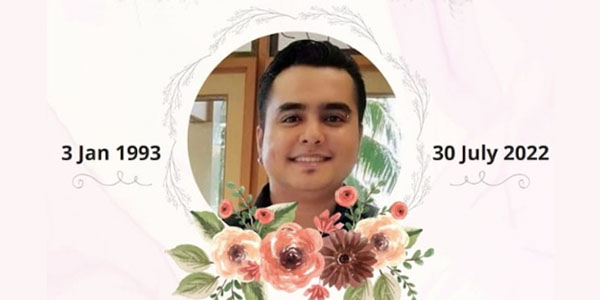
Tashveen Singh Rendhawa (1993 – 2022), Bayan Lepas, Penang

Path Da Bhog

SDR. TASHVEEN SINGH RENDHAWA
S/O Sdr. Harbhans Singh Rendhawa (Burns) & Sdrn. Gurwant Kaur (Khaty)

3.1.1993 – 30.7.2022

Left for heavenly abode on Saturday 30 July 2022.

Dearly missed by family, relatives & friends.

Antim Ardass will be held at Gurdwara Sahib Bayan Baru on Saturday 13 August 2022 from 8am to 12pm. For direction, click here.

Residence: 42A, Jalan Nuri 9, Setia Pearl Island, 11900 Bayan Lepas, Penang

Contact:

Tharminder +60 19 387 4740

Jagdish +60 12 321 5583

Manisha +60 16 432 2727

| Entry: 7 Aug 2022 | Source: Family


ASIA SAMACHAR is an online newspaper for Sikhs / Punjabis in Southeast Asia and beyond.Facebook | WhatsApp +6017-335-1399 | Email: asia.samachar@gmail.com | Twfffitter | Instagram | Obituary announcements, click here

Kuljinder Kaur Dhillon (1936 – 2021), Baru Sahib

KULJINDER KAUR DHILLON

Village: Majitha

17.8.1936 – 17.5.2021

Spouse: Late Dharam Singh Dhillon

Children: Jasinderpal, Sonia, Kamaldeep

Grandchildren: Akansha, Trishagani, Sean, Connor

In loving memory of Kuljinder Kaur Dhillon (Wife of Late Dharam Singh Dhillon) who departed our lives on 17 May 2021.

1st Barsi, Sahej Path da Bhog will be held on 14 August 2022 (Sunday), 10 am – 12 pm at Gurudwara Sahib Petaling Jaya. Guru Ka Langgar will be served.

Leaving behind Siblings, Children, Nephews, Nieces and Grandchildren to mourn their loss and forever cherish her memory.

Contact:

Jasinderpal 016 219 6331

Sonia 012 330 4092

Kamaldeep 012 371 5272


| Entry: 6 Aug 2022 | Source: Family


ASIA SAMACHAR is an online newspaper for Sikhs / Punjabis in Southeast Asia and beyond.Facebook | WhatsApp +6017-335-1399 | Email: asia.samachar@gmail.com | Twfffitter | Instagram | Obituary announcements, click here

Memorializing the 10th anniversary of the Oak Creek Gurdwara carnage, Oak Creek, Wisconsin!​

By American Sikh Council | August 5, 2022 | Press Release |

The carnage at the Gurdwara in Oak Creek, Wisconsin was the first time when a white male targeted a Sikh house of prayer on Aug 5, 2012 in our nation. It has been ten years, but this was not the first time that Sikhs have been beleaguered with violent racism. Hate, bigotry and violence against Sikh-Americans has always been there for more than a century. The crimes against the Sikh religious community have waxed and waned over decades.

There are many factors for the xenophobia against the very distinct and distinguished religious community. Some of those are; societal factors, the role of media, the role of education in schools, the role of the state, specific laws against hate crimes (which are now mostly in place) and leadership.

There was definitely an uptick in serious crimes against Sikh Americans under the leadership of the former President of our country which has taken its toll on many. Based on the current data by the Department of Justice – USDOJ, from 2019 to 2020 the crimes against Sikhs have gone up by 82%.

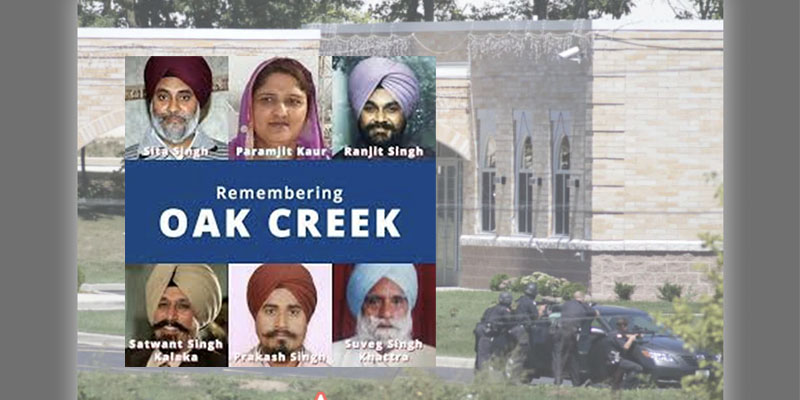
Every year, Sikh Americans remember the members of their faith who became victims of the mass murder at the Oak Creek, Wisconsin Gurdwara. Six innocents were slain, and many others were wounded. The ones whose lives were taken away that fateful day on August 5, 2012 were Satwant Singh Kaleka, Paramjit Kaur, Sita Singh, Suveg Singh Khattra, Ranjit Singh, and Prakash Singh. Punjab Singh was shot and wounded, finally succumbed from his wounds on March 2, 2020. We will never forget them!

Lt.Brian Murphy who was one of the first responders, a police officer, stood up for the innocent congregants while taking over a dozen bullets to defend them inside the Gurdwara on that fateful day. He was a true hero!

Hate crimes against Sikh Americans have taken place in almost every state in the union on a regular basis and has not spared little children or seniors either. It behooves our nation’s leadership at every level to be cognizant of protecting everyone equally and respectfully, so that no one is left behind or otherized.

By memorializing this day and remembering the victims each year, all Sikh Americans have an opportunity to reflect and contemplate ways to not only prevent hate crimes but how to proactively engage with the larger society around us in order to make a safer tomorrow.

American Sikh Council (ASC) President Jasbir Kaur stated, “On this 10th anniversary we pray and remember the victims and their families who were impacted by of the Oak Creek Gurdwara carnage. We beseech all Americans to join us in remembering this solemn occasion, and make sure no one of any religious faith is targeted for what they wear or how they look.”

The American Sikh Council continues to engage with all religions and denominations from the local to the national, across the country through interfaith dialog, so that there is better understanding and mutual respect for a peaceful nation.

The American Sikh Council is the umbrella organization representative of Sikhs in the United States. It is an elected body of Sikh Gurdwaras and institutions. Currently 74 Gurdwaras and other Sikh institutions across the nation are members of ASC. The major governing purpose of the organization is to represent the collective view of Sikhs in the United States. ASC works to promote Sikh interests at the national and international level focusing on issues of advocacy, education, and well-being of humankind.

RELATED STORY:

The Oak Creek massacre signaled the rise of White supremacist violence. But the warnings went unheeded – CNN (Asia Samachar, 6 Aug 2022)


ASIA SAMACHAR is an online newspaper for Sikhs / Punjabis in Southeast Asia and beyond.Facebook | WhatsApp +6017-335-1399 | Email: asia.samachar@gmail.com | Twitter | Instagram | Obituary announcements, click here

The Oak Creek massacre signaled the rise of White supremacist violence. But the warnings went unheeded – CNN

By Harmeet Kaur | CNN | United States |

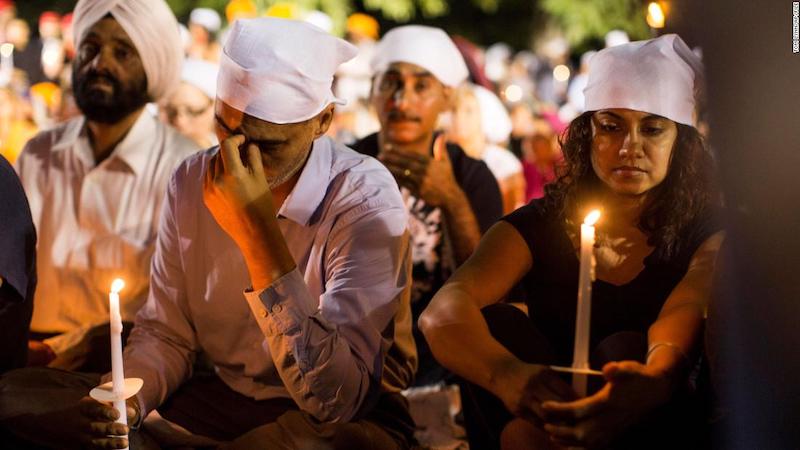
(CNN)No one in the Sikh community in Oak Creek, Wisconsin, could ever have imagined the horror that would unfold on August 5, 2012.

But when Pardeep Singh Kaleka looks back on that tragedy, in which a White supremacist gunman killed his father and six others at a Sikh gurdwara, he wonders if they should have seen it coming.

“There was a certain understanding that it could happen in life, it could happen in the streets, and it could happen in different places — but not at a faith site while people pray on a Sunday,” he told CNN. “At the same time, especially around the surrounding Milwaukee areas, there was a heightened sense of political tension with the changing demographics.”

When Kaleka’s family moved to Wisconsin from Punjab, India, in the ’80s, they got curious looks and questions about their turbans. Despite occasionally being subjected to hate, Kaleka says, they mostly felt welcomed. After 9/11, that curiosity turned to suspicion and prejudice and brown people across the country were being targeted in racist attacks. Tensions simmered as more immigrants moved in, and the gulf between Republicans and Democrats grew wider.

The Oak Creek shooting was a wake-up call — a harbinger of the racist, extremist violence that would again rear its head in other places like Charleston, South Carolina; PittsburghEl Paso, Texas and Buffalo, New York. But the warning signs were largely ignored, Kaleka and other Sikh community advocates say. In the decade since, the domestic terror threat has only escalated in the US, and mass shootings have become a fixture of American life. And with each new tragedy, Oak Creek fades further and further from public memory.

As families of the victims and Sikh civil rights organizations prepare to mark the 10th anniversary of the Oak Creek massacre, they’re calling on elected officials to remember — and to take concrete steps so that another community doesn’t have to endure the same pain.

Sikh advocates began working to prevent another Oak Creek from happening right after the attack.

But as community groups including the Sikh Coalition demanded that political leaders take seriously the threat of extremist violence, they also had to fight simply to be recognized.

About a month after the attack, in powerful testimony before the US Senate, Harpreet Singh Saini asked the federal government to give his mother “the dignity of being a statistic.”

Saini was 18 when the Oak Creek gunman killed Paramjit Kaur, along with Satwant Singh Kaleka, Suveg Singh Khattra, Ranjit Singh, Sita Singh and Prakash Singh. (Baba Punjab Singh, who survived the attack but was left paralyzed, died from complications stemming from his injuries in 2020.) Saini’s mother would never see him go to college or get married. His life would never be the same.

Up until that point, the Oak Creek shooting was the worst hate crime committed in a house of worship since the 1963 church bombing in Birmingham, Alabama. It seemed clear to Saini that the victims were targeted because of their distinct appearance. Paramjit covered her head with a dupatta as she sat for morning prayers, while the men wore turbans as symbols of their faith. Still, even though Sikhs had been targets of xenophobia and discrimination since their arrival in the US, the FBI at the time didn’t track hate crimes against Sikhs.

Read the full story here.

RELATED STORY:

A decade after Wisconsin Sikh gurdwara shooting, more can be done to stop white supremacists (Asia Samachar, 25 July 2022)


ASIA SAMACHAR is an online newspaper for Sikhs / Punjabis in Southeast Asia and beyond.Facebook | WhatsApp +6017-335-1399 | Email: asia.samachar@gmail.com | Twitter | Instagram | Obituary announcements, click here

Space, time, truth and Sikh philosophy

0

By Gurnam Singh | Opinion |

The below salok (verse), which appears on page 1 of Guru Granth Sahib at the beginning of the Jap Bani, invokes the idea that absolute truth exists outside of temporal constraints.

ਆਦਿ ਸਚੁ ਜੁਗਾਦਿ ਸਚੁ ॥
True before time. True throughout the unfolding of time.

ਹੈ ਭੀ ਸਚੁ ਨਾਨਕ ਹੋਸੀ ਭੀ ਸਚੁ ॥੧॥
True in the present. O Nanak, True in the future. ||1||

Though ‘religious’ people tend to link every utterance in gurbani to ‘God worship’, for me there is something much more profound that Guru Nanak is seeking to reveal about the nature of time, space and existence in this short verse.

The central concepts referred to specifically in the verse are ‘truth’ and ‘time’. On the surface these seem like pretty uncomplicated ideas; we all know about being truthful and not telling lies! And most of us have a clear sense of time as something that structures most of our lives, year to year, week to week, day to day and hour to hour. Here, time and truth can be understood as a set of organising structures, beliefs and behaviours, but what is the idea of timeless truth that Guru Nanak is asking us to contemplate here?

One interpretation could be that ‘truth’ is some entity that sits outside of space and time, as a kind of independent observer of the unfolding of the universe. This fits in well with a theistic conception of God as a all knowing, all powerful, all living conscious being that watches over the unfolding of his creation and chooses to intervene when he feels the need to do so.

Whilst not discounting the idea of such a super being, not least because it is almost impossible to disprove this possibility, coming from a scientific angle, I would like to offer an alternative interpretation. Could it be that here Guru Nanak is suggesting that universal truth, for it to be so, must transcend time and space? That is to say that because of our own limitations we perceive space and time as absolute and unconnected, the reality is quite the opposite.

Until the early part of the 20th Century there was a common belief amongst philosophers, theologians and scientists that time and space were fixed, absolute, and they were unconnected. However, in 1905 the famous German theoretical physicist, Albert Einstein, came along and argued that space and time were not only intimately linked, but personal! Put another way, he theorised that each one of us experiences time at different rates, though because the temporal distortion’s are slight, we do or perhaps cannot perceive this to be so. His theory was later proven to be correct through various experiments using people travelling and atomic clocks.

What has become known as Einstein’s theory of special relativity, in very simple terms helps us to understand the correlation between speed of travel, time and space. Because time is relative, it behaves like personal property I.e. we all experience time from our subjective experience. It’s like reading a novel. Though, as readers of a novel we perceive there to be a linear progression in the story, from the beginning, middle and end, in truth, they are all in the same temporal space of the book. And so, though we perceive time in terms of past, present and future, in truth this is just an illusion.

For me this is precisely what Guru Nanak is trying to convey in the above salok, namely, that we perceive our lives to be travelling through time and space, but in truth the past, present and future, has already been written. The salok draws attention to the ultimate, transcendent, constant nature reality. It reveals to us the importance of this eternal truth.

In practical terms Guru Nanak, beautifully illustrated through this short verse, is teaching us to tune our minds in order to engage in deep reflection/contemplation about the beauty and nature our existence, of the absolute timeless truth if you like. We humans are trapped in time or ‘kaal)’, whereas ultimate reality is beyond time or timeless (akaal). When we are able to see the connection perhaps we can claim to have achieved our true mission as human beings.

So, as well as encouraging us to gain knowledge and think critically (budh, vichar), Guru Nanak is also helping us to accept that we may never be able to fathom the mystery of absolute truth. In this sense, we can regard this a method of learning to appreciate that our existence is but a fleeting moment, or if you like, a minor role in story of the universe. The most difficult thing perhaps for us to comprehend is that this story has already been published, the past, present and future are but manifestations of the universal unchanging truth.

Gurnam Singh is an academic activist dedicated to human rights, liberty, equality, social and environmental justice. He is an Associate Professor of Sociology at University of Warwick, UK. He can be contacted at Gurnam.singh.1@warwick.ac.uk

* This is the opinion of the writer and does not necessarily represent the views of Asia Samachar.

RELATED STORY:

Miracles and Godmen (Asia Samachar, 31 July 2020)


ASIA SAMACHAR is an online newspaper for Sikhs / Punjabis in Southeast Asia and beyond.Facebook | WhatsApp +6017-335-1399 | Email: editor@asiasamachar.com | Twitter | Instagram | Obituary announcements, click here |

How errors crept into Guru Granth

0

By Asia Samachar | Sikhi |

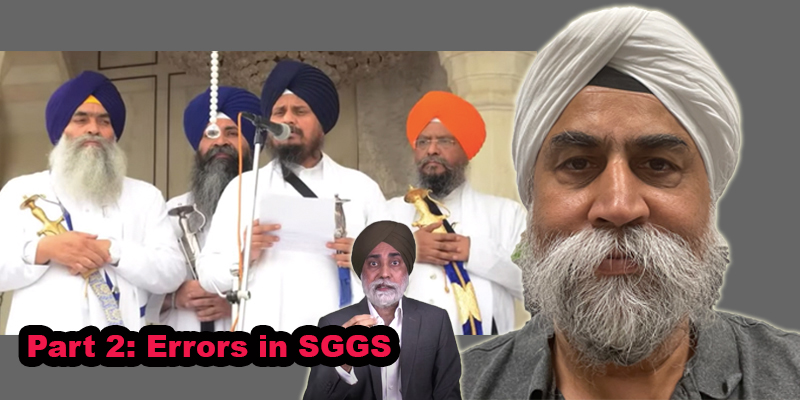
Human errors, printing processes, evolution of Gurbani presentation and clergy self-interest are among the causes that led to the numerous errors in prevailing printed versions of the Sri Guru Granth Sahib (SGGS).

These are among the reasons outlined by , Sikh author Dr Karminder Singh Dhillon in the second video on the topic.

In a second part of the video, Karminder ponted out that the errors within the SGGS is the result of duplication.

The early copies of the scripture were handwritten, a ‘process that is a definite source of errors’.

“A great deal of the hand copying was undertaken by the clergy, the Nirmalas, in particular, who were trained in Hindi and not Punjabi. So the propensity of errors was multiplied,” he said in the video entitled ‘Errors in the Sri Guru Granth Sahib – Part 2′.

Panjabi version: ਸ੍ਰੀ ਗੁਰੂ ਗ੍ਰੰਥ ਸਾਹਿਬ ਵਿਚ ਅਸ਼ੁਧੀਆਂ – ਭਾਗ ਦੂਜਾ ।.

Next, printing. The process of printing, typesetting and proof reading were equally subject to human errors. This is all the more so if the critical processes were neglected, done unprofessionally, overlooked or ignored.

FOR PART ONE OF THIS STORY, GO HERE

The printing brought about possibilities of technical errors. In the type set print era, individual letters had to be picked up and arranged in reverse to print form one page. Potential areas for errors: Letters frequently dropped out, wrongly placed or the printers simply ran short of them, he argued.

The evolution in the process of presenting Gurbani had also led to errors. There are two aspects here. There is the change from the continuous to the separated style of Gurbani presentation (jurdvi to pad-shed).

“The process of separating words can, and does, result in errors,” he argued. Then there is the evolution of the printing technology, from stone press to typeset and then to plate printing. “Each time this happened, old errors got preserved, and new one got added on,” he noted.

Third, advent of clergyism in Sikhi. Here, Karminder pointed out three ways how the class came into being in Sikhi.

“We need to keep in mind that there is always a contradiction between the original religous narrative – the one espoused by the founding fathers, or, prophets, if you like – and the narrative created by the clergy. This contradiction arises because the objectives of the founder and the clergy class are in contradictions,” he said.

He shared a shabad by Bhagat Namdev. He argued that it  lays down a critical and foundational basic principal, exposing the clergy’s role in spiritual distortion and corruption. “The message [in the shabad] is to expose the decadent role of the clergy and to prevent us, Sikhs, from falling prey into the rot in spirituality that the clergy inflicts upon the original belief system, all in the name of serving his own interest, and that of his clergy class,” he said.

Karminder then examines the position of the clergy in Guru Nanak’s Sikhi (begins at 13:45). He also examines stories that Sikhs have been constantly fed – including that Guru Arjan (5th Sikh Guru) supposedly sang a shabad in praise of Bhai Mohan to get him to share the collection of shabads of the first four Guru.

He also outlined seven step in the advent of the clergyism that is supposed to have brought Sikhs to their present predicament with the SGGS (37:30). Here, he touches on the question if the original Pothis written by the Gurus exist today, and about the position of the Baba Mohan Pothis, Bhai Bano Vali Beerr and the Kartarpuri Beerr.

In concluding remarks (1:00.00), he noted that the accepted prevailing view is that only the Shiromani Gurdwara Parbhandak Committee (SGPC) has the authority to make the corrections to the errors in the SGGS. He makes some strong remarks on this point of view.

The videos (see here for the first video) were in response to moves by the Amritsar-based Sikh bodies to take to task a United States based Sikh volunteer who had recently highlighted the issue of errors with in the SGGS.

In May, Sikhs around the globe were jolted with news that Thaminder Singh had made unilateral changes to the SGGS. On May 3, Akal Takht acting jathedar Giani Harpreet Singh pronounced US-based Thaminder Singh as “tankhaiya” (guilty of religious misconduct) for allegedly publishing online the GGS with the changes, including adding extra “lagan-matravan” (suprasegmental symbols of Gurmukhi).

RELATED STORY:

Printing errors in Guru Granth: This issue is not about to go away (Asia Samachar, 24 June 2022)

Grappling with Guru Granth printing errors. Thaminder takes the hit (Asia Samachar, 7 May 2022)


ASIA SAMACHAR is an online newspaper for Sikhs / Punjabis in Southeast Asia and beyond.Facebook | WhatsApp +6017-335-1399 | Email: asia.samachar@gmail.com | Twitter | Instagram | Obituary announcements, click here

Malaysia: Thanksgiving, appreciation and joy at Subang gurdwara maiden family day

0
Autar Singh (right) presenting a certificate to Manvir Kaur recognised for scoring a A+ for the Punjabi paper in SPM examinations. Her parents are Serdul Singh and Nasib Kaur – Photo: GSS

By Asia Samachar | Malaysia |

Gurdwara Sahib Subang’s inaugural Family Day took place over the weekend, showcasing a combination of thanksgiving, appreciation and joy.

The event started with a couple of table games followed by a kirtan sessio. The Subang Istri Satsang members had come together to perform a sehaj paath, the full reading of the Guru Grant Sahib done intermittently.

They then presented awards to Sikh students who did well in major examinations. The presentation was unique in that parents were called upon to accompany their child in the ceremony – honouring parents who are the source behind the students’ success.

The event was jointly organized by the GS Subang Istri Satsang and Education Team.

MORE PHOTOS AT ASIA SAMACHAR FACEBOOK & INSTA

[Something interesting happening at your local gurdwara or community? Send us an update. See contact details below]

RELATED STORY:

Battle hardened mothers feted at Subang gurdwara (Asia Samachar, 9 May 2022)


ASIA SAMACHAR is an online newspaper for Sikhs / Punjabis in Southeast Asia and beyond.Facebook | WhatsApp +6017-335-1399 | Email: asia.samachar@gmail.com | Twitter | Instagram | Obituary announcements, click here

Crime and Religion: Tenth anniversary of attack on Oak Creek Gurdwara

By Prabhjot Singh | Opinion |

The Sikh Community of Wisconsin and worldwide will be remembering on August 5 not only those who laid down their lives in an armed attack on Oak Creek Gurdwara but also a rare act of valour and dedication to duty by Lieutenant Brian Murphy.

Lieutenant Brian Murphy who while rescuing the injured also prevented any further loss of human life was seriously injured in the fire by the attacker.

The attack that sent shock waves everywhere left six devout dead and three others injured.

Many believed it was an attack on religious freedom for all. Some others felt it had been a mistaken perception of taking Sikhs for Muslims.

According to the Sikh Coalition, there are more than half a million Sikhs in the United States. The Justice Department, which before the Oak Creek shooting, had been through the FBI, tracking crimes committed against Jews, Catholics, Protestants, Muslims, atheists, as well as those with “other religion” or “multiple religions,” but did not track crimes against Sikhs. Now the crimes against the Sikhs are tracked.

“Whatever be the reasons or provocations behind the Oak Creek assault on the Sikh sangat, the gallant role of Lieutenant Brian Murphy will always be remembered,” says Professor Inderjit Saluja, a NY-based writer, author and journalist.

The Sikh community felicitated Lieutenant Murphy besides thanking him and the police department profusely for minimising the loss of human life in the attack.

“We want to eulogise his role by instituting a medal in bravery for religious freedom,” adds Professor Saluja, holding that those who lost their lives in defending the honour of the gurdwara are “martyrs” of the community.

Members of the Sikh community, had as usual, gathered at their local gurdwara for regular Sunday services. As they got busy with their prayers and other activities, including preparation of “langar”, an intruder, who was later identified as a white supremacist, arrived and opened fire on unsuspecting worshippers, leaving Paramjit Kaur, Suveg Singh Khattra, Satwant Singh Kaleka, Prakash Singh, Ranjit Singh, and Sita Singh dead. Besides, three others were seriously injured.

The worshippers felt terrorised as they ran for shelter. Lieutenant Brian Murphy, who was the first to respond to the distress call from the Gurdwara, tried to rescue the injured worshippers as the attacker continued to fire. Brian took a couple of shots on his body as the assailant got turned on him thus making other horror-stricken worshippers safe.

Brian Murphy succeeded in his act though he himself landed in hospital with grievous injuries.

The horror of the shooting not only shook Sikh communities around the globe but also other faith-based communities and advocacy organizations.

As August 5 marks the 10th anniversary of the Oak Creek tragedy, global Sikh communities and allies are getting together in remembering the victims. Since then a lot has happened. Though attacks on Sikhs, both as acts of terror and cases of mistaken identity, have been continuing unabated. Following a bipartisan resolution passed by the Senate, Sikh community, like all other faith communities, now enjoys full religious liberty, free from fear of violence and harm. The Department of Justice had since then started tracking crimes against Sikh community.

Prabhjot Singh is a veteran journalist with over three decades of experience covering a wide spectrum of subjects and stories. He has covered  Punjab and Sikh affairs for more than three decades besides covering seven Olympics and several major sporting events and hosting TV shows. For more in-depth analysis please visit probingeye.com  or follow him on Twitter.com/probingeye

RELATED STORY:

A decade after Wisconsin Sikh gurdwara shooting, more can be done to stop white supremacists (Asia Samachar, 25 July 2022)

ASIA SAMACHAR is an online newspaper for Sikhs / Punjabis in Southeast Asia and beyond.Facebook | WhatsApp +6017-335-1399 | Email: editor@asiasamachar.com | Twitter | Instagram | Obituary announcements, click here 
Canada: No longer ‘sleepy little’ Bradford amid shifting demographics

By Jeffery Tram | Barrie Today | Canada |

It wasn’t easy in 1989 to be among the first people of colour to move to Bradford West Gwillimbury, a then-sleepy little farming town about 60 kilometres north of downtown Toronto.

Leaving Toronto’s Jane and Finch neighbourhood, the Sandhus were the first Sikhs to move to Bradford. Their children were the first to wear turbans in the local high school. A brother later became the first Sikh police officer with a local police force. And Raj Sandhu went on to become Bradford’s first person of colour to be elected to town council.

“I am proud of this accomplishment,” Sandhu says. “I hope to represent a new voice in the community.”

Sandhu has served as Ward 1 councillor for Bradford since 2010 and is currently running for deputy mayor.

The Sandhus were on the vanguard of a vast demographic shift in rural Ontario, a movement that would accelerate over the years, and then be driven even faster by the COVID-19 pandemic.

Immigration is vitally important to Ontario. In fact, provincial immigration ministers from Ontario, Alberta, Saskatchewan, and Manitoba are meeting federal Immigration Minister Sean Fraser in Saint John, N.B., urging him to do more to attract immigrants, particularly in skilled trades, and to allow provinces to select newcomers in response to their own specific labour market needs.

Meanwhile, many immigrant families in Ontario are moving out of heavily populated urban areas for smaller cities and rural communities. One of those towns is Bradford. There are many reasons why people from urban areas like the GTA are moving to Bradford, but the biggest ones are affordability and its proximity to Toronto.

“Bradford went from a sleepy little town to a thriving commuter town,” says Mark Contois, a Bradford town councillor of First Nations descent.

As a councillor since 2006, Contois has seen tremendous change. The town had a population boom, growing to 42,880 residents in 2021, a 21.4 per cent increase in just five years.

“This was certainly planned growth,” says Bradford Mayor Rob Keffer, referring to a 2002 community plan that aimed to greatly increase residents while still retaining a ‘small-town’ character.

With easy access to Highway 400 and GO Transit, people can commute with relative ease to Toronto for work or play.

In fact, Ontario sees towns like Bradford as being instrumental to the overall growth of the province.

Sandhu witnessed first-hand the changing demographics of the town. Bradford was generally welcoming to Sandhu as he grew up in the area, but he did have his share of racist encounters.

“Some of it was casual racism, such as ignorance and stereotyping, but I also had my house egged at one point,” says Sandhu.

Click here to read the full story.

RELATED STORY:

Tasmania’s ‘first Sikh couple’ moved from Malaysia to Australia five decades ago. Here’s their story. (Asia Samachar, 31 Aug 2020)


ASIA SAMACHAR is an online newspaper for Sikhs / Punjabis in Southeast Asia and beyond.Facebook | WhatsApp +6017-335-1399 | Email: asia.samachar@gmail.com | Twitter | Instagram | Obituary announcements, click here