Grandson of the late Sardar Ujagar Singh and late Mata Manjeet Kaur
Passed away peacefully on 19th June 2022
Leaving behind beloved:
Father: Jaswant Singh s/o Ujagar Singh
Uncles, Aunties and Cousins
Godmother: Mariana
Relatives and friends to mourn their loss
“Beloved Talvinder, you left us too soon. We will miss you and love you always. You will forever be in our hearts.”
Monday 20th June 2022 Last Respects at Shamshan Bhoomi, Jalan Loke Yew Crematorium, Kuala Lumpur from 2pm to 3.30pm, followed by Saskar/Cremation at 4pm
For Enquiries contact (whatsapp msg)
Jaswant Singh(father): 014-9219557
Jaswant Kaur(aunt): 012-9302383
| Entry: 19 June 2022 | Source: Family
ASIA SAMACHAR is an online newspaper for Sikhs / Punjabis in Southeast Asia and beyond.Facebook | WhatsApp +6017-335-1399 | Email: asia.samachar@gmail.com | Twfffitter | Instagram | Obituary announcements, click here
There is no doubt that the idea of the existence of an all-powerful and all-pervasive God, is universal. There are few conversations that at some point or other, even amongst scientists, do not invoke the idea of God. It was no other than the Cambridge theoretical physicists and self-professed atheist Stephen Hawking, who in the final lines of his best-selling book a Brief History of Time, where he discusses black holes and the origins of the universe, ends with the speculation that if humanity did discover a complete theory of the cosmos, “it would be the ultimate triumph of human reason – for then we would know the mind of God.”
Though he later clarified that he was invoking God as a metaphor and not some latent belief in a divine creator as such, it’s worth noting that the idea of God is still very much mobilised by contemporary philosophers seeking to make sense of our existence.
The idea of God is so infused into human culture and language that even for non-believers, it is impossible to ignore God. The idea of God is at least as old as the major world faiths, though consensus about what God is and how God can be attained varies considerably. Indeed, it is the ongoing differences in theology and practice that sustains divisions, not only between faith groups but also among all the faiths. These divisions can range from friendly doctrinal disputes to war, conflict, and genocide. Though all religions extol the virtues of love and peace, as history shows, those very same commitments to faith identities can lead to mindless violence, which is almost always justified in the name go God.
Though Sikhs can proudly claim to have never launched jihad or holy war on another faith, we are not immune from internal divisions and conflict. Even though we have one common divine scripture, the Guru Granth Sahib Ji (SGGS), and notionally a common code of conduct, the Sikh Rehit Maryada, beliefs and practices amongst the various Sikhs groups can vary considerably. Internal doctrinal differences are usually played out in verbal insults, but occasionally this can morph into physical violence which thankfully tends to be limited to the confines of the Gurdwara.
Though almost all the great world faiths assert the idea of the one creator, God, Allah, Parmershwar, Paratma etc, there is little consensus about how one might conceptualise that entity and how one can attain union with the divine. Amongst Sikhs, perhaps because we are such a small community in comparison to the major faiths, there is much confusion to the point where we have a polarisation of views on a whole range of practices.
The problem doesn’t appear to be in the general acceptance of the reality of the existence of a divine entity, though atheists will strongly dispute this, but in how we interpret what it means to express a belief in something that can appear to be quite abstract or beyond our comprehension. The paradox is that in some senses the idea of God as a supernatural entity can only be sustained through mystification, but this also means that this lack of clarity will lead to different perspectives on what God is.
Whether or not God exists separate from consciousness, we can all agree that as an idea, God resides in our own creative imagination, and for this reason, it is almost impossible to make any logical, scientific, or even reasonable statement about the nature of God that may satisfy everybody. The irony is that though we can all agree that the very essence of God is universality and timelessness, humanity has been incapable of agreeing on what that essence is.
So, what does Sikhi have to say about the concept of God? Given the infinite vastness of God, which incorporates the whole of the cosmos, time and space, past present and future, and indeed, before time itself, any attempt to answer this question is likely to end in failure. Indeed, Guru Nanak in Siree Raag GGS P25, even though we possess immense intellectual capacity as human beings, reminds us of the limits to our capacity to understand.
ਤੂ ਦਰੀਆਉ ਦਾਨਾ ਬੀਨਾ ਮੈ ਮਛੁਲੀ ਕੈਸੇ ਅੰਤੁ ਲਹਾ ॥
You are the River, All-knowing and All-seeing. I am just a fish-how can I find Your limit?
ਜਹ ਜਹ ਦੇਖਾ ਤਹ ਤਹ ਤੂ ਹੈ ਤੁਝ ਤੇ ਨਿਕਸੀ ਫੂਟਿ ਮਰਾ ॥੧॥
Wherever I look, You are there. Outside of You, I would burst and die. ||1||
ਨ ਜਾਣਾ ਮੇਉ ਨ ਜਾਣਾ ਜਾਲੀ ॥
I do not know of the fisherman, and I do not know of the net.
ਜਾ ਦੁਖੁ ਲਾਗੈ ਤਾ ਤੁਝੈ ਸਮਾਲੀ ॥੧॥ ਰਹਾਉ ॥
But when the pain comes, then I call upon You. ||1|| Pause || (SGGS, 25) (English translations by Sant Singh Khalsa)
The fact that our mental capacities may be finite doesn’t mean we should not think about the nature of God. However, perhaps rather than arguing over establishing some general description of what is ultimately indescribable, a more sensible approach is to focus on the impact that the divine entity has on our lives. Here one can draw an analogy with the moon or sun. Both celestial bodies can literally be seen to exist, and as well as making scientific measurements about their make-up, shape, and size of these, we can generate a whole set of myths about their nature. However, in practical terms, the way the sun and moon impact us directly is through the waves of light and radiation and the gravitational effects. Indeed, without the gravitational effects of the moon, we would not have the tidal flow that we see in the seas.
So, in realising the futility of seeking answers to an impossible question, Guru Nanak places great emphasis on the experiential dimension of knowing, i.e., the pursuit of understanding and realising God, the creator, or whatever name one might want to give to the entity that represents ultimate truth or ‘sat’. In this regard, there is an associated concept which is woven through Gurbani in the writings of all the various contributors, and that is the concept of ‘Naam’. Repeatedly Gurbani talks about the importance, power and centrality of Naam to the realisation of the divine. Whilst acknowledging that God has many, perhaps an infinite number of descriptive attributes, it is naam that is its true essence.
Guru Arjan ji, in Raag Maroo, after extensively listing some of the commonly held attributes that are recounted in various mythological texts, concludes that beneath the descriptive names lies a true essence, ‘sat naam’
With my tongue I chant the Names given to You. ‘Sat Naam’ is Your perfect, primal Name. (SGGS, 1083)
One of the ways in which this notion of ‘sat naam’ is commonly understood is that it is a mantra that through repetition, one can unlock a path towards enlightenment. In this regard, often reference is made to a Saar by Bhai Gurdass, in which he says that Guru Nanak came to this world to deliver the ‘sat naam’ mantra.
ਕਲਿਜੁਗੁ ਬਾਬੇ ਤਾਰਿਆ ਸਤਿ ਨਾਮੁ ਪੜ੍ਹਿ ਮੰਤ੍ਰੁ ਸੁਣਾਇਆ।
Baba Nanak liberated this dark age (kaljug) and recited the mantra of satnaam for one and all.
A complete exposition of the concept of Satnam would require a separate article, needless to note that it is one of the central concepts within Sikhi. Satnaam constitutes a foundational component of the Maglacharan or Moon mantra, which can be found in the commencement of most sections of the Guru Granth Sahib, after “Ik Onkaar…”
The term can be literally translated as ‘true, timeless name’. And because there the reference is being made to Ik Oankaar or the divine all-pervasive entity, commonly called ‘God’, here Nanak is suggesting no name whatsoever, hence Sat naan can be seen as a negation of labels, hence avoiding reducing what is ultimate to some limited property or attribute.
And so, in this sense within Sikhi, because God is beyond our imagination, attempts to talk about God are at best futile. It logically follows that the only way to realise the divine entity that has no label is to realise and experience divine virtues and practice those in our lives. In this regard, belief in a superpower, God etc is perhaps less important than developing an appreciation that to be born a human being, unlike all other species beings, is to be programmed to both possess self-awareness, out of which ego itself is manifest, but also the capacity, like a divine being, to be creative, loving, beyond hate and fear etc. In other words, to realise the divine virtues of Ik Oankaar that are set out in the Manglacharan or mool mantra, need to be inculcated into our lives. In short, to realise the divine is to become like the divine. As Kabeer Ji notes:
ਕਬੀਰ ਪਾਨੀ ਹੂਆ ਤ ਕਿਆ ਭਇਆ ਸੀਰਾ ਤਾਤਾ ਹੋਇ ॥
Kabeer, what then, if one could become water? It becomes cold, then hot.
ਹਰਿ ਜਨੁ ਐਸਾ ਚਾਹੀਐ ਜੈਸਾ ਹਰਿ ਹੀ ਹੋਇ ॥੧੪੯॥
The humble servant of the Lord should be just like the Lord. ||149|| (SGGS, 1372)
If one accepts that God and the disciple appear to possess separate bodies, other than the lack of realisation of such, there is no separation. How one achieves this realisation and union is where major differences can emerge. For example, the Yogis advocated aestheticism, a social, and, as far as possible, physically withdrawal from society. For them, enlightenment or perfect union with the creator could only be achieved through a precise set of practices designed to suppress desires through austerities and rituals. Though many Sikhs tragically are trapped in ritualistic practices, albeit with a coating of Sikh symbolism, in truth Gurbani rejects completely rejects the general idea that it is only through religious ritualistic practices that one can become one with the divine.
The Guru makes it clear that the Sikh way of establishing a union between the self and the divine is to fully appreciate the world around so and to achieve a state of balance by living the life of a householder, earning an honest reflective life and by serving others. Union with God or the divine, according to the Sikh perspective, is not through occasional intense emotional experiences induced through Sufi or Yogic practices and rituals, which were deemed to be temporary and performative, but through everyday connections, through sehaj or steadily developing one’s appreciation of the divine aspects of life.
In condemning many of the prevailing ritualistic practices that were deemed to be the only way to attain union with mythical gods in the present, or afterlife, Guru Nanak in Suhee Rag, offers a simple path:
ਅੰਜਨ ਮਾਹਿ ਨਿਰੰਜਨਿ ਰਹੀਐ ਜੋਗ ਜੁਗਤਿ ਇਵ ਪਾਈਐ ॥੧॥ Remaining unblemished in the midst of the filth of the world – this is the way to attain Yoga. ||1||
ਗਲੀ ਜੋਗੁ ਨ ਹੋਈ ॥ By mere words, Yoga is not attained.
ਏਕ ਦ੍ਰਿਸਟਿ ਕਰਿ ਸਮਸਰਿ ਜਾਣੈ ਜੋਗੀ ਕਹੀਐ ਸੋਈ ॥੧॥ ਰਹਾਉ ॥ One who looks upon all with a single eye, and knows them to be one and the same – he alone is known as a Yogi. ||1|| Pause ||
To conclude, the answer to the original question, what is the concept of God in Sikhi is to reject the idea of God as a thing, concept or entity that is separate from our being. It is the quest for a realisation that we and God are no separate entities and that to live our lives (manukji janam) as human beings in balance with the world around us, by sharing, serving and learning.
Gurnam Singh is an academic activist dedicated to human rights, liberty, equality, social and environmental justice. He is an Associate Professor of Sociology at University of Warwick, UK. He can be contacted at Gurnam.singh.1@warwick.ac.uk
* This is the opinion of the writer and does not necessarily represent the views of Asia Samachar.
ASIA SAMACHAR is an online newspaper for Sikhs / Punjabis in Southeast Asia and beyond.Facebook | WhatsApp +6017-335-1399 | Email: editor@asiasamachar.com | Twitter | Instagram | Obituary announcements, click here |
Gunmen launched an attack on a Sikh Gurdwara in Afghanistan’s capital Kabul on Saturday, killing at least two people, Kabul police chief spokesman Khalid Zadran said.
Seven attackers tried to storm the temple in the early hours of Saturday morning, throwing grenades at security guards who were standing at the entrance. The attackers also detonated a car bomb in the area but no casualties were reported from the explosion, rpeorts CNN.
All seven gunmen were killed after a standoff that lasted several hours inside the temple’s compound, Zadran said. There was no immediate claim of responsibility. The attack killed a member of the security forces and a Sikh worshiper, according to state-run news agency Bakhtar.
A gurdwara official Gornam Singh told Reuters that 30 people were inside the temple at the time of the attack. “We don’t know how many of them are alive or how many dead,” he said, adding that temple authorities were at a loss at what to do as the Taliban were not allowing them inside.
Sikhs are a tiny religious minority in Afghanistan, with very few left since the Taliban takeover last year. Religious minority groups like the Sikhs have been a target for violence in the country. In 2020, 25 people were killed in an attack at another Sikh gurdwara in Kabul, which ISIS claimed responsibility for, the report added.
The report also carried condemnations by UN Assistance Mission in Afghanistan (UNAMA), European Union (EU) envoy and the Indian foreign ministry.
The UN Assistance Mission in Afghanistan (UNAMA) condemned the attack, writing in a tweet that “attacks on civilians must cease immediately. UNAMA calls for protection of all minorities in Afghanistan, including Sikhs, Hazaras and Sufis.”
The European Union Ambassador to Afghanistan said the attack is terrible and “religious (and ethnic) pluralism needs to be protected with full force.”
India’s Foreign Ministry said they were “deeply concerned at the reports emanating from Kabul about an attack on a sacred Gurudwara in that city.”
ASIA SAMACHAR is an online newspaper for Sikhs / Punjabis in Southeast Asia and beyond.Facebook | WhatsApp +6017-335-1399 | Email: asia.samachar@gmail.com | Twitter | Instagram | Obituary announcements, click here
Keshmendip Singh once again showed his mantle when he emerged as the ‘Most Valuable Player’ at the 26th Maba Matrix Cup Basketball Championship, a major national basketball tournament in Malaysia.
This is the third time he won the accolade. The 22-year-old player was also selected as the Top Rebounder, for the second time, in the tourney which ended last week.
Keshmendip represented Penang which ended up fourth in the games won by Negeri Sembilan.
“I started playing at 10 because of my height,” he told Asia Samachar when contacted. Standing at 6′ 2″, he plays small forward, centre and power forward.
Keshmendip donned the national jersey for the first time when he was 15. He represented Malaysia under-18 for the Asia School Games in Singapore.
As about his experience playing for the national team, he was a little nervous, but as the games went on, he collected himself and began enjoying the game. “The games have been a source of motivation for me. I want to keep improving my game.” he said.
His parents live in Sungai Petani, Kedah. His father is former security guard officer Azbeel Singh Gill who is now a Malaysia Civil Defence Force (MCDF) volunteer at the Butterworth Base. His mother Dharminder Kaur Gill teaches Punjabi in Sungai Petani and Butterworth.
ASIA SAMACHAR is an online newspaper for Sikhs / Punjabis in Southeast Asia and beyond.Facebook | WhatsApp +6017-335-1399 | Email: asia.samachar@gmail.com | Twitter | Instagram | Obituary announcements, click here
Gunmen stormed a Sikh gurdwara in the Afghan capital Saturday (June 18), lobbing at least one grenade and wounding two people, the interior ministry and witnesses said, according to a foreign news agency.
“I heard gunshots and blasts coming from the gurdwara,” Gurnam Singh, a Sikh community leader told AFP.
Interior ministry spokesman Abdul Nafi Takor said a grenade blast wounded two members of the Sikh community. Minutes later a car bomb detonated in the area but caused no casualties, Takor said, the report added.
In another report, it noted that gurdwara official Gornam Singh also confirmed the attack.
“There were around 30 people inside the temple. We don’t know how many of them are alive or how many dead. The Taliban are not allowing us to go inside, we don’t know what to do,” the official said.
Videos posted on social media showed plumes of black smoke rising from the temple, known as a gurdwara, in the Bagh-e-Bala neighbourhood of Kabul. Gunfire can also be heard.
In March 2020, 25 men, women and children were killed in a terror attack upon a Sikh gurdwara in central Kabul. The next day, an explosive went off just outside the crematorium as the Sikhs were cremating their dead. And the next day, yet another attack.
For many amongst the then 2,000 odd Sikhs and Hindus, the senseless attack upon the Gurdwara Guru Har Rai in Shor Bazaar was the proverbial straw that broke the camel’s back as far as their dreams of continuing to live in Afghanistan. The gunmen stormed the gurdwara, shot discriminately and held 80 hostages.
There are now only around 200 Sikhs living in Afghanistan, compared to around half a million in the 1970s.
ASIA SAMACHAR is an online newspaper for Sikhs / Punjabis in Southeast Asia and beyond.Facebook | WhatsApp +6017-335-1399 | Email: asia.samachar@gmail.com | Twitter | Instagram | Obituary announcements, click here
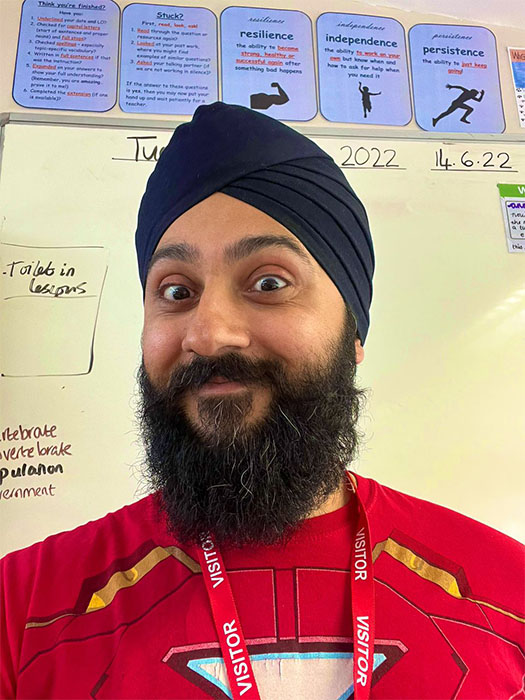
Was invited to my sons school to talk to year 4 about Sikhi. Here are some observations.
1) I love how multicultural the school is. I wish it was this diverse when I was their age. Lots of respect for each other too.
2) the ones that had questions had MANY questions. And the ones that didn’t, listened attentively. Probably because of the iron man T-shirt..
3) They were SUPER excited to see Gurmukhi script being written, and I was so excited to write that I forgot some letters ?
In my defence it’s been years (maybe even decades) since I’ve written any Panjabi. Man’s gotta brush ?
Overall I love that they all had a thirst for knowledge and I think they appreciated that I was representative of the religion being talked about. Must make a difference to have an actual Sikh talk about Sikhism!
Adapted from Sunny Osahn’s entry at his Twitter handle.
ASIA SAMACHAR is an online newspaper for Sikhs / Punjabis in Southeast Asia and beyond.Facebook | WhatsApp +6017-335-1399 | Email: asia.samachar@gmail.com | Twitter | Instagram | Obituary announcements, click here
Taran Singh Kainth is quickly becoming known in Calgary as one of the city’s most innovative and driven tech entrepreneurs. As co-founder and CEO of the fintech startup Flahmingo, Kainth seeks to improve investor education while also exposing the systemic weaknesses of the modern stock market.
Recently named one of 11 Canadian tech companies to watch in 2022 by Betakit, Flahmingo has already made a big splash despite being a fairly new player in the fintech world. The company has raised C$3 million in funding and generated a list of 6,100 people eagerly awaiting its beta launch this summer.
An alumnus of Mount Royal University’s bachelor of business administration program, Kainth has been investing and trading for the last 11 years.
“Flahmingo is on a mission to empower Canadians through something we call empowered investing, where you feel enabled to be able to take the first step towards controlling your finances,” he says.
In 2020, Kainth joined forces with fellow MRU computer information systems grad Gio Moros Hernandez, who is the company’s chief technology officer.
“The most rewarding part of Flahmingo is building a product from the ground up that democratizes investing for Canadians,” Hernandez says.
“Mount Royal’s BCIS degree trained me to work under pressure and practice patience when programming a complex product. What might seem like a simple solution is often much more nuanced, especially in fintech.”
With 30 employees — including six MRU students and alumni — Flahmingo continues to grow, develop and disrupt. Implementing a trading application here in Canada within the regulatory landscape is quite a “heavy lift,” but Kainth says the still-compact size of Flahmingo is one of its greatest strengths.
ASIA SAMACHAR is an online newspaper for Sikhs / Punjabis in Southeast Asia and beyond.Facebook | WhatsApp +6017-335-1399 | Email: asia.samachar@gmail.com | Twitter | Instagram | Obituary announcements, click here
Brothers- In-Law/ Sisters-In-Law & Spouses: Late Ranjit Singh (Former President Tatt Khalsa Diwan) & Paritam Kaur, Jaswant Singh, Gurcharan Kaur & Late Jeswant Singh Dhillon
Caregiver: Santi
All Relatives and Friends
Akhand Path will be held at her residence as follows from 22nd June (Wednesday: 9.00am) to 24th June (Friday: 10.00am). Residence Address: No. 58, Jalan Bukit Indah 1/12, Taman Bukit Indah, Ampang.
Guru ka langgar will be served for all the three days.
Please join the family for Sukhmani Sahib prayers on 24th June 2022 (Friday) at 5 pm at the residence (No 58, Jalan Bukit Indah 1/12 ,Taman Bukit Indah, Ampang)
Late Mataji’s SEHAJ PAATH DA BHOG and ANTHIM ARDAS will be held at Gurdwara Sahib Tatt Khalsa on 25th June (Saturday) from 4.00pm to 7.00pm.
Your presence for all prayers would be much appreciated by the family
For Enquiries, contact:
Jaswant Singh: 012-2931953
Dalvinder Singh: 017 -6200156
Avinder Singh Gill: 012 – 3803023
| Entry: 16 June 2022; Updated: 20 June 2022 | Source: Family
ASIA SAMACHAR is an online newspaper for Sikhs / Punjabis in Southeast Asia and beyond.Facebook | WhatsApp +6017-335-1399 | Email: asia.samachar@gmail.com | Twfffitter | Instagram | Obituary announcements, click here
The heading of a recent Panjabi article in The Daily Ajit by S. Tarlochan Singh, Ex-MP and Minorities Commissioner, is: ਕਿਸ ਨੇ ਪੰਜਾਬ ਵਿਚ ਸ਼ਾਂਤੀ ਦਾ ਬੀਜ ਪੁੰਗਰਨ ਨਾ ਦਿੱਤਾ? (Who did not allow the seed of peace to germinate in Punjab?). He felt that there were unanswerable questions which should be probed.
The questions posed reminded me of a report in September 1984 issue of the Surya magazine. The heading was: Dead Men Tell No Tales. The editor claimed that it was an incredible story based on exclusive information provided by patriotic officers of RAW [Research and Analysis Wing – the foreign intelligence agency of India], as told to Surya reporter Rajeev K Bajaj. That the men of the Third Agency were especially recruited from RAW and other agencies to work under the direct supervision of the Prime Minister through the Chief Security Advisor, R N Kao.
The introduction was: This is the story about a super-intelligence agency. The Third Agency. Its credo: Total loyalty to Indira Gandhi Prime Minister of India. Its resources: Unlimited. Its think tank: R N Kao. Its area of operation: Punjab, Kashmir, Rajasthan, Andhra Pradesh, Karnataka, Sri Lanka et al.
The report revealed that the Third Agency kept the supply of lethal weapons flowing into the Golden Temple allowed 47 railway stations to be blown up incited violence in Punjab and, politicised the Army for the use of the Ruling Party. The security agencies were perverted to serve the interests of the ruling party. The security of the nation has had to take second place to the ruling party interests. The Surya report named several senior officers involved in clandestine and treacherous activities with political objectives to discredit the Sikhs. Otherwise, Sikhs have a record of loyalty to the nation second to none.
So, through these incredible revelations, RAW sources claiming themselves to be patriotic Indians, were exposing, allegedly senior RAW and other officials who were betraying their own country, India, due to their personal loyalty to Indira Gandhi and the Congress Party. The aim of the Third Agency was not only to cleanse the Golden Temple but also to destroy all evidence which connected the Third Agency to all that went on in Punjab before Operation Blue Star.
It seems, no matter what the alleged role of Sikh leadership including Baba Jarnail Singh Bhindranwale, the Third Agency of Indira Gandhi had already been plotting to invade Darbar Sahib to ensure massive loss of lives on both sides &ndash the Sikhs and the Indian Army. RAW traitors had set a trap for Sikh leadership to be followed by genocide of the Sikhs.
The religio-social reform movement led by Bhindranwale was also uniting rural Panjabi young Sikhs as a significant political force. This was unacceptable to the Indian Hindutva biased establishment and the communist/socialist parties. Also, as a Sikh intellectual observed, traditional Akali leadership was concerned that Bhindranwale could emerge as a kingmaker and jeopardize their hegemony over the Sikh community. The Indian news media, by and large, joined in the witch-hunt along with several well-known []]so called], intellectuals. What followed was as planned by the powerful politicised and traitorous Third Agency.
So, it seems, the questions raised by S Tarlochan Singh were answered by the Surya investigative report within three months of Operation Blue Star
Gurmukh Singh OBE, a retired UK senior civil servant, chairs the Advisory Board of The Sikh Missionary Society UK. Email: sewauk2005@yahoo.co.uk. Click here for more details on the author. The original article, entitled ‘Surya September 1984 Revelations: How RAW Traitors Destroyed the Peace in Panjab‘,appeared at Punjab Times.
* This is the opinion of the writer, organisation or publication and does not necessarily represent the views of Asia Samachar.
ASIA SAMACHAR is an online newspaper for Sikhs / Punjabis in Southeast Asia and beyond.Facebook | WhatsApp +6017-335-1399 | Email: editor@asiasamachar.com | Twitter | Instagram | Obituary announcements, click here
“Think of me as living in the hearts of those who i have touched. For nothing loved is ever lost and I have loved so much”!….
If we could write a story, it would be greatest ever told of a kind hearted man with a heart of gold. He was very selfless, always went above and beyond to help anyone and everyone. He was a people’s person.Those who knew him will know this about him. He loved and was loved by everyone. We all miss our father, dearly.
We are sincerely extending this invite hoping you could make it for his 1st Barsi. As many weren’t able to during his funeral due to Covid restrictions last year.
| Entry: 16 June 2022 | Source: Family
ASIA SAMACHAR is an online newspaper for Sikhs / Punjabis in Southeast Asia and beyond.Facebook | WhatsApp +6017-335-1399 | Email: asia.samachar@gmail.com | Twfffitter | Instagram | Obituary announcements, click here