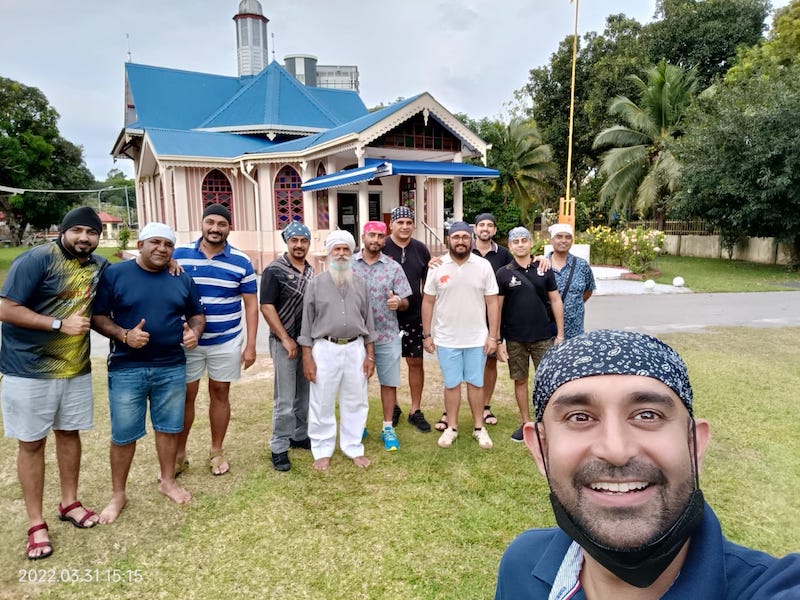
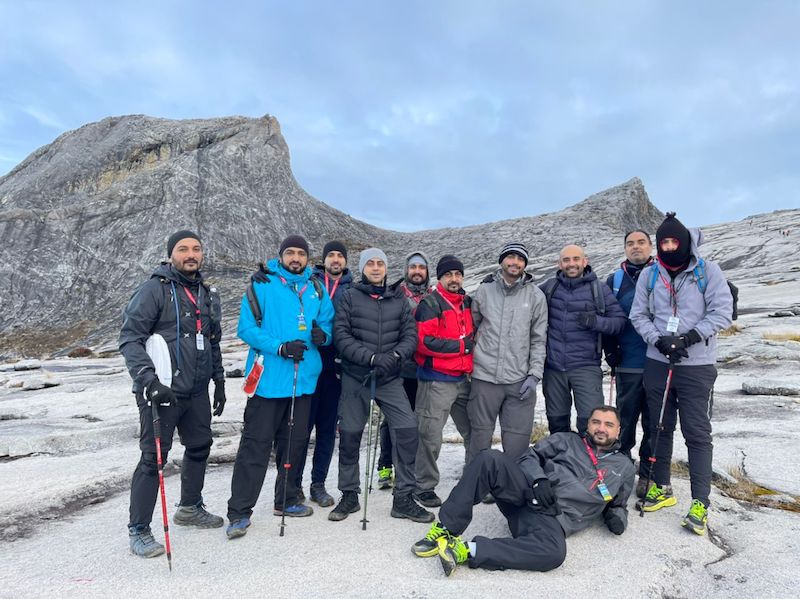
A Malaysian group calling themselves Punjabi Hikers have managed to scale Mount Kinabalu, the heights peak in Southeast Asia.
The group, mainly from Kuala Lumpur and Ipoh, had first stopped at Gurdwara Sahib Kota Kinabalu to say a prayer before embarking on their journey.
“Our group members have been hiking Bukit Gasing or Gunung Keledang actively for the last two months,” Jaswinder Singh, one of the team members, told Asia Samachar in a telephone conversation.
The team of 11 hikers was led by Harbinder Singh Parmar.
ASIA SAMACHAR is an online newspaper for Sikhs / Punjabis in Southeast Asia and beyond.Facebook | WhatsApp +6017-335-1399 | Email: asia.samachar@gmail.com | Twitter | Instagram | Obituary announcements, click here
In many parts of the world, Vaisakhi this year will be a welcome respite. It will be the first Vaisakhi celebration where we can converge in bigger numbers. In the past two years, Vaisakhi had been a subdued affair due to the Covid-19 pandemic control measures.
As we get ready for Vaisakhi 2022, let us ponder as to why we celebrate this day. Yes, Guru Gobind Singh created the Khalsa on this day in 1699.
But why did he chose the 1st of Vaisakh (we are talking about the Indian-based calendar here)? Is this date of any significance to the Sikhs? Why did the 10th Sikh Guru chose to gather Sikhs on this particular day?
Well, apparently, there is a reason. Latest research has revealed that it is actually the day that Guru Nanak – the first Sikh Guru – was born. So, there was a connection, after all, between Guru Nanak and Guru Gobind Singh.
FOR MORE STORIES ON GURU NANAK’S BIRTHDAY, CLICK HERE
ASIA SAMACHAR is an online newspaper for Sikhs / Punjabis in Southeast Asia and beyond.Facebook | WhatsApp +6017-335-1399 | Email: asia.samachar@gmail.com | Twitter | Instagram | Obituary announcements, click here
Senior career officer Harinder Sidhu, who served as Australian high commissioner to India for four years until 2020, has been picked as the nation’s next top diplomat to New Zealand.
Harinder will serve as the high commissioner to New Zealand with whom Australia, Australian Minister for Foreign Affairs and Minister for Women Senator the Hon Marise Payne announced in a statement dated March 31. She replaces Patricia Forsythe AM who has served since 2019.
The Singapore-born Harinder is a senior career officer with the Department of Foreign Affairs and Trade (DFAT) and was most recently Chief Operating Officer and Deputy Secretary.
She has previously served overseas as Australia’s High Commissioner to India and in Moscow and Damascus. In Canberra, she has served in DFAT in senior leadership roles, as well as in the Department of Climate Change and Energy Efficiency, Office of National Assessments and the Department of the Prime Minister and Cabinet, according to the statement
Harinder holds a Bachelor of Laws and a Bachelor of Economics from the University of Sydney.
“Australia’s relationship with New Zealand is our closest and most comprehensive, and its special nature is underpinned by enduring cultural, economic, defence and sporting ties,” said Payne in the statement.
She said Australia and New Zealand stand together to meet strategic challenges and work closely to promote an open, inclusive and resilient Indo‑Pacific and the global rules‑based order.
“We are strong supporters of a multilateral trading system. We promote free, fair and predictable trade benefiting businesses and consumers in both countries and our region,” she added.
Australia and New Zealand benefit from having one of the world’s most open and successful free-trade agreements. This means our businesses and exporters face less red tape and enjoy easier access to each other’s markets. Harmonised investment rules have opened opportunities for Australian investors in New Zealand and New Zealand is one of the top ten investors in Australia, with $66.3 billion in foreign investment from New Zealand to Australia in 2020. The integration of the Australian and New Zealand economies has contributed to our countries’ economic resilience during the COVID-19 pandemic, with two-way trade valued at $23.7 billion in 2020, the statement added.
ASIA SAMACHAR is an online newspaper for Sikhs / Punjabis in Southeast Asia and beyond.Facebook | WhatsApp +6017-335-1399 | Email: asia.samachar@gmail.com | Twitter | Instagram | Obituary announcements, click here
Khalsa Land, possibly the largest Sikh campsite size-wise in Asia outside of India, is all set to kickstart its next phase of development.
The 20-acres campsite, owned and managed by the Sikh Naujawan Sabha Malaysia (SNSM), is at Kuala Kubu Bahru, an hour’s drive from Kuala Lumpur.
SNSM has now launched what it calls the Phase 1 of the Khalsa Land development project. This phase includes the construction of a multi-purpose hall, accommodation units and other supporting facilities estimated to cost a total of RM6 million.
They plan to kickstart the phase with the construction of two units of accommodation building at a contract sum of RM683,000. Construction work will start in mid-April and is expected to be completed in 10 months.
“This is an important milestone in the development of Khalsa Land,” a project team volunteer member told Asia Samachar.
SNSM acquired the land in 2001 with the generous support of Sikhs in Malaysia and abroad. They envisioned a place where the Sikh youth could come together in a Sikhi setting and develop their Sikhi knowledge and skill sets for the greater good of the community.
Following a lengthy process to obtain approvals from various departments and authorities, the land status was successfully converted from agriculture to institutional use. Since then, earthworks to create building platforms and construction of the access road, drainage system, and water and electricity supply, including the building of the TNB substation, have been successfully carried out.
To bring the land to use, various facilities have been built which include a Darbar Sahib, classrooms, cabins for accommodation, and washroom and kitchen facilities. Recreation facilities are also available including a football field and playground for children. More than 350 fruit trees have also been planted, according to details shared with Asia Samachar.
Khalsa Land in more recent times. More trees all around and a darbar sahib for prayer activities
SNSM’s signature event, the Annual Gurmat Parchar Samelan, have been held at Khalsa Land for four years from 2016-2019, where more than 1,000 youth participants and volunteers (sewadars) were present at each time. No physical Samelans could be held in 2020 and 2021 due to the Covid-19 pandemic. Only e-Samelans were held during this period. We expect physical Samelans to resume in December 2022. See: here.
In addition, during the period 2018-2019, nearly 80 youth and family activities were held at Khalsa Land, including Gurmat getaways, youth and family camps, and mini-Samelans.
For those wishing to contribute to the development, they can make online bank transfer (Account Name: SNSM Khalsa Land: Account No: 514012428084; Name of Bank: Malayan Banking Berhad). For more information, they can contact Hardev Singh (+6017-486 2648) or Harnarinder Singh (Harry) (+6017-215 0305).
ASIA SAMACHAR is an online newspaper for Sikhs / Punjabis in Southeast Asia and beyond.Facebook | WhatsApp +6017-335-1399 | Email: asia.samachar@gmail.com | Twitter | Instagram | Obituary announcements, click here
Perak-born medical doctor Dr Kajel Kaur is the first Punjabi and a Sikh to be crowned Miss Earth Malaysia. She took the title for 2022 in Kuala Lumpur on Sunday (27 March).
And the Ipoh-girl is raring to pursue her passion: rescuing and rehousing stray animals, as well as feeding them.
“As a Punjabi, Sikh, it is in my blood to help and feed everyone in need. Every Punjabi from every corner of this Earth is taught the importance of “sewa” (service) and “langgar” (kitchen), in order to serve the hungry. Even in the recent floods in Malaysia, it can be seen that Punjabi, Sikhs gathered to help everyone in need, especially from Gurdwara Sahib Petaling Jaya (GSPJ).
“Whenever there is need, Punjabi, Sikhs from all around the world will be there. Together with every race, Punjabis will always fight for what is right and help everyone; we are taught to do so,” she told Asia Samachar.
She was referring to the Petaling Jaya gurdwara stepping forward to provide emergency relief and assistance to flash flood victims in Taman Sri Muda in Shah Alam, Selangor, in December 2021. The efforts snowballed into a massive operation, attracting folks from all faiths and races.
Born in Ipoh, Kajel, 26, completed the Bachelor of Medicine and Bachelor of Surgery at Quest International University in December 2021.
Her father Dalbir Singh is an enforcement office at Majlis Bandaraya Ipoh while her mother Karamjit Kaur is a manager at the General Post Office in Ipoh.
Elaborating on her passing, Kajel said she had been feeding stray animals since childhood.
“Dogs and cats have taught me love and kindness,” she said. “”I look forward to working with various animal rescue centres to try to obtain more food donations from caterers and stores, so that it doesn’t go to waste and can be used for charity purposes instead.”
ASIA SAMACHAR is an online newspaper for Sikhs / Punjabis in Southeast Asia and beyond.Facebook | WhatsApp +6017-335-1399 | Email: asia.samachar@gmail.com | Twitter | Instagram | Obituary announcements, click here
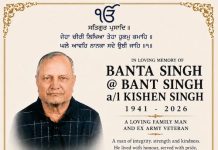
Also dearly missed by a host of nieces, nephews, grandnieces and grandnephews.
Kirtan Darbar and Sahej Path, Da Bhog will be held on 9th April 2022 (Saturday) at Gurdwara Sahib Changkat, 31000 Batu Gajah, Perak from 10am to 12 pm. Guru Ka Langgar will be served thereafter.
We humbly request that everyone fully complies with the Covid-19 Standard Operating Procedures at all times.
Contact:
Preton Singh (Brother) 016 216 2474
Jesvinder Kaur (Daughter) 012 624 1589
Darshen Kaur (Niece) 012 663 3156
| Entry: 1 April 2022 | Source: Family
ASIA SAMACHAR is an online newspaper for Sikhs / Punjabis in Southeast Asia and beyond.Facebook | WhatsApp +6017-335-1399 | Email: asia.samachar@gmail.com | Twitter | Instagram | Obituary announcements, click here |
Guru Nanak’s travel – Source: Snapshot from Allegory
By Dya Singh | Opinion |
I have never been one to watch ongoing serials, let alone long-drawn-out documentaries, even in retirement (semi-retirement really), and with all the time in the world. I can watch a few episodes and then I find most rather tiresome and draggy.
This following-in-the-footsteps-of-Nanak series proved different right from the outset. Firstly, it is getting a stunning visual perspective of Baba Ji’s odysseys (‘udasis’). For me, perhaps, it was the validations and in many instances corrections and additions, of what I already knew of Guru Ji’s life. In other words, there were many ‘WAH’ moments, which to me, then become ‘WAH-GURU’ moments.
Amardeep Singh, the brainchild behind the 24 series programme called Allegory: A Tapestry of Guru Nanak’s Travels, also added a few further dimensions which lent a considerable philosophical and spiritual tangent. He was able to connect certain ‘bani’ of Guru Ji with the locations and anecdotes, as we followed the journey. He added his own personal perspective which one could accept, discard or complement.
This ‘work’ is well-researched with references to the research of numerous scholars and the ‘janam-sakhi’ tradition, and balanced, sometimes precariously, between fact and fable.
This especially proves interesting as he gives his own humble opinion on some of the ‘miracles’ which we associate with Nanak. There will be those who might disagree with him. I found that aspect quite refreshing. I have a certain scepticism to ‘miracles’ yet they exist all around, even around us in our lives. Life itself, as we know it, is one big miracle! Miracles surrounding the Guru Sahibs are, nevertheless, also important, to increase the ‘faith’ (shardha) element of the masses and stories for our kids. My grandchildren, for example, love the stories of miracles associated with our Guru Sahibs, when I narrate them as they fall asleep at night. Some ‘miracles’ and ‘adventure stories’ I make up as I go along to make certain points to them or fire their imagination.
His side-tracking to places where certain bhagats and Sufi pirs were from, ancient mandhirs, temples, samadhs, dargahs, and shrines added to the ‘travelogue’ value. They also complemented the bigger picture surrounding Nanak as he travelled, and his interactions with such sages or their lineage, and the significances of some of these sacred sites.
I also commend Amardeep on his choice of period music and renditions including location music and song, and attempts at the appropriate raags for the bani being presented. The local ‘qawalis’ and renditions for example of the Bauls of Bengal were very spiritually uplifting. Amardeep’s own voice as narrator is soothing, clear and relatively free of slang.
Some of the scenery that Amardeep’s cinematography team has captured is breathtaking, and the music to go with that is well selected enhancing the cinematic experience.
Some of these countries that Baba Nanak travelled through are now virtually out of bounds for the ordinary traveller and if allowed, one probably will need an armed escort to go there. I am certain Amardeep put his own, and the lives of his team, in danger when filming at some of these locations. He has taken us to places which we can never visit – at least not in my lifetime.
It is heart-breaking when we see the gurdwaras and dharamsalas which are now in ruins or reverting back to being ‘Udasin’ places of worship, but then that is the transient nature of life itself. For each gurdwara or dharamsala which has fallen into ruins I would suggest at least a hundred gurdwaras have been built in other parts of the globe! At least we get the chance to see these ruins and gauge the extent of Baba Nanak’s influence and philosophy which is still existing in those parts and which is ongoing in other parts of humanity.
I saw the series as Amardeep released it – weekly, and also ‘binge-watched’ the last 22 episodes before seeing the final two. I found the series very informative, but more so, very meditative and soul-therapeutic. A very highly spiritual experience – just watching and ingesting each episode.
I have always been a great believer that to fully appreciate the life philosophy laid down by Nanak and expanded upon by remaining ‘patshahis’ culminating in the Guru Granth Sahib, we need to delve into the lives of each Guru – simply because they ‘lived’ the philosophy. Not just accepting the ‘stories’ and fables surrounding each Guru Sahib, but reflecting upon the stories and striving to separate the ‘fables’ (accepting some as great appropriate anecdotes) from the facts.
Amardeep has done credit to Nanak. Others are attempting to separate the chaff from the grain of the lives of other Guru Sahibs and other aspects of Sikhi Itihas (History). For example, a recent research exposition of S. Gurmukh Singh, “Guru Tegh Bahadur – The True Story” has facts which override the fables and is an attempt in correction of errors in historical narrative that we have been exposed to about 9th Master Guru Tegh Bahadur.
I believe this is healthy and inevitable. It allows the reader and watcher to be more discerning – helping one to find one’s own direction in life the Sikhi way. While there will always be others who will vehemently oppose such research with the fear that it dilutes the intensity and direction of Sikhi as they believe it.
Absorbing the last episode was like coming to the end of one’s own life – a surreal experience, to die and be born again, with a new perspective on life.
Thank you, Amardeep. I don’t think even you realise the amazing contribution to the Quom this is, on your part. And the personal sacrifices you have made. Surely the hand of the Guru guided you through it all. This series should be properly archived for posterity. Shabash.
I know Amardeep has further aspirations to dub this further in Panjabi and also Hindi. I wish him well and I urge those with means to help Amardeep achieve his aspirations. But my cup runneth over.
Malaysian-born Dya Singh, who now resides in Australia, is an accomplished musician and a roving Sikh preacher. The Dya Singh World Music Group performs full scale concerts on ‘music for the soul’ based on North Indian classical and semi-classical styles of music with hymns from mainly the Sikh, Hindu and Sufi ‘faiths’. He is also the author of SIKH-ING: Success and Happiness. He can be contacted at dyasingh@khalsa.com
* This is the opinion of the writer and does not necessarily represent the views of Asia Samachar.
ASIA SAMACHAR is an online newspaper for Sikhs / Punjabis in Southeast Asia and beyond.Facebook | WhatsApp +6017-335-1399 | Email: editor@asiasamachar.com | Twitter | Instagram | Obituary announcements, click here |
Inderpal Singh Kohli has been named vice president of information technology and chief information officer at Englewood Health, a helathcare provider based at New Jersey, New York.
Kohli, who came aboard in December of 2021, brings over 20 years of experience as a leader in the field of information and healthcare technology to his new post.
At Englewood Health, he will oversee all IT-related activities and strategy for the health system, including its acute care hospital, network of more than 100 physician locations, and several urgent care centers, all connected through one electronic medical record system.
“Together we will apply all existing and emerging tools to optimize the flow of information, help improve patient outcomes, and improve the user experience across the Englewood Health system,” Kohli said in a statement released by the hospital.
“Inder brings a wealth of experience from the world of IT to his work here at Englewood Health,” said Englewood Health presidet/CEO Warren Geller in the same statement.
Englewood Health is composed of Englewood Hospital, Englewood Health Physician Network, and Englewood Health Foundation.
After earning his bachelor’s in computer science from North Maharashtra University in India, Kohli obtained his master’s degree in technology management from Columbia University. He would go on to serve as a manager of information systems at his New York alma mater, during which time he designed and developed a flexible information infrastructure for clinical research and helped conduct an epidemiological study that produced one of the nation’s largest databases of genetic material.
Most recently, Kohli served as the assistant vice president at the Hospital for Special Surgery in New York City, where he led the implementation of several enterprise information systems, including Epic, to support clinical and business operations. Kohli was also instrumental in developing and deploying a first in the country digital pathology solution that enabled integrated diagnostics by capturing, sharing, and correlating high-resolution digital images of glass laboratory slides.
Kohli also teaches at the master’s level. He oversees a curriculum on healthcare informatics at Weill Cornell Medical College in New York; it is here that he transfers his knowledge to the next generation of IT professionals.
ASIA SAMACHAR is an online newspaper for Sikhs / Punjabis in Southeast Asia and beyond.Facebook | WhatsApp +6017-335-1399 | Email: asia.samachar@gmail.com | Twitter | Instagram | Obituary announcements, click here
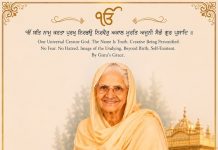
Our beloved mother left for her heavenly abode, peacefully on 31st March, 2022. She will be deeply missed & forever remembered by all her loved ones.
Children / Spouses: Surindar Kaur & Darshan Singh Bains Late Harjeet Kaur & Late Harpajan Singh Manjeet Singh & Harbans Kaur Late Gurmeet Singh & Sharan Kaur Late Sarjeet Singh Sharanjeet Kaur & Late Ravindra Singh
Will also be missed by Grandchildren, Great Grandchildren, Relatives & Friends
Saskaar / Cremation: 12pm, 2 April 2022 (Saturday) at Nirvana Memorial Park, Shah Alam, Taman Perkuburan, Jalan Pusaka 21/1, 40300 Shah Alam.
Cortège leaves from No 19, JLN SP 4/15, 42610, Bandar Saujana Putra at 11am
Path da Bhog: 9 April 2022 (Saturday), 10am – 12 pm, at Gurdwara Sahib Petaling Jaya. Programme: Kirtan Katha (10am onwards), Ardas: 12 noon, followed by Guru ka Langgar.
Contact:
Manjeet : 016-7812997
Nisha : 012 4017079
Harveen : 012-7029701
| Entry: 1 April 2022 | Source: Family
ASIA SAMACHAR is an online newspaper for Sikhs / Punjabis in Southeast Asia and beyond.Facebook | WhatsApp +6017-335-1399 | Email: asia.samachar@gmail.com | Twitter | Instagram | Obituary announcements, click here |
Chandigarh: Entrance from Zirakpur, photo taken 2008 – Photo: Ashwani Verma / Flickr
By Prabhjot Paul Singh | Panjab Politics |
On November 1, 1966, when Chandigarh was carved out of Punjab as a Union Territory, Dr MS Randhawa, ICS, was appointed its first Chief Commissioner. Since then, Chandigarh has grown from “a city of greying beards and green hedges” to a throbbing millennial mini-India, while remaining mired in various controversies.
Unlike major Punjab cities, the Union Territory has a large population of migrants from far off places, including Tamil Nadu, Kerala, Uttar Pradesh, Bihar, Uttarakhand, Manipur, Nagaland, and Jharkhand that has assimilated into a multiethnic and multicultural community making it unique in more than one way.
Built as a planned city and capital of Punjab, it has been gradually inching to clinch its own special identity. Supported by the Central Government with lavish funding since 1966 and the unfortunate diminishing interest of parent States of Punjab and Haryana, this adopted territory stands alienated from its motherland.
Developed as a City of Excellence with top of the shelf facilities like open green spaces, wide roads, storm water drainage system, it soon grew to an educational and top-class health care hub with the coming up of institutions.
Less than one third of the normal size of a district in Punjab or Haryana, Chandigarh now boasts of institutions that provide world class education in health, engineering, architecture, law, pharmacy, home care and art. It has exclusive sports stadia for cricket, hockey, tennis, football, skating, indoor sports, and water sports. It has one the highest ratio of tennis courts to population, an extremely popular Golf Club, and a golf range besides several swimming pools, including centrally heated pools.
Besides Zakir Hussain Rose Garden, Chandigarh has the distinction of having plant specific gardens, like Bougainvillea Garden, in addition to an exclusive Japanese garden, a topiary park, a bird sanctuary and two Botanical gardens. Sukhna Lake and Rock Garden make it a major tourist attraction.
It does not have much industry but still it is a top production centre for steel furniture, sanitary fittings, pharmaceuticals, and needles. It had investment from world leaders in pharmacy (Pfizer) and needles (Goetz & Beckett). The Chandigarh Administration, in its wisdom, decided to put a full stop before further growth of industry and allowed change of land use making room for multiplexes, malls, and hotels to come up in place of existing industrial units like Pfizer.
It is the misfortune of the Union Territory that continuity was a glaring missing link that followed the change of administrative head. Ambitious projects like captive power generation – Chandigarh does not have a source of power generation – building of Nehru Centre for Performing Arts, construction of elevated road from the PGI to the Transport Chowk, flyover over The Tribune inter section, Mass Rapid Transport System, and building of Chandigarh Trade Fair ground on the lines of Pragati Maidan never progressed beyond paperwork. Huge amounts were spent on consultancies and feasibility reports. Money was spent lavishly on holding foundation stone laying ceremonies of Nehru Centre for Performing Arts and the Chandigarh Trade Fair ground, but no one was ever held accountable for these languishing projects.
These aspects apart, Chandigarh has always remained a bone of contention between Punjab and Haryana, both claiming their rights over its control. When the 1966 Reorganization Act was implemented, Chandigarh was declared a Union Territory as a stop gap arrangement so that Haryana could build its own new capital. It was to be transferred to Punjab. However, claims and counter claims continued with the Centre playing the role of a clever monkey in a fight between two cats.
The Reorganization Act mandated that Union Territory of Chandigarh would be run by employees drawn from Punjab and Haryana in the 60:40 ratio. Since it was a small territory, it had a Chief Commissioner as its administrative head followed by Home Secretary, Finance Secretary, Chief Engineer, Chief Architect, an Inspector-General of Police (of the rank of a Deputy Inspector-General) and a Superintendent of Police. These posts were equitably divided between Punjab and Haryana.
All employees, from top to bottom, used to be drawn from the “partner” states. The system continued to work well till about late 80s and early 90s when on the command of the Centre, the Union Territory of Chandigarh started recruiting people directly by gradually cutting down the share of both Punjab and Haryana. Since the protests from Punjab and Haryana were meek, the move picked pace. A stage was reached when the number of employees on deputation was reduced to almost nothing. Most of the positions, from bottom to top, are now filled with UT cadre employees except for a few top bureaucratic slots like Home Secretary, Finance Secretary and Deputy Commissioner.
Even before the “centralization” of the Chandigarh Administration started, the rehabilitation of migrant workers scheme was given a boost by offering tenements to jhuggi dwellers. Thousands of migrant workers, given these tenements, started making capital out of it as they would sell their dwellings at a huge profit and move back to jhuggis to stake claims for new units in future colonies.
Punjab was caught in a vicious fight against terrorism. It was during this period that the Governor of Punjab was appointed Administrator of Chandigarh and the post of the Chief Commissioner was changed to Adviser to the Administrator. Mr. Krishna Banarji, who was till then Chief Commissioner, became the first Adviser to the Administrator of Chandigarh.
In 1985, when the Rajeev Gandhi-Sant Harchand Singh Longowal agreement was signed, hopes were raised that the decision to transfer Chandigarh to Punjab on January 26, 1986, would finally be implemented. Punjab Government led by then Chief Minister Surjit Singh Barnala drew all plans for the smooth transfer of Chandigarh.
A senior bureaucrat Inderjit Singh Bindra was named Administrator of Chandigarh. Invitations were sent out for the formal ceremony that was to take place as a part of the Republic Day celebrations. However, on the night of January 25, the decision was put on hold. Once again, there was a little hue and cry in Punjab political circles. No sincere or concerted effort was made thereafter to get the Rajeev-Longowal agreement implemented.
It was Darshan Singh Pheruman, who led a breakaway group of Shiromani Akali Dal, who started fast unto death to demand immediate merger of Chandigarh with Punjab. His fast continued till his death but nothing moved either the Centre or the then Punjab political leadership. His sacrifice remains unacknowledged by the Punjab government.
Several significant decisions taken in recent months by the NDA government at the Centre were a clear indication that transfer of Chandigarh to Punjab was nowhere under its consideration. Intriguingly, on eve of the Punjab Assembly elections in February, speculations were afloat that the Prime Minister Narendra Modi during his pre-election rallies in Punjab may announce transfer of Chandigarh to this border State. For many, writing on the wall was obvious. Changing the structure of the Management of the Bhakra Beas Management Board (BBMB) was an indication of the Centre Government’s thinking. And if that was not enough, the union home minister during his last visit to Chandigarh, announced a major policy decision of bringing Union Territory of Chandigarh employees under the central Civil Service rules thus putting to an end to the continuation of Punjab Civil Service rules. While the decision was overwhelmingly welcomed by employees in general as the retirement age now goes up from 58 to 60 and they also get other benefits, including extended maternity leave for women employees, Punjab units of a couple of political parties, including the ruling Aam Aadmi Party (AAP), have not only assailed the move the NDA government at the Centre but also announced to fight it tooth and nail to save the rights of Punjab.
Prabhjot Singh is a veteran journalist with over three decades of experience covering a wide spectrum of subjects and stories. He has covered Punjab and Sikh affairs for more than three decades besides covering seven Olympics and several major sporting events and hosting TV shows. For more in-depth analysis please visit probingeye.com or follow him on Twitter.com/probingeye
ASIA SAMACHAR is an online newspaper for Sikhs / Punjabis in Southeast Asia and beyond.Facebook | WhatsApp +6017-335-1399 | Email: editor@asiasamachar.com | Twitter | Instagram | Obituary announcements, click here