
















UA-56202873-1
Page 331

Something very different this Vaisakhi

2


By Hb Singh and Kawal Jeet Kaur | Vaisakhi 2022 |

Sikh groups in Malaysia, Singapore and Britain are celebrating Vaisakhi 2022 on two counts: the creation of the Khalsa and the birthday of Guru Nanak.

Now, everyone is familiar with the former. Most Sikhs would have heard of the story of Guru Gobind Singh, the 10th Sikh Guru, establishing the Khalsa Brotherhood in 1699. This historic event took place in the month of Vaisakh (which corresponds to the month April in the Gregorian calendar).

But the second count – celebrating Guru Nanak’s birthday in this time of the year – is something new and probably alien to many Sikhs. The birthday of the first Sikh Guru has usually been celebrated with pomp and splendour in the month of Kathik (sometime in October or November).

“The evidence before us tells us that Guru Nanak was born in the month of Vaisakh. The time has come for us to acknowledge that fact,” a key organiser of the Malaysian leg of the event told Asia Samachar. “We want to draw the attention of fellow Sikhs to the fact that Guru Gobind Singh had unveiled the Khalsa on Guru Nanak’s birthday.”

In Singapore, the group will be holding a prayer event at the Silat Road Gurdwara on April 15 (more details below). In Malaysia and Britain, two separate groups are celebrating it on April 16. It is understood that some gurdwaras in India and other countries will also be celebrating Guru Nanak’s birthday in conjunction with this year’s Vaisakhi celebration.

“A few of our friends have decided to celebrate it with Sukhmani Sahib ji prayers at Silat Road Gurudwara from 2pm to 4pm. We invite you to join in and participate in this auspicious occasion,” read an invite sent out by the Singapore organisers.

The new injection to the Vaisakhi celebration will surely thrust Sikhs to understand better the connection between Guru Nanak’s birthday (gurpurab) and the establishment of the Khalsa (Khalsa Sirjina).

Five of the six popular janam sakhis point to a Vaisakh birth date for Guru Nanak, with the exception of the Bhai Bala janam sakhi which points to a Kathik birth.

SEE ALSO: Explainer: Guru Nanak’s birthday [6 Questions You May Have On Your Mind]

SEE ALSO: From Frankfurt to Tampa, Vaisakhi anew

At the same time, seven prominent Sikh and non-Sikh writers have argued that Guru Nanak was born in Vaisakh. They include historian Karam Singh, Sikh scholar and scholar and encyclopaedist Bhai Kahn Singh Nabha (author of Mahan Kosh), Prof Sahib Singh (author of Sri Guru Granth Darpan or the Punjabi translation of Sri Guru Granth Sahib) and M.A. Macauliffe (author of the The Sikh Religion, Vol 1-VI).

In his well-researched book Katak Kay Vesakh (ਕੱਤਕ ਕਿ ਵਿਸਾਖ), historian Karam Singh (1884-1930) had concluded that Guru Nanak’s birth date was in Vaisakh, blaming the Bhai Bala janamsakhi for the Kathik fiasco.

In the recent past, steps to remedy the anomaly began with the implementation of the Mool Nanakshahi calendar.

The Mool Nanakshahi calendar was first introduced by Sikh schol­ars and the Shi­ro­mani Gur­d­wara Parbandhak Com­mit­tee (SGPC) in 1999, on the 300th an­niver­sary of the Khal­sa. It was adopted by the Akal Takht on the premise that it was histor­i­cally and sci­en­tif­i­cally accurate and conformed to the Gurbani.

On 14 April, 2003, the SGPC implemented and launched copies of the Mool Nanakshahi calendar from Takhat Sri Damdama Sahib on the occasion of Vaisakhi, in the presence of a large community gathering. At that time, SGPC was headed by Prof Kirpal Singh Badungar and Giani Joginder Singh Vedanti was the Akhal Takht jathedar.

FOR MORE STORIES ON GURU NANAK’S BIRTHDAY, CLICK HERE

The new calendar was a significant departure from the lunar-based Bikrami calendar. The dates on the 2003 Mool Nanakshahi calendar were based on the fixed solar calendar system, with the exception of three dates, which were reverted back to lunar Bikrami dates, due to cultural and political concerns. These were Guru Nanak’s birthday, Bandi Chhor Divas and Holla Mahalla.

These three dates were eventually synchronised to the solar calendar system in 2017, at the Chicago Mool Nanakshahi Cal­en­dar Implementation Con­fer­ence. At the conference, the Bikrami lunar calendar was discarded entirely from the Mool Nanakshahi calendar and all the dates which were variable from year to year under the Bikrami system, were fixed and synchronised in accordance with the solar calendar system. This included the Gurpurab of Guru Nanak on April 14.

The 2017 Mool Nanakshahi calendar continues to gather support across the world as Sikhs yearn to follow fixed dates which are an accurate representation of Sikh history.

EVENTS UNDER NOTE:

Punjab: 14 April 2022 (Thursday), 10am-2pm, at Kendri Sri Guru Singh Sabha, Chandigarh

Germany: 14 April at Gurudwara Sikh Center in Höchst, Frankfurt

USA: 14 April 2022 at Wheaton Gurdwara Sahib in Wheaton, Illinois

Singapore: 15 April 2022 (Friday), 2pm-4pm, at Silat Road Sikh Gurudwara

Malaysia: 16 April 2022 (Saturday), 6.45pm-9pm, at Gurdwara Sahib Parliament, Kuala Lumpur

Britain: 16 April 2022 (Saturday), 6pm-8pm, at St Andrew’s Church, Ilford

USA: 17 April, 2022 (Sunday), 9am to 2pm, at Tampa Gurdwara (USREF), Thonotosassa, Florida, US

(Do you know of another such event? Do send us an email or Whatsapp to be included)


RELATED STORY:

Adopt Mool Nanakshahi Calendar, stop confusion, says Sikh Chicago meet – WSN (Asia Samachar, 7 Dec 2017)


ASIA SAMACHAR is an online newspaper for Sikhs / Punjabis in Southeast Asia and beyond.Facebook | WhatsApp +6017-335-1399 | Email: asia.samachar@gmail.com | Twitter | Instagram | Obituary announcements, click here 
Experience: Autism Is Taboo In Our Culture. Our Daughter’s Diagnosis Made Us Face It.


By Baljit Ghuman | HuffPost | United States |

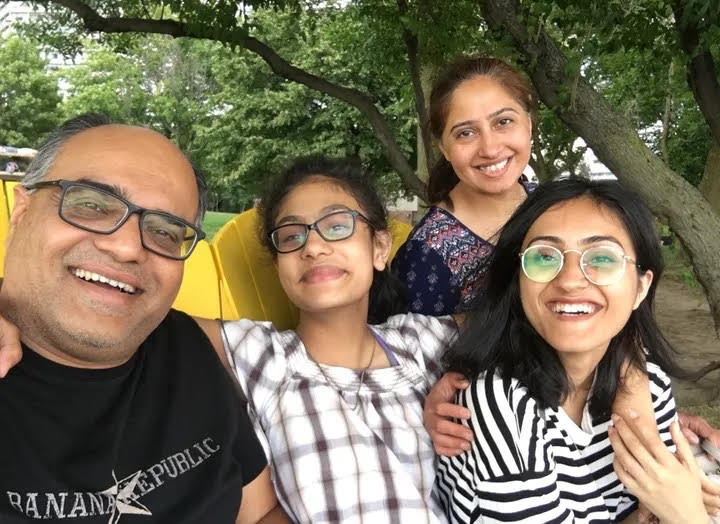
For a long time, our daughter’s lack of understanding about personal space caused my wife and I extreme anxiety. Her apparent tantrums at malls and family gatherings made it difficult for us to go out into public. We became accustomed to receiving judgmental stares from other parents. My wife remembers parents yelling at her when our daughter veered too close to their kids or acted pushy on the playground. The best she could do is apologize and leave the park as soon as she could.

I admit, I did not take our daughter’s outbursts very well. But my wife is the stronger one — she never once gave up on taking my daughter into the public, and through her resilient efforts we began to see improvements in her social interactions.

Around 2014, at the urging of staff at our daughter’s school, we sought help from the medical community to help identify our daughter’s behaviour. In a Mississauga hospital room, a group of experts diagnosed our daughter with Autism Spectrum Syndrome (ASD) and Attention Deficit Hyperactivity Disorder (ADHD). Unaware of the discussion, our tall and beautiful seven-year-old daughter continued to play with toys in the children’s area, as the medical professionals eyed us, possibly trying to read our reactions.

My wife and I bottled our emotions and blankly nodded in agreement with the diagnosis. We made it clear that we did not plan to put our daughter on any ADHD medications, as her school’s administrators had suggested; the doctor was on board. But inside, our hearts were breaking. We silently prepared for the fact that our child’s diagnosis could mean a lifetime of struggle. A new source of anxiety welled up: how would we navigate our South Asian community as parents of a special-needs child?

Our community in Ontario’s Peel Region is demographically Punjabi Sikh. Disability is a taboo topic not openly discussed in our culture, often linked to feelings of shame. There is a lack of awareness around autism, mental health and disabilities. Many elders in our community would explain away our daughter’s behaviour as the product of “bad parenting” or being “spoiled;” others would simply deny that our daughter’s condition exists. I had little success explaining her medical condition to them, and was frustrated by their misplaced pity. As parents, it made us feel helpless and isolated.

Guided by the founding principle of the Sikh faith — “seva,” or selfless service — we were inspired to bring the rest of our community into the conversation. In April 2019, we launched the Sikhs for Autism awareness campaign on social and local ethnic media. Sikh parents of special-needs children started reaching out, surprised and thankful to hear the topic of autism discussed in their native language. I could hear the relief in their voices. As a parent of an autistic child I know what they felt: a sense of validation, an acknowledgement that they are not alone, and hope that their children will be accepted for who they are.

Read the full story, ‘Autism Is Taboo In Our Culture. Our Daughter’s Diagnosis Made Us Face It’ (HuffPost, 29 Jan 2021), here.


RELATED STORY:

At 15, Heeren Kaur Gill knew psychology was her thing (Asia Samachar, 12 Jan 2022)


ASIA SAMACHAR is an online newspaper for Sikhs / Punjabis in Southeast Asia and beyond.Facebook | WhatsApp +6017-335-1399 | Email: asia.samachar@gmail.com | Twitter | Instagram | Obituary announcements, click here 

RM650k in 4 years. Sikh Welfare Society Malaysia intends to ramp up financial aid


Harbans Singh Gill Kaleke

By Asia Samachar | Malaysia |

Sikh Welfare Society Malaysia (SWSM) had given just over RM650,000 in financial aid to need Sikh families in the last four years. This averaged out to slightly more than RM160,000 annually.

The actual breakdown, according to details provided by the society, was as follows: RM146,700 in 2018, RM181,901 in 2019, RM195,450 in 2020 and RM128,150 in 2021.

Among others, the society runs the “Adopt A Family” scheme. Here, the society shares details of needy families with potential donors who can adopt them for one or two years. It can also involve additional assistance such as providing guidance to children’s education and school uniforms.

“This way, you know exactly where your donation is going and how it is used,” SWSM president Harbans Singh Gill Kaleke told Asia Samachar.

Harbans assumed the role, taking over from Tarlochan Singh Dhaliwal, at SWSM’s 40th annual general meeting (AGM) on Feb 27. Harbans, who joined the society as a committee member in 1988, had previously served as the honorary secretary (1998 to 2001) and president (2001 to 2014).

The society welcomes assistance in the form of donations, contributions or adopting a needy Sikh family. Membership fee is RM250 plus a donation of RM250 (total RM500). Email tjgill62@gmail.com or Whatsapp (+60 13 330 1011) to request for a membership form. Official receipts are issued for all payments.

The society’s bank account details are as follows – Account Name: Sikh Welfare Society Malaysia; Bank Name: CIMB Bank; Account No: 8001216563.

SWSM OFFICE BEARERS FOR 2022 / 2024

President: Harbans Singh Gill Kaleke (+60 13 330 1011)

Vice President: Balvinder Kaur (+60 12 200 6008)

Secretary: Aman Singh (+60 12 200 6008)

Assistant Secretary: Achhinda Singh (+60 19 228 9579)

Treasurer: Ravinder Singh Gill (+60 19 231 8997)

Committee Members:

Hardip Kaur (+60 16 204 0336)

Sukhdev Singh (+60 19 319 6939)

Tara Singh (+60 13 353 8822)

Santokh Singh (+60 12 666 1422)

Mahinder Kaur (+60 16 680 8370)


RELATED STORY:

Sikh welfare society low on funds, now assisting 58 families (Asia Samachar, 18 Aug 2021)


ASIA SAMACHAR is an online newspaper for Sikhs / Punjabis in Southeast Asia and beyond.Facebook | WhatsApp +6017-335-1399 | Email: asia.samachar@gmail.com | Twitter | Instagram | Obituary announcements, click here 
Living in the ‘real’ world: Some personal reflections

0

By Manjit Kaur (UK) | OPINION |

Have you ever been told to ‘get real’ or asked ‘which world are you living in?’ These phrases are used when someone feels that you are failing to face up to the ‘reality’ of a situation. Whilst in casual conversation, facing reality may just be about taking responsibility, in truth, defining reality is not an easy task. Within most Indian religious traditions, reality is defined in terms of the concept of ‘dharma‘. Simply speaking, dharma means ‘path’, a way of life, or the natural order of things as set down in ancient texts. In western traditions, reality is related to the world as we perceive it, and how this is represented in the human mind.

So where does Sikhi stand in terms of ‘reality’? According to the teachings of Guru Nanak, there is a physical reality that is governed by the laws of nature, which is called Sargun (visible or seen) and a reality that is beyond material existence, which is Nirgun (invisible or unseen). In Sikhi, both are real. Indeed, Gurbani clearly states that being born into human form or manukhi jeevan, one has the opportunity to become one with Akaal Purakh or the universal formless divine power in this world.

To succeed in this mission, there are some clear instructions. One of these is doing ‘nishkaam seva‘ or selfless service. This is easier said than done, especially in today’s world where we are only concerned about our needs and material things. If that wasn’t challenging enough, Guru Nanak focuses on the importance of serving in the ‘real world’. “By serving in this world, you shall be given a place of honour in the Court of the divine”. (Guru Granth Sahib, p24). The Guru also states that the greatest ‘seva‘ is to serve the Guru.

The next question is, how can one serve the Guru? The answer that Guru Nanak gives is, that to serve the world (duneya) is to serve the Guru! The air, the water and the land are, according to Guru Nanak, your ‘Guru’, your ‘father’ and your ‘mother’. By emphasising the importance of serving in the world, Guru Nanak offers a much deeper concept of seva. Whilst service in the Gurdwara, such as making and serving langar, offering donations, cleaning, performing prayers and kirtan is important, serving in the world can involve many other things. Indeed, one can see the idea of ‘serving in the world’ as an invitation to focus on one’s wider responsibility to humanity.

This then has led me to think about several questions, such as, how should I live as a human being? What does it mean to serve humanity? And, perhaps, most importantly, what does it mean to truly live in the ‘real’ world?

There are no easy answers to these questions and in some senses, we will all need to find the answer for ourselves. Here are some brief reflections from my journey toward living in the real world; you may or may not find these helpful as you walk your path in life.

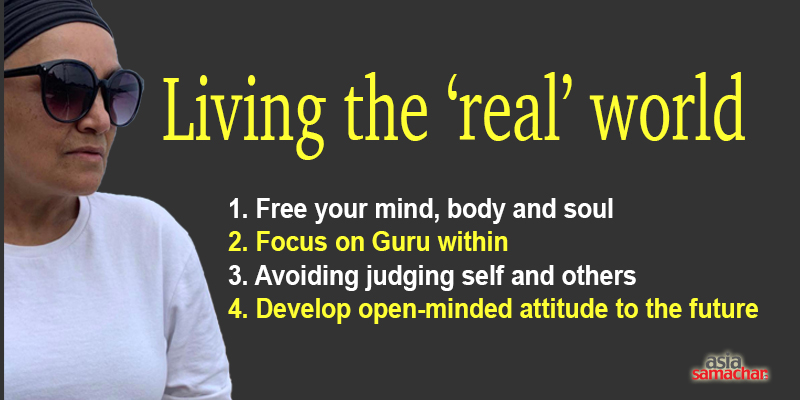
1: Free your mind, body and soul: Living in the real world means having a free spirit and this is not possible without a free mind. And without a free mind, you can not have a free or healthy body; all these things are connected. If we are not free to think, then I believe our spirit will be imprisoned. So the question arises, what do we need to free ourselves from? In this regard, I think there are three things that Gurmat advises. One is that we need to free ourselves from ‘agiaanta‘ (ignorance or lack of knowledge), which leads to superstition and irrational beliefs, an over-reliance on materialism, and most importantly egotism.

2: Focus on the Guru within: To become free from the ego or the five thieves of lust, greed, pride, attachment and anger, we need the help of the Guru, and that means realising the Guru is within every one of us. Living in the real world means seeing the Guru everywhere and everpresent. And when we do this we will not see Sikhi as a performance and will avoid behaving as ‘Sunday Sikhs’. It is important to attend Gurdwara because this helps you to remain connected to the sangat and to become spiritually charged. Nothing can be more blissful than listening to Kirtan in the Sangat and wearing traditional Sikhi bana, but our Sikhi needs to be 24/7, at home, at play, at work, in the community and everywhere else. If we truly believe in the Guru then we will reject false idols and rituals and with the help of our Guru, we will take charge of our lives. As Gurbani says, “it is with our own hands that we can resolve the challenges we face in life”

3: Avoiding judging self and others: When we harshly criticise others or ourselves we may think we are being powerful but in truth, it is a sign of weakness. Being judgemental means you haven’t worked hard on yourself to learn about the importance of self-love, self-control and kindness. Often criticism of others is simply a projection of our inner negativity or inability to deal with our problems, so we put these onto others. Sikhi demands that we should not judge others, but sadly, my experience, especially of some Amritdhari Sikhs, is that they can be highly judgemental about such things as race, caste, and gender. Whilst it is important for us all to dress in a dignified way, I do think we should stop judging women who may choose to dress as they wish. I am not talking about women revealing their bodies, but simply wanting to express their personality in a certain way. I believe that ancient Islamic influences about the requirement for women to cover their entire bodies are still very strong within Panjabi culture, even though our Gurus advocated women’s empowerment.

4: Develop an open-minded attitude to the future: Though we are all influenced by the generation in which we live our lives, in reality, culture, society and the world are constantly changing. Because of the development of technology, media, and the ongoing mix of people, social norms are changing. Just look, for example, at attitudes towards marriage, which have changed to the extent that nowadays children are making their own choices in finding their partners, and their parents are required to understand their feelings and wishes; this was not the norm when I was growing up. Indeed, attitudes towards traditional beliefs and rules have also dramatically changed, and most people have much more liberal attitudes. But sadly, whilst people generally have become much more tolerant towards each other, I do find amongst some Amritdhari Sikhs, especially those who associate with groups, jathas and deras, to be quite rigid. It is as if they fear by mixing with others they will lose their Sikhi. Some even think of other Sikhs, who may have different views on Sikhi, as ‘weak’ or ‘bad Sikhs’. In this regard, I say we Sikhs can become our own worst enemies, but if we are truly to call ourselves the followers of Guru Nanak, then we must embrace humanity and embrace the future and stop judging.

Living in the real world can sometimes feel like being on a fast roller coaster. Today, because of so much technology, the world is changing before our very eyes. All change is not good, but generally, we have to go with the flow, but that does not mean abandoning the Guru or Sikhi, but it does mean adapting and using the Guru’s message as a guide to navigate and overcome the many challenges that the real world poses. Some of those challenges are ones that every generation has had to face, but others are completely new, which means at times letting go and taking risks. But in the end, we don’t have a choice but to learn to live in the real world; there are no hiding places! But don’t forget, wherever you go the Guru is there to guide you, but only if you realise this to be true.

Manjit Kaur, a UK-based therapist and counsellor, is a presenter of the 1 Show on Akaal Channel. She can be contacted via email at manjitkaur1show@gmail.com

RELATED STORY:

Who is the real enemy of the Sikhs? (Asia Samachar, 19 Sept 2021)

ASIA SAMACHAR is an online newspaper for Sikhs / Punjabis in Southeast Asia and beyond.Facebook | WhatsApp +6017-335-1399 | Email: editor@asiasamachar.com | Twitter | Instagram | Obituary announcements, click here |

High Court declares Klang-born Nalvin Dhillon a Malaysian citizen

The High Court today (5 April) declared that 24-year-old Nalvin Dhillon — who was born to a Malaysian father and Filipino mother — a Malaysian citizen under the country’s Federal Constitution as he was not born a citizen of any other country, finally putting an end to years of being stateless.

Nalvin, who is due to turn 25 in June, had been trying together with his biological father since December 2009 or slightly more than 13 years ago to have himself recognised as Malaysian.

The decision was delivered by High Court judge Datuk Wan Ahmad Farid Wan Salleh to recognise the boy from Klang as Malaysian.

“The plaintiff has fulfilled the condition precedents of Section 1(e) of Part II of the Second Schedule of the Federal Constitution. Once this is established, the law is that citizenship by operation of law is almost automatic. It is a matter of birthright.

“For the aforesaid reasons, I am making a declaration that the plaintiff is a Malaysian citizen by operation of law under Article 14(1)(b) of the FC read together with Section 1(e) of Part II of the Second Schedule of the FC.

“As a consequential order, the defendants are directed to issue a MyKad to the plaintiff within 21 days from the date of this order,” Wan Ahmad Farid said while delivering his decision through video-conferencing.

The Federal Constitution’s Article 14(1)(b) provides that every person born on or after Malaysia Day and fulfilling any of the conditions in Part II of the Second Schedule is a citizen by operation of law — or automatically entitled under the law to Malaysian citizenship.

Section 1(e) is the condition where the person born within Malaysia is not born a citizen of any country.

Read the full story, ‘After years of being stateless, High Court recognises Klang-born man with Malaysian-Filipino parents as citizen’ (The Malay Mail, 5 April 2022), here.

RELATED STORY:

(Asia Samachar, xx 2022)


ASIA SAMACHAR is an online newspaper for Sikhs / Punjabis in Southeast Asia and beyond.Facebook | WhatsApp +6017-335-1399 | Email: asia.samachar@gmail.com | Twitter | Instagram | Obituary announcements, click here 

In Loving Memory: Mata Punjab Kaur (1930-2021), Sentul

FIRST YEAR BARSI

MATA PUNJAB KAUR D/O LATE RAM SINGH

Wife of Late Mr. Sampuran Singh Johal (Formerly Ministry of Education and Former Secretary of Wadda Gurdwara Sahib Jalan Kampung Pandan, Kuala Lumpur)

Children / Spouses:
Gurdeep Singh
Gurmeet Singh / Amarjeet Kaur
Kuldeep Kaur
Jagjeet Kaur / Gurdit Singh
Charanjeet Singh

Grandchildren:
Nashvinder Singh
Hasvinder Singh
Satvinder Singh

Also missed by Sisters, Sisters-in-Law, Brothers-in-Law and a host of Relatives.

Akhand Path: 29 April 2022 to 1 May 2022 at Wadda Gurdwara Sahib Jalan Kampong Pandan, Kuala Lumpur. Guru-ka-Langgar will be served on all three days.

Please treat this as a personal invitation. We humbly request that everyone fully comply with the Covid-19 SOP ‘s at all times.

Contact:

Gurdeep Singh 012-6850712

Gurmeet Singh 013-2964921


| Entry: 5 April 2022 | Source: Family


ASIA SAMACHAR is an online newspaper for Sikhs / Punjabis in Southeast Asia and beyond.Facebook | WhatsApp +6017-335-1399 | Email: asia.samachar@gmail.com | Twitter | Instagram | Obituary announcements, click here |

Mata Sarjit Kaur (1946-2022), Puchong

MATA SARJIT KAUR @ BANSA D/O HARI SINGH

daughter of Late Hari Singh and Harnam Kaur Gill (Cameron Highlands)
daughter-in-law of Late Palla Singh and Mohinder Kaur

19.6.1946 – 29.3.2022

Forever remembered by family, friend, and especially by

Husband: Sardar Ballebir Singh Sidhraha

Children:
Surinder Pal Singh (Larissa Kaur)
Ravinder Kaur
Manmohan Kaur (Late Muthurakan)
Harvinder Pal Singh

Grandchildren:
Charanpreet
Reena
Mahinder Pal
Satish
Sheelan
Pawanpreet

Path da Bhog: 10th April 2022 (Sunday), from 10am – 12pm, at Gurdwara Sahib Puchong (No. 5473A, Lebuh Puteri, Bandar Puteri, 47100 Puchong, Selangor). Guru ka Langar will be served.

Contact:

Ballebir Singh +60111-6888026

Bachan Kaur @ Bachani +6016-2742804

Jasbir Kaur (Guddi) +6019-2385617

The family express their heartfelt thanks to all relatives and friends for their support during the recent bereavement.


| Entry: 5 April 2022 | Source: Family


ASIA SAMACHAR is an online newspaper for Sikhs / Punjabis in Southeast Asia and beyond.Facebook | WhatsApp +6017-335-1399 | Email: asia.samachar@gmail.com | Twitter | Instagram | Obituary announcements, click here |

Pakistani-American vocalist Arooj Aftab lands a Grammy, thanks to Mohabbat


Arooj Aftab – Photo: Mengwen Cao / NPR

By Asia Samachar | United States |

Pakistani-American singer and composer Arooj Aftab landed the Best Global Performance category award at her first Grammy on Sunday (3 April). This makes the Brooklyn-based vocalist the first Pakistani to win a Grammy.

She won the prestigious trophy for her song “Mohabbat“, one of the songs in third album Vulture Prince. She was also nominated for the much coveted Best New Artist prize.

The 37-year-old — who has lived in New York for some 15 years — has been steadily gaining global attention for her work that fuses ancient Sufi traditions with inflections of folk, jazz and minimalism, reports AFP.

The first-time Grammy nominee is truly global in her life. Aftab was born to Pakistani parents in Saudi Arabia. The family returned to Lahore, the capital of the Pakistani province of Punjab, when she was 10 years-old. It is here that she spent her teens. The next move was to the U.S. to study music production and engineering at Berklee School of Music. She has lived in New York for the past 15 years.

Aftab’s heritage and penchant for mysticism come through in her music, which is rooted in the ancient Sufi tradition made famous by poets like Rumi, reports NPR in the run-up to the grammy award. Sufi music is traditionally thought of as devotional and repetitive, allowing humans to connect with a higher power. Aftab’s definition is looser. “To me, what characterizes Sufi music is minimalism and cyclical motifs in the songs, in the writing of the song structure,” she told NPR. “Anything that evokes a sense of peace, even if it’s very fast paced.”

For Aftab, it isn’t just the sound of the music that qualifies it as Sufi, it’s what it does to you and where it takes you. She has spent more than a decade digesting some of the ancient poetry that is featured in her music, the same report added.

“It takes that long, really, to sit with poetry that is that old and understand it and absorb it like proper osmosis, and really feel it in your own body,” she says. “Pakistanis, on a cultural level, are never without music, never without poetry, never without some form of art or dance,” she says.


RELATED STORY:

Tu Jhoom: Pakistani duo strikes deep in the heart (Asia Samachar, 17 Jan2022)


ASIA SAMACHAR is an online newspaper for Sikhs / Punjabis in Southeast Asia and beyond.Facebook | WhatsApp +6017-335-1399 | Email: asia.samachar@gmail.com | Twitter | Instagram | Obituary announcements, click here 

Roots: Singapore NRIC belonging to late Justice Choor Singh

Singapore NRIC belonging to the late Justice Choor Singh (1948) – Source: Collection of Indian Heritage Centre; Gift of the family of Justice Choor Singh

By Roots | Singapore |

Choor Singh was the first Indian to hold the position of Magistrate in Colonial Malaya, and was appointed as a judge of the Supreme Court of Singapore in 1963. Apart from an illustrious legal career, he made significant contributions to the Sikh community in Singapore. He was one of the founders of the Singapore Khalsa Association, and advocated the teaching of Punjabi in Singapore as the Chairman of the Sikh Advisory Board. He also authored several books on the Sikh religion and the Sikh community in Singapore.

(Click here for original source. The Roots website has been established by Singapore’s National Heritage Board strives to preserve and catalogue the elements of that unique inheritance, and to present them to the public in an engaging and accessible format.)

RELATED STORY:

Choor Singh – Diligent and distinguished (Asia Samachar, 3 June 2016)

ASIA SAMACHAR is an online newspaper for Sikhs / Punjabis in Southeast Asia and beyond.Facebook | WhatsApp +6017-335-1399 | Email: editor@asiasamachar.com | Twitter | Instagram | Obituary announcements, click here 

Kaldeep Singh Bal (Deepi), (1957-2022), Sentul

KALDEEP SINGH BAL (DEEPI)

12.10.1957 – 3.4.2022

Village: Batala

Wife: Madam Nanth Kaur Rai

Children / Spouses:
Sandeep Kaur Bal / Daljit Singh
Late Randeep Singh Bal
Govindeep Singh Bal (SG)

Grandchild: Davieen Sidhu

Saskaar / Cremation: 3pm, 4 April 2022 (Monday) at Jalan Loke Yew Crematorium, Kuala Lumpur

Last Respects can be paid at Gurdwara Sahib Sentul (Jalan Haji Salleh, Kuala Lumpur) from 10.30am to 1.30pm, or Jalan Loke Yew Crematorium from 1.30pm to 2.30pm

Contact:

Teeraj 017 – 622 2884

Sandeep 012 – 527 0161

Prithpal 012 – 932 7071

Kaldeep Singh Bal (Deepi) was a dedicated sewadar (volunteer) at Gurdwara Sahib Sentul. He will be dearly missed by family, relatives and friends.

| Entry: 3 April 2022 | Source: Family


ASIA SAMACHAR is an online newspaper for Sikhs / Punjabis in Southeast Asia and beyond.Facebook | WhatsApp +6017-335-1399 | Email: asia.samachar@gmail.com | Twitter | Instagram | Obituary announcements, click here |