The Singhs, one of India’s most-followed social media influencer families, have a total social media following of over 18 million.
By Yashraj Sharma | India |
It’s early in the morning and the Singh family piles into their SUV with pillows, blankets, toys, and snacks. The Singhs — mother and father Ramneek and Puneet, and their three preteen kids, Anaanya, Shanaya, and Siaan — have signed up for the “24 hours living in the car” challenge, and none of them can now leave the vehicle, not even for a loo break, for the next 24 hours.
They spend the day driving around Delhi, vlogging the whole way. As night falls, they park, put their seats back, and go to sleep. Until 3:30 a.m., when 6-year-old Siaan starts nagging to go to the toilet. They give up, a few hours short of their target. More than 3.4 million people watch them fail the challenge.
The Singhs are one of India’s most-followed social media influencer families. With six YouTube channels, five individual Instagram accounts, three Facebook pages, and two accounts on MX TakaTak, they have a total social media following of over 18 million. Their YouTube videos — which offer a peek into their day-to-day life, almost like Keeping Up with the Kardashians on a budget — have been watched over 8 billion times. Each week, the family produces 75 Reels and 35 video posts for Instagram, and 35 Shorts and 20 full-length videos for YouTube, featuring everything from short films and vlogs to dance videos. They have promotional deals with major brands and entertainment studios, even their own merchandise line.
The Singhs are at the forefront of an emerging trend on the Indian internet: family influencers. What started on TikTok, which is now banned in India, has moved to Instagram and YouTube, where relatives — brothers and sisters, mothers and daughters, and grandmothers and grandsons — are making content together. But behind the happy faces on social media, the reality of content creation involving families, and particularly children, can be complex and fraught with risk.
“When parents are the producers, the whole act is synonymous to sending your kid to school and saying, ‘score at least 80% or above,” Shriram Venkatraman, a digital anthropologist who has studied social media families, told Rest of World. “Now, on social media, these kids have to perform every evening. This is like sitting [for] an exam every day.”
Ramneek Singh was introduced to TikTok by a relative in January 2019. Ramneek, who had been running his family’s car dealership for around 20 years, was quickly hooked.
Read the full story, “Everything is content”: Inside the daily grind of one of India’s biggest influencer families (Rest Of World), 13 Jan 2022, here.
RELATED STORY:
(Asia Samachar, xx 2021)
ASIA SAMACHAR is an online newspaper for Sikhs / Punjabis in Southeast Asia and beyond.Facebook | WhatsApp +6017-335-1399 | Email: editor@asiasamachar.com | Twitter | Instagram | Obituary announcements, click here
Two-time SEA Games gold medallist Semret Singh, the Malaysian athlete who literally took over his father’s mantle, passed away today (15 Feb 2022). He was 66.
He was involved in the transportation business.
Semret won gold medals at Sea Games Bangkok (1985) and Kuala Lumpur (1989). In 1986, he broke the national record set by his father, Ghenda Singh. At the Police Games that year, he managed a throw of 51.644m, breaking his dad’s record of 44.14m that was set in 1966 in Ipoh.
Semret also bagged three silver medals in the 1981 edition (Manila), 1985 (Singapore) and 1987 (Jakarta).
“The cremation details will be announced soon. We are now awaiting for the arrival of some relatives form abroad,” his son Amarraj Singh told Asia Samachar. “For those wanting to pay their last respects, they can do so at the Loke Yew Crematorium, probably on Friday or Saturday.”
UPDATE: Last Respects: 2.30pm – 4.30pm, 18 Feb 2022 (Friday), at Jalan Loke Yew Crematorium, Kuala Lumpur. Saskaar / Cremation: 4.30pm.
Ghenda started competing in 1960 and retired after the 1977 KL Seap Games at the age of 55. A pectoral muscle tear did not stop him as he defied doctors’ orders to compete in the 1977 Games where he won the bronze medal. Ghenda passed away in 2011 at the age of 89.
The story as to how Semret got into the sports makes amazing reading. It happened after his father was forced to retire due to an injury, and looked at one of his four children and one daughter to take over.
Semret related the story in an article he shared with a sports portal. Here is the story:
One of my sweetest memories in athletics was setting a Malaysian record for the hammer throw at the 1981 Australian Spring Championship in Perth.
Not only did I set a new distance of 50.5 metres for this event which bettered my Pitaji (father) Genda Singh’s record, I also defeated Australia‘s Matt Barber, the defending champion. This came after my three-month training stint in Perth. All of a sudden, people started taking notice of this Malaysian athlete at the Perry Lake Stadium. One of them was a talent scout attached to a European athletics club.
After the many back-slapping and bear hugs from my competitors and spectators, this talent scout took me aside and made me an offer to turn professional with his club.
He then handed me several sheets of paper, which were supposed to be a contract, and asked me to take my time to read them and get back to him the following day.
As I browsed through it that night in my room, I was totally surprised by its contents. It was like a once in a lifetime offer and I found it too good to be true.
They were offering me a US$18,000 monthly salary, a Mercedes Benz (model was not mentioned), a bungalow, and the possibility of being a citizen of the country where the club was situated.
As for prize money winnings, and the personal sponsorship, they did not mention the quantum I will receive, but were open for discussion after I signed the contract.
However, there was one paragraph that caught my eye and I was uncomfortable with it. It was regarding medical and clinical services which read: “We will provide the best and you will not question us.”
And I had to agree to all these terms and conditions without any being deleted or for further discussion.
Ghenda Singh – Photo: Haresh Deol blog
As I stared at these words “medical and clinical services,” my thoughts took me back to November 27th, 1977 in my home in Ipoh with my Pitaji Genda Singh and how I ended up being involved in the hammer throw. My Pitaji, was the undisputed hammer throwing hero in our family and he had just returned after winning the bronze medal in the Kuala Lumpur SEA Games. He achieved this despite going against doctor’s advice as he was injured with a pectoral muscle tear.
All strapped with plasters on his chest, he called me and all my other siblings, brothers Kulwant Singh, Kaldip Singh, Manohor Singh, and Mahinderjit Singh and sister Persin Kaur together. He announced that this was his last competition internationally.
He then looked at us and said: “One of you will have to carry on where I left off.’’ It was more like an order, and he did not say which one of us.
There was silence among us siblings. We just looked at one another but no one said a word. As soon as we were out of earshot, all my siblings unanimously decided that I should be the chosen one. You have to carry on with the legacy as you are the eldest in the family.”A couple of days later after careful thought, I informed my Pitaji at lunchtime that I would continue where he left off. I was just 22 years of age and had never thrown a hammer as I was more a 400m runner.
My Pitaji beamed with delight and said: “Train with the right attitude and stay clean.”
My Pitaji’s words especially “stay clean” jolted me to the situation in Perth and the contract. So, when I met up with the talent scout I enquired:” ‘‘Does medical and clinical services mean I have to go on anabolic steroids?”
He was slient and I told him I cannot accept the offer although it was very tempting. He was surprised and never tried to change my mind.
As for me, the offer was too good to be true and I have had no regrets turning my back on a professional career. I continued to compete internationally until the 1989 SEA Games in Kuala Lumpur and thus fulfilling my Pitaji’s dream.
Malaysia’s King & Queen, Yang di-Pertuan Agong Al-Sultan Abdullah Ri’ayatuddin Al-Mustafa Billah Shah and the Raja Permaisuri Agong Tunku Azizah Aminah Maimunah Iskandariah, expressed their condolences in a message shared on the Istana Facebook page
ASIA SAMACHAR is an online newspaper for Sikhs / Punjabis in Southeast Asia and beyond.Facebook | WhatsApp +6017-335-1399 | Email: editor@asiasamachar.com | Twitter | Instagram | Obituary announcements, click here
Gurpreet Kaur Shergill is a Sydney-based car mechanic fixing cars and stereotypes. Source: Supplied by Ms Shergill
By Sumeet Kaur | SBS Punjabi | Australia |
Sydney-based Gurpreet Kaur Shergill is one of the very few female mechanics of Indian origin in Australia. Proud of her choice, she now hopes to inspire other women to break into the male-dominated trade.
At 31, Gurpreet proudly runs her own automotive workshop in Sydney’s South Windsor.
This mother of two assesses and diagnoses every car entering her workshop, handles client queries and organises parts.
“The road to becoming independent and running my own business has not been smooth,” Ms Shergill tells SBS Punjabi.
Coming from a conservative family where she was married at a very young age, this mum has chosen an unconventional career en route to self-discovery.
Hailing from Ballamgarh, a small village in Patiala, Punjab, Ms Shergill migrated to Australia with her husband in 2014 as an international student.
In pursuit of doing something different and finding her feet, she opted for an automotive career over more lucrative choices like nursing.
“I come from a conservative rural family where the fathers just want to marry away their daughters instead of educating them, so decades later when I got a chance to make a mark, I just grabbed it,”
“Luckily, I married into a progressive family, and my husband is very supportive and always gives me the freedom to make my own decisions,” she says.
Sharing her journey, Ms Shergill reflects on the gender and cultural barriers she overcame to run her own automotive shop.
Read the full story, ‘What spurred Gurpreet to challenge gender norms and become a mechanic’ (SBS Punjabi, 14 Feb 2022), here.
ASIA SAMACHAR is an online newspaper for Sikhs / Punjabis in Southeast Asia and beyond.Facebook | WhatsApp +6017-335-1399 | Email: editor@asiasamachar.com | Twitter | Instagram | Obituary announcements, click here
A palki inspired by Japanese design – Photo: Courtesy of Ishar Singh Mahinder Kaur Collection
By T Sher Singh | Opinion |
In homes that have the wherewithal, Sikh families strive to set aside a room for prayer, contemplation and meditation. In daily parlance, it is referred to as ‘Baba ji da Kamra”, literally, the room of divinity.
It usually contains only a handful of items, but I am overwhelmed by the layers and dimensions of the Sikh way of life they convey.
The focal point of it all is Guru Granth Sahib, our one and only Scripture. No wonder that many Persian scholars have referred to us as The People of The Book, even though the abrahamic faiths also lay claim to the moniker. For Sikhs, though, our scripture is not only The Word but our entire lives revolve around it. It is not merely a ‘Book’, for us it is our Teacher. Its contents represent the living embodiment of our Gurus.
Hence we treat it as a living presence. Given that, how would we behave if Guru Nanak was in our midst? We’d give him with the same deference as one does any royalty!
Which is exactly how we regard our Scripture. In accordance with that principle, we surround it with all the accoutrements associated with royalty. Not in worship but to convey respect and reverence. Think of how in our cultural tradition we bow before our parents, teachers and elders and touch their feet. That is why we bow (mattha tekna) before the Guru Granth Sahib.
Once we understand that, all other things in the room begin to have meaning. The palki is the throne … remember, royalty? The chandoa (canopy) that adorns the ceiling above the palki. The chhabba (jewellery) that hangs from it. The chaur (fly whisk). The rumalas (ornate fabrics) that adorn the physical Scripture.
The kirpan in the room is part of the royal presence. It is also symbolic of one of our primary terms for God (Waheguru) – Bhagauti, The Sword. That is, the sword of justice and compassion, the sword that cleaves truth from falsehood.
We bow in respect every time we enter this royal presence, and always sit facing it. (In a royal court, you’d never sit with your back towards the King, would you?) We sit cross-legged to ensure our feet are not pointing to the palki. We dress modestly and we keep our heads covered; we leave our shoes outside … Again, all for the same reason: we are in the presence of royalty!
The ultimate purpose of it all was to wean us away from idol worship: there could be no other higher or equal personage in the presence of a King and Emperor. All submit to his suzerainty. Hence, there was to be no place in a Sikh home for idols. Their absence was to remind us, inter alia, that we don’t worship Guru Granth Sahib, we learn from it. And then try to live by the teachings.
There is absolutely no ritual involved because there is a reason behind all that we do. We remember these reasons each time we enter. And we ensure that we convey them to our children.
T. Sher Singh is a writer, editor and publisher at sikhchic.com. The Sikh media portal, now undergoing a major overhaul to bring it up-to-date with the latest gadgets, aims to be up by Spring.
ASIA SAMACHAR is an online newspaper for Sikhs / Punjabis in Southeast Asia and beyond.Facebook | WhatsApp +6017-335-1399 | Email: editor@asiasamachar.com | Twitter | Instagram | Obituary announcements, click here
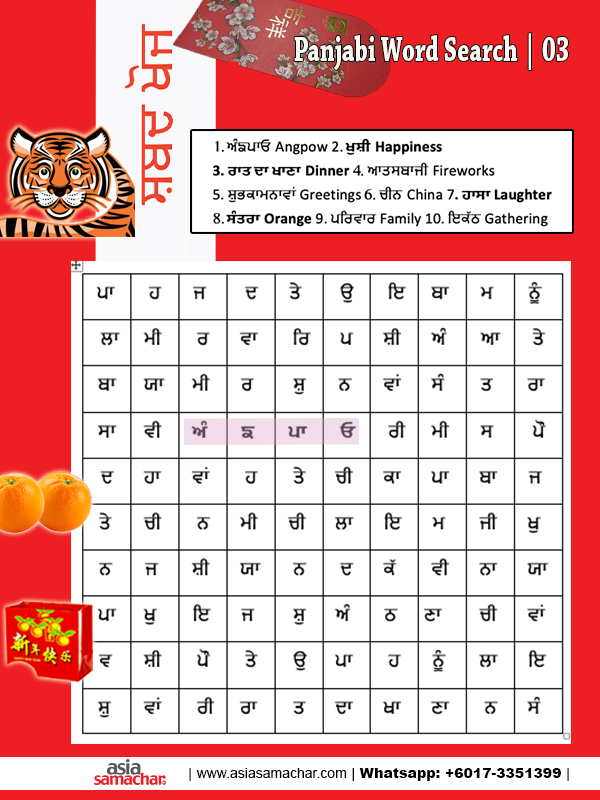
We just finished celebrating the Chinese New Year. So, we let us dabble in a CNY-inspired word search. Let’s see how long you take to find these words.
1. ਅੰਙਪਾਓ Angpow
2. ਖੁਸ਼ੀ Happiness
3. ਰਾਤ ਦਾ ਖਾਣਾ Dinner
4. ਆਤਸਬਾਜੀ Fireworks
5. ਸ਼ੁਭਕਾਮਨਾਵਾਂ Greetings
6. ਚੀਨ China
7. ਹਾਸਾ Laughter
8. ਸੰਤਰਾ Orange
9. ਪਰਿਵਾਰ Family
10. ਇਕੱਠ Gathering
ASIA SAMACHAR is an online newspaper for Sikhs / Punjabis in Southeast Asia and beyond.Facebook | WhatsApp +6017-335-1399 | Email: editor@asiasamachar.com | Twitter | Instagram | Obituary announcements, click here
This is new. Some Sikhs would have been receiving greetings for ‘Bandhi Chhor Diwas‘, marking the day when Guru Hargobind would arrive in Amritsar after being released from imprisonment.
It’s a little odd for most of us. All this while, Bandhi Chhor Diwas‘ has been linked to Diwali, which usually falls in November. This particular greeting wish is dated 12 February.
The one received by Asia Samachar was initiaited by Dr Kala Singh, a thinker, speaker and writer based in Canada.
We approached fellow writer and thinker Dr Karminder Singh Dhillon, a regular contributor to this media portal, to explain the Bandhi Chhor Diwas greeting. This is his take on the issue:
“The Guru was imprisoned in Agra and released after two years. The objective was to quell the Sikh anger arising out of the execution of Guru Arjun. Jahangir had also ordered some Hill rajas imprisoned on a host of charges – not paying taxes etc. Their imprisonment had nothing to do with Sikh issues. This much is recorded in the Mugal side of history.
“Jahangir’s wife was of Hindu origin. So its natural and possible that when Jahangir decided to release Guru Hargobind, she pressed him for the release of the rest as well. Guru Hargobind himself would have pressed Jahangir to release them as well given that they were religious or political prisoners.
“The part that is concocted by the Hijackers of Sikhi is the 52 kaliyan vala chola and the Guru reaching Darbar Sahib on Diwali day to celebrate Diwali. The guards at the jail would have been deaf, blind and stupid to allow 52 prisoners to walk out holding on to the dress of the ONLY person who was ordered to be released. And if the other 52 were ordered to be released as well, then there was no need for them to to do the pakhand of hanging on to the Guru’s dress.
“Given the distance between Agra and Amritsar – and given the fact that the Guru would have stopped in multiple places along the way to meet with Sikhs – the writers of Bhatt Vahi put February 12 as the date the Guru arrived in Amritsar. February is not a Divali month.”
ASIA SAMACHAR is an online newspaper for Sikhs / Punjabis in Southeast Asia and beyond.Facebook | WhatsApp +6017-335-1399 | Email: editor@asiasamachar.com | Twitter | Instagram | Obituary announcements, click here
Renowned human rights activist and former judge Justice Ajit Singh Bains passed away in Chandigarh, Punjab, yesterday (11 February 2022). He was 99.
He was no ordinary judge while on the bench, and lived an even more remarkable life upon his retirement.
He is survived by his wife Rashpal Kaur and four children, including senior advocate Rajwinder Singh Bains. His grandson Utsav Bains is also an advocate.
Justice Bains served as a judge of the Punjab and Haryana High Court from October 1974 to May 1984. Upon retirement, he was thrown into the deep end of the fight for human rights.
Born in Bada Pind near Guraya in Jaladhar in 1922, he studied at a local school and then studied subsequently law and MA (Economics) in Lucknow. After a brief stint at the Punjab education department as a teacher, he left to join the law profession in 1953. He started his practice at high court in 1961.
“He changed the dominant view about High Court judges who normally defend establishment. He delivered many judgements during his ten year tenure (from 1974 to1984 at Punjab and Haryana High Court) to defend the interests of working people, disadvantaged and women. He ruled against many employers and establishment figures,” writes Pritam Singh, the Emeritus Professor at Oxford Brookes University and an avid Punjab politics watcher.
Upon retirement in 1985, he formed Punjab Human Rights Organisation. The NGO played an instrumental role in exposing human rights violations in Punjab.
Justice Bains devoted his life to the protection of human rights movement especially when massive human rights violations were taking place in Punjab during the tyrannical rule of Punjab chief minister Beant Singh and the hawkish police chief KPS Gill.
Things took a turn when Justice Bains was hauled up for making seditious pronouncements for a run-of-the-mill speech from the ramparts of Keshgarh Sahib Gurdwara on Holla Mohalla in 1992.
“I was picked up after a morning golf game. The police came in two jeeps,” he told Rozana Spokeman in an interview in 2014.
He was handcuffed, manhandled, finger-printed and illegally detained by the police. It was only after more than 52 hours of detention and rigorous interrogation that he was produced before a district magistrate on April 5, only to be remanded to police custody for two more days. His detention stirred up a hornet’s nest that the Government hadn’t bargained for, reported India Today. It added that Sikh organisations and human rights groups abroad attacked the manner in which such an eminent man was being treated.
“Gill had the temerity to have him arrested once and even getting him handcuffed and taken to a police station. Gill did this to terrorise that no one was safe, not even a former High Court judge, if they criticised his misdeeds. Gill did not know that Bains was made of a different stuff. Bains became even more determined after this realising even more deeply that if a retired High Court judge could be mishandled, what chance an ordinary farmer or worker had in Gill’s police raj,” commented Pritam.
But Justice Bains does not display any rancour with the police force. In the same Rozana Spokeman interviews, he says: “The police force is independent. But the politicians don’t allow them to stay independent. They sideline the honest officers, and [promote] tainted officers.”
Justice Bains authored ‘Siege of the Sikhs: Violation of Human Rights in Punjab’, a book published in 1988. The book touched on human rights in the Punjab as well as the problem of Center-State relations.
Amritsar-based human rights activist Sarabjit Singh Verka, who was associated with justice Bains since 1998, was quoted in The Hindustan Times, as saying: “It is a loss to humanity and an end of an era in Punjab. It is very rare to see such people who through their life worked selflessly for oppressed against all odds.”
In closing, Pritam says: “Men like Justice Bains are born once in many decades. His voice was heard at the highest level in the UN and other world forums with great respect and attention. He will remain alive through his magnificent work for justice and human rights. He leaves a powerful family legacy-one of his sons (R S Bains) and grandson (Utsav Bains) are very fine human rights lawyers.”
RELATED STORY:
(Asia Samachar, xx 2021)
ASIA SAMACHAR is an online newspaper for Sikhs / Punjabis in Southeast Asia and beyond.Facebook | WhatsApp +6017-335-1399 | Email: editor@asiasamachar.com | Twitter | Instagram | Obituary announcements, click here
D/O LATE SARDAR SANTA SINGH & LATE SARDARNI KIRPAL KAUR
Departed peacefully on 7th February 2022 in Perth, Australia
Leaving Behind:
Husband: Sardar Jai Singh s/o Late Sardar Amar Singh & Late Sardarni Nihal Kaur (Perth, formerly from Jelebu)
Siblings & Spouses:
Late Teja Singh & Late Kelvant Kaur (Malacca) Kartar Singh & Late Sowaran Kaur (Rawang) Late Karam Kaur & Late Jagjit Singh (Tanjung Malim) Late Harcharan Kaur & Late Avtar Singh (Klang) Dr. Sarjit Singh & Harphajan Kaur (Sydney)
Grand Children & Spouses Dr. Simerenjit Kaur & Patvinder Singh Roshanpal Singh Dr. Ashvinder Singh Jashrin Kaur & Joshua Callum Brady Jasvinder Singh Sandev Singh
Great Grand Daughter: Pershel Neyna Kaur
And a Host of Relatives & Friends
Path Da Bhog will be held at Gurdwara Sahib Subang, Subang Jaya on 19th February 2022 (Saturday) from 5.00 PM to 7.00 PM. Guru Ka Langgar will be served thereafter.
The family expresses its sincere appreciation & heartfelt thanks to relatives & friends for their condolences, prayers & support during the recent bereavement.
| Entry: 12 Feb 2022 | Source: Family
ASIA SAMACHAR is an online newspaper for Sikhs / Punjabis in Southeast Asia and beyond.Facebook | WhatsApp +6017-335-1399 | Email: editor@asiasamachar.com | Twitter | Instagram | Obituary announcements, click here |
A New York-based angel investor, Intel India country head, a TV sports producer, a chief investment officer and a former Australian high commission to India. These are the calibre cobbled together for a conference organised by an Aussie-based Sikh group next Saturday (19 Feb 2022).
They will speak at ‘Elevate 22 – Re-Think & Re-Bound’, an annual event organised by Young Sikh Professionals Network (YSPN).
The speakers will touch on three topics: Journey of migrants leading to the future of work, diversity and intergenerational support, and building a career from deep tech to high impact management.
With New York-based investor Bhavdeep Singh, conference participants have a chance to tap into his broad corporate experience spanning retail, healthcare, consulting and human resources. He was the CEO Fortis Healthcare, one largest private hospital operators in the world, between 2009 and 2011. Prior to that, he was the CEO of Reliance Fresh where he led the effort to open almost 700 new stores in less than two years.
He is currently working to launch HealthQuarters which he describes as a new and exciting concept in healthcare, according to his Linkedin page profile. Bhavdeep is also a board member of the US-based Sikh Coalition.
He is joined by Intel Corporation’s Nivruti Rai, Sky Sport New Zealand producer and presenter Ravinder Hunia, Singh Capital Partners chief investment officer Manpreet Singh and Australian Department of Foreign Affairs and Trade (DFAT) deputy secretary Harinder Kaur Sidhu.
Nivruti is the vice president for Intel foundry services at Intel Corporation and the country head of Intel India.
Based in Bengaluru, she provides overall engineering and business unit leadership and leads operations for the site, driving innovation, cross-group efficiencies and execution for engineering teams delivering global products and roadmaps. She also leads engagements with national and local governments and policymakers and collaborates with ecosystem players to enable innovation and entrepreneurship.
Ravinder, whose comes from a mixed Maori-Sikh parentage, was radio sports journalist of the year at the TP McLean Awards in 2018.
Prior to the current role, Manpreet worked at DC-based Profit Investment Management where he helped to grow assets under managed from US$20 million at the time to over US$2 billion via stints in trading, marketing, research, investing, operations, and maintaining client relationships. He was also president and co-founder of TalkLocal Inc. TalkLocal has raised US$4 million in venture funding and has delivered over 4 million calls nationwide.
Harinder is the deputy secretary for service delivery group at DFAT. She is also the senior champion for culturally and linguistically diverse staff in DFAT. She was the Australian high commission to India and Bhutan from 2016 to 2020. Prior to the India posting, she she headed DFAT’s Multilateral Policy Division.
There is a A$50 entrance fee for the event. Click here to register.
ASIA SAMACHAR is an online newspaper for Sikhs / Punjabis in Southeast Asia and beyond.Facebook | WhatsApp +6017-335-1399 | Email: editor@asiasamachar.com | Twitter | Instagram | Obituary announcements, click here
Gurdeep Singh was a founder of Gurdwara Aid, which provides advice to Sikh temples in the UK on charitable donations and compliance with the law
By Maurice Ostro | The Guardian | Britian |
My fellow interfaith activist Gurdeep Singh, who has died of a heart attack aged 59, was the co-creator of Gurdwara Aid, a community interest company that helps Sikh temples in the UK to deal with all kinds of administrative chores, from obtaining food safety certification to registering for gift aid and arranging safeguarding training.
Gurdeep set up Gurdwara Aid with a friend, Mandip Singh, in 2019, after having spent a number of years on the committee of his local gurdwara in Hitchin, Hertfordshire, where he became involved in all aspects of its running. Initially the idea was to help and encourage other gurdwaras to claim gift aid, but soon he found himself in demand for advice in lots of other areas, including governance, risk assessments, charity registration and dispute resolution.
Gurdeep was born in Pragpur in the Punjab, India, to Ajit Singh, a till installer at a computer company, and Surjit Kaur, a factory worker, who emigrated to Britain in 1964 and settled in Hitchin. After attending Hitchin Boys’ school, Gurdeep studied telecommunications engineering at Kingston Polytechnic (now Kingston University), graduated in 1984 and worked as an a engineer with GEC Plessey Telecommunications until 1989.
Settling for the rest of his life in Stevenage, after two years with Mercury Communications as a maintenance engineer he moved into management at Nortel Networks (1991-94), Telewest (1994-97) and various other telecoms companies, including Tekmark, until, through his gurdwara contacts, he became involved with the Sikh Channel television station in 2012.
At the invitation of the channel’s proprietor, Gurdeep presented a weekly programme called Sikh Spectrum, in which he interviewed Sikhs from all walks of life. The show ran for two years, during which time Gurdeep co-founded the Khanda Poppy project to honour the Sikh contribution in the two world wars. Eventually the Sikh Channel appointed him as head of operations, and later CEO, and he remained there until he set up Gurdwara Aid.
Gurdeep brought to his new venture great business sense, an enormous smile, a big heart and the ability to look for the best in everyone. Gurdwara Aid conferences were always packed because they reflected his caring and committed attitude, backed up by admirable professionalism.
During the first Covid lockdown, the company was instrumental in setting up a group to provide Sikh feedback to the government via a special taskforce, advising on timings for the re-opening of places of worship. Gurdeep also built an online network of Sikh support, the smile shining as bright as ever each Sunday over Zoom, on which he would help to share and solve problems.
When PPE became short he quickly found a donor and ensured that masks, aprons and gel were delivered in generous quantities not just to gurdwaras, but to mosques, synagogues, churches and other temples.
Gurdeep is survived by his wife, Kalvinder Kaur, whom he married in 1988, a son, Jeevan, daughter, Pavenn, and three granddaughters.
See the full story, ‘Gurdeep Singh obituary’ (The Guardian, 10 Feb 2022), here.
ASIA SAMACHAR is an online newspaper for Sikhs / Punjabis in Southeast Asia and beyond.Facebook | WhatsApp +6017-335-1399 | Email: editor@asiasamachar.com | Twitter | Instagram | Obituary announcements, click here