UA-56202873-1
Page 356

Ability to learn new things stays with you, says data scientist

0

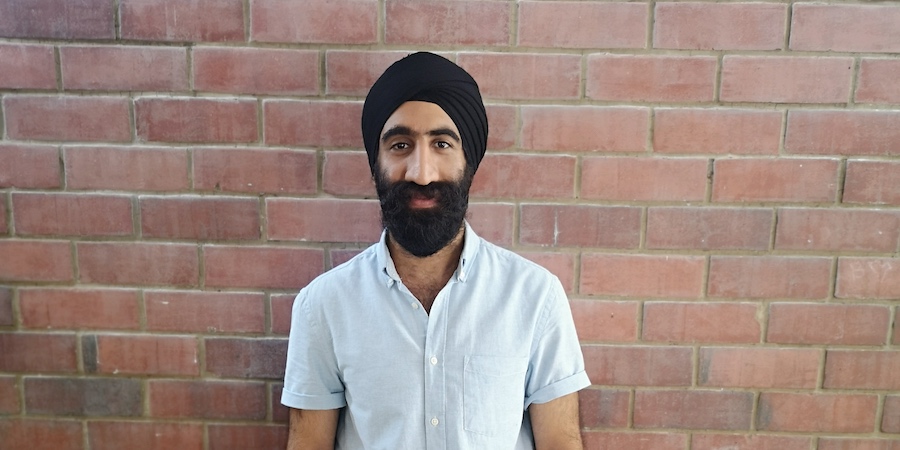
Kaviraj Singh Khurana – Photo: Supplied

By Anandpreet Kaur | Thailand |

Kaviraj Singh Khurana studied aerospace engineering but has now moved into data science. But he has no regrets in choosing the subject for his undergraduate.

“Technology is changing so fast in every field right now. Many things that university teaches you become obsolete fast, but the ability to learn new things is what stays with you. The courses and skills I learnt during the course, especially the programming units, have a high transferable skills,” he tells Asia Samachar in an interview.

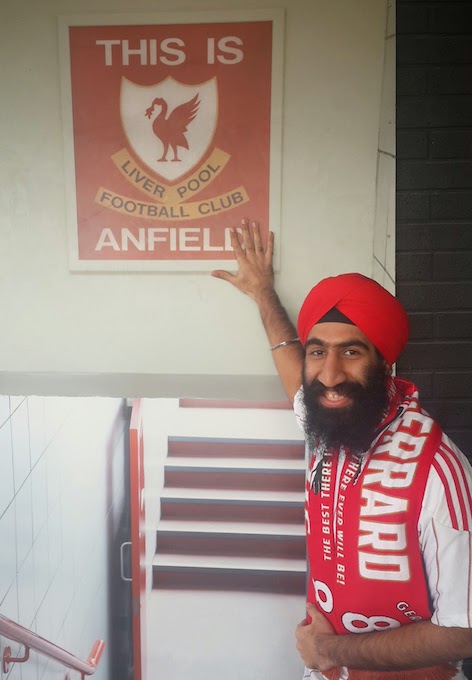
Today, the Liverpool fan since he was 9-years-old is a data scientist at Pomelo Fashion, a fashion tech brand/platform that started in Thailand nearly eight years ago and is fast expanding in Southeast Asia.

Excerpts from his interview.

Tell us more about yourself?

I was born and raised in Bangkok, Thailand and did my schooling in Thai Sikh International School. The school followed the British Curriculum but also had Punjabi and Sikh history subjects to make sure we were in touch with our roots. I was fortunate to get the opportunity to do my undergraduate in the UK. I graduated with a Masters of Engineering in Aerospace Engineering from the University of Bristol. During my first and third year summer vacations I did my internships at Thai Airways in Thailand and Genser Aerospace in Bangalore, India, respectively. It was during my internships that I realized Aerospace Engineering was not something I would want to continue my career in, I felt that it was too specific, which is when I started exploring different options.

I joined True Corporation, which is one of the largest telecommunication companies in Thailand for a management trainee programme. I had to sell SIM cards door-to-door in rural area in the province of Chonburi, Thailand as part of one of the rotations. It was an experience I’ll never forget, and something that taught me so much about the importance of communication. I also got to work in the data analytics department for a short while, and it was something I enjoyed the most. I like how it requires the combination of technical and business skills.

I didn’t really enjoy corporate culture too much and wanted to try out a career in startups, as I imagined my work would have more impact on the overall business. That’s when I applied to Pomelo Fashion to join their data science team. I loved the culture and my job here. This was more than two years ago, and I have been here ever since.

I also teach high school tuition Physics and Mathematics part time. Teaching is a passion I have had since I was in high school, and is something that I have been doing since I was university.

In my free time, I enjoy watching series, and I’m a football and F1 enthusiast. I have been a Liverpool FC supporter since I was 9-years-old. Going to the UK gave me the opportunity to witness the magnificent Anfield.

Tell us more about your parents?

My parents were also born in Bangkok, Thailand. My dad Prem Singh Khurana has a business, while my mom Hirdehpal Kaur is a housewife, but is also a part-time music teacher. She teaches Kirtan to mostly kids, and has been doing so for the past 20 years.

In general my parents have been extremely supportive of most of the decisions that me and my brother make. My parents have always stressed the importance of education, which has motivated both me and my brother to do our best while in university and at our jobs, and we see the fruits of it coming out now.

Tell us about your immediate family?

I have a younger brother, who’s working in Deloitte as a Tax Consultant. Funnily enough, he’s an Everton FC supporter, following my dad. So we always have this friendly rivalry at home during football games.

My extended family stems from Malaysia. My paternal grandfather Dalip Singh Khurana (from Kuala Lumpur) and maternal grandmother Iqbal Kaur (from Ipoh) were both born in Malaysia. Our family is known as ‘Malaysia Wale’ here in Bangkok. So I used to travel to Malaysia nearly every summer or winter holiday until I was about 10, then we started exploring other countries/cities as well. I have a really strong connection to Malaysian culture due to this. I especially love Malaysian food!

What attracted you to pursue your studies in aerospace engineering?

Two key things influenced me. One, my dad has always loved planes. He would take me and my brother to the airport once in a while to watch planes land and take-off. This ignited my interest in planes. Second, since high school, mathematics and physics were my strongest subjects, and engineering seemed like the degree that could give me the best of both the subjects. Combining the two, it didn’t take me very long to pick Aerospace Engineering.

Any regrets in pursuing that path?

Well, one’s analytical skills and ability to learn new skills are amongst the most important skills in any field. And Aerospace Engineering, being one of the most rigorous engineering fields, really did develop both of these skills in me that has benefitted me up until today. Technology is changing so fast in every field right now. Many things that university teaches you become obsolete fast, but the ability to learn new things is what stays with you. The courses and skills I learnt during the course, especially the programming units, have a high transferable skills. So, I have no regret in choosing Aerospace Engineering for my undergraduate.

You’re a data scientist at Pomelo Fashion. What does this job entail?

Pomelo Fashion is a fashion tech brand/platform that started in Thailand nearly eight years ago and is expanding rapidly in Southeast Asia. Data Science is an interdisciplinary field that combines computer programming, mathematics and business domain. As a data scientist, my job primarily entails creating statistical and machine learning models to enhance customer experience and optimize profits for the company. This involves inputting quality data into the above mentioned models to make accurate predictions. Being a fast fashion brand, it can be hard to predict the quantity of different styles to order. If you order too less, you lose potential revenue, whereas if you order too much, you end up with excess inventory. An example of a project that I am a part of includes the Demand Forecasting Model, where we use Machine Learning to find the sweet spot between maximum revenue with minimum excess inventory.

Would you recommend this path to students looking for a career in engineering?

Data Science is a relatively new field that is growing fast with the growth of technology companies in every industry. As these companies grow, more data becomes available to them, and the ability to use this data to optimize their business is what makes them stand out and beat competition. It is a challenging role, but I definitely recommend anyone interested to go for it! As for me, I love it and I think it’s as exciting as a job can get!

Any last word?

One thing that I would like to share to the readers and all the youngsters in college is, don’t be bound by your degree. Life is a lot more than that. The most important thing is to understand what kind of a life you want, and try to create/find a job that caters to that. Everything you study in university has some value to what you do or will do, even though it may not be directly involved.

RELATED STORY:

Explorer Ravin (Asia Samachar, 26 Nov 2021)

He sure stands out. Sikh American enters Forbes’ 30 Under 30 (Asia Samachar, 4 Dec 2021)

ASIA SAMACHAR is an online newspaper for Sikhs / Punjabis in Southeast Asia and beyond.Facebook | WhatsApp +6017-335-1399 | Email: editor@asiasamachar.com | Twitter | Instagram | Obituary announcements, click here 

Dr. Gurucharan Singh (Gendhi) s/o Amar Singh & Nihal Kaur (1938-2021)

ਹੁਕਮੇ ਆਵੈ ਹੁਕਮੇ ਜਾਵੈ ਹੁਕਮੇ ਰਹੈ ਸਮਾਈ ॥

hukmay aavai hukmay jaavai hukmay rahai samaa-ee.
By His Command we come, and by His Command we go; by His Command, we merge into absorption.

DR. GURUCHARAN SINGH (GENDHI) S/O AMAR SINGH & NIHAL KAUR

13.11.1938 – 25.12.2021

Beloved husband and partner of Jogender Kaur Bedi

Spiritual guide, father, moral compass and the love of Lashvinder Kaur, Sharon Sidhu & Prof. Reena Sidhu

Father-in-law and Dad to Richard Arnold & Ranbir Lal

Loving Nanna of Maxim, Maya & Rahoul

Grandfather, Father, Husband, Brother, Uncle, Friend.

Guided by his Northern Star, Gendhi as he was also known to many, nurtured his tribe, and those he loved, to be fearless, purposeful, and kind. The bedrock of stability, he always had an open door and an even bigger heart for those in need. His sense of humour and dry-wit had the power of teasing out many a smile, even from the stoniest of faces. His strong principles and integrity, reshaped many a life.

Like his moniker Guru, he was the guiding light for many…

Daddy, thank you for blessing us with your love, steadfastness and wisdom. You will always be our Rock and Pillar of strength

Rest well knowing that your legacy lives on strong.

Missed by:

Jai Singh & Gursant Kaur (Perth), Balbir Kaur & Sarain Singh Jassal (Melbourne), Dr. Balbir Singh & Dr. Indra Anthony (P.J.), Gurmukh Singh (Ipoh) and Sarjit Kaur (Penang w/o the late Hari Singh). Joining Sohan Singh, Bhagwan Kaur & Karam Singh

The family will forever remain indebted to Datuk Dr. Harjit Singh (Prince Court Hospital) for being their pillar of support & thank Hospis Malaysia for their incredible kindness and care.

For details please contact Lash at +6012 220 0253 or Sharon at +6012 326 1753

Akhand Paath will start on Tuesday, December 28, 2021 at 4pm and Path Da Bhog will be held on Thursday, December 30, 2021 at 4.30 pm, followed by Kirtan, Katha and Antham Ardaas: 5.00 – 7.00 pm at Gurdwara Sahib Subang Jaya, Persiaran Kewajipan, SS13.

| Entry: 25 Dec 2021 | Source: Family

ASIA SAMACHAR is an online newspaper for Sikhs / Punjabis in Southeast Asia and beyond.Facebook | WhatsApp +6017-335-1399 | Email: editor@asiasamachar.com | Twitter | Instagram | Obituary announcements, click here |

Soldier and diplomat

0

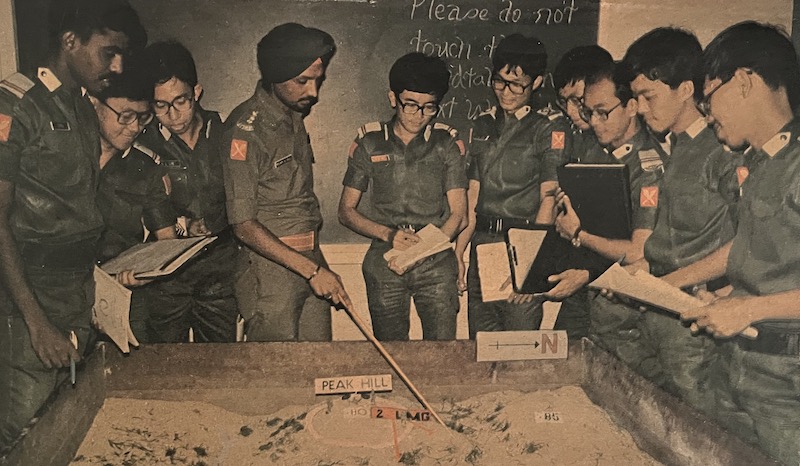
Mejar Singh Gill: Instructor at Officer Cadet School, Singapore Armed Forces Training Institute, 1982 – Photo: Supplied

BACKGROUND

Born in 1949, Mejar Singh Gill alias Major Singh Gill landed in Singapore as a 6 year old in 1955. He comes from a very humble family background.  His father, without any formal educational background, came to Singapore in 1950 where he joined the British Naval Police Force as an ordinary Police Constable. Mejar grew up with his large family of 7 siblings in the Naval Base, among the large community of over 400 Sikh families then constituting the Naval Police Force.  He was the third eldest in his family, with two sisters older than him. His father, being rather conservative and having plans then of eventually returning to Punjab, chose not to send his elder two daughters to school, being quite content with them mastering Gurmukhi and being proficient in the Guru Granth Sahib (Sikh Scripture) but quite happy to send Mejar to an English School, followed by other siblings later.

This was the period of significant changes in the region, and Singapore in particular, which impacted everyone’s life including Mejar’s.

“I did my initial primary education at the Admiralty Asian School within the Naval Base where we sang British National Anthem ‘God save the Queen’ daily. With Singapore attaining self-government in 1959, we all got transferred to Naval Base School, a newly built school outside of the Naval Base. Our national anthem, Majulah Singapura replaced ‘God save the Queen’. Just 4 years later we were singing another national anthem, Negara Ku when Singapore merged with Malaysia in September 1963.
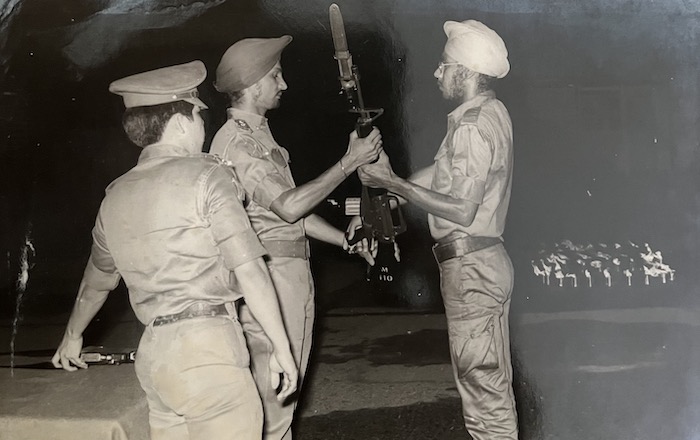
Mejar Singh Gill: Weapon presentation ceremony for recruits, 1974 – Source: Supplied

“What seemed to be interesting times, soon changed into turbulent times. Singapore’s merger with Malaysia was fraught with difficulties both within and from outside. Not only did Indonesia announce its policy of Konfrontasi (Confrontation) against Malaysia, there were also the racial riots of 1964. Not long after, we woke up on the morning of 9 Aug 1965 to see our Prime Minister Lee Kuan Yew emotionally announcing the separation of Singapore from Malaysia to become sovereign nation, and we all reverted to singing Majulah Singapura all over again.”

Immediately after obtaining his Senior Cambridge Certificate, and given his family’s financial situation with the younger siblings already going to school, Mejar applied for and got selected as a trainee teacher. He taught at West Hill Primary School in the morning session and attended classes at the Teachers’ Training College at Patterson Road for three afternoons a week, as was the arrangement those days.

But the ongoing developments in the region in the 1960s were to further change Mejar’s life. Instead of pursuing a teaching career, he soon found himself serving in the Armed Forces instead. Other than the Indonesian Confrontation, the Vietnam War was still raging and there were fears of the ‘domino effect’ on the non-communist states, including tiny Singapore. Hence, the emphasis on defence and the reliance on a conscript army rather than a regular army to defend Singapore.
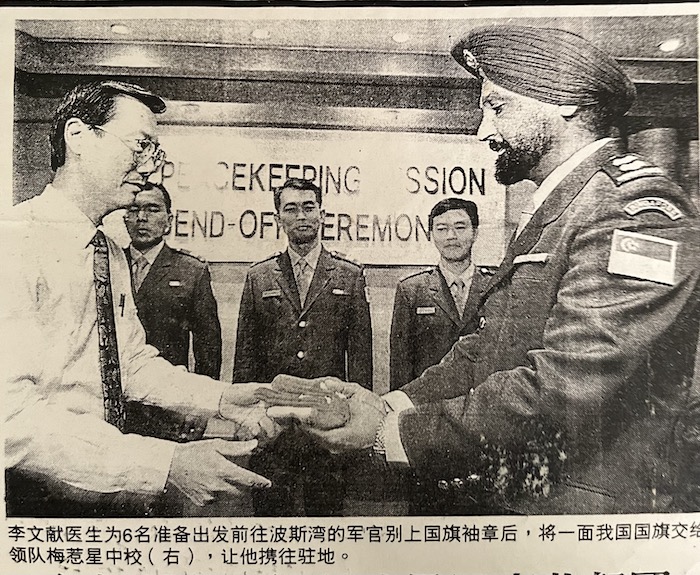
Mejar Singh Gill receiving the state flag from Singapore defence minister for UNIKOM Mission, 1995 –  Photo: Supplied (Chinese newspaper cutting)

CALL UP TO SERVE

The first inkling of conscription being introduced in Singapore came in November 1966 when the Government announced that all newly appointed government and statutory board officers, subject to physical fitness, would have to do a stint of full time national service.

“When I became a trainee teacher, I was already anticipating being called for some form of military training but did not know where, when and how I will be involved. Things moved rather fast in 1967 when new legislation was tabled to amend the National Service Ordinance (which had originally been passed by the British in 1952),” he said.

On 21 Feb 1967 (which coincidently was his 18th birthday), PM Lee made the announcement of the introduction of national service, and in March 1967 the National Service (Amendment) Bill was  formally  passed in parliament.  Soon after, small select groups of civil servants as well as students of institutions of higher learning under 30 years of age started receiving call up notices. A few days later, Mejar was one of over 9,000 18-year-old Singaporeans who received the enlistment notices, or pink cards, instructing us to register for NS at CMPB in Kallang.

“I did not just get one call-up notice but four! I happened to fall under all four categories of Singaporeans liable for national service during those early days of national service; namely young 18 years olds, new citizens, students of higher learning and new civil servants.

“In my case, I was 18 years old who had only recently become a naturalised citizen, was a new civil servant and was a student at Teachers Training College, which was then designated as an institution of higher learning. So even if I had tried to get deferment, which I had no desire to do so, there was little possibility for me succeeding as I fell into all four categories of persons liable for national service then,” he said.

On 9 Aug 1967, he proudly joined fellow Singaporeans in the republic’s second National Day Parade. The attention of all was on the marching uniform contingents, especially the one from SAFTI. Mejar was in the Teachers Training College Contingent. In subsequent years, after he enlisted into the Army on 21 Aug 1967, he too had a few opportunities to both participate in the participating contingents as well as be involved in some way or another in the organisational set up of the National Day Parades.

During his 30 years in the army, Mejar held various command, staff and instructional posts. In addition to commanding a Reserve Battalion, he also served in key staff roles at division level as well as in the Ministry of Defence (MINDEF). At the instructional level, he commanded companies training non-commissioned officers (NCOs) as well as Officer Cadets. His last post was that of Directing Staff at the Singapore Command and Staff College.

During his stint in the Army, he had the opportunity to train in several countries. In particular, he specialised in jungle training, where he underwent training at the renowned British Jungle Warfare School in Ulu Tiram, Malaysia; the Counter Insurgency & Jungle Warfare School (CIJWS) in Vairengte, Assam, India, as well as in the jungles of Brunei, Thailand and Taiwan. He also underwent various other forms of training in other countries such as Hawaii, US as well as Australia and New Zealand as well as participated in joint exercises with foreign armies.

Singapore, despite its small size, has played a very active role as a responsible member of the United Nations (UN). It has contributed in various fields, including humanitarian missions and peacekeeping operations. Mejar headed one such mission during his military career, which left him with ‘great memories being involved in such a noble cause’. He led the 5th SAF UNIKOM Team overseeing peacekeeping at the Kuwait/Iraq border.
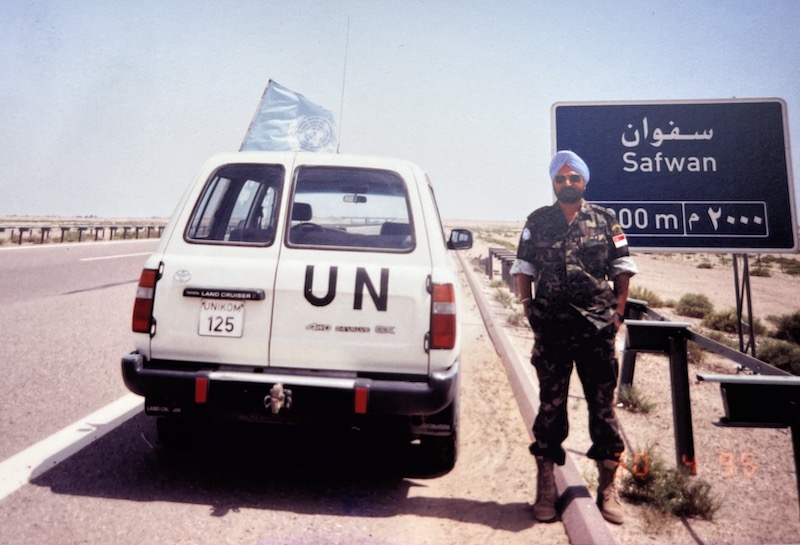
Mejar Singh Gill: Serving at Kuwait/Iraqi Border under the UN Peacekeeping Mission, 1995 – Source: Supplied

During his 30 years of service in the SAF, Mejar said that stands out as one of the most meaningful and insightful assignments he had undertaken in his military career. His greatest satisfaction was the opportunity to visit the Baba Nanak Shrine (also referred to as Tomb of Bahlol among the Arabs) in Karkh District of Baghdad which was still intact then.

Mejar joined the SAF with “O” levels but was fortunate that it gave him the opportunity to upgrade himself with a tertiary education. While serving the SAF, he did his “A” levels on a part-time basis and was awarded a scholarship to pursue studies at National University of Singapore (NUS) where he obtained a BA (Hons) in 1986.

After serving 30 years in the SAF and having attained the rank of Lieutenant Colonel, he decided to retire prematurely at the age of 47 at the end of 1996, when he joined the Ministry of Foreign Affairs (MFA).

 DIPLOMATIC SERVICE

His second career lasted another 22 years. At MFA, his first new job was as Deputy Director, Consular Directorate, which required him to handle consular matters, including contingency planning. Given his military experience, for the first few years, despite having left the SAF, he found himself working hand-in-hand with SAF counterparts in planning and executing various operations that MFA undertook in assisting Singaporeans in distress overseas, namely the evacuation of Singaporeans from Cambodia and the Silkair Crash in 1997 followed by the assisted departure of Singaporeans from Indonesia during the 1998 riots in Indonesia.

Evacuation of Singaporeans from Cambodia in 1997. Barely 6 months after joining MFA, he was involved in working with MINDEF in executing the evacuation of over 450  Singaporeans from Cambodia whose safety was threatened by the Jun 1997 coup d’état and resultant civil war. The contingency plan in place was to pull out the Singaporeans, i.e. an “assisted departure” plan entailing use of commercial flights if civilian airport was operational and an “evacuation” plan through use of military aircraft if airport closed to civilian aircrafts. As the situation worsened, with clashes also taking place near the airport, the military option had to be activated. He represented MFA in coordinating the plan with MINDEF officials, which resulted in a successful operation involving 6 flights of C-130 aircraft with small groups of commandos on board.

Silkair Crash. Barely six months after the Cambodian Crisis, Mejar was back in action interacting with the SAF during the Silkair crash. Silkair MI 185, a scheduled Boeing 737-300 flight from Jakarta to Singapore plummeted into Musi River near Palembang in Southern Sumatra on 19 Dec 1997. There were 97 passengers of various nationalities and 7 crew members on board. He describes it as “a heart-breaking scene at the airport with friends and relatives trying to get information about the aircraft that had going missing.” With the SIA Crisis Management Group taking the lead, he led the MFA Contingency to assist in liaison on the ground with the Indonesian authorities. Unfortunately, no bodies were recovered from the scene. But it was a trying period spending time with the families in Palembang, desperate for news of their beloved ones.

1998 Riots in Indonesia. The fall of President Suharto in May 1998 resulted in serious civil disorder and unrest that warranted the safe evacuation of Singaporeans. Mejar was again involved in assisting in the planning and execution of the “assisted departure” of thousands of Singaporeans from Indonesia to Singapore. He remembers the chaotic scenes at Jakarta Airport with families of all nationalities desperate to get out.
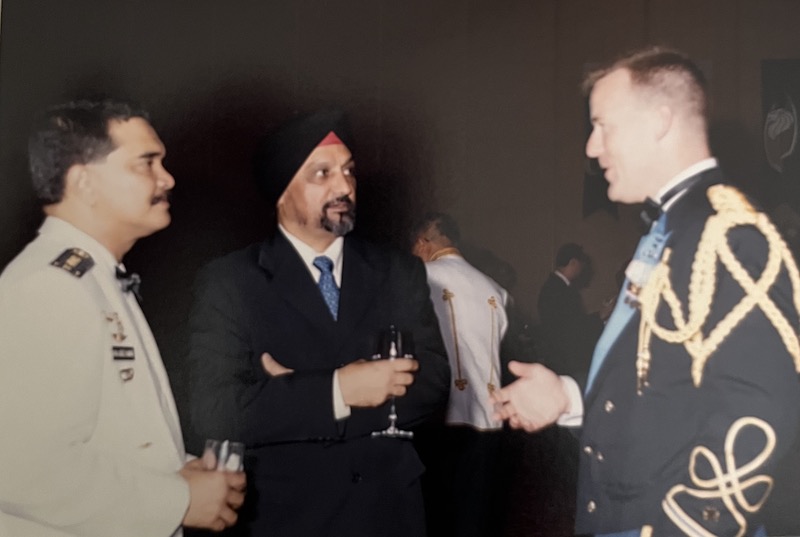
Mejar Singh Gill: Interacting with foreign military officers abroad, 2000 – Source: Supplied

OVERSEAS MISSIONS

Having served at the MFA HQ, the rest of his career entailed doing stints at overseas missions, namely in Indonesia, United States and India. To him, these were interesting times, where he had the opportunity to interact with the officials of the various countries in representing Singapore’s interests as well as interacting with foreign diplomats and the larger communities, including Singaporeans living there. The postings also provided him the opportunity of making many more friends as well as exploring the beautiful countries. But there were also occasions where he was again involved in assisting in several contingencies, including the 2004 Tsunami in Indonesia and the Nepal Earthquake in 2015.

The massive underwater earthquake of 26 Dec 2004, measuring 9.0 on the Richter scale, that stuck off the western coast of Sumatra, Indonesia, triggering several tsunamis which wrecked destruction in countries bordering the Indian Ocean, is one event etched in his memory.  He was then serving at the Singapore High Commission in Jakarta and was at the scene for over two weeks where he saw hundreds of bodies and the mass graves dug as burial grounds.

“When the Tsunami took place, I was actually in Medan, about 400 km down south of Aceh, where I was attending a wedding of an Indonesian friend’s son. The hotel that we stayed in started shaking around 8 am in the morning. Though it did cause some alarm, with water spilling out of the swimming pool, the hotel management’s checks showed that there was no structural damage and we moved back to hotel after the short evacuation carried out,” he said.

Little did they realise the extent of the calamity befalling the people of Aceh around the same time that day. In the evening, he returned to Jakarta but was instructed to return back to Medan the next morning when the extent of the disaster become more apparent. From then onwards, it was a busy period for him and the Defence Attaché’s staff onsite coordinating with its Embassy Staff, MINDEF and other Indonesian agencies in rendering the necessary assistance.

Nepal Earthquake. During his posting in India, he was again involved in assisting Singaporeans in distress who found themselves stuck in Nepal during the massive earthquake that took place there in April 2015. This is because Singapore High Commission in India is also accredited to Nepal and Bhutan, and hence Mejar’s involvement. It was another trying experience.
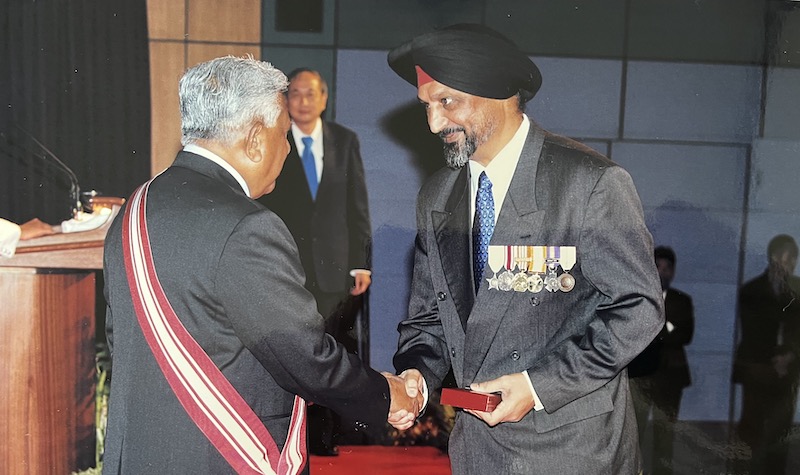
Mejar Singh Gill: Receiving National Day Award from President S R Nathan, 2005

SPORTS AND COMMUNITY

Mejar was an active sportsman in his schooling and army days, representing the Combined Schools and Singapore Armed Forces in hockey as well as playing for Singapore Khalsa Association (SKA). He was Singapore Armed Forces Hockey Convenor and also served as SKA’s vice president as well as vice president of Malaysia Singapore Sikh Sports Council (MSSSC). He is a serving trustee of SKA.

He has also been actively involved in community service. He was the founder member of Singapore Anti-Narcotics Association – Sikh Counselling Service in the mid-1970s, where he also served as chairman for several years. He is today actively involved at Gurdwara Sahib Yishun in Singapore.

In the course of his 52 years of service in the Singapore Armed Forces (SAF) and the MOF, LTC Mejar Singh Gill has won several commendation awards and citations, in addition to the UN (UNIKOM) Medal, SAF Overseas Service Medal and the National Day Long Service Medal and the Public Administration Medal.
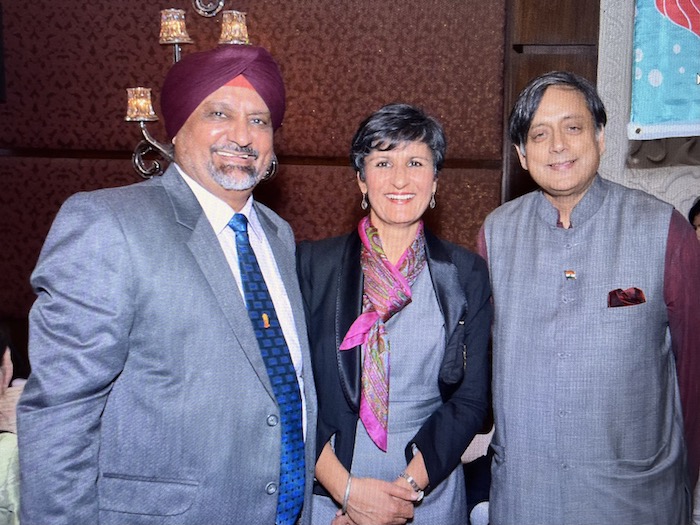
Mejar Singh Gill: With High Commissioner of Australia to India Harinder Sidhu (daughter of Ajaib Singh also previously from Naval Base Singapore) and former international diplomat, politician and writer Sashi Taroor, 2017

INTERESTING ANECDOTES

Name Confusion. For some reason or other, my father gave me a lower ranking order name, i.e. Mejar (spelled as Major in my identity card), while he named one sister of mine as Karnail and another as Jarnail (Punjabi pronunciations for Colonel and General!). This understandably caused much confusion when he served in both the SAF as well as MFA.

“For example, I went through several ranks, such as Corporal, 2nd Lieutenant, Lieutenant, Captain, Major and Lieutenant Colonel and most people got confused as to what my rank actually was. In my overseas diplomatic assignments too, when I introduced myself by name, some took me as an Army Officer serving in the Defence Attaché Office instead of as a diplomat,” he said.

He recollected a visit by a Malaysian Staff College delegation to his division, when one of the visiting Malaysian officers asked why he was wearing a name tag showing his rank while others were not. His name tag showed Mejar, the Malay spelling for major rank!

“There was another occasion when I once was pulled over in Johore by a Malaysian traffic policeman for a minor infringement. When he saw my name as Mejar, he asked if I was “Askar” and when I responded in the positive, he let me off,” he said.

RELATED STORY:

Rising Sikh star in Malaysian army (Asia Samachar, 30 April 2021)

ASIA SAMACHAR is an online newspaper for Sikhs / Punjabis in Southeast Asia and beyond.Facebook | WhatsApp +6017-335-1399 | Email: editor@asiasamachar.com | Twitter | Instagram | Obituary announcements, click here 

Sikh Christmas in Canada’s Bible Belt

0

Source: Abbotsford Downtown Facebook page

By Steve Burgess | TheTyee | Canada |

Sharanjit Kaur Sandhra recently received a letter. It was written in Punjabi, which is understandable, since Sandhra and her family have long been members of the local Sikh community. The letter urged her and her family to convert to Christianity. That’s also unsurprising — Sandhra grew up in Abbotsford.

The cultural struggle surrounding the Christmas holiday season is nowhere as clear as in the Raspberry Capital of Canada. “It’s a Bible Belt town,” says Sandhra, who is a member of the history faculty at the University of the Fraser Valley. “But Abbotsford has one of the largest Sikh populations per capita in all of Canada. And yet we don’t recognize them.”

Abbotsford has the fourth-largest Sikh population of any Canadian city — 25 per cent of residents identified as South Asian in the 2016 census. Sandhra, who now lives in Aldergrove, grew up in Abbotsford celebrating Christmas in ways that anyone who has ever watched a holiday TV ad would recognize.

“It was about family and togetherness,” she says. “Cousins got together, my mom did the turkey dinner, we would eat and have fun and open presents. We had the tree and the Christmas lights. I grew up with that. We happily took part in all the school functions.”

As an adult, Sandhra has continued the tradition. “It’s huge in my family,” she says. “My boys still believe in Santa Claus. They write letters to Santa. My husband and I have to go through the whole escapade of pretending to be Santa. Because I believe in the spirit of imagination that the holiday brings.”

But in recent years Sandhra has had a growing awareness that Sikh acceptance of other religious traditions is not always reciprocated. “I struggle a lot, having been in Abbotsford and being proselytized to for 30-plus years,” she says. “As a Sikh I am taught not to approach that with hate. But it pisses me off to no end. Because these systems are entrenched in our politics in Abbotsford. They’re entrenched in our business structures.”

“When you’re growing up you don’t question it,” she says. “It’s not just Christmas holiday break. It’s Easter holiday break, it’s every kind of identity-making notion comes through that Christian lens. Even as a historian, writing AD and BCE, I struggle with it.”

Sandhra recently ran up against that entrenched attitude in a particularly upsetting way. Her youngest child attends an elementary school she estimates to be about “90 per cent South Asian,” but the school had never celebrated Diwali or Vaisakhi. When a new principal arrived, he wanted to institute the celebrations in order to show the kids they belonged.

“Oh my god, the pushback,” Sandhra says. “There were these five white women whose kids were at the school, and they lost their shit. ‘How dare you celebrate Diwali!’”

“That hurt me very deeply,” she says. “I just assumed it was a no-brainer.”

“My children deserve to see themselves reflected, right? Why is there this pushback? What is it about hearing about Sikhi or Islam or Buddhism that makes certain Christians very nervous? It’s about power.”

Moninder Singh, president of the Gurdwara Sahib Dasmesh Darbar in Surrey and spokesperson for the B.C. Gurdwaras Council, says that for B.C. Sikhs, there is no one approach to the Christmas season.

“The community in general doesn’t have one position,” he says. “You will find people who completely involve themselves in Christmas trees and Santa and the whole idea of Christmas, outside of the religious connotations. And you have those who will not engage at all.”

“There’s a deep respect in the Sikh community for any days that have a religious component,” he says. “There’s always an opportunity to reflect on values on these days, similar to days like Vaisakhi which are closer to our hearts. You look for the goodness in humanity, giving back to the community, finding ways to support people that are less privileged. As parents in every community, not just for Sikhs, those moral lessons are an opportunity to celebrate by giving back.”

Read the full story, ‘Sikh Christmas in the Bible Belt’ (TheTyee, 22 Dec 2021), here.

RELATED STORY:

A letter to SGPC: Unethical conversion of Sikhs in Punjab (Asia Samachar, 24 Dec 2021)

ASIA SAMACHAR is an online newspaper for Sikhs / Punjabis in Southeast Asia and beyond.Facebook | WhatsApp +6017-335-1399 | Email: editor@asiasamachar.com | Twitter | Instagram | Obituary announcements, click here 

A letter to SGPC: Unethical conversion of Sikhs in Punjab

1

A LETTER FROM GLOBAL SIKH COUNCIL (GSC) TO SHIROMANI GURDWARA PARBANDHAK COMMITTEE (SGPC), DATED 20 DEC 2021

Sardar Harjinder Singh Dhami, President
Teja Singh Samundri Hall, Sri Harmandir Sahib Complex,Sri Amritsar, Punjab, INDIA Pin: 143006
Email: president@sgpcamritsar.org

Subject: UNETHICAL CONVERSION OF SIKHS IN PUNJAB

Firstly, the Global Sikh Council (GSC) wishes to congratulate yourself for being elected as the President of Shiromani Gurdwara Parbandhak Committee in the recently concluded SGPC elections. GSC hopes under your leadership the SGPC will become the true institution to enhance and protect the Sikh religion, cultural rights and Sikh interests.

  1. The GSC has written 2 letters on the above matter to the earlier President of SGPC Bibi Jagir Kaur Ji:
    • (a)  First letter was dated 29th October 2021 under heading “Unethical Conversion of Sikhs to Christianity”, highlighting:
      • ➢  The different unethical methods used to convert Sikhs to Christianity.
      • ➢  Different media reports on the matter were highlighted.
      • ➢  Terms such as Satsangs, Langgar, Jesus, Gurdwara, Satnam, Waheguru & Satguru for Jesus were used by Christian Missionaries. Further, there was Religious & Cultural Appropriation of the Sikh Faith and its practises, customs, Gurbani and traditions so as to deceive the convert Sikhs into believing they were merely following Christianity, an off shoot of Sikhism.
      • ➢  Setting up a rival body called “Shiromani Church Parbandhak Committee” mimicking the Historical and Sikh religion based “Shiromani Gurdwara Parbandhak Committee”.
    • (b)  Second letter was dated 27th November 2021 under heading “Freedom of Religion Act urgently needed in Punjab to combat nefarious ‘Faith-Healing’ and ‘Unethical Religious Conversion’” of Sikhs.
      • ➢  That the numerous “Faith-Healing” sessions are used to dupe the Sikhs into converting to Christianity.
      • ➢  Three of the biggest Faith-Healing groups were named as
        1. (i)  Pastor Gursharan Kaur Deol
        2. (ii)  Apostle Ankur Narula and
        3. (iii)  Prophet Bajinder Singh.
  2. Numerous reports from Punjab suggest that instances of unethical conversions in Punjab have arisen dramatically over the last about 10 years. To control and check such unlawful conversions and nefarious “Faith-Healing” sessions many States in India have enacted laws criminalising such activities called “Freedom of Religion Act (or Ordinance”). The States that have enacted such laws include Gujarat, Tamil Nadu, Madhya Pardesh, Uttar Pardesh, Odisha and Himachal Pardesh. These states after the passing of this laws have seen a tremendous drop in the unethical conversion and Faith-Healing instances leading to a drastic drop in conversions to Christianity.
  1. There is clear evidence that the “Freedom of Religion Act” really helps and is the answer in controlling the conversions through unethical means such as using force, coercion, inducement, allurement, undue influence, fraudulent means or by Marriage Deceit. We quote from “TFIPOST” dated 30th May 2021 under heading “Sikhs in Punjab are turning into Christians at a breath neck pace with foreign visas and salaries as incentives”, by Sanbeer Singh Rawhotra, as follows: “The need of the hour is to immediately counter the narrative being spread by Christian missionaries in Punjab. At the national level, bringing in a stringent mass anti-conversion law is the need of the hour. Within the State of Punjab, Sikh and Hindu organisations must take up the battle of protecting their culture and faith from prying Christian missionaries. The anti- conversion law, meanwhile, is a necessity since these Christian missionaries will soon spread their wings dangerously to all States in the country.”
    -In HINDU POST dated September 20, 2021 is stated:

    “….we have covered how the conversion industry is flourishing in Punjab with proselytizers like “Apostle” Ankur Narula. Gursharan Kaur, rape accused Bajinder Singh etc. using fake miracle cures, deception, illegal foreign funds and the good old-fashioned “rice bag” (including illegally diverted government rations) to lure converts from among the poor underprivileged sections of Sikhs & Hindus”.


  2. The SUPREME COURT INDIA decision in REV. STAINISLAUS VS STATE OF MADHYA PARDESH & ORS (1977) A.I.R. 908 is referred:

    The Fundamental Principles established are:
    • (i)  The provisions of the Madhya Pardesh Freedom of Religion Act” establishes the equality of religious freedom for all citizens by prohibiting conversion by objectionable activities such as conversion by force, fraud and by allurement.”
    • (ii)  That there can be “no such thing as a fundamental right to convert any person to one’s own religion.”
    • (iii)  The provisions prohibiting “conversion from one religion to another by use of force or allurement, or by fraudulent means and matters incidental thereto” are valid.
  1. In view of above, the situation of Unethical Conversions and fake “Faith-Healing” instances are quite wide-spread in Punjab especially in the poor class. Thus, as is mentioned earlier a Freedom of Religion Act is a need of the hour. It is noted that SGPC has announced that it is launching campaign of “Ghar Ghar Andar Dharamsal” to counter unethical conversions. This is a step in the right direction but not enough. It will not be able to overcome the sustained missionary campaign. A law to criminalise such objectionable methods of conversion is urgently needed.

  2. The GSC has prepared a Draft law for Punjab called the Punjab Freedom of Religion Act which is modelled on the Freedom of Religion Act passed by other States. A copy of the Draft law is attached which could be used as a basis for SGPC to push for such law to be enacted in Punjab. For a start the SGPC should consider sending this Draft law for adoption by main political parties in Punjab, Of course the political parties will be free to make any changes as they desire.

  3. The GSC is hopeful that SGPC would take immediate necessary steps in the matter including pushing for the enactment of the Freedom of religion Act for Punjab. The proposed Act does not target any religion. Anyone who uses unethical means and fake Faith-Healing methods will be covered by the Act.

Dr Kanwaljit Kaur- Lady Singh President, UK
Dr Karminder Singh, Chairman Religious Affairs Committee, Malaysia
S Jagir Singh, Barrister, Chairman Legal Affairs Committee, Malaysia
S Ram Singh, Co- Chairman Punjab Affairs, and Media Affairs, India
S Paramjit Singh Bedi, Co- Chairman Punjab Affairs and Afghan Affairs Committee, USA
Dr Jasbir Singh Puri, Chairman Fund raising Committee, Ireland
S Gurdial Singh, Chairman European Affairs, France
S Harsaran Singh, Chairman Organisational Development, India
Sd Surachna Kaur, Chairman, Punajbi language affairs, Hongkong
S Amanjeet Singh, Chairman Community and economic Development, Dubai
S Yashpal Singh, Chairman Heritage Committee, USA
Sd Sngeeta Kaur Rehal Chairman Women’s Empowerment
S Harjeet Singh Chairman Sikh sports Development

Global Sikh Council is a confederation of National Level Sikh Organisations worldwide, working together for the advancement of the Sikh religion guided by the Guru Granth Sahib and the socio-economic development of the Sikh community.

(Attached to the letter was a draft copy for the ‘Punjab Freedom of Religion Act ‘2020)

RELATED STORY:

Christianity’s onward march in Punjab; need for a strategic response (Asia Samachar, 26 Nov 2021)

ASIA SAMACHAR is an online newspaper for Sikhs / Punjabis in Southeast Asia and beyond.Facebook | WhatsApp +6017-335-1399 | Email: editor@asiasamachar.com | Twitter | Instagram | Obituary announcements, click here 

Turbaned Sikh creates Singapore naval history

0

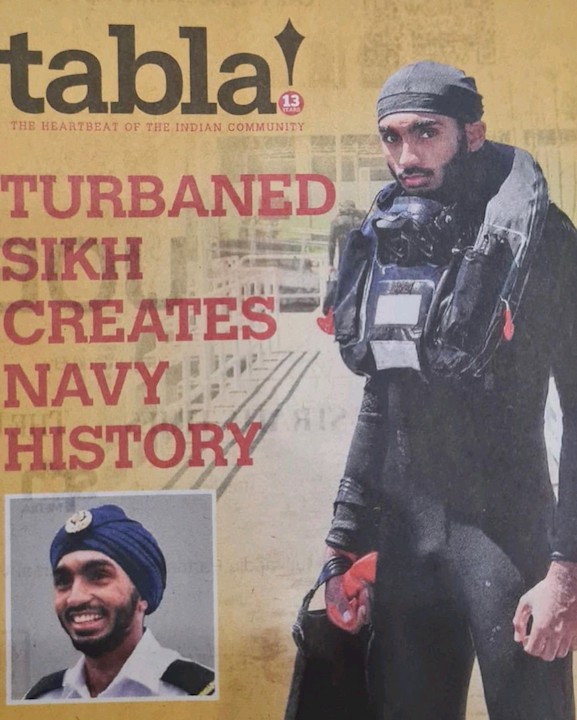
Corporatel Balraj Singh – Tabla

By Tabla | Singapore |

Corporal Balraj Singh is honoured that he has become the first turbaned Sikh in the history of the Singapore Navy to undergo and complete the intensive Combat Diver Course (CDC) of the elite Naval Diving Unit (NDU).

“While having long hair made it challenging, since we spend a lot of time in the water, I am glad to prove that it does not hinder Sikhs from becoming operational divers,” he told tabla!.

“Even without this added challenge, meeting the stringent requirements of the course was a personal achievement in itself.”

There have been Sikh NDU divers in the past, but CPL Balraj is the first turbaned Sikh with unshorn hair to graduate from the CDC.

The 19-year-old was initially shocked to receive the letter for diver vocational assessment and the subsequent letter stating that he would be enlisted into the NDU.

But he quickly overcame his apprehension and decided to take up the challenge.

“After finding out more, I decided to train to be a naval diver as not many are given the opportunity,” he said. “My parents were also very supportive.”

Father Harjit Singh, 55, is an army regular, while mother Rajbinder Kaur, 52, is a part-time accounts assistant. He is their only child.

CPL Balraj could swim decently as he had taken lessons when he was younger. However, his confidence in the water was not great.

“Combat diver training really honed my confidence and conditioned me to perform in more challenging waters,” he said. “The CDC was pretty challenging, especially in terms of the physical demands.

“However, playing hockey before enlisting helped me to adapt better to the demands as I was already physically fit.”

CPL Balraj played hockey for Raffles Institution and won the Schools A, B and C division titles with them.

He also played for the Singapore Khalsa Association in the National Hockey League (Division 1) and trained with the national developmental squad before enlistment.

CPL Balraj also found the CDC mentally challenging as some days were long and stretched into the wee hours when there were night dives.

However, the constant support from his parents, batch mates and instructors helped to spur him on to achieve his goals.

“My biggest challenge came during the last few weeks of the physical training phase when I came down with an ear infection,” he said.

“I was given medical leave for a few days and was excused from submersion for almost a week. As a result, I was able to attempt only my water confidence test on the second last day. But, with the advice and support of my instructors, I was able to complete the test in my second attempt.”

Being a Sikh with unshorn hair, he had to maintain the proper decorum and hygiene during the demanding course. CPL Balraj said minor adjustments helped him through.

“Once the course started, I had to make some adjustments,” he said.

“I began tying my hair behind in a man bun instead of the usual top knot so that I could carry the rubber dingy on my head safely. This arrangement made diving easier as well.

“I wore my swimming cap during swims and dives to maintain personal hygiene and washed my hair regularly even when there was limited time.”

CPL Balraj strived to keep in balance his commitment to country and faith. “As a Sikh, I chose not to cut my hair as a sign of respect to God,” he said.

“So, I made minor adjustments, like how I tie my hair and put in the effort to maintain my personal grooming and hygiene. This allowed me to not compromise my faith while training to be a naval diver.”

Read the full story, ‘Committed to country and faith’ (Tabla, 24 Dec 2021), here.

RELATED STORY:

Gold commendation for Aussie Sikh corporal with exemplary technical skills (Asia Samachar, 5 July 2021)

ASIA SAMACHAR is an online newspaper for Sikhs / Punjabis in Southeast Asia and beyond.Facebook | WhatsApp +6017-335-1399 | Email: editor@asiasamachar.com | Twitter | Instagram | Obituary announcements, click here 

Panch Khalsa Diwan Malaya supports Petaling Jaya gurdwara flood relief efforts

0

Balvinder (right) handing cheque to Awtar Singh – Photo: Supplied

By Asia Samachar | Malaysia |

Panch Khalsa Diwan Malaya (PKDM) came forward to support the gallant efforts led by Gurdwara Sahib Petaling Jaya (GSPJ) to assist flood victims in the Klang Valley and neighbouring states.

PKDM president Balvinder Singh handed a RM2,500 cheque to GSPJ committee president Awtar Singh (Terry) at the gurdwara compound yesterday (Dec 23). Also present were PKDM committee members Ajitpal Singh and Dr Jasbir Singh.

GSPJ has been spearheading a massive effort to cook hot vegetarian meals in the thousands, which are then sent direct to the victims by volunteers. They are also maintaining a call centre as well as collecting and distributing necessary items.

RELATED STORY:

Now you can eat gurdwara food ‘tanpa was-was’ (Asia Samachar, 22 Dec 2021)

ASIA SAMACHAR is an online newspaper for Sikhs / Punjabis in Southeast Asia and beyond.Facebook | WhatsApp +6017-335-1399 | Email: editor@asiasamachar.com | Twitter | Instagram | Obituary announcements, click here 

Former banker to lead Malaysia Singapore Sikh Sports Council

MSSSC new team: (L-R) Baljit Singh, Amerjet Singh, Sarjit Singh and Kesmahinder Singh

By Asia Samachar Team | Malaysia |

Malaysian-Singapore Sikh Sports Council (MSSSC) has elected a new team to run the seven decade old organisation for the next two years.

Former banker Baljit Singh Randhay from the organisation’s Negeri Sembilan affiliate has been appointed as president. The two deputy president slots went to Amarjet Singh from Selangor and Sarjit Singh Sona from Singapore Khalsa Association (SKA).

Keshmahinder Singh from Johore is secretary and Sarban Singh (Kedah) as the deputy, while Jagvinder Singh from Perak is the new treasurer with Sarban Singh (Kedah).

Its five vice presidents are Jesbere Singh (Kuala Lumpur), Hardev Singh (Perak), Sarban Singh (Selangor), Daljit Singh (Pahang) and Paramjit Singh (Johore).

The organisation was formed as the Malayan Sikh Sports Council (MSSC) on 31 July 1949 by a group of enthusiastic sports minded Sikhs with the intent to develop and promote sporting activities among the Sikh in Malaysia. In 1968, it was renamed MSSSC.

Since then, MSSSC has been organising sporting activities for Sikhs in Malaysia and Singapore, with the Gurdwara Cup as its signature event. The first ever Gurdwara Cup hockey tournament took birth in Ipoh, Perak, in 1952.

The challenge trophy was presented to MSSC by the Police Sikh Temple, Ipoh. The silver trophy has become a symbol of hockey supremacy for Sikhs in Malaysia and Singapore.

Over the years, other games were introduced at the Gurdwara Cup such as football, badminton, netball and golf. As such, the Gurdwara Cup games were named as the Gurdwara Cup & Sikh Festival of Sports.

RELATED STORY:

The games must go on (Asia Samachar, 26 June 2021)

ASIA SAMACHAR is an online newspaper for Sikhs / Punjabis in Southeast Asia and beyond.Facebook | WhatsApp +6017-335-1399 | Email: editor@asiasamachar.com | Twitter | Instagram | Obituary announcements, click here 

Seremban gurdwara preparing hot meals for Jelebu flood victims. Volunteers welcome

0

Volunteers at Gurdwara Sahib Seremban preparing hot meals for Jelebu flood victims – Photo: Supplied

By Asia Samachar | Malaysia |

Seremban gurdwara’s community kitchen (Guru Ka Langgar) will be a hive of activity for the next four days as they are preparing hot vegetarian meals for the flood victims in Jelebu and other affected areas in Negeri Sembilan.

“We started preparing meals today,” Gurdwara Sahib Seremban committee president Gurbachan Singh (Guru) told Asia Samachar. They start preparing the meals at 8am.

In Klang Valley, gurdwaras in Petaling Jaya, Subang and Shah Alam are actively involved in providing assistance to flood victims.

Heavy rain towards the end of last week had caused flash floods in a number of places, impacting thousands of families.

Volunteers at Gurdwara Sahib Seremban preparing hot meals for Jelebu flood victims – Photo: Supplied

RELATED STORY:

Now you can eat gurdwara food ‘tanpa was-was’ (Asia Samachar, 22 Dec 2021)

ASIA SAMACHAR is an online newspaper for Sikhs / Punjabis in Southeast Asia and beyond.Facebook | WhatsApp +6017-335-1399 | Email: editor@asiasamachar.com | Twitter | Instagram | Obituary announcements, click here 

JPA scholar Harmeet Kaur pursues mechanical engineering in Japan. She shares her experience

0

Harmeet Kaur in Japan: Left: Enjoying the cheery blossom; Right: Sports festival at the Niigata University – Photo: Supplied

By Harmeet Kaur | Japan |

I am from a small town in Cameron Highlands, Pahang. After getting good results in SPM, I was awarded with the JPA [Public Service Department] scholarship and got the golden opportunity to pursue my degree in Mechanical Engineering. While I was still digesting the fact that I will be going to a country that is known for their advanced technology, the two years in language school (INTEC Education College, Shah Alam) passed by speedily.

In Japan, I studied for three years at the National Institute of Technology, Nagano College and earned an Associate’s Degree in Mechanical Engineering.

While I was in Nagano, I lived in a students’ dormitory with Japanese students and other international students from all around the world. I also actively engaged myself in the various international exchange programmes, using that as a platform to communicate views and learn more about the cultural differences.

During my final year in Nagano College, I managed to secure a place at Niigata University to pursue my degree in Mechanical System Engineering. I am currently conducting research related to solar power generation as a final year project, graduating in March 2022.

During public holidays or semester breaks, I love travelling to other parts of Japan. There is this unique thing of Japan; every prefecture here has its own speciality that differs it from the others. Trying new food and exploring local places are things I really enjoy doing especially with the convenient public transport.

This journey of five years here was nothing but truly memories that I will treasure forever. I would not have made it this far if it wasn’t for the support and love from my beloved parents and sister, who studied abroad herself. I am looking forward to fully utilize not only the knowledge and technical skills, but most significantly the experience that I gained from this beautiful country of the rising sun.
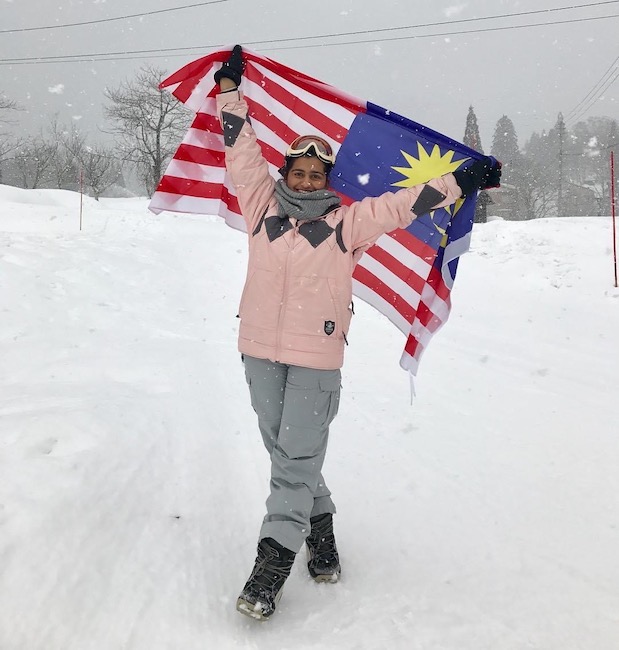
Harmeet Kaur’s father is retired policeman Gurbachan Singh while mother is housewife Surjit Kaur. Her sister Manmeet Kaur is a medical doctor

RELATED STORY:

Sikh student wins Chevening scholarship, gets to pursue Master of Laws at Nottingham (Asia Samachar, 21 Oct 2020)

ASIA SAMACHAR is an online newspaper for Sikhs / Punjabis in Southeast Asia and beyond.Facebook | WhatsApp +6017-335-1399 | Email: editor@asiasamachar.com | Twitter | Instagram | Obituary announcements, click here