












UA-56202873-1
Page 388

Principal Tara Singh: Father of Engineering Education in Punjab

3
Principal Tara Singh. Right: After his return from London (1940)

By Hardev Singh Virk | Opinion |

Tara Singh was born in village Thetharke, inhabited by Jat Sikh Randhawas in the vicinity of Dera Baba Nanak, presently on the border of Pakistan in District Gurdaspur on 1st Feb., 1899. His family was not rich but of moderate means. His father Bagh Singh owned a few acres of land in the village but he was keen to educate his son. Tara Singh received his primary education in Government Primary School, Dharamkot Randhawa. He passed his Matriculation examination from Government High School at Dera Baba Nanak in the First division and securing First position in the district. At that time, Gurdaspur district was so backward in education that he had to travel to Amritsar for appearing in Matriculation examination. It was his first trip to Amritsar and first experience of train travel.

He joined Khalsa College, Amritsar as a science student and passed F.Sc. (Intermediate in Science) in 1918 securing First division. Encouraged by his Science teachers, he joined Thomson College of Engineering, Roorkee (1847-1949), one of the oldest in Asia, and completed a dual degree course in Mechanical and Electrical Engineering in 1921 with Honours in both. He brought laurels to his family, the Sikh community and his home state Punjab by standing FIRST in the Thomson College. This College was upgraded to University of Roorkee in 1949 and then to Indian Institute of Technology (IIT) in 2001. He joined N-W Railway as Apprentice Engineer for practical training of two years to complete the requirement of his engineering degree.

Tara Singh was highly qualified for any job in the engineering services of British India but he preferred to join teaching profession. He joined as Vice-Principal of Victoria Diamond Jubilee Hindu Technical Institute, Lahore in 1923 and taught there for 3 years. It may be of interest to know that this Technical Institute was first of its kind set up for commercial and industrial development of Punjab in June 1897, coinciding with the Golden Jubilee celebrations of Queen Victoria in India. Its inaugural address was delivered by Professor Ruchi Ram Sahni, himself a brilliant Scientist in area of Chemistry and a great promoter of Science in Punjab, on 21st June, 1897. When Puran Singh returned from Tokyo University after his training in Pharmaceutical Chemistry in 1904, he was made its Principal but he left to join FRI (Forest Research Institute), Dehradun in 1906.

Tara Singh joined as Lecturer in Maclagan Engineering College of Lahore in 1926. This college was founded by Sir Edward Douglas Maclagan, the Governor of Punjab in 1923 under the name Mughalpura Technical College, which was renamed as Maclagan Engineering College in 1925, to commemorate the services of the Governor to Punjab. After Partition of India, it gave birth to two institutions; University of Engineering and Technology, Lahore in Pakistan and Punjab Engineering College, Chandigarh, now a deemed university of Indian Punjab.

Tara Singh started his long innings in engineering education in Punjab after joining this premier institution. He was among the founding members of its teaching faculty and perhaps the first Indian and a Sikh to teach in this college. He started as Lecturer in Mechanical engineering department but shifted to Electrical engineering after two years where he continued to teach for next twelve years. In 1937, he was sanctioned study leave and he joined London University. He passed B.Sc. (Hons.) in Civil Engineering from London University and returned to join as Assistant Professor of Civil engineering in this college in 1940. He was promoted as Professor of Civil engineering in 1944.

Tara Singh with his vintage car in London University (1938)

As a biographer of Tara Singh, I fail to comprehend why he changed his field from Mechanical/ Electrical to Civil engineering. Why he did not opt for higher studies to Master/ Doctorate level in his chosen profession? The only reason which comes to my mind must be some obligation of his study leave for which he had to opt for Civil engineering. Perhaps, Tara Singh wanted to make a hat trick by completing a full-fledged course in Civil engineering in London. He is a rarest of the rare teachers who was qualified to teach all three branches of engineering in India. After his return to Punjab, he continued to teach Civil engineering till the last before his retirement. He was a popular teacher in Theory of Structures and Strength of Materials in Civil engineering education in India.

After partition of India, Maclagan College, renamed as Punjab Engineering College, was temporarily shifted to Roorkee in United Provinces (UP) on the campus of Thomson College of engineering. It was shifted to Chandigarh, the new capitol of Punjab, in 1955. Tara Singh remained as Professor and Head of Civil Engineering and Vice-Principal of this college for seven years from 1948 – 1954. He was promoted as Principal when the College shifted to its new campus in Chandigarh in 1955. He retired as Principal on 31st May, 1956.

Punjab and Bengal were the only two states which were divided during Partition of India in 1947. After Partition, east Punjab joined India and west part became Pakistan. For the development of Indian Punjab, new Universities and Engineering Colleges were created. Guru Nanak Engineering College (GNEC), Ludhiana and Thapar College of Engineering and Technology (TIET), Patiala were both founded in 1956. The foundation stone of GNEC was laid by Dr. Rajindra Prasad, the first President of India on 8th April, 1956. Nankana Sahib Educational Trust (NSET) was set up to run this College. The land for this College was donated by the Panchayat of Gill village and the present Campus is located in the Gill Park.

NSET was in the lookout for a suitable Principal of GNEC. What a coincidence? Tara Singh retired on 31st May 1956 from Punjab Engineering College, Chandigarh and joined as Principal of GNEC on 1st June, 1956 without enjoying a single day of retirement. He was a stalwart of engineering education in Punjab and hence the best choice for this Sikh institution. He started from a scratch and built this institution with full zeal and dedication into a global institute of engineering education. He served as Principal for 14 years and retired on 30th June, 1970. After his retirement, he was appointed as Director of GNEC but he left after three months.

Foundation Stone of GNEC laid by President of India (1956)

GNEC is one of the premier institutions of Northern India. It caters to the needs of rural areas of Punjab and the Sikh community. The admission rules allowed 70 percent reservation quota for students who had passed their primary, middle or high school examination from rural areas of Punjab. As a minority institution, it has 50% reservation for the Sikh community. In the beginning, it was affiliated to Punjab University, Chandigarh but presently, it is affiliated to Punjab Technical University (PTU) Jalandhar. It is the first engineering college of Punjab which has been conferred the Autonomous Status by University Grants Commission, New Delhi since 2012.

In 1956, there was lack of highly trained engineering faculty in Punjab. Principal Tara Singh took special care in recruitment of faculty. He was heading a private institution but always took decisions on merit without bothering about political interference which was rampant in Punjab. Teaching standards were so high that most of the Toppers of Punjab University in Engineering disciplines belonged to GNEC. This college was known for its discipline. Principal Tara Singh was a strict disciplinarian; he used to check the entry of students and teachers as his daily routine. Punctuality of teachers was an order of the day. I served GNEC for two years (1963-65) in Applied Physics Department and can vouchsafe for the integrity, honesty of purpose and discipline maintained by the Principal.

Tara Singh expired in 1992 at the ripe old age of 93. He left behind two sons, late Er. Prahlad Singh retired as Chief Engineer from department of Irrigation in Punjab. The younger, Gurcharan Singh Randhawa, retired as Comptroller Punjab Agriculture University, Ludhiana. His daughter, Parkash Kaur was married to late Er. Parshan Singh Dhesi, retired as Managing Director, Punjab Tubewell Corporation.

Tara Singh left behind a rich legacy in the shape of GNEC and its students who are serving all over the globe. The GENCO Alumni Association has its Chapters all over North America and Europe. GNEC graduates (Genconians) have found success in a variety of diverse fields including cultural, political, public and private sectors in India and abroad.

Principal Tara Singh can be rightly called the Father of Engineering Education in Punjab. He rose from the grassroots level of Rural Punjab where education was not given any importance in farming communities during early twentieth century. He was a teetotaler and believed in the motto “simple living and high thinking”. He always took interest in the education of poor students. He believed that the real function of a teacher is not so much in imparting knowledge as in inspiring the pupil and instilling a spirit to learn. He was a real Role Model of students of rural Punjab in engineering education.

Acknowledgement: I am grateful to Sardar Gurchran Singh Randhawa (Ludhiana), son of Principal Tara Singh for providing the salient features of life history of his father. I owe my thanks to Dr. Surinder Kaur Randhawa, d-in-law of Tara Singh and Doctor Rupi Virk of San Jose, California, for the supply of Photos of her grandfather. Dr Jaswant Singh Bhatti, an old colleague of GNEC and active member of GENCO motivated me for this write up.

Scholar and scientist Hardev Singh Virk retired from Amritsar-based Guru Nanak Dev University in 2002 after serving as Founder Head Physics Department and Dean Academics. Ex-Professor of Eminence, Punjabi University, Patiala. He is the present Visiting Professor at SGGS World University, Fatehgarh Sahib (Punjab), India. 

RELATED STORY:

Sikh engineer shifting gears at China carmaker Geely (Asia Samachar, 11 Feb 2020)

Betrayal of the Sikh Community (Asia Samachar, 11 May 2019)

ASIA SAMACHAR is an online newspaper for Sikhs / Punjabis in Southeast Asia and beyond. Facebook | WhatsApp +6017-335-1399 | Email: editor@asiasamachar.com | Twitter | Instagram | Obituary announcements, click here |

All eyes on Navjot Kaur and her finishing touch

By Asia Samachar| India  |

Navjot Kaur became the toast of India as she netted the solitary goal that would sink Australia and send the Indian women hockey team into the semifinals of the Olympic 2020 at Tokyo. The field hockey made history as this would be the first time they made it into the semi-finals at the Olympics.

The victory was all the more sweeter knowing that they had just beaten three-time champions Australia.

Drag-flicker Gurjit Kaur rose to the occasion when she converted India’s lone penalty corner in the 22nd minute to surprise the Australians.

On Wednesday (4 Aug 2021), they face Argentina in the semifinal .

At 25, Navjot is already one of the most experienced players in the squad and is growing into her role as a finisher. Navjot’s role is a vital one – to bury the chances her teammates create. In a sense, she is the tip of the spear. It is her role to finish off the opposition and with each game, she seems to be getting even better at that.

“The finisher’s job is very critical for any side,” she says. “The entire team puts in the effort of creating openings and then the finisher has to find the back of the net. There’s a lot of pressure that comes with the job, but I enjoy it and make sure that I put myself into good positions in every match.”

Her father, a mechanic, encouraged young Navjot to make a mark in hockey, which she took to in the sixth grade. “She was around 11-year-old when she started practicing. I had never imagined that she will be playing in such an intense Olympics match,” he said in one interview. Navjot is eldest of the three siblings.

Navjot and fellow teammates – skipper Rani Rampal and Navneet – all hail from Shahabad , a town in Kurukshetra.

RELATED STORY:

‘Papa couldn’t afford to buy me a stick’: Indian women’s hockey team captain Rani Rampal shares inspiring journey (Asia Samachar, 2 Aug 2021)

ASIA SAMACHAR is an online newspaper for Sikhs / Punjabis in Southeast Asia and beyond.Facebook | WhatsApp +6017-335-1399 | Email: editor@asiasamachar.com | Twitter | Instagram | Obituary announcements, click here |

‘Papa couldn’t afford to buy me a stick’: Indian women’s hockey team captain Rani Rampal shares inspiring journey

By Indian Express | India  |

‘Papa couldn’t afford to buy me a stick’: Indian women’s hockey team captain Rani Rampal shares inspiring journey

Indian women’s hockey team skipper Rani Rampal became the youngest player in the national team for 2010 World Cup at the age of 15.

The 26-year-old, who participated in the Olympics this year, shared her inspiring journey on the Humans of Bombay page recently.

Hailing from Shahabad Markanda in the Kurukshetra district of Haryana, Rampal talked about how she started practising with a “broken hockey stick”. With her father working as a cart-puller and mother as a househelp, it became difficult to make ends meet. “I wanted an escape from my life; from the electricity shortages to the mosquitoes buzzing in our ear, from barely having two meals to seeing our home getting flooded. There was only so much my parents could do — Papa was a cart puller and Maa was a maid.”

Tokyo Olympics: India rejoices women's hockey team's semi-final spot: India's women's hockey team has scripted history after qualifying for the semi-finals of the Olympics for the first time with a stunning 1-0 victory. They beat Australia, who had been looking for their first medal since securing a podium finish in Sydney in 2000, in the quarter-finals. India's Gurjit Kaur scored the match's only goal in the second quarter. - BBC (2 Aug 2021)

Rampal developed an interest in hockey once she started spending hours watching the game at a nearby academy. “Every day, I’d ask the coach to teach me. He’d reject me saying, ‘You aren’t strong enough to pull through a practice session.’ So, I began practicing with a broken hockey stick-I used to run around in a salwar kameez. But I was determined,” she said, adding that she finally managed to convince the coach too.

Rampal’s family, however, were not in favour of watching their daughter play in a skirt. “I’d plead, ‘Please mujhe jaane do (please let me go). If I fail, I’ll do whatever you want.’ My family gave in.”

In 2017, she fulfilled her dream of buying a home for her family. “We cried and held each other tightly! And I’m not done yet,” she wrote.

Read the full story, ‘Papa couldn’t afford to buy me a stick’: Indian women’s hockey team captain Rani Rampal shares inspiring journey (The Indian Express, 28 July 2021), here.

RELATED STORY:

Tokyo 2020: Hockey India names Rani Rampal, Manpreet Singh to lead India (Asia Samachar, 23 June 2021)

ASIA SAMACHAR is an online newspaper for Sikhs / Punjabis in Southeast Asia and beyond.Facebook | WhatsApp +6017-335-1399 | Email: editor@asiasamachar.com | Twitter | Instagram | Obituary announcements, click here |

Jagjit Singh (1971-2021), Seri Kembangan

PATH DA BHOG:  11am, 10 Aug 2021 (Tuesday) at Gurdwara Sahib, Serdang Lama, Selangor (In view of MCO, the Gurdwara will comply with the Standard Operating Procedure as set out by the authorities for places of worships which is only 5 immediate family members will be prioritized. Facebook Live will be shared  | Malaysia

A Noble and Caring Soul with lots of Compassion and Humbleness.

Will be deeply missed and forever remembered by loved ones

JAGJIT SINGH S/O PREM KUMAR

11th May 1971 – 29th July 2021)

Parents: Late Prem Kumar @ Pritam Singh and Late Sardarni Swaran Kaur.

Grandson of the Late Sardar Gurdit Singh (J.P), of Quarry Road, Brinchang, Cameron Highlands.

Path Da Bhog & Antim Ardas: 11am, 10 Aug 2021 (Tuesday) at Gurdwara Sahib, Serdang Lama, Selangor

In view of MCO, the Gurdwara will comply with the Standard Operating Procedure as set out by the authorities for places of worships which is only 5 immediate family members will be prioritized. Facebook Live will be shared

| Entry: 2 Aug 2021 | Source: Family

ASIA SAMACHAR is an online newspaper for Sikhs / Punjabis in Southeast Asia and beyond.Facebook | WhatsApp +6017-335-1399 | Email: editor@asiasamachar.com | Twitter | Instagram | Obituary announcements, click here |

Bhai Lalo or Malik Bhago: Where do you stand?

3

Indian farmers at one of the Delhi protest sites – Photo: Kisan Ekta Morcha

By Gurnam Singh | Opinion |

One of the positive outcomes of the historic ongoing Indian farmer’s protest on the borders of Delhi that has been running for almost a year is the establishment of unity amongst progressive forces in ways that cut across lines of race, religion, class/caste, gender, and politics. Of particular note was a recent press conference. It involved the Sikh scholar Sarabjit Singh Dhanda, US activist medic Dr. Svemaan Singh and farmers union leader and known Marxist Joginder Singh Ugraha standing shoulder to shoulder.

Following the terrible events of June 1984 and for some decades afterward, much animosity and acrimony existed between progressive leftist groups and Sikhs activists. However, this encounter offers hope that the mistrust and ideological tensions may just be diminishing. The irony is that many Sikh activists that lost their lives at the hands of the Indian state, had formerly been involved in Naxalite movements that too were brutally repressed by the state. As well as being inspired by Marxist ideas, as their literature reveals, the Naxals were also infused by the revolutionary traditions of the Sikh Gurus. So in seeing what were previously disparate factions together on one platform, having identified the real enemy, I get a real sense that a unity of purpose is emerging.

For sure, some will object to this rapprochement. The Hindutva inspired forces, many of whom have infiltrated key Sikh bodies, as well as some of the more blinkered leftists, will not be happy. However, in reality, given their common social program, one cannot separate the revolutionary project of Guru Nanak and leftist ideas associated with the German political philosopher, Karl Marx. Though their respective historical contexts were quite different, in terms of aspirations for ordinary people, arguably there is considerable overlap between the two of them.

Over the years, through a combination of failed communist states and right-wing demonization, the idea of communism has become tarnished; some even argue it belongs to the dustbin of history, and that following the collapse of the Berlin Wall in 1989, as the American political theorist Frances Fukuyama proclaimed, the triumph of liberal capitalism represented the ‘End of History!’

No doubt communist and socialist parties have been on a steep decline over the past 40 years, but that does not mean the basic challenges facing humanity, namely of inequity and human misery, that both Marx and Nanak identified, are not important anymore! In truth, the battle between the have’s and have not’s, the rich and poor, or if you, between the Malik Bhago’s and Bhai Lalo’s of this world, continue to rage.

In simple terms, communism represents a political system in which property is collectively owned by the community and each person contributes and receives according to their ability and needs. Under these circumstances, each and every human being can engage in a creative and productive life. And if this is the theory, then as well as offering his unique conception of equality and the collective good, Guru Nanak went one step further and established such a utopian arrangement at Kartarpur.

Both Nanak and Marx rejected social division of caste/class, both were critical of individuals accumulating excess wealth, both were against the enslavement and impoverishment of the majority of the population, both supported women’s empowerment, both felt religion was used ideologically by the ruling elites to divide people rather than enabling them to realise their common interest and true potential, and both emphasized the importance of reason and critical thinking.

As for the question of religion, in their unique ways, both identified the divisive nature of religious dogma and rejected the idea of a metaphysical God sitting in judgment in ‘Heaven’. Indeed, underlying their determination to break free from past dogma, both even rejected the beliefs of their parents. Born into a ‘high caste’ Khatari Brahmin family, Nanak rejected beliefs and rituals associated with Brahmanism. Similarly, Marx, who was being groomed to become a Christian priest, turned his back on religion altogether, proclaiming it to be at best only capable of offering temporary emotional support to deep-rooted material inequality. And at worst is simply added to false consciousness and hence allowed suffering to continue.

Both Nanak and Marx were perused that only through a radical transformation of society could ordinary people become truly free. And this would mean a complete redistribution of wealth and power, away from the ruling elites, and priestly classes that were being deployed by the elites to control the minds of the masses. For sure, Nanak and Marx were different people in many respects. Their cultural contexts were quite different, Nanak emerges in the late 15th Century in medieval and largely rural Panjab whereas Marx appears 400 years later in the 19th Century in the midst of the industrial revolution in Europe.

But despite this gap, I have no doubt, they shared a utopian vision where all people could live a useful, creative fulfilling life free from violence and oppression. And in this regard, I have no doubt they had a common vision of a much kinder and more caring world, if you like, they both wanted to create Heaven on Earth.

Gurnam Singh is an academic activist dedicated to human rights, liberty, equality, social and environmental justice. He is an Associate Professor of Sociology at University of Warwick, UK. He can be contacted at Gurnam.singh.1@warwick.ac.uk

* This is the opinion of the writer and does not necessarily represent the views of Asia Samachar.

RELATED STORY:

Towards a more loving, sharing and caring world in 2021 (Asia Samachar, 22 Dec 2020)

ASIA SAMACHAR is an online newspaper for Sikhs / Punjabis in Southeast Asia and beyond. Facebook | WhatsApp +6017-335-1399 | Email: editor@asiasamachar.com | Twitter | Instagram | Obituary announcements, click here |

‘Questions will always remain’: Sikhs respond to FedEx shooting investigation findings

By Natalia E. Contreras | Indianapolis Star |

Some Sikh Hoosiers say uncertainty is lingering as many questions remain unanswered after law enforcement concluded their investigation of the FedEx mass shooting that claimed the lives of eight people in April, including four Sikhs.

On Wednesday, Indianapolis police and FBI officials ruled out racial bias as a motive and said the mass shooting was “an act of suicidal murder.”

In the evidence, FBI Special Agent in Charge Paul Keenan said “there was some viewing of mainly WWII, Nazi propaganda,” but that it was an extremely small percentage of the 19-year-old gunman’s overall media consumption.

“There was no evidence of animosity against the Sikh community,” Keenan said.

A majority of the workers at the FedEx Ground Facility were immigrants and members of the Sikh community. Many felt they were targeted when the shooting happened.

Amrith Kaur, Sikh Coalition legal director, said more facts need to be released explaining exactly what led investigators to rule out racial bias.

Kaur said ruling out bias without more details dismisses and fails to acknowledge the experiences of the Sikh community and of all marginalized groups that have been victimized by hate violence.

“How do you completely rule out what all of these other things could include? Because the one person that can confirm that for you, or deny it, is dead,” Kaur told IndyStar. “They say the investigation is over but for all of the families who lost loved ones and the survivors, the Sikh community, and everybody that has been impacted by violence like that, those questions are always going to remain.”

The Sikh Coalition, which includes attorneys, has been acting as legal representation and advocating for two survivors of the shooting and the family of one of the victims who was killed.

The victims who died were identified as Amarjeet Kaur Johal, 66; Karli Smith, 19; Matthew R Alexander, 32; Samaria Blackwell, 19; Jasvinder Kaur, 50; Jaswinder Singh, 68; Amarjit Sekhon, 48 and John Weisert, 74.

Read the full story, ”Questions will always remain’: Sikhs respond to FedEx shooting investigation findings’ (Indianapolis Star, 28 July 2021), here.

RELATED STORY:

Four Sikhs, including a grandmother, among 8 killed in Indianapolis FedEx mass shooting (Asia Samachar, 17 April 2021)

ASIA SAMACHAR is an online newspaper for Sikhs / Punjabis in Southeast Asia and beyond.Facebook | WhatsApp +6017-335-1399 | Email: editor@asiasamachar.com | Twitter | Instagram | Obituary announcements, click here |

Naranjan Singh Gill (1961 – 2021), Klang

SARDAR NARANJAN SINGH GILL S/O MEHENDAR SINGH GILL

Passed away peacefully on 30th July 2021.

A Noble and Caring Soul with lots of Compassion and Humbleness who will be deeply missed and forever remembered by loved ones.

In light of the MCO and SOPs in place, Sehaj Path da Bhog will be held on Sunday, 29 August 2021 @ Gurdwara Sahib Klang @ 8.30am as a private affair, limited to immediate family members only. We thank everyone for their kind understanding, support, messages of condolences and prayers.

For more details contact:

Mr Ranjeet Singh (Brother) @ 0122167872

Mr Naranjan Singh (Brother-in-Law – Police) @ 0196171140

| Entry: 1 Aug 2021; Updated: 26 Aug 2021 | Source: Family

ASIA SAMACHAR is an online newspaper for Sikhs / Punjabis in Southeast Asia and beyond.Facebook | WhatsApp +6017-335-1399 | Email: editor@asiasamachar.com | Twitter | Instagram | Obituary announcements, click here |

Amazing athlete Maan Kaur dies at 105

By Asia Samachar| India |

Awe-inspiring veteran athlete Maan Kaur passed away on Saturday (31 July 2021). She was 105.

After battling with gall bladder and liver cancer for six months, Mann suffered a cardiac arrest and passed away at a hospital near Chandigarh, a month after being hospitalised.

Her 82 year-old son and coach Gurdev Singh was by her side.

In 2019, Maan took part in the 21st Asia Masters Athletics Championship hosted by Sarawak. At 103, she was reportedly the oldest participant of the championship.

The centenarian had been on liquid diet and had been treating the disease with the help of homeopathic medicines, as operation was not an option at her age, according to media reports.

Born in Patiala on March 1, 1916., Maan took took up athletics at 93.

In 2016, she was declared the fastest centenarian at a competition in the American Masters Games. In the World Masters Games 2017 in Auckland, she completed the 100-metre sprint in 74 seconds.

In 2019, she competed in Poland winning four events in her category: Shot put, 60m sprint, 200m and the javelin. In 2019, she won the gold in the 200m dash and shot put at the Asian Masters Championship in Malaysia.

As a young girl, Sardarni Man Kaur, 103, did not receive any education. However, her late father taught her to read and write in her mother tongue Punjabi. She also studied the Sikh scripture.

Wanting her to maintain a fit lifestyle, eldest son Gurdev Singh had asked his mother to run the track field. “She had no problems doing so at the age of 93 in 2009,” he said.

Ever since then, she enjoyed running and had quickly improved. Two years later, she joined her first competition.

With three children on board, the centenarian represented India in the World Masters Athletic Championship held in the US where she had won two gold medals in the 100- and 200-metre races. From there, she had broken the existing world record and was declared Athlete of the Year 2011.

She will be cremated on Sunday (1 Aug).

RELATED STORY:

The life of a 103-year-old grandmother (Asia Samachar, 23 Dec 2019)

ASIA SAMACHAR is an online newspaper for Sikhs / Punjabis in Southeast Asia and beyond.Facebook | WhatsApp +6017-335-1399 | Email: editor@asiasamachar.com | Twitter | Instagram | Obituary announcements, click here |

The blanket at Punjabi weddings

5

By Dr. B.S. Bains Opinion |

Milni is a Sanskrit Derivative; meaning union of two. Milni at the Punjabi wedding ceremony is the meeting of the bride and groom’s families.

In the Punjabi tradition the groom travels to the bride’s home town or village to get married. The parents of the groom will invite his close relatives and associates to form an entourage who would follow the groom to witness and solemnize the wedding. This entourage is called baraat. Some dialects in Punjab call this a jan-jh.

BARAAT

In the past, Punjab was not well connected by roads and good transportation as it is today. In fact, the whole of India was not well connected. The means of travel were bullock carts, horses and elephants; depending on the socio-economic condition of the family.

A baraat sometimes travelled for days breaking journey in homes of relatives or gurdwaras of the villages, before they would reach their destination. With poor infrastructures and distant market places, the baraatis (baraat members) would carry trunks (metallic luggage used during those days in travels) stuffed with food and even stoves to cook.

Imagine them travelling in their traditional clothing for miles on their charts. They did not have simple clothes like jeans and shorts as we do today. Their toothbrushes were literally twigs of the Acacia trees. They would need to fetch water from wells and lakes during their travels. Over and above, there were poor toilet system.

Women were not allowed to form the component of the baraat as they would face much inconvenience. During those days there were poor sanitary systems to cater for their menstrual needs. Uncomfortable night-stays and lengthy travelling were main reasons for them not to be included in a baraat. Apart from this, there were plenty of dacoits to encounter in their travels who would attack and loot the jewelry and belongings of the women. Ladies in those days would vail themselves to shy away from males.

In that cumbersome condition, travelling for days would definitely pose a challenge to women. Last but not the least, men would get intoxicated with wine and drinks by night and are bound to misbehave. To avoid such circumstances that could cause unnecessary injuries to the baraatis’, the ladies were prohibited. Further to give a twist to this prohibition, bad omen of fear, like women in baraat would bring bad luck if the newly wedded couple were linked to it. Tales like the couple will not enjoy longevity and would not bear children were among the common curses linked to this prohibition. If unmarried girls follow a Barat then they are likely to remain unmarried. All these fear created a complex in the Punjabi women’s world in the yesteryear. For this reason, even today mothers of the groom are not allowed to witness the Gurdwara circumambulate (laavaa) ceremony.

Today things have changed with good travel infrastructures, good comfortable hotels to rest in. Hence, ladies are well encouraged to be part of the baraat. Infact their involvement has indeed added more colors and life to the baraat. Today the baraatis are more glorified with bands and decorated horses. In the olden days they would carry a drum (dholki and chamtta – traditional musical instruments) to play the songs sung by the baraatis while on the journey and at the time of milni.

DURING THE MILNI

The baraat would advance towards the home or the allocated point of meet with dances, drums and singing. At a final point, everything will stop with prayers in unison just as both parties come face to face. This prayer (supplication) is normally conducted by the granthi from the bride’s side.

The elder members of the two families will greet each other. The member from the bride would welcome the groom’s leader (usually the father), the groom and the entire baraat with a token of appreciation. Some would present their appreciation with a gold ring and some would present a gold bangle. They would then garland each other and hug as a sign of friendship in Punjabi culture.

PRESENTING BLANKET

A blanket is presented to the leader of the baraati. This is a significant gesture that most of us might not know. It is done with utmost respect and with some money placed underneath.

The blanket is a representation of honor, respect, love, care, protection, warmth and comfort. There is a silent message of the father of the bride.

“My daughter represents all these above virtues of my home, and today onwards I present this Bundle of Love to you and your family!”

“Hey the elderly of the groom, please make sure our love is not denied of all these which she enjoyed while I groomed her from childhood till today…Give her all the warmth, care, love and appreciate her for existence… She might err, let that not be a reason to shower hatred over her… To the members of the Baraat…You shall be the witness to this if she is denied of any…”

This blanket is presented. The groom’s father accepts it with respect and the money is returned to the bride’s father in a gesture that silently would say that, ”She is worth more than this” and a sense of promise is conveyed, that “every care shall be given to her in all possible manner.” These are hidden expressions deem present during this part of the ceremony.

Both the parents then hug each other. Sometimes counterpart uncles and aunties would hug each other as well. This is then followed by the baraatis being ushered to breakfast before the wedding ceremony commemorates.

SIGNIFICANCE OF BLANKET

We, the Sikhs would all know the title that is given to our 9th Guru Sahib, Guru Teg Bahadur Ji. He is titled Hind-Ki-Chaddar. Meaning “The Blanket of Hindustan”. To provide the then citizens of Hindustan freedom from Mogul tyranny he sacrificed his life. The Mogul were forcing the citizens to embrace Islam or face their sword. Guru Ji himself in the earlier instance denied conversion to Islam. Guru ji was very influential in the Indian Northern Province. By threatening Guru Ji to a decapitation punishment, Emperor Aurangzeb thought that the Guru would condone to conversion to Islam in fear any every of his followers would follow suit.

Instead Guru Ji stood firm agreeing to the punishment by giving his head away to fulfill the promise to save his fellow citizens from torture and assault. Guru Ji surrendered himself and was executed by way of decapitation of his head on 24th November 1675, at Sees Gunj, in front of Red Ford, Delhi. It was the darkest days in the Sikh history. Thousands of fellow Hindustani witnessed this cruelty. India had then declared a provisional, non-gazetted national holiday, in the memory of this heroic gesture of the great Sikh Guru and titled him as Hind-Ki-Chaddar.

SIGNIFICANCE OF BLANKET AT HOME

When the father or the mother checks in on their children in their bedroom while they are asleep, they would pull up the blankets over them to ensure warmth, comfort and care.

So a blanket commemorates Love, Care and Comfort in the Indian culture. Hence the significance of the blanket in Milni unifying two families.


Dr Balwant Singh Bains is a Malaysia-based kirtan enthusiast and a practicing physiotherapist with a chain of physiotherapy clinics.


RELATED STORY:

A colourful Punjabi wedding (Asia Samachar, 29 Nov 2019)


ASIA SAMACHAR is an online newspaper for Sikhs / Punjabis in Southeast Asia and beyond. Facebook | WhatsApp +6017-335-1399 | Email: editor@asiasamachar.com | Twitter | Instagram | Obituary announcements, click here |

Missing Person: Surgit Singh from Puchong

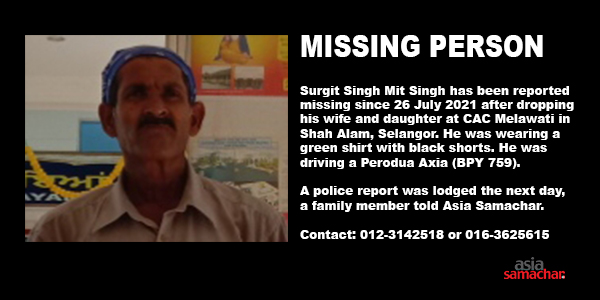
Missing Person | Puchong, Malaysia: Surgit Singh Mit Singh has been reported missing since 26 July 2021 after dropping his wife and daughter at CAC Melawati in Shah Alam, Selangor. He was wearing a green shirt with black shorts. He was driving a Perodua Axia (BPY 759).

A police report was lodged the next day, a family member told Asia Samachar.

If you have seen him or have any information, contact persons: 012-3142518 or 016-3625615

ASIA SAMACHAR is an online newspaper for Sikhs / Punjabis in Southeast Asia and beyond.Facebook | WhatsApp +6017-335-1399 | Email: editor@asiasamachar.com | Twitter | Instagram | Obituary announcements, click here |