Great Grandchildren: Gyan Kaur, Brahmvir Singh, Rahana Kaur, Kyra Kaur
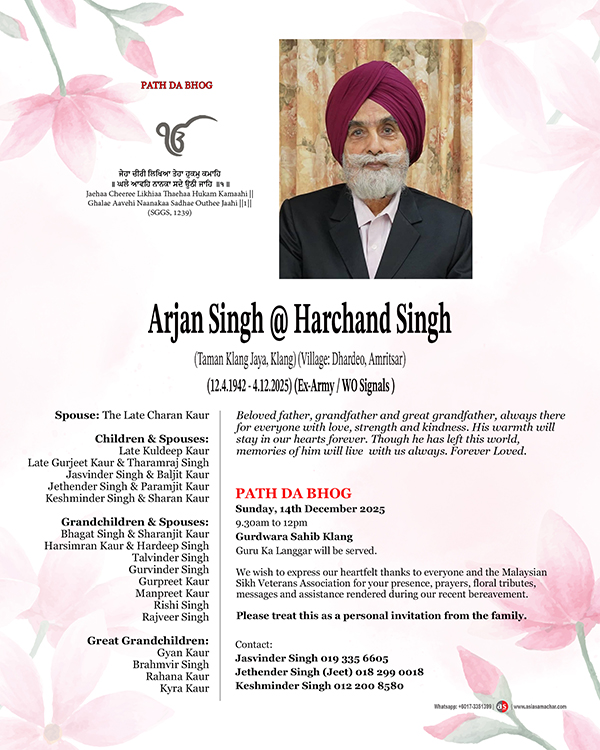
Village: Dhardeo, Amritsar
Beloved father, grandfather and great grandfather, always there for everyone with love, strength and kindness. His warmth will stay in our hearts forever. Though he has left this world, memories of him will live with us always. Forever Loved.
Antim Ardas Bhog will be held on 14th December 2025 (Sunday) from 9.30am to 12pm at Gurdwara Sahib Klang.
Guru Ka Langgar will be served.
We wish to express our heartfelt thanks to everyone and the Malaysian Sikh Veterans Association for your presence, prayers, floral tributes, messages and assistance rendered during our recent bereavement.
Please treat this as a personal invitation from the family.
| Entry: 4 Dec 2025: Updated: 9 Dec 2025 | Source: Family
ASIA SAMACHAR is an online newspaper for Sikhs / Punjabis in Southeast Asia and beyond. You can leave your comments at our website, Facebook, Twitter, and Instagram. We will delete comments we deem offensive or potentially libelous. You can reach us via WhatsApp +6017-335-1399 or email: asia.samachar@gmail.com. For obituary announcements, click here
Time, the most fundamental, yet most mysterious dimension of existence, stands at the core of what it means to be a human being. Arguably, without a conception of time, i.e. past, present and future, we would have no sense of history, identity or purpose. It is almost unimaginable to conceptualise human consciousness, psychology, culture and society without the conception of time. It was no other than the 4th Century Christian theologian and philosopher, St. Augustine, who speculated that time might be an extension of the mind itself.“What, then, is time? If no one asks me, I know what it is. If I wish to explain it to him who asks, I do not know”. (O’ Donnell, 1992))
This article considers the concept of time and the unique Sikh philosophical perspective on this. In doing so, as well as exploring different scientific, cultural and religious conceptions of time, it speculates on what insights we can draw from Gurbani on the nature of time and timelessness.
Conceptualising Time
The concept of time is a universal organizing feature of all human societies. It provides the essential framework for memory, anticipation, and the coordination of social life. Historically, across cultures, time has been understood through the cyclical rhythms of the natural world. These rhythms include the basic division of day and night, the broader cycles determined by the movement of the moon and sun. Time is also associated with weather and the seasons which govern sustenance and agriculture. And at a more fundamental, time is connected to the intrinsic, non-repeating biological mechanisms of physical life and death.
In modern society, the perception and experience of time is significantly shaped by technology and patterns of work, travel and functioning of industry and organisations. Tools such as mobile phones, watches, clocks, calendars, and diaries have standardized time into precise, uniform, and linear units (seconds, minutes, hours, days, weeks, months and years), transforming it from a natural phenomenon into a measurable and shared social construct.
Chronos and Kairos
This standardisation of time, which the Ancient Greeks termed ‘Chronos’, is woven into the functioning of our lives in ways that is unimaginable to think outside of this framing. The other conception of time conceptualised by the Greeks was ‘Kairos’ which embodies qualitative time. Here the focus in not on duration but on the right, opportune, or critical moment for action. It is a more “natural” concept, linked to intuition and the unique significance or particular instant or moment in time rather than sequential flow as in the case of Chronos. Kairos focuses on the ripeness of an event, such as, for example, the specific, correct season for a farmer to plant or harvest.
Ultimately Kairos refers to the issue of life and death and everything between. Whether one is talking about the creation and destruction of biological life forms through to planets, stars, solar systems and the universe itself, this is a natural feature of all matter. As Guru Tegh Bahadur Ji states, “ਜੋਉਪਜਿਓ ਸੋ ਬਿਨਸਿ ਹੈ, ਪਰੋ ਆਜੁ ਕੈ ਕਾਲਿ ॥“ “Whatever has been created (sprouted) shall be destroyed; Everyone shall perish, today or tomorrow.” (GGS, 1429)
Scientific Conception of Time
Across human history and cultures, the nature of time has been conceived both as a linear and cyclical idea. Deeply connected to the natural rhythms of the Earth, time is measured in terms of the reliable movement of the Moon, the arc of the Sun, and the recurring seasons. Indeed, this notion of cyclical time is embodied in the design of clocks with go round and round on a 12/24-hour cycle to record the passage of each day.
The Newtonian model posited absolute time, namely, a universal, unchanging continuum independent of any observer. In total contrast, Einsteinian physics revealed relative time, where time is not fixed but a perception whose duration is stretched and bent with positionality, velocity and gravity (Greene, 2004). In his famous best seller, A Brief History of Time, drawing on Einstein’s theory of relativity, Stephen Hawking explains that time is not absolute but is interwoven with space into a dynamic entity called spacetime, meaning an observer’s motion and gravity affect their experience of time.
At the quantum or smallest sub-atomic level, unlike our everyday experience, there is no inherent “arrow of time”. At this level time is not a fundamental, but an emergent phenomenon that arises from quantum entanglement. Most bizarrely, in quantum entanglement, time becomes a personal property but for an external observer who is not entangled with the system, it does not appear to exist for the system itself.
Religious conceptions of Time.
Within religious traditions, in mapping the history of creation and divine interaction, historical time is recorded through various sequence of days, months, years, through to vast ages or cycles. In the Abrahamic traditions, historic time is primarily understood as linear and purposeful, possessing a clear beginning, middle, and end. History in the traditions is understood as a divine narrative starting with Creation and moving toward a final Judgment Day which marks the ultimate climax and conclusion of all temporal existence. This linear view emphasizes the unrepeatability of key events, such as the birth of Christ or the prophecy of Muhammad as the last prophet in Islam. Time is therefore understood as a divinely orchestrated drama in which salvation or accountability is achieved.
In contrast, the Indic Dharmic traditions predominantly conceptualize time as cyclical, vast, and eternal. These immense scales dwarf human time, revealing the impermanence of even the universe itself. The scriptures reference the four great ages, or Yugas, namely, Satya Yuga, Treta Yuga, Dvapara Yuga, and Kali Yuga. Even more colossal is the Kalpa or 4.32 billion human years which represents the ultimate end age of the Universe, which is followed by a period of total cosmic rest. This cyclical worldview diminishes the unique importance of any single historical event or individual life, viewing them as temporary phases within an infinite cosmic rotation. This framework shapes human experience through the laws of Karma and Samsara (reincarnation), where actions echo through successive lives across these vast temporal spans.
The Conception of Time in Sikhi
Sikhi offers a unique conceptualization of time, which lies in its ability to reconcile the seemingly disparate views represented by scientific and the faith traditions, that is of absolute and subjective time. Sikhi frames all measurable time as Kaal (time, change, mortality) while holding the Divine to be Akaal (the timeless One).
Gurbani contains a remarkably sophisticated understanding of time that blends spirituality, cosmology, and an intuitive mathematical sensibility (Singh, 1996). Far from treating time as simply linear of cyclical, the Gurus explore its micro, macro, and cosmic dimensions to reveal a fundamental spiritual truth that all existence unfolds within time, while the Divine is timeless. By examining the briefest flicker of a moment (ਪਲ/ ਛਿਨੁ) to the longest cosmic cycles, Gurbani constructs a powerful contrast: everything measurable is finite, transient, and dissolving, while the Divine remains eternal, unbound, ever present and timeless. This contrast becomes a practical guide for spiritual living, where existence itself becomes understood as simply a series present moments.
This idea of a timeless divine is perhaps most powerfully captured in the following shabad.
The central idea that Guru Nanak seeks to convey in this the Shabad is the idea of Akaal Purakh (The Timeless Being) existing in a state of ‘Sunn Samaadh’ or ‘profound trance’ completely independent of the chronological measurements that govern the created world. And most profoundly by listing the items such as earth, sky, moon, sun, and life itself did not previously exist but then later came to exist through the divine Hukam or command, the shabad confirms that time itself, defined by cycles and motion, is an aspect of the manifested universe, rather than a fundamental limit on Divine, who is timeless.
The Urgency of Micro-Time and Macro-Rhythms
Whilst offering important insights in the nature of cosmic time, Gurbani also repeatedly invokes extremely short time intervals to emphasize how fragile and unpredictable life is. To drive home the point, the Gurus use vivid Indic micro, units of time, many based on the human body’s own rhythms to connect time as perceived reality to timelessness as Divine consciousness.
The Chasa or the time it takes for an eye to blink (roughly one, eighth of a second), is used to underscore the importance of spiritual vigilance. Gurbani reminds us that life can vanish in a single chas, as stated:
“The seconds, minutes and hours, lunar days, days of the week, and months, The Sun is One, but the seasons are many.O Nanak, in just the same way, the many forms originate from the Creator. ||2||2|| (Guru Nanak, SGGS, Ang 120)
Here Nanak explains how, Just as the Sun is One but its light and influence create many seasons and changes (seconds, hours, days, months, the Divine is also One, but manifests in the many forms and appearances that make up the entire universe.
Here Guru Nanak explains how, just as the Sun is One but its light and influence create many seasons and natural changes (seconds, hours, days, months), the Divine is also One, but manifests in the many forms and appearances that make up the entire universe.
“Within the home of your own inner being, the merchandise is obtained. All commodities are within. Each and every moment, dwell on the Naam, the Name of the Divine; the Gurmukhs obtain it. The Treasure of the Naam is inexhaustible. By great good fortune, it is obtained. ||1||” (Guru Amardas Ji, SGGS, 29)
The phrase “khinkhin” or “moment by moment” emphasises the extremely transient and fleeting nature of human life and the rapid passage of time.
This reverence for the shortest possible moment finds a striking modern analogue in experimental physics: the zeptosecond, or 0.000000000000000000001 seconds that has been by scientists capturing the time a photon takes to cross a hydrogen molecule (Ossiander et al., 2020). Whether considering the ancient chass or the modern zeptosecond, Gurbani emphasizes the same philosophical reality: even the most precise measurements of time are still within the domain of Kaal, they are quantifiable, divisible, and ultimately transient.
Cosmic Time and the Eternal Akaal
To demonstrate the Divine’s supremacy over all creation, Gurbani references the grand cosmic cycles of Indic cosmology mentioned earlier. Gurbani speaks of uncountable Kalpas passing, with universes continually forming and dissolving. Through all this change, the Divine remains untouched, unbound, and unchanged. The contrast is starkly drawn in the following line from Sukhmani Sahib: “ਕਈ ਕੋਟਿਕਾਲ ਮਹਿ ਆਏ। ਕਈ ਕੋਟਿ ਤੇ ਊਤਮ ਥਾਏ।” “Countless millions came into time (kaal), and countless millions have obtained the most sublime place.” (SGGS, Ang 276).
The Mool Mantar in the foundational text, Japji Sahib, begins by defining the Creator as “Akaal Mūrati” or “Form of the Timeless One”, establishing the Divine’s timeless nature as the primary reality (Singh, 1979).
The Sikh concept of time, as articulated in Gurbani, therefore offers a profound resolution to the paradoxes of time identified by both science and culture. By distinguishing sharply between the finite, changeable Kaal and the infinite, unchanging Akaal, Sikhi provides a unified metaphysical framework. The philosophical achievement of Gurbani is to take the scientific urge to measure the smallest moment and the cosmological need to grasp the largest cycle, and use both to underscore the same practical truth that time is limited and fleeting.
The idea of a Divine Creator, ੴ / Ik Onkaar is conceptualised as being infinite in dimensions, virtues, capabilities, functions and time, itself. This infinite nature also means that God’s essence remains unknowable and impenetrable in its entirety by the finite human mind. As Guru Nanak proclaims, “ਅੰਤੁ ਨਸਿਫਤੀ ਕਹਣਿ ਨ ਅੰਤੁ ॥ ਅੰਤੁ ਨ ਕਰਣੈ ਦੇਣਿ ਨ ਅੰਤੁ ॥ ਅੰਤੁ ਨ ਵੇਖਣਿ ਸੁਣਣਿ ਨਅੰਤੁ ॥ ਅੰਤੁ ਨ ਜਾਪੈ ਕਿਆ ਮਨਿ ਮੰਤੁ ॥““Many struggle to know His limits, but His limits cannot be found. No one can know these limits. The more you say about them, the more there still remains to be said.” (Guru Nanak, SGGS, 5)
Conclusion
The ultimate conclusion to the paradox of time is therefore not academic, but existential. If all existence, from the briefest zeptosecond to the grandest imaginable scale, is defined by its eventual dissolution. Accordingly, one embrace one of two positions. First, that existence and the universe represent a chaotic system without any meaning or purpose, where paradox of time is one feature of this chaos. The other position is the belief that there is an enduring anchor, that is Akaal Purakh (The Timeless Being), Accordingly the human practice of thinking and remembrance (Simran) leads to realisation that time itself is made up of a series of present moments. Through this process one can transcend the linear, changing confines of Kaal by awakening to the eternal, constant reality of Akaal Moorat/Timeless Form.
References
Greene, B., 2004. The Fabric of the Cosmos: Space, Time, and the Texture of Reality. New York: Vintage Books.
O’Donnell, J. J. (1992). Confessions: Commentary on Books 1-7 (Vol. 2). Oxford University Press, USA.
Ossiander, S. et al., 2020. ‘Attosecond spectroscopy of helium atoms: the smallest time interval’. Science, 369(6505), pp. 885-890.
Singh, D., (1979). Sikhism: A Comparative Study of its Theology and Mysticism. New Delhi: Sterling Publishers.
Singh, T., (1996). Gurbani and Science. New Delhi: National Book Shop.
Sri Guru Granth Sahib (SGGS). Various Shabads.
Zimmerman, J. C., (2012). The Encyclopaedia of Traditional Indian Time, Keeping. 2nd ed., Privately Published.
Gurnam Singh is an academic activist dedicated to human rights, liberty, equality, social and environmental justice. He is an Associate Professor of Sociology at University of Warwick, UK. He can be contacted at Gurnam.singh.1@warwick.ac.uk
* This is the opinion of the writer and does not necessarily represent the views of Asia Samachar.
ASIA SAMACHAR is an online newspaper for Sikhs / Punjabis in Southeast Asia and beyond. You can leave your comments at our website, Facebook, Twitter, and Instagram. We will delete comments we deem offensive or potentially libelous. You can reach us via WhatsApp +6017-335-1399 or email: asia.samachar@gmail.com. For obituary announcements, click here
With profound sorrow, we announce the passing of Madam Ranjit Kaur, who has left us to join the Almighty. May her soul pass gently into the Eternal Light as she begins her sacred new journey.
She leaves behind a legacy of grace, compassion, and unwavering strength. Her presence touched every heart she encountered, and her kindness will continue to inspire all who knew her. Though she has departed from this world, her spirit remains deeply cherished and forever remembered.
May Almighty Waheguru grant her peace, comfort, and a blessed place in His divine embrace. May her memory remain a guiding light for her family and loved ones.
| Entry: 3 Dec 2025; Updated: 12 Dec 2025 | Source: Family
ASIA SAMACHAR is an online newspaper for Sikhs / Punjabis in Southeast Asia and beyond. You can leave your comments at our website, Facebook, Twitter, and Instagram. We will delete comments we deem offensive or potentially libelous. You can reach us via WhatsApp +6017-335-1399 or email: asia.samachar@gmail.com. For obituary announcements, click here
| Entry: 3 Dec 2025; Updated: 8 Dec 2025 | Source: Family
ASIA SAMACHAR is an online newspaper for Sikhs / Punjabis in Southeast Asia and beyond. You can leave your comments at our website, Facebook, Twitter, and Instagram. We will delete comments we deem offensive or potentially libelous. You can reach us via WhatsApp +6017-335-1399 or email: asia.samachar@gmail.com. For obituary announcements, click here
SIWEC-led volunteers visiting Singapore prisons to mark the birth anniversary of Guru Nanak – Photo: SIWEC
By Asia Samachar | Singapore |
The Sikh Welfare Council (SIWEC), together with a team of dedicated volunteers, marked the birth anniversary of Guru Nanak with a compassionate outreach programme held at Singapore’s prison institutions on 2 and 3 December.
The annual commemoration, eagerly anticipated by inmates, featured the support of head granthis from both Central Gurdwara and Katong Gurdwara, who led the singing of hymns and guided the gatherings in prayer and reflection.
As part of the celebration, inmates received degh (sweet pudding) and Channa, traditional offerings in Sikh practice, and were presented with the Gutka, a pocket-sized prayer book intended to strengthen their personal spiritual journeys.
In a social media posting, SIWEC described the experience as both humbling and uplifting, noting that it served as a poignant reminder of Guru Nanak’s enduring message of equality, hope and compassion—values that transcend physical boundaries and continue to resonate even within the walls of correctional institutions.
The council expressed gratitude to its volunteers and the religious leaders who supported the initiative, reaffirming its commitment to serving communities through acts of care, dignity and spiritual fellowship.
ASIA SAMACHAR is an online newspaper for Sikhs / Punjabis in Southeast Asia and beyond. You can leave your comments at our website, Facebook, Twitter, and Instagram. We will delete comments we deem offensive or potentially libelous. You can reach us via WhatsApp +6017-335-1399 or email: asia.samachar@gmail.com. For obituary announcements, click here
Maa, your life was a blessing, your memories and love is a treasure which we will cherish forever. You are loved beyond words and missed beyond measure. Rest in Peace, dearest Maa????????????
ASIA SAMACHAR is an online newspaper for Sikhs / Punjabis in Southeast Asia and beyond. You can leave your comments at our website, Facebook, Twitter, and Instagram. We will delete comments we deem offensive or potentially libelous. You can reach us via WhatsApp +6017-335-1399 or email: asia.samachar@gmail.com. For obituary announcements, click here
Johor Bahru Naujawan Satsang, more commonly known as JB Satsang, is celebrating a major milestone this year — its 50th Anniversary. The celebrations will be held on 5–6 December 2025 (Friday–Saturday) at the Gurdwara Sahib Johor Bahru (GSJB), and all are warmly invited to join in this special occasion.
Some of the early pioneers from Johor Bahru, Kuala Lumpur, and Singapore — along with former Sewaks and current leaders — will be attending and sharing their experiences. They include Jasbir Singh, Gurmukh Singh, Giani Balbir Singh, Sardar Sukdev Singh (KL), Gurcharan Singh (Singapore), Master Daljit Singh (KL) and Ashmit Singh. The Isteri Satsang and other well-meaning ladies, who have always supported the Naujawans, will also be represented, and a designated representative will share their experiences of this support.
Origins of JB Satsang
The idea to form JB Satsang in its current format took shape in November 1975. On the second day of Guru Nanak’s Gurpurab celebrations that year, Sardar Joginder Singh and Master Arjan Singh met Jasbir Singh and Gurmukh Singh to discuss the structure. They asked about their objectives, interests, and expectations. The name “Satsang” was chosen to avoid confusion with Sikh Naujawan Sabha Malaysia branches and to integrate the group directly with the local Sangat and GSJB. To reduce rivalry among young Naujawans, the concept of Sewaks was introduced instead of an organisational hierarchy.
FOR MORE DETAILS ON THE 50TH CELEBRATION, CLICK HERE OR HERE
Ten Sewaks — five boys and five girls — formed the first team: Jasbir Singh, Gurmukh Singh, Giani Balbir Singh, Daljit Singh, Jasbeer Singh, Major Harbans Kaur, Rajinder Kaur, Sarjit Kaur, Kuldip Kaur, and Sukhjit Kaur. The intention was to pass these responsibilities to younger members, particularly those not in key examination years, ensuring continuity under the guidance of appointed Advisors and senior Sewaks.
Johor Bahru Naujawan Satsang turns 50: A flashback to Vaiskahi in 1978
To ensure proper guidance and connection with the wider community, the role of Advisor was created. The first Advisors were Sardar Joginder Singh and Master Arjan Singh. Sardar Joginder Singh was posted as a Nursing Tutor at Johor Bahru Hospital, while Master Arjan Singh — a former secondary school teacher and national athletics coach — managed the senior youths. Joginder Singh guided the juniors in the early years, later taking over fully when Master Arjan Singh had to reluctantly step back for other commitments.
Support, Service and Naujawan Satsangs
The Naujawan Satsang received strong support from Giani Mahinder Singh Khalsa of the former Malacca Vidyala. The JB Satsang team frequently visited gurdwaras to promote the Naujawan Satsang concept as they travelled to attend Gurmat Samelans (Gurmat Camps). They organised separate kirtan tours to Johor and Malacca, led by Advisor Joginder Singh. Over time, numerous similar Satsangs emerged across Malaysia and Singapore.
Johor Bahru Naujawan Satsang turns 50: The farewell for Joginder Singh in 1977.
In Malaysia, the Naujawan Satsangs received valuable support from the late Surjit Singh Basian and Master Daljit Singh, both strong advocates for the Satsang concept and its connection to local gurdwaras and the community. Many Satsangs across the country were formed by Naujawans who attended the SNSM Annual Gurmat Samelans and returned home inspired to start similar initiatives.
The Annual Gurmat Parchaar Samelan, organised by the Sikh Naujawan Sabha Malaysia (SNSM), became a focal point for Sikh youth nationwide, a place where they connected with others, learned about Sikhi, and exchanged ideas. This annual gathering remains an important event for the Malaysian Sikh community, focusing on education, spiritual growth, and youth engagement, traditionally held during the year-end holidays.
Johor Bahru Naujawan Satsang turns 50: The fifth edition of Singha, the magazine of the JB Naujawan Satsang, dated December 1978
During the 1977 Samelan, JB Satsang and Naujawans from Petaling Jaya invited Master Daljit Singh to hold the First National Conference of Satsangs — a historic step towards sharing ideas and integrating Satsangs with community aspirations.
A separate team — Giani Balbir Singh, Jasbir Singh, Pushpinder Singh, Manmohan Singh, and Ranjit Singh — with the encouragement of the GSJB Committee and well-wishers, opened and catalogued the existing library. On regular weekly Gurdwara programmes, jormela, and Satsang days, the library was kept open for members to borrow books, return them, or simply sit and read.
Some key volunteers of Johor Bahru Naujawan Satsang taking a group photo with Advisor Joginder Singh and his wife (seated) as he was leaving his Johor posting in 1977. Standing (L-R) are Gurchan Singh (US), late Jaswant Singh, Prem Singh (Prisons), Kuldip Singh, Gurmukh Singh (1st batch Sewak), Late Mithoo Singh (2nd batch Sewak), Jasbir Singh (1st batch Sewak), Daljit Singh (Australia, US, 1st batch Sewak) & Giani Balbir Singh (1st batch Sewak)
JB Satsang also decided to produce an annual magazine, just as national schools did. The magazine, named “Singha”, documented activities throughout the year and featured articles, jokes, and contributions from members. The first issue was cyclostyled; later editions were professionally printed — thanks to Major Kirpal Singh, who became an Advisor after Sardar Joginder Singh was transferred out of JB. He also played a key role in installing air-conditioning in the library.
Cross Border Bonds
JB Satsang enjoyed a close relationship with various Singapore groups, especially the Naujawans from Sembawang and the Sikh Sewaks Singapore. Groups from both sides of the border visited each other on alternate weeks, building strong friendships and shared learning. Seniors such as Satwant Singh Ajit (Sembawang) and Mehrvaan Singh (Chartered Accountant, Singapore; Author) supported and guided the Naujawans in the early years.
Johor Bahru Naujawan Satsang turns 50: Some of the lady volunteers at 1975 Gurmat Samelan. (L-R) Mrs Maktiar Singh, Mrs Gurdev Singh, Mrs Chanan Singh, Mrs Surjit Singh Basian and one other.
After one such Samelan, JB Satsang — with the support of Advisor Sardar Joginder Singh — arranged for GSJB to subscribe to two Sikh Dharma magazines from the 3HO USA Foundation. This also opened avenues for correspondence between Malaysian and American Sikh youth.
From Humble Beginnings to a Vibrant Legacy
In the very beginning, JB Satsang was unsure of the level of support it would receive. A date after Guru Nanak’s birthday was set for the first Satsang meeting. To everyone’s pleasant surprise, a member of the Sangat anonymously donated “degh” for the first ardaas, even though only a sharing session followed by ardaas after Rehraas had been planned. The kind donor was Kartar Singh “1129”, a former policeman, and his supportive wife.
Johor Bahru Naujawan Satsang turns 50: An outing at the Palace Grounds in Johor Bahru (possibly 1978/79)
Today, JB Satsang — along with many Naujawan Satsangs across Malaysia and Singapore — is blessed beyond measure and enjoys abundant support by Waheguru’s grace. What began as a modest gathering has blossomed into a thriving, multi-generational movement. JB Satsang and the numerous Naujawan Satsangs across the region continue to flourish — a testament to Waheguru’s blessings and the dedication of countless Sewaks over the past five decades.
(The author, Jasbir Singh Sekhon, is a founder member and former Sewak of JB Satsang)
ASIA SAMACHAR is an online newspaper for Sikhs / Punjabis in Southeast Asia and beyond. You can leave your comments at our website, Facebook, Twitter, and Instagram. We will delete comments we deem offensive or potentially libelous. You can reach us via WhatsApp +6017-335-1399 or email: asia.samachar@gmail.com. For obituary announcements, click here
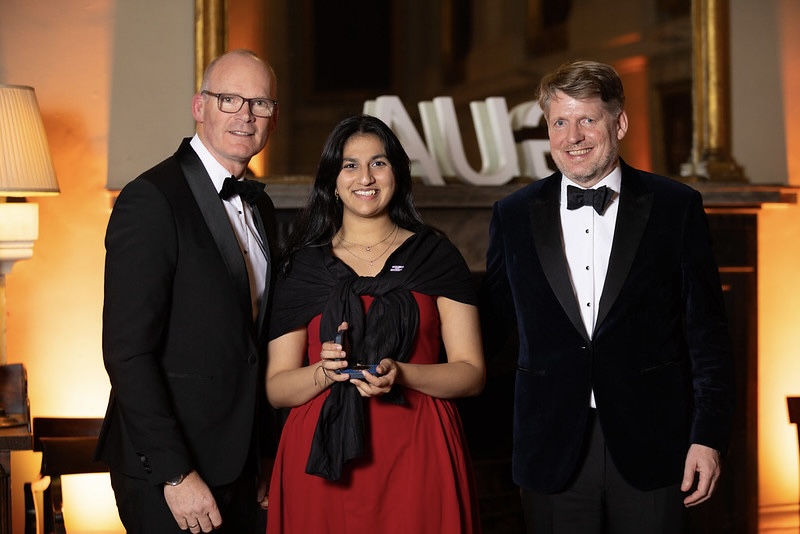
Balvinder Kaur Dhillon with former Deputy Prime Minister of Ireland Simon Coveney (left) at the awards ceremony in Dublin on Nov 11, 2025
By Asia Samachar | Malaysia |
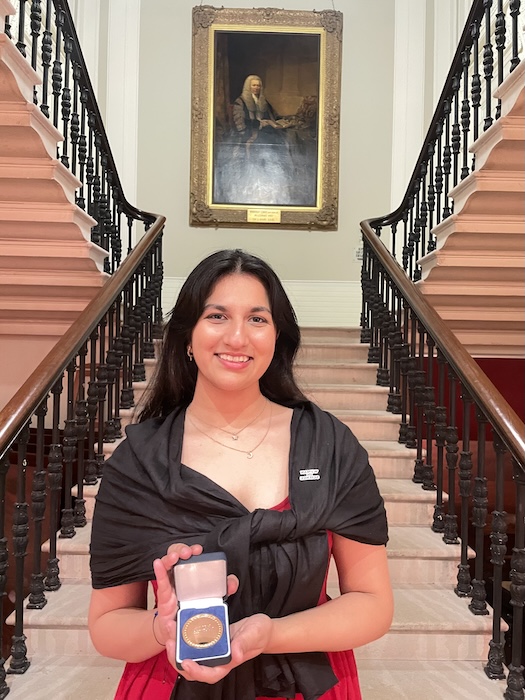
Balvinder Kaur Dhillon has once again etched her name into the annals of academic excellence—becoming the first and only engineering student to win the Global Undergraduate Award in Engineering for two consecutive years, an honour often dubbed the “Junior Nobel Prize.”
The Global Undergraduate Awards, widely regarded as the world’s leading academic recognition programme for undergraduate work, received 3,567 submissions this year from 352 universities across 99 countries. Balvinder’s project ranked among the top 1% globally, according to Queen Mary University of London’s official announcement.
Her award-winning paper—“Developing a Multimodal Deep Learning Pipeline for Automated Glioma Subregion Segmentation and 3D Reconstruction with Integrated Spatial Analysis for Clinical Insight”—bridges artificial intelligence, robotics, and healthcare. Conducted during her final year of an MEng in Biomedical Engineering at Queen Mary University of London, the research was supervised by Professor Zion Tse and Dr. Hadi Sadati.
Reflecting on her journey, Balvinder told Asia Samachar: “Across the last few years, the biggest lesson I’ve learned is that progress rarely comes from sudden breakthroughs. It comes from consistency, small steps that compound over time, and a genuine curiosity to challenge assumptions and push beyond the status quo.”
Hailing from Teluk Intan, Perak, Balvinder recently graduated with top honours and is now pursuing a Master’s in Human and Biological Robotics at Imperial College London.
With this latest achievement, she joins an elite group: only two individuals in the history of the Global Undergraduate Awards have secured back-to-back wins—and Balvinder is the sole double-winner in the Engineering category.
BALVINDER KAUR’S STORY, IN HER OWN WORDS
Winning the Global Winner award for Engineering for the second time is something I am still processing. It’s a privilege, and it means a lot to me, not because of the award itself but because of the work behind it. My submissions over the past two years spanned two very different areas of biomedical engineering: one in biomaterials and the latest in machine learning. Both were shaped by countless hours of refinement, learning, and intentional effort.
Across the last few years, the biggest lesson I have learned is that progress rarely comes from sudden breakthroughs. It comes from consistency, small steps that compound over time, and a genuine curiosity to challenge assumptions and push beyond the status quo. However, I strongly believe that achievements like this should not be viewed as rare exceptions but as examples of what becomes possible when we invest in our people, our communities and the environments that allow potential to grow.
Balvinder Kaur Dhillon with the Global Undergraduate Award in Engineering
Our community has a long history of excellence and innovation with figures like Narinder Singh Kapany, the father of fibre optics, and Harvinder Sahota, the inventor of modern-day stent treatment. They have expanded the boundaries of what Sikhs are known for in global space. This legacy should not be passive and only celebrated, it should be something we actively build upon.
I hope that this encourages more young Sikhs to aim high and dream big, not only in scientific academia but in any field, the arts or startups. Equally, I hope it motivates our organisations and families to support their dreams at every stage. We are entering a world of constant change and our community’s strength will depend on how boldly we support the next generation to take a risk and step into it.
The only real limit any of us have is the one we place on our own minds. Work hard, stay curious, question the status quo, and do not be afraid to push into spaces where we are underrepresented. If my story inspires at least one Sikh person to feel that these spaces are accessible to them, then I have done a bit of justice to the cause.
If anyone would like to speak more about how we, as a community, can grow our presence in these fields, please feel free to reach out. I would love to help build an initiative that supports and develops Sikh talent at any age.
ASIA SAMACHAR is an online newspaper for Sikhs / Punjabis in Southeast Asia and beyond. You can leave your comments at our website, Facebook, Twitter, and Instagram. We will delete comments we deem offensive or potentially libelous. You can reach us via WhatsApp +6017-335-1399 or email: asia.samachar@gmail.com. For obituary announcements, click here
The motivation for the supreme martyrdom of Guru Tegh Bahadur ji, his message for the entirety of mankind, and the philosophical underpinnings of the unprecedented sacrifice are found within the writings of the ninth Guru as recorded within the Aad Guru Granth Sahib (AGGS). This has however, not stopped a whole gamut of individuals, institutions and the ruling elite from making efforts to obscure, corrupt or hijack the truth of the event, its motivation and its philosophical foundations for a whole host of reasons. Four sources of such efforts are identified in this brief essay. The earliest attempts at such corruption can be discerned in the classical Sikh historical literature, which serves as the primary source. The second source is Sikh clergy, institutions, intellectuals and leadership that propagate the corrupted narratives unthinkingly and un-critically; failing to apply the touchstone of Gurbani in their analysis. The third source comprises the Hindutva led movements within India whose primary aim the co-option of Sikhi and Sikh Gurus. The general population of Sikh masses – large proportions of whom have broken away from reading, critical thought and the ability to analyze information objectively and form reasoned judgments cannot be without blame; and hence comprise the fourth source.
By Karminder Singh Dhillon | Opinion |
INTRODUCTION
The Sikh world generally accepts Chandar Sain Sainapat’s account of the martyrdom of Guru Teg Bahadur in Sri Guru Sobha Granth (1711 AD) as the earliest attribution towards the motivation and philosophical underpinnings of the event. Counted as a contemporary of the tenth Guru, his attribution is captured herein: ਤੇਗ ਹੀ ਬਹਾਦਰ ਜਗ ਚਾਦਰ ਸਭ ਤੂਹੀ ਹੈ। Teg Hi Bahadur Jug Chador Sabh Tuhi(n) Hai. (Chap 2, 5:56); and again herein: ਪ੍ਰਗਟ ਭਏ ਗੁਰੁ ਤੇਗ ਬਹਾਦਰ। ਸਗਲ ਸ੍ਰਿਸਟ ਪੈ ਜਾਕੀ ਚਾਦਰ।Pargatt Bhaye Gur Teg Bhadur. Sagal Srishtt Paiy Jaki Chador. (Chap. 1:14). His use of the word Chadorpoints to a poetic depiction of the concepts of “protection, defence, cover and shield.” His use of the words Jug Chador and Srishtt Ki Chador illustrates Sainapat’s belief that a universal objective was the philosophical underpinning of the event. His choice of words further points towards the defense of humanity and protection of mankind as a whole being the philosophical foundation and message of the martyrdom.
As will be argued later in this essay, Sainapat’s account is in line with the writings of the ninth Guru pertaining to humanity, mankind and universality as found within the Sri Guru Granth Sahib (SGGS). He appears to have been aware of the ninth Guru’s bani.
CLASSICAL SIKH LITERATURE.
The gamut of texts that are generally (and erroneously) put into the category of “Classical Sikh History” are plagued with intrinsic problems that are beyond the scope of this essay. Questionable authorship; unverifiable time frames of their actual writing; anti-Sikh and anti-Guru slants; and agenda-based accounts are just some of the problems.[2] A great number of them are written by non-Sikhs, anti-Sikhs or individuals or organizations with particular agendas. It was thus normal that classical Sikh literature would occupy a foundational and pivotal position in obscuring, corrupting and distorting the truth, motivation and philosophical foundations of the martyrdom of Guru Teg Bahadur ji.
A cursory yet systematic examination of some of the classical literature provides us not just with the pattern of the distortion, but the underlying purpose of the obscuring and distortion. It appears to be motivated by the desire to drown Sainapat’s depiction and replace it with a parochial analysis that the martyrdom was inspired by a particular group of people and undertaken in the defense and protection of a specific belief system. The foundational objective is the co-option of both Guru Teg Bahadur ji in particular and the Sikh faith in general: aimed at absorbing or assimilating both into the narrower fold of a specific belief system.
Kesar Singh Chibber’s Bansavalinama of 1769 relegates the martyrdom of Guru Tegh Bahadur to within the narrow and parochial scope of “religion.” He does so by using the term dharam in his depiction of the event, but stops short of specifying the belief system. He writes of Guru Teg Bahadur telling Sikhs during his imprisonment: ਇਸ ਦਾ ਅਸਾਡਾ ਹੈਸੀ ਸਦਾ ਲੇਖਾ, ਧਰਮ ਰਹੇ ਅਤੇ ਸੀਸੁ ਜਾਉ । Chapter 9 verse 157. Translation[3]: This is my account; religion gets saved at the expense of my head. He further writes of Mata Gujri ji saying to Guru Gobind Singh ਤੇਰੇ ਪਤਿਾ ਧਰਮ ਰੱਖਆਿ ਤੇ ਸੀਸੁ ਕਟਾਇਆ। Chapter 9 verse 163. Your father was beheaded in protection of religion.
To be fair, Chhibber does not specify the one particular “religion” for which Guru Teg Bahadur was martyred. That task is undertaken seven decades later, in 1841, by Ratan Singh Bhangu in Pracheen Panth Parkash. He writes: ਤੇਗ ਬਹਾਦਰ ਫਿਰ ਗੁਰ ਭਯੋ ।ਪਰਸਵਾਰਥ ਹਿਤਿ ਜਿਨਿ ਸਿਰ ਦਯੋ । ਕਲਯੁਗ ਮੈ ਬਡ ਸਾਕਾ ਕੀਯਾ ।ਧਰਮ ਕਰਮ ਰਖ ਹਿੰਦੂ ਲੀਯਾ । Episode 11, verse 7. Translation: Tegh Bahadur then became Guru, who gave up his life for the protection of the rights of others. He made the supreme sacrifice in Kaliyuga, and protected the religious rights and rituals of the Hindus.
But it would fall on the shoulders of Nirmla Kavi Santokh Singh’s Gurpartap Suraj Granth to relegate, not just the objective of the martyrdom to the protection of Hinduism, but that the motivation and inspiration of the supreme sacrifice came from a particular group of Hindus – namely the Kashmiri Brahmins who were being forced to convert out of their religion by the narrow-minded tyrannical Aurangzeb.
He writes that a delegation of Kashmiri Brahmins went to Shivji to seek his intervention in the tyranny. Shivji is said to have composed a personal letter with instructions and handed it to the Brahmins to deliver to Guru Teg Bahadur. Santokh Singh writes: ਪ੍ਰਾਨ ਅੰਤ ਲਉ ਦਿਜ ਭਏ ਜਾਨੈ ਰਿਦੈ ਤ੍ਰਿਨੈਨ। ਕ੍ਰਿਪਾ ਧਾਰਿ ਪੱਤ੍ਰੀ ਬਿਖੇ ਲਿਖਿ ਉਪਾਏ ਕਿ ਬੈਨ।1। ਸ਼੍ਰੀ ਨਾਨਕ ਜਹ ਗੁਰੂ ਬਿਸਾਲਾ। ਅਪ੍ਰਮੇਯ ਸਮਰਥ ਕਲਿ ਕਾਲਾ।ਤਿਨ ਗਾਦੀ ਪਰ ਬੈਠਯੋ ਜਾਇ। ਕਾਜ ਤੁਮਾਰੈ ਸਾਰੈ ਸੋਇ।2।ਇਹੀ ਪੱਤ੍ਰਕਾ ਲੈ ਤੁਮ ਜਾਵਹੁ।ਬਿਰਥਾ ਅਪਨੀ ਸਕਲ ਸੁਨਾਵਹੁ।ਸੋ ਰਾਖਿਂਹਗੇ ਧਰਮ ਤੁਹਾਰਾ।ਇਨ ਬਿਨ ਅਨ ਤੇ ਹਵੈ ਨਾ ਉਬਾਰਾ।3। Suraj Parkash Vol 9 Chapter 28. Translation: Shivi realized the predicament the Brahmins were in. He became benevolent and wrote the following instructions in his letter. Guru Nanak was a great Guru in Kaljug, all capable. Whoever is now sitting on his throne will help resolve your problem. Take this letter of mine to give to him and narrate your problem. No one other than him can save you.
Then we have the text of Bachittar Natak (Dasam Granth) which further relegates the underpinnings of the martyrdom not just to a particular religion, but to two very specific symbols of that religion. The verses read: ਤਿਲਕ ਜੰਞੂ ਰਾਖਾ ਪ੍ਰਭ ਤਾਕਾ । ਕੀਨੋ ਬਡੋ ਕਲੂ ਮਹਿ ਸਾਕਾ।…ਧਰਮ ਹੇਤ ਸਾਕਾ ਜਿਨ ਕੀਆ। ਸੀਸ ਦੀਆ ਪਰ ਸਿਰਰ ਨਾ ਦੀਆ। Tilak Janju Rakha Prabh Taka. Kino Bdo Klu Meh Saka…Dharm Heyt Saka Jin Keeya. Sees Diya Par Sirer Na Diya.(Dasam Granth page 54). Translated these verses mean: The massive event of the sacrifice in Kalyug was in defense of the sacred mark tilak and the sacred thread janju. He gave his head in the name of religion for these symbols, but not his faith in them (Sirer na diya). These verses do more than just tie the martyrdom of the Guru to the two symbols, but pin the Guru’s faith onto the same symbols – neither of which were adorned by the Gurus or prescribed by them for Sikhs.
The obscuring, corrupting or distorting the truth, motivation and philosophical foundations of the martyrdom of Guru Teg Bahadur ji does not stop there. Other classical texts have gone so far as to assert that the execution of Guru Teg Bahadur at the hands of the tyrannical regime never took place.
Parchian Seva Das (written in 1709 AD as claimed) has 4 sakhis pertaining to Guru Teg Bahadur. The third one pertains to his arrest and sacrifice. The sakhi says that Guru Teg Bahadur ji left Anandur with 3 Sikhs for a hunting trip and ended up in Agra where they were all arrested. Two of the Sikhs pleaded with him for their release and their leg irons opened up miraculously, while the third one remained with the Guru. The narrative continues: ਫਿਰ ਗੁਰੂ ਬਾਬੇ ਇਹ ਕਾਰਨ ਕੀਨਾ। ਕੈਦ ਹੀ ਬੀਚ ਸਿੱਖ ਕੋ ਹੁਕਮ ਹੂਆ, ਜਬ ਹਮ ਅੰਮ੍ਰਿਤ ਵੇਲੇ ਇਸ਼ਨਾਨ ਕਰਕੇ ਜਪ ਕਾ ਜਾਪ ਕਰੋਂ, ਭੋਗ ਪਾਏ ਕਰ, ਨਿਰੰਕਾਰ ਆਗੇ ਅਰਦਾਸ ਕਰੋਂ, ਮਸਤਕ ਟੇਕੂੰ, ਤਬ ਤੁਮ ਤਿਸ ਸਮੇਂ, ਧੜ ਸਿਉ ਸੀਸ ਕੋ ਜੁਦਾ ਕਰ ਛੋੜੋ। Translation: Then the Guru Baba did as follows. While imprisoned, he ordered his (remaining) Sikh: when I wake up at dawn, complete reciting the Jap, do an ardas, and then bend down to bow, you should then proceed to behead me (at that point).
In essence, then, Guru Teg Bahadur ordered his own Sikh to behead him. When the Sikh expressed his reservations, Guru Teg Bahadur assured him that he would suffer no consequences. The sakhi concluded with ਹੁਕਮ ਹੂਆ, ਸਿਖਾ, ਕਾਰਜ ਕਰ ਲੈ। ਤਬ ਸਿਖ ਬਚਨ ਪਾਇ ਭਗੌਤੀ ਸਿਉਂ ਕਾਰਜ ਕਰ ਲੀਆ। ਧੜ ਸਿਉਂ ਸੀਸ ਕੋ ਜੁੲਾ ਕਰ ਛੋੜਿਆਂ। Translation: The command was given: O Sikh, undertake the deed (now). And following the command, the Sikh used his sword, severing the head from the body. In reality then, the writings of Seva Das reduce the martyrdom of Guru Teg Bahadur ji to suicide through a command to his loyal disciple. The narrative concludes that when the emperor came to know, he had the Sikh executed. The emperor was ostensibly furious that the Guru had escaped his death at the hands of the emperor’s executioner.
SIKH CLERGY, INSTITUTIONS, INTELLECTUALS AND LEADERSHIP
It is evident that our clergy (ragis, parcharaks, kirtanias, kathakars), institutions and intelligentsia has failed to play their respective roles. The narrative that had been provided by this group has largely relied on that provided by Nirmla Kavi Santokh Singh and of the Bachittar Natak. Even then, the reliance on these two sources has been selective at best and dishonest at worst.
For instance, this group owes the Sikh world an explanation as to why the Suraj Parkash’s narrative of a specific group of 500 Brahmins being the motivators for the martyrdom of Guru Teg Bahadur is accepted as fit for propagation, but the part about the role of Shivji in the episode – in effectively instructing the Guru to sacrifice himself – is left out.
One could argue that our clergy, institutions and intelligentsia have consciously chosen not to expose the true level of corruption and co-option within the narrative of Santokh Singh. In essence, Santokh Singh is linking the entire motivation of the martyrdom to an instruction from Shivji. In so doing, this Nirmla Kavi is turning the ninth Guru into a devotee of Shivji or at least someone who is inclined to be loyal to Shivji’s instruction. It can be argued that our Clergy have “decided” to leave out the part concerning Shivji. This reasoning is as dubious and dishonest as it is corrupting. After all, the best thing to do would be to drop the entire narrative all together.
Another reason our clergy, institutions and intelligentsia leave out the Shivji part is to preserve the sensitives of the devotees of Shivji. An argument may be made that Shivji is made to come across as helpless by Santokh Singh. One wonders why it is acceptable to paint the Brahmins of India as sufficiently helpless to go to Guru Teg Bahadur – a non-Brahmin and non-Hindu – but not their deity. In any case the selective acceptance of a narrative, and then basing the selection on dubious reasoning is a problem in itself.
A Sikh would be hard pressed to find a Gurdwara celebrating the martyrdom of Guru Teg Bahadur ji wherein the ragis, kirtanias, parcharaks and dhadees are not singing, reciting or sermonizing the verses of the Bachitar Natak: ਤਿਲਕ ਜੰਞੂ ਰਾਖਾ ਪ੍ਰਭ ਤਾਕਾ । Tilak Janju Rakha Prabh Taka. (Dasam Granth page 54) – thus tying the event to the sacred mark tilak and the sacred thread janju; and saying, unequivocally, that the Guru gave his head for these symbols, but not his faith in them.
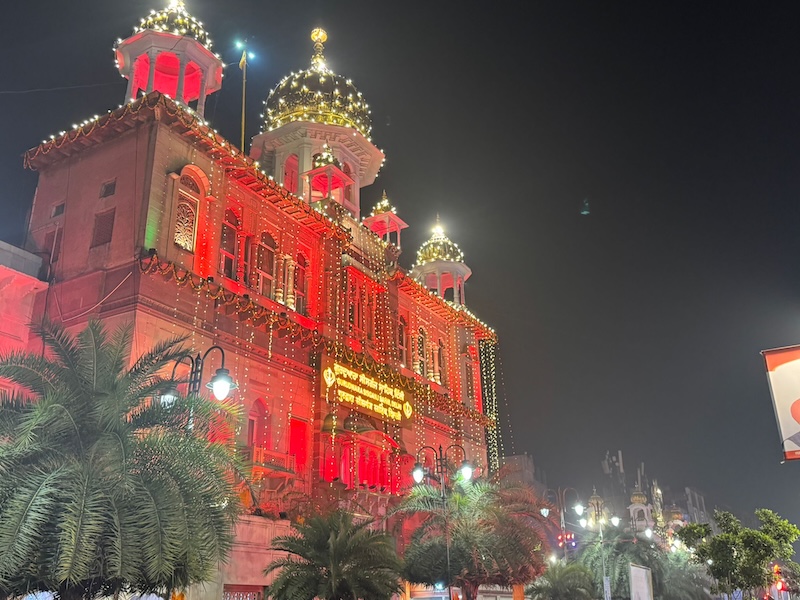
Gurdwara Sahib Sis Ganj, Delhi during the commemoration of Guru Tegh Bahadur’s martyrdom on 23 Nov 2025 – Photo: Daljit Singh Khalsa
The dishonesty here is baffling. Our clergy assert that the above verses were composed by Guru Gobind Singh ji – saying outright that the tenth Guru is in effect imprisoning Guru Teg Bahadur’s universal underpinnings within a parochialism that does not befit both the ninth and tenth Gurus. In attributing these verses to the tenth Master, our clergy are further suggesting that the Guru was ignorant of the banni of his father as contained within the SGGS (to be discussed below). Our clergy, institutions and intelligentsia need to tell us this: if indeed the tenth master had written these verses, how did Sainapat, a contemporary of the Guru, escape being aware of them to write an account that was so fundamentally contradictory to these verses.
Had our clergy, institutions and intelligentsia played their respective roles honestly, the Sikh world at large would not have been at the quagmire it is in – believing and accepting the lie that the martyrdom of the ninth Guru was at the behest of 500 Kashmiri Brahmins, for the purpose of protecting a particular religion, and its two symbols.
At every commemorative event of the martyrdom, our clergy ingrain this false narrative, our institutions go along with the concocted narrative, and our intelligentsia either see no hope in correcting the narrative or have themselves come to subscribe to it. The Sikh world has been ingrained with the narrative that Guru Teg Bahadur is Hind Dee Chador – the protector of Hind – protector of the Hindu nation to whom the symbols of Tilak and Janju belong. One wonders if Sikhs will ever come out of this virtually impossible to exit situation.
THE HINDUTVA ENTERPRISE
The Hindutva designs of forces within the government and ruling elite who have the agenda of co-opting Sikhs and Sikhi into their bigger fold end up as the biggest beneficiaries of the corruption and distortion that has befallen the narrative of the martyrdom. These forces go around making public statements to the effect that if not for the sacrifice of Guru Teg Bahadur, Hinduism would not have survived. They make public calls for this or that road, institution or structure to the be named or re-named after Guru Teg Bahadur ji. Case in point is the call to remove the word Aurangzeb from existing structures and to replace it with the name of the ninth Guru. They set aside public funds for the construction of monuments and commemorative celebrations of the event.
Sikhs feel proud and honored that non-Sikhs are honouring their Guru. Little do they realize that any such honor cannot exist if the basis for such honor is a distorted, corrupted and hijacked narrative to begin with. Little do they realize that there can be no honor in relegating a martyrdom of universal stature to one that happened merely for the protection of one religion and two symbols. Little do they realize that such honor may be driven by the Hindutva agenda of fostering ill-will between Sikhs and Muslims.
Hiduvta designs have infiltrated deepy into a number of Sikh institutions, in particular deras and taksals. At the time of this writing, Hanam Singh Dhumma of the Damdmi Taksal is said to have first inspired and then encouraged popular Punjabi entertainer Satinder Sirtaj to write and sing a song depicting the martyrdom of Guru Teg Bahadur ji. The song is conspicuous in its mention of the 500 Brahmins, the Tilak and Janju and “Hind di Chador.” While it can be argued that entertainer Sirtaj can be excused for not being aware of the truth of the martyrdom and the Hindutva agenda, the same cannot be said about Dhumma, who has taken great pains to publicly display his loyalty and affiliation to the agenda.
THE MARTYRDOM, ITS MOTIVATION AND ITS PHILOSOPHICAL FOUNDATIONS.
Guru Teg Bahadur ji was put to death – by the order of then Emperor Aurangzeb – in the public square of Chandni Chowk, Delhi on the 11th of November 1675. The ninth Guru thus became the second of the two Guru martyrs in the Sikh faith. The first was Guru Arjun ji.
In 1670 Emperor Aurangzeb announced his policy of Ek Mazhab – or one religion. The foundational justification of this policy was that the only way to have peace and unity was for everyone to profess just one religion. Aurangzeb had decreed the destruction of all places of worship and education belonging to faiths other that the one he subscribed to. He further ordered the discontinuance of all customs, rituals and practices that contravened his Ek Mazhab dictate.
In the mind of Guru Teg Bahadur, the notion of a single mazhab was anti-thesis to the foundational principle of nature – which was diversity. This principle of diversity was a foundational belief of Guru Nanak’s Sikhi as encapsulated in the verse on page 385 of the SGGS:
Translation: The Orchard – meaning Humanity – is One, But the Vegetation Within it – meaning the people – is Diverse Aplenty. It is Within Such Kind of a Diverse Creation That Divinity Comes to Fruition.
Here is yet another verse on page 1056 that says that diversity was the foundational tenet of creation.
ਮੇਰੈ ਪ੍ਰਭਿ ਸਾਚੈ ਇਕੁ ਖੇਲੁ ਰਚਾਇਆ ॥ ਕੋਇ ਨ ਕਿਸ ਹੀ ਜੇਹਾ ਉਪਾਇਆ ॥ Mairaiy Prabh Sachaiy Ek Kheyl Rchaya. Koye Na Kis Hee Jeha Upaya.
Translation: The Creation Of My Master Lord Is Such: No Entity Is Created Like The Other.
Guru Teg Bahadur thus decided, on his own accord, and according to his own humanist convictions, to take a stand on the issue in a very public way. He went to Aurangzeb on his own, to send a message to Aurangzeb that his One Mazhab dictate was unacceptable. That Aurangzeb would stand by his narrow, extremist and intolerant beliefs and resort to tortures and death was known to Guru Teg Bahadur.
An ultimate martyrdom thus became necessary to convey an ultimate message to humanity at large that defending the right to one’s beliefs was an unassailable right. And for such a stand and message he laid down his life.
CONCLUSIONS
The Sikh world celebrates the 350th anniversary of the martyrdom of Guru Teg Bahadur ji on the 24th of November 2025. It’s a timely occasion for us to ask if we have understood and presented the true reasons for the martyrdom of our beloved Guru in the real and accurate sense. It’s a timely occasion to pledge to stop unthinkingly presenting the martyrdom in a way that reduces its significance and narrows its importance. The narrative of the Guru laying down his life for one particular religion its two particular symbols is akin to encapsulating the depths of an ocean into a tea-cup. It’s an attempt to fit the heights of a mountain into a wheelbarrow. Any particular religion, belief or symbol was inherently irrelevant. What was relevant was standing up for the oppressed – no matter their faith and beliefs. What was relevant was to stand up even when faced with certain tyranny and death. And that Guru Teg Bahadur ji stood up on his own, not at the behest of any number people in a concocted number from any particular religion. The Sikh world needs to realize that we are reducing Guru Teg Bahadur ji to Hind Dee Chadur, when even to address him as Manukhta Dee Chadur or Insaniyat Di Chadur or Sresht Di Chador would be an understatement.
The 350th anniversary is also an occasion to ponder over the real messages that emanate from the supreme sacrifice. Messages that are relevant to Sikhs in particular and humanity in general. It is further an occasion to be aware of the systematic and organized efforts that have been undertaken for the past 264 years and continue unabated even today to obscure the truth of the matter. This essay is an effort towards these two objectives.
Republished with courtesy from The Sikh Bulletin, Vol 5/2025.
This is a more detailed version of an essay by the same author and title that appeared in The Sikh Review, November 2025. ↑
The author has provided a detailed commentary on these problems in “The Challenge of Anti Gurmat Content in Classical Sikh Literature” available here: https://sikhivicharforum.org/2024/10/28/6006/↑
All translations rendered within this essay are done by the author himself, unless otherwise indicated. ↑
Sikh thinker, writer and parcharak Karminder Singh Dhillon, PhD (Boston), is a retired Malaysian civil servant. He is the joint-editor of The Sikh Bulletin and author of The Hijacking of Sikhi. Click here to retrieve archived copies of the bulletin. The author can be contacted at dhillon99@gmail.com.
ASIA SAMACHAR is an online newspaper for Sikhs / Punjabis in Southeast Asia and beyond. You can leave your comments at our website, Facebook, Twitter, and Instagram. We will delete comments we deem offensive or potentially libelous. You can reach us via WhatsApp +6017-335-1399 or email: asia.samachar@gmail.com. For obituary announcements, click here
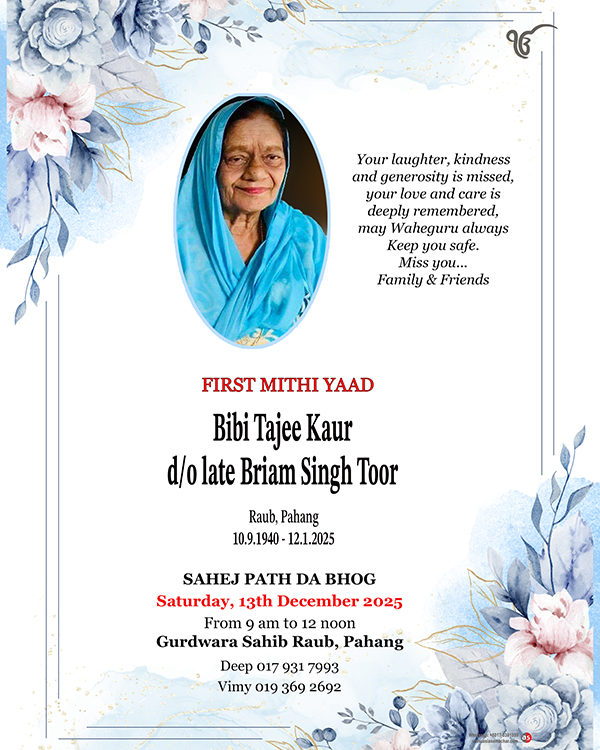
SAHEJ PATH DA BHOG Saturday, 13th December 2025 From 9 am to 12 noon Gurdwara Sahib Raub, Pahang
Missed by Family & Friends
Contact Deep 017 931 7993 Vimy 019 369 2692
Your laughter, kindness and generosity is missed, your love and care is deeply remembered, may Waheguru always Keep you safe. Miss you… Family & Friends
ASIA SAMACHAR is an online newspaper for Sikhs / Punjabis in Southeast Asia and beyond. You can leave your comments at our website, Facebook, Twitter, and Instagram. We will delete comments we deem offensive or potentially libelous. You can reach us via WhatsApp +6017-335-1399 or email: asia.samachar@gmail.com. For obituary announcements, click here