UA-56202873-1
Page 453

Sikh family balances faith, military service

0
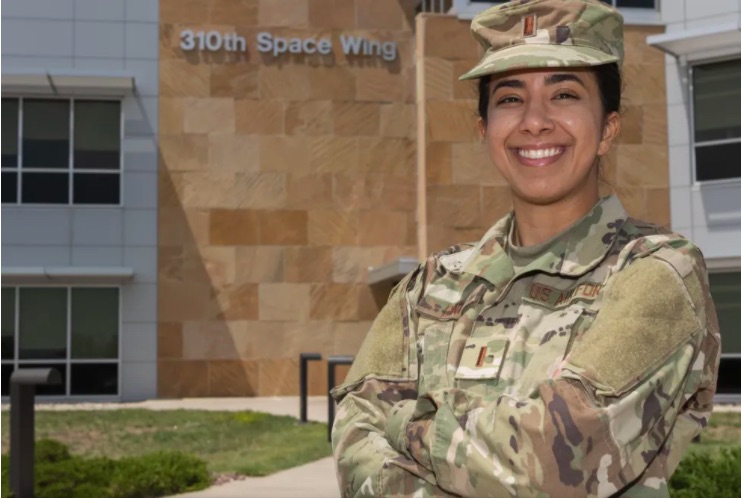
AIr Force 2nd Lt. Naureen Singh, the 310th Space Wing director of equal opportunity, stands outside the wing headquarters building on Schriever Air Force Base, Colorado. Photo by Staff Sgt. Marko Salopek. – Photo: Reserve & National Guard Magazine
By Jessica Manfre | UNITED STATES |

Sikhism is the fifth largest world religion, according to the Sikh Coalition, with 500,000 Sikhs living within the U.S. Among the core beliefs is service to humanity, a principle the Singh family hopes to be fulfilling through their military commitment across generations.

Air Force Reserve 2nd Lt. Naureen Singh, 26, grew up watching her father, retired Col. G.B. Singh, serve as an officer in the U.S. Army. Though he was stationed overseas in places like Korea and Germany, her parents made the decision to keep the family in Colorado Springs for stability.

When attending community group events for South Asians or Sikh, Naureen was confused about why her father was the only one in the military.

“It didn’t really click in my head that my dad is a really unique case until I got a lot older,” she said.

The distinctiveness comes into play because as a Sikh there are certain aspects to their faith that made a goal of military service difficult to obtain at the time. Those who identify as Sikh do not believe in cutting any hair on their bodies and most men wear a turban. In fact, the Sikh Coalition states 99% of the people wearing turbans in America are Sikhs.

Both the turban and unshorn hair are considered articles of faith and a constant reminder to remember their values. These two articles in particular create a barrier to a military that prides itself on uniformity.

Singh’s father pursued a commissioning in 1979. Two years later the Department of Defense banned the turban and long hair. Although he was grandfathered in, Naureen says her father felt honor bound to fight for Sikhs to be able to serve while following their faith.

“It was not easy for him. Day in and day out he had an uphill battle trying to be an officer but then also be an officer with a certain faith,” Naureen explained.

Second Lieutenant Naureen Singh and her dad Colonel (Ret.) G.B. Singh

SOME NAUREEN QUOTES IN THE REST OF THE ARTICLE:

“I do think it is really important to recognize that when you are diverse of thought or of background, you bring a new voice to the table … that voice can help with mission accomplishment.”

“I was born in the states and my parents, who immigrated from India, grew up with a different outlook than mine. I was always too American for my Indian friends and too Indian for my American friends. It was so hard to see where I belonged.”

Naureen Singh speaking at the 14th Annual International Human Rights Summit in New York in August 2017 – Photo / Ian Carberry

“I grew up in the shadows of 9/11. I think growing up after 9/11 and seeing how we equated the turban with terrorism in this country … Here I was trying to fit in, but in media I would see people who had turbans like my dad be projected in a very certain light. That’s why I think I shoved my identity to the side, I didn’t want to make myself stand out.”

“If you look at Sikh history and especially Sikh soldiers, it makes me meant to be in this force. It took a long time to get there though.”

“Don’t ever doubt yourself or put restrictions on yourself … Keep pushing. If my dad could do it in the 1970s, anyone can do it.”

Read the full story, ‘Sikh family balances faith, military service’ (Reserve & National Guard Magazine, 8 Sept 2020), here.


RELATED STORY:

Second-gen Sikh officer in US armed forces. Proud to serve! (Asia Samachar, 7 July 2020)

I had questions from people wanting to learn more about Sikhism (Asia Samachar, 5 Oct 2017)

ASIA SAMACHAR is an online newspaper for Sikhs / Punjabis in Southeast Asia and beyond. Facebook | WhatsApp +6017-335-1399 | Email: editor@asiasamachar.com | Twitter | Instagram | Obituary announcements, click here |

First Sikh to lead Bar Association of India

0
Amarjit Singh Chandiok – Photo: Supplied
By Asia Samachar Team | INDIA |

Seasoned lawyer Amarjit Singh Chandiok is the new President-Elect of the Bar Association of India, making him the first Sikh to take up the top position at the 58-year old body.

Amarjit was one of its 12 vice presidents in the out-going committee led by Lalit Bhasin.

Inaugurated in 1960, the body a federation of the Supreme Court, High Court, District Court and other local bar associations, law societies in India and the Society of Indian Law Firms (SILF), cumulatively representing as a voluntary body almost the entire legal profession, according to information at its website.

When asked what drives him, Amarjit told Asia Samachar: “It is of utmost interest to me and it is such a field that it deals with dispensation of justice, which is inextricably linked to all kinds of human activities.”

Amarjit has been the president of Delhi High Court Bar Association for a record six terms. A former additional solicitor general of India, he was also principal counsel to the European Union Commission from August 2013 to March 2016, being the only Indian lawyer to hold that position so far.

He is also president of Maadhyam Council for Conflict Resolution, a professional organisation in the fields of law and conflict resolution. He is also the vice-chairman of Society of Insolvency Practitioners of India and advisory committee member of the Insolvency and Bankruptcy Board of India.

Amarjit is also working group chairman of the Insolvency and Bankruptcy Board of India.

On the Sikh front, Amarjit has also been involved with the gurdwara in Delhi’s Defence Colony for the past many decades.

“I assisted the Gurdwara Sahib by rendering legal assistance in procuring the land where it stands now. I do assist the SGPC whenever a need arises,” he said in a text message. SGPC is the Amritsar-based Shiromani Gurdwara Parbandhak Committee.


RELATED STORY:

Justice Khehar first Sikh to become Chief Justice of India (Asia Samachar, 7 Dec 2016)

Singapore High Court judge Dedar Singh Gill sworn in (Asia Samachar, 3 Aug 2020)

ASIA SAMACHAR is an online newspaper for Sikhs / Punjabis in Southeast Asia and beyond. Facebook | WhatsApp +6017-335-1399 | Email: editor@asiasamachar.com | Twitter | Instagram | Obituary announcements, click here |

Insurance broker to lead MSU FT

0
MSU FT team for 2020-22 – Photo: Supplied
By Asia Samachar Team | MALAYSIA |

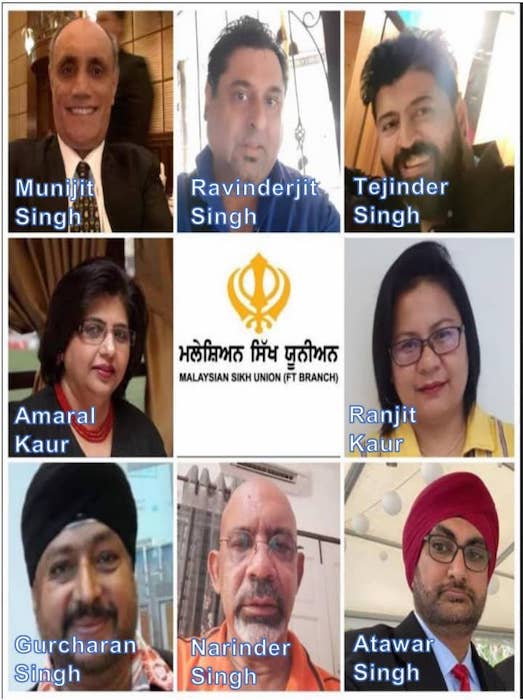
Insurance broker Munijit Singh @ Manjit has been elected to lead the Malaysian Sikh Union (MSU) FT Branch for for the next two years. He takes over from Tara Singh.

Manjit will be assisted by Ravinderjit Singh @ Roshan as the vice-chairman, Amaral Kaur (secretary) and Tejinder Singh @ TJ (treasurer).

The 2020-2022 leadership team will include the following as committee members: Ranjit Kaur, Narinder Singh, Gurucharan Singh, Atawar Singh and Malkit Kaur.

MSU FT held its annual meeting yesterday (11 Sept).


RELATED STORY:

MSU examination seminars for Sikh students on 20 Aug (Asia Samachar, 12 July 2017)

ASIA SAMACHAR is an online newspaper for Sikhs / Punjabis in Southeast Asia and beyond. Facebook | WhatsApp +6017-335-1399 | Email: editor@asiasamachar.com | Twitter | Instagram | Obituary announcements, click here |

Punjab former top cop Sumedh Saini on the run to evade arrest

0
Former Punjab Director General of Police Sumedh Singh Saini . Insert photo, top: Dal Khalsa posters against Saini. Below: Saini and former Punjab Chief Minister Sukhbir Singh Badal
By Asia Samachar Team | PUNJAB, INDIA |

Former Punjab police chief Sumesh Singh Saini — badged top cop of the Indian state and who used to get glowing media attention for his hard hitting method in addressing Sikh issues — is now on the run. He has stealthily avoided arrest, with the government-provided security for him probably feigning ignorance.

The former Punjab Director General of Police (DGP) has been missing since Sept 3 after being booked on May 6 in a 29-year-old case of abduction, torture and disappearance of junior engineer Balwant Singh Multani.

The Punjab and Haryana High Court judge had denied his attempts to get anticipatory bail after two co-accused in the case turned approvers in August, leading to the addition of a murder charge against him.

A Mohali court has ordered his arrest and custodial interrogation for the 1991 murder case. It is believed he is avoiding it in a tactical move. By avoiding arrest, Saini can still try to move the judicial system to avail him the anticipatory bail, with the last resort now being the Supreme Court. If arrested, he has to opt for other options to stay free.

Saini was made the Punjab DGP in 2012. At 44, he made history by becoming the youngest ever DGP in the country.

But his appointment was greeted with a hue and cry by some quarters, including the Canada-based World Sikh Organisation (WSO), which said the move was ‘in opposition to all human rights norms’.

“Saini is accused of serious human rights violations including abduction, illegal detention and torture and is currently under trial for murder,” WSO said on a statement then.

Punjab Chief Minister Parkash Singh Badal made the appointment after he was made the CM for a record fifth term on 14 March 2012, despite five Punjab Police officers who supersede Saini in seniority.

At that moment, WSO said Saini was facing trial in the abduction and murder case of Vinod Kumar who was abducted and disappeared in 1994 along with his brother-in-law and drive.

“During the late 80s and 90s, Saini was posted to areas in Punjab where severe human rights abuses took place. He has been implicated in the abduction, torture and killing of several Sikh youth during that period,” the statement added.

Saini is alleged to have indulged in gross human rights violation and torture during his career, especially when he served as Senior Superintendent of Police in at least five districts in Punjab and as Chandigarh SSP. All through his career, Saini has had his own set of admirers and critics, reported The Indian Express.

During terrorism in Punjab, when K P S Gill headed the state police force, Saini was given a free hand. His style of working remained controversial. A section of officers are still fans of his fight against terrorism with an “iron hand”, while others flag his alleged disregard for human rights, the report added.

The state was preparing to get him declared a proclaimed offender (PO) in the 1991 Multani murder case as he continued to evade arrest despite his bail plea rejected by the Punjab and Haryana High Court, reported The Tribune yesterday (11 Sept). Once declared, the government can attach his movable and immovable assets.

MAKING SENSE OF THE SUMEDH SAINI SAGA

Sikh Political Analyst Bhai Ajmer Singh on Case Against Sumedh Saini & Role of Indian Judiciary

Former Punjab Police chief Sumedh Saini is booked for enforced disappearance of Sikh youth Balwant Singh Multani. The FIR against Sumedh Saini was registered on 6 May 2020, about 29 years of the occurence. During these 29 years Sumedh Saini was enjoyed state patronage and was awarded high ranks in police, including the top rank of Director General of Police.

The registration of FIR has its own significance but other hard facts can not be ignored that Sumedh Saini still enjoys state patronage. Despite registration of FIR he was not arrested by police. A Mohali court has already granted him anticipatory bail, which means police can not arrest him in this case.

In this video Sikh political analyst and author Bhai Ajmer Singh has touched various fundamental aspects of human rights abuses in Punjab and Indian state’s policy of impunity. (SikhSiyasat, 14 May 2020)

The Punjab Police have conducted raids in Hoshiarpur, Chandigarh, Delhi and some other locations in Punjab in the past 24 hours, but Saini remains untraceable. Notably, Z-security officials posted by the Central Government and Punjab Police have failed to explain how the former DGP was roaming around without the mandatory security, the report said.

When dismissing the anticipatory bail plea in the three-decade-old Multani kidnap and murder case, Justice Fateh Deep Singh described Saini as as a blue-eyed boy wielding much influence owing to political patronage.

It added that the former top cop even went to the extent of intimidating the judicial process as evident from observations of a senior HC Judge in 1995 followed by “earlier recusal in these matters by two sitting Judges of this court”.

If arrested, Saini could be the second IPS officer from Punjab to go behind the bars and face the murder case in the so-badged terrorism-related cases. The last was Ajit Singh Sandhu, who, in 1997, threw himself in front of the Himalayan Queen train to commit suicide. Before this, he was indicted by CBI in two out of 16 cases against him and spent some time in Amritsar jail, reported India Today. 

SUMEDH SAINI FACT SHEET

(As listed in WSO media statement when Saini was made Punjab DGP in 2012)

  • Saini allegedly armed and gave police immunity to a vigilante group under the command of Ajit Poohla which was responsible for attacks on the families of suspected ‘militants’
  • On July 12, 1992 near Ambala (Haryana) a car was signaled to stop by plain clothes members of the Punjab Police under the command of then SSP Sumedh Saini. The occupants of the car believed the police officers to be criminals and tried to speed away. The Punjab Police officers chased the car and indiscriminately opened fire, killing the unarmed occupants, Jaswinder Singh (28), his four year-old son and brother-in-law Jasbir Singh. The Police claimed that they had been informed that the car was driven by terrorists. A murder case was registered against Sumedh Saini by the High Court.
  • Sumedh Saini suspected that Punjab Police Constable Manjit Singh was aiding militants. He was arrested on August 16, 1993 and kept in police station Sector 26, Chandigarh. Manjit Singh was severely tortured by Saini and he was released the following day with severe injuries including electrical shocks, broken bones and gouge marks all over his body. Manjit Singh died under medical treatment. His wife, Karamjit Kaur filed a petition asking for a formal post mortem. The post mortem report found that Manjit Singh had died due to multiple external injuries
  • Saini abducted a Sikh youth by the name of Parminder Singh alias “Heera”. During a week of interrogation, Heera was severely tortured. He was presented before the Court of Judicial Magistrate at Chandigarh for a 10 day police remand at which time he was severely injured with multiple bleeding wounds and badly scratched eye lids. Despite his injuries, Heera was remanded to custody another week without any medical treatment. According to then SSP of Ropar, Mohammad Mustapha (now ADGP Punjab), Saini later killed Heera and dumped his body in Ropar and asked the Ropar Police to report that he had been killed while trying to escape
  • Sumedh Saini has been implicated in the abduction and disappearance of Davinderpal Singh Bhullar’s father Balwant Singh, best friend Balwant Singh Multani and his maternal uncle. All three were allegedly held in custody and tortured before being killed. Although charges were filed against Saini, they were thrown out by the Indian Supreme Court due to legal technicalities
  • According to the Times of India, since 1990, Saini has been forcibly occupying a government allotted residence in Chandigarh’s Sector 16.


RELATED STORY:

India on war footing with Sikh social media, says reports (Asia Samachar, 21 July 2020)

Indian intelligence use money, disinformation to influence Canadian politics – Report (Asia Samachar, 18 April 2020)

ASIA SAMACHAR is an online newspaper for Sikhs / Punjabis in Southeast Asia and beyond. Facebook | WhatsApp +6017-335-1399 | Email: editor@asiasamachar.com | Twitter | Instagram | Obituary announcements, click here |

Baljit Singh (1960-2020), Rtd RMAF (Fauji)

PATH DA BHOG & ANTIM ARDAS:  19 September 2020 (Saturday) from 09.30am to 11.30am at Guru Nanak Darbar, Tatt Khalsa Diwan, Kuala Lumpur  | Malaysia


 ਘਲੇ ਆਵਹਿ ਨਾਨਕਾ ਸਦੇ ਉਠੀ ਜਾਹਿ ॥੧॥

Ghalley Ayeh Nanka Sadhe Uthhe Jayeh


SARDAR BALJIT SINGH S/O MHAN SINGH, Rtd RMAF (Fauji)

Age: 60

Passed away peacefully on 11/09/2020.

Leaving behind;

Wife: Late Davendar Kaur d/o Magar Singh (Bangi)

Children / Spouses:

Ammanjit Singh / Harpreet Kaur

Ishvinder Singh

Mother: Late Gurnam Kaur

Mother-in-Law: Surjit Kaur

Siblings / Spouse:

Late Amar Singh  / Mohinder Kaur

Amar Kaur / Late Bara Singh

Mender Kaur  / Mehar Singh

Late Daljit Singh / Kulwant Kaur

Harmendar Kaur / Amar Singh

Patminderjit Singh / Satwinder Kaur

Balbindar Singh (USA)

Balmendar Singh (Canada) / Suvinder Kaur

And a host of relatives, nephews, nieces, grandnephews/nieces and friends to mourn their loss.

Path Da Bhog & Antim Ardas will be held on 19 September 2020 (Saturday) from 09.30am to 11.30am at Guru Nanak Darbar, Tatt Khalsa Diwan, Kuala Lumpur  

Kindly treat this as personal invitation & adhere to RMCO SOP guidelines.  

Contact:  

016 – 620 5155 (Amman)

017 – 621 1459 (Hardev)

012 – 203 1395 (Kabir)


| Entry: 11 Sept 2020; Updated: 15 Sept 2020 | Source: Family

ASIA SAMACHAR is an online newspaper for Sikhs / Punjabis in Southeast Asia and beyond. Facebook | WhatsApp +6017-335-1399 | Email: editor@asiasamachar.com | Twitter | Instagram | Obituary announcements, click here |

Sikhi beyond the Singh Sabha story

1
By Ranvir Singh | OPINION |

Sikhi is about panentheism not monotheism; Grace not human effort; virtue ethics through emotional and social intelligence not rules; spiritual-worldly transformation not the brainwashing of priests and kings; and a borderless Now, not idolisation of fictional lines and narratives. This has been obscured by Singh Sabha activists trying to influence a Christian audience and by Sant Babas writing for a Hindu one.

It has been just over 300 years since the Guru has been the Khalsa. This was set up in 1699 when Guru Gobind Rai bowed before the Khalsa asked to be initiated at their disciple. It was demonstrated when he obeyed their instruction and abandoned the Fort of Chamkaur. For the first 150 years the Khalsa needed to maintain its uniqueness as members of the Muslim and Hindu communities joined the new movement.

The extent of Muslim involvement can be gauged in many ways. The Persian writing Diwan-i-Goya is a response to the popular text Diwan-i-Hafez and is approved for recital in the gurdwara according to the Rahit Maryada or Code of Conduct. The mother of the Khalsa was the daughter of a Muslim holy man. Guru Gobind Singh was protected by Muslims who announced him as Uch ka Pir and, finally, the four taboos of the Khalsa are all related to customs common to Muslims — marriage to a Muslim lady, smoking of tobacco, eating halal meat and shaving or trimming of hair. These would have been boundary markers for Muslims joining the Khalsa.

Hindu influence was more subtle, from the introduction of the fictional Hindu character Bala as a balance to the historical Muslim best friend of Guru Nanak, Mardana; to Hindus looking after Sikh buildings during the period of persecution under the late Mughal Empire when there was a price on the head of every Sikh man, woman and child. Many of these Hindu practices were purged by the reformist Singh Sabha movement in the late nineteenth and early twentieth centuries.

For the next 100 years it strived to explain itself to Christians who directly ruled Punjab from 1849 to 1947. The Singh Sabha movement represented Sikhi in a way that the Christians ruling India could understand and be comfortable with. This Church of England Christianity had been influenced by Kant. Morality was reduced to following rules, religious experience and miracles were regarded as implausible and therefore interpreted as metaphor and scripture was interpreted to promote morality. The Singh Sabha orthodoxy has been the default for Sikhs as immigrant minorities in the West and broader diaspora. It retains a grip in India even while the independence of Sikhi from Hinduism has been challenged by Sant Babas sponsored by the Indian state as a return to the pre-Singh-Sabha Hinduised formula which may be termed Babamat to distinguish it from Gurmat, or way of the Guru. This is because the ultimate source of authority is not the Guru but the Baba whose lifestyle, interpretation and rules are binding for the disciples or chelas.

My agenda is not to decide that Muslim, Hindu or Christian lens is the right one to understanding Sikhi but to suggest that awareness of the glasses one is putting on will affect what is being seen. In particular, I suggest that Sikhi will always involve a dialogue between the Guru and Sikh and that this involves taking off one’s glasses to see what is actually there. It involves a dialogue among Sikhs to discuss what each person sees.

It is obvious that translations of Sikh scriptures are mistaken when they use ‘He’ when the male pronoun is not being used to describe WaheGuru. This was the term used for the male, monotheistic God of the Abrahamic religions — Judaism, Christianity and Islam, but it is not appropriate for the divine in Sikhi. There is no doubt that it is appropriate to speak about God as a personal God. The prevalence of the theme of God and the individual as lovers can only refer to a virtuous relationship. In this sense, there are times when the maleness of the divine is relevant.

Nevertheless, there is also a panentheistic vision of God. The creation exists within the Light of God, and God’s Light fills creation and, more crucially, inscribes each person (‘likhia naal’). It is the Being of God that inscribes the being-in-process of each person, whether they hear and align to the True Call of the Sabd or are shaped by the dialogues of the shifting world. This Energy consciousness — the soul/mind of the universe — obviously has links both with modern science and also animistic religions, including Taoism. This emphasis on the divine as energy is seen as Naam and as Guru.

Naam is the presence of the divine and justifies the reality of the world of phenomena. Unlike Hindus and Buddhists who seek to escape a world of appearances, a Sikh’s unity with the divine is based on an active relationship in our everyday world.

As experts in grammar point out the opening phrase is: ‘IkOankarSat.’ Reality Is 1, Unity of Being.

Naam is a separate word that appears by itself hundreds of times in the Guru Granth Sahib, separate from Sat. Nam is the presence of the divine that brings dead matter into consciousness, Life. Sat is matter itself, reality, being, what is. One could argue that Gurmat actually did not use a word for ‘God’. There are Names that describe the different Activities. The most common Name is probably ‘Nam’ translated as Numenon and ‘Sat’ translated as Reality. Sikhs do, indeed, believe that Reality is made alive by Presence. Guru Nanak sees One Reality. A sachiara seeks the truth of this one reality, and does not divide the One, although different methods, e.g. scientific methodology may be appropriate for different landscapes along the journey. The Sikh ideal is not the Khalsa; it is, as Jap Ji Sahib tells us, the sachiara = the real-i-ser, the truth-full.

Gurprasad. Grace. A part of the mission given to Nanak the Guru. Grace implies the spiritual experience of loving kindness from the Universe (panentheism) and from a Person (monotheism). This teaching distinguishes our beliefs from those of others. If Grace reaches out to all, then there can be no chosen people (Judaism), and no exclusive access to God for either Christians or Muslims. If there is a Person who loves then rejection of that Person is blindness, whether through recognising many to be devoted to (Hinduism) or none (Jainism and Buddhism).

The oneness of the divine and oneness of humanity is tied by the passionate thread of grace. This 1ness is the distinctive Sikh standpoint or basis.

There are no magical formulas or ethical showings to demonstrate to and calculate about an absent God, a stingy God. This is a God of love and joy, who wants us to love and joy — gurprasad transmuted, transforming into the negation of selfishness (which has no place in love; hence, humility or emptiness), and the affirmation of lovingkindness, meeta. God wants a loving character, as love is active, as God is active love, gurprasad. There is no debate about ‘Rahits’ as the purpose is the training and cultivation of goodness. Goodness is no guarantee of Grace; Love wanders where It Will. Its Will, Its Direction is goodness, so we can explore life together, rather than throwing it away in rejection of Love.

The Personhood of God makes us certain that we exist and this can make us authentic, a sachiara. The doubt of haumai is gone and we are not made by the changing dialogues of the world, but awakened to the Sabd within and throughout. Our answer to this Call is the making of ourself.

Reality is God and we cannot impose ourselves on it, yet we can choose it or deny It. Through ‘being Real’ we can inspire others to do likewise.

The Sabd is the Divine Itself inside of us. This Light is the Guru, the grace, that knows what is Real. It knows and we know, when we accept this knowing. This is one meaning of Guru and Sikh.

One thing we can know is the Perfection of God’s qualities or names. We intuit the Perfect and this reality is demonstration of its reality and our place in the matrix threaded on this bead of names.

The Perfect is the ontological basis — that is, the fundamental building block of what is. A leap is necessary for our selves, our history, our ego, is not the Real me. At times the Guru’s Call is clear — we should listen to the Soundless Voice and not to the voices that deny, rather than affirm, the Love of the divine that has set up the place of the self. It is our duty to make this a place of bliss, a Begumpura or Anandpur Sahib and not cut it off from the flow of the divine and turn it into a swamp where we will be hurt by the thorn of ego we carry with us.

We do not know merely in the mind; above all, we know in the senses, we feel it in our gut, we taste it in our mouths, some see with their eyes. This direct experience is more Real than our experiences when we are separated, for we are correspondingly unreal. We can certainly process these thoughts and experiences but while we can communicate them we will not be able to tie them in words.

This is because words are shared creations of our empirical selves, the egotistical self that ‘acts’. People who have known love, loss of a parent, whatever, share the reality of that experience with others who have had them. A religious experient will know another religious experient. This the simple meaning that only a brahm giani will know another brahm giani. Given that millions of people worldwide claim to have religious experiences those who have had them will recognise those who are faking it. They are pitiable like a young boy who has never kissed, boasting about it. We know when someone has not had an experience and there is not much to be said.

We can use common sense as the basis of our philosophy. I cannot carry on in my daily life as if I do not exist so I must assume that I do. I cannot carry on in my daily life as if the external world is not real so I must assume that it is. If my senses of the external world are connected to something real then when I have a religious experience I should assume it also is real. I can question it, just as I would question any other unusual experience, but not assume that it is impossible. Hence, there is a collection of testimony of religious experience in the Guru Granth Sahib from people from different religions and none over a period of around five hundred years from the 12th to 17th centuries over a span of thousands of miles in South Asia.

By denying the realm of spiritual experience and miracles Singh Sabha scholars were led to suggest that people could please God by following his moral law. This law (hukam) could be followed by joining the moral discipline of the Khalsa. The aim of preaching is to promote this moral law, mainly by making people feel guilty for not joining the Khalsa, or following its rule.

The idea that morality lies in following rules is called deontology. Therefore, someone could be as angry or arrogant as possible, but unless they break the rules, they are ok. It is hard to distinguish the karamakanda of Babamat from the Rahit fixation of the Singh Sabha.

VIRTUE ETHICS

Both focus on acts rather than being. I think Gurmat suggests virtue ethics. We know what a saint is without having to have a checklist. It is like the cow (God) in a calf. The qualities are, among others, calmness, respect for all, respect for themselves, courage, loving kindness, patience.

The theory of virtue ethics which Gurmat shares with Buddhism is that it is that what makes us good is having the right traits. (Buddhism derived modifications to the virtues as it wanted monks to be able to focus on escaping from the world while Gurmat focuses on the One Reality.) It is the concept of sehaj (spontaneous adjustment to the middle) that tells us that courage, for example, is neither aggression nor cowardice; it lies in between. The five thieves — pride, anger, lust, greed, attachment — are crushed and destroyed not by fighting them, but by accepting and owning these energies. Lust, for instance, is not overcome by monastic vows of celibacy but a loving marriage. Attachment is not overcome by abandoning your family, but as loving your family as you would love other people and want to be loved yourself, rather than taking them for granted and sucking away their energy.

MORAL

How do we learn to be moral? First of course through the sangat of the family and then of the new family, the Khalsa. They provide us with examples and support when we fail. Crucially, it is not EXPLAINING the Sikh ethic to us, but TRAINING us in it. This is why the gurdwara of today was originally called dharamsala, the training ground of virtue.

Crucially, this training is in attentiveness to the Presence, the One Reality. Saintliness becomes a commitment to help those around us, not in the abstract; by choosing how to live, what to commit ourselves to, we become authentic, rich in colour and shape, and not the wraiths of the iron cage of rationality. Other people are inspired to holiness, not lectured with guilt trips. Some are inspired to justice, which is to say loving kindness in the moment, which is the wonderful plan that God has for us at all times.

It might be useful to pause and summarise the journey so far. If knowledge is innate (inside us) there is no need for priests or any other form of intermediary. Moreover, there are going to be limits to what we can say since language has been created for shared discussion about the world outside. As Kabir says, the religious experient is like a dumb person eating sweets. Our direct experience of Life means that it does not make sense to separate the world into ‘God’ and ‘science’ but to see the Sikh as trying to be authentic and truthful, a sachiara, in their life.

If God is with us then there is no need for rituals and acts to ‘show’ God. What is attractive to God is a godly character and not acting. Yet one very common ethical attitude is about ‘duty’ with the preaching emphasis on guilt. This made sense in a socio-political climate dominated by the British Army — obedience, lecturing, ordering. It makes sense in the context of Kantian deontology — right and wrong as fulfilling or not one’s duty in a godless world. It makes no sense given the content of the Guru Granth Sahib which is NOT about rules, and is about virtuous character.

If all things are in God, it becomes clearer why many Sikhs talk about God as ‘Nature’. It explains the kinship many Sikhs feel with indigenous traditions — is it the graphic ‘kar’, the creative spirit of the universe? It also underlines my point about the Unity of Being and it ties with the ‘new physics’. Adding Panentheism to the more familiar Monotheism description also emphasises the role of Grace.

After all, Gurprasad is the most significant of the attributes of God for Sikhs. Gurmat is the religion. Universal Grace distinguishes us from all other religions and explains why the tedious quarrels about Rahits are futile; Grace, not human effort, is decisive. There are no preconditions to the Love of God. The Guru Granth Sahib provides evidence for God based on the testimony of the direct experience of South Asian mystics from the twelfth to seventeenth centuries. Some of them are Gurus of the Sikhs; others are not.

In the Christian world the Singh Sabha authors were writing for, space and time are devoid of knowledge of God and so they need to be filled with human knowledge. However, for Sikhs God is a Presence in the world — this is God’s world. So a Sikh recognises no human limits or boundaries. This would explain why the Gurdwara is a Fort as much as a training school for virtue (dharamsal). It has a flag (Nishan Sahib), drum (ranjit nagara) and is the court of the Guru (diwan). Armed soldiers (knights of the Khalsa) inhabit the building and they consider themselves an army (Akaal Purkh Ki Fauj). The Khalsa is sovereign, under God.

Sikhs also have a different attitude to time. It is not rushing towards disaster, but is always fresh and optimistic as with God’s grace all things are possible. Hence, rather than pessimism about the future – the Rapture, Day of Judgement, or appearance of Kalki, a Sikh enjoys chardi kala, dynamic optimism, their spirits uplifted by grace beyond the selfish.

This would-be virtuous being forms friendships that can inspire and support for virtue is trained and practised. To fulfil this they may join a nation of friends, a free community across space and time. Inspirations come in many forms; hence, the Guru Arjun and Mian Mir can be friends without reducing one to the ‘religion’ of the other.

The Khalsa form completes the aspiring Sikh as weaving together their sense of the universe. It is the form that calls a Sikh to their destiny. Not merely an animal homo sapien, the knight of the Khalsa may be termed a ‘techno sapien’ with the kakkars not mere dress but ‘ang sang’, part of that authentic person, a sachiara.

DIFFERENT VEILS

Different veils may have coloured our views of Sikhi. As a result, Islamic and Buddhist influences and concerns, and Gurprasad have been underplayed. We are no longer under military occupation and are, therefore, able to discuss our beliefs on their own terms, without reference to the need for dialogue with the dominating worldview of occupying powers.

The task is not just, intellectually, to recover these glossed over elements. They are just not visible wearing a particular set of lens. It is to explore the implications and more; to live out these implications in our individual and community lives — a non-territorial republic of virtue.

There are some misunderstandings based on Singh Sabha theology. The Guru which relates to the inner voice, the Sabd within, becomes associated with ten bodies of the ten Gurus. Also, the Guru Granth-Panth, becomes Guru Granth only with the Guru Panth, the living body of the Guru, is reduced to obedience to ‘priests’, the creation of a Brahmin-Mullah figure, totally opposite to the Guru’s teachings. Sikh history is reduced from the school of Amritsar, a the history of a universal spiritual message, alone among the teachings of the world, proclaimed around the world, in different languages, to the history of a nation’s striving for, and decline from, political power.

The ethics of the Sikh proclaimed in gurbani — humbleness, courage, forgiveness, compassion, truthfulness are conspicuously absent from most Sikh groups. It is replaced by ritualistic debate on the length of the kachera, an obsession with turbans, length of nitnem, ardas and various other things not to be found in Gurbani. What is significant is behaviour in their everyday lives, treatment of family, business dealings not when they are wearing traditional clothing on “ritual duty”. Spiritual teachings about meditation, the afterlife and demonology are absented by the Singh Sabha in favour of an outdated rationalism. While rebirth can be read as the tossing and turning of the mind in some contexts, in others it is evidence of consciousness across life forms. What would a post Singh-Sabha Sikhi look like?

Since Sikh ethics are virtue ethics the gurdwara is about training and character building. The activities it provides such as the langar help shape a person’s values, attitudes and actions. The 5 thieves are emotions and what is being taught is emotional intelligence. If this idea, alone, is accepted then the domestic violence, alcohol abuse and other issues that affect society would be openly discussed.

No less a scholar than Kapur Singh rejected the idea of the kurehats of the Rahit Maryada as a moral issue; these are, he suggests, taboos. Sikhs and Baba-chelas argue about the Rahit when it is obvious that all the moral guidance needed is provided in the Guru Granth Sahib. This guidance is not about actions or duties or principles, but about what sort of person you are, and how attractive this makes you to God and how receptive to the presence of God.

It is important to focus on the link between emotional intelligence (awakened mind as disciple or chela) of spiritual intelligence (sabd, grace). This emotional intelligence is linked to spiritual intelligence and the spiritually alive, numinous world that Sikhs inhabit and that Puran Singh described so well. It is a world that is pantheistic, with spirits abounding in praise of God, and panentheistic in the sense that everything is bathed in the ocean of the light of God. No doubt, anyone wishing to further their spiritual practice should join the Khalsa, for discipline and clear doctrine are the basis for personal spiritual exploration. Another thing that is needed is a sangat and the Khalsa can provide that sangat.

Architecture. A sharing of feelings and experiences, emotional and spiritual, is the veechaar that Guru had in mind and this is reflected in the ‘circle time’ layout of traditional Gurdwaras where
the Guru — a testimonial of spiritual experiences from the twelfth to seventeenth century in South Asia — sits at their heart. Architecture reflects the belief system and the typical Singh Sabha system
reflects the lecturing style adopted by someone having a lectern at the front of the diwan/court, a self-appointed spokesperson for the Guru.

What is Is? What does it mean to be? How are we authentic? The question at the beginning of Gurbani — kiv sachiara hoe? How can we be authentic / real? Gurbani provides a sensuous description of spiritual experience — the Gurus simply reject the materialist argument that the world we can meaningfully discuss is the world of the five senses. Kapur Singh, again, recounts his experience with Wittgenstein on the limits of language. “If it is sayable, it is within the range of the word, If it is unsayable, it is outside the steady grasp of the mind, The real is where the sayable and the unsayable meet What the real truly is, is altogether beyond comprehension” (Guru
Granth Sahib: 340).

Interfaith superhighway. Gurbani explains why it is impossible to describe God. Although people can say something about their relationship with God there is a limit to what can be communicated
through language. Kabir writes: “Inexpressible is the story of Love It cannot be revealed by words, Like the dumb eating sweet-meat, Only smiles, the sweetness he cannot tell”. The implication of this
is that the maps of the different religions, including Sikhism, can be used or ignored; what is important is the personal experience of the actual territory of God. Guru Gobind Singh writes: “I salute That which is beyond religion.” Yet what Sikhism offers the world is an interfaith highway where Buddhist ‘sunnya’ joins Islamic ‘wujud’.

The gurdwara has a social role, providing wells or dispensaries as experience of the Divine within and within others, must drive a person to social action. It is a gateless gate, a meeting place. It has a flag, a drum and is a portal of God on Earth. It is an embassy of God and is, therefore, not subject to the laws of any land; hence, Guru Hargobind’s architecture of the Akal Takht.

Guru Nanak’s mission. This, then is the mission of Guru Nanak, a purpose given in a spiritual experience, of spreading the religion of the numinous, graceful presence of one God reaching out to all humanity and expressing itself in emotionally and spiritually intelligent relationships. Guru Nanak did not walk 30,000 miles for lack of a compass! He went at God’s command, as he himself testifies, and it is this mission that he continued in the House of the Guru, a House that, since 1699, comprises all the family members of the Khalsa.

Singh Sabha Sikhism was a presentation that was designed to positively engage with the British rulers. It served its purpose, and it may still be useful as a ‘simplification’ for those who wish to engage with them today. However, it is far from the lived truth of a Sikh life like that of a Randhir Singh and is a mere cartoon to the stunning vistas of Natural and authentic living in the vision of Puran Singh.

Ranvir Singh is a UK-based human rights activist and member of Akaal Purkh Ki Fauj.  This article was first published here.

ASIA SAMACHAR is an online newspaper for Sikhs / Punjabis in Southeast Asia and beyond. Facebook | WhatsApp +6017-335-1399 | Email: editor@asiasamachar.com | Twitter | Instagram | Obituary announcements, click here |

Here’s why every Australian soldier wears the subcontinental invention that is the puggaree – SBS Punjabi

0
Lieutenant Amrinder Ghuman leads 2 Initial Employment Training Troop onto parade – Photo: SME
By Avneet Arora | AUSTRALIA |

Few things are as uniquely Australian as the iconic slouch hat.

But what completes this symbol of military pride worn by every soldier is an element of adornment hailing from the subcontinent and its British colonial era. The khaki-coloured cotton puggaree is worn above the brim of the Slouch Hat with a unit colour patch sewn on the right side.

  • Slouch Hat is the “standardised headdress” for all members of the ADF, with every member issued a ‘puggaree’
  • Puggaree is a light-coloured cotton band worn on the Slouch Hat
  • The current official puggaree has seven pleats, each representing the states and territories of Australia

Paul McAlonan, a senior historian at the Australian Army History Unit told Manpreet Kaur Singh of SBS Punjabi that every ADF member is issued a puggaree. He said the only variance to this requirement is “consideration of the respective religious or cultural affiliations of the personnel.”

“Personnel whose recognised cultural or religious affiliations preclude wearing of the Slouch Hat wear a headdress that is respective of that cultural or religious affiliation.

SEE ALSO: The Slouch Hat

Khaki felt slouch hat – Photo: Australia War Memorial

Last year, Jasjit Singh, an Army Reserve Combat Engineer scripted history as he became the first and only turban-wearing sapper who formed part of the Catafalque Party that slow-marched inside the historic Melbourne Cricket Ground ahead of the annual Anzac Day match on April 25.

Speaking to SBS Punjabi after the march in April 2019, the young sapper said, “It was a great honour as it allowed me to represent the Australian Army and the Sikhs at the same time.”

“People are already messaging and commenting on Facebook that they had no idea about the ‘puggaree’ and a high school history teacher has mentioned that they are going to be taking this information to the classrooms,” said Mr Singh.

Read the full story, ‘Here’s why every Australian soldier wears the subcontinental invention that is the puggaree’ (SBS Punjabi, 20 Feb 2020), here. 


RELATED STORY:

What made American comedian Nick Cannon don a turban? (Asia Samachar, 9 Sept 2020)

ASIA SAMACHAR is an online newspaper for Sikhs / Punjabis in Southeast Asia and beyond. Facebook | WhatsApp +6017-335-1399 | Email: editor@asiasamachar.com | Twitter | Instagram | Obituary announcements, click here |

Failure of Sikhs to gain an Independent State during Partition of India

1
Source: Wikimedia Commons
By Hardev Singh Virk | OPINION |
INTRODUCTION

After more than 70 years of Indian independence, Sikhs are not yet reconciled to their fate. As a hindsight, they considered themselves as “Rulers of Punjab” who have been reduced to second rate citizens of free India. Much water has flown in the river Sutlej since 1947 but the Sikhs are looking for alibis to blame the Sikh leaders for their lapse. India was divided on the basis of  two nation theory into India and Pakistan. Sikhs were considered as part of Hindus along with Jains and Buddhists. During political parleys with the British, the Sikhs were  invited as equal partners with Muslim League and Indian National Congress but Sikh leaders failed to put up their case with the acumen and political wisdom desired at such meetings. It is well known about the Sikhs that they are the bravest fighters on the battle field but on the negotiation table, they are mostly the losers as they have not perfected the art of chicanery.

Master Tara Singh was the indisputable leader of the Sikhs before and after partition  of India. Master Tara Singh and Akali Dal strongly opposed the partition of India. It has become a fashion with Sikh intelligentsia to blame the Master squarely for all failures in getting an independent Sikh State (Sikhistan or Khalistan) at the time of partition of India. I believe Master did his best to involve educated Sikhs available in his party as his nominees to represent the case of Sikhs. It is failure of his nominees which is being thrust on him. Another reason, which is obvious, Sikh leaders were not sure of their moves at the negotiation table. They had not done their homework sincerely. Sometimes, they were asking for Azad Punjab with dominant Muslim population, other times they were opposed to partition of India, which shows that in both these cases the Sikhs were fighting a losing battle. Ultimately, they were caught in a trap well laid out by the leaders of Indian National Congress and opted to join India without asking any written guarantees for their liberty and status as an independent nation.

Looking for the documents based on the Sikh demands, I have come across a long letter of 27 pages written by Prof. Puran Singh to John Simon of Simon Commission on 21st October, 1928. Puran Singh laments about the fate of Sikhs in free India. His predictions about  Indian Democracy, Self Government and Sikh issues are proverbial. He writes: “Self Government in India means Government by the very few cunning and aggressive people who, once put in possession of the authority, would twist all letters of law and constitutions to their individual wills and make them work on the communal or the so called religious bias“.

His views on Indian Constitution and Democracy are noteworthy: “The truly Democratic Constitution should not allow one community to get into power and work mischief through the democratic institutions to crush the other. In the grant of your New Constitution, the right of all people should be equal in the eye of law. No Democracy can be made to work equitably in India”.

Puran Singh knew that if the principle of universal adult suffrage is going to be introduced in Indian Democracy, the Sikhs will be loser because of their lower numbers. So he was worried about the fate of Sikhs in democratic India. He writes: “The Nehru Committee has ignored the Sikh because he is not as many in numbers as the Muslim. But conquerors like Ahmad Shah acknowledged the Sikhs as the only entity in the Punjab. If that principle is granted why should not the Central Punjab be made into a Sikh Province?” He argues succinctly to support his viewpoint: “Under Maharaja Ranjit Singh, the Punjab was never a Muslim province but a Sikh province. The Muslim ministers of the Maharaja remained faithful to the last, while the Hindu and the Brahmin ministers proved traitors”.

There are several studies on failure of Sikh leadership to obtain an independent  Sikh state at the time of Partition of India but I shall summarize the results of two for the sake of brevity. Akhtar Hussain Sandhu of London University in his paper “Sikh Failure on the Partition of Punjab in 1947” published in International Journal of Punjab Studies  (September, 2012) has presented an incisive survey of the Sikh failure. The main points of this study are summed up as follows:

  1. Sikh leaders lacked political vision, therefore the Akalis were simultaneously anti-government, anti-Muslim League, anti-Congress, anti-Unionist, anti-British, anti-Khalsa National Party and anti-Communist and other Sikhs who were not their allies.
  2. The Sikh leadership sometimes would adopt aggressive approach but lost the fervour when ever some British agents approached them. Major Short and Sir Penderel Moon’s activities prove this contention.
  3. Sincerity of purpose was badly missing in the political creed of the Akalis. While dealing with the Congress, the Sikh leadership many times demonstrated compromising behaviour on political issues.
  4. The Sikh leaders tried to purport themselves as nationalists which aggravated their confusion because their agenda in essence was communal. They were not clear what to do with the provincial and national politics. Nationalism did not suit the Sikhs and their political demands. Their struggle was purely of a communal nature while they kept on posing as nationalists.
  5. Sikhism attracted the main bulk of the followers from Hinduism. The impact of this link remained intact and affected the political idealism of the Sikhs. The Congress repeatedly betrayed them on many issues but the Sikh leadership never thought to get rid of the undue influence of the Hindus.
  6. The Congress gave word in the Ravi Pledge of 1929 during its annual Session held at Lahore that no constitutional package would be conceded by the Congress until the Sikhs approved it but practically they never honoured this pledge.
  7. At every crucial moment, the Congress ignored the Sikhs but the Akali leadership did not dare to adopt an independent direction in their politics. The acceptance of the Congress’ influence proved pernicious for the Sikh future.
  8. They supported and secured support of the Hindu Mahasabha in the Punjab in the name of enmity with the Muslims.
  9. Although Master Tara Singh repudiated the incident of brandishing kirpan on the stairs of the Punjab Assembly in a talk with Dr. Bhai Harbans Lal but he admits that his own lieutenants had misquoted it just to highlight the Akali courage and unremitting enthusiasm against the Pakistan scheme.
  10. The Akali policy to sideline and humiliate the Sikh aristocracy, Communists, Mazhabi Sikhs, Congress-supporting Sikhs, and other groups proved detrimental in the long run.
  11. Akali Dal itself could not avoid factionalism within the party. It was divided into Giani Kartar Singh and the Nagoke groups and the top Akali leadership had to back a specific group in the Gurdwara elections.
  12. The dual membership of many Sikhs was another problem as many were enjoying affiliation with more than one party. A Sikh was a Congressite and the Akali member at the same time or a Communist and Congressite .
  13. The political culture popularized by the Akalis convinced them that the sagacious policy for them was to support the Congress. Akalis won 23 seats, yielding 10 to Congress in the 1946 provincial elections in Punjab.
  14. The Akalis brainwashed the Sikh masses through speeches and statements that the Muslims were their enemies and the Hindus were their friends.
  15. Master Tara Singh undertook the anti-British stance while the Sikh community needed an opposite policy. He took the British advice and showed strong reliance on them but acted differently. The decisions and erratic postures at this critical moment meant a narrow role and a disaster for the Sikhs. Gurmit Singh writes that ‘Master Tara Singh lured by the false promises of the Congress leaders gave a wrong lead to the Sikh Community’ (in: Failures of Akali Leadership).
  16. Master Tara Singh remained unchallenged as the sole leader of the Sikhs during the period 1923 to 1947. The Sikh masses rendered their wholehearted support to him but at the most sensitive time he went into the background and left the Sikh panth at the mercy of Sardar Baldev Singh and Sardar Swaran Singh. One of the main causes of Master Tara Singh’s aloofness was the severe opposition from within the Akali circles which convinced him to remain in the background for the time being as a deliberate tactic.
  17. He (Master Tara Singh) was headmaster of a high school who lacked the vision of a national or provincial political leadership.
  18. The Sikh demographic pattern was such a critical disadvantage which could not be adequately addressed by the Sikh leaders. They did not form a majority of the population in any district of the Punjab. When the Sikhs tried to take an independent course like the Azad Punjab scheme or Sikhistan, the Hindus opposed them and forced them to reverse their stand on the schemes pledged with their community.
  19. In March 1946, Surjit Singh Majithia opposed the separate electorates and Sikh state on the ground that by accepting the principle of Pakistan, the Sikhs would weaken their position and the task of the League would become easier while the Sikh state would even then be a doubtful phenomenon.
  20. Sikhs issued every statement that could undermine the Muslim cause whether it helped their own cause or not. The Sikhs had rejected the Cabinet Mission proposals but even then they were pursuing a change in the plan which testifies to their weak performance in the political contest. Therefore, the Akalis’ pro-Congress politics as a one item agenda throttled the possibility of their being workable alternatives for the Sikh future.
  21. Sikhs trusted Jenkins, the Governor of Punjab, a lot but he gave them nothing. By using his friendly relations with the Sikhs, he obtained information from them regarding their plans and dispatched it to the Viceroy. Sikhs shared information, desire and even their secret plans with Jenkins.
  22. Creation of a Sikh state or joining Pakistan or India were the main options available to the Sikhs but as freedom was coming closer the Sikhs started restricting their options. Their leaders were not talking to the Muslim leaders and were least interested in taking advantage of their bargaining position. They were pleasing the Hindu leadership by posing themselves as the champions of united India and protectors of the Hindus. They relied on the Congress which had betrayed them on every important political turn in their history. The Congress and the Hindu press gave a cold shoulder to the Sikhs but still they did not take the independent course in politics.
  23. The third option was Khalistan or Sikhistan which had no concrete foundation due to the scattered population of the Sikhs and dissent within the community, the attitude of the Congress and the League which were the main stakeholders.
  24. The Sikh leadership also became victim of their traditional weakness in political parleys. Moreover, they had to deal with the competent leadership like M. A. Jinnah, M. K. Gandhi and Jawaharlal Nehru which put them in a defensive position.
  25. Attaining Khalistan was the best option; joining Pakistan would have been the second best option while joining India was never a good option for them but they went for it in 1947 without paying attention to the British advice and the concessions offered by the League leadership.
  26. Sikh leadership, in the run up to partition, could not gauge the depth of the political issues confronting their community. They joined hands with the Congress and favoured united India in which they were only one per cent of the population. The main reasons behind this decision was their religious and cultural affinity to Hinduism, weak leadership, disunity, Mughal atrocities during the early centuries of the rise of Sikh tradition, and the Muslim onslaught in the late 1940s.
ANOTHER STUDY

The Second Study “The Role of Sikhs during the Partition of India” has been reported by Avinash Hingorani (www.academia.edu) in 2014. He reports that after creation of Khalsa by Guru Gobind Singh, the Sikhs aspired for their political identity and fought for independent political status in Punjab: From the time of Guru Nanak (1469-1539) to the last Guru, Guru Gobind Singh (1666-1708), Sikh followers began to acquire their own political identity which was independent from that of the Hindus and Muslims.  Due to religious persecutions, the Sikhs wanted to create their own empire that was independent from Mughal rule, and this led to a war between the Sikhs and the Mughal Empire. Guru Gobind Singh inaugurated a group of Sikh authoritative leaders known as the Khalsa. Guru Gobind Singh then sent Banda Singh Bahadur, a Sikh general, to go fight the Mughal rulers”.

The main points of this study are summed as follows:

  1. But there was a third religion which was the odd man out in this situation, and this, was Sikhism. When partition occurred in 1947, the Sikhs wanted their own state in the Punjab region. Unfortunately the British Raj categorized the Sikhs as merely being a subdivision of the Hindus and never considered giving them their own separate nation.
  2. While the Sikhs shared many similarities to the Hindus it would be unfair to consider them as merely being a subdivision or a caste of Hinduism.
  3. In the Lucknow pact “50 percent of seats were reserved for Muslims under this League-Congress pact and Sikhs were completely ignored.” Sardar Gajjan Singh of Ludhiana, a Sikh representative recommended an amendment calling the addition of a similar pact that the Muslims had received but both Hindus and Muslims ignored his wishes. The Sikhs were vastly underrepresented in the Indian politics as they only had two Sikhs in the legislative assembly.
  4. In 1928, the Chief Khalsa Diwan, an apolitical Sikh organization believed the Sikhs should cooperate with the rest of India in creating a unified country, but still believed that the Sikhs needed to maintain their individuality. In response to this the Sikhs decided that they would be the first religious group in India to welcome a national government, which would be based purely on merit and not favour political leaders from a particular caste or religion.
  5. The British did not acknowledge the Sikhs grievances, and in 1943 it became clear that the Muslims would be given their independent state of Pakistan. In response to this Giani Kartar Singh called for a separate state called Azad Punjab, which was to be comprised of Ambala, Jullundar, Lahore, Multan, and Lyallpur divisions. Many Sikh leaders supported this independent state of Azad Punjab. Lahore was once the capital of the Sikh empire and the Sikhs wanted Lahore most of all. Giani Kartar Singh asked “if Pakistan was to come out of compulsion because Mr. Jinnah’s demand could not be resisted, why not give an independent state to the Sikhs also?”.
  6. In 1944, Sikh leader and activist Master Tara Singh led the Sikhs in declaring their own independent state. Tara Singh believed that the creation of Azad Punjab would be necessary to protect Sikhs and Hindus from Muslim rule. Tara Singh believed that Azad Punjab could “take out the overwhelming majority of the Hindus and Sikhs from Muslim domination and get rid of the present Pakistan”.
  7. Master Tara Singh feared that if Pakistan were created the Sikh community would be “lost forever”. After making these comments Tara Singh was invited to a round table conference at Simla at the end of the Second World War by Governor-General Lord Archibald Wavell to represent the Sikhs of India and to quell the political relations between the different religious groups of India. Tara Singh argued that the “creation of Pakistan would be more injurious to his community than to any other community”. He strongly encouraged against the demand of Pakistan by the Muslims and coincidentally made several Muslim enemies.
  8. Muhammad Ali Jinnah learned of Tara Singh’s disapproval of Pakistan and decided to meet with him with to discuss their disagreements. At this meeting “Mr. Jinnah, who outwardly maintained an attitude of sullen and studious disregard towards the Sikhs, tried to cajole them privately. He knew in his heart of hearts that Sikh opposition to Pakistan was one real obstacle in his way and made several secret overtures to the leaders of the community. He chided them for being too subservient to Congress influence and held out all kinds of allurements, including the formation of an autonomous Sikh area within Pakistan. Some British officers also conveyed similar offers to Sikh leaders.
  9. It can be argued that the Muslims were able to achieve their own separate state from India because they were more assertive than the Sikhs. The Sikhs did not use violence against the other ethnic groups of India like the Muslims chose to do.
  10. The Sikhs were ultimately the odd man out in India’s partition and now had to make a difficult choice between India and Pakistan. For most Sikhs India seemed like the better option even if it meant leaving behind “their homes, their livelihoods, and their ancestral villages”.
  11. They also argued that an independent Punjabi Sikh majority state “was promised to the Sikh leader Master Tara Singh by Nehru in return for Sikh political support during the negotiations for Indian Independence”.
  12. This promise would finally be fulfilled on November 1st, 1966 and Punjab would finally become a Sikh majority state. Before 1966 Sikhs “constituted just over 33 percent of Punjab, after 1966, they made up a majority at 66 percent”. The Sikhs finally had power again in the land of their ancestral history and even though Lahore was still a part of Pakistan, the Sikhs were at least once again the majority group in Punjab.

It is evident from the letter of Prof. Puran Singh and other studies based on documents retrieved from the British archives that there was neither a strong case presented by the Sikh leadership nor any offer made by the British to divide India into three parts just for accommodating the Sikhs as equal partners with Hindus and Muslims. Out of all options available to the Sikhs, joining India was considered to be the most viable option by the Sikh leadership due to their cultural affinity with the Hindus.


Scholar and scientist Hardev Singh Virk retired from Amritsar-based Guru Nanak Dev University in 2002 after serving as Founder Head Physics Department and Dean Academics. Ex-Professor of Eminence, Punjabi University, Patiala. He is the present Visiting Professor at SGGS World University, Fatehgarh Sahib (Punjab), India. 


RELATED STORY:

Betrayal of the Sikh Community (Asia Samachar, 11 May 2019)


ASIA SAMACHAR is an online newspaper for Sikhs / Punjabis in Southeast Asia and beyond. Facebook | WhatsApp +6017-335-1399 | Email: editor@asiasamachar.com | Twitter | Instagram | Obituary announcements, click here |

Melvinder best all-round student at Penang university

0
Melvinder Singh, 23, (centre, seated) joining his mother Datuk Dr Marina David, 64, (right, seated) and father Dr Avtar Singh (seated, left), 68 and third brother Ashvinder Singh, 27, after graduating as a doctor during the RCSI & UCD Malaysia Campus’ (RUMC) virtual conferring ceremony at his home in Sungai Ara, Penang. – Photo: CHAN BOON KAI / The Star
By Asia Samachar Team | MALAYSIA |

Melvinder Singh, hailing from a family with a string of medical practitioners, has emerged as the best all-round student for his holistic achievements in all domains as a medical student at a Penang-based university.

The 24-year old graduate also the Penang Medical Practitioner’s Society’s Tun Dr Lim Chong Eu Book Prize, reported The Star.

He was one of the 92 graduates at the RCSI & UCD Malaysia Campus’ (RUMC), formerly known as Penang Medical College.

Melvinder’s father and eldest brother are medical doctors while his mother and third brother are dentists, reported the Malaysian newspaper.


RELATED STORY:

Mohar Medical to the rescue (Asia Samachar, 8 Sept 2020)

ASIA SAMACHAR is an online newspaper for Sikhs / Punjabis in Southeast Asia and beyond. Facebook | WhatsApp +6017-335-1399 | Email: editor@asiasamachar.com | Twitter | Instagram | Obituary announcements, click here |
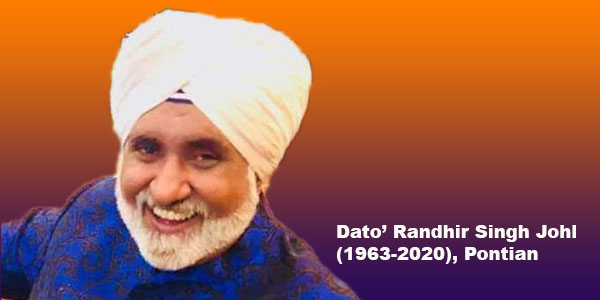
Dato’ Randhir Singh Johl (1963-2020), Pontian

AKHAND PATH:  17 – 19 September 2020 at Shota Darbar, Level 3, Gurdwara Sahib Petaling Jaya (Commences at 4pm). PATH DA BHOG: 19 Sept 2020 (Saturday), 5pm-7pm, at Main Darbar, Gurdwara Sahib Petaling Jaya | Malaysia

ਜੋ ਮਾਗਹਿ ਠਾਕੁਰ ਅਪੁਨੇ ਤੇ ਸੋਈ ਸੋਈ ਦੇਵੈ ॥

ਨਾਨਕ ਦਾਸੁ ਮੁਖ ਤੇ ਜੋ ਬੋਲੈ ਈਹਾ ਊਹਾ ਸਚੁ ਹੋਵੈ ॥੨॥੧੪॥੪੫॥


DATO’ RANDHIR SINGH JOHAL 

DIMP, FMIM, FIPMA (UK), MIMM, MIPRM, AIPD (UK), ISO:9000 (Lead Trainer), MSc (Comm) Putra, LLB (Hons) London, BSc (Hons) Malaya, CITD (UK)

(Managing Director Inovasi Makmur Sdn Bhd, Ex-CWC MIC National, Division Head MIC Pontian)

Age: 57 years

Passed away peacefully on 9th September 2020

Leaving behind his immediate family, Ex-wife Jagdish Kaur (UM),

Late Datuk Dr. Jasbir Singh Johl (Father) and Datin Rajinder Kaur Sidhu (Mother) 

Sisters / Spouses:

Mrs Parminder Kaur / Mr Wasakha Singh Dhaliwal (Canada)

Mrs Kamaljit Kaur / Mr Gurcharn Singh Toor (Singapore)

Brothers / Spouses:

Ir Jagjit Singh Johl / Mrs Gurjit Kaur

Ir Nirinder Singh Johl / Mrs Jaspal Kaur

Mr Satbir Singh Johl / Mrs Parminder Kaur

Mr Ajit Singh Johl / Mrs Kiranjeet Kaur

nephews, nieces and a host of friends and relatives to mourn his loss.

Akhand Path: 17 – 19 September 2020 at Shota Darbar, Level 3, Gurdwara Sahib Petaling Jaya (Commences at 4pm)

Path Da Bhog: 19 Sept 2020 (Saturday), 5pm-7pm, at Main Darbar, Gurdwara Sahib Petaling Jaya

For details, please contact

019-2222 898 (Ajit),019-271 9209 (Nirin), 019-7731 372 (Balpreet) 


| Entry: 10 Sept 2020: Updated: 13 Sept 2020 | Source: Family

ASIA SAMACHAR is an online newspaper for Sikhs / Punjabis in Southeast Asia and beyond. Facebook | WhatsApp +6017-335-1399 | Email: editor@asiasamachar.com | Twitter | Instagram | Obituary announcements, click here |