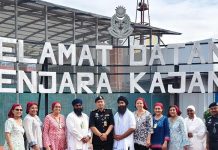
Jagdeep Singh Deo (red turban) at the Wadda Gurdwara Sahib Penang – Photograb from video at Jagdeep Singh Deo facebook
By Asia Samachar Team | MALAYSIA |
All six gurdwaras in Penang will begin operating today, along with other places of worship nationwide, as Malaysia relaxes restrictions imposed to curb the spread of the novel coronavirus.
“We must not let our guards down,” Penang state executive councillor Jagdeep Singh Deo said at a press conference at the Wadda Gurdwara Sahib Penang (WGSP) today.
Jagdeep said that the authorities will not compromise with compliance and adhere strictly with operating procedures in place to ward off the spread of Covid-19.
In addition to existing SOPs, Penang has also decided that children below 12 should not be allowed to attend programmes at places or worship.
ASIA SAMACHAR is an online newspaper for Sikhs / Punjabis in Southeast Asia and beyond.Facebook | WhatsApp +6017-335-1399 | Email: editor@asiasamachar.com | Twitter | Instagram | Obituary announcements, click here |
The Mighty Indus River at Attock Khurd: Emotionally Punjab ends at Indus River! Some of the greatest ancient civilizations in the world were cultivated in the Indus river valley. The Indus River (locally called Sindhu) is one of the longest rivers in Asia (about 2,000 miles long), originating in the Tibetan Plateau and ending near Karachi as it merges into the Arabian Sea. It is one of the few rivers in the world that has a tidal wave…Visited the British era Attock Khurd railway station built 1884 and saw the steel bridge with train from Peshawar crossing over it – same as 135 years ago! The treat was to come at lunch! Jahandad Khan and I sat by the river bank eating lunch on the land where our ancestors fought with each other in early 1800s. This time the competition was over sagg, maaki di roti, and lassi! This would have to be the most memorable visit of the trip. – Text / Photo: Dr. Tarunjit Singh Butalia
Dr. Tarunjit Singh Butalia | EXPERIENCE |
Imagine the joy of visiting the shrine of Baba Farid in Pakpattan — where your ancestors served Baba Farid more than 750 years ago, imagine the ecstatic feeling of stepping foot on the land of Siri Guru Nanak Sahib — where he was born and passed away, imagine visiting the Gurdwara in Lahore’s Chuna Mandi — where Siri Guru Ram Das Sahib was born, imagine praying at the Gurdwara — where Siri Guru Arjan Sahib was martyred, imagine the goosebumps when visiting Gurdwara Shaheed Singh Singhnian near Lahore railway station — where Sikh mothers were garlanded by Mir Mannu with the decapitated bodies of their own children.
Imagine walking the Lahore Fort — where your ancestors served about 200 years ago in the army of the Lion of Punjab, imagine discovering your maternal ancestral home late at night in Lahore — to see your maternal grandfather’s name outside the house waiting for someone to come reclaim its identity, imagine visiting Aitchison College in Lahore — where your grandfather and father studied, and imagine the circle of life that leads to your ancestral home through which your paternal grandparents walked out in 1947 never to return and you kiss the door walking back inside as a way to honor the promise of goodness of humanity.
The list goes on — but you get the point. It was a roller coaster of sad, poignant, and moments of hope and loving kindness.
I was born in October 1965 in East Punjab when my father and several of my uncles who were in the Indian armed forces were at war with Pakistan. I grew up being told that Pakistanis were evil — no exceptions, and with prejudiced stereotypes that Muslims were unclean. I now realize that I was being indoctrinated in the patriotism of hate. Patriotism of hate is love of your country based on hate of another country — in this case Pakistan. The Islamaphobic comments by family and friends were casual — usually said with humor to rub it in. I traced most of these prejudiced feelings to the bloody 1947 partition of Punjab by the British Empire, which drew an arbitrary line through the heart of Punjab dividing people who had lived together for thousands of years.
These were my thoughts as I landed at Allama Iqbal International Airport in Lahore. The taxi driver who picked me up asked if this was my first visit to Lahore. As soon as I said yes he quipped, “Jinae Lahore ni vaikhya o jamia nahi” [He who has not seen Lahore has yet to be born]. At that moment I knew I had been re-born!
Shrine of Baba Farid in Pakpattan – Photo: Dr. Tarunjit Singh Butalia
The hospitality of Pakistanis was overwhelming. Restaurants would not take money, Uber drivers refusing fare, Sardarji said with love and affection, the trolley guy at the airport shouting — give way to Sardarji — in Panjabi. The list goes on and on. The one I remember most fondly is that I was chatting with a Mualvi while both of us were eating dessert at the famous Yusaf Faluda shop in Gawalmandi of Lahore. When I got up to pay, the halwai informed me that the Maulvi Sahib I was talking with had already paid my bill and left. I was being drowned in hospitality and kindness — nowhere else in the world have I experienced such respect. If it were up to my hosts, they would have lifted me up on their shoulders!
Dr Tarunjit’s entry at his Facebook page in April 2019:
This post will help you understand why I chose “My Journey Home” as the title of this series of posts! See below.
Butala Sardar Jhanda Singh: This had to be the most emotional part of my journey. Located near Gujranwala, this is our family ancestral home. My ancestors lived here for many generations (during rule of Maharaja Ranjit Singh and his ancestors and successors). They owned 42 jagirs (42 means batali in Punjabi hence my family name and name of this village are the same Butala or Butalia). My grandparents stepped out in 1947 through these very doors never to return. I return here to complete the circle of life after 72 years. I even met an old gentleman who remembers my grandfather! His photo is below. The three havelis (mansions), one Baradari (12 door open guest house), one Samadh (memorial grave) of an ancestor, and a pond built by our family have survived the vagaries of weather and time. The hatred of the partition must turn into compassion for those on the other side. This is where our hope and future of humanity lies – and not in the patriotism of hate!
Ancestral home near Gujranwala – Photo: Dr. Tarunjit Singh Butalia
I was expecting to see women in burqas but was surprised to see that most women were not covered head to toe in burqa, unlike what much of the western media portrays about women in Pakistan. Some women covered their head in public with a chunni or scarf but faces were not covered. I met many women on my trip and found them to be inquisitive, balanced, and very perceptive.
Some of my most interesting conversations were with ordinary people such as Uber driver, restaurant cook, guard, waiter, and best of all “Bacha” — the mighty old Pathan outside my hotel who polished my shoes, all people making a living to raise a family with dignity. I did not meet one person, not one, who bad mouthed the country of my birth. Instead I heard a sense of appreciation that India had progressed significantly and they hoped Pakistan would also do the same.
But in my conversations, I heard something deeper. I heard the common person talking about how Pakistan had learned valuable lessons from its experiment with Islamic fundamentalism and that religious nationalism is not the way for their country. I reflected on their comments and it sent shivers down my spine as I thought of the bigotry that Trump and Modi are weaving in the oldest and largest democracies of the world. Both nations have lessons to learn from Pakistan’s date with religious nationalism.
Dr. Tarunjit Singh Butalia with the man who remembered his grandfather who left Pakistan in 1947 – Photo: Dr. Tarunjit Singh Butalia
Dr. Tarunjit Singh Butalia is a US-based interfaith activist and scholar with deep roots in East and West Punjab in South Asia. He currently serves as Executive Director of Religions for Peace USA and is a Board Trustee of the Council for a Parliament of the World’s Religions as well as Sikh Council for Interfaith Relations.
Tarunjit visited his family ancestral home near Gujranwala in 2019, seventy-two years after his grandparents left in 1947, never to return. His ancestors lived there for many generations, including during rule of Maharaja Ranjit Singh. They owned 42 jagirs (42 means batali in Punjabi hence my family name and name of this village are the same Butala or Butalia). The article first appeared here.
ASIA SAMACHAR is an online newspaper for Sikhs / Punjabis in Southeast Asia and beyond.Facebook | WhatsApp +6017-335-1399 | Email: editor@asiasamachar.com | Twitter | Instagram | Obituary announcements, click here |
Her thoughtful look as she chewed the last morsel of her salad appeared heavy on her shoulders. My wife and I knew that our eldest girl was going through the maturing process on understanding the surroundings around her and is even beginning to form her own thoughts and principals on society and people. So, we sort of guessed what thoughts would’ve been running in her head at the dining table during that dinner.
“You still having that spat with your school mate about Black Lives Matter?”
A few days before, she had an online argument on social media with a school mate. It was during the early tensed days when images and visuals of the US unrest were literally in our faces. And that got teenagers around the world sharing their support or their thoughts on racial discrimination.
Because it was on social media, anyone and everyone who had access to my girl’s Instagram account by following her, was privy to this spat. And very quickly, judgements were made, sides were taken, making it all more important for her to be on the right side of the argument. Suffice to say, without divulging the details, my wife and I were personally proud of the stance our daughter took in this argument.
Her premise was simple. If we are to show support online, we are also to practice what we preach with our own actions in the real world, not just in the virtual world of social media. So, the argument was made by our girl, why not start with ourselves at home in our own country. She argued that while we show support to those fighting for equality abroad, we should show compassion and equality to the discriminated in our own backyard.
The timing of her assertion was uncanny as Malaysians, more recently, took exceptions to many of the downtrodden immigrants fleeing away from their harsh conditions seeking shelter here. There was anger that immigrants, illegal mostly, were threatening our very sensitive ecosystem when fighting the Covid-19 pandemic.
“Yes, Papa. But I was thinking more about the documentary we watched last night. It’s so sad that racism is so deep in our society and yet we can’t see it because of how normal it has become.”
The night before, we had watched Netflix’ ‘13th’. It was a documentary that explores the racial inequality in the US. While watching, we compared to the situation in other countries, including Malaysia. We couldn’t run away from the fact that there are many similarities where we see ourselves as the discriminated and as the ones discriminating.
While the fight for justice continues throughout our lives because discrimination is so deep rooted in our societies and our psyche, my daughter saw a lot of hope and potential to better ourselves and start the change from within. She didn’t see herself being a people’s champion that would change the solid and systematic entrenched racism in our environment. Rather she thought she would start being more sensitive internally when dealing with humans as their unique selfs, now she has the awareness of what’s it like being on the receiving end of racial discrimination.
“I won’t turn away from that Bangladeshi worker working so hard in the hot sun any more”, she says. “I won’t ignore that chatty Indonesian laborer any more….I won’t see Indian teenagers with tattoos and earrings as gangsters any more.
I couldn’t help being more cynical than my daughter. I’ve made generalized ideas of people from different races based on my lifetime experiences and anecdotes from my closest of friends. And it’s very hard to turn it off like a switch. I wish I had that honesty and ideals my daughter talks about over these past few days. But, alas, I think having that conversation, and internally questioning myself or introspecting myself seems like a first of many steps towards being a better person who doesn’t discriminate on the color of skin, or any physical attributes for the matter. We have to strive towards it.
I’m glad that I can learn from the lenses of my children. Their thinking, and their maturity, can be astonishingly adult-like but more importantly liberal that focuses on equality and humanity.
Jagdesh Singh, a Kuala Lumpur-based executive with a US multinational company, is a father of three girls who are as opinionated as their mother
* This is the opinion of the writer, organisation or publication and does not necessarily represent the views of Asia Samachar.
ASIA SAMACHAR is an online newspaper for Sikhs / Punjabis in Southeast Asia and beyond.Facebook | WhatsApp +6017-335-1399 | Email: editor@asiasamachar.com | Twitter | Instagram | Obituary announcements, click here |
SASKAAR / CREMATION: 2pm, 18 June 2020 (Thursday) at Jalan Loke Yew Crematorium, Kuala Lumpur. Cortège leaves at 1pm from our residence No. 17, Jalan Penggawa 19/2, Sunstone Villa, Sec. 2, Bandar Mahkota Cheras, 43200 Selangor. PATH DA BHOG: 10.00am, 28 June 2020 (Sunday) at Gurdwara Sahib Sungei Besi (Shapa), Kuala Lumpur| Malaysia
Saskaar / Cremation: 2.00 PM, 18 June 2020 (Thursday) at Jalan Loke Yew Crematorium, Kuala Lumpur
Cortège timing: Cortège leaves at 1pm from our residence No. 17, Jalan Penggawa 19/2, Sunstone Villa, Sec. 2, Bandar Mahkota Cheras, 43200 Selangor
Path da Bhog: 10.00am, 28 June 2020 (Sunday) at Gurdwara Sahib Sungei Besi (Shapa), Kuala Lumpur
Contact:
Roy 012 – 222 2059
Ranjit 014 – 605 1053
The family would like to thank all relatives and friends who have supported us during our bereavement. Our sincere appreciation and heartfelt thank you.
DAD WILL BE FONDLY REMEMBERED AS A CHEERFUL PERSON TO FAMILY AND FRIENDS.
As it is still RMCO, the family will abide and strictly comply to the Standard Operating Procedure (SOP) for place of worship. They include:
Only 20 people are allowed at any one time
Visiting is allowed for only 5 minutes
Please maintain social distancing
Please register your name upon arrival
| Entry: 16 June 2020 | Source: Family
ASIA SAMACHAR is an online newspaper for Sikhs / Punjabis in Southeast Asia and beyond.Facebook | WhatsApp +6017-335-1399 | Email: editor@asiasamachar.com | Twitter | Instagram | Obituary announcements, click here |
Sushant Singh Rajput – Sketch by ToonistBains (Correction for the year: It should read 1986-2020)
By DJ Bombay Singh | OPINION|
BOLLYWOOD’S rising star Sushant Singh’s death by suicide continues to teach a lesson to humanity. It continues because this is not the first celebrity or a popular person of interest whose life ended tragically.
The horror is, it will be just a matter of time when we may hear of another one happening in another part of the world.
So, is it as simple as “celebrity stress” that drives them to this unimaginable act? If that were to be the case, then suicide rate would have been extremely high among celebrities. We know suicide happens even among the simple and ordinary folks.
This points us that ultimately it is the person him/herself the main driving factor.
And that can mean just any one of us! Period.
Suicide have had the tags of “crime” and “coward” attached to it. But have these tags stopped one in “excessive mental pain and irrationality” from taking the final plunge?
It is found that most suicides happen during a highly charged emotional storm, totally blowing away rationality. But the seeds of it has already begun somewhere. Because much more danger than the physical disability is the ailment of the mind, which may not give much obvious clues.
Therefore, the labels of criminality and cowardice has no place to describe their act. What we need is a real, massive awareness.
Suicide can happen to just about anybody and the onus is on us all to start learning and talking about it more, in every way possible, so that a would be person could self identify quickly and seek help as easy as, for example, as calling an emergency number, such as 999 (in Malaysia including Singapore).
As long as humans have emotions, the enemy called suicide is just lurking at some corner within us. We must be trained, we must be prepared.
For life is fleeting, as Sushant penned for the final time.
(The writer is a reader based at George Town, Penang)
ASIA SAMACHAR is an online newspaper for Sikhs / Punjabis in Southeast Asia and beyond.Facebook | WhatsApp +6017-335-1399 | Email: editor@asiasamachar.com | Twitter | Instagram | Obituary announcements, click here |
KIRTAN | NEW RELEASE: Dya Singh releases Tu Thakur (Ardas) as a tribute to the late Jagjit Singh, the Indian ghazal singer, composer and musician fondly known as the The Ghazal King. Jagjit passed away in 2011. Click here.
[TAKE NOTE OF ASIA SAMACHAR OFFICIAL WHATSAPP NUMBER: +6017-3351399. You can contact us to provide news alerts, community updates or obituary announcements. Stay in chardi kalaa]
ASIA SAMACHAR is an online newspaper for Sikhs / Punjabis in Southeast Asia and beyond.Facebook | WhatsApp +6017-335-1399 | Email: editor@asiasamachar.com | Twitter | Instagram | Obituary announcements, click here |
#GurmatPick | Virtual satsang by Malaysian-based Dr Parmjit Singh & Family. Sukhbir Kaur shares 3 lessons from the martyrdom (shahidi) of Guru Arjan Sahib (starts at 18:30). Dr Parmjit shares the sakhi of Kabul Sikhs visiting the Guru (starts 36:30). Courtesy of eSikhs. Click here.
https://youtu.be/sHzxnpCcuZ8
[TAKE NOTE OF ASIA SAMACHAR OFFICIAL WHATSAPP NUMBER: +6017-3351399. You can contact us to provide news alerts, community updates or obituary announcements. Stay in chardi kalaa]
ASIA SAMACHAR is an online newspaper for Sikhs / Punjabis in Southeast Asia and beyond.Facebook | WhatsApp +6017-335-1399 | Email: editor@asiasamachar.com | Twitter | Instagram | Obituary announcements, click here |
Some feel the Panjābi language spoken in Eastern Panjāb (in India) has deteriorated. It is argued that they don’t enunciate words properly, have poor grasp of grammar and hardly speak in a way that would make it sound sweet to the ears.
Contrast now with how the language is spoken in Western Panjāb (in Pakistan). Every word is spoken clearly and not even one expression has broken the grammar rule.
Enjoy this new segment dedicated to the late Amanullah Khan. The theatre performer, comedian and TV artist was regarded as one of the best comedians in the Indian subcontinent. Click for the Facebook link or the Youtube link.
ASIA SAMACHAR is an online newspaper for Sikhs / Punjabis in Southeast Asia and beyond.Facebook | WhatsApp +6017-335-1399 | Email: editor@asiasamachar.com | Twitter | Instagram | Obituary announcements, click here |
A United Sikhs food delivery. Members of the Australian chapter of the global aid organisation have worked throughout the bushfires and coronavirus. Photograph: Amrtitvir Sekhon
By Matilda Boseley | AUSTRALIA |
When Amritvir Sekhon and eight other Sikh men and women drove into Bairnsdale in the middle of the worst bushfire crisis in decades, locals didn’t know what to think.
“They had never seen turbanned men with long beards before – we probably looked pretty alien from them,” Sekhon says.
They were from the United Sikhs, a global aid organisation associated with the UN, with a growing presence in Australia.
“They were thankful that we were there, but they weren’t really sure if they could rely on us or what our agenda was.”
As soon as they arrived the small group set up shop, cooking thousands of free hot vegetarian meals for those who lost their homes in January’s Gippsland fires and were sheltering in the town.
“We’re pretty redneck up here,” says Leanne Jennings, who runs the Bairnsdale Neighbourhood House. “So to have people from different cultures come along and help us out in our town was amazing. It certainly does break down some barriers.”
“They made thousands of meals … there was so much rice, we broke a table because there was so much rice on it.”
The team, which soon doubled, stayed for 17 days, sleeping at the community house and working from dusk till dawn preparing meals and helping the Salvation Army sort donations.
Bairnsdale was a massive operation but it wasn’t the first or last crisis the United Sikhs helped with. In fact, the group is becoming a staple of Australia’s emergency response.
During the pandemic, the United Sikhs and Sikh communities have been vital in organising food relief in some of Victoria’s most economically vulnerable areas. At the Wyndham Park community centre in Melbourne, they have been providing hundreds of hot meals a week.
“My mantra is if you want anything done you get the Sikhs involved,” says Greg Ferrington, who managers the centre. “They can just put a list up on Facebook and within 24 hours they can turn it around and get what they need, that’s just the ethos in the community.”
Gurvinder Singh, the director of the United Sikhs’ Australian chapter, says community service is one of the most important tenets in the teachings of Sikhism.
See full story, ‘If you want anything done, get the Sikhs’: community wins admirers for bushfire and Covid aid, (The Guardian, 13 June 2020), here.
ASIA SAMACHAR is an online newspaper for Sikhs / Punjabis in Southeast Asia and beyond.Facebook | WhatsApp +6017-335-1399 | Email: editor@asiasamachar.com | Twitter | Instagram | Obituary announcements, click here |
Deljit Singh (turban) in a photo with his headmaster and mentor Michael Taylor – Photo: Deljit Singh
By Deljit Singh | BRITAIN |
When Priti Patel talks about being called a Paki in the playground, as unpleasant as that was she really got off quite lightly as pretty much everyone with a brown skin got called that and then some of us got a lot worse in the form of physical violence, otherwise known as a damn good kick in.
As a model pupil I never got into trouble with the teachers and prided myself on never getting summoned to the headmaster’s office for punishment – apart from that one time in 1977 when I was 15 years old because of an incident in a classroom.
Yes, its another long read so please sit comfortably…….
Bullying and racism even back in the 1970’s wasn’t the exclusive domain of boys as some girls could be equally as unpleasant and nasty. I had to endure a small group of girls in my class who would call me Paki, towelhead, badhead and other racist names.
I pretty much kept out of their way but then on particular day as we returned to the classroom from lunch one of these girls came up behind me and ripped my turban off my head and ran to the window which she tried to open so she could throw it out of the window. As I sprinted towards her to get my turban back, one of her gang tripped me so I fell forward face first bashing my face on the floor. I had been bought up never to hit girls but as I was now in pain, and with other pupils laughing at me, my anger got the better of me, so I lashed out. I picked up the nearest thing to me, a chair and threw it at the girl holding my turban, it hit her on the arm and she dropped my turban on the floor so I was able to pick it up. She swore at me and ran towards me but in her haste she tripped over the chair and went sprawling to the ground just as I had done. By now the furore hadn’t gone unnoticed and a teacher stepped in to separate us as once she was off the floor she and her friends started physically attacking me.
Given the opportunity to retie my turban, both she and I were frog marched to the headmaster’s office and told to explain ourselves. As the girl was incandescent with rage, she was sent outside to calm down while I was spoken to. Unbeknownst to me or the headmaster she’d phoned her father from the call box in reception and he arrived a short while later. As I left the headmaster’s office to go and wait in reception after explaining myself, the girl pointed me out to her father who immediately started threatening me. He was calmed down by staff and then he and his daughter went into the headmaster’s office so she could have her say.
I had thought about calling my father too but I felt so ashamed of myself for getting into trouble, getting him involved would only add to my shame so I decided against it. I was only waiting about fifteen minutes but it felt like a lifetime especially when the headmaster came out of his office and disappeared into another room and then back to his office and gave me no eye contact. I was fearing the worst when I was called back into his office and stood to one side away from the girl and her father, who was now calmer but staring at me with malicious intent.
The headmaster explained how he had heard both sides of the story as well as accounts other pupils had given to staff and the attack on me by the girl was unprovoked and she was the aggressor. The headmaster went onto explain that so far as he was concerned the attack on me was race related and so he was treating it as a racial assault. I’d never heard any white person use these words. He agreed my throwing a chair was wrong and I’d apologized for this unlike the girl who continued to say she’d done nothing wrong. As the incident happened on school premises it looked like it would be down to the headmaster to decide what happened next, and what happened was not what I expected.
The headmaster said that the girl’s attack on me wasn’t just racial but also an assault on my Sikh religion which he believed made it an even more serious matter. He explained how Sikhs had fought in world wars alongside the British while wearing turbans and her ripping my turban off was something I could if I wanted report to the police, he and staff would fully support me in doing so as in his school he wanted equality for everyone. Before the girl and her father had time to reply he asked her father how he would have felt if a boy, any boy had put their hands on his daughter in what would be a sexual assault, and whether or not he’d report it to the police. The father nodded his head and shrank back into his chair.
The headmaster then announced that if it was left up to him his decision would be to expel the girl from school for her racist assault, but with that said he wasn’t the one that had been assaulted, so it shouldn’t be down to him. I was taken aback when he turned to me and said; “Well, Deljit, what do you think should happen?”
So now it was down to me to play Solomon and do the right thing. As the girl was now tearing up and her father was ashen faced I turned to the headmaster and replied. “I don’t want to ruin anyone’s life, so can she stay in school if she and her friends who I know don’t like me just leave me alone, and I’ll stay away from them too. If they do that then I’d rather not take this any further, is that alright?”
The room fell silent as he looked down at his desk and he looked at the girl and asked; “Are you willing to do that or not?”. She nodded and her father promised she would and even mouthed the words thank you in my direction. The headmaster agreed to honour my decision and warned the girl if she, her friends or anyone else did anything like this he would take more drastic action.
After the girl and her father left, the headmaster turned to me and said, “I’m sorry I put you on the spot but I know how you are and I knew you’d do the right thing for all concerned. After all Sikhism talks about the welfare of all”. I replied, “Yes, sir, Sarbat Ka Bhalla, is what we say to do right by everyone”. “What you did in forgiving her makes you a credit to the Sikh faith Deljit, I’m very proud of you young man”.
The name of my headmaster was Michael Taylor, he was my hero and my mentor. He was always about fairness, doing the right thing and of course learning. That day in Mr Taylor’s office I learned that there are white people who abhor racism and will always stand shoulder to shoulder with us in the name of equality.
In later years I would consult with Mr Taylor whenever I felt anxious, particularly after finishing my A Levels, and needed advice, or just someone to quote me Shakespeare. It was because of his quoting me Shakespeare that I read many of the Bard’s works. Sadly I only have this one photo of Mr Taylor as part of a group shot of the Jack Hunt School 6th Form in 1979. Michael Taylor is the gentleman in the light suit on the front row second from the right, I’m in the second row with the same hairstyle I have today but without the facial hair.
Thank you to those who’ve commented that my speech on Saturday at the Black Lives Matter event inspired them to speak to their kids and to speak up on racism. I do so because I was mentored by the likes of Michael Taylor to do the right thing and say the right thing.
DEL’S FOOTNOTE TO THE VIDEO:
I was honoured to speak at the Black Lives Matter Protest in Peterborough following the murder of George Floyd and other black people in the US.
I spoke specifically about the racism and prejudice I have faced in Peterborough and how racism isn’t just a US thing. There were over 1000 people in attendance who listened, cheered and applauded all the speakers who were brilliant on the day.
About a minute of my speech is missing where I talk about how in school in Peterborough in 1966 my two brothers and I as the only non-white kids in our school were forced to change our names from Manjit, Sarbjit and Deljit to Peter, David and Paul respectively to “help” the teachers and other pupils. So on the video when I ask “How would you feel if your kids’ school told you they’d need to change their names?”. Just in case you don’t get the context.
The rest of the video is pretty straightforward in terms of All Live Matter when Black Lives Matter that’s a given.
Thank you to Chris David Martin and all at Everything Peterborough for filming this and sharing with me, check out the Everything Peterborough channel on YouTube.
(Adapted from Del Singh’s sharing on his Facebook page)
ASIA SAMACHAR is an online newspaper for Sikhs / Punjabis in Southeast Asia and beyond.Facebook | WhatsApp +6017-335-1399 | Email: editor@asiasamachar.com | Twitter | Instagram | Obituary announcements, click here |