Don’t let a bad day make you feel like you have a bad life – Sketch by ToonistBains
ASIA SAMACHAR is an online newspaper for Sikhs / Punjabis in Southeast Asia and beyond.Facebook | WhatsApp +6017-335-1399 | Email: editor@asiasamachar.com | Twitter | Instagram | Obituary announcements, click here |
Kabul gurdwara attacked – Photo: Ramesh Singh Khalsa
By Asia Samachar Team | UNITED STATES |
A Sikh organisation has called upon President Donald Trump to take executive action to provide immediate safe harbor to Sikhs and Hindus who are being forced to flee their own homes in Afghanistan.
The Afghan minority communities have been facing terror attacks for years now, with the latest and most deadly blow coming on 25 March when 25 people were killed at Gurdwara Guru Har Rai Sahib Ji in Kabul.
Ever since the latest attack, Sikh organisations, especially in the US and Canada, have ramped up efforts to assist the small number of Sikhs and Hindus left in Afghanistan to find a way out of the country that has seen increasing attacks upon the minorities.
In the US, humanitarian agency United Sikhs have reached out to the U.S. State Department and the American Sikh Caucus Committee (ASCC) to find a resolution.
United Sikhs chief legal counsel and acting national legal director Wanda Sanchez Day said President Trump’s and the US’ stated commitment to protecting religious freedom around the world was at this moment being tested.
“Sikhs, Hindus, and other ethnoreligious groups, who during 18 years of war in Afghanistan following 9/11 were protected by the United States and coalition military forces, are now in harm’s way. This is especially true, and was foreseeable, after February 29, 2020, U.S.-Taliban Agreement and the March 2020 withdrawal of U.S. military personnel.
“The U.S. should rightfully include protections for these religious minorities as part of the Taliban- Afghanistan peace-making process. Those protections should include granting political asylum to victims of religious persecution,” she said in a statement released today.
ASCC executive director Harpreet Singh Sandhu said it has reached out to Congress members John Garamendi, Jim Costa, Eliot Engel, and the House Foreign Affairs Committee members, as well as Senator Dick Durban and international leaders.
“We are presently waiting for a response from the Trump Administration on what will be done to assist Sikhs and other religious minorities who are forced to flee Afghanistan,” he was quoted in the same statement.
United Sikhs international humanitarian aid director Gurvinder Singh said the organisation have had numerous discussions with the State Department.
He said U.S. ambassador on religious freedoms Sam Brownback has been key to establishing a direct dialogue with India and Pakistan on the issue.
“We hope the U.S. and the Trump Administration can keep these religious minority communities safe from further attacks, and offer resettlement given the immediate and real threat,” he said.
There are hopes that the international community will help and that India will accommodate many Sikh and Hindu refugees who have family ties in that country. Pakistan, Canada, UK, and the U.S. are also likely safe havens for Sikhs and Hindus who must re-settle, the statement added.
ASIA SAMACHAR is an online newspaper for Sikhs / Punjabis in Southeast Asia and beyond.Facebook | WhatsApp +6017-335-1399 | Email: editor@asiasamachar.com | Twitter | Instagram | Obituary announcements, click here |
MEMORIES: Personal belongings of Baba Sohan Singh displayed during the annual programme in his memory at Malacca – PHOTO / ASIA SAMACHAR
By Asia Samachar Team | MALAYSIA |
It’s official. Malacca’s largest annual Sikh prayer gathering in the memory of Baba Sohan Singh has been cancelled due to the novel coronavirus threat.
In a statement released today (29 April), Gurdwara Sahib Malacca (GSM) announced the cancellation of the programme scheduled for May 22-24.
“The Sangat of Malaysia and Singapore are requested to comply with the government’s restrictions on all gatherings to minimise the spread of Covid-19. The Covid-19 epidemic is not over yet and there is always a danger of it spreading again through gatherings,” said GSM management committee president Tirath Singh.
Congregation members with queries can call the GSM secretary at 012-6122057.
On 4 April, Sant Sohan Singh Ji Melaka Memorial Society Malaysia, popularly known as the Vidyala, told Asia Samachar that it had decided to cancel its involvement in the programme for this year.
GSM and the Vidyala are the two main parties in organising the event that attracts Sikhs from neighbouring Singapore and Indonesia, as well as other countries.
Officially known as the Sant Baba Sohan Singh Ji Yaadghari Semagam, it is usually simply called the Malacca barsi.
ASIA SAMACHAR is an online newspaper for Sikhs / Punjabis in Southeast Asia and beyond.Facebook | WhatsApp +6017-335-1399 | Email: editor@asiasamachar.com | Twitter | Instagram | Obituary announcements, click here |
Like you, I’m sitting at home, in the safe comforts of it, with my loved ones, slightly worried about how things are going to turn out economically. We sit in peace, the only fear worth brooding over about is the possibility off getting infected with the Covid-19 virus somehow and surviving it. And then, we ponder if we will have income in the coming months when the economy is in a shape never seen before. In short, uncertainty is the only discomfort.
There’s nobody trying to persecute us. Nobody trying to find us from our hiding. Nobody trying to chase us away from our homes. Nobody trying to harm our children. And there’s nobody hating us for our religious beliefs. We have the luxury of peace and the means to prosper as families and as minorities in the country we make a living in. Yet, I sometimes think we do take this for granted.
For Sikhs, we have hand-me-down tales and memories of similar persecution during the times of our Gurus, where we had our own militia formed to fight back. Running away wasn’t really an option, for some reason. Children and women were many a times the casualties of war. Until we lived the Golden age of Maharaja Ranjit Singh. The hardship and pain of religious persecution as a minority has been ingrained in our psyche, making us a tad more sensitive when ever so faced with the slightest indication of our religious beliefs being questioned.
Early in the 20th century, while the world fought it’s Wars, immigration via the seas was rampant. As empires crumbled, economies collapsed, pushing migrants from India and China to seek opportunities and peace in countries like Malaysia. My grandfathers ran away from absolute poverty and hunger to start their families here in the then Malaya. Many ran away from persecution, many ran away just to survive from poverty, without the dreams of green grass or gold. Ask any of the minorities in Malaysia, you will hear these typical tales recounted, handed down to their children and grandchildren.
Today, we prosper under the blanket of citizenship and the safety that comes along with the country being relatively safe, and any semblance of persecution on the minorities are answered through the voice of democracy. Yet, with our sensitivities of our forefathers seeking shelter in this country in the last century, we seem to have built an immunity towards treating other humans escaping the very same persecution that pushed them to escape their home countries.
Most recently, the Rohingyas of Burma have literally spilled into our shores, dying of hunger while hoping for some safety for their families. While some made it to the refugee camps in our country, a few were turned back into the perils of the seas, with no direction to turn towards but certain death. We justified our actions of turning them back by pointing out the dangers of contamination amidst this global pandemic. There’s a curve we need to flatten.
You might say that I should get off my high horse, and if it really mattered, you would’ve questioned my sincerity by asking if I would house these refugees in my own home and risk contraction of the Covid-19 virus with my family. And you’re probably right. But our humanity as a country and as a government would’ve figured a way to help these refugees, if there was any will whatsoever. If there’s a will, there’s a way, I’m sure of it.
And then, there’s the Rohingya refugees that already made it here before the pandemic. Some have already begun assuming some semblance of citizenship of our dear country, enjoying benefits that even the minorities are hard to come by. If there’s any truth to this, of which I’m very wary of, I would say that questions are to be asked of our administrative government to the loopholes that allow this imbalance of rights. Still, I suspect that this is more the exception than the rule.
In a recent statement, Mercy Malaysia points out: “Because Malaysia is not a signatory to the 1951 Refugee Convention, the country does not have a legal framework regulating the status and rights of refugees. This simply means that refugees are regarded as illegal or undocumented migrants, and they do not have legal access to employment, education, healthcare or protection.
“This failure to accord refugee status has resulted in more harm than good, where there is no administrative framework for the implementation of refugee law nor protection laws that recognizes and acknowledges their presence in this country.”
In other words, there is no way an illegal immigrant, which is what the stateless Rohingyas are, can access even the bare necessities of healthcare during this vicious pandemic that we’re in. They have nowhere else to run to, and have come to us for our humanity.
And our humanity is more so relevant when we remember how our forefathers came to be hardworking citizens of his country less than a century ago. We should be as sensitive, as minorities, and as grateful for our existence in this country, had it not been to the humanity that allowed our forefathers the opportunities they craved.
Our memories, our sensitivities and our backgrounds demand that we treat other humans who are suffering and running away from the evils of persecution as how we would treat any other humans. If we can’t help them directly, at the very least, help them by not being selfish to think that they’re here to steal our dreams and our peace. This is what makes us humane. This is what makes us human. Remember, just like our forefathers, they never had a choice nor the luxury of peace that we take for granted in our homes.
Jagdesh Singh, a Kuala Lumpur-based executive with a US multinational company, is a father of three girls who are as opinionated as their mother
* This is the opinion of the writer, organisation or publication and does not necessarily represent the views of Asia Samachar.
ASIA SAMACHAR is an online newspaper for Sikhs / Punjabis in Southeast Asia and beyond.Facebook | WhatsApp +6017-335-1399 | Email: editor@asiasamachar.com | Twitter | Instagram | Obituary announcements, click here |
Sikh critical thinker Dr Karminder Singh Dhillon has retired after a 32-year stint with the Malaysian civil service.
He retired yesterday (28 April) as the deputy secretary general (management) of the Ministry of Defense (Mindef).
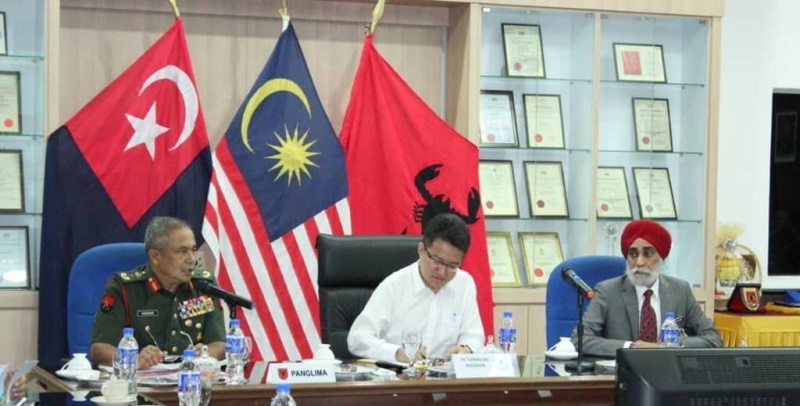
Among those who noted his departure was Liew Chin Tong, the former Malaysian deputy defence minister from the Pakatan Harapan government which stormed into office after the surprise victory in the May 2018 polls.
In a Facebook entry yesterday, Liew said he and former defence minister Mohamad Sabu had a ‘great time’ working with Dr Karminder during their tenure in Mindef.
“He is knowledgeable and has written a PhD on Malaysia’s foreign policy, in part based on his experience during his first tour at MinDef. This research work later culminated into a book, titled “Malaysian Foreign Policy in the Mahathir Era, 1981-2003: Dilemmas of Development, which is often cited by scholars internationally when discussing Malaysia’s development.
“He was a great advocate for Defence White Paper and good governance in Defence. Good luck in retirement, Dr. Karminder,” he said.
Asked what was the biggest learning after more than three decades serving the Government, Karminder said it all came down to individuals.
“The greatest hope society and the nation can have is in individual character. Not technology, processes, systems and a whole host of other things we tend to focus on,” he told Asia Samachar.
Karminder, whose father was a granthi and a Sikh intellectual, is also a well-known Sikh writer and speaker who never shies away from tackling difficult and controversial topics.
Karminder is currently the joint editor of US-based The Sikh Bulletin and sits on the board of the Sikhi Vichar Forum website which aims to create awareness on ‘authentic SGGS based Sikhi’.
Karminder was appointed deputy secretary general in July 2018 which made him the senior most Sikh in the Malaysian civil service.
Earlier, Jesbil Singh also ended his career as a deputy secretary general at the same ministry. He is now an assistant vice chancellor at the National Defence University of Malaysia (UPNM).
One of the photos shared by Liew (middle) who is seen here chairing a Mindef meeting
Prior to his last position, Karminder was the senior deputy director at the National Institute of Public Administration Malaysia, popularly known by its Malay acronym Intan.
He has previously served at the Prime Ministers Department, the Institute of Diplomacy and Foreign Relations and Ministry of Foreign Affairs.
Karminder teaches at the National University of Malaysia on an adjunct basis. He has previously served as adjunct faculty in the Department of International Studies, University of Malaya and UPNM.
He holds a B.Sc in political science, a post-grad diploma in public management, an MA in international relations and international communication, and a doctorate in international relations.
He has obtained his educational and professional qualifications from Harvard University, US; the University of Nottingham, UK, and the National Defense University, Beijing; Boston University, US, and University of Science Penang.
Here are excerpts from an interview with Karminder.
Q: The biggest learning you take along after 32 years of service.
A: That it all comes down to individuals. The greatest hope society and the nation can have is in individual character. Not technology, processes, systems and a whole host of other things we tend to focus on. Individuals must want the change, progress and development that society and the nation aspire; else it will simply not happen.
In my 32 years, what I remember most are individuals: individuals who made a difference, individuals who stood up for what is right, individuals who valued other individuals.
Q: What was your most memorable moment while in the civil service?
The change in government that happened in May of 2018 stands out as the most recent. The civil service had not known any other government. The novelty of the entire process and the whole range of unknowns that hung over the heads of everyone involved was what made it inimitable.
I guess the new minsters and their teams were as anxious as we were. Neither side knew what to expect. Witnessing Minister Mat Sabu take the guard of honor given to him by the Armed Forces was historic in itself.
Experiencing the intellectual passion of Deputy Minister Lew Chin Tong in all matters of defense of the nation – in particular the Defense White Paper – something never done in the history of Mindef – was equally historic.
In the end professionalism triumphed on the side of Mindef and patriotism on the side of the new administration.
Q: So, what’s next?
Back to basics. Family, Writing, Teaching and Consulting.
ASIA SAMACHAR is an online newspaper for Sikhs / Punjabis in Southeast Asia and beyond.Facebook | WhatsApp +6017-335-1399 | Email: editor@asiasamachar.com | Twitter | Instagram | Obituary announcements, click here |
There will be life-style changes in how people live, work and behave.
Economic impact can be catastrophic: some states can collapse with knock on effects leading to increase in regional conflicts.
There can be law and order problems as people at the fringes of society starve.
Yet, human loss can be environmental gain as there is slow-down of polluting human activity.
In an article, ‘Can life return to normal after Covid-19?’ (The Malay Mail, 30 March 2020), two Malaysian doctors, Amar-Singh and Lim Swee Im, predict that return to normal life as we know it, is highly unlikely.
The aftermath of Covid-19 can be compared to the consequences of World War II. Even if a vaccine for Covid-19 is found, it will take a long time to produce on a global scale.
In this process the world will only recover from the pandemic if all countries recover. Thus the global human interdependence becomes a practical reality. The Malaysian doctors conclude that there is no immediate return to the old ways. We cannot continue indefinitely with some form of lockdown. The impact of the changes forced by Covid-19 on the way we live, will be permanent.
Massive economic impact will continue to be felt for some years. Many will die from other diseases as medical facilities are taken up by Covid-19. The poor will die from starvation and suicides will increase. Human beings have to face a new post coronavirus reality and learn how to adapt to and survive this reality.
The authors list three exit strategies: 1) Countries can give up and return to normal life and allow the pandemic to spread. The capacity of the health service to treat people will be overrun, and the death toll will be enormous, but it may be relatively shorter-lived. There is no certainty that Covid-19 will not return in follow up waves of infection.
Exit strategy 2 can be segregation of old people and children/adults with chronic conditions. This is not a practical option when all aspects are considered.
Exit strategy 3 is more realistic and is to allow the virus to spread at a controlled rate while we get back to some normality in life. That is happening in most countries. However, the virus will return after we control each wave until it fades away over a period of time.
Human behaviour will need to change quite drastically due to the need for social distancing in most areas of human activity. Just think of all the places where human beings come close together – travel, sports and recreational activities, office work, education, meetings, social events, worship, public services including health and medical services etc – the list is almost endless. Innovative ways are already being found to be able to do much online from home. Thousands of office premises will be vacated! Fewer cars on roads and, maybe, more cycles? Even children should feel safer on the roads.
There will be massive advances in communications technology as more people work and shop from home. Electronic commerce will take a quantum leap. The economic impact can bring about own global consequences due to world trade interdependence. The aerospace and tourism/hospitality industries with their pyramid structures will be hit hard and may not recover for some years. Single product countries like those depending on oil can face major challenges which will need to be faced through global arrangements. There can be law and order implications.
There will be a plethora of new laws at national and international levels.
There is already a pause in the destruction of the environment due to a massive slow-down of human activity and waste. It is just possible that human beings will become more conscious of the flora and fauna and the interdependence of life on earth. Already, many are switching over to a life style which is more in consonant with nature.
The above are just some pointers to a very different world as we continue to face an uncertain future. Yet, human beings are resilient and innovative and have survived such challenges before.
Gurmukh Singh OBE, a retired UK senior civil servant, chairs the Advisory Board of The Sikh Missionary Society UK. Email: sewauk2005@yahoo.co.uk. Click here for more details on the author.
* This is the opinion of the writer, organisation or publication and does not necessarily represent the views of Asia Samachar.
ASIA SAMACHAR is an online newspaper for Sikhs / Punjabis in Southeast Asia and beyond.Facebook | WhatsApp +6017-335-1399 | Email: editor@asiasamachar.com | Twitter | Instagram | Obituary announcements, click here |
Malaysian Gurdwaras Council (MGC) letter with regards to the oversized Guru Granth Sahib at the Puchong gurdwara. The letter was confirmed the sender.
Date: 28th Apr 2020
Ref: MGC/OF/282/05(11-20)
To: All Gurdwaras
President, Gurdwara Sahib
……………………………
Waheguru Ji Ka Khalsa, Waheguru Ji Ki Fateh
Sardar Ji / Sardarni Jio,
Subject: Largest Sroop of Holy Sri Guru Granth Sahib Ji
There have recently been many comments in the blogs relating to the above matter. Many comments are clearly unjustified and are made according to the perception of the individual and the facts one has.
For instance, a video clip by GURSEWAK SINGH has been widely circulated. It makes allegations that Sdr. Awtar Singh, President of Gurdwara Sahib Puchong had collected more that 2 “Crores” from the Project. This is inaccurate as no collection of RM1,000/= per Ang of SGGSJ was done.
This project by Gurdwara Sahib Puchong started in 2010. At that time there were some complaints which were addressed. This project was undertaken by the Gurdwara Sahib committee and the Sanggat of Puchong.
The MGC Religious committee on coming to know of the Project had considered the matter at its Meeting held in July 2011. All the Pros and Cons were considered including that the Project was started by the Sanggat of Puchong after having done Ardas and taken the Hukamnama.
The MGC Religious committee further had taken note of fact that at the moment the Holy SGGSJ’s Sroop is found in different sizes, that is:
Those printed and published under authority of the SGPC, Amritsar more than one size.
There is the smallest Holy SGGSJ in the world which is hardly 4”X6”.
There are handwritten Sroop of Holy SGGSJ. The one installed at Amritsar is about 6 feet wide and weighs 45 kilograms, the one installed at Freemont, America is about 7 feet wide and weighs 84 kilograms. Its installation was officially done by the Jathedar of Akal Takht.
On the further advise of the MGC Religious Committee a letter dated 02 August 2011 was written to Akal Takht Jathedar then Singh Sahib Giani Gurbachan Singh Ji. A copy of this letter is attached as Appendix-A.
The whole History of this Largest Saroop of the Holy SGGSJ was stated in the letter including fact that this Project is by the Sanggat of Puchong which was undertaken after doing Ardas and taking Hukamnama. All the known questions were detailed and explained for the consideration of Akal Takht.
The letter at the end sought guidance from the Akal Takht. To date no replay has been received.
It is within MGC knowledge that Sdr. Awtar Singh, the President of Gurdwara Sahib Puchong had met with the Akal Takht Jathedar then Singh Sahib Giani Gurbachan Singh Ji. Acting on the advice of Akal Takht Jathedar, the Gurdwara Sahib Puchong committee does not allow any Sanggat member to go in to “Matha Tekh” but can do “Darshan” of the Holy SGGSJ through the mirrors from the Gurdwara’s corridor. Only the Granthi Sahiban go into the small Darbar to do Sewa with Sharda and as per Sikh Rehet Maryada.
Two other concerns expressed in the blogs are that (i) there is Moorthi Pooja (ii) there is Beadbi.
There is no question of any Moorthi Pooja as the Holy SGGSJ’s “Darshan” are done through the mirror from the corridor. This is similar position as those SGGSJ Sroop placed behind glasses in Darbar Sahib compound.
There is no question of Beadbi as the greatest reverence is given to the Holy SGGSJ as per the Sikh Rehet Maryada.
Thus, the only issue is “Size of SGGSJ”. There is no question of Beadbi and Moorthi Pooja.
The MGC understands that the Akal Takht is looking at this matter anew. We welcome whatever decision is made by the Akal Takht that is whether the Holy SGGSJ can continue to remain installed at Gurdwara Sahib Puchong as at present with full reverence being given or any other decision it may make.
The Sanggat will appreciate that the MGC had acted in accordance with the Sikh Rehet Maryada. After advice from its religious Committee had referred the matter to the Akal Takht. We await the decision.
ASIA SAMACHAR is an online newspaper for Sikhs / Punjabis in Southeast Asia and beyond.Facebook | WhatsApp +6017-335-1399 | Email: editor@asiasamachar.com | Twitter | Instagram | Obituary announcements, click here |
Oversized SGGS copy in Puchong gurdwara, believed to the largest in the world – Photo: Supplied
By Asia Samachar Team | MALAYSIA |
The oversized Sri Guru Granth Sahib (SGGS) in a Malaysian town of Puchong is again making news.
For the second time in a decade, the issue has attracted the attention of the Amritsar-based Akal Takht, the Sikh faith’s key religious decision making body.
Puchong, a bustling town just outside of Kuala Lumpur, is home to what is believed to be the largest copy of the Sikh scripture in the world. The SGGS was completed and placed in Gurdwara Sahib Puchong in 2011.
After the matter was raised on the social media recently, the Akal Takht had written to the gurdwara management team seeking clarifications.
In a letter dated 22 April 2020, the Akal Takht said that representatives sent by the jathedar in July 2011 to investigate the earlier complaint on the SGGS copy had advised them to stop [from proceeding with the making of the large SGGS].
“Based on viral messages and reports on social media, you have completed printing the saroop and is making it available for darshan. Your management committee is required to submit in writing your justification re this matter to Akal Takht within 15 days,” it said.
The letter was signed by Akal Takht jathedar personal assistant (PA) Jaspal Singh.
CRUX OF THE MATTER
What’s at issue? At the crux is whether the oversized SGGS copy can be produced, and whether it can be displayed to the general public.
Puchong gurdwara advisor Awtar Singh, who was the prime mover of the oversized SGGS copy idea, said the matter probably arose due to some misunderstanding and misinformation on the part of those commenting on the social media.
“This is an old matter,” he told Asia Samachar.
Awtar, the immediate past president of the gurdwara management committee, said the idea came about when gurdwaras were challenged by the then Gurdwaras Council Malaysia (MGC) leadership to think of ideas to attract the Sanggat (congregation).
“When I came back from the meeting, this idea came to mind. I thought it would spark the interest of the Sanggat and also pique the curiosity of the youth,” he said.
And so they set forth on the project.
Awtar Singh (left) interviewed on the largest SGGS copy some years ago – Photograb from Simran Production video
At some point, they were faced with a hurdle when they received their project caught the attention of the Sikh authorities in Amritsar.
In a letter dated 31 Aug 2011, the Akal Takht said it had received complaints from the Malaysian sanggat that the Puchong gurdwara was printing with stickers the SGGS saroop containing 1,490 pages, with a measurement of 15×4 feet and weighing 700kg. It said that thus far 70 pages had been sold for RM70,000.
The letter, addressed to three persons, including Awtar, had asked them to submit in writing as to who granted them permission.
In the letter signed by Akal Takht jathedar PA Inder Mohan Singh, they were also summoned to appear before five Singh Sahibs at 11am on 26 Sept 2011 to state their case.
“We had responded to the letter in writing. I also told them I could not make it within the stipulated time as we need visa to travel, as well as make some other arrangements as well,” he said.
Eventually, he did meet the Akal Takhat jathedar towards end-2011.
In that meeting, he was advised to keep the SGGS copy under wraps, perhaps covered in a mirror case. In others, not to do ‘parkash‘ of the copy. Parkash refers to the act of opening of the SGGS, accompanied by prayers, every morning. Similarly, in the evening, the SGGS is then respectfully closed for the day.
“I asked them to give that in writing, but they declined,” he said. “We agreed to their instruction. And we have observed them since.”
PERMISSION FOR OVERSIZED GURU GRANTH
When embarking on the project, MGC had given the Puchong team its blessings via a letter dated 31 March 2011.
In the letter, then MGC president V Harcharan Singh said that the council was ‘pleased to note your noble endeavour to prepare the largest copy of Sri Guru Granth Sahib in the world’, described as a ‘historical project’.
At one point of time, Awtar and his team wanted to get sponsorship of RM1,000 for every page of the SGGS to pay for the project, but the idea was shot down. Eventually, Awtar said he bore the bulk of the cost to finance the project.
In the latest development, MGC said has welcomed Akal Takht looking at the matter anew.
“We welcome whatever decision is made by the Akal Takht that is whether the Holy SGGSJ can continue to remain installed at Gurdwara Sahib Puchong as at present with full reverence being given or any other decision it may make,” MGC president Jagir Singh said in a letter that will distributed to all Malaysian gurdwaras tomorrow.
An advanced copy of the letter, dated 28 April, was made available to Asia Samachar.
Explaining the project background, MGC said its religious committee had deliberated on the matter in July 2011 when it was brought to their attention.
“All the Pros and Cons were considered including that the Project was started by the Sanggat of Puchong after having done Ardas and taken the Hukamnama,” he said.
The committee noted that SGGS copies were to be found in different sizes, including those printed and published under the authority of the Amritsar-based Shiromani Gurdwara Parbandhak Committee (SGPC).
It noted that there also existed the smallest SGGS copy ‘measuring hardly’ 4”X6” as well as the handwritten copies.
“The one installed at Amritsar is about 6 feet wide and weighs 45 kilograms, the one installed at Freemont, America is about 7 feet wide and weighs 84 kilograms. Its installation was officially done by the Jathedar of Akal Takht,” it said.
The world’s largest SGGS copy is kept in a mirror casing at the gurdwara in Puchong, Malaysia – Photo supplied
In August 2011, Jagir said MGC wrote a letter to then Akal Takht Jathedar Singh Sahib Giani Gurbachan Singh.
“The whole History of this Largest Saroop of the Holy SGGSJ was stated in the letter including fact that this Project is by the Sanggat of Puchong which was undertaken after doing Ardas and taking Hukamnama. All the known questions were detailed and explained for the consideration of Akal Takht.
“The letter at the end sought guidance from the Akal Takht. To date no replay has been received,” he said.
In the latest letter, Jagir said that it was within MGC knowledge that Awtar had met with Giani Gurbachan.
“Acting on the advice of Akal Takht Jathedar, the Gurdwara Sahib Puchong committee does not allow any Sanggat member to go in to ‘Matha Tekh’ but can do ‘Darshan’ of the Holy SGGSJ through the mirrors from the Gurdwara’s corridor. Only the Granthi Sahiban go into the small Darbar to do Sewa with Sharda and as per Sikh Rehet Maryada,” he said.
Jagir also addressed the supposed sacrilege caused by the Puchong oversized SGGS copy.
“There is no question of any Moorthi Pooja as the Holy SGGSJ’s “Darshan” are done through the mirror from the corridor. This is similar position as those SGGSJ Sroop placed behind glasses in Darbar Sahib compound,” he said.
He noted that the only issue was the “Size of SGGSJ”.
ASIA SAMACHAR is an online newspaper for Sikhs / Punjabis in Southeast Asia and beyond.Facebook | WhatsApp +6017-335-1399 | Email: editor@asiasamachar.com | Twitter | Instagram | Obituary announcements, click here |
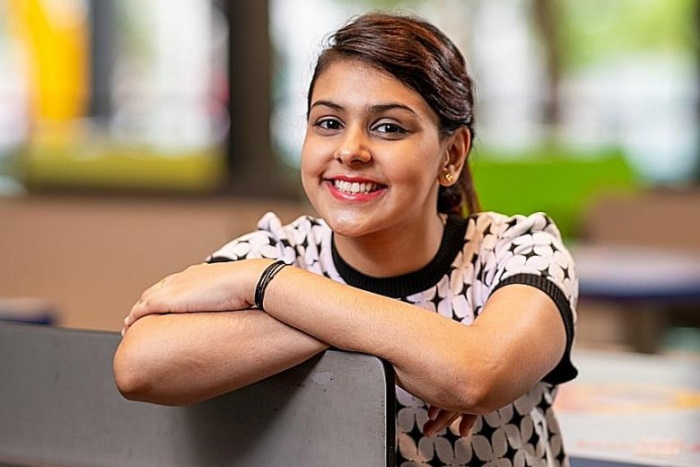
Amrita Kaur Ishwar Singh – Photo: Singapore Polytechnic / ST
By Amelia Teng | SINGAPORE |
With a grade point average (GPA) of 3.9 out of 4, Singapore Polytechnic (SP) graduate Amrita Kaur Ishwar Singh is on her way to reading accountancy in university.
But life was not always smooth-sailing for the 23-year-old.
Distracted and unmotivated, partly owing to the death of her grandmother, she did not do well at the Primary School Leaving Examination (PSLE), and was posted to the Normal (Technical) stream at Gan Eng Seng School.
“I knew my mum was disappointed, I could see the look on her face when she saw my results slip,” she said.
Her mother is an administrative employee and her father, a delivery driver.
The years in secondary school were not any easier.
“My family moved house at least twice and we stayed with relatives, so that we could pay our debts.”
The sight of her parents working hard brought a change. It spurred her to study hard. Her form teacher also triggered her interest in mathematics, and led her to take the subject at a higher level in school.
Read full story ‘Rising above adversity to become a maths whizz and top student’ (TheStraits Times, 27 April 2020), here.
ASIA SAMACHAR is an online newspaper for Sikhs / Punjabis in Southeast Asia and beyond.Facebook | WhatsApp +6017-335-1399 | Email: editor@asiasamachar.com | Twitter | Instagram | Obituary announcements, click here |
The Sikh community has fed 15,000 families over the past fortnight – and hundreds of people are still lining up each day for help. Photograbs from Newshub video
By Zac Fleming | NEW ZEALAND |
Around 100,000 people are currently relying on food grants and parcels to feed their families each week.
The Sikh community has fed 15,000 families over the past fortnight – and hundreds of people are still lining up each day for help.
Around 700 families queued outside a Sikh temple in Auckland on Sunday to receive a food parcel. They turned up early because they’re so desperate they couldn’t miss out.
So many people are in need of food that before the food parcel pickup had even opened at 2pm the line went down the driveway, down the road, and around the corner.
None wanted to talk on camera and many said it was their first time asking for help.
The New Zealand Sikh community has fed around 15,000 families in just the past fortnight from Auckland right down to Queenstown.
“People from any ethnicity, any religion are welcome. We are all one and in this difficult time we are all New Zealanders. We should all stand with the wider community,” says Daljit Singh, from the Supreme Sikh Society.
And every day, the number of hungry families exceeds their worst predictions.
“[On the] North Shore we expected only 350 yesterday and 750 turned out,” Singh says.
He says they’re serving 12 tonnes of food a day to the community.
That’s on top of the Ministry of Social Development currently giving out around 70,000 food grants each week whereas it was giving out less than 15,000 a week this time last year – that’s a more than four-fold increase.
And when you consider Sikh drive-thrus weren’t here this time last year the number of people in need is shocking.
See original story and video here (Newshub, 26 April 2020)
ASIA SAMACHAR is an online newspaper for Sikhs / Punjabis in Southeast Asia and beyond.Facebook | WhatsApp +6017-335-1399 | Email: editor@asiasamachar.com | Twitter | Instagram | Obituary announcements, click here |
























 Don’t let a bad day make you feel like you have a bad life – Sketch by ToonistBains