KIRTAN | NEW RELEASE: Zafarnamah of Guru Gobind Singh ਜ਼ਫ਼ਰਨਾਮਾਹੑ ظفرنامه by Satinder Sartaaj. The Persian/Punjabi recording is said to be the first in the recent times.
Composer and sung by Satinder Sartaaj, music arranged and programmed by Beat Minister, video conceptualised by Sandeep Sharma, research assistance by Jasjeet Singh (California) & Dr Mandeep, Persian assistance by Muzaffar Ali, Aziz Mahdi (Embassy of Iran).
[TAKE NOTE OF ASIA SAMACHAR OFFICIAL WHATSAPP NUMBER: +6017-3351399. You can contact us to provide news alerts, community updates or obituary announcements. Stay in chardi kalaa]
ASIA SAMACHAR is an online newspaper for Sikhs / Punjabis in Southeast Asia and beyond.Facebook | WhatsApp +6017-335-1399 | Email: editor@asiasamachar.com | Twitter | Instagram | Obituary announcements, click here |
SikhInside puts together Vaisakhi greetings from across the globe – Photograbs from SikhInside
By Jagdesh Singh | OPINION |
A quick scan of your individual timelines on your preferred social media platform over the past week will immediately tell you how we celebrated Vaisakhi at home, with our loved ones.
Some of us dressed up in our beautiful traditional attire, cooked up the typical dishes found in the gurdwara, basically trying our very best to celebrate akin to how we’ve been doing all our lives.
We showed that our spirits were still high despite the Covid-19 situation canvassed in the background. We showed that life does indeed go on. We showed that even if we were in different countries or even continents, with different customs and different ways of celebrating, we were all universally celebrating at home with our loved ones. Goes to show how universally drastic our lives have changed as we brave this pandemic one day at a time.
In Malaysia, online broadcasting or streaming of keertan and prayers by local keertanis and their jathas (groups) were admirably filling the vacuum created by the governmental lock down that disallowed our gurudwaras to host the typical celebratory congregations during Vaisakhi. Many families, like mine, found solace that we could at least have the akand-da-path live-streamed into our living rooms, as we sang along the majestic Deh Shiva anthem while the nishan (flag) was being hoisted right there on our television or devices.
Even on Facebook, the streaming of a few keertanis, singing along with their families, for their followers to enjoy and participate, as another option for many families. We made do as the best we could to carry on.
But leading the pack in this wonderful sewa of bringing the Gurudwara ‘look and feel’ into our living rooms, as the hand that helped us celebrate the one big holiday in our Sikh calendar was the SikhInside.
These group of volunteers had camped out in one of our prominent Gurudwaras in Kuala Lumpur over the period of lock-down, selflessly away from their families and friends, to make sure the live-streaming was there on time, with the necessary keertans going on. Their equipment was minimal but effective as they worked hard every day improving on their quality. For many alone at home, like my father living in another state far away from us, the familiarity of keertans playing in the background provided much needed comfort. Due to the prevalence of WhatsApp messages, anyone with a smartphone and connectivity will get the daily reminders and links to the keertan live-streaming early in the morning from someone or another in our community. Marketing through word of mouth in the digital age, at its finest.
Through the same social media platforms, and in serendipitous fashion, the digital whispering game helped build up the screening of Malaysia’s very first locally produced Punjabi movie. What better timing for Punjabis, all at home with nowhere to go due to the lockdown, to sit down as families and watch this much anticipated movie.
I’m no Bollywood aficionado to say the least, but I was excited to see how this movie was going to fare, particularly with the unprecedented situation we were in, being locked down and all. I’ll leave the movie critic review in better hands, but I thought Rabba Mereya showed some nice and natural acting talent. The dialogue script sounded as authentic as any Malaysian Punjabi growing up in the settlement areas outside of our cities would sound. The acting direction looked professional and matured for a Punjabi speaking movie that’s never been done before. Alas, maybe because of the lack of Bollywood diet that I have, I was a bit bewildered with the story that was intended to be told. I was left hanging at the end of the movie with so many questions. Again, maybe it’s just me. But in any case, kudos has to be given to the film makers (Sri Saheb Production Sdn Bhd, directed by Arjin Uppal) for embarking on this project and delivering something unique for us Punjabis. There’s lots of room for improvement, but that first step is always the hardest.
Both of these media forms, be it live-streaming of keertans or the 90-minute Punjabi movie, will be etched in our memories as sort of groundbreaking in their own ways to how we began celebrating Vasakhi in 2020. Both may be different sides of the same coin, depending on the reception from our Sikh Punjabi communities in Malaysia. But both are significant developments and markers to some long standing changes to our community
Jagdesh Singh, a Kuala Lumpur-based executive with a US multinational company, is a father of three girls who are as opinionated as their mother
* This is the opinion of the writer, organisation or publication and does not necessarily represent the views of Asia Samachar.
ASIA SAMACHAR is an online newspaper for Sikhs / Punjabis in Southeast Asia and beyond.Facebook | WhatsApp +6017-335-1399 | Email: editor@asiasamachar.com | Twitter | Instagram | Obituary announcements, click here |
We are in the thick of a lockdown here in Malaysia and disheartening images of mass graves of Covid victims in Hart Island, frightening statistics of deaths throughout the globe and a fear of recession are in the news every day. I was discussing with my child, Sharon, yesterday, how the Great Depression of 1929 ruined many lives.
How are people generally reacting to this pandemic? Well it depends …
HEDONIC HAPPINESS
It is believed that the pandemic has a profound effect on almost every one especially on those who are called hedonistic. A hedonistic person (literally someone committed to seeking sensual pleasure) — the type of person you might find in a restaurant, at a club, at the local gym, the Indian barber shop, the mall, or at the pubs. We can include in this list doing things that accepted by society – a successful career, a good job, status , recognition, etc. Hedonic happiness, while being quite real, nevertheless tends to be more superficial and transient, as in the source of happiness is usually outside of a person.
Sooner or later, one or more or all of them starts diminishing; and if the happiness is not based on something more enduring, that’s when that person shall start to fall apart too , becoming anxious , depressed or miserable.
EUDAIMONIC HAPPINESS
The second category is a qualitatively different sort of happiness. It seemed to focus more on the cultivation of a strong inner life. It is found in people who have …..meditated, prayed a lot, practiced mindfulness, who sought to live life purposefully; who eagerly sought wisdom; who had the attitude of gratitude and forgiveness, practiced conscious non attachment, explored spirituality, practiced loving kindness and compassion.
This type of happiness came to be called “Eudaimonic Happiness”. Coming from the ancient Greek word Eudaimonia, which meant 2 things. Firstly Eu…. Daimon (not to be mistaken for the Doraemon!) meant Good spirit, … a divine essence that was found deep within us and that if we took the trouble to go within ourselves and discover its counsel, we would have the wisdom and insight to live a truly profound
HOW HAVE WE REACTED TO COVID 19?
A tiny virus has stopped the entire planet. For the first time in the history of the planet, the whole world is moving towards a shutdown. Government lockdowns are to move from every two weeks to now possibly months? One person remarked: “If we have to wait 12 to 18 months for a vaccine, what will there be left to come out to? Mass unemployment, mass poverty and a mental health epidemic of seismic proportions!”
It was said and estimated by some sources that full recovery is only possible in 2022.
THE RESULT
For the majority of people who hold a hedonic view of happiness, there is hell on earth. All the things that were their sources of happiness are now put on hold – to travel, to do shopping, eating at restaurants, to attending or organising parties, functions or even visits to pubs.
What happens when the things that gave you happiness, cease? Do you too go into meltdown?
Psychologists for depression, alcoholism, marriage breakdown and domestic violence psychologists as well as mental health practitioners are already predicting an exponential rise in depression and other mental illnesses. Alcoholism and domestic violence is escalating
STATISTICS
In Penang, police has recorded 13 reports on domestic violence lodged in the first phase of the movement control order (MCO), between March 18 and 31. Penang executive councillor Chong Eng said the numbers increased by two between April 1 and 12. All this is a big wake up call for us to start paying more attention to the cultivation of a stronger inner life.
RELIGION / SPIRITUALLY
The religious practices of hundreds of millions of people are undergoing profound changes in response to the Covid-19. In Malaysia, we Sikhs have did not celebrate Vaisakhi in our Gurdwaras. As for me, we did not go to Shaapa Gurdwara (my late wife’s favourite) but stayed at home. I made kheer and degh at home.
The crisis has prompted many religious leaders (but not all) to appeal to their followers to not only take safety precautions but also to embrace their spirituality to help confront the health, social, and economic challenges ahead.
Some spiritual guru recently said: “IF you don’t go WITHIN, then you go WITHOUT.”
This might be more true than we imagine. Unless we go within to cultivate eudaimonic happiness, the future of our personal and collective happiness remains very uncertain.
ASIA SAMACHAR is an online newspaper for Sikhs / Punjabis in Southeast Asia and beyond.Facebook | WhatsApp +6017-335-1399 | Email: editor@asiasamachar.com | Twitter | Instagram | Obituary announcements, click here |
ASC wishes the Sikh Nation a very happy Guru Nanak Sahibji’s Parkash Purab, and Khalsa Saajna Divas!
The American Sikh Council (ASC) conveys its best wishes to the Sikh Nation on the most auspicious day of ‘1 Vasakh 552 Nanakshahi’ (April 14) according to the Mool Nanakshahi (Sikh) Calendar.
People of any religion consider their religious calendars to be crucial in guiding them about the celebrations of various religious, historic and other dates/holidays with accuracy. The unique and distinctly independent Sikh religion also has its own unique ‘Mool Nanakshahi Calendar’ (MNC). The MNC used by the Sikh nation is in the above link.
This date is the backbone of our nation as on this day we learnt how to be imbued with the Guru’s love and therefore also in love with humanity and everything around us. This is the same day when Sikhs were blessed with Piri and Miri, and this is something that every Sikh is commanded to follow responsibly!
Every Sikh anywhere on the planet yearns for their children to be highly educated and successful, based on sound teachings of Gurbani which is the touchstone of universal truth and love!
Furthermore, on such important days we must remember to always use the correct Sikh vocabulary and we should not let anybody change the terminology of our faith and heritage. For example; a gurdwara is not a gurughar or a Sikh temple, the holy Darbar Sahib is not the Golden Temple, a Jathedar is a political leader and not a high priest, etc.
The American Sikh Council (ASC) extends its sincere best wishes to the entire Sikh Nation on the most important two religious’ holidays – namely, ‘Guru Nanak Sahibji’s Parkash Purab’ and the ‘Khalsa Saajna Divas’, on ‘1 Vasakh 552 Nanakshahi’ (April 14, 2020)! It is not any accident or a coincidence but that the birth of the founder of the Sikh religion and the formation of the Khalsa are on the same day, but a deliberately well thought foresight of the glorious enlightener to charge us with the spirit of the truly ‘sovereign’ through ‘his’ divine revelations, so we remember both.
Furthermore, the cultural harvest festival celebrated in Punjab happens to be ‘Vaisakhi’ which also falls on the same day! Spring brings blossom in the environment and so does the harvesting of crops in Punjab brings bountiful abundance. Let us all remember to celebrate “1 Vasakh 552 Nanakshahi” (April 14) as very responsible Sikhs and not allow our cultural sensibilities to overpower the religious.
Once again wishing everyone a very happy Gurpurab, Khalsa Sajaana Divas and Vaisakhi!
The American Sikh Council is the umbrella organization representative of Sikhs in the United States. It is an elected body of Sikh Gurdwaras and institutions. Currently 74 Gurdwaras and other Sikh institutions across the nation are members of ASC. The major governing purpose of the organization is to represent the collective view of Sikhs in the United States. ASC works to promote Sikh interests at the national and international level focusing on issues of advocacy, education, and well-being of humankind.
ASIA SAMACHAR is an online newspaper for Sikhs / Punjabis in Southeast Asia and beyond.Facebook | WhatsApp +6017-335-1399 | Email: editor@asiasamachar.com | Twitter | Instagram | Obituary announcements, click here |
Volunteers of Sikh organisation Khalsa aid helping Rohingya refugees at Teknaf, a border town in Bangladesh (Express Photo)
By Gurnam Singh | OPINION |
Like no doubt many other Sikhs throughout the world, I too have been reflecting on the meaning of Vasakhi, but this year there is an extra twist related to the coronavirus crisis, which is impacting the whole of humanity.
For Sikhs the North Indian harvest festival of Vaisakhi is associated with the birth of the Khalsa, the order of Saint/Soldiers established by Guru Gobind Singh on 14th April 1699. He asked his followers if they were willing to die for his beliefs and 5 came forward and they became immortalised as the ‘Panj Piaray’ or the 5 beloved ones. Along with his wife Mata Sahib Kaur, Guru Gobind Singh Ji administered the Amrit. And in an astonishing act of humility he then bowed the Panj Piaray and asked them to reciprocate the gesture. By doing so he elevated the downtrodden and gave them confidence to aspire to the highest ideals.
The context of this historic act was the need to build an organised and principled force to defeat, on the one hand the evil of the Mogul imperialists, and in the other, the corrupt Brahmanical ideology of caste divisions. This ancient pernicious practice had not only divided Indian society but had condemned the so called ‘shudra’ (lower) caste to the status of ‘untouchability’.
The ‘Khalsa di pahul’ initiation ceremony, where the Guru invited people of all so called caste backgrounds to drink the Amrit or nectar from the same pot, was nothing short of revolutionary and a direct challenge to the ruling elites of the time. In seeking to unite a hopelessly divided population, the Guru had to pay a big price, including sacrificing all his family and ultimately his own life. But his mission succeeded in dislodging the Moguls, on the one hand, and legitimising and popularising idea of human racial equality, on the other.
Though sadly today evil ideologies and tyrants have not disappeared, humanity as a whole is facing another dangerous genocidal enemy known as Covid-19 coronavirus. The big difference now is that this is a hidden enemy who operates according to a completely different set of rules. The coronavirus is not a visible enemy and operates by stealth and makes no distinction of race, caste or religion; we are all its enemies! So the question is how does the Khalsa confront such a destructive enemy?
Clearly, weapons, traditional or modern, are no match for Covid-19. To defeat this virus the armed forces are scientists, epidemiologists, health workers and community volunteers. Their weapons are protective clothing, labs, ventilators, drugs and medical appliances. And, unlike traditional wars, this is not a battle for territorial domination. What inspires this different kind of army is not to take lives but to save them. In other words, the battle facing them is not to defeat the Other, whether they are defined in terms of race, ethnicity, religion, nationality, class or political affiliation, but to save humanity.
And no doubt, if not defeated, the enemy will be controlled and life will return to some normalcy. But given the massive toll on people, families, communities and the global economy, we will be confronted with a second wave, of poverty, unemployment and unimaginable health problems. Again, traditional weapons of war will not be my use. Here we will need visionaries, humanitarians, politicians and ordinary people to rebuild a new world where we work toward uplifting all and protecting the planet. In the new historical context, this is and will be the mission of the Khalsa.
Whilst this years Vaisakhi will be a somewhat muted celebration, it doesn’t stop each and everyone of us recommitting ourselves to the highest ideals and virtues of the Khalsa, that are symbolised by the 5 K’s was all Khalsa Sikhs are required to keep.
The Kirpan – to promote justice and fight against all forms of oppression.
The Kesh – to promote acceptance of nature and natural beauty.
The Kashera – to promote human dignity and to protect us from all forms of sexual abuse.
The Kara – to promote unity and universality.
The Kanga – to promote healthy living, both physical and mental.
And so on this historic Vaisakhi day, as we all seek to make sense of and fight the coronavirus, may I wish you all peace, love and justice.
Waheguru ji ka Kahlsa waheguru ji ki fateh!
[Gurnam Singh is an academic activist dedicated to human rights, liberty, equality, social and environmental justice. He is an Associate Professor of Sociology at University of Warwick, UK. He can be contacted at Gurnam.singh.1@warwick.ac.uk]
* This is the opinion of the writer and does not necessarily represent the views of Asia Samachar.
ASIA SAMACHAR is an online newspaper for Sikhs / Punjabis in Southeast Asia and beyond.Facebook | WhatsApp +6017-335-1399 | Email: editor@asiasamachar.com | Twitter | Instagram | Obituary announcements, click here |
Khalsa Values teach us that all humanity is one as we face global threats to human survival today.
Guru Gobind Singh ji warned against the Bipran (Brahmanic/Vedic) influence
The Khalsa concept represents the underlying humanity in each of us. It is an inclusive concept. It is a way of life above human divisions. Transformation to Khalsa is revelation of the soul bride in each of us which is yearning for union with the Creator Being while serving fellow human beings and the creation. Thus is Khalsa Akal Purakh ki Fauj – the army of the Timeless Lord.
It can be said that Khalsa rises above exclusivity itself by giving up ego-centric sense of status indicated by caste, rich and poor divide, race, position in society and xenophobic attitude of them and us. Understanding the Khalsa concept requires a paradigm shift in thought.
The word Khalsa combined the concepts of khalsa derived from land law, as land directly owned by the king, and the concept of purity in thought and action by being immersed in God awareness. That pre-condition for Khalsa initiation is the total renunciation of earlier lifestyle based on birth and bringing-up with a false sense of human divisions. The pre-condition is the death of previous lifestyle to be reborn a mar-jeevda Khalsa. Khalsa rises above human prejudices and inequalities which give rise to social, economic and political exploitation.
It is not surprising that Khalsa stood for much that the bipran caste-class system opposed. Yet, most converts to Sikhi were from the Hindu masses seeking freedom from bipran reets (practices). It is not surprising that Guru Gobind Singh ji warned against those who had not completely given up their previous bipran practices. Regrettably, that is exactly what has been happening over the centuries. Bipran practices have taken over Sikh institutions. Some pseudo-scholars in Sikh guise are working to complete the Hindutva mission to absorb Sikhs into Hinduism. However, true Sikhi, based on the teachings of Guru Nanak Sahib (Nanaks 1-10) and enshrined in Sri Guru Granth Sahib, is way beyond the reach of such Hindutva machinations. Khalsa generations will continue to seek guidance from Gurbani as interpreted by the Guru persons in own lives and as practised by the Khalsa Panth tradition.
The current COVID-19 global threat brings to mind some Khalsa values. Bill Gates, the Microsoft founder, published an open letter in The Sun. He wrotethat the Virus reminds us that people are equal; that our destinies are linked, and things that affect one person also affect another; that we should cooperate and help each other, share, give, and support each other; and, that we should be aware of our global responsibilities.
Khalsa institutions of langar and the denunciation of all sorts of societal divisions during Amrit initiation point in the same direction. Khalsa way of life requires constant vigilance against human tendency to fall back into old habits. Such vigilance is ensured through the discipline of Khalsa Rehat – the code of physical and spiritual conduct. And so, Guru Gobind Singh ji placed stress on Rehat and warned against the Bipran ki reet (the Brahmanic ways) from which the Khalsa had been emancipated. This was Khalsa Akal Purakh ki Fauj empowered to serve the Lord by serving humanity and creation.
Gurmukh Singh OBE, a retired UK senior civil servant, chairs the Advisory Board of The Sikh Missionary Society UK. Email: sewauk2005@yahoo.co.uk. The article appeared here.
* This is the opinion of the writer, organisation or publication and does not necessarily represent the views of Asia Samachar.
ASIA SAMACHAR is an online newspaper for Sikhs / Punjabis in Southeast Asia and beyond.Facebook | WhatsApp +6017-335-1399 | Email: editor@asiasamachar.com | Twitter | Instagram | Obituary announcements, click here |
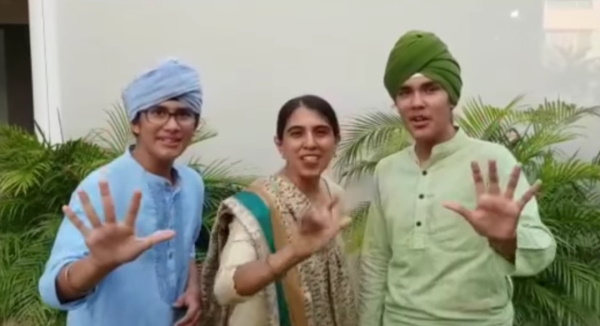
Dalveer Kaur and her kids Jasdave Singh and Harjas Singh
By Asia Samachar Team | SINGAPORE |
A Singapore family has a novel Vaisakhi idea. Check this video. Mother Dalveer Kaur and her children Harjas Singh, 14, and Jasdave Singh, 12, will tell you all about it. See here.
If you and family are joining Dalveer & kids, then say something in the comment section of Asia Samachar facebook page. Spread the cheer!
ASIA SAMACHAR is an online newspaper for Sikhs / Punjabis in Southeast Asia and beyond.Facebook | WhatsApp +6017-335-1399 | Email: editor@asiasamachar.com | Twitter | Instagram | Obituary announcements, click here |
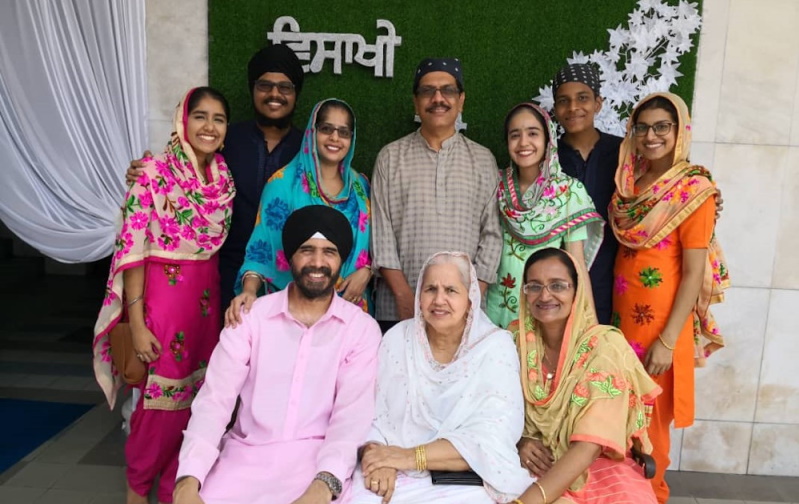
THE GURMUKH FAMILY: (L-R) Kavelnain Kaur, Gursimer Kaur, Gurmukh Singh, Inderjit Kaur and Gurishver Singh – Photo: Gurmukh Singh / Asia Samachar
By Azdee Amir | MALAYSIA |
KUALA LUMPUR: Like many Malaysians, the Gurmukh family from Kepong Baru have been staying at home and adhering to the Movement Control Order (MCO), which is entering the third phase, to curb the spread of Covid-19.
Having to stay indoors for close to a month has not dampened the family’s spirits as today they will celebrate Vaisakhi with other Sikhs by using technology.
Inderjit Kaur, 52, a retired leading stewardess who is now a real estate negotiator and homemaker, said while her family missed being able to go to the gurdwara during Vaisakhi, they understood the situation and were making the best of it from the safety of their home.
“We miss the joy and excitement of going to the gurdwara and participating in congregational prayers, which we call satsang, and communal service, which we call sewa.
“We also miss taking part in fun family activities and mingling with the Sikh community.
“Since we are homebound due to the MCO, gurdwaras and other organisations, notably Sikhinside, have organised prayers that are broadcast live on social media, such as Facebook and YouTube.
“Through this, we can still get the feeling of being present for prayers at the gurdwara while being in the sanctity and relative safety of our homes.”
Inderjit said her family used to lead the congregation in singing hymns, called the kirtan.
“My family continues to do the kirtan, albeit this time from home, and these kirtan sessions are broadcast via social media, mainly through Facebook Live.
“These live kirtan sessions are followed by a huge number of congregation members and temple-goers,” said the mother of three.
Inderjit said Vaisakhi had a special religious and spiritual significance.
She said the Sikh community celebrated primarily by taking part in prayers, which were usually held at the gurdwara, including a complete reading of their spiritual scripture, the Sri Guru Granth Sahib Ji (SGGS).
Read the full story, ‘Family keeps up Vaisakhi tradition’, (New Straits Times, 14 April 2020), here.
ASIA SAMACHAR is an online newspaper for Sikhs / Punjabis in Southeast Asia and beyond.Facebook | WhatsApp +6017-335-1399 | Email: editor@asiasamachar.com | Twitter | Instagram | Obituary announcements, click here |
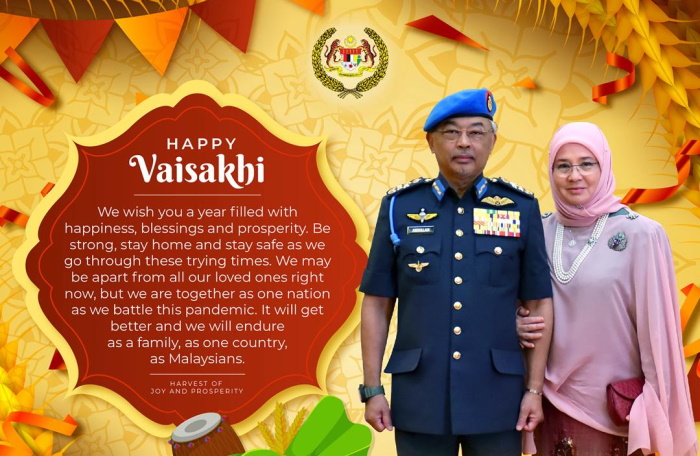
From King to KJ to opposition MP Nurul Izzah, we pick up some of Vaisakhi greetings Malaysian leaders. Check out the video Asia Samachar Facebook page (click here).
ASIA SAMACHAR is an online newspaper for Sikhs / Punjabis in Southeast Asia and beyond.Facebook | WhatsApp +6017-335-1399 | Email: editor@asiasamachar.com | Twitter | Instagram | Obituary announcements, click here |
While Darshan Singh misses ushering in the new year with the community, he is grateful to have his family with him this year for Vaisakhi. — Picture courtesy of Darshan Singh
BY Anne Grace Savitha | MALAYSIA |
PETALING JAYA, April 13 — Malaysian Sikhs took to celebrating Vaisakhi this year without the usual grand celebrations due to the Covid-19 movement control order.
Vaisakhi, is a traditional festival celebrated by the Sikhs to commemorate the inauguration of the Khalsa (a term used for the Sikhs who have been initiated or baptised) that is celebrated annually either on April 13 or 14.
The celebration takes place over a three-day period with the recitation of the Guru Granth Sahib (the holy book) at gurdwaras.
Meals are also served during the three days. They also replace the gurdwara flag with a new one.
Instead of following this normal ritual, the Sikhs are celebrating this year’s auspicious occasion with their immediate family members at home.
Retired teacher Datin Ranjeet Kaur said her family watched the Facebook online stream of the Akhand Paath prayers today, which is a reading of the Sikh’s holy book, Guru Granth Sahib.
“The prayers usually take three days — from today till Wednesday — and for the three days, we would indulge in vegetarian meals followed by eating sweet delicacy, degh made at home.”
Darshan Singh, on the other hand, celebrated Vaisakhi today at the comfort of his home with his family and followed the online Akhand Path prayers.
“We recited the live streaming Akhand Paath prayers at about 10am before breaking for lunch where we had a home-cooked vegetarian meal.”
Read the full story, ‘Malaysian Sikhs celebrate Vaisakhi by reciting live-stream prayers, having home-cooked meals amid Covid-19 crisis’ (The Malay Mail, 13 April 2020), here.
ASIA SAMACHAR is an online newspaper for Sikhs / Punjabis in Southeast Asia and beyond.Facebook | WhatsApp +6017-335-1399 | Email: editor@asiasamachar.com | Twitter | Instagram | Obituary announcements, click here |