















UA-56202873-1
Page 514

‘Sikh power’ behind Singapore Indians Hall of Fame

0
The inaugural induction to the Singapore Indians Hall of Fame took place on 8 Feb 2020 with MP vikram Nair (front row, 3rd from left) as the guest of honour. – Photo: Asia Samachar
By Suresh Nair | SINGAPORE |

TAKE a bow, Inderjit Singh Dhaliwal, Sarvindar Singh Chopra, Malminderjit Singh and Satinder Singh for the special roles behind the inaugural Singapore Indians Hall of Fame (IHFS) awards to salute the icon Indian personalities at the exclusive Singapore Recreation Club over the weekend.

The “Sikh power” quartet pulled the delicate strings to ensure that the IHFS awards, the first of its kind in Singapore, timely recognise the achievements of many of the pioneering and contemporary heroes who have contributed to the success of Singapore by excelling in multiple fields from politics, arts and sciences, community service, women empowerment, philanthropy, medicine, sports, just to name a few.

The iconic honourees included former presidents C.V. Devan Nair (1981-1985) and S.R. Nathan (1999-2011). Both the late Nair and Nathan were Malaysian-born. Nair from Malacca in 1923 and Nathan in Muar, Johore, in July 1924.

Former Member of Parliament (MP) and serial entrepreneur Inderjit Singh, 59, who hails from Punjab, as Chairman of Panel of Advisers (IHFS) noted that the pats-on-the-back come during the bicentenary celebrations of Singapore, where the multi-racial people contributed to the “success of Singapore, not just from the post-independence days but also the last 200 years or so.” He said: “The Indian community indeed played an important part in helping build the Singapore of today.”

The IHFS was set up last year to recognise the contributions of Singaporeans of Indian origin, to nation-building. He says: “It is an opportune time, for the Indian community, to take stock of our collective contributions to Singapore’s success and to build up our history so that future generations of Singaporeans will remember the contributions of their forefathers.”

OLYMPIC SPORTS

In the pinnacles of Olympics sports, few ever come close to Kesavan Soon, who retired career-wise as a Lieutenant-Colonel (LTC) in the Singapore Armed Forces (SAF). He rightly says that the experience in an Olympic Games – the pinnacle in any sportsman’s career – as a track and field athlete, was a “breathtaking journey”.

He says candidly: “On hindsight, I can never ever be like a (swimmer) Joseph Schooling, 64 years later (who won the 100m butterfly at the 2016 Rio de Janeiro Olympic Games), simply because if you’re not prepared for the world’s ultimate sporting stage, it can well be more pressure than pleasure. What matters is the inevitable mind-bending pressure before the performance of your life.”

He adds that like retired teacher Kunalan and the majority of the Singapore-based icon athletes, whatever the sport, an “Olympic debut means close to an early lifetime of training – full of innumerable repetitions, practice sessions, and sacrifices – finally paying off”. He recounts: “There comes a point not long into every Olympics when hope and reality start to divide. It’s sometimes the part you don’t always see on television, or read about here, when the Olympics become less about the faster, higher, stronger, and more about holding back the tears.”

Kunalan, who competed against Malaysia’s “Flying Doctor” Dr Mani Jegathesan in the 1960s to be Asia’s “Fastest Man”, says: “Multiple questions crackle my head over the blood, sweat and tears of Singaporeans who have worked and trained and only a few of us ever come away from the Olympics with all we’ve been dreaming for.

“God only knows what it must be like for the older generation of athletes. For every Lloyd Valberg (London Games, 1948), Tang Pui Wah (Helsinki, 1952), Mary Klass, Janet Jesudason and Tan Eng Yoon (Melbourne, 1956), Tan Howe Liang (Rome, 1960), Ang Peng Siong (Los Angeles, 1984) and Joseph Schooling (Rio de Janeiro, 2016), there are countless others who come away with nothing at all.”

For the record, Kunalan’s legendary track and field feat of 20 regional medals – four golds, nine silver and seven bronzes – will be heroically acknowledged as he was the face of Singapore sports in the formative years of Singapore’s independence. Poignantly, he was named Singapore National Olympic Council’s (SNOC) Sportsman of the Year, consecutively in 1968 and 1969.

Also decorated for sports, was former Selangor-born Dr A. Vijiaratnam, who outstandingly represented Singapore in four sports, namely hockey, cricket, football and rugby during the years from 1946-1956. He passed away in February 2016, at 94 years, not without excelling even in academics as Singapore’s first Asian engineer and a top civil servant and the first pro-chancellor of the Nanyang Technological University (NTU).

Kunalan and his wife Chong Yoong Yin – Photo: Asia Samachar
PIONEER LEGENDS

Three-time SEA (South-East Asia) Games medallist Sarvindar Singh Chopra, who represented Singapore at athletics, weightlifting and judo, saluted the IHFS recipients as he was one of the key figures behind-the-scenes as he sat on the founding IHFS management council.

He says: “Kesavan and Kunalan were among the pioneering legends who contributed to making Singapore a great regional sporting nation. I’d say that the awards are a timely celebration of the achievers who have made, or are making, an impact on our nation – the boundary breakers and record holders, the risk-takers and change-makers, the role models and the standard setters.”

Sarvindar, the Deputy President of IHFS Management Council, salutes that for sportsmen the “Olympics mania, in a nutshell, is all about overcoming life’s obstacles and adversities.” He adds: “It’s about how you touch people and every day, they’ll remember what motivated them to run in the world’s highest platform, once in a lifetime, and to come home and be a Singaporean Olympian for the rest of their lives.”

The other prominent individuals, to name a few, nominated included Naraina Pillai, the first Indian to set foot on Singapore soil together with Sir Stamford Raffles in 1819, former Deputy Prime Minister and Senior Minister S. Rajaratnam, former Minister Balaji Sadasivan and the late Presidents C.V. Devan Nair and S.R. Nathan along with many other writers, social workers, entrepreneurs, philanthropists, performing artistes, politicians, doctors, lawyers, sports personalities and military and police officers.

Significantly in Singapore, as Sarvindar Chopra pointed out, meritocracy always takes precedence over other considerations. And many deserving Indians have been appointed to the highest offices including the Presidency, Deputy Prime Minister, Senior Minister, Chief Justice, Justices, Attorney General, Diplomats, Members of Parliament and many others.

“The continued success of this fair-minded multi-racial approach boils down to fair and sound policies implemented by the successive governments led by Founder Prime Minister Lee Kuan Yew, former PM Goh Chok Tong and the incumbent Lee Hsien Loong,” says Sarvindar.

Thumbs-up to Sikh pioneers like Kartar Singh Dalamnangal from a small village in north-western Punjab, whose selfless gentleman attributes stood out in the service of others. The moniker he earned as jarabanwala (the stocking man) instantly conjures the image of his humble all-white attire, complete of course with the knee-high socks, which was essentially the uniform of a British Admiral.

CHARITY WITH BIG HEART

The Dalamnangal family shared that the success in the form of wealth Kartar had achieved personally “was never as important to him as the good that he could do with it.”

Kartar Singh Thakral was also hailed as among the titan Sikhs for his iconic hand in the business fraternity. From a small business outlet dealing with wholesale textile trading in the corner of High Street, the family expanded to 25 countries and now runs a diversified portfolio of businesses. In 1995, Kartar was awarded the “Businessman of the Year” award and Thakral Brothers ranked the “Top Private Company” in Singapore in the first-ever “Enterprise 50 List” by Andersen Consulting and The Business Times.

Jamit Singh was singled out for achievements in labour as he was the “flaming torch” behind port workers in colonial Singapore against the Singapore Harbour Board and gamely won concessions for thousands of people he campaigned for.

As an elite sports administrator, S.S. Dhillon, born in Lumut, Perak in 1931 (which makes him close to 90 years!) was inducted for his rousing sporting attributes as he was the longest-serving Secretary-General of the SNOC (1971-1996) and the organising secretary for three regional games – the 1973 SEAP Games, the 1983 SEA Games and the 1993 SEA Games – when Singapore played host over three decades.

Professor Kernail Singh Sandhu was saluted for academia achievement as he was the Director of the Institute of South-East Asian Studies (ISEAS) in 1972 and he raised it to be the leading hub for inter-disciplinary research for the Asean region over two decades of leadership. By 1992, it had global researchers with 40 percent coming from South-East Asia.

As Inderjit Singh, who outstandingly served as Ang Mo Kio GRC Member of Parliament from 1996 to 2015, says: “The Sikhs rank as a small yet significant constituent in their multiple contributions to Singapore’s prolific development and, deservingly so, must be acknowledged for their blood, sweat and tears in nation-building.”
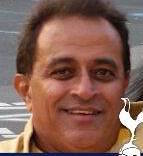
Suresh Nair, an award-winning Singapore journalist, has covered regional sports for over four decades. He feels the IHFS awards is a perfect recognition for Singapore Sikh celebrities, too, rightly so in the current Bicentenary celebrations of Singapore.


RELATED STORY:

Minder Singh Maneke: A rare breed (Asia Samachar, 7 Jan 2020)

ASIA SAMACHAR is an online newspaper for Sikhs / Punjabis in Southeast Asia and beyond. Facebook | WhatsApp +6017-335-1399 | Email: editor@asiasamachar.com | Twitter | Instagram | Obituary announcements, click here |

Trying to Accept

0
By Jagdesh Singh | OPINION |

She sobbed uncontrollably, unhappy that she couldn’t get to watch her favorite video series on Netflix because the weekend is over. She is merely 8, and yet she couldn’t accept that the rule to adhere was ‘No TV come Sunday night’.

She was of the age where the idea of who she was and how she could satisfy her wants and needs was beginning to flourish. At this age, her wants and needs are simple, often at the mercy of her parents and elder siblings. Her favorite food to eat out, her favorite games to play, her friends to play with, her favorite TV shows to watch. Getting these wants fulfilled was mostly within the control of her father, her mother and her elder teenage sisters. There was an acceptance of who she was in our eyes, we knew her character and adjusted accordingly.

Meanwhile, her elder sisters’ wants and needs have evolved over the years, getting ever more complicated. Now, they are also influenced by the outer circle of friends and schoolmates, uncles and aunties, and last but not least, cousins.

Now, the margin to be disappointed has also enveloped around this outer circle. There are higher chances of being disappointed by outside circumstances than within the family circle of parents and siblings. This is where they begin to understand that life can be cruel, people can be cruel if we don’t meet their expectations or we don’t satisfy their wants and needs.

As for us, the adults, expectations of what life can offer would tend to be a bit more realistic. We can get disappointed because when we engage and interact with the outer circles of our life, reality can really differ from the expectations that we have built within our hearts and minds.

Our wants and needs get very complicated, as quite often, these wants and needs also include the wants and needs of our loved ones. My wife’s disappointment on an unwanted outcome will certainly be on my mind as well. The same can be to see my elder daughter not excelling in something they expected to be. As parents, we too feel their disappointment. We too feel their sadness.

Within this family circle of ours, the wants and needs of each of us individually converge and swirl around us, creating emotional whirlwinds. We swing, from joyful happiness to abject sadness, as we helplessly navigate through these whirlwinds. A bit like dried leaves in the monsoon drains after the torrential rain. I might have gone overboard with the euphemism, but I really do feel helpless as our search for everlasting peace and bliss while being caught up with life, like that leave in the monsoon drain, is virtually impossible.

The Gurus, the saints, the sages have figured this out. They’ve compelled us through their teachings that the one way we can achieve a perpetual state of bliss and peace is to accept. The less we expect from our surroundings, the more we accept that we really have no say on why many of our wants and needs won’t be satisfied. Like that leaf, we’re going down that monsoon drain, whether we like it or not. We might as well enjoy the ride.

My problem is, this is the paramount of ‘Easier said than done’. I’ve understood the idea of accepting. Accepting people for who they are, and not try to change them or teach them a lesson so they would change. Accepting that results happen due to unseen circumstances (or as some of us call ‘bad luck’). Accepting that death is upon us at any time, slow or quick.

But I’ve yet to realize and practice this. It’s hard. I know we have a choice. We can accept our circumstances, and accept that it’s the Hukum or Order that we’ve got to go through these whirlwinds whether we like it or not. But to actually experience the feeling of being still, and not be happy or sad or angry in a moment in that whirlwind, is too far scarce in my memory.

I guess I can only ask for guidance through the teachings of our Gurus, our Saints and Sages, that I learn to enjoy that ride down the monsoon drain without expecting anything but a ride that I have no control or say.

Jagdesh Singh, a Kuala Lumpur-based executive with a US multinational company, is a father of three girls who are as opinionated as their mother

* This is the opinion of the writer, organisation or publication and does not necessarily represent the views of Asia Samachar.


RELATED STORY:

Lessons from the retired (Asia Samachar, 18 Jan 2020)

A more vibrant Samelan (Asia Samachar, 24 Dec 2019)

ASIA SAMACHAR is an online newspaper for Sikhs / Punjabis in Southeast Asia and beyond. Facebook | WhatsApp +6017-335-1399 | Email: editor@asiasamachar.com | Twitter | Instagram | Obituary announcements, click here |

Tapah Sikhs, past and present, come together

Tapah Sikhs, past and present, gather for a family day – Photo: Supplied
By Ranjit Singh | MALAYSIA |


Past and present residents of Tapah, Perak, got together for their first Grand Family Shukrana Kirtan-katha Semagam and Mini Games at Gurdwara Sahib Tapah on 8 February 2020.
More than 150 people attended the event. Kirtanees kept the sangat enthralled. Games for kids, adults and those over 60 made it a great event. Shot putt and tug of war ended the day with prizes for the winners.
Food was in abundance throughout the day with extras like ice kacang, chendol, mango lassi, cakueh, mee goreng, and much more for the games period.
A wonderful day by all accounts.
[Ranjit Singh, who now lives in Canada, describes himself as a Tapahan at heart]

ASIA SAMACHAR is an online newspaper for Sikhs / Punjabis in Southeast Asia and beyond. Facebook | WhatsApp +6017-335-1399 | Email: editor@asiasamachar.com | Twitter | Instagram | Obituary announcements, click here |

Pritam Singh Gill (1926-2020), Former Ketua Pengarah Kewangan, KTM Malaysia

PATH DA BHOG: 16 Feb 2020 (Sunday), 5pm to 6.30pm, at Gurdwara Sahib Petaling Jaya | Malaysia

PRITAM SINGH GILL S/O NARAIN SINGH, KMN

(1926 – 2020, Aged 94)

Chartered Institute of Transport (UK)

Former Ketua Pengarah Kewangan, KTM Malaysia

Village: Bohona, Moga

Late Wife: Gobinder Kaur d/o Harnam Singh

Daughter / Sons-in-Law

Amrat Kaur / Inderjit Singh (Lawyer)

Kuldip Kaur / Brian Hobday (UK)

Nasib Kaur / Manhore Singh

Teejwant Kaur / Dadar Singh (Darshan)

Karamjeet Kaur / Harjit Singh (Canada)

Siblings: Late Hakam Singh Gill, Late Bhajan Singh Gill, Lall Singh Gill, Sarjit Kaur (Singapore),  Bhajan Kaur, Jaswant Kaur (Singapore), Late Balwinder Kaur

Nephews, Nieces, Grandchildren, Great-Grandchildren, relatives and friends.

Path Da Bhog: 16 Feb 2020 (Sunday), 5pm to 6.30pm, at Gurdwara Sahib Petaling Jaya

Contact:

Ajitpal Singh : 012 277 3912

Satpal Singh 012 277 1251

| Entry: 8 Feb 2020; Updated: 12 Feb 2020 | Source: Family

ASIA SAMACHAR is an online newspaper for Sikhs / Punjabis in Southeast Asia and beyond. Facebook | WhatsApp +6017-335-1399 | Email: editor@asiasamachar.com | Twitter | Instagram | Obituary announcements, click here |

Her son was bullied for his Sikh head covering. Then he explained his faith on TV

Sukhvir Kaur with her two sons. Her older son Anmol, standing, is part of a public service announcement on Valley PBS that explains the Sikh faith. CONTRIBUTED SPECIAL TO THE BEE
By Sukhvir Kaur FRESNO BEE  | US |

I’m the mom of two boys, ages 9 and 4, both of whom wear a patka, a head covering worn by Sikh boys that represents a Sikh’s commitment to equality.

As a mother in America in 2019, I’ve watched in horror as members of our faith, and other faiths, have been persecuted for no reason other than looking different. With the recent murder of a Sikh uber driver in Washington state, it’s hard to not wonder if his death was in part because of his turban and beard.

According to a Sikh Coalition survey, “60% of young Sikh males who wear patkas say they’ve been harassed and verbally or physically abused because of their faith. Half of those kids, almost 40%, reported being hit or involuntarily touched because of their appearance.”

I realize that now is the time to stop this cycle of hatred and it starts with educating our children.

My 9-year-old son, Anmol, has had to deal with harassment that no child should have to go through. Starting in kindergarten, Anmol was bullied because of the patka he wore on his head. Kids of all ages would call him cruel names like “tomato head” and “the weird-headed guy.” It got so bad that he would try to hide his patka underneath hooded sweatshirts. He would come home from school and ask me, “Mom, do I look American?”

My heart broke. But what hurt more was that these children were showing hate because of ignorance. It was then that I decided to take action to make real change.

Over the next two years, I worked with local teachers and administrators to help educate students about the Sikh faith. During that time, we learned that the National Sikh Campaign’s “We Are Sikhs” initiative and PBS were holding a casting call at the local Gurdwaras (Sikh worship centers) for a series of public service announcements they were producing to help educate children about the visual identity of Sikhs and our core belief in equality. In the end, Anmol was so excited to be selected as one of the boys to star in one of the videos.

Anmol’s PSA is one of four, 15-second videos that explain common questions children have about Sikhs, like why we wear a patka and why many of us have the same last name. The PSAs are currently airing on Valley PBS and will remind children to be kind and treat everyone equally.

Being a part of the PSA really helped Anmol. He will often tell people that he played a role in it and has a renewed sense of pride because it’s given him a way to tell people about his patka and the confidence to say, “This is who I am and I’m not changing.” These PSAs also take the pressure off of us as parents trying to explain the same things to adults. As a mom, it’s great to see my shy, quiet kid become more confident.

This year, when a child tried to remove his patka, Anmol worked with his teacher to bring the kids together and explained how disrespectful it is to touch the patka because it is a symbol of equality. I’m not sure he would have had the confidence to do this before being a part of the Valley PBS PSA program.

These PSAs will reach more than 94% of households with a television in their service area, and Valley PBS broadcasts more than 70 hours of children’s programming each week. So it is my hope is that it will inform people about our faith and reduce misconceptions as parents watch with their children.

To learn more about this effort, please visit: http://www.wearesikhs.org/pbs. To learn more about We Are Sikhs, please visit: www.wearesikhs.org

The story first appeared at The Fresno Bee (7 Feb 2020). Click here.


RELATED STORY:

Bullied in the US (Asia Samachar, 18 Oct 2014)

ASIA SAMACHAR is an online newspaper for Sikhs / Punjabis in Southeast Asia and beyond. Facebook | WhatsApp +6017-335-1399 | Email: editor@asiasamachar.com | Twitter | Instagram | Obituary announcements, click here |

Ambassador Sandhu presents credential to President Trump

0
Indian ambassador Taranjit Singh Sandhu presents his credentials to US President Donald Trump – Photo: Sandhu Twitter
By Asia Samachar UNITED STATES |

Career diplomat Taranjit Singh Sandhu presented his credentials to US president Donald Trump at the Oval office of the White House on Thursday (6 Feb).

Taranjit, who last served as the Indian high commissioner in Sri Lanka, takes over the top US envoy in the US.

Sandhu has been described as one of the most experienced Indian diplomats on US affairs.

His latest stint in the US was as the Deputy Chief of Mission in Washington from July 2013 to January 2017. He was also First Secretary (Political) at the Embassy of India, Washington, DC, responsible for liaison with the US Congress from 1997 to 2000. He was also the Permanent Mission of India to United Nations, New York, from July 2005 to February 2009.

RELATED STORY:

Taranjit made new India envoy to US (Asia Samachar, Feb 2 2019)

Modi taps seasoned ambassador Hardeep Singh Puri as minister (Asia Samachar, 3 Sept 2017)

ASIA SAMACHAR is an online newspaper for Sikhs / Punjabis in Southeast Asia and beyond. Facebook | WhatsApp +6017-335-1399 | Email: editor@asiasamachar.com | Twitter | Instagram | Obituary announcements, click here |

Former Thai PM Abhisit gets a book on Sikh philosophy

0
Ravneek Singh handing a book on Sikhi to former Thai PM Abhisit Vejjajiva – Photo: Supplied
By Asia Samachar Team | THAILAND |

Thai entrepreneur Ravneek Singh seems to be on a mission to bring the Sikh message to as many key Thai leaders as possible.

When Sikhs the world over were celebrating the 550th birth of Guru Nanak, he met a Thai minister to put out a message on the major Sikh celebration. He also managed to get 20 large banners carrying messages of Guru Nanak to be strategically placed at the Thai parliament house.

The latest Thai personality to receive a personal update on Sikhs and Sikhi was former Thai Prime Minister Abhisit Vejjajiva.

In a meeting in Bangkok yesterday (6 Feb 2020), Ravneek, also known as Apichai Sakulsureeyadej, handed a book on Sikhism to the former leader of the Democrats, Thailand’s oldest party.

“This is my small contribution towards promoting the Sikhi message in Thailand,” he told Asia Samachar in a telephone conversation.

“I’ve kept in touch with party for a long time. They have a good reputation. Many urban people like him (Abhisit).”

Abhisit, who was prime minister from 2008 to 2011, had relinquished the party’s leadership when the Democrats performed poorly in the March 2019 general election. At 44, he was the nation’s youngest PM in more than 50 years.

RELATED STORY:

Sikhs are progressive, says Thai cabinet minister (Asia Samachar, 5 Nov 2019)

ASIA SAMACHAR is an online newspaper for Sikhs / Punjabis in Southeast Asia and beyond. Facebook | WhatsApp +6017-335-1399 | Email: editor@asiasamachar.com | Twitter | Instagram | Obituary announcements, click here |
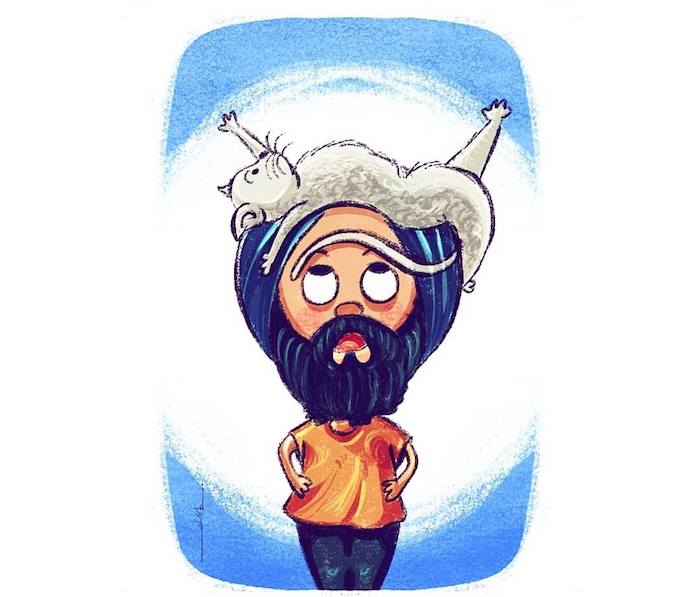
Dashmeet Singh captures childhood memories in his comics

0
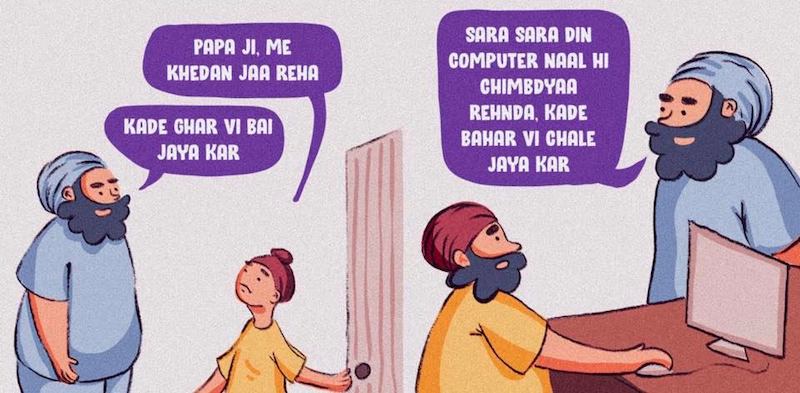
Dashmeet Art – Photo: Facebook
By Hindustan Times INDIA |

There is something to childhood memories. They keep coming back to us to remind us who we are and to keep us in touch with our real selves. Delhi based artist Dashmeet Singh also did something similar. He revisited those memories and that’s what his art is all about.

Whether it is your nani doing chumpy for you (rubbing oil onto your long hair and massaging it) or playing jhootei maiyya (A traditional Punjabi childhood rhyme, where the parents or grandparents sing to the kids while they act like a human swing carrying the children), they are some of the fondest memories you have of growing up. Recreating these very remembrances through comics on Instagram is Delhi based artist, Dashmeet Singh.

We spoke with Dashmeet, asking him about what made him start the comics, the response from the Sikh community and whether SikhPark inspired him or not.

An entry at DasmeetArt Facebook page in September 2019

How did you come up with the idea of this particular comic?

I started sketching and painting in the 11th standard after seeing Sharan Art (Sharandeep Singh) on Facebook. I was amazed at how beautifully one can put their ideas and thoughts into paintings. I had opted for Medical Science and in my free time, I used to watch YouTube tutorials to learn how to sketch and paint. I would also ask my mother to teach me a few basics as she was into fine art.

I ended up losing my focus in studies and my grades were affected, after which I joined an Engineering college named Guru Tegh Bahadur Institute of Technology (GTBIT) instead of pursuing my career in Medical Sciences.

Meanwhile, I got an opportunity to work with the NGO Akal Network, and made a few digital paintings for their Free Langar Sewa, they named it Stall On Wheels. The idea was to distribute the ‘langar of knowledge’ through the medium of art.

As time passed by, I created a lot of paintings, majorly on Sikh narratives.

I always wanted to portray the events of my daily life through my artwork, but because I was more into paintings, it was not possible to create stuff on a daily basis so I started making quick rough sketches and making portraits of random people travelling in the metro to improve and manage my work speed.

Later I got to know about the work of Alicia Souza on Instagram and was mesmerised by her work. She talks about her life through daily comics on Instagram. I wanted to do the same for myself, but because I am an introvert I was afraid to share the details of my daily life with others. Then I came up with the idea to create comics which are based on daily life, but not specific only to me, to which everyone can relate. So the character I portray in my comics is myself.

I also realised that there is no Sikh, in my knowledge, who documents their life in the form of comics. Now I am keener on documenting my life instances and soon will be coming up with more comics so that when someone sees it they can relate to it on first sight and say – “Oh this is me!”

Read the full story, Meet the Indian artist who is bringing back childhood memories of the Sikh community through his comics (Hindustan Times, 5 Feb 2020), here.

RELATED STORY:

(Asia Samachar, xx Jan 2019)

ASIA SAMACHAR is an online newspaper for Sikhs / Punjabis in Southeast Asia and beyond. Facebook | WhatsApp +6017-335-1399 | Email: editor@asiasamachar.com | Twitter | Instagram | Obituary announcements, click here |
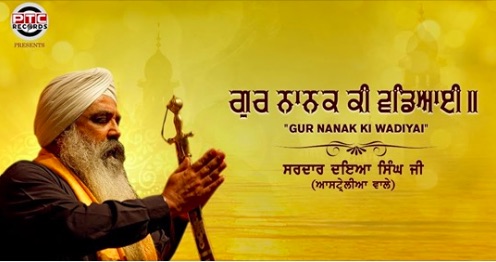
Kirtan video release: Gur Nanak Ki Wadiyai by Dya Singh

0
Kirtan video release: Gur Nanak Ki Wadiyai by Dya Singh

KIRTAN | JUST RELEASED: PTC Records has released a kirtan video ‘Gur Nanak Ki Wadiyai’ by Bhai Dya Singh and group. It is accompanied by a well-presented video cuts showing Harmandir Sahib and nature.

[TAKE NOTE OF ASIA SAMACHAR OFFICIAL WHATSAPP NUMBER: +6017-3351399. You can contact us to provide news alerts, community updates or obituary announcements. Stay in chardi kalaa]


RELATED STORY:

Dya Singh jatha in Delhi for multiple ‘Dastar bandhi’ (Asia Samachar, 10 Feb 2019)

ASIA SAMACHAR is an online newspaper for Sikhs / Punjabis in Southeast Asia and beyond. Facebook | WhatsApp +6017-335-1399 | Email: editor@asiasamachar.com | Twitter | Instagram | Obituary announcements, click here |
Rashvin Pal Singh’s journey to make upcycling cool

Rashvin Pal Singh – Photo: Rashvin Pal Singh / Gen.T
By Melissa Twigg | GEN.T | MALAYSIA |

Rashvin Pal Singh first got the idea for Biji-Biji Initiative when he saw a pile of discarded wood outside a new-build house in Kuala Lumpur. Most people would walk past without a backward glance, but Singh immediately saw the potential in this beautiful wooden flooring and ornate ceiling finishes, so he arranged to take them home. The rest, much like those interiors might have been, is history.

“Coming from an urban context, the most glaring problem we have with sustainability is the waste problem,” he explains, on the phone from Malaysia. “The linear economy simply doesn’t work. I realised that people could get excited about a circular economy as soon as I brought all the wood back to my apartment, put a post on Facebook to call for ideas, and then started making a few things.”

After they sold quickly on social media, he realised that what had begun as a weekend project could turn into something bigger—both for himself and Malaysian consumption habits.

“Humanity is at a turning point,” he explains. “In our pursuit of modernity, we have wanted more and more, faster and faster.”

“For all our successes, there is a dark side: our consumption patterns. We have been taught to believe that buying more things will bring happiness. In the name of progress, we have neglected the ecosystem around us. We have lost touch with nature and in doing so, we have suffered an extreme loss of biodiversity. Rather than completely cease to consume, our mission must be to reimagine consumption in a way that is beneficial to the people as well as to the planet.”

For Singh, all it took to see the deeper value in discarded goods was to look beyond the surface.

See full story, ‘From The Dump To The Boardroom: How Rashvin Pal Singh Made Upcycling Cool’ (Generation T, 6 Feb 2020), here.


RELATED STORY:

(Asia Samachar, xx Jan 2019)

ASIA SAMACHAR is an online newspaper for Sikhs / Punjabis in Southeast Asia and beyond. Facebook | WhatsApp +6017-335-1399 | Email: editor@asiasamachar.com | Twitter | Instagram | Obituary announcements, click here |