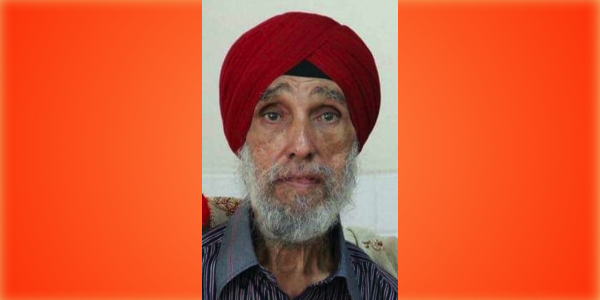
Path Da Bhog: 11 Jan 2020 (Saturday) at Gurdwara Sahib Ampang (morning programme till lunch)
Contact:
Tirath (daughter): 016-2789619
Ishdev (son): 010-2191567
| Entry: 4 Jan 2020; Updated: 7 Jan 2020 | Source: Family
ASIA SAMACHAR is an online newspaper for Sikhs / Punjabis in Southeast Asia and beyond.Facebook | WhatsApp +6017-335-1399 | Email: editor@asiasamachar.com | Twitter | Instagram | Obituary announcements, click here |
Mohammed Hassan’s brother (with mobile) is leading the protest at the Nankana Sahib gurdwara
By Asia Samachar Team | PAKISTAN |
Nankana Sahib gurdwara has returned to normalcy after a protest by a group on Friday (3 Jan 2020), according to local reports.
Scores of protesters surrounded the Gurdwara Nankana Sahib on Friday afternoon, threatening to overrun the holy site if their demands for the release of suspects in an alleged forced conversion case were not met, reports The Dawn.
The protesters dispersed after several hours in the evening following successful negotiations between them and government representatives, which led to the release of the arrested persons, the report added.
He newspaper reported that the talks were between the protesters and the PTI Nankana Sahib president Pir Sarwar Shah.
Pakistan Sikh Council (PSC) patron Ramesh Singh Khalsa said the situation had returned to nomalcy.
“The situation is under control right now, I just confirmed from local Sikh Sangat. All the mob and people outside the Gurdwara [have been] removed,” he said in a text message shared in a discussion group at 1am (Malaysia time) today (4 Jan 2020).
According to The Dawn report, on Friday evening, scores of charged protesters staged a sit-in outside the Gurdwara. They were led by the family of a man, Ehsan, who was accused of forcibly converting a Sikh woman, Jagjit Kaur, earlier this year.
In a Facebook posting, an individual with the handle ‘Imranchishti Baba’ spoke about how some family members were picked up by the police and that the matter had now been resolved.
The profile says the individual studied at Lahore-based University of the Punjab and Govt Guru Nanak High School at Nankana Sahib.
On August 28, a First Information Report (FIR) was filed in the Nankana police station against six people who were accused of abducting and forcefully converting the 19-year-old woman.
Gurdwara Nankana Sahib, also known as the Gurdwara Janam Asthan, is the site where the first Guru of the Sikhs, Guru Nanak, was born.
ASIA SAMACHAR is an online newspaper for Sikhs / Punjabis in Southeast Asia and beyond.Facebook | WhatsApp +6017-335-1399 | Email: editor@asiasamachar.com | Twitter | Instagram | Obituary announcements, click here |
The heat is on. Manjit Singh, a teacher with three decades of service under his belt, was seen assisting a student who fainted at a Malaysian school.
In a video clip received by Asia Samachar, Manjit was seen carrying the student to a classroom to recover after fainting possibly due to heatwave.
The incident took place at SMK Dusun Nanding, a national secondary school in Hulu Selangor yesterday (2 Jan 2020) when schools resumed for the new year.
ASIA SAMACHAR is an online newspaper for Sikhs / Punjabis in Southeast Asia and beyond.Facebook | WhatsApp +6017-335-1399 | Email: editor@asiasamachar.com | Twitter | Instagram | Obituary announcements, click here |
I refer to the news about the CAA in India and Uyghur Muslims in China. Though the two issues appear far removed, I find that there are similar broad strokes and will be drawing attention to both here.
The Citizenship Amendment Bill (CAB), now Citizenship (Amendment) Act 2019 (CAA) – as the bill has already been passed – in India has brought with it an intense debate, on both sides of the shore.
Those who are in support, or rather those who are against the protests against it, are of the mind that most people are not understanding the CAA in its entire context. We are simply reacting, following the masses. So, are we?
Let’s look into what the CAA is, in a simple manner. It is an “addition” of sorts to the Citizenship Act 1955. It appears, prima facie (on the face of it), to spell an integral shift in the concept or rather reality of what it means to be an Indian citizen. It brings a positive impact to the rights of citizenship of the Hindu, Sikh, Buddhist, Jain, Parsi and Christian religious minorities, giving them a face – where there was none codified in the Citizenship Act before.
The problem (and this is no trivial problem: it is in fact reminiscent of the nationality laws for foreigners in Saudi Arabia) is that the bill (quite deliberately) deprives this right from Muslim minorities. This, in essence, would go against the (is ultra vires the) Indian Constitution and is likely to be a grave violation of the International Covenant on Civil and Political Rights (ICCPR) and the International Convention on the Elimination of All Forms of Racial Discrimination (ICERD), which India has ratified.
The CAA has caused a whole new debate on the National Population Register (NPR) and subsequently the National Register of Citizens (NRC).
One of the voices, namely, writer and activist Arundhati Roy (author of The God of Small Things) has become highly prominent in this debate, suggesting (perhaps in anger and an attempt to institute a movement) that names and addresses be forged in the Indian NPR to pull wool over the eyes of the government that has now passed a law that is – without a shadow of a doubt – anti-Muslim. Although Arundhati Roy was perhaps driven to say and do these things because of the nature of the CAA, some citizens and even the Indian government have instead gone against her, not realizing that her arguments are an almost unavoidable by-product of the CAA.
Such is the power of media. Silence is appreciated (surprisingly, the worshipped Bollywood celebrities have failed to give a strong reaction to the CAA, I think the words of Albert Einstein is important here “The world is a dangerous place, not because of those who do evil, but because of those who look on and do nothing”) and people who voice out are condemned, vilified and subsequently silenced. A truly sorry state of affairs.
In another stronghold Asian nation, there is the issue of Uyghur Muslims in China, for which the waters are evidently muddled. On the one hand, we have all read and become aware of the “apparent” issue in the continent: that Muslims are being put into “modern-day” camps (eerily resembling Nazi-era concentration camps). This is bad, we all know that, right? Alas, it seems that isn’t so simple after all. China has since then voiced out on the fact that this is simply the evil of Western media (they’re at it again!).
This then becomes a wholly different issue, what is the truth and what is the lie? Is the viral (honestly, quite clever) video from an earnest young girl on Tik Tok to be believed? Are Uyghur Muslims truly being terrorized, deprived of their rights to practice religion or is all of this a fabricated crisis, one that is borne out of a “need” to stifle China’s growth as an economic superpower of the 21st century?
The facts and statistics released by China seem legitimate. According to China, they have invested in the Uyghur Muslims and the re-education camps are merely a means for them to be able to become on par with the rest of China’s society.
So, does this mean that China is the next victim of the dreaded (supposedly obsolete) “yellow journalism”? The answer is one that cannot be found, it appears. When one Googles “Uyghur Muslims”, one only finds “data” and “research” that smacks of a one-sided media coverage (data and research are in quote marks here because there is no responsible journalism surrounding the facts). The source of most of it is speculative: primarily gained from members of extremist group (the main one being the East Turkestan Islamic Movement (ETIM)), terrorists and separatists. How then do we search for the truth?
The answer to that is: the truth lies somewhere in between. There perhaps is some level of control on the part of the Chinese government (as they are after all a unitary one-party socialist republic), and we all know that China is famed for its control over outside media. This control, however, appears well-meaning, an action that became “necessary” due to the attacks on Xinjiang (notice that I am using the word “appears” and “necessary” here, because the truth is hard to find, especially in regard to Uyghur Muslims). We have been led to believe for ever so long, that there is a crisis in China, that there is a lack of transparency with information and this is with reason, no doubt.
The question is: is the issue truly about Uyghur Muslims or is it simply that China is a conservative country that guards its doors against “Western” coverage? It could very well be that because China is so secretive about its goings-on that we are quick to believe any coverage on it (good or bad) because there is nothing else to fall back on? Perhaps.
If anyone were to ask: why should we care about issues that do not directly affect us? Why am I, a Malaysian citizen, talking about these issues? The answer would be in Martin Luther King Jr’s words, in a letter from Birmingham Jail “Injustice anywhere is a threat to justice everywhere. We are caught in an inescapable network of mutuality, tied in a single garment of destiny. Whatever affects one directly, affects all indirectly”.
Parveen Kaur Harnam is a Kuala Lumpur-based lawyer.
* This is the opinion of the writer, organisation or publication and does not necessarily represent the views of Asia Samachar.
RELATED STORY:
ASIA SAMACHAR is an online newspaper for Sikhs / Punjabis in Southeast Asia and beyond.Facebook | WhatsApp +6017-335-1399 | Email: editor@asiasamachar.com | Twitter | Instagram | Obituary announcements, click here |
ASIA SAMACHAR is an online newspaper for Sikhs / Punjabis in Southeast Asia and beyond.Facebook | WhatsApp +6017-335-1399 | Email: editor@asiasamachar.com | Twitter | Instagram | Obituary announcements, click here |
Maharaja Ranjit Singh, the ‘Lion of Punjab’, sits before ministers, an astrologer and holy men in an idealised depiction of the Sikh court from c1830. (Image by Bridgeman / BBC)
By Asia Samachar Team | UK |
Maharaja Ranjit Singh and Mughal emperor Akhbar were among the 20 leaders who caught the attention of a group of historians and authors challenged by the BBC to name the world’s greatest leaders.
They were asked to nominate the greatest leader – someone who exercised power and had a positive impact on humanity – and to explore their achievements and legacy.
Ranjit, listed as the Ruler of the Sikh empire 1801–39, was great because he forged a modern empire of toleration.
Dubbed the Lion of Punjab, his reign marked a golden age for Punjab and north-west India.
“Though a devoted Sikh who embarked on a campaign to restore the great monuments of his religion – including the Harmandir Sahib or ‘Golden Temple’ at Amritsar – he also went to great lengths to ensure religious freedom within his lands,” writes Matthew Lockwood, an assistant professor of history at the University of Alabama.
The list appeared in a recent issue of the BBC World Histories Magazine.
It includes Amenhotep III (Egypt’s greatest pharaoh when Egypt ruled the ancient world, c1390–1352 BC), Isabella of Castile (the Queen of Castile, 1474–1504, whose influence reshaped the western world) and Oda Nobunaga (Japanese feudal lord in the 16th century who succeeded in unifying Japan, 1534-1582).
Maharaja Ranjit Singh painting by Sarabjit Singh, uploaded on 12 August 2015.
The full entry on Maharaja Ranjit Singh:
Maharaja Ranjit Singh:
Ruler of the Sikh empire 1801–39
For most of the 18th century, India was a fractured and war-torn place. As the once-dominant Mughal empire entered its period of terminal decline, it left behind a power vacuum. Punjab was not exempt from this problem. By the time Ranjit Singh was born in 1780, Afghan raids, chronic infighting among Punjab’s various misls (sovereign states) and the looming presence of British expansion left the region politically fragile, economically weak and religiously splintered. All this changed with the rise of Singh, the ‘Lion of Punjab’.
By the early decades of the 19th century, he had modernised the Sikh Khalsa army, embraced western innovations without abandoning local forms and institutions, unified the fractious misls, stabilised the frontier with Afghanistan, and reached a mutually beneficial detente with the British East India Company. Singh, however, was more than a mere conqueror. While the Indian subcontinent was riven with imperial competition, religious strife and wars of conquest, Singh was, almost uniquely, a unifier – a force for stability, prosperity and tolerance.
His reign marked a golden age for Punjab and north-west India. Though a devoted Sikh who embarked on a campaign to restore the great monuments of his religion – including the Harmandir Sahib or ‘Golden Temple’ at Amritsar – he also went to great lengths to ensure religious freedom within his lands. He patronised Hindu temples and Sufi shrines, attended Muslim and Hindu ceremonies, married Hindu and Muslim women, and even banned the slaughter of cows to protect the religious sensitivities of Hindus. Muslims, Hindus, Sikhs and Europeans were all employed in the modernised army and administration of his empire. Under his leadership, infrastructure was improved, commerce opened and expanded, and the arts flourished.
This golden age would not survive him. After his death in 1839, Ranjit Singh’s empire of toleration unravelled. The British invaded, the Sikh empire collapsed and instability returned to the region. Though certainly an imperialist, Ranjit Singh represented a different, more enlightened, more inclusive model of state-building, and a much-needed path towards unity and toleration. We could still benefit from his example.
You can read the full article, ‘Who is the greatest leader in world history?’, here
ASIA SAMACHAR is an online newspaper for Sikhs / Punjabis in Southeast Asia and beyond.Facebook | WhatsApp +6017-335-1399 | Email: editor@asiasamachar.com | Twitter | Instagram | Obituary announcements, click here |
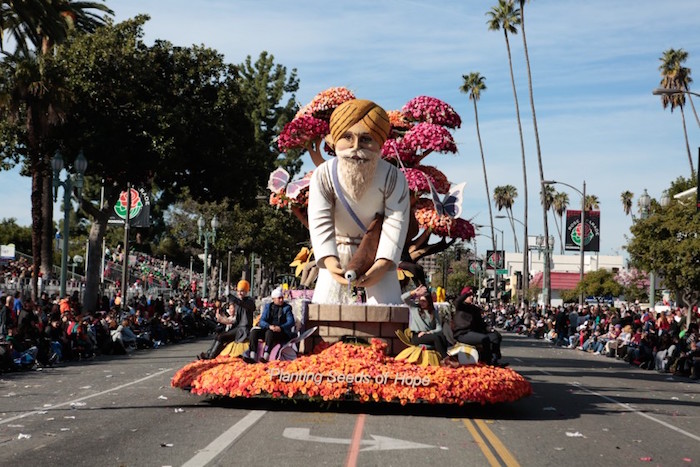
The Sikh American Float Foundation’s entry makes its way along the Rose Bowl Parade route on New Year’s Day.(Jason Armond / Los Angeles Times)
By ERIN B. LOGANSTAFF WRITER | LOS ANGELES TIMES |
For the sixth year in a row, the Sikh American Float Foundation motored a float down the 5½-mile parade route. This year, coffee grounds, lentils, walnuts, cranberries, spices and coconut flakes adorned the 85-foot-long float, titled “Planting Seeds of Hope.”
Maninder Minu Singh, creative director of the foundation, began thinking about the float’s design a year ago. She had to think of a way to connect this year’s parade theme, “The Power of Hope,” with the Sikh faith. Eventually, Singh settled on a large sculpting of Bhai Ghaneya Singh Ji, a Sikh from the 18th century known for giving water to wounded soldiers on the battlefield regardless of faith.
With the Irwindale-based Phoenix Decorating Co., Singh and 1,400 volunteers were able to bring to life a man who exemplified what the world should be, she said, “putting humanity above affiliations and differences.”
The float shows Ji pouring water, surrounded by 69,000 live roses and 16 real-life children. The presence of children from different backgrounds was important to showcase, Singh said, because they are the future of the world.
“If we plant seeds of love, compassion and service into young minds today, then they can design a world in the future that is more peaceful, kind, loving and beautiful,” she said.
An estimated 500,000 Sikhs live in the United States. The religion has roots in the 15th century Punjab region of India.
Some people wrongly assume that Sikhs are Muslims because of the turbans they wear. Violence against American Sikhs intensified after 9/11, when Islamophobia was on the rise.
In 2012, six people died in a mass shooting at a Sikh temple in suburban Milwaukee.
Recently, reports of hate crimes against the group have increased. In 2015, the FBI recorded six reports of hate crimes against Sikhs. In 2018 there were 60, a 200% increase from the 20 reported in 2017, according to figures provided by Brian Levin, director of the Center for the Study of Hate & Extremism at Cal State San Bernardino.
“Sikhs are attacked not only because they are confused with Muslims, but also because their adherents are doubly stereotyped” as part of a “foreign” faith, Levin said in an interview. He noted that changes in law enforcement data collection and the “excellent outreach made by the Sikh community” contributed in part to the dramatic increase in reports.
Local Sikhs see the parade as an educational opportunity. Having a float that showcases diversity and works with non-Sikhs, like Lhotka, is key to spreading a message of kindness and compassion, Singh said.
“At the end of the day, we all believe in freedom, equality, compassion and service,” she said. “Those are the things necessary to blur the lines of division and bring us together.”
See original report , Rose Parade 2020: Sikhs roll out a float to sow seeds of hope, generosity and harmony, here.
ASIA SAMACHAR is an online newspaper for Sikhs / Punjabis in Southeast Asia and beyond.Facebook | WhatsApp +6017-335-1399 | Email: editor@asiasamachar.com | Twitter | Instagram | Obituary announcements, click here |
The murder of Amitpal Singh Bajaj in the tragic incident in Thailand in August caught the attention of many of our readers. It was our most-read story in 2019.
Amitpal, the 34-year-old Malaysian-born IT consultant who held British citizenship, perished in the scuffle on the night before he was scheduled to leave with his Singapore-born wife and their two-year-old son.
The next most-read story came from Indonesia. Indonesia lost its most prominent Sikh son with the passing on of Harbrinderjit Singh Dillon in September.
Known widely as Pak H.S. Dillon, Harbrinderjit is easily one of the most well-known Indonesian Sikhs who has held important positions in the Indonesian government and civil society.
And the third most-read story in 2019 was on the making of the gurdwara in Putrajaya, the seat of Malaysia’s administrative capital.
Here are the top 30 most-read stories at Asia Samachar for 2019.
ASIA SAMACHAR is an online newspaper for Sikhs / Punjabis in Southeast Asia and beyond.Facebook | WhatsApp +6017-335-1399 | Email: editor@asiasamachar.com | Twitter | Instagram | Obituary announcements, click here |
Path Da Bhog: 12 Jan 2020, 5pm-7pm, at Wadda Gurdwara Sahib Jalan Kampung Pandan, Kuala Lumpur
Contact:
Jagmohinderjeet: 011-52192937
Asvin : 010-2260762
Deeply missed by wife, children, grandchildren, siblings, relatives and friends.
| Entry: 31 Dec 2019; Updated: 1 Jan 2020 | Source: Family
ASIA SAMACHAR is an online newspaper for Sikhs / Punjabis in Southeast Asia and beyond.Facebook | WhatsApp +6017-335-1399 | Email: editor@asiasamachar.com | Twitter | Instagram | Obituary announcements, click here |
Voyage of Mercy: Shamdev Singh in the Global Sikhs-Waves of Mercy maiden mission – Photo: The Sikh (Special Edition), March 2005
The Dec 26 2004 Asian tsunami – triggered following a seabed earthquake that measured 9.0 on the Richter scale off the coast of Sumatra in Indonesia – saw waves of destruction smashing into parts of Indonesia, Sri Lanka and India. Close to 500,000 people have died and millions more have been left in urgent need of food and shelter. As Asia grappled with tsunami aftermath, the world has come together in an overwhelming show of sympathy, love and support.
In Malaysia, an established Sikh body – the Sikh Naujawan Sabha Malaysia rose to the occasion by spearheading Global Sikhs,a humanitarian relief team that has ventured into the heart of destruction in Aceh, Indonesia, to do their bit in offering assistance to the victims.We capture their story in this special issue.
By Habhajan Singh | THE SIKH (SPECIAL EDITION) | MALAYSIA |
THEY are familiar with men in turbans.The tsunami-ravaged Aceh, a province in the sprawling Indonesia archipelago, is known for its Islamic credentials. But the “new men in turban” who descended on their land early this year were a new sight for the people of Aceh, who associate turbans and beards as being Islamic or Arab.
“Are you a Muslim?” asks an elderly lady as Dr Jaswant Singh attends to her in the first few weeks following the Dec 26, 2004 tsunami that slammed Aceh with waves as high a three story building.
“No, I’m a Sikh,” he replies.
“What are you doing here?” the lady asks. One look and you can tell something is bothering her. She’s not alone. Many others in Aceh carry the same look of bewilderment and agony. This lady has lost almost her entire family in the killer waves that smashed into Aceh following a massive undersea earthquake off the coast of Sumatra. Aceh alone lost close to 300,000 people in the tragic incident Hence, the makcik – the Malay word for an elderly lady – has many reasons to be anxious.
“I’m here to help,” replies the 37 – year old doctor who grew up in Puchong, Selangor.
”Where are the Arabs?” the lady shot back another question, gazing at his turban.
Dr Jaswant is from the Global Sikhs – Waves of Mercy, an ad-hoc humanitarian relief team powered by a group of Sikhs and expatriate sailors in Malaysia. The soft-spoken doctor signed up to be part of the maiden team of 31 volunteers to carry out relief work in Aceh.
It is a brave act, indeed. as Aceh is closest to the epicenter of the earthquake and one of the worst hit by the tsunami. The almost daily tremors that occurred were a grim reminder to the volunteers that the region could be whacked by another earthquake. These volunteers were walking on Ground Zero that may witness an epidemic outbreak.
Yet Dr Jaswant and his friends braved on.
it did not take long though for the people of Aceh to get to know more about these men in turban. They were not Arabs.They are the Bhai Khanaiyas of today – men and women who are willing to go deep into troubled areas, carrying with them aid and relief, plus bringing hope and love to people desperately in need of them regardless of nationality and race.
True blue humanitarian workers
The Global Sikhs – Waves of Mercy, a mission spearheaded by the Sikh Naujawan Sabha Malaysia (SNSM), has been tremendously successful, both in accomplishing its mission and endearing the hearts of the Malaysian public, plus those from outside the country.
When the SNSM decided to shoulder this mission, it was something it had never executed before. Volunteers of the SNSM, the Malaysian-based Sikh organisation established in the early 1960s, are experts in running Gurmat camps gatherings we come to know as Samelans. They have little or no knowledge of humanitarian relief work. But the call for seva was so strong that these Sabha volunteers found themselves sailing across the deep blue sea, wearing the badge of humanitarian relief work to do their bit for the tsunami victims.
Take Malkith Singh, for example. A long-time dedicated volunteer of SNSM, currently its vice president, Malkith has been assisting in running the day-to-day affairs of the SNSM for many years now. He has organised countless Gurmat camps and coordinated the kirtans and parchars of international raagi jathas. Malkith partakes in the cooking of Guru-ka-Langgar almost every other day in one Gurdwara or another and has attended to to families in need of assistance.
On Jan 7, 2005 Malkith sailed with 30 others on the maiden Global Sikhs‘ relief mission to Aceh. He was on a yatch, fully loaded with thousands of boxes containing food, medicines and emergency supplies and ready to sail more than 500kms.
Malkit Singh (left) and Dr Jaswant Singh (right)were part of the Global Sikhs’s first mission to Aceh in 2004 – Photo: The Sikh (Special Issue) 2005
Within weeks the Global Sikhs-Waves of Mercy team of volunteers was nursing some 10,000 people in two areas. In Pulau Weh, an island just north of Banda Aceh, the volunteers were assisting some 7,000 people displaced and housed temporary in 15 makeshift camps. While Pulau Weh was not as badly hit by the tsunami as other areas in Aceh, aid and relief work carried out by Global Sikhs-Waves of Mercy did become the turning point for the people of this beautiful island who had lost their homes and everything else.
In Paroe and its surrounding areas – villages facing the Indian Ocean that faced the full brunt of the tsunami – some 3,000 villagers came under their care. Here, however, was a story of death and destruction.
In no time, thousands of makciks, like the one under Dr Jaswant’s care, came to know of Sikhs. Whenever they see the men in turban or the words ‘Global Sikhs‘, the villagers knew help has arrived. Not only do they bring food, medicine and love abundance, to the delight of the villagers, the people of Aceh were amazed that the Global Sikhs brought them the Quran and other religious items required by Muslims.
The word began to spread, carrying forward the good name of the followers of Guru Nanak, the founder of Sikhism. An incident in Sabang,the small port city in Pulau Weh that acts as the forward station for the mission illustrates the point.
A group of doctors from the Global Sikhs-Waves of Mercy were left alone to carry out thew work. Feeling hungry walked into the town to buy some food. The shop owner refused to accept payment. “Kamu orang bawa pertolongan” (You’re men who brought us aid),” he said. And when they see men in turban, or the Global Sikhs banner, even the army waves you on. While they may know nothing of the Sikhs, they found them to be honourable people, providing true blue humanitarian relief, with no hidden agendas.
Back in Malaysia, people from all walks of life came to know of these Sikh volunteers: how they have joined in efforts to provide emergency aid to Aceh. Malaysians are impressed as to how such a small community is able to mobilise aid and relief within such a short span of time.There are less than 80,000 Sikhs in Malaysia out of a population of 25 million people. News of the good work of Global Sikhs and other agencies also began making its round in the Sikh circles, as well.
SNSM hopes the good work being carried out by Global Sikhs will correct the misperception people have regarding Sikhs. Global Sikhs hopes to put forward an image of the Sikhs that is dynamic, vibrant and humanitarian. “For years, Sikhs have been branded as terrorists and people who gave trouble. Sadly this image has lingered on, ” Global Sikhs operations director Harvinder Singh told team members in a meeting in the early days of the mission. “This disaster is an opportunity. We will represent Sikhs around the world. Hopefully, it will remind them of Bhai Khanaiya, the first Red Cross.”
What is the spirit of Bhai Khanaiya? We go back some 300 years ago. ln the midst of a battlefield. one solitary soul was walking around, water and medicine in hand. He would attend to anyone in sight, no questions asked. There was a battle going on, with two sides at war with each other. That did not stop him from nursing the wounds of everyone in his path.
Bhai Khanaiya had performed selfless service of humanity with no distinction of nationality, caste or creed. Some Sikhs complained to Guru Gobind Singh that Khanaiya had been resuscitating the fallen enemy soldiers. He was summoned to the Guru’s Darbar. The case against him was put forward. Now, what do you say, Brother Khanaiya? ”Yes, my Lord, what they said is true in a sense, but I saw no Mughals or Sikhs in the battlefield. I only saw human beings.” The Guru. pleased with the reply, blessed him and told the Sikhs that Khanaiya had understood his teachings correctly. In a sense, the Global Sikhs-Waves of Mercy mission works on that very principle: we are here to serve anyone who needs our help.
Global Sikhs operations director Harvinder Singh (left)
THE BEGINNING
The story of Global Sikhs began in the days following the Dec 26 disaster. The province of Aceh on the island of Sumatra is just across the Straits of Malacca. Malaysia is its closest neighbour. Some key volunteers of the SNSM were approached with the idea of providing some form of assistance to the victims in Aceh. At that time, the number of dead reported was way much lower and Indonesia was still not in the news as the place worst hit by the deadly waves.
Within days, the Sabha House the SNSM headquarters in Bangsar, Kuala Lumpur, turned its premises into a center facilitating and coordinating relief operations. More than 100 volunteers were deeply engaged in one activity or another towards this end. Donations in the form of food, clothes and others began pouring in by the lorry loads. Every nook and corner of the two-story bungalow was almost filled up with goods from generous Malaysians. Clearly. a humanitarian relief agency was taking shape at Sabha House. The meeting room was transformed into the mission’s Command and Control Centre, which soon would be operating 24-hours a day. By all accounts this is probably the largest Sikh humanitarian relief agency, in terms of number of volunteers, to go into action in an international tragedy.
By end-March, the Global Sikhs-Waves of Mercy would have sent some 160 volunteers to Aceh over seven missions, performing all kinds of relief and rehabilitation work. Indeed, history is in the making for Sikhs in Malaysia and worldwide.
The energy levels these volunteers exude were simply amazing and contagious. In a matter of no time hundreds came forward to render help in one way or another. These volunteers, most of them with full-time jobs or people running their own companies, came forward to lend time, energy and expertise. Without doubt, the mission needed all the expertise it could muster. Being new to relief work the learning curve was steep. The ‘to-do’ list was lengthy: clarifying the mission, identifying the right people for the right job, providing basic emergency and relief training, searching for funds and goods, coordinating with other relief agencies, getting the necessary approvals, reaching out to people about the work, and so on.
As the mission moved on, the right people and the required stuff began falling in place. At times, it was almost as if miracles were unfolding, one after another. For the first few shipment, the mission needed medicines costing millions of dollars. Overnight, the supply reached our doors at Sabha House. We needed foodstuff to take to Aceh. Again, the donors came forward.
Critical to the mission was a proper control centre. A couple of army experts with just the right expertise and experience came forward to help in that area. At the end, the Command Centre transformed into a mission operation centre: there were clocks on the wall telling you the time In Aceh and Kuala Lumpur, and maps of Aceh were plastered on both corners of the room. Dedicated telephone lines and networked computers were put in place for volunteers to get cracking. The man responsible for putting the Command Centre into place was Global Sikhs deputy operations director, Satwant Singh, a globetrotting environmentalist with a multi-national company.
ROUTE BY SEA
So, how did we get to Aceh? At that point the big international agencies were already making a beeline to Banda Aceh, the capital of the province, perched at the tip of the Sumatra. But feedback that we got noted that the relief teams and goods were stranded at the capital as the complete destruction of the road network on the west coast of Aceh hindered onward movement into the remote areas of Aceh.
Bearing this in mind, what do we do? That was one of the most critical questions for operations director Harvinder Singh and the team. A dedicated and long-time SNSM volunteer, Harvinder played an instrumental role In providing leadership to the team, at that point already in high gear. Having put In so many collective man-hours, they were not about to col back. “lf you want success, you have to do something you have never done before,” Harvinder had said to the team.
And that‘s exactly what happened – treading on a path other volunteers had never treaded before. By sheer coincidence, Global Sikhs were matched with the Waves of Mercy, a group of sailors based in Langkawi, an Island on the West coast of Malaysia. Led by Captain Hugo Crawford, the group of expatriate sailors was already busy putting together a team to send goods and people to Aceh. The Irish-born Capt Hugo and friends were at Langkawi when tidal waves rocked the shores of Langkawi an island on west Side of peninsular Malaysia. The US$10m ship under his care – it belongs to a businessman – was one of the few that were spared during the incident on Dec 26. The 52-year old former carpenter, who hails from Belfast, refused to let the tragedy get the better of him. “The images haunted my mind as I tried to sleep,” says Capt Hugo.”In a flash, it was clear to me what I had to do. I’m a captain of a 130-foot motor yatch. So, why not I attempt a rescue mission for the thousands of unfortunate people along the coastline of Northern Sumatera.” He bandies around his fellow-seamen. That’s how Waves of Mercy came about.
Within a week – by Jan 7 – the new partnership of Global Sikhs – Waves of Mercy sent out two vessels carrying 31 volunteers and 150 tons of emergency supplies on its way to Aceh.The first team, led by with Malkith Singh as the chief-de-mission, also included a group of 10 medical personnel.
Global Sikhs volunteer Raj Sonia (second from left) at one of the camps under the care of Global Sikhs-Waves of Mercy – Photo: The Sikh (March 2005)
The new partnership changed the plan we had initially wanted to operate, thus realigning the mission’s anchor. Unlike most humanitarian agencies in Aceh that came in via air, Global Sikhs now could avoid Banda Aceh and the likelihood of its volunteers and goods getting stranded.
As the only humanitarian aid agency fully mobile with sails, Global Sikhs set its base camp in Sabang, Pulau Weh. The local hospital in Pulau Weh was in dire need of extra help. It had lost five of its nine doctors to the tsunami. Dr Susheelwant Kaur and colleague went straight to work making their way from one camp to another, handing some 7,000 people at 15 Internally Displaced Camps.
Some 20 days after the tsunami, the Global Sikhs team sailed along Paroe. The village caught the attention of Global Sikhs. Since the tsunami incident, the village facing the epicenter of the earthquake had not received any relief, save for a solitary air drop a couple of days earlier. But that proved of little use. Cooking rice with the polluted water made everyone sick. “Move than half its population had been wiped out. When we first landed there, some of the children there could not even walk,” says Malkith Singh, who was on board the Sean Paquitto yacht that brought relief to the villagers.
Dr Tikfu Gee (left) and Dr King (right). Global Sikhs-Waves of Mercy maiden mission – Photo: The Sikh (Special Edition), March 2005
Back at home In Malaysia, things were moving at break-neck speed. Right from the beginning, the mission was meant to embrace anyone and everyone who wanted to serve as humanitarian relief workers, regardless of race, religion or nationality. From the onset, Global Sikhs had enlisted non-Sikh members. Dr Tikfu Gee was busy drawing up the medicine list together with Jagdeep Singh and his wife Jasmeet Kaur. Kishore Kumar was gallantly handling logistics. The husband-wife couple of Tik and Stephanie were working into the wee hours of the night, alongside Tarminder Singh, to get the website up and running.
From day one, the mission adopted the inclusive route. To keep the platform open to other concerned organisations, the team adopted the name Global Sikhs. SNSM Jathedar (president) Harwindar Singh spelt out its mission: “Global Sikhs is a platform for anyone who wants to serve in providing relief to the devastated people of Aceh and to assist them In rebuilding their lives.” At that juncture, the Global Sikhs alliance had already included the United Sikhs. Others Sikh organisations soon began lending a helping hand.
Global Sikhs Aceh Mission 2004 – Photo: The Sikh (Special Issue) 2005
MAKING A DIFFERENCE
Over the weeks, Global Sikhs have been concentrating its efforts in providing assistance to Pulau Weh and Paroe. At Pulau Weh, the team embarked on several other projects. One of them is ensuring proper sanitary conditions at displaced people’s camp.
With the operations moving from the emergency phase to the rebuilding process, Global Sikhs have just sent 16 boats to Paroe. This is to help the predominantly fishing community back on its feet. More boats are on its way. ”You should have seen the glow in the eyes of the people In Paroe when they got the boats. It was simply awesome,” said one volunteer working there.
More importantly, it’s giving the people there – the four or five villages there lost at least half their members and saw the waves destroying their homes – something to look forward to. “We‘re now me the rebuilding phase,” says Jagdev Singh, SNSM Vice President who has taken over as Global Sikhs‘ director of operations.
The work being done by the brave volunteers of the Global Sikhs-Waves of Mercy is definitely making a difference. For years to come, the people of Aceh will remember the men in turban who came as waves of mercy following the waves of destruction.
[The article first appeared in the The Sikh (Special Edition), a SNSM magazine, published in March 2005. The author was the Global Sikhs media director]
ASIA SAMACHAR is an online newspaper for Sikhs / Punjabis in Southeast Asia and beyond.Facebook | WhatsApp +6017-335-1399 | Email: editor@asiasamachar.com | Twitter | Instagram | Obituary announcements, click here |
EKTA volunteers accompany the single mothers who took part in a Mitra women empowerement programme. L-R: Eve, Kuldeep Kaur, Harwinder Kaur, Nirmal Ajit (Bobby), Harindar Kaur, Mindy and Sharon Kaur – Photo: Supplied
By Asia Samachar Team | MALAYSIA |
A skill or two can make a huge difference in our lives. That’s what three ladies from the Klang Valley found when they took part in a single mother empowerment programme not too long ago.
Three Sikh single mothers took part in a two-month training where they were exposed to parenting, IT, communication and social media marketing skills.
Kuldeep Kaur, who had to make alternate arrangements for her daughter for the day, appreciated the learnings from the social marketing classes. “Now I can even teach my daughter a thing or two,” she said in a note shared with Asia Samachar.
Another participant said they were greatly motivated by the EKTA Club of Kuala Lumpur & Selangor volunteers to take part in the programme. “Otherwise, we may not have enrolled,” she said.
EKTA Club, a Kuala Lumpur-based NGO, comprises some 50 lady members from different professions and age groups.
(For singles mothers who would like to enrol in short courses, please contact Bobby from Ekta’s welfare wing at +6012-3055708)
ASIA SAMACHAR is an online newspaper for Sikhs / Punjabis in Southeast Asia and beyond.Facebook | WhatsApp +6017-335-1399 | Email: editor@asiasamachar.com | Twitter | Instagram | Obituary announcements, click here |























 ਜੇਹਾ ਚੀਰੀ ਲਿਖਿਆ ਤੇਹਾ ਹੁਕਮੁ ਕਮਾਹਿ ॥ ਘਲੇ ਆਵਹਿ ਨਾਨਕਾ ਸਦੇ ਉਠੀ ਜਾਹਿ ॥੧॥