















UA-56202873-1
Page 53

Racism and violence: A Sikh woman’s rape ordeal in Sandwell

0
Sikhs and local communities gathered in strength and solidarity against the violent hate assault and rape of the young Sikh girl in Sandwell in the UK Midlands – Photo: Screengrab from SkyTV

By Gurnam Singh | Opinion |

On Tuesday, 11th September 2025, a horrific attack on a British-born Sikh woman in her twenties sent shockwaves through the community. What makes it even more worrying is that this attack took place within touching distance of eight gurdwaras in the small town of Oldbury. Part of the Borough of Sandwell in the UK Midlands, this is one of the most ethnically diverse parts of the UK and home to a large Sikh community.

The assault was not merely an attack on an individual; it was an assault on the dignity, humanity, and the shared values that bind us all. In this regard, it must be seen as wake-up call for those who may have felt that the kinds of racial hatred that the first generation of migrants had to endure in the 1960’s and 70’s was part of history. On a positive note, the response from all sections of the community has also demonstrated extraordinary resilience: a community united in protest, MPs demanding justice, and a faith that calls for the welfare of all.

The Sandwell Attack

Police are treating the crime as racially aggravated, after the perpetrators reportedly told the victim during the assault: “You don’t belong in this country, get out.”

The victim was on her way to work near Tame Road in Oldbury when she was attacked by two men. In a courageous public statement, she expressed both the trauma she endured and the gratitude she feels for the support she has received: “I would never wish this on anyone. All I was doing was going about my day on my way to work, and what has happened has deeply affected us. Through it all, my family has been my rock, and my community has stood strong beside me… We are going through a lot, but the strength and kindness shown by the right people in the community has been incredible, and I can’t thank them enough for being my voice.”

Her words reveal the devastating impact of the crime, but also the resilience and strength that emerge from communal solidarity.

Protest and Political Response

On the Sunday 14 September, hundreds of members of the Sikh community took part in a peaceful demonstration, beginning at the Guru Nanak Gurdwara in Smethwick and moving toward the scene of the attack. The march was both an act of solidarity with the victim and a collective demand for justice and safety. As Kuldeep Singh Deol, former president of the Guru Nanak Gurdwara, said:
“This attack on our sister is shameful. Our daughters, sisters, and mothers deserve to be safe, regardless of colour or which faith they belong to.”

Local MP Gurinder Singh Josan has actively pursued justice at the highest levels of government, confirming that he had raised the case with ministers in the Equalities Office and with the Home Secretary, Rt Hon Shabana Mahmood MP, including asking a direct question in the House of Commons on 16th September. The Home Secretary condemned the racially motivated attack and reaffirmed the government’s commitment to ensuring justice is delivered.

Other community voices were equally resolute. Sangat Singh reminded the nation of the Sikh community’s longstanding contribution to Britain: “This was a vile act of racial hatred and sexual violence. Sikhs have stood for this nation, from Saragarhi to the world wars, earning Victoria Crosses for bravery. We are proud citizens, contributing through the NHS, in business, and across British society. This was not only an attack on our community, but a violation of a woman’s dignity; it must be met with justice. We have as much right to this country, and its symbols, as anyone else. We will not tolerate extremism in its name.”

Sikhs and local communities gathered in strength and solidarity against the violent hate assault and rape of the young Sikh girl – Photo: Sikh Federation UK

On 16th Sept ordinary people and activists from across communities gathered at a vigil in Oldbury to show their support for the woman and discuss violence against women. Calls by attendees were made to raise awareness of misogynism and abuse against women and the need for the community from all backgrounds to “stand together united”.

Sikh Teachings and the Politics of Division

From a Sikh perspective, this attack is far from an isolated incident. It occurs within a broader climate of hostility, racism, and far-right extremism in the UK. Figures such as Tommy Robinson have built movements on a strategy of divide and rule, exploiting societal tensions to foster hatred between minority communities.

Regrettably, and somewhat bizarrely given that the case in question is clearly a race-hate crime, a small but vocal number of misguided Sikhs, almost entirely men, have been drawn, mostly via social media, into anti-Muslim and anti-immigrant rhetoric, expressing solidarity with the Far-Right. To the credit of the broader Sikh community, these individuals have been widely condemned.

One of the core Sikh teachings is to reject ideas and individuals who sow divisions amongst people. Guru Nanak’s vision of the oneness of humanity (Ik Onkar) and Guru Gobind Singh’s proclamation to ‘recognise the human race as one’, calls on us to see beyond artificial divisions of race, religion, caste, class, gender and sexuality. Guru Tegh Bahadur, whose 350th martyrdom anniversary is being commemorated this year, sacrificed his life to defend the religious freedom of all, not just Sikhs. Guru Gobind Singh insisted that tyranny must be resisted, but never at the expense of truth or justice. The Gurus understood that oppression thrives when communities are turned against one another, and they rejected such politics in favour of solidarity with the downtrodden.

It is therefore deeply concerning that even a small number of Sikhs, particularly on social media, appear to align with far-right propaganda, spreading Islamophobia and xenophobia. In doing so, they betray Sikh principles and play directly into strategies that weaken all communities. True Sikh activism must never build walls between communities; it must build bridges. It must always reflect sarbat da bhala, the welfare of all, which all Sikhs attest to twice per day during their morning and evening prayers. Our strength has always come from standing together, aligning with the truth and not from false alliances rooted in hatred.

Lessons from Britain’s Anti-Racist Struggles

The Sandwell race hate rape case compels reflection on Britain’s history of anti-racist struggle. In the 1970s and 80s, minority communities organised powerful movements to resist discrimination and far-right violence. Asian Youth Movements, the British Black Panther Movement, the Black Unity and Freedom Party, and various trade unions and workers’ associations played pivotal roles in grassroots resistance.

These movements were non-sectarian and secular, recognising that unity across communities was essential to winning civil rights. Sikhs, Muslims, Hindus, and Afro-Caribbean communities often stood shoulder to shoulder against the National Front and other racist organisations. Their strength came from solidarity, from refusing to be divided, and from recognising that an attack on one community was an attack on all.

Though from different parts of the world and a variety of linguistic and faith traditions, what bound them in solidarity was a universal and shared sense of justice and human dignity and rights that had been fostered during anti-colonial struggles in the post War period from the 1940’s. Indeed, the unity was so powerful that most non white minority groups chose to privilege their collective identity of Black’ rather than emphasising the ethnicity and religious, which is the case today. This legacy of anti-imperial and anti-racist collectivist politics must inspire us today. Just as the youth and workers of that generation refused to bow to racism, we too must resist the Far-Right’s attempts to pit communities against one another.

A Wider National Picture

The Sandwell case is not an isolated incident but part of a disturbing national trend over the past decade or so. Since the Brexit referendum, the rise in hate crimes, normalisation of racist rhetoric, especially in relation to migrants and asylum seekers, and emboldening of far-right figures have created a climate in which minorities feel less safe. From attacks on Muslims to racist abuse against Black Britons, violent protests outside asylum hotels, and upsurge of race hate crimes against Sikhs and Hindus, the pattern is clear: Far-Right extremism threatens the safety and dignity of all.

We must resist the temptation to view these attacks narrowly as communal issues. They are attacks on justice, equality, and humanity itself. If we allow extremists to divide us, we all lose. If we stand together, we gain the strength to resist.

Remembering Who We Are

As we reflect on the horrific attack in Sandwell, we must remember the values we uphold. Sikh teachings leave no room for sectarianism or alliances with those who trade in hate. Our Gurus taught that humanity is one, dignity belongs to all, and oppression must be resisted wherever it appears. Standing with those who seek to divide communities betrays these principles.

The example of Britain’s anti-racist struggles of the 1970s and 80s remains instructive. Asian Youth Movements, Black Panther organisations, and trade unions demonstrated that minority communities, united across faith and culture, could challenge the Far-Right and achieve meaningful change. Their strength came from solidarity, from refusing to be divided, and from recognising that an attack on one was an attack on all.

To those few misguided individuals in our community who might be drawn to far-right rhetoric, I say, reflect carefully. The Far-Right neither defends Sikh dignity nor safeguards equality. Its goal is division, weakening all of us. Sikhism and our shared history in Britain show a different path; one of unity, resistance, justice and love, not hate!

The Sandwell case should strengthen, not weaken, our resolve. Let it remind us that our is not one of division but solidarity with all who face racism and violence. Only by upholding these traditions can we honour both the sacrifices of our Gurus and the struggles against racism and oppression of those who came before us on these very streets of Britain.

Gurnam Singh is an academic activist dedicated to human rights, liberty, equality, social and environmental justice. He is an Associate Professor of Sociology at University of Warwick, UK. He can be contacted at Gurnam.singh.1@warwick.ac.uk

* This is the opinion of the writer and does not necessarily represent the views of Asia Samachar.

RELATED STORY:

Man arrested over ‘racially motivated’ rape of Sikh woman in Britain (Asia Samachar, 15 Sept 2025)


ASIA SAMACHAR is an online newspaper for Sikhs / Punjabis in Southeast Asia and beyond. You can leave your comments at our website, FacebookTwitter, and Instagram. We will delete comments we deem offensive or potentially libelous. You can reach us via WhatsApp +6017-335-1399 or email: asia.samachar@gmail.com. For obituary announcements, click here

Mata Manjit Kaur Hullon wife of Late Lall Singh Muker (1925 – 2025)

MATA MANJIT KAUR HULLON W/O LATE LALL SINGH MUKER

Aged 100 passed away peacefully on 17th September 2025 leaving behind

Children/Spouses
Sukhinderjit Singh Muker (Ajit) / Cathie Muker
Indarjit Kaur Muker (Indra) / Ir. Inderjit Singh Purba
Rajinder Singh Muker (Raj) / Gale Muker
Mahinderjit Singh Muker (Mike) / Penny Muker
Sukhinderjit Kaur Muker (Goodie) / Arjan Singh Sagoo
Satwant Singh Muker (Sathi) / Bhagwant Kaur (Cherry)

Grandchildren/Spouses
Harinderjit Singh Muker / Danet Muker
Late Ameet Kaur Purba
Sharon Muker
Manjeev Muker
Dr. Raveen Kaur Purba
Sanjeet Muker
Harveen Kaur Sagoo / Lavindar Singh Jay
Kiranjeet Singh Purba / Rachvin Kaur Dhillon
Samreet Singh Sagoo / Dr. Reenaraj Kaur Sandhu
Randeep Singh Muker / Isabella Van Schaik
Rani Kaur Muker
Shaneeta Kaur Muker

Respects can be paid at her residence
489, Jalan 5/53, Petaling Garden, 46000 Petaling Jaya, Selangor
from 12.00pm to 6.00pm from Thursday, 18th September 2025 onwards.

Cortege leaves the residence at 12.00pm on the 20th September 2025
to MBPJ Crematorium, Jalan 229, Seksyen 51a, Petaling Jaya for 1.00pm cremation.

The Final Rights Prayers/ Path Da Bhog will be held at Gurdwara Sahib Petaling Jaya
from 5.00pm to 7.00pm on Sunday 28th September 2025.

Kindly treat this as a personal invitation.

Contact Numbers:
012 – 209 6106 (Mike Muker)
012 – 603 9500 (Samreet)

Link to posting at Facebook and Instagram

| Entry: 18 Sept 2025 | Source: Family

ASIA SAMACHAR is an online newspaper for Sikhs / Punjabis in Southeast Asia and beyond. You can leave your comments at our website, FacebookTwitter, and Instagram. We will delete comments we deem offensive or potentially libelous. You can reach us via WhatsApp +6017-335-1399 or email: asia.samachar@gmail.com. For obituary announcements, click here
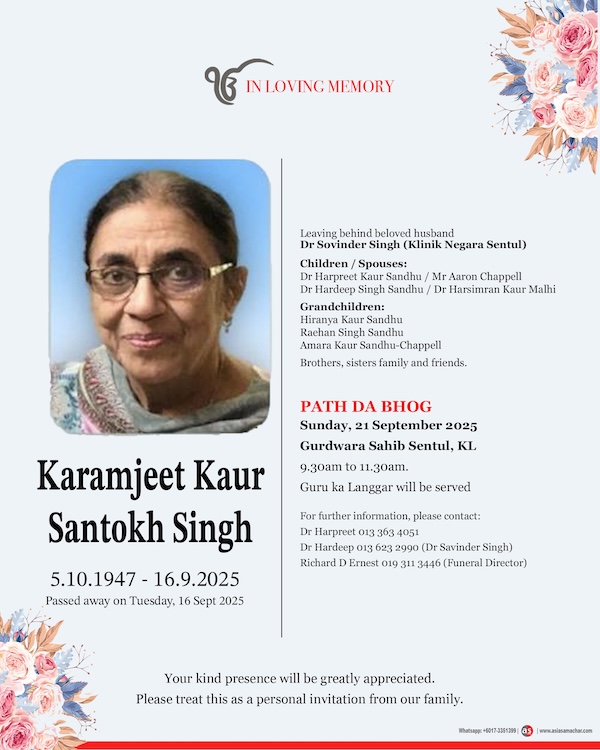
Karamjeet Kaur Santokh Singh (1947 – 2025)

Karamjeet Kaur Santokh Singh

5.10.1947 – 16.9.2025

Passed away on Tuesday, 16 September 2025

Leaving behind beloved husband Dr Sovinder Singh (Klinik Negara Sentul)

Children / Spouses:

Dr Harpreet Kaur Sandhu / Mr Aaron Chappell
Dr Hardeep Singh Sandhu / Dr Harsimran Kaur Malhi

Grandchildren:
Hiranya Kaur Sandhu, Raehan Singh Sandhu, Amara Kaur Sandhu-Chappell

Brothers, sisters family and friends.

PATH DA BHOG
Gurdwara Sahib Sentul, KL
Sunday, 21 September 2025
9.30am to 11.30am.
Guru ka Langgar will be served

For further information, please contact:
Dr Harpreet 013 363 4051
Dr Hardeep 013 623 2990 (Dr Savinder Singh)
Richard D Ernest 019 311 3446 (Funeral Director)

Link to posting at Facebook and Instagram; Updated Facebook and Instagram

| Entry: 16 Sept 2025; Updated: 19 Sept 2025 | Source: Family

ASIA SAMACHAR is an online newspaper for Sikhs / Punjabis in Southeast Asia and beyond. You can leave your comments at our website, FacebookTwitter, and Instagram. We will delete comments we deem offensive or potentially libelous. You can reach us via WhatsApp +6017-335-1399 or email: asia.samachar@gmail.com. For obituary announcements, click here
Madam Jasbir Kaur (1932 – 2025), Seremban

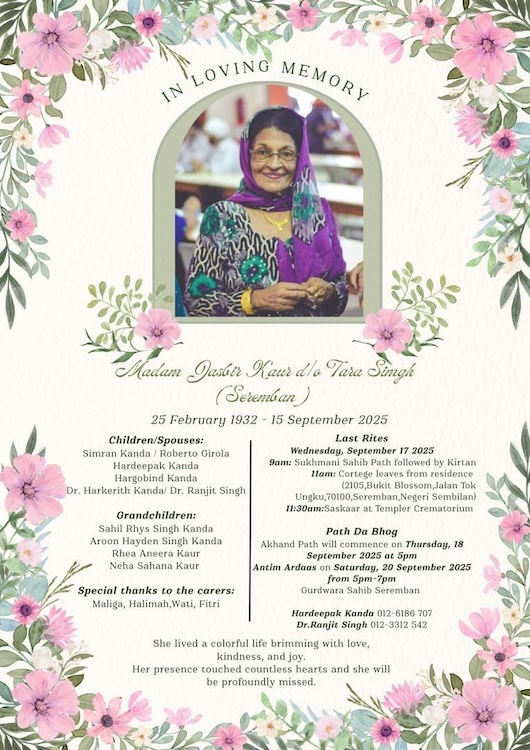
Madam Jasbir Kaur d/o Tara Singh

(Seremban)

25 February 1932 – 15 September 2025

Children / Spouses:
Simran Kanda / Roberto Girola
Hardeepak Kanda
Hargobind Kanda
Dr. Harkerith Kanda / Dr. Ranjit Singh

Grandchildren:
Sahil Rhys Singh Kanda
Aroon Hayden Singh Kanda
Rhea Aneera Kaur
Neha Sahana Kaur

Special thanks to the carers: Maliga, Halimah, Wati, Fitri

LAST RITES
Wednesday, 17 September 2025
9am: Sukhmani Sahib Path followed by Kirtan
11am: Cortege leaves from residence (2105, Bukit Blossom, Jalan Tok Ungku, 70100,Seremban, Negeri Sembilan)
11:30am:Saskaar at Templer Crematorium

PATH DA BHOG
Akhand Path will commence on Thursday, 18 September 2025 at 5pm
Antim Ardaas on Saturday, 20 September 2025 from 5pm-7pm
Gurdwara Sahib Seremban

She lived a colorful life brimming with love, kindness, and joy.
Her presence touched countless hearts and she will be profoundly missed.

Hardeepak Kanda 012-6186 707
Dr. Ranjit Singh 012-3312 542

Link to posting at Facebook and Instagram

| Entry: 16 Sept 2025 | Source: Family

ASIA SAMACHAR is an online newspaper for Sikhs / Punjabis in Southeast Asia and beyond. You can leave your comments at our website, FacebookTwitter, and Instagram. We will delete comments we deem offensive or potentially libelous. You can reach us via WhatsApp +6017-335-1399 or email: asia.samachar@gmail.com. For obituary announcements, click here

Ranjit Sagar and Shahpur Kandi Dams: Unpacking the Ravi Flood Debate

0
The Ranjit Sagar Dam, also known as the Thein Dam, is a major water reservoir and hydroelectric power project located on the Ravi River in Panjab. Located about 24 kilometers from the international border with Pakistan, the dam was constructed to harness the waters of the Ravi River and was completed in 2000. It is a concrete gravity dam with a height of about 162 meters (531 feet) and a length of approximately 518 meters (1,699 feet).

This article has been revised to reflect the correct river geometry: the Ujh–Ravi confluence lies downstream of the Madhopur Barrage. Consequently, Ujh could not have contributed to the peak discharge recorded at Madhopur during the August 2025 event. We have amended our analysis accordingly—shifting emphasis from downstream tributaries to release patterns at Ranjit Sagar Dam, the limited buffering role of Shahpur Kandi by design, and issues of gate management and inter-station coordination across RSD–SKD–Madhopur. The earlier inference about tributary-driven peaks at Madhopur has been withdrawn. Our purpose remains clarity, not blame; we welcome publication of official hydrographs, gate logs, and inspection records to further validate or correct this assessment.

CLICK HERE FOR THE ORIGINAL ARTICLE FOR MORE DETAILS

By KBS Sidhu | Panjab |

The operation of the Ranjit Sagar Dam (RSD) and the Shahpur Kandi Dam (SKD) lies entirely within the purview of the Punjab Irrigation Department—unlike the Bhakra and Pong dams, which are run by the Bhakra Beas Management Board (BBMB), an inter-state body that in theory represents partner states but in practice functions under the effective control of the Central Government. Against this backdrop, opposition politicians in Punjab have often asked whether the floodgates of RSD were opened too late or in a manner that aggravated flooding. These are political questions, posed for accountability in public life, but they are rarely anchored in the technical or hydrological realities of dam operation. It is important to distinguish political debate from engineering fact. What follows is not about blame; it is a search for clarity through the lens of hydrology, dam safety, gate management, and public transparency.

The Shahpur Kandi Project today

The Shahpur Kandi Dam (SKD) is structurally complete and edging toward full operation. Designed as a balancing reservoir between the upstream Ranjit Sagar Dam and the downstream Madhopur Headworks, SKD’s job is to smooth power peaking and stabilise canal supplies; it is not a flood-cushioning reservoir. The site lies ~11 km below RSD and ~8 km above Madhopur, with two powerhouses, live storage of about 9.7 million cubic metres, and a full-reservoir level in the 401–404.5 m band. Civil works were completed in early 2024 after decades of delay; commissioning of the power component has been targeted for mid-September 2025, subject to safety clearances.

Is Shahpur Kandi fully “live”?

Even after completion, SKD is not yet functioning at full capacity. Jammu & Kashmir’s entitlement of 1,150 cusecs is pending because pondage has not reached the authorised level and Dam Safety Act compliance is still being closed out. In this first-fill period, impoundment has necessarily been conservative. SKD has therefore been operated cautiously, passing most inflows rather than storing aggressively.

What the new maps and table tell us

Three pieces of material shared here reset the emphasis of any fair analysis:

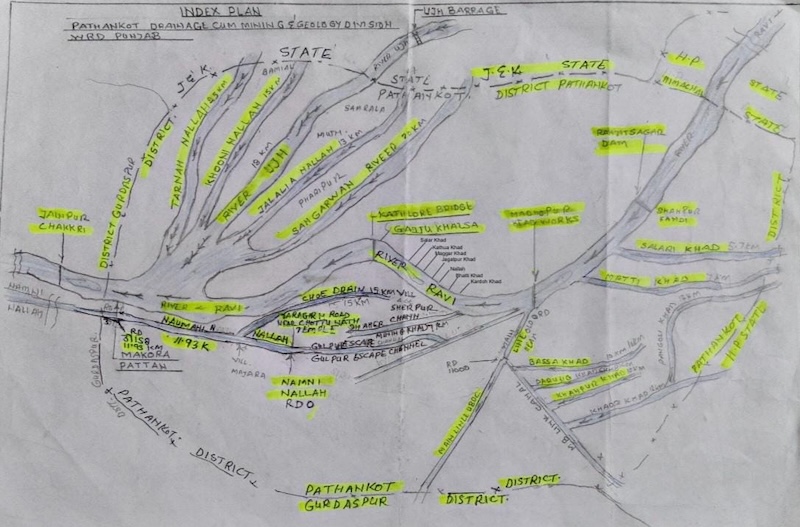
  • The schematic line diagram places the Ujh confluence ~20 km downstream of Madhopur. SKD lies ~8 km upstream of Madhopur; RSD is ~11 km upstream of SKD.
  • The departmental table of khads/nallahs between RSD and Madhopur lists an aggregate discharge on the order of one lakh cusecs (≈100,200), distributed across minor tributaries such as Sukhal, Basantpur, Bhatindi, Barni, Kiala, Dhanna, Binaat, Dhanot, Kardoh and a few smaller nallahs.
  • The index plan corroborates these placements, showing numerous khads fanning across the landscape, but either joining below Madhopur or adding modest flows above it.

These three facts have a direct consequence: the Ujh and other downstream tributaries could not have contributed to the peak measured at the Madhopur Headworks, and the small khads that do enter above Madhopur provide only a limited increment to whatever RSD passes.

The August 2025 floods—reframed

Because the Ujh joins below the barrage, it could not have contributed to the peak discharge recorded at Madhopur. Likewise, the khads/nallahs listed between RSD and Madhopur, even taken together, account for ~1 lakh cusecs, which is significant but not of the same order as the multi-lakh peaks reported at the barrage during the crisis window. It follows that the Madhopur hydrograph for 26–27 August must have been driven primarily by the release pattern from RSD, with only a modest increment from the listed khads.

Put plainly: if Madhopur saw a sudden, high-magnitude surge at the very time its gates failed, that surge cannot be attributed to the Ujh or to tributaries below the headworks. The most plausible hydrological explanation is a sequence at RSD that combined (i) insufficient pre-monsoon drawdown, (ii) delayed or inadequate early releases as inflows began to climb, and then (iii) a rapid ramp-up—a “panic opening”—to protect the dam as reservoir level approached the red line. Such a pattern would produce a steep rising limb that a downstream barrage not engineered for fast, large changes in head may be unable to pass safely—especially if its own gate management (inspection, lubrication, hoist capacity, synchronisation, and operator readiness) was less than ideal.

This reframing does not accuse individuals. It only aligns the observed outcome with the basin geometry now established: Ujh is downstream of Madhopur; khads above Madhopur are limited; therefore, RSD releases dominate the hydrograph at the headworks.

Why Shahpur Kandi could not “soak up” the wave

Some ask why SKD did not cushion the flood. The answer lies in first principles:

  • Purpose and scale. SKD’s live storage (≈9.7 MCM) equals <1 hour of flow at 1,00,000 cusecs, and ~½ hour at 2,00,000 cusecs. It was never designed as a monsoon sponge.
  • Proximity and first-fill limits. Being only 11 km below RSD, SKD has almost no travel-time to reshape a surge; during first-fill and pending final safety sign-offs, operators are obliged to pass most inflow.
  • Geometry. With the Ujh below Madhopur, there is no “downstream tributary cushion” for SKD to intercept. By design, SKD’s hydraulic influence on the Madhopur peak is minimal.

So where did the water at Madhopur come from?

From RSD’s gated releases, primarily. The departmental table suggests the incremental capacity of the khads above Madhopur is around one lakh cusecs. That alone cannot explain a multi-lakh peak. If the observed peak at Madhopur exceeded that order of magnitude by a factor of two, three or more, the balance must have been passed through RSD. This is consistent with field accounts of a sudden acceleration in flow during the critical hours, the kind of step change associated with rapid gate opening upstream.

Gate management and coordination

None of this is said to assign guilt; it is a call for systems discipline. The material points toward a coordination gap across three control points—RSD (large storage with gated outlets), SKD (balancing structure), and Madhopur (barrage gates). When a basin is run as a chain, gate management must be synchronised across all links:

  • Rule-curves and pre-monsoon drawdown targets at RSD should be explicit, published, and audited.
  • Ramping limits (maximum rate-of-change of discharge) should be enforced to avoid shock-loading Madhopur.
  • Shared telemetry and a single incident commander should bind RSD, SKD and Madhopur during alerts, with hour-by-hour logs of level–inflow–outflow–gate opening states preserved and disclosed after the event.
  • Madhopur gate health—inspection, lubrication, hoist tests, and contingency procedures—must be maintained to a standard that assumes fast-rising flows will occur.

Safety and commissioning

There is no evidence at present of damage to the SKD dam body or to its two powerhouses. The project should proceed to commissioning once the safety checklist is complete. But the flood has revealed the need for a tighter operating doctrine on the Ravi: shared situational awareness, stricter ramping discipline, and pre-agreed Emergency Action Plans that bind the three assets to act as one system.

Pathankot drainage cum mining & geology division, WRD Punjab

Key technical questions for the record

  • Rule-curve and drawdown: What were the target pre-monsoon levels at RSD, and were they achieved on schedule?
  • Logs and ramp rates: Please publish the 15-minute logs of level–inflow–outflow–gate openings at RSD for 20–31 August, and the ramp-rate limits applied to each gate.
  • Madhopur gate management: What was the gate-by-gate condition prior to failure, and what does the root-cause analysis say about structural/operational weaknesses?
  • SKD first-fill constraints: What limits (if any) did Dam Safety Act compliance place on SKD impoundment during the event window?
  • Tributary accounting above Madhopur: Using the departmental table, what fraction of the Madhopur peak can be attributed to the khads above the barrage, and what residual must therefore have come from RSD?
  • Protocols and command: What coordination protocol integrates RSD, SKD and Madhopur during flood alerts, and who serves as incident commander?
  • Forecast support: When forecasts diverged from reality, what fallback meteorology and upstream telemetry guided decisions at RSD, and how did those inputs flow to the Madhopur gatehouse in real time?

A constructive way forward

The new material clarifies the hydraulics of the reach: the Ujh is below Madhopur; the khads above it are limited; therefore the Madhopur peak must be understood primarily as a function of RSD’s release strategy. The lesson is not to wage a political blame-game, but to insist on data transparency, disciplined gate management, and a single chain of command. Shahpur Kandi will still deliver its promised value—peaking optimisation, steadier canals, and the conservation of Ravi waters—once it is fully live and safely integrated into a whole-of-river operating plan.

And as we conclude, a reminder: political narratives will always search for intent and fault. The durable answers, however, lie in engineering data, hydrological fact, and transparent governance. Only by bridging that divide can Punjab move from suspicion to confidence in its water infrastructure—and prevent a repeat of the Madhopur surge that a coordinated system should have managed without catastrophe.

Karan Bir Singh Sidhu, IAS (Retd.), is former Special Chief Secretary, Punjab, and has also served as Financial Commissioner (Revenue) and Principal Secretary, Irrigation (2012–13). With nearly four decades of administrative experience, he writes from a personal perspective at the intersection of flood control, preventive management, and the critical question of whether the impact of the recent deluge could have been mitigated through more effective operation of the Ranjit Sagar and Shahpur Kandi Dams on the River Ravi.

RELATED STORY:

Punjab floods 2025: Infrastructure gaps, mismanagement intensify disaster (Asia Samachar, 14 Sept 2024)

ASIA SAMACHAR is an online newspaper for Sikhs / Punjabis in Southeast Asia and beyond. You can leave your comments at our website, FacebookTwitter, and Instagram. We will delete comments we deem offensive or potentially libelous. You can reach us via WhatsApp +6017-335-1399 or email: asia.samachar@gmail.com. For obituary announcements, click here
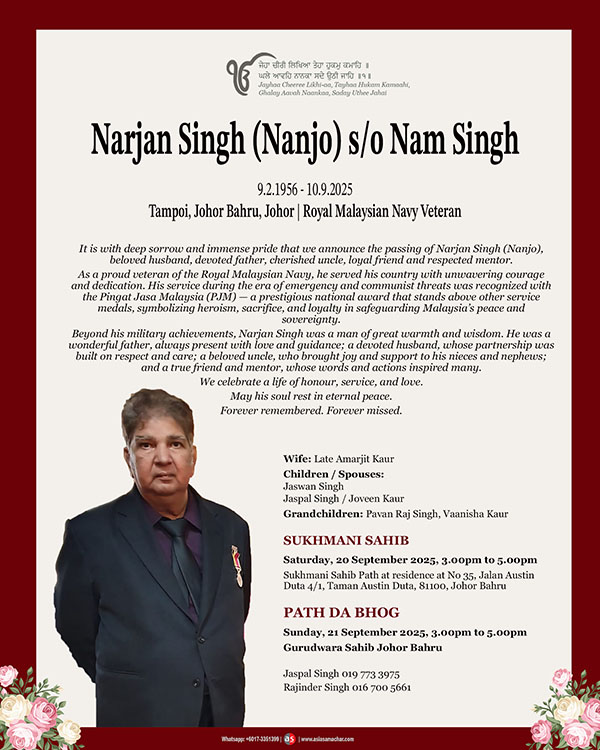
Narjan Singh (Nanjo) (1956 – 2025), Johor Bahru / Royal Malaysian Navy Veteran

Narjan Singh (Nanjo) s/o Nam Singh

9.2.1956 – 10.9.2025

Tampoi, Johor Bahru, Johor | Royal Malaysian Navy Veteran

Wife: Late Amarjit Kaur

Children / Spouses:
Jaswan Singh
Jaspal Singh / Joveen Kaur

Grandchildren:
Pavan Raj Singh
Vaanisha Kaur

SUKHMANI SAHIB
Saturday, 20 September 2025
3.00pm to 5.00pm
Sukhmani Sahib Path at residence at No 35, Jalan Austin Duta 4/1, Taman Austin Duta, 81100, Johor Bahru

PATH DA BHOG
Sunday, 21 September 2025
3.00pm to 5.00pm
Gurdwara Sahib Johor Bahru

Jaspal Singh 019 773 3975
Rajinder Singh 016 700 5661

It is with deep sorrow and immense pride that we announce the passing of Narjan Singh (Nanjo), beloved husband, devoted father, cherished uncle, loyal friend and respected mentor.

As a proud veteran of the Royal Malaysian Navy, he served his country with unwavering courage and dedication. His service during the era of emergency and communist threats was recognized with the Pingat Jasa Malaysia (PJM) — a prestigious national award that stands above other service medals, symbolizing heroism, sacrifice, and loyalty in safeguarding Malaysia’s peace and sovereignty.

Beyond his military achievements, Narjan Singh was a man of great warmth and wisdom. He was a wonderful father, always present with love and guidance; a devoted husband, whose partnership was built on respect and care; a beloved uncle, who brought joy and support to his nieces and nephews; and a true friend and mentor, whose words and actions inspired many.

We celebrate a life of honour, service, and love.
May his soul rest in eternal peace.
Forever remembered. Forever missed.

Link to posting at Facebook and Instagram

| Entry: 16 Sept 2025 | Source: Family

ASIA SAMACHAR is an online newspaper for Sikhs / Punjabis in Southeast Asia and beyond. You can leave your comments at our website, FacebookTwitter, and Instagram. We will delete comments we deem offensive or potentially libelous. You can reach us via WhatsApp +6017-335-1399 or email: asia.samachar@gmail.com. For obituary announcements, click here

Man arrested over ‘racially motivated’ rape of Sikh woman in Britain

0
Sikhs and local communities gathered in strength and solidarity against the violent hate assault and rape of the young Sikh girl – Photo: Sikh Federation UK

By Asia Samachar | Britain |

A man has been arrested on suspicion of rape by police investigating reports of a racially motivated attack on a woman in the West Midlands.

The woman, in her 20s, reported being attacked by two men on Tuesday morning near Tame Road in Oldbury.

West Midlands Police said a man in his 30s was detained on suspicion of rape on Sunday evening and was in custody.
The arrest came hours after members of the Sikh community gathered in protest over the incident, reported the BBC.

On Sunday, Sikhs and local communities gathered in strength and solidarity against the violent hate assault and rape of the young Sikh girl this week. This was a call and action to the Police and Government to act faster to find the perpetrators and protect the community.

In an earlier report, Express & Star reported that the attackers had shouted ‘you don’t belong here’ before brutally attacking the British-born Sikh woman.

She was allegedly sexually assaulted, raped and brutally beaten in a horrific attack on Tuesday morning (September 9) shortly before 8.30am.

The attackers are described as being white, one with a shaved head, heavy build, and was reported to be wearing a dark coloured sweatshirt and had gloves on, while the second man was reportedly wearing a grey top with a silver zip, according to the newspaper.

Sikh Youth UK has met and is supporting the victim and her family, while West Midlands Police say they are ‘working really hard’ to identify those responsible.

This serious attack follows the recent attack on two elderly Sikh taxi drivers in Wolverhampton, an investigation that is currently ongoing, the report added.

ASIA SAMACHAR is an online newspaper for Sikhs / Punjabis in Southeast Asia and beyond. You can leave your comments at our website, FacebookTwitter, and Instagram. We will delete comments we deem offensive or potentially libelous. You can reach us via WhatsApp +6017-335-1399 or email: asia.samachar@gmail.com. For obituary announcements, click here
Sikh nurse saves Malaysia Airlines crew member mid-flight

0
Trained nurse Parminder Kour saves life of a crew on Malaysia Airlines flight

By Asia Samachar | Malaysia |

A young Sikh nurse is being hailed as a hero after saving the life of a Malaysia Airlines (MAS) crew member who collapsed during a flight from New Delhi to Kuala Lumpur today (Sept 15).

Parminder Kour, 25, a trained nurse currently working in Britain, was on board when urgent calls for medical assistance rang out. Without hesitation, she stepped forward to assist the stricken crew member, who had reportedly suffered a cardiac arrest.

A fellow passenger told Asia Samachar that Parminder remained calm under pressure and managed to revive the crew member before the flight landed safely in Kuala Lumpur.

In a message from a flight crew to her, Malaysia Airlines praised her swift and selfless response: “When one of our crew members suffered a sudden cardiac arrest, a young Sikh nurse immediately stepped forward without hesitation. With extraordinary calm and skill, she revived our colleague and kept her stable until further medical assistance was available. Her quick thinking and courage reflect the true spirit of humanity and service.”

The message added that Parminder’s actions were “an inspiration, and a reminder that everyday heroes walk among us.”

(Article was edited to clarify the message received by the nurse.)

CHECK OUT THE STORY AND COMMENTS AT ASIA SAMACHAR FACEBOOK & INSTAGRAM

RELATED STORY:

Sikh nurse performs CPR at Sabah airport emergency (Asia Samachar, 19 Dec 2024)

ASIA SAMACHAR is an online newspaper for Sikhs / Punjabis in Southeast Asia and beyond. You can leave your comments at our website, FacebookTwitter, and Instagram. We will delete comments we deem offensive or potentially libelous. You can reach us via WhatsApp +6017-335-1399 or email: asia.samachar@gmail.com. For obituary announcements, click here

Jaswant Singh Dhillon (1953 – 2025), Alor Setar, Kedah

ਜਿਉ ਜਿਉ ਤੇਰਾ ਹੁਕਮੁ ਤਿਵੈ ਤਿਉ ਹੋਵਣਾ ॥
Jio Jio Thaeraa Hukam Thivai Thio Hovanaa || (SGGS, 523)

Jaswant Singh Dhillon s/o Late Udham Singh

Pejabat KDYMM Tuanku Sultan Kedah
Wisma Darulaman (Istana Anak Bukit-Rtd) Alor Setar, Kedah

24.12.1953 – 15.9.2025

Wife: Nirvere Kaur Randahawa d/o Late Surjit Singh

Children / Spouses:
Keshvinder Kaur / Ravinder Singh
Balraj Singh / Sheetal Kaur
Capt. Gurjit Singh / Sangeeta Kaur
Rekhraj Singh / Navjeet Kaur

Grandchildren:
Rajveer Singh Rathord
Rishiraj Singh Dhillon
Herleen Kaur Dhillon
Jayvin Singh Dhillon
Deeraj Singh Dhillon

PATH DA BHOG
27 September 2025
10am – 12noon
Gurdwara Sahib Alor Setar

Capt. Gurjit Singh 019 432 6846
Rekhraj Singh 019 555 8661
Keshvinder Kaur 010 218 1274

Special thanks to carer Muhammad Haikal Bin Che Lathafi

Link to posting at Facebook and Instagram

| Entry: 15 Sept 2025; Updated: 22 Sept 2025 | Source: Family

ASIA SAMACHAR is an online newspaper for Sikhs / Punjabis in Southeast Asia and beyond. You can leave your comments at our website, FacebookTwitter, and Instagram. We will delete comments we deem offensive or potentially libelous. You can reach us via WhatsApp +6017-335-1399 or email: asia.samachar@gmail.com. For obituary announcements, click here

Smethwick installs world’s largest solar system for gurdwaras

0
Guru Nanak Gurdwara Smethwick installs 195kW rooftop solar power system

By Asia Samachar | Britain |

Guru Nanak Gurdwara Smethwick, just 15 minutes from Birmingham city centre, has unveiled what it says is the world’s largest solar power installation at a Sikh place of worship.

The West Midlands gurdwara has fitted a 195kW rooftop system comprising 420 high-performance panels. According to the gurdwara, the installation will cut around 78,000 kilograms of carbon emissions annually — equivalent to planting 3,500 trees.

In terms of energy output, the system can generate enough clean electricity each year to power about 50 homes. The project was announced on the gurdwara’s social media platforms, where leaders highlighted it as a milestone in combining faith with sustainability.

In Malaysia, Asia Samachar reported that the sole gurdwara in Klang, a city in the state of Selangor, had installed a 68.58kWp rooftop solar panel system.

RELATED STORY:

Klang gurdwara goes green with rooftop solar panels (Asia Samachar, 13 Sept 2025)

ASIA SAMACHAR is an online newspaper for Sikhs / Punjabis in Southeast Asia and beyond. You can leave your comments at our website, FacebookTwitter, and Instagram. We will delete comments we deem offensive or potentially libelous. You can reach us via WhatsApp +6017-335-1399 or email: asia.samachar@gmail.com. For obituary announcements, click here