PATH DA BHOG: 9 November 2019 (Saturday), 10am to 12pm, at Gurdwara Sahib Port Klang |Malaysia
Gurdial Singh (1931-2019), Port Klang
ਤੇਰਾ ਕੀਆ ਮੀਠਾ ਲਾਗੈ ॥
Tera kiya mitha lagee
GURDIAL SINGH SANDHU S/O TELOK SINGH
Husband of late Basant Kaur d/o late Harnam Singh
Village: Moga
Born: 5 July 1931
Departed: 1 November 2019
Children / Spouses:
Balraj Singh/ Amarjit Kaur
Grandchildren: Raajdev Singh
Also dearly missed by relatives and friends.
Path da bhog: 9 November 2019 (Saturday), 10am to 12pm, at Gurdwara Sahib Port Klang
Contact:
Balraj Singh 012-2681790
Amarjit Kaur 012-3462560
| Entry: 4 Nov 2019 | Source: Family
[ASIA SAMACHAR is an online newspaper for Sikhs / Punjabis in Asia. How to reach us: Facebook message or WhatsApp +6017-335-1399. Our email: editor@asiasamachar.com. For obituary announcements, click here]
HAPPENING TONIGHT | PETALING JAYA, MALAYSIA: Malaysia gets to connect with the Sikhs worldwide when Gurdwara Sahib Petaling Jaya hosts a global event in conjunction with the 550th birth of Guru Nanak.
At 7.30pm (Malaysia time; 5pm Indian time), the Sikh Sanggat will recite the Mool Mantar for 10 minutes, to be broadcast live over PTC News, PTC Simran and the ‘Gurbani Gavah Bhai‘ Facebook page.
Everyday at 5pm (Indian time), from Nov 1 to 13, Sikh Sanggat from different parts of the world will go live with the recitation of the Mool Mantar.
It began at Sri Akal Takht Sahib, Sri Amritsar, on Nov 1, then moved to Canada and UK. After Malaysia, the programme will go to Australia, Singapore, Brazil, UK, Kenya, Pakistan and the UAE (See poster at Asia Samachar Facebook page).
Gurbani Gavah Bhai is being organised by Sri Akal Takht Sahib, Sri Amritsar. The Malaysian chapter is co-hosted by Sikh Naujawan Sabha Malaysia (SNSM).
ASIA SAMACHAR is an online newspaper for Sikhs / Punjabis in Southeast Asia and beyond.Facebook | WhatsApp +6017-335-1399 | Email: editor@asiasamachar.com | Twitter | Instagram | Obituary announcements, click here |
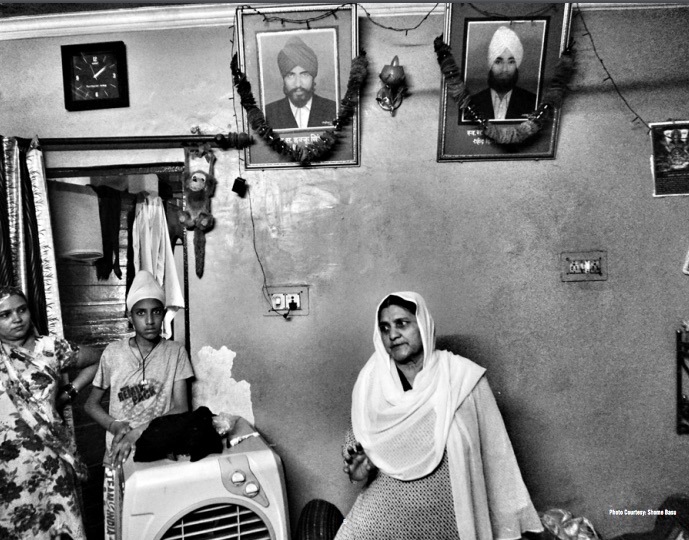
Lakhsmi Kaur – Photo: Shome Basu; Courtesy of Chauraasi Ki Nainsaafi: The continuing injustice for the 1984 Sikh massacre (Amnesty International India briefing released in 2017)
LAKSHMI KAUR
Migrated from Mongolpuri to Tilak Vihar (Delhi). Her husband, five brothers and other relatives were killed.
“They put a tyre filled with petrol around my husband’s neck set it on fire outside a police station.
A middle-aged man from the mob came back at night and tried to touch me inappropriately. When I resisted, he went out and called his entire group. They searched my house and killed all the eight men hiding inside.
I was regularly threatened and harassed so I decided to withdraw my case. I was scared to pursue it.
The government should come and see how we are living.”
Cover page of Chauraasi Ki Nainsaafi: The continuing injustice for the 1984 Sikh massacre
From 31 October to 3 November 1984, over 3,000 Sikh men, women and children were slaughtered by violent mobs, following the assassination of Prime Minister Indira Gandhi.
Sikh men had their necks ringed with tyres which were set on fire, while others were shot or hacked to death; women were raped and assaulted. Eyewitnesses told official commissions of inquiry that police personnel did nothing to prevent the killings; and some actively participated in the massacre. Several witnesses reported seeing members of the ruling Congress party instigating mobs and taking part in the attacks.
A government-appointed judicial commission described the killings as “organized carnage”.
The massacre of 1984 was a national shame, and it was followed by another: over three decades of impunity for perpetrators of these crimes.
Survivors reported that the police refused to register complaints in many cases, and in others they registered vague ‘omnibus FIRs’ covering all the offences in a neighborhood. In Delhi, 587 First Information Reports (FIRs) related to the massacre were registered, of which the Delhi police closed 247 as ‘untraced’, meaning that they had been unable to trace any evidence. Over 33 years later, only a handful of police personnel charged with neglecting their duty and protecting the attackers have been punished.
The agony of the survivors of the 1984 massacre have not ended. Their children continue to live with the pain and injustice that followed the violence.
This photo digest presents a glimpse into the lives of these forgotten people. The screams of the victims still echo in the narrow lanes of neighbourhoods where thousands were butchered. It is time for India to ensure that the injustice for massacre of 1984 does not remain a festering sore.
ASIA SAMACHAR is an online newspaper for Sikhs / Punjabis in Southeast Asia and beyond.Facebook | WhatsApp +6017-335-1399 | Email: editor@asiasamachar.com | Twitter | Instagram | Obituary announcements, click here |
Prof Tan Tai Yong (right) speaks at SKA’s inaugural Singapore Sikh Community Lecture series, moderated by Aljunied GRC MP Pritam Singh – Photo: SKA Facebook
By Asia Samachar Team | SINGAPORE |
Sikh community institutions, organisations and gurdwaras, which had traditionally defined the Sikh culture in Singapore, may have to evolve and adapt. At the same time, they have to actively engage the Sikh youth.
These were some of the key messages delivered at the inaugural Singapore Sikh Community Lecture series yesterday (2 Nov).
“They will find it increasingly more challenging to control and shape the narrative and markers of Sikh identity,” Yale-NUS College president Prof Tan Tai Yong, an academician who has published extensively on the Sikh Diaspora, told the audience.
The inaugural lecture series, organised by the Singapore Khalsa Association (SKA), was launched to commemorate the 550th birth of Guru Nanak. It attracted more than 120 guests.
Prof Tan, who is also the deputy chairman of Institute of South Asian Studies, NUS, said that the Sikh community will need to “create spaces for a diversity of voices and new perspectives on how Sikh identities can be negotiated”.
He felt that one important group that the community needs to more actively engage with is young Sikhs.
However, he noted that “engagement with the youths, with their different worldviews and priorities, will be the major challenge.”
He added that it was important to get them interested and take some form of ownership in the preservation of Sikh religion, traditions and culture.
In the lecture entitled “The Sikhs in Singapore – Past, Present and Future”, Tan described the Singapore’s Sikh community of 12,000 as a “minority within a minority” in a multiracial population of 5.64 million.
The presentation examined how the Sikh community has adapted and responded to the changing environment in Singapore. It also traced the arrival of the early Sikh migrants to Singapore in the 19th century to them becoming local citizens, contributing to the development of the society.
Prof Tan also examined some of the key achievements made by the Sikh community as well as the challenges it faces as it continues its efforts to remain an integral part of Singapore’s multi-cultural and multi-religious fabric.
In Prof Tan’s view, young Sikhs may want to do things in certain ways that may cause discomfort. For instance, more could be done to acknowledge the arts and creative fields as much as the Sikh community has acknowledged and supported successes in politics, business and other professional fields.
“As much as gurdwaras and community institutions play important roles in the shaping of Sikh identity, so too can film, art and fiction created by Punjabi Sikhs,” he said.
Prof Tan suggested “…cultivating in the Sikh youths, the consciousness based on core beliefs and values, while allowing space for them to engage (sometimes critically) and adapt to the contexts and circumstances of their everyday lives may be the surest way of ensuring that “Sikhism and the Sikhi will continue to thrive in Singapore.”
Audience at SKA’s inaugural Singapore Sikh Community Lecture series – Photo: SKA Facebook
PANEL DISCUSSION
The address was followed by a panel discussion with former Member of Parliament and Chairman of the Coordinating Committee for Sikh Institutions Inderjit Singh, moderated by Pritam Singh, Member of Parliament for Aljunied GRC.
The questions ranged from connecting with the next generation of Singapore leadership; impact of developments in India on the Sikhs in Singapore to greater engagement with young Sikhs; Sikh women empowerment and the Singapore Sikh community being able to continue to punch well above our weight, among others.
Spearheaded by SKA, the lecture series will see eminent personalities – Sikhs and non-Sikhs – from Singapore and overseas being invited periodically to discuss key issues which have an impact on the Sikh community vis-à-vis the other communities in Singapore as well as internationally.
The lecture series aims to provide an important platform for the Sikh community in Singapore to gain a deeper understanding of local, regional and global issues, and to devise relevant mechanisms to address these issues.
ASIA SAMACHAR is an online newspaper for Sikhs / Punjabis in Southeast Asia and beyond.Facebook | WhatsApp +6017-335-1399 | Email: editor@asiasamachar.com | Twitter | Instagram | Obituary announcements, click here |
Some members of the Sikh community who attended the Purple Parade – Photo: YSA Facebook
By Asia Samachar Team | SINGAPORE |
Members of the Sikh community made their to the Purple Parade yesterday (2 Nov), a signature Singapore event for people with special needs.
They joined the rest of the nation for the parade which entered into its seventh year.
Those present at the carnival were able to purchase one-of-a-kind handmade items by persons with special needs, enjoy unique purple food and beverages, score exclusive Purple Parade merchandise, bond over interactive games, and enjoy an inclusive Concert.
The Purple Parade is a unifying national platform to promote awareness and celebrate abilities of persons with special needs, according to information at its website.
The core of the movement is to ensure that people with special needs are included in the main chapter of Singapore’s growth and have equal access to education, employment, transport and social networks.
ASIA SAMACHAR is an online newspaper for Sikhs / Punjabis in Southeast Asia and beyond.Facebook | WhatsApp +6017-335-1399 | Email: editor@asiasamachar.com | Twitter | Instagram | Obituary announcements, click here |
PANJA SAHIB: A Jatha from Malaysia and Singapore involved in akhand path in Panja Sahib in Hasan Abdul in Punjab, Pakistan. It ends tomorrow (4 Nov 2019). Video and voiceover by Baldave Singh LEO. #GuruNanak550
ASIA SAMACHAR is an online newspaper for Sikhs / Punjabis in Southeast Asia and beyond.Facebook | WhatsApp +6017-335-1399 | Email: editor@asiasamachar.com | Twitter | Instagram | Obituary announcements, click here |
Bhagi Kaur – Photo: Karan Sharma; Courtesy of Chauraasi Ki Nainsaafi: The continuing injustice for the 1984 Sikh massacre (Amnesty International India briefing released in 2017)
BHAGI KAUR
Migrated from Trilokpuri to Tilak Vihar (Delhi). Her husband and seven relatives were killed in 1984.
“To everyone else, the massacre took place 32 years ago, but for me it just feels like it all happened yesterday. Almost my entire family was wiped out in front of my eyes, and even after so many years we haven’t got any justice.
“The culprits are still roaming free. We are still fighting the consequences of what happened. My life is almost over, but my kids are facing hardships that they don’t deserve. The only hope I have is that maybe my grandchildren will one day see happiness.”
Cover page of Chauraasi Ki Nainsaafi: The continuing injustice for the 1984 Sikh massacre
From 31 October to 3 November 1984, over 3,000 Sikh men, women and children were slaughtered by violent mobs, following the assassination of Prime Minister Indira Gandhi.
Sikh men had their necks ringed with tyres which were set on fire, while others were shot or hacked to death; women were raped and assaulted. Eyewitnesses told official commissions of inquiry that police personnel did nothing to prevent the killings; and some actively participated in the massacre. Several witnesses reported seeing members of the ruling Congress party instigating mobs and taking part in the attacks.
A government-appointed judicial commission described the killings as “organized carnage”.
The massacre of 1984 was a national shame, and it was followed by another: over three decades of impunity for perpetrators of these crimes.
Survivors reported that the police refused to register complaints in many cases, and in others they registered vague ‘omnibus FIRs’ covering all the offences in a neighborhood. In Delhi, 587 First Information Reports (FIRs) related to the massacre were registered, of which the Delhi police closed 247 as ‘untraced’, meaning that they had been unable to trace any evidence. Over 33 years later, only a handful of police personnel charged with neglecting their duty and protecting the attackers have been punished.
The agony of the survivors of the 1984 massacre have not ended. Their children continue to live with the pain and injustice that followed the violence.
This photo digest presents a glimpse into the lives of these forgotten people. The screams of the victims still echo in the narrow lanes of neighbourhoods where thousands were butchered. It is time for India to ensure that the injustice for massacre of 1984 does not remain a festering sore.
ASIA SAMACHAR is an online newspaper for Sikhs / Punjabis in Southeast Asia and beyond.Facebook | WhatsApp +6017-335-1399 | Email: editor@asiasamachar.com | Twitter | Instagram | Obituary announcements, click here |
KIRTAN | NEWLY RELEASED: Aussie-based Amith Kaur is the lead vocal in a newly released kirtan album presenting So Ki-o Mandaa Aakhee-ai, a shabad composed by Guru Nanak.
The release has been timed for the 550th commemoration of Guru Nanak’s birth which is being observed worldwide this year.
Vocals: Amith Kaur
Composer: Arvinder Raina
Music Arrangement: Chintoo Singh Wasir
Music Programming: Ritesh Jha
Guitar and Rebab: Chintoo Singh Wasir
Tabla: Shamsher Ali Niazi
Mix and Master: Ravinder Sharma
Video: Gurpratap Singh Sandhu of Pixelpopy Films
Director of Photography: DOP Gursharan Mahi
Backing vocals by Sri Dasmesh Students: Maheep Kaur, Piya Kaur Gill, Nimmerta Kaur, Rhea Kaur Gill, Maneesha Kaur and Jaskirat Kaur.
ASIA SAMACHAR is an online newspaper for Sikhs / Punjabis in Southeast Asia and beyond.Facebook | WhatsApp +6017-335-1399 | Email: editor@asiasamachar.com | Twitter | Instagram | Obituary announcements, click here |
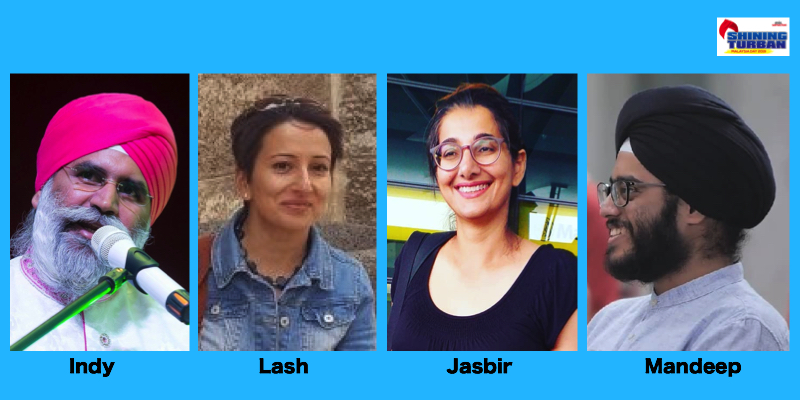
Shining Turban 2019 competition judges: Indy, Lash, Jasbir and Mandeep
By Asia Samachar Team | MALAYSIA |
Meet the Shining Turban competition judges. They will decide who will walk away with the newly released i-Phone 11 and two AirAsia tickets to Vietnam.
Inderjeet Singh, Lashvinder Kaur, Mandeep Singh and Jasbir Kaur are already at work, going through the Top 30 entries for the #ShiningTurban competition, organised in conjunction with the Malaysia Day celebration. The results will be announced soon.
“I would want to see the younger generation don the dastaar with pride,” the Canada-based Inderjeet told Asia Samachar in one of his conversations.
In November 2017, Malaysian-born Inderjeet Singh was appointed as the first Canadian Sikh Chaplain at the University of British Columbia (UBC). He now also acts as the Sikh chaplain for Kwantlen Polytechnic University (KPU).
In Malaysia, Inderjeet was active in running Sikh camps, especially with his involvement with Sikh Naujawan Sabha Malaysia (SNSM).
Next, meet former journalist Lashvinder. While busy equipping regulators, enforcement officials and financial institutions with the latest tools to weed out specimens crawling in the underbelly of the financial crime world, she has agreed to be an external judge for the Shining Turban competition.
She has fond childhood memories of helping starch her dad’s turban and doing the ‘tug of war’ to get it fixed just right.
Joining them on the judges panel are Asia Samachar editor Jasbir Kaur and Mandeep Singh who is consultant physiotherapist at BainsPhysio. Mandeep is also the person behind ToonistBains doodles.
HASHTAGS:
#ShiningTurban2k19MalaysiaDay
#st2k19md
#ShiningTurban2019AsiaSamachar
PRIZES:
iPhone 11
One return-ticket to Phu Quoc, Vietnam
One return-ticket to Can Tho, Vietnam
SUPPORTING PARTNERS:
Malaysian Gurdwaras Council (MGC)
Khalsa Diwan Malaysia (KDM)
Malaysian Punjabi Chambers of Commerce and Industry (MPCCI)
ASIA SAMACHAR is an online newspaper for Sikhs / Punjabis in Southeast Asia and beyond.Facebook | WhatsApp +6017-335-1399 | Email: editor@asiasamachar.com | Twitter | Instagram | Obituary announcements, click here |
Darshan Kaur – Photo: Shome Basu; Courtesy of Chauraasi Ki Nainsaafi: The continuing injustice for the 1984 Sikh massacre (Amnesty International India briefing released in 2017)
DARSHAN KAUR: Migrated from Trilokpuri to Raghubir Nagar (Delhi). She lost her husband and 11 other family members.
“My husband tried to hide in the kitchen of our house in Trilokpuri. But the mob dragged him out by his hair, and wrapped a quilt around him and put a tyre on him. They then poured oil on him and set him on fire. He was severely burnt, and died later. The mob mercilessly stripped all the women, who were still in shock and disbelief at the deaths of their husbands and relatives. They were raped by several men countless times.’’
It is 35 years back that the massacre of Sikhs took place mostly in Delhi but also in many North Indian towns in the first week of November to ‘teach them a lesson’ i.e. to beat them to submission before Hindu majoritarianism in India.
The deep wounds inflicted by that genocidal murder spree have not been healed because the Indian state, irrespective of the party that have controlled the power at the Centre since then, have done next to nothing to acknowledge this genocide and take steps to heal those wounds. On the contrary, every government in power at the Centre has hurled abuse at those within India or abroad who have tried to uncover truth and demand justice. If those uncovering truth happen to be Sikhs, an attempt is made to straight away terrorise them by labelling them Khalistanis, and if they happen to be non-Sikhs, which many of them are, they are abused as sympathisers of Khalistanis.
In this game of gross indifference verging on arrogance towards the sense of discrimination and alienation the Sikh community feels worldwide, both the two main Indian political parties – the Congress and BJP – have been guilty in one way or another.
Congress party’s Rajiv Gandhi, who became Prime Minister after the massacre, made his infamous speech on 19th November 1984 that when a big tree falls, the earth shakes. He was referring to his mother Indira Gandhi’ assassination by her two Sikh security guards who shot her dead because of her decision to send army to the Sikhs’ holiest shrine Golden Temple in Amritsar to deal with the crisis in Punjab. This was a calculated message being sent to the goons who had participated in the massacre of more than 3000 Sikh men and boys that their murderous acts were justified. The Congress party leaders who had led these goons into this murder and arson spree were also being lauded for ‘shaking the earth’.
What is less known than this criminal speech of Rajiv Gandhi is that his party had organised a massive media advertisement saying: “Why should you feel uncomfortable riding in a taxi driven by a taxi driver who belongs to another state?”
Since the Sikhs are known widely in Delhi as taxi drivers, this was directly aimed at provoking hatred against the Sikhs. This advertisement was paid for and circulated just a few days after the genocidal massacre had taken place. HKL Bhagat was promoted to Cabinet rank as a reward because the largest number of Sikhs slaughtered in any area in Delhi was in his East Delhi parliamentary constituency.
Even after 35 years of these genocidal murders (the word ‘genocide’ being used as defined by UNO), the parliament of the country has still not passed a resolution condoling those who died, leave aside condemning the massacre. Can one expect peace to prevail in a land where there is no remorse over those killings and where murderers are rewarded? Is it a wonder that another massacre (2002 in Gujarat) of another minority (Muslim) took place less than two decades after that?
Reports have now emerged that it was not only Congress led goons but that some RSS workers were also involved in this violence. Many Hindutva supporters were swayed into supporting Congress due to the Hindu card played by Indira Gandhi on Punjab. The distinction between a Hindutva organisation member or a Congress supporter which may have some relevance at other times had disappeared at that juncture. Congress had become the chief articulator of Hindutva sentiments and the sole beneficiary of Hindu mobilisation in the election in which Rajiv Gandhi surpassed even his grandfather Nehru in winning the seats to the parliament. This Hindu card played by Congress paved the way for the subsequent rise of BJP led Hindutva. Congress is in denial of its role in this rise of BJP led Hindutva.
I was in Chandigarh when Rajiv Gandhi led Congress had scored that unsurpassed parliamentary victory. An RSS activist known to me unhesitatingly acknowledged the Congress victory as Hindu mobilisation and facilitating Hindutva cause. He remarked very insightfully, ‘Organisationally the Congress has won, ideologically we have won”.
DARK PERIOD
This is certainly the darkest period in India’s post-independence history where a genocide took place in the capital of the country with the state machinery conniving with the murderers. The critical reflection on this genocide have so far missed the aspect of moral degradation in Indian society in general but in Delhi in particular that has been the consequence of the silence and denial of this genocide.
Each Sikh man or boy who was killed must have been killed by a group of people. Even if we assume as a gross underestimate that on an average a mob of 10 killers was involved in each killing, the total number of murderers in Delhi works out to be 30,000. Whenever any family member is involved in a killing, the family and close relatives always come to know about it in one way or another. Even if we assume a low figure of 10 family members and relatives knowing this crime, this means 300,000 (3 lakh) persons knew about this crime. So, all these 35 years, 30,000 murderers have lived in Delhi keeping the secret of their crime to themselves and their close family members and relatives, and all these 3 lakh persons have lived with this knowledge of the crime. Many of these murderers and their family members would be involved in performing public duties in security services, transport, health, education, post offices, prisons, education and media. They would have obviously lied in not reporting their crime.
Not even a single case has come to light where, leave aside a murderer making a confession of his crime, a family member has come forward and reported to the police that a certain member of the family had committed the crime. It is not difficult to imagine the depth of moral degradation of Delhi’s everyday life as a result of this mass crime. Outwardly, the society seems to be carrying on with the daily life cycle but beneath that apparent normalcy are a very large number of damaged human being-criminals and liars.
Only through a mass atonement for this mass crime can there be a small possibility of beginning the path to mass therapy. Otherwise, living with this crime without redemption would lead to it becoming a moral cancer in Delhi society and beyond.
Prof Pritam Singh is a Visiting Scholar at Wolfson College, University of Oxford, UK. He is the author of ‘Federalism, Nationalism and Development: India and the Punjab Economy‘ (Routledge, London, 2008), Economy, Culture and Human Rights: Turbulence in Punjab, India and Beyond (Three Essays Collective, Delhi, 2010), Hindu Bias in Indian Constitution (Critical Quest, Delhi, 2017), Institutional Communalism in India (Critical Quest, Delhi, 2019) and co-editor with S Thandi of ‘Punjabi Identity in a Global Context‘ (Oxford University Press, 1999) and with M Pearl of ‘Equal Opportunities in the Curriculum‘ (Oxford Brookes University, 1999).
ASIA SAMACHAR is an online newspaper for Sikhs / Punjabis in Southeast Asia and beyond.Facebook | WhatsApp +6017-335-1399 | Email: editor@asiasamachar.com | Twitter | Instagram | Obituary announcements, click here |