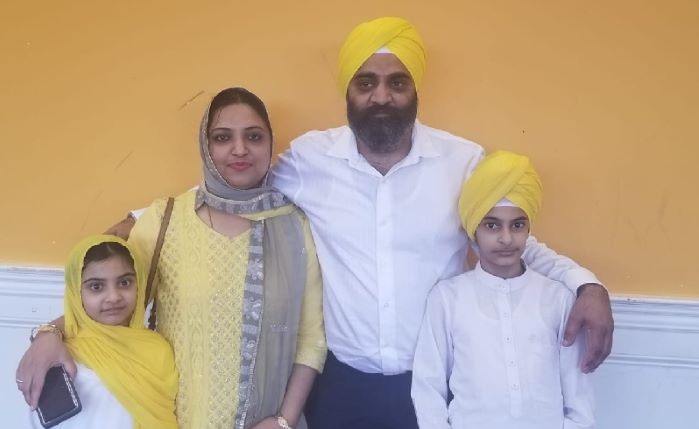
Gurmej Kaur holds an image of her husband and sons who died in the 1980s, at the height of tensions in Punjab as calls for a separate Sikh state led to a bloody crackdown [Bilal Kuchay/Al Jazeera]Rights group which documented 8,000 cases of enforced disappearances files case at top court, stirring hope for justice, reports Aljazeera
Punjab, India – A collage of four men wearing turbans hangs on a wall in Gurmej Kaur’s village home, in the Punjabi district of Gurdaspur.
At 80, she carefully stepped up on a bed, brought the frame down, and cleaned her glasses with her white headscarf.
“The man with the white beard is my husband. The three young men are my children,” she said.
“They were all killed by the police and security forces in fake encounters and labelled as Khalistan militants.”
In 1980s Punjab, the heartland of India’s Sikh minority, there were heightened calls for a separate Sikh homeland in the northern Indian state.
In 1986, Gurmej Kaur’s youngest son, 12-year-old Sukhdev, was arrested by police, accused of possessing weapons and ammunition.
“It was a common phenomenon in Punjab then. Civilians were abducted, taken into illegal custody and tortured,” said Gurmeet Kaur, Gurmej’s daughter.
From 1983 until 1995, during “counter-insurgency” efforts in Punjab, thousands of Sikhs were killed or allegedly went missing.
More than 10 years after the anti-Sikh riots, in 1995, Punjab-based activist Jaswant Singh Khalra filed a petition with the Supreme Court of India claiming police had cremated 25,000 bodies, which they labelled “unidentified” and “unclaimed”.
Later that year, Khalra was abducted and killed by the police.
Read the full story, Families of Punjab’s disappeared pin hopes on Supreme Court bid (AlJazeera, 22 Aug 2019), here.
Amitpal Singh Bajaj and wife Bandhna Kaur Bajaj and their son Veer Singh – Photo: Supplied by family
By Asia Samachar Team | THAILAND / SINGAPORE |
“Please just go, go, save Veer”!”
These were among the last words Amitpal Singh Bajaj told his Singaporean-born wife when he was in a scuffle with a Norwegian in the morning of Wednesday (21 Aug 2019).
Amitpal, the 34-year-old Malaysian-born IT consultant who held British citizenship, perished in the scuffle on the night before he was scheduled to leave with his wife Bandhna Kaur Bajaj and two-year old son Veer Singh.
But things did not go as planned when the last night on the Thai island turned into a nightmare.
In a statement sent to Asia Samachar, Bandhna recounted the events that led to the tragic loss of her husband.
Her sequence of events disputes suggestions, as shared by some local Phuket media, that Amitpal had confronted the Norwegian man involved in the incident.
In the statement, Bandhna said that in the early hours (0000 hours) of 21 August, she said the family was asleep at the Centara Grand Hotel in Karon, Phuket, when she heard loud noises from the adjoining room, but went back to sleep.
Close to 4am, she said loud noises and banging started coming from their folding panel balcony door, which separated both rooms. At this juncture, she woke her husband up who confirmed that someone was trying to knock open the balcony door.
He told her to call security, and she called the hotel reception desk to ask for urgent security help. That was the first call for help she made. Security, however, did not arrive as the banging on the door grew more ferocious and so she called again for help.
She said that almost as soon as the call ended, a fully-naked big-built Caucasian man – later came to be known as 53-year-old Norwegian Roger Bullman – barged in through the balcony door and stormed aggressively towards Amitpal.
She said that this was the first time they had ever seen Bullman.
“He barged into our room. He just started charging at my husband. And we wanted to make an exit but he just came running, hitting my husband. And my husband tried to block the man and move me and my son away. As the man was kicking, punching and just, beating him up, my husband told me to please leave and save our son. He said, “Please just go, go, save Veer”!”,” she said in the statement.
Carrying her baby, Bandhna said she dashed out of the hotel room and towards the lift, looking for help and she noted that Bullman was shouting out to her asking her where she was going.
As she turned around to look, she said she saw her husband fall to the ground in the corridor outside the hotel room door.
Bandhna said she took the exit staircase and ran down a few flights of stairs to the ground floor as Bullman was still shouting after her.
She said she then found a tree and hid amidst the bushes in a dark area near the hotel spa with her son in her arms.
“I knew that my life was in danger and my baby’s life was in danger. So I hid under the tree and I used my phone again and I called the reception, and I asked the reception to please make sure someone attends to my husband. Please give him some medical help, I’m very scared, I’ve escaped!”
“I could still hear him screaming. I didn’t want to be attacked,” she said.
On a further call to the hotel reception, she said she found help as a buggy arrived. Still clutching on to her young son, she ran towards it asking the driver to take her to the hotel lobby. While she waited in the lobby, Bandhna said she urged the reception to get someone to help her husband and to check if he was fine.
The ambulance and police subsequently arrived at the hotel lobby at around 4am and took Amitpal to Patong hospital, where Bandhna learnt about her husband’s death.
“My husband sacrificed his life to save my son’s life and mine. He will always be our hero,” she said.
Amitpal will be cremated at the Mandai crematorium in Singapore on Saturday (24 Aug).
ASIA SAMACHAR is an online newspaper for Sikhs / Punjabis in Southeast Asia and beyond.Facebook | WhatsApp +6017-335-1399 | Email: editor@asiasamachar.com | Twitter | Instagram | Obituary announcements, click here |
Norwegian tourist Roger Bullman (right), 53, arrives at Karon Police Station to answer questions after the deadly fight early yesterday morning (Aug 21). Photo: Tourist Assistance Centre (TAC) / The Phuket News
By Asia Samachar Team | THAILAND |
A British Sikh and his family’s trip to the Phuket island ended tragically when he was killed allegedly in a scuffle with a Norwegian tourist.
The early morning incident yesterday (21 Aug 2019) was believed to have been triggered by the noisy Norwegian tourist, according to a report in The Phuket News.
The newspaper reported that the Norwegian tourist was charged today (22 Aug) with killing a British man after the two were fighting over the Norwegian causing too much noise in his hotel room at 4am at a resort on Phuket’s west coast.
British national Amitpal Singh Bajaj, 34, came to Phuket on holiday with his wife, who is a Singaporean national, and their one-year-and-eight-month-old baby boy, also a Singaporean national, Maj Ekkachai Siri of the Phuket Tourist Police told The Phuket News.
The Norwegian was identified as 53-year-old Roger Bullman, the newspaper reported.
In another report, CNA quoted Police Major Techin Deethongon from Karon police station as saying that the incident was sparked by Bullman’s singing on the balcony at about 1am to 2am and he was confronted by the British man.
“The husband came out to complain about the loud noise because the couple has a young child. They then started wrangling. Later, the Norwegian national kicked open the wooden door on the balcony separating their rooms and they fought,” it quoted Maj Deethongon.
[The story has been edited with a few paragraphs from the original version removed, and CNA version added]
ASIA SAMACHAR is an online newspaper for Sikhs / Punjabis in Southeast Asia and beyond.Facebook | WhatsApp +6017-335-1399 | Email: editor@asiasamachar.com | Twitter | Instagram | Obituary announcements, click here |
Tweets by some Malaysian national leaders congratulating Sri Dasmesh pipe band on their feat in Scotland
By Asia Samachar Team | MALAYSIA |
In the midst of his massive trial, Malaysian former prime minister Mohd Najib Razak found time to recognise the incredible success of the Sri Dasmesh Pipe Band in their Scottish outing.
“Tahniah kepada kumpulan pancaragam Sri Dasmesh Pipe Band. Muncul juara Kejohanan Pipe Band Dunia di Scotland. Satu kejayaan besar!” the former premier tweeted yesterday.
This shout out should reach out to quite a few people as Najib has more than 4 million followers on his Twitter account.
After his shock defeat in the 2018 polls and despite an on-going corruption trial, Najib has kept himself visible on the social media with crisp and at times witty tweets.
Malaysian federal minister Gobind Singh Deo was among the first Malaysian national leaders to acknowledge the band when it emerged as category champion at the World Pipe Band Championship in Glasgow on 17 Aug 2018.
Gobind had shared on his social media platforms the Asia Samachar report which broke the story. The report was then picked up by Bernama and splashed by various Malaysian newspapers and online portals.
In another entry yesterday, Gobind writes: “Gave cabinet a briefing today about success of our champions Sri Dasmesh Pipe Band at World Pipe Band Championship in Scotland on Saturday. Malaysia is proud of this achievement. Frm d Government of Malaysia, huge congratulations to the team. Keep up d great work. #KitaMalaysia”
Sri Dasmesh Pipe Band emerged champion of entry level Grade 4B at the Worlds, as the participants call the competition.
On the whole, the championship attracted up to 8,000 pipers and drummers from 195 bands from 13 nations.
Sri Dasmesh was the only Asian participant. The other bands came from New Zealand, Australia, Canada, Austria, Switzerland, Eire, the US, Belgium, England, Spain, Northern Ireland and Scotland.
Gobind, who is the communications and multimedia minister, holds the distinction of being the first Sikh to join the ranks of the Malaysian Cabinet at the Federal government level. The only other nations with Sikhs as national ministers then were India and Canada.
Fellow minister Syed Saddiq Abdul Rahman also took notice of the band’s success.
“Congrats on the win! Amazing job. Keep on flying the Malaysian flag high ??,” said the sports minister when retweeting a message by sports journalist Haresh Deol, who had shared the Asia Samachar initial report on the victory.
The band, which received a rousing welcome on their return to Malaysia on Monday night, said the victory was a ‘Merdeka’ gift to the nation. They had proudly waved the Jalur Gemilang, or the Malaysian flag, upon their victory.
ASIA SAMACHAR is an online newspaper for Sikhs / Punjabis in Southeast Asia and beyond.Facebook | WhatsApp +6017-335-1399 | Email: editor@asiasamachar.com | Twitter | Instagram | Obituary announcements, click here |
Eleven-year-old Yash Singh was left alone when his entire immediate family perished in an auto accident in Virginia last week (15 Aug 2019). The tragic accident claimed the lives of his dad Gurmeet Singh, mum Jasleen Kaur, and 6-year-old sister Harjas Kaur.
While he was recovering from a pelvic fracture and a few other injuries om hospital, a group of New Jersey Sikhs had rallied to raise funds to assist Yash.
Within three days, the fundraising campaign at GoFundMe raised US$226,406 (as on 21 Aug), surpassing the $200,000 goal.
“While nobody can ever fulfill the void in Yash’s life, as friends and family, the least we can do is to come together and contribute our share for the medical expenses of Yash, funeral expenses of the deceased, and more importantly, contribute towards the future of Yash,” went the call in the fund raiser organised by Prabhjot, Gagan, Parminder and Jagmeet Singh.
In a note today, they said:
With God’s Grace, a whole community of friends, family, and well wishers across the globe have overwhelmingly come forward to support this cause. We cannot be thankful enough to each and every one of you for your blessings & wishes, your support to extend this campaign on your social media accounts, and your contributions.
Yash is doing well now, and is at home with his uncle’s family. Though the mental & emotional scars are life long, his physical ailments should heal with time over the next few months. May God bless him all the strength – he will need a lot of it.
For the funds, we are working with 2 attorneys and other experts to set up a Trust Fund. The process will take some time but we are following all the right steps to make sure that every dollar of this fund goes towards his future financial support. We will provide more details once things are set up. If you have any questions or suggestions, please reach out to us at contactforyash@dashmeshdarbarnj.org
ASIA SAMACHAR is an online newspaper for Sikhs / Punjabis in Southeast Asia and beyond.Facebook | WhatsApp +6017-335-1399 | Email: editor@asiasamachar.com | Twitter | Instagram | Obituary announcements, click here
Kasmir map from National Geographic Education Blog. Insert: Modi national address on Resolution 370, Home Minister Amit Shah moving the resolution at Indian Parliament to scrap J&K’s special status
By Gurnam Singh | UK | OPINION |
With one stroke of a pen, by revoking Article 370 of the Indian Constitution ensuring autonomy for the Jammu & Kashmir, the Government of India, led by the Bharatiya Janata Party (BJP), has dramatically and radically altered the relationship between the erstwhile princely state of Jammu and Kashmir (J&K)and the Indian Union.
The J&K Reorganisation Act, which comes into effect from 31 October 2019, will result in the dissolving of the present semi autonomy state and the creation of two new union territories, namely J&K and Ladakh. This will mean that neither state will have its own elected assembly and will be governed by the Central Government in Delhi.
Since the move, many parts of the state have been under a military lock down and the message from Prime Minister Narendra Modi and Indian Government has been unambiguous, namely that a “historic wrong” has been corrected in Kashmir and that it is only through a integration of J&K into the Indian Union that the future political and economic situation of the region can be secured.
J&K is a very special place, which makes the tragedy that has unfolded over the past 70 years all the more bitter.
On his first visit to the region in the 17th Century, the then Mughal Emperor Jehangir proclaimed “Ghar firdaus baruue zamin ast, hami asto, hamin asto, hamin ast” (If there is heaven on earth, it is here, it is here, it is).
But after years of conflict, for many residents of J&K, their paradise has become a living hell. Traversing two nuclear powers, India and Pakistan, Kashmir (and its close neighbour Panjab) represent a post partition legacy of division resulting in the most militarised international border in the world.
UNCANNY RESEMBLANCE TO 1984
The present annexing of J&K through an ongoing major military operation has an uncanny resemblance to the Congress attach on Panjab in June 1984.
The Indian PM Mr Modi’s justification, for what is in essence a profound undemocratic action, is wholly predictable. Like Indira Gandhi then, Modi too has been extolling the dangers of extremism, of separatist forces, of external enemies and of the desire to bring peace and economic development to the region.
The problem with such justifications is that there is no way of testing their sincerity, other than by making comparisons to the past and other similar situation; and when one does, an altogether different scenario emerges.
Most objective evaluations of similar military expeditions by powerful nations show that, with very few exceptions, it is not benevolence but the exercise and abuse of power resulting in the enslavement of a whole people that is at work. This is the painful truth of all imperial projects and in this respect Modi is no different to Indira Gandhi and other autocratic leaders of the past and present.
In his novel Sea of Poppies, Amitav Ghosh, makes this precise point through the character of a British sea captain who offers an honest appraisal of British imperialism. “The truth is, sir, that men do what their power permits them to do. We are no different from the Pharaohs or the Mongols: the difference is only that when we kill people we feel compelled to pretend that it is for some higher cause. It is this pretence of virtue, I promise you, that will never be forgiven by history.”
My fear is that far from representing some kind of break from the past, offering a truly democratic and benevolent rule, the only difference between the British Imperialists of the past and the Hindutva nationalists of the present is that the ‘gora walas’(white skinned people) have been replaced by the ‘brown valas’ (brown skinned people). Far from offering ‘India’ the possibility of truly breaking free from the remnants of the historical colonial influences of the Moguls and the British, as Modi and the RSS claim, in reality we are seeing a further entrenchment of this project.
Arguably, the only way to free the peoples of the sub continent from the shackles of past colonialism is to respect their right to self determination, not to take it away! Even the British realised the only way to hold the empire together was through allowing the Princely states a degree of autonomy, but what we appear to be seeing in Modi’s vision is a Soviet Style centrally planned Brahmanical state.
Given Modi’s electoral advantage and the abysmal performance of the opposition parties coupled with the deafening silence of so called Western democracies the only hope is that, as with most imperial adventures, the end game is often self-destruction and ultimately the will of the masses cannot be contained. But even then, despite the huge levels of violence and destruction, history rarely admonishes imperialists and no doubt, unless he comes to his senses, Narendra Modi will end up in the dustbin of history reserved for tyrants.
[Gurnam Singh is an academic activist dedicated to human rights, liberty, equality, social and environmental justice. He is a Visiting Fellow in Race and Education at University of Arts London and a Visiting Professor of Social Work at University of Chester as well as a presenter at UK-based Akaal channel. This views were shared on his Facebook page]
* This is the opinion of the writer and does not necessarily represent the views of Asia Samachar.
ASIA SAMACHAR is an online newspaper for Sikhs / Punjabis in Southeast Asia and beyond.Facebook | WhatsApp +6017-335-1399 | Email: editor@asiasamachar.com | Twitter | Instagram | Obituary announcements, click here |
Recently a ‘whatsappie’ (one who loves to forward daily sayings or clips on whatsapp), forwarded to me a rather amusing image called ‘Punjabi Naming Theory’.
It has two parts of the most common Sikh names – the first, like ‘Gur’ and the second, like ‘vir’. The list showed that they are interchangeable.
For example, below are two lists. The first list is of ‘first’ syllables of some common Sikh names and they can be put in front of any of the set of syllables in the second list.
Sample of common first syllables of Sikh names:
Har Gur Bal/Bul Jas/Jus Man Nav Sukh Sat Kush/Khush Kul/Kal
Sample of common second syllables:
preet meet geet jeet/jit deep dev vir/bir want inder or vinder.
You can pick any one of the first syllables and fit them in front of any of the second set and you have a Sikh name.
For example, for the first syllable ‘Har’ in the first list and matching each syllable from the second list, you can have Harpreet, Harmeet, Hargeet, Harjeet, Harpreet, Hardeep, Hardev, Harvir, Harwant, Harinder or Harvinder.
In fact I know a good young table player in Sydney who is Harpreet. For the life of me, and creeping old age, I can never remember whether he is Harpreet, Hardeep, Harmeet, etc.! And he naturally gets offended when I blurt ‘Har’ loudly and mumble the rest of his name because I cannot remember what the rest of his name is! So, the only way I now remember his name is by remembering him as HP after HP sauce and then follow on with Harpreet. I think he has got used to me calling him just HP now!
Let us take one more example. For first syllable ‘Kul’ you can have Kulpreet, Kulmeet, Kulgeet, Kuljeet, Kuldeep, Kuldev, Kulvir, Kulwant, Kulvinder or even Kulinder! You can try any of the others for your own amusement. In fact your own name probably falls into this mix and match! Jas is a common start syllable. So, Jaspreet, Jasmeet, Jasgeet, Jasjeet, Jasdeep, Jasdev, Jasbir, Jaswant, Jasvinder! And with ‘pal’ at the tail – Jaspal.
Even some two syllabled names are lengthened. Take Karam – a great name! But parents then find it necessary to add further syllables. Karamjit, Karamvir, Karamdeep, Karaminder, etc.
By the way, most of this article is tongue-in-cheek and for fun. It is not meant to hurt. I do hope that I do not offend anyone who has or has named a Sikh child with a good Sikh name. The ones, supposedly ‘Sikhs’ who have given their kids silly, without meaning, or just non-Sikh names are justified in getting offended.
These are merely observations and perhaps some insight if you are involved in naming a Sikh child in the future – food for thought. All these names mentioned above are good solid traditional Sikh names. But perhaps we need to become more imaginative, creative and perhaps responsible if choosing a name for a kid.
Then, there are those who feel that the name is not long enough. Then, just add on a second syllable from the second list, like Balvinderjit, or add two on two in some cases and one can have Gurbalvinderjit, Harbalvinderpal, etc. Some folks just love triple-barrel names with ever confusing meanings. It is as if they are compensating for some deficiency by having as long a name as possible!
Meanings? Some of you ask! Yes, Sikh names and even names in a great many other religions and cultures have meanings. The aura of the meaning of a name can have a profound effect on the personality of the person so named. I have personally witnessed this.
Names used to be simple and short. Panj Pyare – Daya, Dharam, Sahib, Mohkam and Himmat. I even shortened mine further to Dya. (Incidentally, I am often asked why my name is Dya when the normal English spelling is Daya. Well, Daya is a male-midwife (dayi/daya). Dya is compassion. I prefer to be compassion!)
Very few Dharams now. Now, you have Dharamvir, Dharamjeet, Dharampal, etc. Even Sahib now becomes Sahibjeet or Sahibvir.
I have friends who will add ‘jeet’ or ‘win’ or ‘pal’ or ‘want’ after the names of all their children because their own names ended with that syllable. A friend has his name ending in ‘jeet’. He has named all his offsprings with ‘jeet’ at the end. Now he even has his grandchildren all ending in ‘jeet’ as well! His son wanted to name him son Keshminder. No! It had to be Keshminderjit!
One couple has all their offsprings start with the syllable ‘Har’ because both their first syllables are also ‘Har’. One dear friend, bless him, has even used his first name Partap as surname for his children. He wants his own first name to live on as a surname. So, his offsprings are Delvinder Partap, Kashminder Partap, Gavinder Partap and Sheila Partap. He has done away with Singh or Kaur altogether. And, of course, future generations will have the surname Partap.
We sometimes seem to lack a certain degree of originality and perhaps basic understanding of how to name our Sikh kids and what profound impact it can have on the child.
There are those who prefer camouflaged Christian names like Sharan (Sharon), Harman (Herman), Pal (Paul). Or names with a view of having a Christian nickname – Rickywant for Ricky; Shirleypreet for Shirley; Vickydeep for … you guessed it – Vicky. Perhaps, it is some sort of inferiority complex for anything ‘Sikh’? And the names are without any kind of meaning.
I can understand Sikh parents in western countries wanting to ensure that their offsprings’ names are not open to ridicule from non-Sikhs, like Faqir, Arsdeep, Sukdeep, Ramandeep, Fagun, etc.
My grandson, born and bred in Australia, had a calling card handed to him by a Sikh restaurateur nicknamed Paddy. When he looked at the name later he could not stop laughing. The name was Pardaman, a good solid Sikh name no doubt. Even though he only knows very basic Punjabi, he does know that the first part of the name means flatulence – ‘the flatulence man!
A friend not fully conversant with naming, took my advice and came to me for the Naamkaran ceremony. The letter which came up from the Guru Granth Sahib Hukmnama was ‘a’ (airda). We discussed a few names and luckily he rang me just before registering the kid’s name. He said, his wife who was from India, insisted on Asman (sky). I stopped him immediately. I asked him whether he had considered the English pronunciation and inevitable derivation – Assman or Arseman! No, he had not considered that of course. You can imagine the ridicule and bullying that kid would have faced just because of his name! I suggested Akash and thankfully he accepted that.
Let us look at the protocol or Sikh rite for naming. It is called ‘Naamkaran’. We name our children after asking for Guru Ji to shower His blessings on the newborn. In the Ardaas for the newborn we normally ask for lemi umar (long life), chardhi kala (ever optimistic temperament), Sikhi jeevan (life in Sikhism), tandrosti (good health), etc, and most importantly – gift of naam. And, also, we request direction and His Blessings in what name the child should have. We carry out all that we do, every function, with His Blessings and by His direction. It is no different for naming the newborn. (Keeta lodiyay kam so Har pai aakhiyai.)
Then we take a Hukmnama or Vaq (reading of a short stanza from Sri Guru Granth Sahib Ji at random). The name should start with the first letter of the first word of the Hukmnama. (With my name my venerable father had no problem because the first word itself was ‘Dya’!) Some say that if you cannot find a suitable name from the first letter then you can also do so from the first letter of the second word.
I have a saintly friend who names a child if asked, after reading the HukmNama, reflecting on it and bearing in mind the ‘rehni-behni’ (life-style or spiritual bent) of the parents then naming the child to best suit them and the child, within Sikhi or towards Sikhi. The name is always with direct relevance to the Hukm Nama. The HukmNama then becomes the primordial sikheya for the child and the family. He normally insists that the HukmNama is printed and kept for posterity, preferably framed and put on a wall. It is like a life ‘Mission Statement’ for the child.
But then, one couple recently, very reverently asked for such a naming ceremony, went through the process and then named their child Jaydn, after the son of the actor Will Smith. “O Will Smith’s son is sooo cute”! I was flabbergasted!
A great many just do not even know that there is such a protocol and blessings from Guru Ji. Secondly, from advice from wise elders, I have gathered that a name must be meaningful because the meaning can influence the character of the child.
My oldest daughter is named Jamel Kaur. (Yes, ‘J’ was the first letter of the first word of her HukmNama and I researched her name after finding it in an Urdu dictionary.) Jamel is an adjective which means pleasant, kindly, well-meaning in Pharsi/Urdu/Punjabi. It normally applies to thoughts, feelings. One with kindly thoughts for others. And she has turned out to be that kind of a person. She has been hurt numerous times by others, but she never does anything to harm someone else. In fact she goes out of her way to help others – even go to the aid of those who have hurt her previously.
I am yet to come across a Sher Singh who looks, acts or behaves like a goat! (Sher means tiger.) I have a nephew Nehal Singh. He is a staunch level-headed amritdhari Sikh, born and bred in Australia. He is studying law. Humble, yet he lights up a room with his presence!
I came across a young lady in a Sikh youth camp in USA who was called Pinkypreet. She was shy and with little self-esteem. On asking her how she had come to have received such a name, she told me that when she was born, she was apparently pink and very pretty that her father just had to name her Pinkypreet. I was dumbfounded! She is pink no more. Of course, her nickname is Pinky! There is a Loveleen Kaur – Lovely for short. Bubblejeet – Bubbly for short.
A friend in UK named his daughter Trishul. He had seen and liked a Hindi movie with that name and that was it. I asked him if he knew what trishul meant? No, he did not. Within one year the family fell apart. The couple broke up and Trishul is an angry, fiery kid with a split personality and into drugs – always getting into trouble. (Trishul is a three-pronged spear – a Hindu weapon of offence.)
On the other hand, I know an American Sikh whose name is Kirpan Singh. He is a no-nonsense, sharp of mind kind of a guy, yet very compassionate. He is also one of the founding organisers of the huge annual Sikh Vesakhi Function at the Convention Center in Los Angeles which attracts around 50,000 every Vesakhi celebration there! Kirpan has also assisted in organising various functions for my group in USA.
I know a couple of Sewa Singhs who naturally enough are great Guru-kay-Sewadar.
Some folks look down upon ‘old-fashioned’ or Guru Granth Sahib driven names and in their efforts to find new names come up with sometimes hilarious answers like Dimple, Kaseyjeet, Kelvinder and so on. Names that have nothing to do with Sikhi.
Others resort to names of famous actors or just popular Hindu names. We have Shatrugan Singh, Akshay Singh, Aruna Kaur, Sadhana Kaur, Amitabh Singh and also his son Abhishek Singh, Abhinash … you catch my drift.
There are strong traditionalists who insist only on old traditional names. I am a little less traditional but I still urge some thought and understanding and just not mindless modernity or trends.
I believe that as Sikhs we are responsible for serious thought when coming to name a child. Think of the child’s future. What are your own aspirations for your kid for the future? Think meaning. Think lofty ideals. Think Sikhi. Think nearness to Guru Ji and Waheguru. You do want Guru Ji’s Blessings and His ‘neder’. Don’t you? Go beyond your own selfish reasoning. Think outside all that. Think global. Think global Sikhi. Think of the path of enlightenment of your child, besides its good health, not to be bullied, being able to study well, earn a good living and so on.
A good, strong name with deep meaning helps the one with the name, a name to live up to.
For originality of fresh ‘Sikh’ names, I have always admired Yogi Harbhajan Singh Ji. He gave those who became Sikhs through him some memorable names. Who can go past Gurumustuk, Guruka, Gurshabad, Satkartar, Har-rai, Hargobindhari, Harmandharjot, Jodha, Jivanjyot, and the list goes on.
In days gone by, it was usual for the Granthi Sahib or some venerable sangat (congregational) member to name a child. These days, especially with western influences, parents feel the right to name their child. Even within the royal family in UK, Prince Harry’s American wife has decided to break with centuries-old British protocol by naming her newborn Archie! So I guess why should Sikh parents be different.
All I suggest is that – look for advice from older Sikhs, especially the Sikhi learned older folks before naming your child. Also do some research of your own. Remember, most importantly, a name should have a meaning and will have a bearing on the moulding of the character of the newborn.
I had the honour of meeting Sikh children’s book writer, poet and active member of SikhRi, Inni Kaur and asked her why such an unusual name? Inni is a small fragrant flower surviving in the desert of Iran and her father bestowed her with that name. What a wonderful name! Universal, yet Sikh and very significant. Inni is a resilient and service-orientated lady. She certainly is strong, determined and leaving her mark on the Sikh world!
Happy Sikhi Naming.
Malaysian-born Dya Singh, who now resides in Australia, is an accomplished musician and a roving Sikh preacher. The Dya Singh World Music Group performs full scale concerts on ‘music for the soul’ based on North Indian classical and semi-classical styles of music with hymns from mainly the Sikh, Hindu and Sufi ‘faiths’. He is also the author of SIKH-ING: Success and Happiness. He can be contacted at dyasingh@khalsa.com
* This is the opinion of the writer and does not necessarily represent the views of Asia Samachar.
ASIA SAMACHAR is an online newspaper for Sikhs / Punjabis in Southeast Asia and beyond.Facebook | WhatsApp +6017-335-1399 | Email: editor@asiasamachar.com | Twitter | Instagram | Obituary announcements, click here |
Punjabi language teacher course underway in Ipoh – Photo: PETM
By Jaginder Singh Raipatti | MALAYSIA |
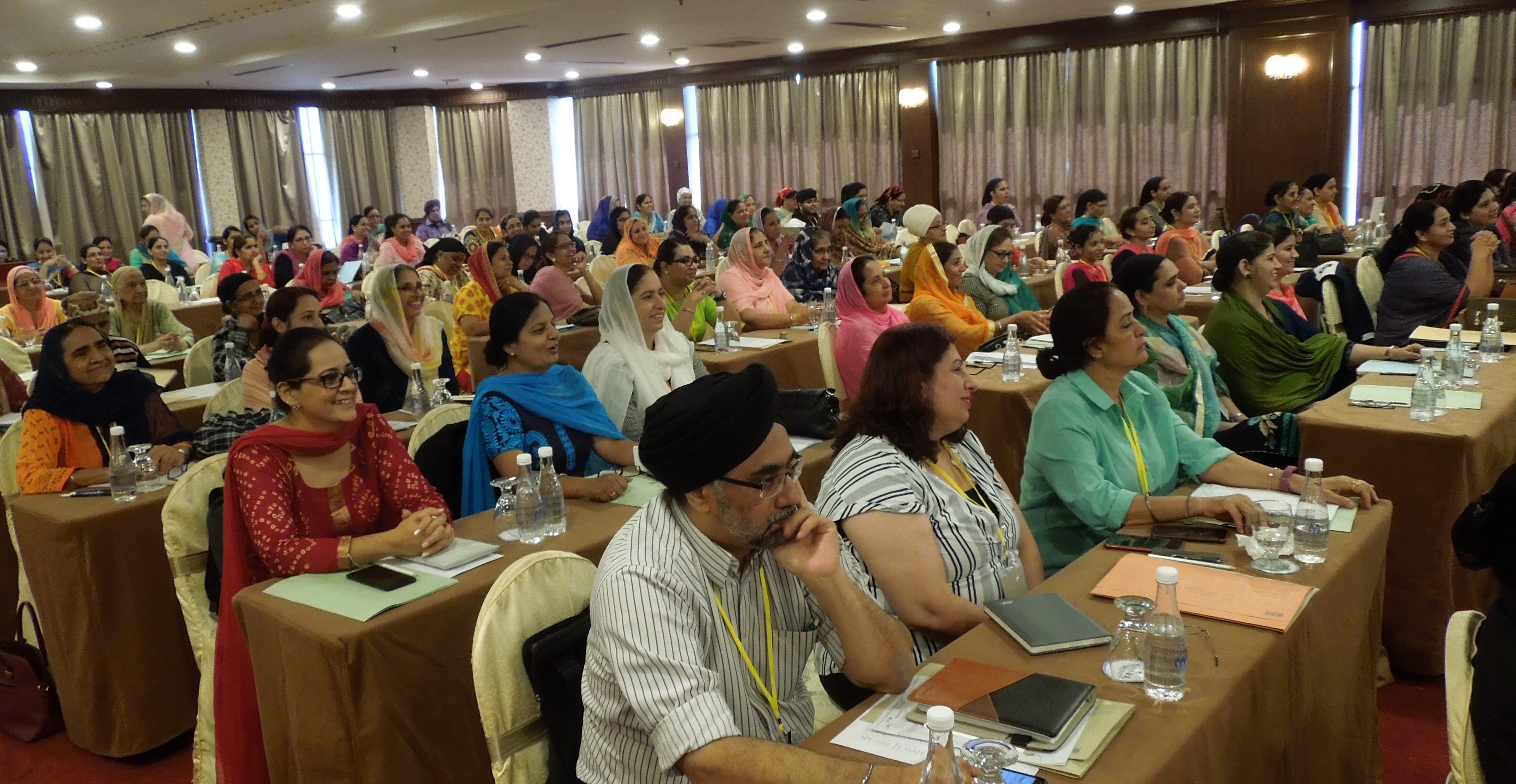
Some 200 Punjabi language teachers and support officials attended a two-day course in Ipoh, Perak, as part of an on-going effort to bolster the teaching of the language in Malaysia.
They took part in the annual Teacher Development Course designed for Punjabi Language teachers teaching in more than 40 Punjabi Education Centres (PECs) nationwide.
Organised by Punjabi Education Trust Malaysia (PETM), the education wing of Khalsa Diwan Malaysia (KDM), the two-day event held at an Ipoh hotel ended on 17 Aug 2019.
The participants comprised of kindergarten, primary and secondary teachers, as well as the PEC inspectors.
The course was conducted by four facilitators and 12 co-facilitators led by Prof Dr Kuldip Kaur who heads PETM’s teacher training.
Themed “Instructional Technology In Punjabi Language Classroom”, the course was geared to keep the Punjabi Language teachers on par with the current trends in the field of education.
The teachers were trained to include the use of laptops and desktops, with access to the internet, when planning and executing their lessons. Instead of using poster sheets and Manila cards, teachers were trained to use Powerpoint presentations. This indeed is a major shift from past practices, and teachers reacted positively to this change.
Such courses are conducted annually in an effort to keep improving the knowledge base of teachers and classroom delivery besides providing a platform for teachers to share and exchange knowledge and experience.
The objectives of the course were achieved, thanks to the contribution and effort of the dedicated team of facilitators and co-facilitators, who were mostly professionals in the field of education.
The feedback from the participants was testimony to this fact. Most teachers were satisfied with the course content and delivery, and gained invaluable knowledge on how to incorporate instructional technology in the classrooms.
Punjabi language teacher course in Ipoh – Photo: PETMTwo-day Punjabi language teacher course in Ipoh – Photo: PETM
KDM president Santokh Singh Randhawa and PETM chairman Gurnam Singh Dhillon had addressed the teachers during the closing ceremony.
They spoke about the past and present struggles in teaching the Punjabi Language, and stressed on the importance of a united effort and cooperation from all parties to ensure the continuity of this programme. They also urged the teachers to continue improving themselves, and keep in touch with the current developments in the field of education.
PKR Perak vice chairman Baldip Singh officiated the closing ceremony. In his speech, he praised KDM for doing a splendid job in teaching and preserving the Punjabi Language, and gave a donation of RM 10,000 towards the noble cause.
PETM wishes to thank all the coordinators, facilitators and course participants for the smooth running of this course, and hopes that the support and cooperation from all the relevant parties will continue to prosper in the years ahead.
Jaginder Singh Raipatti is the secretary of Punjabi Education Trust Malaysia (PETM), the Punjabi language education wing of Ipoh-based Khalsa Diwan Malaysia (KDM).
ASIA SAMACHAR is an online newspaper for Sikhs / Punjabis in Southeast Asia and beyond.Facebook | WhatsApp +6017-335-1399 | Email: editor@asiasamachar.com | Twitter | Instagram | Obituary announcements, click here |
Sikhs have made turbans their own – from left Balvir Singh, Malkeet Singh, Surinder Kaur, Puran Singh, Inderpreet Kaur and Anoop Singh. Photo: John Borren/SunLive
By Asia Samachar Team | MALAYSIA |
Puran Singh hasn’t had a haircut for 48 years – in fact he’s never had a haircut.
“Never, never, never in my life,” insists this elder and president of the Tauranga Sikh community.
This morning, as he does every morning, Puran tucked his waist length locks up into an elegant cream coloured turban. He cuts a dash, he is ready to face the day, ready to satisfy the punters at his novelty Indian food shop in Cameron Road.
Sikhs maintain five articles of faith, referred to as the five ‘Ks’ because they all start with K. The most distinctive one is kesh – keeping hair uncut and maintained in a turban.
But it’s what can’t be seen that fascinates The Weekend Sun – after nearly five decades growing wild, how long is that hair contained in the cream turban?
“It is not much, it is just like this,” says Puran Singh indicating to his middle, lower back. That requires Puran to put a myth to bed. “At a certain point the hair stops growing. Like height, people stop growing.” Which puts paid to the fairy tale about Rapunzel.
Why are blokes sitting around sharing grooming points, intimate behind-the-closed-bathroom-door personal stuff. Because Puran and a couple of other Sikhs are kindly educating an unenlightened, non-turban wearing Pakeha reporter with some insights into arguably the most recognisable cultural accoutrement anywhere in the world – the turban.
All this ahead of Tauranga’s Turban Day on Saturday, August 24, between 11am and 2pm. The Sikh community invites us to “come and try the crown yourself”, instilling The Strand with a faint but exotic flavor of the Sikhs holy city of Amritsar in the northwestern state of Punjab.
“We just want to share our culture,” says 17-year-old music studies student at Otumoetai College Inderpreet Kaur. “We just want to show people who we are and what we stand for, that we are a bit different but are part of your community, and to share our culture.” And a little knowledge, she hopes, will bring understanding and appreciation.
When Puran Singh came to Tauranga in 2002 he was a taxi driver. “People would confuse me for a Muslim.” It was the bushy beard that confused his passengers. “I would have to tell them we were different people, there’s a religious difference.”
Read the full story, ‘They‘re turning heads’ (SunLive, 11 Aug 2019), here.
ASIA SAMACHAR is an online newspaper for Sikhs / Punjabis in Southeast Asia and beyond.Facebook | WhatsApp +6017-335-1399 | Email: editor@asiasamachar.com | Twitter | Instagram | Obituary announcements, click here |
By Jaspal Singh Sidhu | COUNTER CURRENTS | INDIA |
The manner and intent of Indian Establishment in sending of the Indian army to the Golden Temple in Amritsar on 3 June 1984 and degradation in special constitutional status of Jammu and Kashmir on 5 August (2019) bear a lot of similarities. Both actions were sudden and unexpected carried with excessive use of the armed forces. These two events were concerted swoops intended to shock and bamboozle the targeted people of Punjab and Kashmir, thereby, rendering them numb and reactionless.
As a journalist reporting for a ‘national news agency’ from Amritsar, the epicenter of the troubled in Punjab during the 1980s, I witnessed that feverish attempts were made to create a public opinion for justifying the sending heavy forces to a religious place. For that purpose, the government hyped and propagated some flimsy grounds through docile domestic mainstream media.
Even my colleague journalists reporting for ‘national newspapers’ from Amritsar never bothered to highlight the latest history and Sikh traditions when the Akalis was the lone political party to launch a ‘morcha’ (agitation) from Golden Temple against the 1975 Emergency clamped by Indira Gandhi which was participated by BPJ leaders like L K Advani.
Now in Jammu and Kashmir the same strategy was adopted by New Delhi establishment for whipping up intended propaganda prior to the 5 August action.
Jaspal Singh Sidhu retired as Special Correspondent with United News of India, New Delhi and can be reached at jaspal.sdh@gmail.com
Read the full story, ‘Punjab of 1984 and Present Kashmir Bears Similarities’ (CounterCurrents, 16 Aug 2019), here.
ASIA SAMACHAR is an online newspaper for Sikhs / Punjabis in Southeast Asia and beyond.Facebook | WhatsApp +6017-335-1399 | Email: editor@asiasamachar.com | Twitter | Instagram | Obituary announcements, click here |