PATH DA BHOG: 2 September 2019 (Monday), 4pm – 6pm, at Gurdwara Sahib Petaling Jaya followed by Guru Ka Langgar| Malaysia
Baldev Kaur (1936-2019), Petaling Jaya
SARDANI BALDEV KAUR
Sardarni Baldev Kaur d/o Late Sardar Mehar Singh, aged 83, wife of the Late Master Tejwant Singh passed away peacefully on 18 August 2019. Forever loved and cherished by her children and loved ones.
Path da Bhog: 2 September 2019 (Monday), 4pm – 6pm, at Gurdwara Sahib Petaling Jaya followed by Guru Ka Langgar
Contact:
Ajeet Singh +6 016 -278 5070
Dr Veerinderjeet Singh +6 012- 218 0624
| Entry: 19 Aug 2019; Updated: 21 Aug 2019 | Source: Family |
ASIA SAMACHAR is an online newspaper for Sikhs / Punjabis in Southeast Asia and beyond.Facebook | WhatsApp +6017-335-1399 | Email: editor@asiasamachar.com | Twitter | Instagram | Obituary announcements, click here
Singapore Sikh Community Harmony Walk flagging off from SGSS – Photo: SKA Facebook page
By Asia Samachar Team | SINGAPORE |
Some 600 Sikhs and fellow Singaporeans took part in the Sikh Community Harmony Walk yesterday (17 August 2019) to celebrate Guru Nanak’s 550th birthday.
Themed ‘Towards a United Community’, the walk was organised by Singapore Khalsa Association (SKA) and Sri Guru Singh Sabha Singapore (SGSS), in partnership with the Inter-Religious Organisation (IRO).
The event witnessed two groups of participants starting from the IRO office and SGSS and walking to the assembly point at Race Course Road.
Senior minister of state for education and trade & industry Chee Hong Tat flagged off the final leg of the walk from Race Course Road to SKA. He joined the participants during the walk to SKA.
Prof Dr Sean Rozario, who chairs the Moulmein-Cairnhill’s Inter-Racial and Religious Confidence Circle (IRCC), flagged off at the SGSS end.
In his address, Chee said the event theme was a strong and constant reminder of the important role that all communities play in creating a united Singapore society.
“The Sikh community’s contributions to Singapore have been significant and it is a vibrant component of our society. The Sikh community numbers about 12,000 in Singapore. This is modest when compared to the other communities.
“However, the Sikh community’s contributions to Singapore have been significant. It has earned a strong reputation for itself, which is the result of a long process of building bridges with the other communities by leveraging the strengths of the Sikh community,” he said.
The Sikhs in Singapore have come together under the auspices of the Coordinating Committee of Sikh Institutions to organise a series of activities and programmes between December 2018 and November 2019 to mark Guru Nanak’s 550th birthday.
The committee is chaired by entrepreneur and former parliamentarian Inderjit Singh.
Singapore Sikh Community Harmony Walk to celebrate Guru Nanak’s 550th birthday – Photo: SKA Facebook page
ASIA SAMACHAR is an online newspaper for Sikhs / Punjabis in Southeast Asia and beyond.Facebook | WhatsApp +6017-335-1399 | Email: editor@asiasamachar.com | Twitter | Instagram | Obituary announcements, click here |
Sri Dasmesh Pipe Band emerge category champions at Worlds Glasgow 2019 – Photo: Sri Dasmesh Pipe Band/Jesmesh Singh
By Asia Samachar Team | SCOTLAND |
A Malaysian Sikh pipe band emerged category champion at the World Pipe Band Championship in Scotland.
The amazing feat at Glasgow capped months of diligent training and a single-minded push to display their very best at the pinnacle of competitive pipe band competition.
Sri Dasmesh Pipe Band were named champs of Grade 4B at the Worlds yesterday (17 Aug 2019). The band emerged tops for overall and drumming as well as best parade.
This is the second time the Malaysian band took part in the world series organised by the Royal Scottish Pipe Band Association.
Up to 8,000 pipers and drummers from 195 bands converged at the Glasgow Green for the last two days (Aug 16-17).
The bands were from 13 countries: New Zealand, Australia, Canada, Austria, Switzerland, Eire, the US, Belgium, England, Spain, Malaysia, Northern Ireland and Scotland.
Sri Dasmesh – named after the tenth Guru of the Sikhs and the only Malaysian pipe band at the event – was formed in 1986 by Sukdev Singh, a commercial pilot and a director of an international school by the same name, with his brother Harvinder Singh.
The world championship winning band was led by pipe major Tirath Singh (22-year old), drum sergeant Tripert Singh (25) and mid-section head Sukhpreet Kaur (22). Tirath Singh and Tripert Singh, who also happen to be brothers, are both pilots with national carrier Malaysia Airlines.
Together, they led the band through 13 months of tireless practice. They met three times a week for two hours or more each session at the Sri Dasmesh International School in Kuala Lumpur.
Tirath said that this was the band’s gift to the country for Merdeka and hope that all Malaysians will hold their heads high in pride because Sri Dasmesh Pipe Band raised the Jalur Gemilang in Scotland and brought home the Silverware.
The band during pre-WorldsSri Dasmesh Pipe Band at Worlds Glasgow 2019 – Photo: Sri Dasmesh Pipe Band/Jesmesh Singh
ASIA SAMACHAR is an online newspaper for Sikhs / Punjabis in Southeast Asia and beyond.Facebook | WhatsApp +6017-335-1399 | Email: editor@asiasamachar.com | Twitter | Instagram | Obituary announcements, click here |
Khalsa Aid’s Ravi Singh with a group of Yezidi women in Iraq – Photo: Ravi Singh Facebook page
By Ravi Singh | OPINION | IRAQ |
How I spent my rakhri (ਰੱਖੜੀ)? I don’t believe in tying threads to prove my love as a brother etc.
I spent the day with the Yezidi women in Iraq who were held as slaves by ISIS and witnessed the slaughter of their loved ones!
I am a brother to all of them ! I wish we had the Khalsa army and I am sure we would have saved them much sooner.
I heard so many heartbreaking stories from the women about the loss of their family members and about their missing children. Most of the women were from the village Kocho which had witnessed a bloody massacre by ISIS. All of the men were executed and all the women taken as slaves !
I am not a perfect person or a perfect Sikh but I do have the blood of the Khalsa running through my veins !! The Khalsa will protect any woman, regardless of faith or race. We don’t need a thread to do so, we got Akal Purakh !
May Waheguru bring peace to the lives of these women.
Deg Tegh fateh!!
RAVI SINGH is the founder/CEO of Khalsa Aid, the London-based humanitarian relief agency
[Editor’s Note: The Hindu festival Rakhsha Bandhan is celebrated on the occasion of Sharva Poornima which usually falls in day of the full moon in August. Rakhsha means protection while bandhan means bond. Some Sikhs, too, observe rakhari when the sister usually tie rakhi on their brother’s wrist]
ASIA SAMACHAR is an online newspaper for Sikhs / Punjabis in Southeast Asia and beyond.Facebook | WhatsApp +6017-335-1399 | Email: editor@asiasamachar.com | Twitter | Instagram | Obituary announcements, click here |
PATH DA BHOG: 24 August 2019 (Saturday), 10am-12noon, at Gurdwara Sahib Petaling Jaya, followed by Guru Ka Langgar| Malaysia
Bachan Kaur (1937-2019), Taman Sri Manja
LATE MATA BACHAN KAUR D/O LATE SARDAR BHAJAN SINGH
(13.11.1937 – 10.8.2019)
Aged: 82 years old
Village: Hirdapur, Punjab
Husband: Late Sardar Gurmukh Singh
? Mother, you left us beautiful memories, your love is still our guide although we cannot see you, you’re always at our side. We remember you in our prayers forever ?
Path Da Bhog: 24 August 2019 (Saturday), 10am-12noon, at Gurdwara Sahib Petaling Jaya, followed by Guru Ka Langgar
Contact:
Gurcharen Singh 013-3803353
Ajeet Singh 013-3603720
Gurcharan Kaur 019-2838364
?? Kindly treat this as a personal invitation from our family.
?? Waheguru Ji Ka Khalsa, Waheguru Ji Ki Fateh ??
| Entry: 17 Aug 2019 | Source: Family |
ASIA SAMACHAR is an online newspaper for Sikhs / Punjabis in Southeast Asia and beyond.Facebook | WhatsApp +6017-335-1399 | Email: editor@asiasamachar.com | Twitter | Instagram | Obituary announcements, click here |
PATH DA BHOG: 31 Aug 2019 (Saturday) at Gurdwara Sahib Taiping (No 23, Jalan Stesyen Ulu, Taiping, Perak). Sukhmani Sahib commences at 4pm, Sehaj Path da Bhog at 7pm followed by Guru Ka Langgar | Malaysia
IN MEMORY: Kartar Kaur & Ranga Singh (Taiping)
In loving memory of
LATE MATA KARTAR KAUR
AND LATE SARDAR RANGA SINGH
Sukhmani Sahib will commence at 4.00pm followed by Sehaj Path da Bhog at 7.00pm on 31 August 2019 (Saturday) followed by Guru Ka Langgar at GURDWARA SAHIB TAIPING (No 23, Jalan Stesyen Ulu, Taiping, Perak)
SPECIAL MESSAGE FOR MUM AND DAD,
BY SWINDER KAUR
Come and sit with me awhile
You know I’d love to have you near
I have been so lonely ever since you departed from here.
I know you went to heaven
But I hope you ‘ll visit me every day
Sending signs to comfort me
You always knew just what to say.
So when I am alone
I’ll talk openly and reveal all that ’s going on inside of me
So you’ll know just how I feel.
Remembered by Children, Grandchildren and Great Grandchildren
Contact: Swinder Kaur (Singapore) 0065 9001 9004
SEE IN LOVING MEMORY VIDEO MONTAGE HERE (FOR YOUTUBE) OR HERE (FOR FACEBOOK)
Ranga Singh with his bullock cart – Photo: Family
| Entry: 16 Aug 2019 | Source: Family |
ASIA SAMACHAR is an online newspaper for Sikhs / Punjabis in Southeast Asia and beyond.Facebook | WhatsApp +6017-335-1399 | Email: editor@asiasamachar.com | Twitter | Instagram | Obituary announcements, click here |
Trans International Logistiks power-team with the Frost & Sullivan award. L-R: Stephen Seine (business development manager), Kuldip Singh Seine (MD) and Harjeet Kaur (general manager) – Photo: Supplied
By Asia Samachar Team | MALAYSIA |
A Punjabi-powered Malaysian logistics firm that played a role in the construction of the Petronas Twin Towers has been named company of the year by Frost & Sullivan.
The global business consulting firm awarded Trans International Logistiks Sdn Bhd (TIL) the Malaysia Project Logistics Service Provider of the Year 2019 award, a badge for a true industry leader in the country.
Described as an exemplary project logistics company, the 12-year old company has been handling projects of every dimension, including heavy and niche industries.
“These companies have a keen eye on the future and drive innovation that meets upcoming needs before they become commonly visible, often being first to market with new solutions,” Frost & Sullivan chairman David Frigstad said in a note recognising the award.
Establishment in April 2007, TIL is involved in the business of total global project logistics management and indirect tax exemption consultancy. It undertakes projects from various industries such as manufacturing, construction & development, infrastructure, oil, gas & petrochemical, power plants, and telecommunication.
At this moment, it is involved in the construction of iconic KL 118 Tower which will be the tallest building in Malaysia when completed.
“We go beyond the norm in logistics. We combine services like taxation, exemptions, licenses. We also go into capex investment,” TIL managing director Kuldip Singh Seine told Asia Samachar.
He added: “We are a combination of all-logistics. When we say we are a one-stop shop, we actually provide all solutions for the logistics from origin to delivery site. We do the complete processes.”
TIL has gradually expanded its services across Malaysia and globally. With two direct branches and agent branches all over the country, the company provides end-to-end project logistics solutions and has been engaged by numerous companies for major projects in Malaysia and internationally.
In the note, Frost & Sullivan noted that TIL’s vast experience in the industry has placed the company among the main project logistics service providers in Malaysia.
Since establishment, it said the company has created an extensive history in providing high-quality support project logistics services and consultant services for manufacturing, power, oil and gas, and petroleum companies.
TIL has handled successfully numerous projects by putting to work its connection between the global network and local expertise. One such project was the co-generation system from China and Germany to Shah Alam, Malaysia, for food processing plant with total revenue tons handled at 2,000 tons.
It also managed the transformer movement from China to a cement plant in Rawang and KLIA2 passenger boarding bridges from China to international airport project site. The latter involved 80 units whose weight ramped up to 25,000 revenue tons.
What does the award mean? Frost & Sullivan said the Company of the Year Award recipient must be recognised as a leader in their own industry as well as the non-industry peers. It requires a company to demonstrate excellence in growth, innovation, and leadership.
“TIL has consistently gone the extra mile in providing industry-leading expertise and services for the smooth execution of its heavy-lift project logistics,” it said.
ASIA SAMACHAR is an online newspaper for Sikhs / Punjabis in Southeast Asia and beyond.Facebook | WhatsApp +6017-335-1399 | Email: editor@asiasamachar.com | Twitter | Instagram | Obituary announcements, click here |
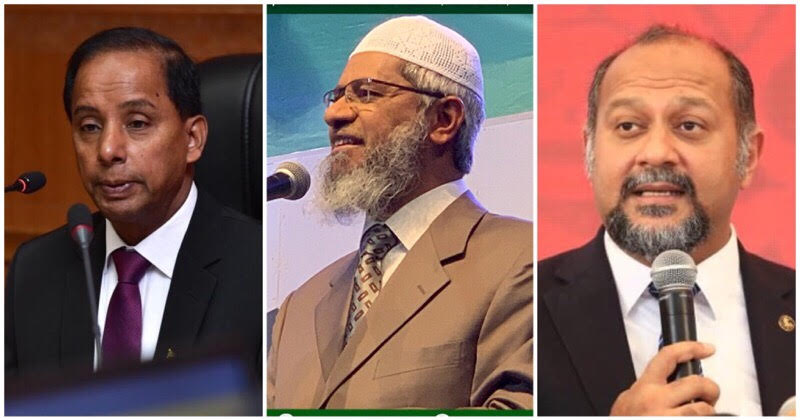
L-R: Kula Segaran, Zakir Naik and Gobind Singh Deo
By Asia Samachar Team | MALAYSIA |
Two ministers have made it plain and clear that Dr Zakir Naik, an Indian-born preacher who has made Malaysia his present base, should no longer be allowed a free reign as his speeches have allegedly disrupted inter-racial and inter-religious harmony.
In a joint statement, federal ministers Gobind Singh Deo and M Kula Segaran said action must be taken and that Zakir Naik should no longer be allowed to remain in Malaysia.
“The Prime Minister has taken note of our concerns. We leave it to him to consider the position and to decide soonest possible what will be done to deal with the problem,” they said in the statement released at Gobind’s Facebook page.
In the most recent speech, the controversial speaker is said to have claimed that Malaysian Hindus were more loyal to Indian Prime Minister Narendra Modi than to Malaysian Prime Minister Dr Mahathir Mohamed despite receiving “100 times” more rights than Muslims in India.
Zakir, who is wanted by Indian authorities over money laundering in his home country, has since tried to distance himself from those remarks in the lecture in Kelantan, a state on the east coast of Penisular Malaysia.
Instead, he has accused his critics of quoting him out of context, according to one media portal.
In their statement, the ministers said that they had raised with the Prime Minister and the Cabinet this morning (14 Aug 2019).
“We also reiterate the concerns raised by many over speeches and statements of his which have been inflammatory in nature. We therefore express our objections to Zakir Naik in the meanwhile holding any further events here in Malaysia or making further statements which impact on race relations and public order,” they added.
Gobind is the Malaysia’s communications and multimedia minister while Kula is the
human resources minister. Both are form DAP, one of the four political parties that make up for Pakatan Harapan that formed the Government in a surprise election victory in March 2018 polls.
This is the second time in a week that Gobind had to wade into the highly charged religious-laden debate in Malaysian politics.
On 9 Aug, he had to come forward to clarify DAP’s stand on a religious conversion matter in the state of Selangor, where he heads the state party.
DAP Selangor had then reiterated its stand that any Bill that was unconstitutional should not be tabled in the Selangor state assembly.
Gobind said that the Bill to allow unilateral religious conversion of minor children with the consent of just one parent was not discussed in the Pakatan Harapan meeting on Thursday (Aug 8).
“The question of it (possibly) being tabled again was never discussed in the meeting so it doesn’t arise,” he was quoted in a report in The Star.
On Thursday (Aug 8) night, Selangor Menteri Besar Amirudin had said that the Bill allowing for unilateral religious conversion could still be tabled at the next state legislative assembly.
Amirudin had reportedly said that at present, only Selangor, Penang and Sabah still have a differing interpretation of laws related to the conversion of minors. He said that was among the reasons the state wanted to standardise it, the newspaper reported.
Gobind said that the Federal Court, in the M. Indira Gandhi case, had clearly explained that consent must be obtained from both parents before a minor is converted.
ASIA SAMACHAR is an online newspaper for Sikhs / Punjabis in Southeast Asia and beyond.Facebook | WhatsApp +6017-335-1399 | Email: editor@asiasamachar.com | Twitter | Instagram | Obituary announcements, click here |
Map of the Punjab and Kashmir region. Retrieved from nationsonline.org
By Anmol Singh Hundal | OPTION |
The reason behind the huge outcry following the Government of India’s amendment of Article 370 is that it took away a status from Kashmiris that they had enjoyed for seven decades. What was that status, however? What does it mean when it is said that Kashmir had — autonomy? It is relatively well known that the Governments of other States are at the mercy of the Union Government, but was that not true for Kashmir? This article will answer that question.
INTRODUCTION
Unlike most other provinces in the Indian Union, which never had any other viable option, Jammu and Kashmir acceded to India through an instrument of accession, according to the terms of which, the Union Government would get powers only in specific domains, with residual power being vested in the State Government of Jammu and Kashmir.
What followed the execution of the terms of the instrument of accession was: a) Article 370 in the Indian Constitution and b) the separate Constitution of Jammu and Kashmir. Article 370 described the parts of the Indian Constitution that would apply to Jammu and Kashmir, and the Constitution of Jammu and Kashmir filled in the gaps in describing the workings of the State Government of Jammu and Kashmir.
ARTICLE 370
Before we proceed, please take a look at the full text of Article 370.
370. (1) Notwithstanding anything in this Constitution, —
(a) the provisions of article 238 shall not apply in relation to the State of Jammu and Kashmir;
(b) the power of Parliament to make laws for the said State shall be limited to —
(i) those matters in the Union List and the Concurrent List which, in consultation with the Government of the State, are declared by the President to correspond to matters specified in the Instrument of Accession governing the accession of the State to the Dominion of India as the matters with respect to which the Dominion Legislature may make laws for that State; and
(ii) such other matters in the said Lists as, with the concurrence of the Government of the State, the President may by order specify.
Explanation. — For the purposes of this article, the Government of the State means the person for the time being recognised by the President as the Maharaja of Jammu and Kashmir acting on the advice of the Council of Ministers for the time being in office under the Maharaja’s Proclamation dated the fifth day of March, 1948;
(c) the provisions of article 1 and of this article shall apply in relation to that State;
(d) such of the other provisions of this Constitution shall apply in relation to that State subject to such exceptions and modifications as the President may by order specify:
Provided that no such order which relates to the matters specified in the Instrument of Accession of the State referred to in paragraph (i) of sub-clause (b) shall be issued except in consultation with the Government of the State:
Provided further that no such order which relates to matters other than those referred to in the last preceding proviso shall be issued except with the concurrence of that Government.
(2) If the concurrence of the Government of the State referred to in paragraph (ii) of sub-clause (b) of clause (1) or in the second proviso to sub-clause (d) of that clause be given before the Constituent Assembly for the purpose of framing the Constitution of the State is convened, it shall be placed before such Assembly for such decision as it may take thereon.
(3) Notwithstanding anything in the foregoing provisions of this article, the President may, by public notification, declare that this article shall cease to be operative or shall be operative only with such exceptions and modifications and from such date as he may specify:
Provided that the recommendation of the Constituent Assembly of the State referred to in clause (2) shall be necessary before the President issues such a notification.
For those who are unfamiliar, the Constitution of India describes three Lists in its Seventh Schedule.
Union List: the areas in which the Union Government has the exclusive power to make laws.
State List: the areas in which the State Governments have the exclusive power to make laws.
Concurrent List: the areas in which both the Union and the State Government can make laws, with the laws made by the Union Government taking precedence.
The part that is of our interest in Article 370 is Clause (1) Subclause (b) which describes the domain in which the Union Government of India has the power to make laws for Jammu and Kashmir. Note the emphasis that is placed on the President (who is nothing more than a rubber stamp in the hands of the Prime Minister of India); although the decision the President makes has to be in conjunction with the Government of the State [of Jammu and Kashmir].
What is it meant by the Government of Jammu and Kashmir though? The answer is provided in Appendix 1 of the Constitution of India, which in the 2015 version of the Constitution that I have, has a copy of the “THE CONSTITUTION (APPLICATION TO JAMMU AND KASHMIR) ORDER, 1954”. It provides for Article(367)(4)(b) according to which the reference to the Government of Jammu and Kashmir should be construed as a reference to the “the Governor of Jammu and Kashmir acting on the advice of his Council of Ministers”.
Now, this Governor is a person who is appointed by the President himself. The section reads “acting on the advice of his Council of Ministers”, but it does not clarify whether or not that advice is binding. So, we have two personnel, the President of India and the Governor of Jammu and Kashmir, both of whom are appointed, indirectly and directly respectively, by and work for the Union Government of India and they decide the matters for which the Union Government has the power to make laws, with the role of the Council of Ministers in this matter being ambiguous. What, if anything, prevents the exploitation of the discretion that is granted to these personnel?
THE CONSTITUTION OF JAMMU AND KASHMIR
The Constitution of Jammu and Kashmir is relatively easier to understand. Section 5 describes the “extent of the executive and the legislative powers of the State [of Jammu and Kashmir]”. The section is reproduced as follows:
5. Extent of executive and legislative power of the State:- The executive and legislative power of the State extends to all matters except those with respect to which Parliament has power to make laws for the State under the provisions of the Constitution of India.
Since the framing of this section is in negative, it tells us that the State of Jammu and Kashmir is not vested with some inherent powers, but instead the power it has depends on the powers that the Indian Parliament has in accordance with the Constitution of India, which we have just seen is decided by the Union Government itself.
Now, it turns out that it is beyond the capacity of elected Legislative Assembly of Jammu and Kashmir to amend Section 5. We know this from Section 147 which describes the procedure for Amendment.
147. Amendment of the Constitution. — An amendment of this Constitution may be initiated only by the introduction of a Bill for the purpose in the Legislative Assembly and when the Bill is passed in each House by a majority of not less than two thirds of the total membership of that House, it shall be presented to the Sadar-i-Riyasat for his assent and, upon such assent being given, to, the Bill, the Constitution shall stand amended in accordance with the terms of the Bill:
Provided that a Bill providing for the abolition of the Legislative Council may be introduced in the Legislative Assembly and passed by it by a majority of the total membership of Assembly and by a majority of not less them two-thirds of the members of the Assembly present and voting:
Provided further that no Bill or amendment seeking to make any change in- (a) this section; or (b) the provisions of sections 3 and 5 ; or (c) the provisions of the Constitution of India as applicable, in relation
to the State, shall be introduced or moved in either House of the Legislature.
In other words, the people of Kashmir are stuck with this arrangement and have no democratic way out of this conundrum. In addition, it turns out that there is another mechanism in the hands of the Government of India which allows it to take control of the Government of the State of Jammu and Kashmir. Section 35 describes the relation between the Council of Ministers (which is chosen from the elected members of the State Legislative Assembly) and the Governor appointed by the Indian Government, who is also the head of the State.
35. Council of Ministers to aid and advise the Governor:- (1) There shall be a Council of Ministers with Chief Minister at the head to aid and advise the Governor in the exercise of his functions. (2) All functions of the Governor except those under sections 36, 38 and 92 shall be exercised by him only on the advice of the Council of Ministers.
Paragraph (2) makes room for exceptions, which are not that serious in the case of Section 36 and 38 but call the alleged democracy in question in the case of Section 92. The following is a reproduction.
92. Provisions in case of failure of constitutional machinery in the State.- (1) If at any time, the Governor is satisfied that a situation has arisen in which the Government of the State cannot be carried on in accordance with the provisions of this Constitution, the Governor may by Proclamation-
(a) assume to himself all or any of the functions of the Government of the State and all or any of the powers vested in or exercisable by anybody or authority in the State;
(b) make such incidental and consequential provisions as appear to the *Governor to be necessary or desirable for giving effect to the objects of the Proclamation, including provisions for suspending in whole or in part the operation of any provision of this Constitution relating to anybody or authority in the State:
Provided that nothing in this section shall authorise the Governor to assume to himself any of the powers vested in or exercisable by the High Court or to suspend in whole or in part the operation of any provision of this Constitution relating to the High Court.
(2) Any such Proclamation may be revoked or varied by a subsequent Proclamation.
(3) Any such Proclamation whether varied under subsection (2) or not, shall except where it is a Proclamation revoking a previous Proclamation, cease to operate on the expiration of six months from the date on which it was first issued.
(4) If the Government or by a Proclamation under his section assumes, to himself any, of the powers of the Legislature to make his laws, any law made by him in the exercise of that power shall, subject to, the terms there of continue to have effect until two years have elapsed from the date on which the proclamation ceases to have effect, unless sooner
(5) No Proclamation under this section shall, except where it is a Proclamation revoking a previous Proclamation, be laid before each House of the Legislature as soon as it is convened.
This provision allows the Union Government appointed Governor to assume all functions of the Government of Jammu and Kashmir as long as he personally is satisfied of the breakdown of Constitutional machinery. Again, what if anything prevents the exploitation of his discretion?
CONCLUSION
As we have seen, whatever “autonomy” Kashmir had was at the mercy of the Union Government. In that case, what is the purpose of the Modi Government’s recent amendment of Article 370. If Kashmiris never had any autonomy to begin with, what did they have to lose, and what did the Union Government have to gain?
Was it to distract the public of India from the pending financial crisis? Was it to show the Hindus that BJP is looking out for them? Or was it to simply damage the re-emerging relationship between Pakistan and the Sikhs worldwide? It is probably a combination of all of these factors.
ASIA SAMACHAR is an online newspaper for Sikhs / Punjabis in Southeast Asia and beyond.Facebook | WhatsApp +6017-335-1399 | Email: editor@asiasamachar.com | Twitter | Instagram | Obituary announcements, click here |