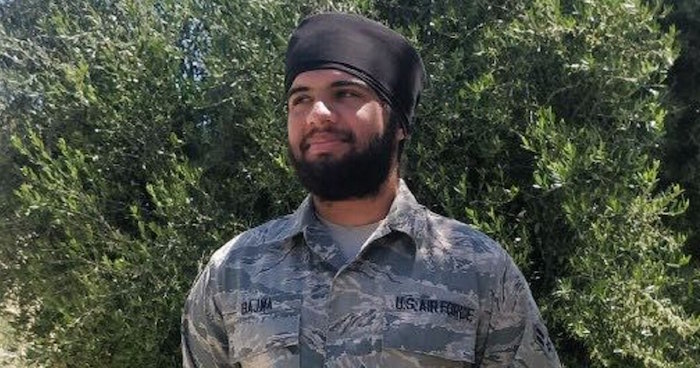
Airman 1st Class Harpreetinder Singh Bajwa has become the first active-duty Sikh airman permitted to wear a turban, beard and long hair, following the practices of his faith. (Courtesy of Harpreetinder Singh Bajwa / Air Force Times)
By Kristine Froeba | AIR FORCE TIMES | US |
For the first time, the Air Force has granted a Sikh airman permission to wear a turban, beard and long hair, following the practices of his faith.
Airman 1st Class Harpreetinder Singh Bajwa, a crew chief at McChord Air Force Base, Washington, is now the first active airman who has been authorized to adhere to Sikh religious grooming and dress principles while serving in the Air Force.
“I’m overjoyed that the Air Force has granted my religious accommodation,” said Bajwa. “Today, I feel that my country has embraced my Sikh heritage, and I will be forever grateful for this opportunity.”
A first-generation American, born to an immigrant family, Bajwa enlisted in the Air Force in 2017, eager to give back by serving his country. At the time, he was not permitted to practice certain Sikh beliefs due to Air Force grooming and dress rules.
An Army directive authorizing beards for soldiers based on their religion applies to all religions — as evidenced from this recent memo from a brigade commander.
Sikhs tie their hair in a bun on top of their head, which is then covered by a turban. In the Rehat Maryada, the code of conduct and conventions for Sikhism, it is explicitly written that Sikh men do not cut their hair, shave and must wear a turban. The Rehat Maryada, however, conflicts with current Air Force regulations on uniform and grooming appearances.
In 2018, the Air Force granted its first religious accommodation beard waiver to a Muslim airman, allowing him to wear a beard while in uniform. Previously, the only exceptions for active-duty personnel were medical waivers. There are also exceptions for Air Force Reservists serving less than 30 days.
“I’m extremely happy I can practice my faith and serve my country,” said Bajwa.
Read full story, ‘Beard and turban approved for Sikh airman’ (Air Force Times, 6 June 2019), here
ASIA SAMACHAR is an online newspaper for Sikhs / Punjabis in Southeast Asia and beyond.Facebook | WhatsApp +6017-335-1399 | Email: editor@asiasamachar.com | Twitter | Instagram | Obituary announcements, click here |
Let me overwhelm you with some factoids, then we’ll try moving forward.
Young and brash, I came to this country a generation ago; then I could count on the fingers of one hand the number of recognizable Sikhs on the streets of a city the size of New York and often pined for a familiar face in a sea of strangers. When curious non-Sikhs asked if we had a place of worship (gurduara) nearby, my ironical response said it all: “Yes we do but it’s about 3000 miles away in California and Vancouver, Canada.” The years turned my world upside down.
Now almost 20 gurduaras are within commuting range of where I live, and perhaps twice as many if you count the whole state of New York. About 250 gurduaras dot the landscape of United States of America. Surely, a matter of rejoicing and satisfaction, but for one caveat.
With the exception of a few that I know about, many gurduaras have accumulated a horrible track record. Unbecoming a place of worship, a shocking litany of ongoing infractions — dishonest or non-existent electoral procedures, unresponsive authoritarian management, absence of transparency, accountability and self-governance, while flouting norms of common sense or their own Constitutional framework. Violent interactions among attendees and management followed by legal recourse are not uncommon sequelae. Should such shenanigans be the markers of a spiritual path exemplified by love and service to humanity without discrimination of caste, color or gender that normally fuel disagreements in public space. Today, my gut reaction to this paradox.
If a whole community spread over a vast land as the United States exhibits common symptomology then there must be a common etiology. Many gurduaras are beset by these problems and have been rendered largely dysfunctional. True that some gurduaras serve economically challenged neighborhoods with marginally educated congregants existing in dire economic straits. Yet, a similar picture of fragmented gurduara management emerges whether one is looking at impoverished communities or in posh neighborhoods and historic towns, where Sikhs drive luxury cars, own palatial homes, gurduara buildings are historic landmarks with local political bigwigs residing nearby. Not an iota of difference exists between the two extremes in the viciousness of the disputes. Surely, not the fault of any one person, no matter how vile.
To my baffled simple mind, the thought came that if the large American Sikh community is behaving thus, two possible explanations remain: First, that a fundamental flaw in Sikh teaching surfaced in the diaspora Sikhs of North America. But a careful reading of history, traditions and teachings of Sikhi quickly rubbished the notion. The equally unacceptable alternative is that perhaps a new highly contagious virus caught up with us after a few hundred years of latency. And now the infection may have affected the whole body politic of the Sikh nation.
Such examples surface every day; just watch the latest unfolding news on public health. Newer bugs enter us, infecting all systems quietly with unimagined speed and unheard-of urgency, overriding all control systems, even penetrating a people’s DNA, particularly if it is a largely isolated population. Microbial hunters, cell biologists and geneticists tell us that such viruses take control of organelles, cells and systems that are vital for function and survival. Now the community seems to have caught it — almost a gene mutation for madness. Do we now have an epidemic on our hands? Mind you, Sikhs are not a genetically isolated people.
Only two therapeutic choices appeared hopeful: Either large scale mandated mass counseling services for every Sikh man and woman as if they have gone nuts, or look to modern interventional cellular and subcellular gene therapy from emerging techniques to put us back on track.
After some obsessing, a sensible alternative response surfaced, so let us counsel patience, and not leap to egregious and hasty judgements.
A MIGRANT’S HEART
Most Sikhs are immigrants in this country. Prior to dramatic shifts in the 1960’s, immigration policy was radically biased against Asians, and there were very few countable, small number of Sikhs in the U.S.A. Laws changed and a flood of Indians came. Sikhs, mostly from Punjab, in the northwest territory of India, enjoy an enviable reputation as warriors dedicated to honest work ethic; they earned for Punjab the coveted recognition as the nation’s bread basket that freed India of its yearly famines. Sikhs are also the backbone of India’s muscle – its coveted armed forces. Sikhs are a vigorous, prominent minority of barely two percent in Hindu India and even a smaller statistical presence in contemporary America, or any other part of the world.
Quite expectedly, then, Sikh migrants to America are a mix of students, technocrats, and business professionals but often from agrarian farming roots. Some problems of language and culture accost them as for most migrants from anywhere.
These first Sikh migrants founded the 200 odd Gurduaras in the United States that primarily cater to the needs – religious, cultural, linguistic, etc., also in music cuisine and ambience – of the Punjabi people and their nostalgia for a home (Punjab) that they had abandoned. The gurduara, by definition the community center of a people, becomes critical in re-creating the aura and ambiance of Punjab to capture the essence, sights, smells and sounds of the home they left behind. But for their progeny, born and brought up in the new country, the home is different as are the sights, sounds and smells. And there lies a disconnect.
Now, despite the fact that a large majority of our gurduaras are beset by problems that have rendered them largely dysfunctional, some hopeful progressive examples are arising here and there. Yet, it is almost as if a highly contagious virus has caught up with us or that an epidemic of madness has hit us.
A migrant’s heart and soul often long for the home he has abandoned even while he feverishly works to construct a new home in a new land. Remember that a house is erected in days or months, making a house into a home takes a lifetime. Identity and loyalty remain split a while; that’s an immigrant’s reality though not always in his awareness. To each phase there is a season with an ebb and flow. These are not to be condemned but valued and deserving respectful patience. In that lies a defining hurdle. The Indian cultural milieu, perhaps because of its pervasively defining caste and past colonial realities, comes with an overwhelming vertical structure, crudely but aptly labeled as the Master/Servant; King/Subject or Kick down/Kiss up paradigm. I hasten to add that Sikhi rejects this baggage entirely but reality prevails.
Migrants bring cultural practices and attitudes best tagged as habits of the heart. They prevail despite the best teachings of great religions that speak of egalitarian societies, self-governance, gender equality and, freedom of expression with accountability. The result is a mélange of good teaching and bad practice that coexist.
When a leader ascends the ladder of success in the primarily patrilineal Indian system his sense of self is defined more by ancient cultural commandments of Indian life and less by values of common good. He becomes the leader but sees himself as the king. To him the king is the law, not that the law is king. Therein lies the defining difference between the culture that shaped us and the reality in which we live today. Yet, when he goes to work in an office or business that runs by western values he functions as a loyal servant of the new order where he is the migrant and follows the laws, regulations and practices he should. When he comes home to family or gurduara he often reverts to the ways of his home that his body truly left but not his mind.
PSYCHIC RESPITE
Perhaps because of the closed-shop mentality of many gurduaras and the never-ending turmoil, congregations often become overwhelmingly uninvolved. When asked they rarely offer honest opinions until the pot boils over into visible conflict. Perhaps the allure of apathy reflects the fervent desire for peace. We need some psychic respite after all the commotion in gurduaras pretty worldwide post 1984. Matters lie dormant today but perhaps as a volcano waiting to explode. Remember that Sikhs and Sikhi present, since their beginnings, a glorious history of dynamic activism, not fear.
More than just cessation of hostilities, peace is a state of mind. To quote the comic strip Pogo, “We have met the enemy and he is us.” We may have peace now, but at what price? I am reminded of the Latin aphorism ignoti nulla cupido meaning that one does not desire what one does not know.
My reasoning though plausible remains hypothetical. So, where lies the critically needed therapy? I suggest that we open that box another day.
Our existing conflicts are both inter and intra generational; they lie at the core of our community’s dysfunctional reality and our gurduara imbroglio. (Generational conflicts are not uncommon in other religions as well!) Mind you, I am not prescribing gene-therapy or counseling en masse. Just some self-reflection might be all that the doctor ordered.
My intention here is less a sermon or scolding and more Cri du Coeur. I close with a bit of American folk wisdom:Ask me no questions and I’ll tell you no lies.
[I.J. Singh is a New York based writer and speaker on Sikhism in the Diaspora, and a Professor of Anatomy. Email: ijsingh99@gmail.com]
* This is the opinion of the writer, organisation or publication and does not necessarily represent the views of Asia Samachar.
ASIA SAMACHAR is an online newspaper for Sikhs / Punjabis in Southeast Asia and beyond.Facebook | WhatsApp +6017-335-1399 | Email: editor@asiasamachar.com | Twitter | Instagram | Obituary announcements, click here |
Major Harwan Singh (right), former MAFSVA treasurer and present advisor, handing over a honorary membership of MAFSVA to Gobind. Watching is Major (Rtd) Baldev. – Photo: Supplied
By Asia Samachar Team | MALAYSIA |
Most Malaysian armed forces veterans, including Sikh veterans, are among the most poorly paid when it comes to pension.
“This is a little known fact,” Malaysian Armed Forces Sikh Veterans Association (MAFSVA) MAFSVA president Major (Rtd) Baldev Singh told the gathering at its first Heritage Night and Charity Dinner last month.
This month, he said MAFSVA will prepare a brief on the anomalies with suggestions to rectify its scale in accordance with the relevant law.
“Among others, MAFSVA has organised Pingat Jasa Malaysia Awards (PJM) awards for its members, for which the government is considering an annual/monthly allowance,” he said.
Minister of Communications and Multimedia Gobind Singh Deo, who was the chief guest at the dinner on 19 May 2019 in Subang Jaya, said he shared the concerns of MAFSVA pertaining to the welfare and well-being of the armed forces veterans.
Gobind said the Defence Minister Mohamad Sabu had pledged to look into the various issues faced by the veterans.
“We must always be reminded of the sacrifices of our most-brave and it should be used to educate and inspire confidence in our younger generation, many of whom know very little of our country’s history, in general, let alone specific incident of war, the experiences of our veterans, including the Battle of Kampar,” he said.
When asked to elaborate on the matter, Baldev told Asia Samachar: “Very few officers and soldiers qualify for a full pension due to the nature of the terms of service, completely different from the civil service.”
Among the invited guests were Kampar MP Thomas Su Keong Siong, Malaysia Army Training Academy (LATEDA) commander Col Inderjit Singh. Also present were Col Anirudh Chauhan and Capt Roger Ian Ward, defence advisors at the high commissions of India and New Zealand, respectively.
The event carried the theme “Service and Sacrifice of Malaysian Sikhs in the Police and Military since 1873”.
The funds raised will go towards the preservation heritage and history connected to Sikhs, with the preservation of the ‘Green Ridge’ (WW2 battle site in Kampar, Perak).
The funds will also be used for the welfare needs of the veterans and to undertake veteran’s community projects.
BATTLE OF KAMPAR
Baldev noted that MAFSVA was formed by default. The Adhoc Battle of Kampar (BOK) committee, which was urging the Government to preserve the Green Ridge, realised it had to be a registered body to pursue its objective.
“Maj (Rtd) Bhagwan Singh proposed a veteran association be formed. Thus, MAFSVA was born on 23rd May 2016. Our signature project is to ensure a War Memorial be built in the memory of our brave fallen heroes of BOK,” he said.
BOK, the longest Battle in Malaya, was fought 76 years ago by the British Army comprising Indian troops against the Japanese imperial army in 1941.
“Surprisingly, the British overlooked to build any monument for these brave soldiers. However, the Government of India has pledged to build a world class war memorial and gallery at The Green Ridge.
“We have had several coordinating meetings with The High Commission of India, Perak State Government, Ministry of Tourism & Culture and the Foreign Ministry on the progress of The War Memorial,” he said.
Upon completion, he said The War Memorial & Gallery will be a historic monument and an international tourist attraction.
The then federal Minister of Tourism and Culture Nazri Aziz visited the Green Ridge Site on 17 March 2017 and declared it as a heritage site. The visit was facilitated by Daljit Singh Dhaliwal, a former senator and president of Malaysian Punjabi Chambers of Commerce and Industries.
In January 2019, the BOK Committee had a meeting with Thomas Su in Kampar, who had later raised the matter in the Dewan Rakyat, the lower chamber of the Malaysian parliament, in March 2019.
LAST RITES, THANKSGIVING
In his speech, Baldev also said that MAFSVA also undertakes the last rites for the veterans by drapping the national flag over them and playing The Last Post.
“Veterans present at the ceremony give him a Last Salute. The National flag is then professionaly folded and handed to the next of kin as an appreciation for his services to the Nation,” he said.
MAFSVA also organises thanksgiving prayers with annual jhodmela (Sikh prayer) in all states, with the most significant one at Gurdwara Sahib Kampar in January in remembrance of BOK heroes.
In 2020, MAFSVA plans to turn it into a national affair to create awareness and to send a strong message to the Perak state government to speed up the BOK Project.
“We also have joint Jhodmelas with our Police Brothers during Warriors Day. We have a cordial working relationship with our police brothers,” he said, noting the presence of DSP Balwan Singh.
MAFSVA operates from a leased bungalow in Petaling Jaya. The headquarter, called Fauji Barracks, comprises of an office, a meeting room, a dining hall and a mini bar for fellowship and to hold small functions.
“It needs major renovations. YB and all guests are cordially invited to patronise our Fauji Barracks,” he said.
RECOGNISING VETERANS
In his speech, Baldev also highlighted the contributions of the association’s executive committee.
Major (Rtd) Suaran Singh: Founder honorary secretary. He prepared all SOPs and minuted all exco meetings and AGMs, organised all MAFSVA activities for the first two years.
Major (Rtd) Harwan Singh: Founder honorary treasurer and current advisor.
Major (Rtd) Bhagwan Singh: Founder deputy president and chairman. Also chairman of the Battle of Kampar Committee and the brainchild behind it. He’s the current VP Army.
Cmdr (Rtd) Avatar Singh: Founder and present VP Navy. The most senior Navy veteran. He is also the Perak Branch chairman and a member of BOK Committee.
Lt Col (Rtd) Sirender Singh: VP Air Force and former Selangor Branch chairman.
Fauji (Rtd) Avtar Singh: Assistant Honorary Secretary for the first term and the present honorary secretary.
Capt (Rtd) Pretam Singh: Honorary Treasurer.
Fauji (Rtd) Arjan Singh: Assistant Honorary Treasurer for 1st term.
Lt (N) (Rtd) Sarjeet Kaur: Only lady veteran in present exco. She is the current Honorary Secretary. A former national archer.
Fauji (Rtd) Dial Singh: Exco member for 2 terms.
Fauji (Rtd) Jesvant Singh: Exco member. The association’s very own McGyver who is at the Fauji Barracks every Wednesday.
Lt Col (Rtd) Dr Amar Singh: Medical adviser and exco.
Fauji (Rtd) Jagjit Singh: Exco member as well as committee member of FB.
Lt Col (Rtd) Baldev Singh Johl: Auditor for 2 terms and President of Fauji Barracks (PMC).
Major (Rtd) Harjit Singh: Deputy President and organising chairman of the fund raising event.
ASIA SAMACHAR is an online newspaper for Sikhs / Punjabis in Southeast Asia and beyond.Facebook | WhatsApp +6017-335-1399 | Email: editor@asiasamachar.com | Twitter | Instagram | Obituary announcements, click here |
Gurdwara Design: The Communal Spirit That Binds Us All – Design by Vishal J Singh
By Vishal J.Singh | GURDWARA DESIGN |
Undoubtedly, there is no denying that Sikh/Punjabi communities all over the planet are dynamic cultures. There is energy and vibrancy in the air when large groups of Sikhs/Punjabis meet, where this feel-good energy is easily palpable, and there have been several instances where even non-Sikhs/Punjabis will attest to how true to this is. We all have non-Sikh/Punjabi friends who tell us things like ‘Sikh Weddings Rock!” or the concept of “Langgar” is such a noble act of serving sustenance for the masses, and although we are used to hearing such complimentary things, we still can’t help but feel a sense of pride swelling within us where we hear of such things.
Having felt that swell of pride myself on several occasions when dealing with friends from other communities, I began to contemplate on how community centres are designed to bring people together from all walks of life to experience such communal delight.
Neighbourhoods consists of both commercial and residential zones but other specific urban components such as houses of worship, schools and so forth are weaved into its greater context to accommodate the needs of the local populace as well, and one of those needs are centred on the human need to socialize and gather for various reasons.
Having taken notice of this, I had contemplated on the idea of establishing a design for a Gurdwara where a community centre could be incorporated into its premises. Community centres are essentially made up of a big hall for various activities (such as dinners for weddings, badminton, games, etc) various classrooms for educational purposes, smaller halls that act as studios for either performance or martial arts and so forth.
Having taken three of these essential spaces – the main hall, the studios/classrooms and the sports facilities – as the primary design components for this concept, the design of this proposed Gurdwara combines the idea of prayer with the idea of community on a closer level. The Gurdwara is, and will always serve, as the primary centre for the Sanggat to pray and congregate. However, in its premises we will have a hall, studios and basic sports facilities to cater the to the social needs of the Sanggat themselves or even opened up to the entire neighbourhood should a communal need arise.
As always, please be reminded that this proposed design is only a concept where ideas are being explored on how the evolution of Gurdwara architecture in a modern 21st century context can develop over time to best suit both the contemporary and traditional needs of the Sikh community on a local or even an international level. As of such, this proposal is simply an exercise of the imagination expressed through images to simply indulge in ideas that indulge in both the possible and the whimsical.
Gurdwara Design: The Communal Spirit That Binds Us All – Design by Vishal J Singh
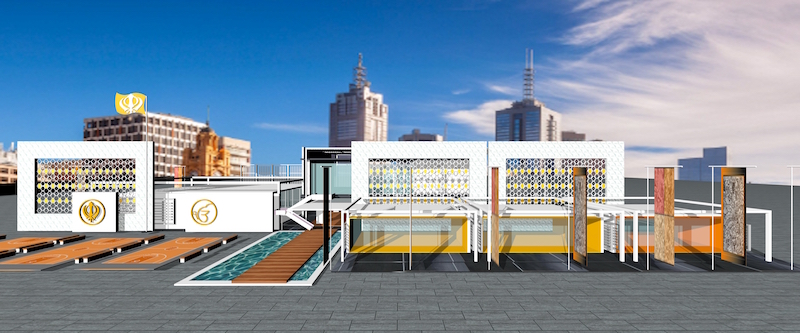
The proposed Gurdwara is divided into three main zones designated for recreation (basketball courts for example – located on the left) for education (classrooms and studios – located on the right) and for gatherings (a multi-purpose hall behind the Nishan Sahib) as seen on the front of the complex upon approaching the premises. The Darbar Sahib is located above the Langgar Hall accessible from the front via a timber bridge for the Sanggat to cross that goes straight into the Langgar Hall itself and subsequently leads to the Darbar Sahib above.
Gurdwara Design: The Communal Spirit That Binds Us All – Design by Vishal J Singh
The front of the complex is directly accessible to members of the general public to use accordingly with the permission of the committee, and these spaces ( basketball courts and the classrooms and studios) conceivably can be used to generate additional revenue for the maintenance of the Gurdwara should the Sanggat agree to the idea, or a form of community service that can remain free of charge. A permeable, semi-open geometric screen provides a notional sense of demarcation between these areas and the Darbar Sahib and the Langgar Hall itself, so as to create a sense organizational hierarchy as to where the prayer areas are and where the common areas are.
Gurdwara Design: The Communal Spirit That Binds Us All – Design by Vishal J Singh
The right side of the complex has areas dedicated to education through the rooms provided for art, music, school programs, performances and so forth, each internally colour coded with bright colours that are shades of the saffron colour connected to Sikh religion and culture. Colours have been proven to stimulate creativity when used in specific environments and in this complex, colours are also used to give certain rooms its own visual identity for people to recognize as they enter the premises.
Gurdwara Design: The Communal Spirit That Binds Us All – Design by Vishal J Singh
The back of the Gurdwara complex where the Langgar Hall and the Darbar Sahib is situated ( on the left of the image above ) is also protected by a series of tall metal screens in white, that establishes a distinct architectural identity for these sacred areas, and provides shading from direct sunlight that could cause the interiors to be uncomfortably warm. The multi-purpose hall ( on the right above ) that serves its own specific agenda of events, is flanked by a semi-open geometric screen as well so that these events that are held here are given a sense of individuality and privacy.
Gurdwara Design: The Communal Spirit That Binds Us All – Design by Vishal J Singh
The multi-purpose hall would have its own areas to allow for events such as weddings lunches and dinners, sports and games, educational seminars, public assemblies and so forth to take place that can be completely opened to anyone who may need them for specific purpose. By allowing this to take place, members of the public are brought together in various functions that could help people to get to know each other better, thus fostering improved social relations with everyone regardless of caste, colour or creed helping in nation-building exercises in general.
Irrevocably, Gurdwaras have always been the heart of all Sikh communities in the world, and this proposal seeks to pay homage and deeply honour that sacred role that Gurdwaras play in the lives of the Sanggat. This concept intends to propose that in the dynamic world of the 21st century that we live in now, there exists other interesting channels that bring people together as well and this proposal seeks to address how best to use those social – centric channels to our advantage for the benefit of our community, both as people of our own identity and the rest of humanity.
By having spaces within the Gurdwara complex dedicated to recreation, education and gatherings for either the Sanggat or the general public, this proposal seeks to cultivate a more robust, interactive form of societal participation from people from all walks of life so that we may all get to know each a little better and in the process, establish a world where people are friendlier and more trusting of each other. It is indeed very heartwarming to see volunteers of the Sikh faith engaged in helping people from other communities in sacred rites such as serving food and drinks during ‘Iftaar’ for example, and this proposal chooses to recognize that kindness and express a method to honour such kindness architecturally through the proposed design.
After all, being human, essentially we are all just one race, and architecture has the power to bring us all together under one roof to recognize that fundamental principle of who we are.
One race. Just one. Waheguru Bless.
The next proposal will center on the idea of building a Gurdwara made predominantly of the various kinds of metal used in construction today, namely, steel, iron, aluminum, bronze and such as celebration of the industrial world we live in
Vishal J.Singh, an aspiring architect, holds a Bachelor of Architecture Degree from Infrastructure University Kuala Lumpur and enjoys engaging in architecture and its theories as his first love.
* This is the opinion of the writer, organisation or publication and does not necessarily represent the views of Asia Samachar.
ASIA SAMACHAR is an online newspaper for Sikhs / Punjabis in Southeast Asia and beyond.Facebook | WhatsApp +6017-335-1399 | Email: editor@asiasamachar.com | Twitter | Instagram | Obituary announcements, click here |
A number of questions have already been received. All from Malaysia. I shall attempt to answer them in this interim post. I am treating this 21-day treatment/retreat like an Akhand Path, or Sehaj Path, if you like. We have reached the madh!
I am writing this not to promote Ayurveda. I write because I am reaching age 70. To put it bluntly, my hanyi (age group) friends are either dead, dying or having ailments, many of which could be averted by some good health management. Some, thankfully, truly look after themselves. Some go running and trekking regularly.
No doubt we need to become conscious of our health needs. We need to watch what eat eat and drink, and exercise regularly. Beyond that, a good regular detoxification is necessary because try as we may, even healthy foods are these days contaminated with herbicides, pesticides, fungicides, etc. The earth is overloaded with artificial and chemical fertilisers. I just happen to find such pampering as this convenient and hopefully help me to remain healthy until the sedha, the final call, comes.
I consider this kind of a retreat, even better than going to religious or spiritual retreats, simply because my body, too, is getting nourishment – proper nourishment. I carry my Guru Ji on my I-phone to address as often as I can. I have created my own body, mind and spirit retreat! So have some like minded friends and relatives!
The diagnosis, herbal medication and massages started on the very first day. I am here mainly to have the proverbial ‘service and oil change’ – basically a good detox. The result, hopefully, is weight loss too, especially because once here you have no choice but to eat and drink what they prescribe. ‘Prescribe’ is the right word. They prescribe and watch what you eat and drink and you end up measuring and counting each bite because it is minimum and precious! Food and drink certainly become medication and meditation.
By the way, my wife claims that the food has improved! It was good three years ago. It is now better! The food is tailored to your specific needs. And change can only take place with the express permission of the chief surgeon. I needed oats a few days ago for breakfast due to a tender stomach and it was communication between kitchen staff, junior doctor and senior surgeon before it was approved!
Food and ingredients are fresh grown. The fridge is non-existent. Basic carbs are chapatti, idly, puttu mayong, dosas of different grains, like wheat, dhal and rice floor and even millet. There is also a mixture called raagi, and there is rice. The chutneys, coconut and also tomato, are to die for! They do not do salads but there is half cooked green mung and concoctions of onions and tomato etc. There is a sambal-like mixture of half cooked onions and tomatoes which I swear, tastes like our sambal sardine or a good taufu sambal!
I guess I am writing about food first because my stomach has had little for the last 10 days, not the usual tambah (add, in Malay) portions. Even the dosas and chapattis are small. As I said, one counts every bite!
But, I feel good already.
Fruit, if allowed, are mainly bananas, pineapple or water-melon. Water, at all times is room temperature or hotter and treated with some herbs. You are constantly urged to drink as much as you can. We all know the benefits of water consumption.
The diagnosis at first meeting is very thorough. I mean, it takes the surgeons about one and a half hours to ask searching questions, your medical and injury history, observing you, checking your blood pressure, pulse, inspecting your eyes, tongue, etc. Your start weight is also recorded. The senior surgeon is a highly-qualified doctor and a qualified Ayurvedic surgeon. He will probably tell you things about yourself which you have forgotten or did not know. Each patient (client?) has a dedicated junior doctor who checks you on a daily basis and supervises the treatment and the medicines. The junior doctor who reports to him sees each and everyone every second or third day.
OIL MESSAGE
I receive a full oil massage almost every morning and a paste (medicated mud?) massage with a herbal poultice rub in the afternoon for the first six days. Every fourth day includes a sauna. Two massues massage in tango with each other with a third assisting. The junior doctor steps in at least once to oversee. The massage is finger-tip to toe-tip literally! Ayurveda massage is not deep tissue massage. It is more to let the oils and herbs be rubbed in firmly and properly and do their job and also allow the energy (chi?) to flow. On the seventh day it was an oil bath – yes literally warm oil was poured all over the body. In the afternoon oil was dripped on the forehead – teladhara, I think it is called. The price is a tasty fresh coconut to drink after each morning massage.
I must admit my body was stiff the first six days, lethargic and painful, with a slightly heavy head. On the seventh day I felt rejuvenated. I was told that often happens because the body gets set in its way. Muscles are not used. The massage jolts the body from its inertia and comfort zone and initially it does not like it. Slowly it becomes supple and the massage becomes more beneficial. Even my ample midriff only responded after 4 or 5 days from its stiffness and bloaty feeling and became soft and responsive to the massage.
No, there are no exercises. One is so fagged out by the massages, that all you want to do is sleep! There is internet coverage and also a TV in every room. Some overseas news channels like CNN and BBC, when there are no thunderstorms, or you just watch Indian movies or listen to Modi Ji. He is very prominent these days. The new Indian ‘god’ on the scene!
There are daily afternoon yoga classes if you wish to join and your surgeon permits it. Jessiee and I try to go for a walk every evening along the river or through the villages. Friendly. The kids speak English. Kerala state has the highest literacy rate (98%) in the entire country. The countryside is like going for a walk in rural Malaysia or the Malaya of old. Lush green, with tropical vegetation. Jackfruit is in season. Mangoes are just over. No durians. Not that you are allowed to eat any of these fruits! Coconut trees, and all the tropical flora you can think of with beautiful tropical flowers on the roadside. All villages are linked by small one and a half lane roads and the most frequent vehicle is either the scooter, bicycle or three-wheeler.
5Ks AND OTHER TOUCHY ISSUES
Now the ‘touchy’ issues. 5K’s, modesty etc. First of all, the massage team with you amongst them say a prayer to their goddess of good health. There is normally soothing south-Indian spiritual music playing. You are in ‘So-Dar-Land’ or ‘simranland’ straightaway, if you know what I mean. Only men massage men, women for women. If you have difficulty in exposing your body to strangers (at first), then you will have to overcome that inhibition. If you can’t, then this is not for you, or take a leap of faith. I pretend that I have died and my body is being given its last cleansing by close ones! It has taken me and my wife time to get used to this. Once we overcame that, we have benefitted.
If you insist, you can keep your kachhera on, at the detriment of getting many kachheray dirty. (They are washed. Laundry is part of the package.) They provide a small loin cloth with a string to tie around your waist. So, there is minimum clothing for maximum massage benefit. Kara, kirpan and kanga can be respectfully kept close to you at hand. Your head will be massaged. So be prepared to bath kesi (hair bath) everyday! Bring along some good fragranted shampoo and hair oil! Their oil mixtures smell of mainly coconut, and sesame oils with other herbs. You can ask for your hair not to be touched or head massaged. Your loss.
More in 10 days at bhog!
FAMILY ATMOSPHERE
What strikes me most about this place and the people is the ‘family’ atmosphere they have created. The staff – doctors, surgeons, admin., massage staff, kitchen staff and all other workers – the gardeners and, cleaners, smile and are very accommodating. And it is also heartwarming, most patients/clients, who come from all parts of the globe, are friendly. Those that do not want to be friendly stay to themselves. Staff also give cookery lessons and there are talks on Ayurveda philosophy, healthy living etc. on a daily basis.
Now, the crunch. I told you that I stood on the scale at 110kgs. On the first day. One Day 10, the scale says 106.5kg. I have lost 3 and a half kilos in 10 days. I am a little disappointed as, like most people would, I expected a greater loss of weight. I am told that the weight loss does not happen overnight. What you do today has an impact on your weight normally a week later! So, I look forward to what the scale says the day I leave…
Again, any questions, write either to Asia Samachar and your note shall appear at the bottom, or if you require privacy, email me.
I will write a conclusion on the finish and any questions that might come in.
Chardhi Kala and Guru dhi meher.
Malaysian-born Dya Singh, who now resides in Australia, is an accomplished musician and a roving Sikh preacher. The Dya Singh World Music Group performs full scale concerts on ‘music for the soul’ based on North Indian classical and semi-classical styles of music with hymns from mainly the Sikh, Hindu and Sufi ‘faiths’. He is also the author of SIKH-ING: Success and Happiness. He can be contacted at dyasingh@khalsa.com
* This is the opinion of the writer and does not necessarily represent the views of Asia Samachar.
ASIA SAMACHAR is an online newspaper for Sikhs / Punjabis in Southeast Asia and beyond.Facebook | WhatsApp +6017-335-1399 | Email: editor@asiasamachar.com | Twitter | Instagram | Obituary announcements, click here |
Meet Santosh from LA. She’s the daughter-in-law of Sant Singh Shattar, the first Sikh employed to work as a postman and wear a turban on duty. She visited the Discovery Room recently to share her memories and find out more about Sant Singh’s story. – The Postal Museum (Official Twitter for London-based Postal Museum @thepostalmuseum, 8 April 2019)
ASIA SAMACHAR is an online newspaper for Sikhs / Punjabis in Southeast Asia and beyond.Facebook | WhatsApp +6017-335-1399 | Email: editor@asiasamachar.com | Twitter | Instagram | Obituary announcements, click here |
Some 500 Sikh youth are expected to take part in the maiden Miri Piri Games over two weekends in Selangor next month (July).
Organised by volunteers from three gurdwaras – Subang, Petaling Jaya and Shah Alam — the games have some unique features. For one, they are open to Sikhs from abroad and the physically challenged.
There will eight categories: badminton, bowling, archery, athletics, football, hockey, netball and futsal. The first four events are open to participants from all ages.
“This game will not only bind the community but also encourage families to work together,” one of the organising team official tells Asia Samachar.
“For the time in Malaysian Sikh sports, we have a special category for our Punjab brothers and sisters (desi veers and bhens). The system is the same: each gurdwara sends their desi reps for the events (tug of war, shot put and long jump),” he said. Desi is the colloquial for Sikhs from Punjab.
.
The games also have a special category for the physically challenged participants for archery.
How did the idea of the #MiriPiriGames2019 come about? “We are passionate about doing something for the society. We got together over a series of phone calls and a common interest. From then, everything went on a flow,” he said.
The games will take place on 13-14 and 20-12 July. Asia Samachar is the event media partner.
ASIA SAMACHAR is an online newspaper for Sikhs / Punjabis in Southeast Asia and beyond.Facebook | WhatsApp +6017-335-1399 | Email: editor@asiasamachar.com | Twitter | Instagram | Obituary announcements, click here |
A Sikh lawmaker made a short but poignant reference to 1984 Indian attack on the Darbar Sahib in Amritsar, the most recognised place of worship for Sikhs around the world
Thirty-five years after the Indian government attack, Gurratan Singh told the Ontario legislative assembly that Sikhs ‘stand unbroken’ and ‘will never forget’.
In the speech at the Canadian state assembly, the MPP for Brampton East said the incident which began unfolding on 1 June 1984 was ‘a military invasion into the Darbar Sahib complex in Amritsar, along with more than 40 other gurdwaras throughout Punjab.’
The Darbar Sahib attack was later compounded by the pogrom of Sikhs in November 1984 following the gunning down of Indian Prime Minister Indira Gandhi by her Sikh bodyguards. Here, tens of thousands of Sikhs were murdered in India in largely government-sanctioned violence.
In 2017, Ontario became the first legislature in Canada to carry a motion, moved by the then Liberal party member Harinder Kaur Malhi, describing the 1984 anti-Sikh riots as genocide.
On 18 May 2019, Gurratan joined fellow Ontarion lawmakers when they voted unanimously to pass a law to recognise the Tamil Genocide Education Week.
In his speech on the floor of the assembly, he noted that trauma was intergenerational which meant that the next generation of Tamils would experience the pain of those before them.
“That is why it is so important to name the Tamil genocide, recognize it and continue to remember it, so the Tamil people can share their memories of those whose lives were lost to make sure their stories are told and to educate the community for generations to come, because we can only heal from trauma once we confront it,” he said.
Here is Gurratan’s full speech on 1 June 2019 marked #NeverForget84 on his social media:
“For the last few days, I’ve had a lot of trouble sleeping. All I could think about is what June 1 represents: artillery firing and destroying the sovereign seat of the Sikh people, the Akal Takht; bullets marring the beautiful golden facade of the Harmandir Sahib, the Golden Temple; the blood of thousands of innocents filling the serene pool that surrounds it, the Sarovar; image the terror when, 35 years later to this very day, in June 1984, as Sikhs gathered to commemorate the sacrifice of our fifth Guru, the Indian government launched a military invasion into the Darbar Sahib complex in Amritsar, along with more than 40 other gurdwaras throughout Punjab, killing thousands of innocent worshippers, burning and looting our libraries, all under a complete media blackout.
“Imagine attending a place that was so important to the heart of your religion – your Masjid during Eid, your Church during Christmas, your Mandir during Diwali – that is the time that Indian government chose to attack the Darbar Sahib complex.
“But more than just kill and destroy, in the words of Dr Joyce Pettigrew, the Indian government’s action were “to suppress the culture of a people, to attack their heart, to strike a blow at their spirit and self-confidence.” Well, 35 years later, we stand unbroken, we stand tall and we say, “We will never forget.”
Gurratan is a lawmaker from NDP, a major political party in Canada led by his brother Jagmeet Singh. Gurratan played an instrumental role in Jagmeet’s ascent to MPP and the leadership of the Federal NDP.
ASIA SAMACHAR is an online newspaper for Sikhs / Punjabis in Southeast Asia and beyond.Facebook | WhatsApp +6017-335-1399 | Email: editor@asiasamachar.com | Twitter | Instagram | Obituary announcements, click here |
Subang Sikhs organise buka puasa at the Sunway police station – Photo: Supplied
By Asia Samachar | MALAYSIA |
When the police and the Sikh community came together. A fortnight ago, the Subang gurdwara organised a buka puasa (breaking fast) for the men and women hard at work at a police station at Bandar Sunway in Subang Jaya, Selangor. The officer in charge at the police station is ASP Sulaiman Baputty. The Gurdwara Sahib Subang held the event in appreciation of the continuous support of the men and women in uniform.
ASIA SAMACHAR is an online newspaper for Sikhs / Punjabis in Southeast Asia and beyond.Facebook | WhatsApp +6017-335-1399 | Email: editor@asiasamachar.com | Twitter | Instagram | Obituary announcements, click here |
PATH DA BHOG:16 June 2019, from 10am till 12pm, at Gurdwara Sahib Mainduab, Jalan Pudu Lama, Kuala Lumpur, and thereafter a Guru Ka Langgar will be served|Malaysia
Daljit Singh Chhran (1966-2019), Singapore High Commission
and a host of family members, relatives and friends.
Sehaj Path da Bhog: 16 June 2019, from 10am till 12pm, at Gurdwara Sahib Mainduab, Jalan Pudu Lama, Kuala Lumpur, and thereafter a Guru Ka Langgar will be served.
Please accept this to be a personal invitation from our family
We wish to express our heartfelt gratitude to all our relatives and friends for their kind presence and support rendered during our recent bereavement.
Contact:
Jagjit Kaur 016 317 6468
Harjagjit Singh 016 658 4075
| Entry: 3 June 2019; Updated: 9 June 2019 | Source: Family |
ASIA SAMACHAR is an online newspaper for Sikhs / Punjabis in Southeast Asia and beyond.Facebook | WhatsApp +6017-335-1399 | Email: editor@asiasamachar.com | Twitter | Instagram | Obituary announcements, click here |