SATUANTH KAUR D/O OF LATE JASWANT SINGH (IMR) & LATE JOGINDER KAUR
Wife of Late Stanley Letchumanan Mother of Sharmini Letchumanan
12 October 2025, Sunday 10.00 am to 12 noon Kirtan & Sahej Path followed by Guru Ka Langgar Gurdwara Sahib Polis (Jalan Parlimen, KL)
Death is a natural part of the soul’s journey, merely a transition from the physical body to the Divine Waheguru. Though I mourn you but, yet I now celebrate your soul’s completion to its Divine source. Missing your smile, Mummy!
ASIA SAMACHAR is an online newspaper for Sikhs / Punjabis in Southeast Asia and beyond. You can leave your comments at our website, Facebook, Twitter, and Instagram. We will delete comments we deem offensive or potentially libelous. You can reach us via WhatsApp +6017-335-1399 or email: asia.samachar@gmail.com. For obituary announcements, click here
The Muslim Council of Britain marked the Islamophobia Awareness Month at an event hosted by Wolverhampton City Council – Photo: MCB
By Gurnam Singh | Opinion |
For some years, there has been a campaign in the UK to introduce a law that would, in effect, make ‘Islamophobia’, that is, hatred towards followers of Islam, namely, Muslims, a criminal offence, similar to the offence of ‘antisemitism’, which relates to anti-Jewish hate crime.
Advocates for legislation against Islamophobia, include the All-Party Parliamentary Group (APPG) on British Muslims, the Muslim Council of Britain (MCB), and the Labour Party. They all argue that a legal definition of Islamophobia, which they often define as a form of anti-Muslim racism, is crucial to better understand, quantify, and effectively combat the unacceptable rise in hate crimes, social inequalities, and discrimination experienced by Muslim communities in the UK
However, not all people are supportive of this move, for varying reasons. One of the most notable opponents is The Network of Sikh Organisations (NSO).
NSO contends that existing hate crime laws already provide sufficient protection and that introducing a broad definition of Islamophobia could undermine the religious freedoms of Sikhs and other faith groups. They go onto argue that such a definition might disadvantage Sikhs by restricting their ability to practise and express their faith. As Lord Singh of Wimbledon, and director of NSO, argues “many Sikh beliefs and practices, though essential to the faith, might be deemed offensive under an expansive interpretation of Islamophobia”. The NSO further warned that defining Islamophobia too broadly could lead to the censorship of Sikh history, particularly where it references oppressive Muslim rulers, and that religious practices such as the prohibition of halal meat could be unfairly labelled as Islamophobic. Singh maintained that it would be illogical and unjust to curtail one community’s religious freedoms in order to protect another’s sensitivities from subjective offence.
I, too, object to the introduction of this legislation, though my concern is more general regarding the principle of freedom of expression and thought. For me, any such proposed legislation, whether relating to Islam, Christianity, Hinduism, Sikhism, Judaism, or any other belief system, that risks impinging on our fundamental right to preserve our historical narratives and to criticise ideas, religious or secular. My fear is that these demands are a further manifestation of the politics of difference, whereas universal principles that protect us all are increasingly being sacrificed in the name of cultural relativism.
The distinction between critique, criticism and hate is not always clear-cut. If we are not careful, attempts to outlaw anything that might be deemed “offensive” could lead us down a slippery slope toward censorship. In a society that values freedom of thought and expression, the right to question, challenge, and even satirise belief systems must remain protected.
This is especially important given the diversity of interpretations within faith traditions themselves. Islam, for example, encompasses a wide spectrum of thought, from Sunni and Shia schools to the Ahmadiyya community to numerous sub-sects. There is much disagreement between these traditions to the extent that they are deemed heretical and banned in some Muslim-majority countries. Legislation intended to protect one interpretation of a religion could, unintentionally, suppress dissent within that same religion.
Antisemitism should rightly be treated as a hate crime because it targets Jews as a distinct ethno-religious community rather than an ideology. It manifests in hostility, harassment and violence against individuals and institutions, causing real and measurable harm, and therefore warrants legal protection similar to that afforded to other vulnerable groups. By contrast, Islam is an ideology or belief system, not a people. While Muslims, as individuals, deserve full protection under existing hate-crime laws against threats, discrimination, or violence, extending criminal sanctions to “Islamophobia” risks conflating criticism of an idea with hatred of people.
This distinction is crucial: laws should protect persons from harm, not belief systems from scrutiny. In a free society, safeguarding individuals from hate must never come at the expense of our right to question or criticise any set of beliefs, religious or secular. Faith systems should not require legal protection from scrutiny. Ideas, unlike individuals, cannot be harmed, only tested, refined, or rejected. Any legislation that restricts our ability to question or criticise religious or non religious ideological systems would ultimately weaken one of the most fundamental principles of a liberal democracy: the freedom to think and speak freely.
Of course, genuine hate, manifesting as hostility, incitement, or violence toward individuals or groups, is wholly unacceptable and must be condemned and dealt with under existing laws, and sure, if they need tightening, thats fine. But in a free and open society, disagreement and debate are not only inevitable; they are essential.
Gurnam Singh is an academic activist dedicated to human rights, liberty, equality, social and environmental justice. He is an Associate Professor of Sociology at University of Warwick, UK. He can be contacted at Gurnam.singh.1@warwick.ac.uk
* This is the opinion of the writer and does not necessarily represent the views of Asia Samachar.
ASIA SAMACHAR is an online newspaper for Sikhs / Punjabis in Southeast Asia and beyond. You can leave your comments at our website, Facebook, Twitter, and Instagram. We will delete comments we deem offensive or potentially libelous. You can reach us via WhatsApp +6017-335-1399 or email: asia.samachar@gmail.com. For obituary announcements, click here
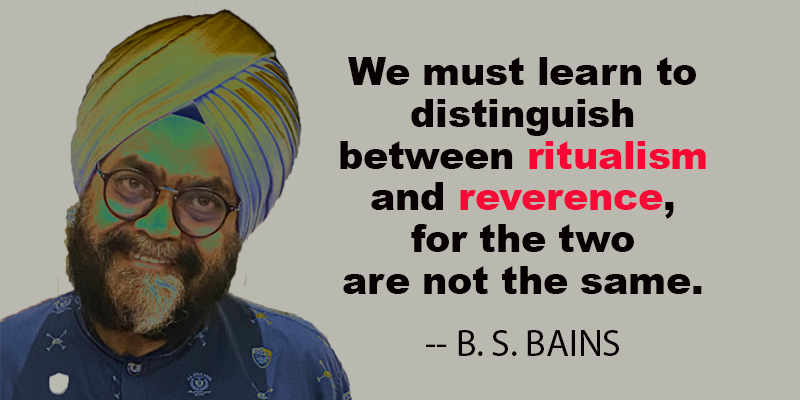
In this reflection, Dr. B.S. Bains urges the Sikh Diaspora to revisit the long-held critique of rituals often termed “Hindu Matt.” He reminds us that through ten human lives, but with one divine spirit, our Gurus emphasized transforming ritualism into reverence — a principle that was deeply embedded in the lifestyle of the populace across the entire Indo-Mediterranean zone for centuries. The essence of Sikhism, he notes, lies not in condemning others but in elevating spiritual consciousness beyond outward forms. While minimizing rituals, Dr. Bains stresses that it must be done with utmost respect for those who practise them — for true harmony lies in unity, the very message our Gurus embodied.
By Dr. B. S. Bains | Opinion |
For generations, Sikh scholars and preachers have condemned empty rituals, often linking them to what is commonly referred to as “Hindu Matt.” So much so it has been instilled into the minds of common Sikhs and often refer to this if they deny any rituals in their home. While this distinction once seems to have helped preserve the purity of Sikh thought and identity, it may now be creating unintended divides within the broader social and cultural fabric of India and around the universe especiallythe followers of the Hindu Faith under various sub groups. After all, many customs that Sikhs reject as “rituals” were once cultural practices shared across faiths — not merely religious boundaries. Perhaps it is time for Sikhs to re-examine the term “Hindu Matt” and consider whether its continued use promotes understanding or widens a rift between communities that share deep historical and spiritual roots.
We must also learn to distinguish between ritualism and reverence, for the two are not the same. Ritualism is often mechanical — an act performed out of habit, fear, or social expectation — whereas reverence is born from genuine love, awareness, and connection with the Divine. Not all rituals express reverence, and not all reverence requires ritual. When an act is filled with humility, mindfulness, and devotion, even the simplest gesture becomes sacred. But when the same act is done without understanding, it loses its spirit and becomes mere performance. Guru Nanak’s teaching reminds us to preserve the essence of reverence while freeing ourselves from the bondage of empty ritual.
The origins of this separation lie not in animosity but in reform. Guru Nanak sought to free spirituality from the grip of rigid ritualism and social hierarchies that shaped the religious life of his time — practices that often-instilled fear in the human mind with ideas of good or bad omens, or divine punishment for neglecting rituals. Such ritualism was visible in Arti, KadwaChawk, ritualistic prayers in Namaaz, and other socially structured observances. Performed merely as routine, these acts often lost their spiritual essence and became mechanical traditions. Guru Nanak, however, perceived them as aspects of culture rather than genuine pathways to the Divine. He did not condemn them outright but gently elevated their meaning — transforming ritual into reflection through the wisdom of his divine poetry. His message emphasized simplicity, equality, and direct communion with the Divine — a call to nurture inner devotion over outward display.
Over centuries, however, the colonial narrative of defining communities into neat religious boxes — “Hindu,” “Muslim,” and later “Sikh” — deepened distinctions that were once fluid. What began as a spiritual reform within the Indian ethos gradually evolved into an assertion of distinct identity. In that process, the phrase “Hindu Matt” became less a theological critique and more a social marker — one that now risks overshadowing the shared moral and cultural lineage between Sikhs and Hindus.
In today’s interconnected world, where divisions often breed misunderstanding, it may be time for Sikhs to reclaim Guru Nanak’s original vision — one that transcended caste, creed, and religious barriers. True Sikh teachings are not threatened by dialogue or shared heritage; they are, in fact, meant to strengthened and enriched our inner systems. Sikhism was born out of conversation — a fearless dialogue between truth and illusion, between self and society, between rituals and deed. Guru Nanak himself travelled far and wide, engaging with Hindus, Muslims, Sufis, and yogis, not to challenge their faiths but to illuminate their understanding through divine wisdom. When Sikhs embrace dialogue, they continue that same sacred journey — one that replaces judgment with understanding and separation with shared discovery. The strength of Sikhism lies not in isolation, but in its ability to stand in the midst of diversity while radiating unity. Every conversation, but not ego related,deepens respect among faiths echoes the Guru’s eternal call: “Na koi Hindu, Na Musalman — all are children of the One Creator.”
The essence of Guru Nanak’s message was never to condemn others but to awaken the divine spirit within each individual. Even today, many practices once dismissed as ritualistic — such as KadwaChawk, Rakhi, Lodhi, and Diwali — are being revisited and understood in a new light, as cultural expressions rather than religious transgressions. Yet, some sections of the Sikh clergy continue to label these observances as part of “Hindu Matt.” One must ask: when will this narrow view end? What harm lies in appreciating these traditions as part of our shared cultural heritage rather than rejecting them outright? The true purpose is not to brand such acts as “Hindu Matt” or distance ourselves from the communities that value them, but to guide humanity toward simplicity, mindfulness, and spiritual depth. It is about minimizing the hold of ritual, not condemning those who practise it. By embracing this inclusive spirit, Sikhs can once again embody the compassion and universality of Guru Nanak’s timeless truth — Ik Onkar: there is but One Creator, and all creation is one family.
There are segments within our Sikh community who openly speak against certain sects or traditions, often in harsh or dismissive tones. Such attitudes, though perhaps born from zeal, can breed bias, misunderstanding, and even quiet resentment. Imagine, for a moment, if the situation were reversed — how would others perceive the Sikh faith? Would they still feel drawn to associate with us, or would they begin to view Sikhs as intolerant or exclusive? This mindset carries not only social but also cultural and economic consequences, as it weakens bonds of cooperation and mutual respect. Despite all the noble service and goodwill Sikhs contribute to society, such divisive remarks risk making us appear unapproachable or rigid. Until we move beyond labeling others with terms like “Hindu Matt,” we will continue to be seen as disengaged from the secular and inclusive spirit that Guru Nanak envisioned for humanity.
Dr Balwant Singh Bains is the President of the Private Physiotherapy Clinic Owners Association of Malaysia and the Past President of Malaysian Physiotherapy Association. He serves on the Advisory Board of Gurdwara Sahib National Putrajaya and is a founding member of the World Sikh Chamber of Commerce (Malaysian Chapter). A Sikh humanist, thinker and passionate Kirtan enthusiast, Dr. Bains continues to promote Guru Nanak’s message of unity, compassion and selfless service through both his professional and spiritual pursuits.
ASIA SAMACHAR is an online newspaper for Sikhs / Punjabis in Southeast Asia and beyond. You can leave your comments at our website, Facebook, Twitter, and Instagram. We will delete comments we deem offensive or potentially libelous. You can reach us via WhatsApp +6017-335-1399 or email: asia.samachar@gmail.com. For obituary announcements, click here
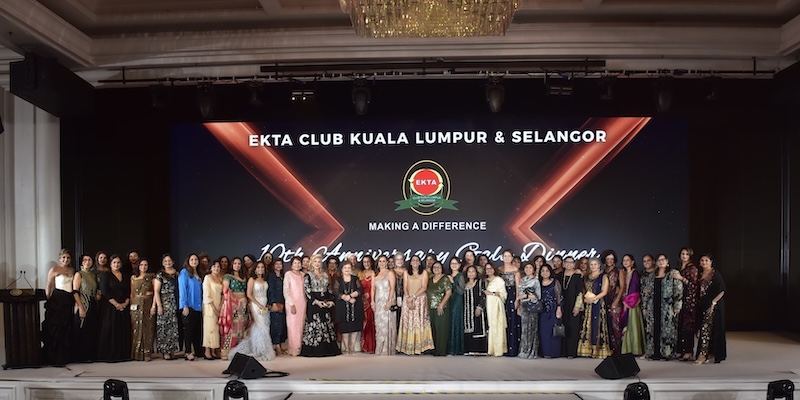
At a fund raising gala dinner in Kuala Lumpur on August 2, the club raised RM550,000, out of which RM450,000 has been set aside for the setup of its first Sikh Senior Citizens’ Activity Centre in the Klang Valley.
“We are on the lookout for a centre. We will provide more details soon,” the club president, Kuldip Kaur, told Asia Samachar.
The rest of the funds will be utilised for various community empowerment activities through its legal, welfare, medical, youth development, and lifelong learning teams.
Malaysia’s Minister of Youth and Sports Hannah Yeoh was the guest of honor.
The club has made its presence felt over the years. In February 2025, for example, more than two dozen Sikh students received invaluable insights into how they can present themselves better to the world and get ahead in whatever endeavour they are pursuing at the Personal Branding for Beginners workshop in Ipoh, Perak.
This is the signature programme designed and championed by the club, with Asia Samachar as the media partner.
In June 2024, they celebrated 280 Sikh women at their maiden Senior Citizens’ Day in Kuala Lumpur on June 22, 2024. Here, they recognised two prominent Sikh women, Dr. Ajeet Kaur Gill and Preetam Kaur Gill, for their contributions to the Sikh community and the community at large.
In March 2024, some 140 participants took part in the club’s inaugural Treasure Hunt Walk held in Kuala Lumpur, again designed to raise funds to sustain some of its key community initiatives for the year. It was a delightful adventure for members and friends around Titiwangsa West Lake.
Some key leaders from the EKTA Club Kuala Lumpur & Selangor at their gala dinner on August 2, 2025
Back to the dinner — the club members have made every effort to ensure that they keep costs to a minimum.
“The Ekta Gala sparkled with world-class entertainment, yet we managed to keep costs to a minimum so that more funds could go directly to our cause.
“This was only possible because of the incredible generosity of our entertainers and performers, who jumped on board without hesitation, believing in our cause,” said one of the club officials.
From Kavita Sidhu’s star power and the dazzling lineup of beauty queens on the runway to Kavita Thulasidas’ breathtaking designs, every act of kindness and passion brought elegance, glamour, and heart to the evening, turning it into a celebration of giving as much as of style.
So, stay tuned to see what this dynamic group of ladies will do next.
ASIA SAMACHAR is an online newspaper for Sikhs / Punjabis in Southeast Asia and beyond. You can leave your comments at our website, Facebook, Twitter, and Instagram. We will delete comments we deem offensive or potentially libelous. You can reach us via WhatsApp +6017-335-1399 or email: asia.samachar@gmail.com. For obituary announcements, click here
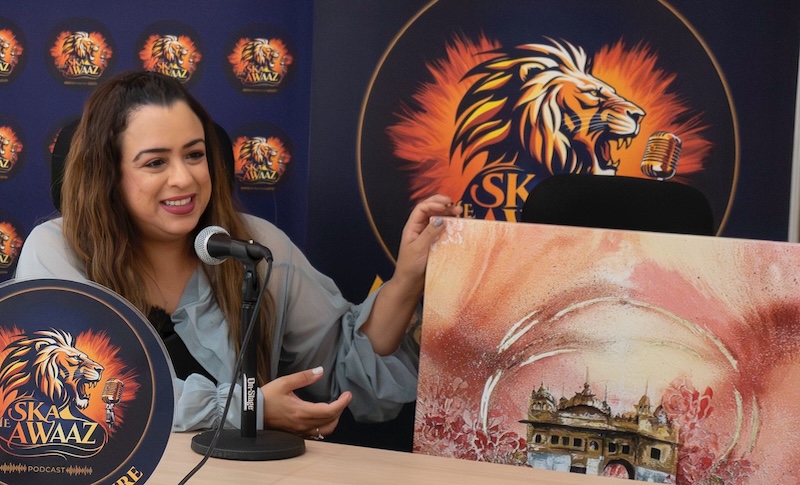
Anit Kaur, a Singapore-based contemporary Sikh artist, has an uncanny ability to transform personal experiences and deep reflections on Sikhi into breathtaking paintings. And her talent has taken her place – from soulful solo exhibition in Bali to her recent showcase in London celebrating Sikh women warriors.
“I think as a Singaporean Sikh who grew up out of Singapore, I always felt I was a minority everywhere….And so as a minority, I feel my style is always different, very fusion,” she shares in the latest episode of the SKA Awaaz podcast.
“But then who I am inside, I don’t make sense without, like my dad used to tell us Sakhi’s growing up, like going to Gurdwara. Like it’s such a huge part of our identity that I didn’t care about painting other things as much as I cared about painting Sikhi art. And somehow when I started painting fusion style with Sikhi art, people wanted to have it in their homes,” she added.
She shares how art became her medium of healing, connection, and empowerment; turning pain into beauty and solitude into strength. Beyond her exhibitions, Anit is also pursuing her Masters in Art Therapy, using creativity as a powerful tool to help others find peace and expression in their own stories.
The self-taught painter’s story is a celebration of self-discovery and perseverance and of choosing light in moments of darkness and using creativity as a force for connection and healing.
Beyond her exhibitions, Anit is also pursuing her Masters in Art Therapy at the Lasalle College of the Arts, using creativity as a powerful tool to help others find peace and expression in their own stories.
Hosted by Harpreet Kaur, SKA Awaaz Voices That Inspire is a podcast by the Singapore Khalsa Association (SKA), with Asia Samachar as its media partner.
ASIA SAMACHAR is an online newspaper for Sikhs / Punjabis in Southeast Asia and beyond. You can leave your comments at our website, Facebook, Twitter, and Instagram. We will delete comments we deem offensive or potentially libelous. You can reach us via WhatsApp +6017-335-1399 or email: asia.samachar@gmail.com. For obituary announcements, click here
ASIA SAMACHAR is an online newspaper for Sikhs / Punjabis in Southeast Asia and beyond. You can leave your comments at our website, Facebook, Twitter, and Instagram. We will delete comments we deem offensive or potentially libelous. You can reach us via WhatsApp +6017-335-1399 or email: asia.samachar@gmail.com. For obituary announcements, click here
A native of Ludhiana, Punjab, Preet Anmol Singh Grewal came to Australia as an international student. He earned a degree in engineering, secured a well-paying job, and permanent residency.
Despite this success, he ended up living on the streets of Blacktown, Sydney, as his mental health declined.
He is now receiving treatment with support from the local Punjabi community, while his mother, Harmeet Kaur, has travelled from India to be by his side.
Speaking with SBS Punjabi, Kaur said, “While living in Australia, Preet Anmol developed depression and began seeking financial help from his family in India”.
ASIA SAMACHAR is an online newspaper for Sikhs / Punjabis in Southeast Asia and beyond. You can leave your comments at our website, Facebook, Twitter, and Instagram. We will delete comments we deem offensive or potentially libelous. You can reach us via WhatsApp +6017-335-1399 or email: asia.samachar@gmail.com. For obituary announcements, click here
Pakistan PM Shehbaz Sharif get a send-off by his Malaysian counterpart Anwar Ibrahim (left, saluting) at the airport on Oct 7, 2025 at the conclusion of his three-day official visit – Photo: PMO
By Asia Samachar | Malaysia |
Pakistan Prime Minister Muhammad Shehbaz Sharif concluded today a three-day visit to Malaysia, his first visit since taking office in March 2024.
In a meeting yesterday, Prime Minister Anwar Irabhim and Shehbaz agreed to reconvene, at a mutually convenient time, the Joint Commission Meeting at the level of the Foreign Minister and the effective utilisation of the Malaysia–Pakistan Closer Economic Partnership Agreement (MPCEPA).
Malaysia expressed its intention to expand palm oil exports to Pakistan, in line with the increasing demand by its food processing and manufacturing sectors, according to a statement released by Malaysia’s foreign ministry.
Both leaders also acknowledged the growing global demand for halal products and services, and agreed to strengthen cooperation in the field of halal.
Shehbaz reiterated Pakistan’s stance on Kashmir and thanked Malaysia for its steadfast support for a peaceful settlement of the Jammu and Kashmir dispute in accordance with UN resolutions.
Speaking at a Pakistan-Malaysia business and investment conference, Shehbaz noted that Pakistan is the 5th largest cotton and milk producing country around the globe, and the 4th largest mango producer.
“Our mangoes, in terms of taste, are second to none. In these areas, small and medium enterprises can be developed, where during the offseason we can collect these wonderful fruits, store them, and add value by making jams, marmalade, and various other products for export.
“Livestock is another promising sector, with Pakistan set to export $200 million worth of meat to Malaysia. We are committed to competing on international prices, ensuring quality, and honoring shipment commitments, adding great value to our bilateral trade cooperation.
“Balochistan’s Reko Diq mine holds vast copper reserves crucial for the global energy transition. Pakistan’s rich geology offers attractive investment opportunities, leveraging natural resources, skilled workforce, and strategic location, while benefiting from Malaysian expertise, technology, and investment capacity.
“By establishing operations in Pakistan, companies gain a strategic gateway to regional and global markets, including competitive access to the Gulf. With joint efforts, we can unlock new horizons of trade, investment and industrial collaboration where one plus one is not two but eleven. Long live Pakistan- Malaysia friendship,” he said, according to text shared at his social media platform.
ASIA SAMACHAR is an online newspaper for Sikhs / Punjabis in Southeast Asia and beyond. You can leave your comments at our website, Facebook, Twitter, and Instagram. We will delete comments we deem offensive or potentially libelous. You can reach us via WhatsApp +6017-335-1399 or email: asia.samachar@gmail.com. For obituary announcements, click here
No matter how powerful, rich or intelligent one is, nobody can evade physical death. It is the most certain thing in life that, for most, is otherwise highly unpredictable. Nobody, really knows what will happen tomorrow, or the day after, but we all know we will die one day! And it is this inevitability of our ultimate demise, coupled with the unique human capacity to contemplate it, that motivates us to be curious about what happens when we die? This question, which is as ancient as humanity itself, sits at the intersection of science, spirituality and psychology. It is not merely a theological puzzle but a deeply human one, revealing our need to find meaning in the face of knowledge of our impermanence.
The Roots of Belief
A cursory scan of cultures, epochs and civilisations, reveals the ever presence of the idea that something of us endures beyond physical death. This universality itself is telling. From the pharaohs of Egypt entombed with possessions for their journey beyond, to the digital age where people now memorialise themselves on social media, to the idea that one day we might be able to download our minds into computers and ‘live for ever’, the instinct to survive death, both symbolically or spiritually, is hardwired into our species. For some, this conviction arises from faith. For others, it emerges from deeply personal experiences that seem to defy simple explanation.
Religious Frameworks
The world’s great religions have provided structured cosmologies to explain what awaits us beyond the grave.
In the Abrahamic traditions the soul is judged by a transcendent God, and its eternal destination depends upon moral conduct and divine grace. Heaven and Hell function as moral endpoints in a cosmic drama of justice.
In contrast, the Indic traditions speak not of finality but of cycles. The soul (ātman) transmigrates, reborn in different forms through saṃsāra, propelled by the moral calculus of karma. Liberation (moksha or nirvāṇa) represents an escape from this cycle — a merging into ultimate reality.
Even among the non-religious, belief in some form of existence beyond death often stems from personal testimony. Near-Death Experiences (NDEs), for instance, feature in medical literature and spiritual discourse alike. Rational explanation would render such claims as anecdotal and unverified subjective experience. For those who live them, they are transformative and beyond doubt.
The Scientific Counterpoint
Science, grounded in materialism, maintains that consciousness is a function of the brain. When the brain ceases, so too does the mind. This view is supported by evidence that brain injury or disease can profoundly alter personality and awareness. Neuroscience proposes physiological explanations for NDEs in terms of surges of serotonin, oxygen deprivation, that that can induce euphoria and visions. Recent research even detects a final burst of neural activity moments before death. Yet a stubborn paradox remains. How do some individuals report clear, structured awareness and verifiable perceptions during periods of apparent brain inactivity? Science, for all its progress, has not yet fully explained consciousness itself, let alone its possible continuity.
The Role of Consciousness
Perhaps the most intriguing insight lies not in empirical data but in the nature of consciousness itself. The very ability to imagine life beyond death may be a defining feature of being human.
We are creatures capable of temporal transcendence. We can revisit the past, anticipate the future, and conceive realities beyond the present moment. This self-reflexive awareness — the “I” that observes the “me” — enables us to think of ourselves as distinct from the physical body. Without this mental separation, even the idea of immortality would be inconceivable.
This cognitive power, intertwined with emotion, gives rise to hope — arguably the most vital of human capacities. Hope allows us to endure uncertainty, to ascribe purpose to suffering, and to imagine continuity beyond dissolution. In this sense, belief in the afterlife may serve not merely a theological function but an evolutionary one: it transforms mortality from a void into a narrative of meaning.
The Sikh Insight
The Sikh perspective offers a subtle yet radical reinterpretation that is distinct from both the major faith traditions and science. It shifts focus from speculative metaphysics to the lived experience of consciousness and the here and now. Guru Nanak challenges us to understand that the real death is not the physical cessation of the body, but the death of ethical and spiritual awareness. To be “dead while alive,” is to be consumed by māyā and the illusion of materiality, ego, and separation from the Divine.
The Sikh path thus calls for an awakening of the mind, or what some call the soul. This is a form of liberation (mukti) that can only be attained through truthful living, ethical conduct, and the realisation of Oneness (Ik Oankar). The “afterlife”, therefore, becomes less a destination and more a dimension of awareness, or what is termed the Chauthā Pad (Fourth State) where individuality dissolves into universal consciousness. In this state of heightened awareness, the question “What happens when we die?” is becomes less important than “How do we live before we die?”
As Guru Nanak Dev Ji (SGGS, 9) proclaims, ਆਖਾ ਜੀਵਾ ਵਿਸਰੈ ਮਰਿ ਜਾਉ ॥ “Uttering the divine Name, I live; forgetting, I die.” In this profound formulation, death is not an ending but a metaphor for transformation — from ignorance to understanding, from separation to union. The real immortality lies not in endless continuation, but in realising the eternal within the temporal.
Conclusion
Science seeks evidence; spirituality seeks meaning. Yet both are animated by the same human impulse, that is the longing to know what, if anything, lies beyond our all too brief and insignificant period in a vast universe. Whether consciousness persists as a metaphysical essence or dissolves into the vast field of energy and matter, the dialogue between science and soul remains one of humanity’s most enduring frontiers.
Perhaps, as Guru Nanak suggests, the true wisdom lies in transcending the question itself and focussing on the here and now. And when we can train our minds to do this, then we start to realise that life is nothing more than a series of present moments, and the question ‘what happens when we die’ simply ceases to have any meaning.
Gurnam Singh is an academic activist dedicated to human rights, liberty, equality, social and environmental justice. He is an Associate Professor of Sociology at University of Warwick, UK. He can be contacted at Gurnam.singh.1@warwick.ac.uk
* This is the opinion of the writer and does not necessarily represent the views of Asia Samachar.
ASIA SAMACHAR is an online newspaper for Sikhs / Punjabis in Southeast Asia and beyond. You can leave your comments at our website, Facebook, Twitter, and Instagram. We will delete comments we deem offensive or potentially libelous. You can reach us via WhatsApp +6017-335-1399 or email: asia.samachar@gmail.com. For obituary announcements, click here
With the grace of Waheguru Ji, we humbly invite you to join us for the Sahej Path Da Bhog and Antim Ardas in loving memory of Sardar Mahan Singh s/o Ranjit Singh (formerly with KTMB Sentul).
Sunday, 19 October 2025 9.30 a.m. Gurdwara Sahib Sentul, Kuala Lumpur
Forever loved, fondly remembered, and deeply missed by his son, Swaran Singh, and daughter-in-law, Tarenjeet Kaur, together with his loving brother, sisters, their spouses, nieces, nephews, and the extended family whose lives he touched with warmth and kindness.
Though he may no longer walk beside us, his gentle spirit and loving presence will forever remain in our hearts.
The family humbly invites relatives and friends to join in prayers for the eternal peace and blessed journey of his soul.
Waheguru Ji Ka Khalsa, Waheguru Ji Ki Fateh
For further information, please contact: Swaran Singh – 012-317 2007
Link to posting at Facebook and Instagram; Updated Facebook and Instagram
| Entry: 5 Oct 2025; Updated: 11 Oct 2025 | Source: Family
ASIA SAMACHAR is an online newspaper for Sikhs / Punjabis in Southeast Asia and beyond. You can leave your comments at our website, Facebook, Twitter, and Instagram. We will delete comments we deem offensive or potentially libelous. You can reach us via WhatsApp +6017-335-1399 or email: asia.samachar@gmail.com. For obituary announcements, click here