UA-56202873-1
Page 587

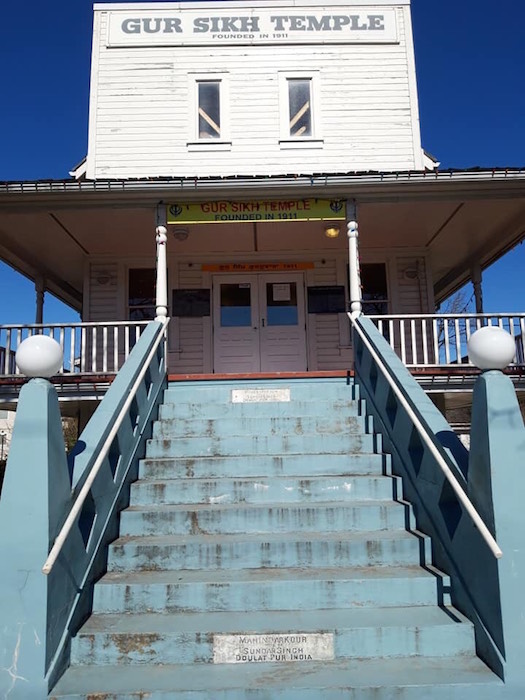
Oldest standing gurdwara in North America

Abbotsford: Oldest standing gurdwara North America

The oldest standing gurdwara in North America is to be found in Abbotsford, Canada. This is what is written on its signboard (Photo: Jasjit Singh):

Abbotsford Sikh Temple: In 1911, determined Sikh pioneers from India built this temple, or Gurdwara, with lumber carried from the nearby sawmill where many of them worked. Blending traditional Sikh and Western frontier designs, the temple includes a prayer hall and a community kitchen. Not only a place of worship, it also became a centre for the social and political life of South Asian immigrants, helping them forge a vibrant community. Today, this oldest surviving Gurdwara reminds us of the immigrant experience of Sikhs in Canada, and continues to be a sacred symbol of their spirituality.


RELATED STORIES:

Roles and functions of a gurdwara (Asia Samachar, 11 Dec 2015)


ASIA SAMACHAR is an online newspaper for Sikhs / Punjabis in Southeast Asia and beyond. Facebook | WhatsApp +6017-335-1399 | Email: editor@asiasamachar.com | Twitter | Instagram | Obituary announcements, click here 

YSA Racial Harmony 4-a-side football tourney is back

The Racial Harmony 4-a-side football tourney by Young Sikh Association Singapore (YSA) is back again. This is the 15th edition. Singapore Education Minister Ong Ye Kung will be the guest of honour at the event on Saturday (6 April 2019). Closing date for registration: 27 March.

Record RM1.6m raised at KL crematorium fund raising dinner

3
By Asia Samachar Team | MALAYSIA |

Sikhs and other north Indian communities raised more than RM1.5 million at a fund raising dinner today for a shared crematorium in the heart of Kuala Lumpur.

An air of bravado and can-do spirit permeated the evening function as gueats mingled with the nation’s first Sikh federal minister who was present to lend his support.

The event once again reflected how the minority communities have put their heads and hearts together to chart their common future.

The subject at hand – the Jalan Loke Yew Sikh-Hindu crematorium which was believed to have started operating in the late 1890s. It badly needs a makeover.

The Shamshan Bhoomi Parbandak Society (Selangor & Federal Territory) manages the crematorium for Sikhs, Gujrati, Sindhi and other North Indian communities.

Going on stage, former Malaysian Sikh top cop Amar Singh could sense the excitement of the more than 200 guests at the fund raising dinner held at a Kuala Lumpur hotel.

Since December 2018 and at the dinner function, he said the team has raised RM1.586 million from 177 individuals.

“I think this is the biggest single collection ever. I’m amazed how they managed to do it,” said Amar, the former Malaysian Federal Police Commercial Crime Director Commissioner. He was also at one point the Kuala Lumpur police chief.

“You will be surprised to see who came forward to give. Many chipped in,” he later told Asia Samachar. “Even today, some have come forward to donate. No collections today, I toldthem.”

MORE PHOTO OF EVENT AT ASIA SAMACHAR FACEBOOK PAGE. GO HERE

Then came the turn of Malaysian Minister of Communications and Multimedia Gobind Singh Deo to take on the stage.

“As we celebrate life, we also have a responsibility to respect those whose journey in life comes to an end.

“This is the reason I stand here as a Minister. I congratulate the commuity for what they have done. This is a great cause. It impacts us all,” he told the audience.

“We must also acknowledge the role of the previous government as well,” he said, noting that it had contributed RM500,000 in terms of infrasturcture and other works.

He singled out the role played by former deputy minister M Saravanan and former senator Daljit Singh, both from MIC.

Gobind announced pledges totalling RM200,000, hinting that the present government would come back with more.

The pledges Gobind made were RM50,000 each from DBKL, Federal Territory Ministry, Ministry of Communications and Multimedia and the family of the late Karpal Singh. Gobind is the son of Karpal, the legendary lawyer and parliamentarian.

Most the guests at the dinner were elated to be part of the crematorium’s redevelopment.

“This is one way to honour the departed,” said education enterpreneur Dr Parmjit Singh who helms Asia Pacific University of Technology & Innovation (APU).

On 5 Aug 2018, Gobind and community members got together for the laying of the foundation stone for a planned complex for the crematorium.

The Sanatam Dharam Sabha Kuala Lumpur, which manages the Shree Lakhsmi Narayanan Mandir Kuala Lumpur, then pledged a RM500,000 donation towards the project which is expected to cost RM5 million.

“That is the single largest donation,” said Amar. It is not part of the RM1.5 million he announced earlier.

The fund raising dinner tonight allows the first phase of the project to move unhindered.

ASIA SAMACHAR is an online newspaper for Sikhs / Punjabis in Southeast Asia and beyond. Facebook | WhatsApp +6017-335-1399 | Email: editor@asiasamachar.com | Twitter | Instagram | Obituary announcements, click here 

Banker turned corporate treasurer Pavan Kaur bags award

Pavan Kaur and her team from UMW Holdings Bhd bagged IFN’s ‘Musharakah Deal of the Year’ for a sukuk issuance 
By Asia Samachar Team | MALAYSIA |

Banker turned corporate treasurer Pavan Kaur and her team from UMW Holdings Bhd bagged the ‘Musharakah Deal of the Year’for a sukuk issuance.

The award from from Islamic Finance News (IFN) recognised their work for a RM1.1 billion issuance under UMW’s RM2 billion perpetual sukuk musharakah program.

Pavan is UMW Group’s General Manager for Group Finance & Treasury. She oversees the group’s funding (both debt and equity) and hedging needs while maintaining critical liquidity levels to ensure investor confidence and day to day running of the group.

Until August 2017, she was the treasury solutions (global markets) head at Hong Leong Islamic Bank. Prior to that, she had stints at HSBC Bank Bhd Malaysia, CIMB Investment Bank Bhd and ING Investment Management Bhd.

At Hong Leong, she was instrumental in setting up the Islamic global markets sales desk to provide comprehensive solutions to clients across various underlying assets classes.

Pavan had gained experience in derivatives and structured products working for HSBC and CIMB Investment for more than 6 years.

Her earlier experience as fixed income manager with ING Investment saw her involvement in managing fixed income portfolios for insurance and unit linked funds, in accordance with investment mandates.

Pavan started her career with Rating Agency Malaysia Bhd (RAM) as a credit analyst evaluating credit profiles and assigning ratings based on risk profile for both banks and local companies interested in raising debt via capital markets.

She holds a Bachelor degree in Law with Honours from University of London, and a MBA Degree from Griffith University Queensland Australia.


RELATED STORIES:

Malaysian sardar ji making waves in Islamic finance (Asia Samachar, 20 July 2018)


ASIA SAMACHAR is an online newspaper for Sikhs / Punjabis in Southeast Asia and beyond. Facebook | WhatsApp +6017-335-1399 | Email: editor@asiasamachar.com | Twitter | Instagram | Obituary announcements, click here 

Be a good human being first, says NZ Sikh lawmaker

“Be a good human being before being a Sikh or Muslim or a Christian or a Hindu,” said a New Zealand lawmaker in the aftermath of the terror attacks on Christchurch mosques.

In an interview with a Malaysian news portal, Kanwaljit Singh Bakshi, the first Sikh MP in NZ, added: “As a practicing Sikh, I believe that humanity is more important than anything else. That was the message from Guru Nanak, the founder of the Sikh faith.”

Talking to Star TV, he noted that the March 15 terror incident had shocked all New Zealanders as well as its agencies and things ‘have definitely changed’.

In the incident, a gunman opened fire on defenceless Muslims during the Friday prayer, claiming 50 lives so far.

The fourth-term MP is also the National Party’s shadow spokesman for internal affairs and justice.

See the report, Let’s return the love in NZ, says MP Kanwaljit Singh Bakshi (The Star, 21 March 2019), here.

ASIA SAMACHAR is an online newspaper for Sikhs / Punjabis in Southeast Asia and beyond. Facebook | WhatsApp +6017-335-1399 | Email: editor@asiasamachar.com | Twitter | Instagram | Obituary announcements, click here 

Suwarn Kaur (1930-2019), Batu Gajah

AKHAND PATH: 5-7 April 2019 at Gurdwara Sahib Kuyow, Kuala Lumpur, followed by Sahej Path da Phog and Antim Ardaas | Malaysia
Suwarn Kaur (1930-2019), Batu Gajah

MATA SUWARN KAUR W/O LATE SARDAR RAM SINGH KLER (Ex-Police), Batu Gajah

(Age: 89)

Passed away peacefully on Thursday, 21 March 2019

Deeply missed by

Children, Grandchildren, Great Grandchildren, Relatives and Friends

Akhand Path, followed by Sahej Path da Phog and Antim Ardaas will be held at Gurdwara Sahib Kuyow, KL, on 5-7 April 2019

Contact:

Maj. Jagendar 019-2469806

Malkit 012-9010154

Lakbir 012-3871803

| Entry: 22 March 2019; Updated: 30 March 2019 | Source: Family |
ASIA SAMACHAR is an online newspaper for Sikhs / Punjabis in Southeast Asia and beyond. Facebook | WhatsApp +6017-335-1399 | Email: editor@asiasamachar.com | Twitter | Instagram | Obituary announcements, click here |

Vaisakhi 1699: The High Point of Guru Nanak Jote-Jugat Mission – Parts I to IV

0
By Gurmukh Singh OBE | PANJAB TIMES |
PART ONE: Introduction

In Sikhi tradition the Guru Jote (Divine Light) was in Guru Nanak Sahib. Jugat was the way or the method for Sikhi living shown by the Guru. He laid down the foundation of Sikh ideology and institutions on the three pillars of Sikhi living: Naam Japo, Kirat Karo & Wand Shako (Constant Waheguru remembrance while living an honest and productive life, and sharing with those in need).

Thus, started the Guru tuition period of Sikhi living from 1469 to Vaiskahi 1699. As we celebrate the 550th anniversary of Guru Nanak Parkaash this year we trace the progress of the Guru Jote-Jugat from Guru Nanak Sahib to the emergence of the Khalsa in 1699. I propose to devote a few columns to this important topic leading on to Vaisakhi 2019 celebration in April. Some repetition is unavoidable and maybe even desirable.

The challenges which Sikh ideology, institutions and distinct theo-political Qaumi identity face, are many. In Sikhi, Jote is the Divine Light (the Universal Spirit) and Jugat the way. It is the guiding principle in Sikhi living or the Sikh reht (code of conduct). Jote and Jugat go together and manifest as the Miri-Piri (temporal-spiritual) twin track Sikh way of life. Sikhs are guided by the teachings enshrined in Sri Guru Granth Sahib as interpreted by the lives of the Ten Guru-persons from Guru Nanak Sahib to Guru Gobind Singh. Jote-Jugat is an unbroken continuity in Sikh tradition from Guru Nanak Sahib through the nine other Guru-persons who followed, to Sri Guru Granth Sahib.

For the above reason, Gurbani interpretation is only possible with reference to the Sikhi reht lived by the Ten Guru persons. There are attempts to separate Sri Guru Granth Sahib from the lives of Ten Guru Sahiban and the collective interpretation of Gurbani by the Guru Roop Khalsa Panth. Such attempts by ‘hijackers of Sikhi’ — an apt expression coined by Dr Karminder Singh of Malaysia – are divisive and dangerous.

Those who hold that Sikhi(sm) is a religion only that the teachings of Guru Granth Sahib are universal and that they prefer to follow the teachings of Guru Granth Sahib only, tend to deny the interpretation of Gurbani in our practical lives. That interpretation of Gurbani into lived Sikhi was done by the Guru-persons and the Guru Khalsa Panth with great sacrifices. The Sikh Reht Maryada (SRM) is the interpretation of Gurbani into a Sikh Code of Conduct and Conventions as the final outcome of Jote-Jugat twin track approach to Sikhi. Denying the Sikh Reht Maryada amounts to denial of Guru and Khalsa history (ithaas) and tradition.

The collective authority for correct interpretation of Gurbani resides in Guru Roop Khalsa Panth. That authority was bestowed on the Khalsa Panth by Guru Gobind Singh. The approach to the interpretation of Gurbani is holistic with reference to ALL the Bani in Sri Guru Granth Sahib. Otherwise, selective quotations of Gurbani to suit own thinking (manmat) lead to divisive gurudoms and deras at one extreme and self-appointed interpreters of Gurbani and Sikhi according to own biases at the other extreme.


PART TWO: Definition of a Sikh

ਜੋਤਿ ਓਹਾ ਜੁਗਤਿ ਸਾਇ ਸਹਿ ਕਾਇਆ ਫੇਰਿ ਪਲਟੀਐ ॥

They shared the One Light and the same way the King just changed His body.

It was stressed in the introductory that approach to the interpretation of Gurbani should be with reference to Sri Guru Granth Sahib — the Divine Light or Jote — and the Jugat or the living way (reht) as shown by the Ten Guru-persons by own example.

Otherwise, we get diverse interpretations which mislead and give rise to deras and gurudoms while modern Sikhs have a free for all preaching their own version of universal Sikhi! We even get different definition of who is a SIKH! These elements deny the Sikh Reht Maryada and the great Sikh institutions and Sikh identity based on a holistic interpretation of Sri Guru Granth Sahib and as lived and taught by the Ten Guru persons.

During the Vaisakhi 1699 at Anandpur Sahib, Guru Gobind Singh ji revealed the identity of the ideal/perfect human being guided by the teachings and lives of the Ten Guru-persons. So, claims by some that they are guided by the universal teachings of Sri Guru Granth Sahib only while they deny the great miri-piri Sikhi institutions built by the Ten Guru-persons by own examples and shaheedis, and defended by the Khalsa Panth over the centuries, do create doubts about their true motives. More so as we face so many challenges to independent Sikh ideology and institutions. We cannot ignore the Sikhi as lived and taught by the Ten Gurus by own example and go back to square one.

Therefore, the definition of a Sikh in the Sikh Reht Maryada is an important assertion of the Sikh identity derived by the Guru Jote-Jugat during the Guru teaching period from 1469 to 1699. The Sikh Reht Maryada describes a Sikh as: Any human being who faithfully believes in One Immortal Being Ten Gurus, from Guru Nanak Sahib to Guru Gobind Singh Sahib The Guru Granth Sahib the utterances and teachings of the ten Gurus and the Amrit Initiation bequeathed by the tenth Guru and, who does not owe allegiance to any other religion, is a Sikh.

Let us be clear: Sri Guru Granth Sahib is universal. It is for all humanity to seek guidance from. However, the path of Sikhi based on the correct interpretation of Gurbani as lived by the Ten Gurus is for committed Sikhs – no matter at which rung of the Sikhi ladder they stand. They must believe in One Immortal Being and the Ten Gurus, from Guru Nanak Sahib to Guru Gobind Singh Sahib. They must believe in the teachings of Guru Granth Sahib and the utterances and teachings of the ten Gurus only and none other. They must have faith in the Amrit Initiation bequeathed by the tenth Master. They must not owe allegiance to any other religion. They must be Sikhs of the Guru.

Next, we look at the contribution of each Guru-person to the ultimate revelation of the Khalsa – the ideal human being – on the Vaisakhi Day in 1699.


PART III: Contribution of each Guru-person 

In Sikhi, there is only One Guru – not many. Each Guru-person from Guru Nanak Sahib to Guru Gobind Singh Ji was the embodiment of the same One Jote-Jugat. Thus, the Guruship succession process is described as ਜੋਤਿ ਓਹਾ ਜੁਗਤਿ ਸਾਇ ਸਹਿ ਕਾਇਆ ਫੇਰਿ ਪਲਟੀਐ ॥ (They shared the One Light and the same way the King just changed His body.)

Today the Jote resides in the Shabd Guru, Sri Guru Granth Sahib, while the Guardian of the Jugat – the way of living or reht (code of conduct) in accordance with Gurbani, is the Guru Khalsa Panth represented through the sovereign institution of Sri Akal Takht Sahib. Office holders at Sri Akal Takht Sahib must be seen to be independent of any outside influence, or they lose the trust of the Guru Khalsa Panth and become unworthy of the office they hold. The Institution of Sri Akal Takht Sahib itself remains the Sovereign Miri-Piri focus of every Sikh.

Continuing from Part Two, we need to understand how each Guru-person contributed to the Jote-Jugat process and progress up to Vaisakhi 1699 when the New Age human being, the Khalsa, was revealed by Guru Gobind Singh ji.

Guru Nanak Dev Ji (1469-1539) laid the foundation of the Path of Sikhi (ਸਿੱਖੀ ਮਾਰਗ) and the egalitarian institutions in 974 Shabads in 19 Ragas including Japji, Sidh Gost, Dhakhani Onkar, Asa Di Vaar and Barah Maha. He revealed the Basic Qualities and Virtues of the One Creator being. He stressed universal human rights, values and that all are equal before the One Creator Being. While preaching these universal truths he confronted the invader Babar and the Sikhi Miri (temporal) principle. The rule from Delhi was conditional on the observance of the universal human rights.

He started the basic institutions of Sangat and Pangat in a free Sikh socio-political environment at Kartarpur. Thus, with the Jote in Him, he laid the foundation for Sikhi miri-piri living (the Jugat).

Guru Angad Dev Ji (Guruship 1539-1552) composed 63 Shabads and Shaloks and introduced the Gurmukhi Alphabet, stressed good health and physical fitness as part of Sikhi life. He continued with the Sikhi institutions which promoted human equality as an essential part of Sikhi life (the Jugat).

Guru Amar Dass Ji, (Guruship 1552-1574), composed 869 Shabads in 17 ragas including Anand Sahib. He vastly strengthened the Sikh organisation with Goindwal Sahib as the centre. Based on the teachings of Guru Nanak Sahib, He further raised the equality status of women and continued to promote human equality and service with humility (seva) through the Sikh institutions.

Guru Ramdas (Guruship 1574-1581) composed 688 Shabads and established Amritsar as a Sikh trading town. Amrit-sar (literally pool of nectar) was dug and He continued developing the Sikh institutions. It needs to be remembered that during this period, the Emperors at Delhi kept themselves informed of Sikhi Sangat progress in India.


Part IV: Development of Sikhi institutions and Qaumi identity

In earlier parts we have seen how each Guru-person contributed to the Jote-Jugat process from Guru Nanak Sahib to Guru Ram Das. In this part, we continue from Guru Arjan Dev Ji, while keeping in mind that the Guru Jote (Divine Light) was One and the same. The Jote manifested Itself in Ten Guru-persons from Guru Nanak Sahib to Guru Gobind Singh. Each Guru-person developed the Jugat or the Sikhi way (Sikh rehni) by own example.

It is only by learning from the lives of the Ten Guru-persons representing the progress of the Jote-Jugat system that we can correctly interpret the Gurbani in Guru Granth Sahib as the foundation of Sikhi Miri-Piri (temporal & spiritual) Sikhi System. The system and way of life so derived is the Sikh Reht Maryada which also defines who is a Sikh.

By the time of Guru Arjan Sahib (Guruship 1581-1606), the development of the Sikhi institutions was nearly complete. The revolutionary Sikhi ideology preached and practised by the Guru-persons, had started attracting the attention of the emperors at Delhi. The Gurbani composed by the Guru-persons taught practical living and a distinct theo-political Sikh community was emerging.

There were Sangats, first established by Guru Nanak Sahib, in many parts of India and Amritsar was a prosperous trading town. The sarowar or pool – Amritsar (literally, the pool of nectar) – from which the town derived its name, had been dug. Guru Arjan completed the project by building Harmandir Sahib in the centre of the Sarowar. Guru Arjan composed 2312 Shabads in 31 Ragas and compiled the Adi Granth Sahib by also including the Bani of earlier Guru-persons and (selectively) that of many Bhagats from diverse backgrounds. He completed the Sarovar and the Darbar Sahib complex (later known as the Golden Temple).

From Guru Nanak Sahib to Guru Arjan Dev, the rulers at Delhi were getting increasingly concerned about the emergence of the Sikhs as a sovereign theo-social and political people. That rankled with the emperor Jahangir and Guru Arjan Dev was martyred as a result.

As directed by Guru Arjan Dev before his shaheedi (as witness to the sovereignty of the Panth of Guru Nanak), the next phase of Sikhi Miri-Piri progress started with the investiture of Guru Hargobind Sahib (Guruship 1606-1644). The Guru now openly wore the swords of the two worlds of Miri-Piri (temporal and spiritual). It is clear from events that followed Guru Arjan the He had already designated the place for Sri Akal Takht Sahib opposite the Harmandir. The Akal Takht project was completed by Guru Hargobind Sahib within a matter of days of the Guru Arjan Dev ji’s martyrdom.

Guru Hargobind strengthened the combination of worldly and spiritual (miri-piri aspects of Sikhi) and introduced armed defence of human rights as a last resort. The final phase of the mission of Guru Nanak Sahib had started, which would lead to the emergence of the Khalsa in 1699 as Akal Purakh ki Fauj. (To be continued).

SEE PART V HERE.


Gurmukh Singh OBE, a retired UK senior civil servant, chairs the Advisory Board of The Sikh Missionary Society UK. Email: sewauk2005@yahoo.co.uk. The article first appeared at The Panjab Times, UK

* This is the opinion of the writer, organisation or publication and does not necessarily represent the views of Asia Samachar.


RELATED STORY:

Antam Sanskar (Last Rites) in Sikhi – Sikh Reht Maryada guidance (Asia Samachar, 24 Jan 2019)

Khalsa Panth: A Sovereign Nation (Asia Samachar, 7 Jan 2019)


ASIA SAMACHAR is an online newspaper for Sikhs / Punjabis in Southeast Asia and beyond. Facebook | WhatsApp +6017-335-1399 | Email: editor@asiasamachar.com | Twitter | Instagram | Obituary announcements, click here 

US Civil Rights And Faith Leaders To FBI: Take White Nationalist Violence Seriously

A group of civil rights and faith leaders are demanding a meeting with FBI Director Christopher Wray in the wake of the New Zealand terror attacks that killed at least 50 people as they prayed in mosques. The killer was a white nationalist who named President Trump as an inspiration in his online racist screed.

The groups want the FBI to address “the threat to public safety” and to their communities “by white nationalist violence.”

Leaders from Muslim Advocates, the NAACP Legal Defense and Educational Fund, the Leadership Conference on Civil and Human Rights, the Union for Reform Judaism and the Sikh Coalition all signed a letter sent to Wray on Tuesday, urging the FBI to take the threat seriously.

“Attacks against houses of worship in the United States have been far too common in recent years,” the letter says.

The letter cited a spate of attacks by white supremacists on houses of worship in recent years, including the killing of six people at a Sikh temple in Oak Creek, Wis., in 2012; the murder of nine African Americans as they worshipped at the Emanuel African Methodist Episcopal Church in Charleston, S.C., in 2015; and the slaying of 11 people at the Tree of Life Synagogue in Pittsburgh, Pa., last year.

“What we’ve seen unfortunately over the last few years from federal law enforcement is a dismissiveness of this threat or sometimes even a deflection,” says Farhana Khera, the executive director of Muslim Advocates, a civil rights organization and a signer of the letter.

“After the horrific attacks in New Zealand last week, we decided that we as faith and civil rights leaders can no longer just stand by,” she says. “We need to start demanding action from federal law enforcement officials beginning with the director of the FBI. It’s time to prioritize the threat of white nationalism.”

Read full story, ‘Civil Rights And Faith Leaders To FBI: Take White Nationalist Violence Seriously’, here.


RELATED STORIES:

(Asia Samachar, 11 Dec 2015)


ASIA SAMACHAR is an online newspaper for Sikhs / Punjabis in Southeast Asia and beyond. Facebook | WhatsApp +6017-335-1399 | Email: editor@asiasamachar.com | Twitter | Instagram | Obituary announcements, click here 

Kesari captures Sikh soldiers in unprecedented battle

Kesari – Handout photo

The movie Kesari starts showing globally today (21 March 2019), including in Malaysia and Singapore.

Starring Akshay Kumar, the movie is based on a true courageous story of 21 Sikh soldiers who fought valiantly and bravely against 10,000 invaders at Saragarhi.

In Malaysia, the movie will be playing in Kuala Lumpur (TGV KLCC, TGV Jaya Shoping Centre, GSC Nu Sentral and GSC Quill Mall), Subang, Cyberjaya, Penang, Ipoh, Taiping, Johor Bahru, Sungai Petani and Kota Kinabalu.

Synopsis: The year is 1897 and the mighty British empire having conquered most of India, is now trying to infiltrate Afghanistan. Fort Saragarhi, in the NWFP (North Western Frontier Province) is a small communication post used to relay messages between two major military forts – Gullistan and Lockhardt. To be posted at Saragarhi is no matter of pride for the newly formed Sikh regiment of the British Indian Army. Marked in color KESARI (saffron), the Sikhs symbolize valor and pride and to die doing one’s duty. Ishar Singh (AKSYAY KUMAR), a proud warrior who prefers to live by his community rules, is often found in direct conflict with the orders of his British officers. As a punishment, Ishar is sent to Saragarhi where a bunch of 20 unruly, undisciplined Sikh soldiers await him. And it is this bunch of cheeky but lovable rouges that Ishar leads into the battle when an army of 10,000 Pathans turns up at Saragarhi on the 12th of Sept 1897. It’s now 21 Sikhs vs 10,000 Afghans on the battle field. KESARI the true story of one of the bravest battles ever fought – the Battle Of Saragrahi.


RELATED STORIES:

British Army second commemoration for Battle of Saragarhi (Asia Samachar, 16 Sept 2015)


ASIA SAMACHAR is an online newspaper for Sikhs / Punjabis in Southeast Asia and beyond. Facebook | WhatsApp +6017-335-1399 | Email: editor@asiasamachar.com | Twitter | Instagram | Obituary announcements, click here 

US Comedian apologizes after racist rant against Sikhs on her plane

0
By Hayley Miller | HUFFPOST | US |

Jessica Moore, a comedian who also goes by the name Jess Hilarious, apologized Monday following backlash over a series of since-deleted videos she posted to Instagram in which she claimed to feel “threatened” by a group of Sikh men who were on the same plane as she was.

“I’m sorry to the Sikhs. I’m sorry to the Muslims. I’m sorry to every person on the plane,” she wrote in a video posted to her Instagram account. “I am ignorant to a lot of shit. … I will do better.”

It all started on Sunday when Moore, who stars on the Fox sitcom “Rel,” posted a video showing what appears to be a man wearing a turban ahead of her in line as she waits to board a plane.

Moore, who has over 4 million Instagram followers, can be heard gasping loudly in the video as she spots the passenger. “Where are you going?” she asks in a quiet and rhetorical question.

After Instagram users called her out for racially profiling what turned out to be a group of passengers, she posted another video defending her behavior.

“If I’m scared, I’m scared,” she said. “F*** y’all. F*** how y’all feel. Y’all mad at me because I don’t side with every other black person, ’cause I don’t side with every other race. F*** y’all. I feel how I feel. I felt threatened and that was it.”

Moore then said that the plane had been evacuated with no explanation, implying that perhaps the turban-wearing passengers played a role in that.

Sikhism, the fifth largest religion in the world, is not a sect of Islam. It’s a monotheistic faith founded in the Punjab region of India about 500 years ago. Sikh means “seeker of knowledge” in Punjabi and followers of the religion believe everyone has equal status before God, who created the universe and all faiths.

Sikhs avoid cutting their hair as a symbol of their love and respect for God. Men ― and some women ― cover their hair with turbans to keep it neat and clean.

SEE full story, ‘Comedian Jess Hilarious Apologizes After Racist Rant Against Sikhs On Her Plane’ (HuffPost, 19 March 2019), here.

RELATED STORIES:

Instagram comedian accused getting passengers with turbans removed from her flight (Asia Samachar, 18 March 2019)

 

ASIA SAMACHAR is an online newspaper for Sikhs / Punjabis in Southeast Asia and beyond. Facebook | WhatsApp +6017-335-1399 | Email: editor@asiasamachar.com | Twitter | Instagram | Obituary announcements, click here