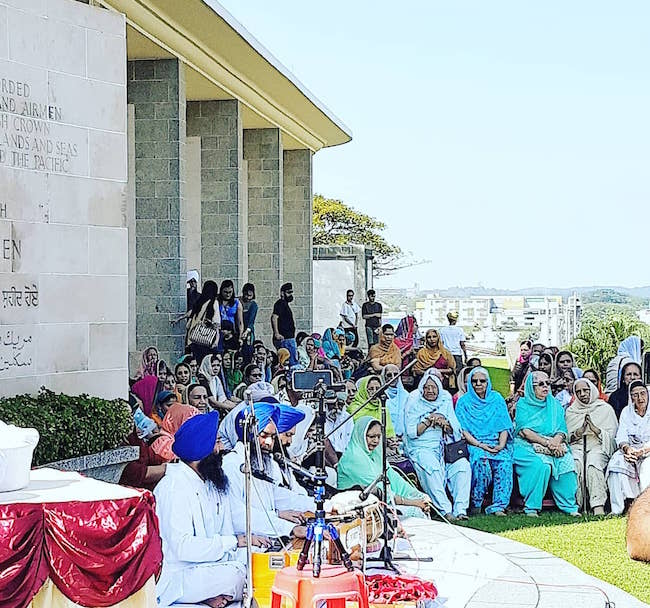
Singapore Sikhs held memorial session at Kranji War Memorial in memory of brave Sikh soldiers who gave their lives in defending the country – Photo / Malminderjit Singh
Sikhs took part in a memorial event today in memory of the thousands of Sikhs soldiers who fought bravely during World War II defending Singapore against the Japanese forces in World War II.
A group of Sikhs took part in Sikh worship and prayer at the Kranji War Memorial which honours the men and women from the Commonwealth who died in the line of duty during WW2.
The event was led by the Gurdwara Pardesi Khalsa Dharmak Diwan (PKDD) Singapore.
The memorial bears the names of more than 24,346 Allied soldiers and airmen killed in Southeast Asia who have no known grave.
A good portion of the names on the walls that line the memorial are of the Punjab Regiments who fought bravely during WW2 defending Singapore against the Japanese forces.
ASIA SAMACHAR is an online newspaper for Sikhs / Punjabis in Southeast Asia and beyond.Facebook | WhatsApp +6017-335-1399 | Email: editor@asiasamachar.com | Twitter | Instagram | Obituary announcements, click here |
Captain Mohan Singh of the Indian National Army being greeted by Major Fujiwara Iwaichi – Original source unknown
By Rishpal Singh Sidhu
This article traces Mohan Singh’s early life and military career, leading to his involvement in the Indian nationalist movement and subsequent elevation as the Commander-in-Chief of the Indian National Army (INA).
Mohan Singh was born on 3 January 1909 in Ugoke Village near Sialkot (now in present day Pakistan), the only son of Tara Singh and Hukam Kaur. His father passed away two months before he was born, and he was brought up by his mother at her parents’ home in Badiana in the Sialkot vicinity.
Following his high school studies, Mohan Singh joined the 14th Punjab Regiment of the British Indian Army in 1927. On completion of recruit training, he was assigned to the 2nd Battalion of the Regiment in the North-West Frontier Province. He was fortunate to be selected for officer training at the Indian Military Academy in Dehra Dun in 1931 and was commissioned on 1 February 1934. He then served for a year in the 2nd Battalion Border Regiment before being posted on 24 February 1936 to the 1st Battalion, 14th Punjab Regiment (also called “Sher Dil Paltan”) stationed at Jhelum.
With the impending threat of Japanese invasion of Southeast Asia, this battalion underwent intensive training at Secunderabad before being posted out for operational duties in the Far East. In the interim, Mohan Singh received a promotion to Captain and married Jaswant Kaur, the sister of a fellow officer, before being posted out to Malaya with his unit on 4 March 1941. Another Sikh officer, Gurbaksh Singh Dhillon, also belonged to this regiment and was posted out together with Mohan Singh.
Not long after the surprise attack on Pearl Harbour on 7 December 1941, the Japanese army overran Southeast Asia within a matter of weeks. Earlier, in September 1941, the Japanese Imperial General Headquarters (IGHQ) had set up a military intelligence operation, Fujiwara Kikan (F-Kikan) named after its head, Major Fujiwara Iwaichi. Fujiwara was chief of military intelligence within the Imperial Japanese Army General Staff and he travelled to Bangkok in October 1941 with the aim of intelligence gathering, developing links with, and assisting fledgling independence movements in British India, Malaya, and the Dutch East Indies. Fujiwara’s military intelligence unit included five commissioned officers and two Hindi speaking interpreters.
Fujiwara had earlier been in contact with Sikh missionary Giani Pritam Singh Dhillon, an Indian freedom fighter and member of the Ghadar Party that took part in the failed 1915 Ghadar conspiracy aimed at fomenting revolt in the British Indian Army and overthrowing British rule over the Indian subcontinent. Following the revolt, Giani Pritam Singh had fled to Bangkok. Giani Pritam Singh Dhillon was close friends with Gurbaksh Singh Dhillon, a fellow officer from the same regiment as Mohan Singh. Gurbaksh Singh Dhillon also had sympathies with the Indian independence movement.
The 1915 Singapore Mutiny (also known as the 1915 Sepoy Mutiny or the Mutiny of the 5th Light Infantry) was a related event linked to the 1915 Ghadar Conspiracy, and involved half a regiment of 850 sepoys. As at 15 February 1915, the regiment had 818 Indian officers and men with nine British officers, and about 300-400 sepoys mutinied against the British in Singapore. Many reasons have been put forward for this outbreak and it was effectively quelled within a week by the British and allied naval forces.
Mohan Singh’s battalion was overpowered by the invading Japanese forces at Jitra in Kedah. Major Fujiwara, Giani Pritam Singh, and Mohan Singh had their first meeting in a rubber plantation at Kuala Nerang near Jitra on 15 December 1941 to discuss the formation of an Indian National Army. Given his background as a formidable Indian freedom fighter, it is more than highly likely that the original idea of forming an INA would have been hatched by Giani Pritam Singh Dhillon quite some time before he and Major Fujiwara met with Captain Mohan Singh to persuade him to lead such an army comprising close to 40,000 captured Indian Prisoners of War (POWs). Mohan Singh initially had his reservations but relented and agreement was reached for him to establish the INA from the Indian POWs. The INA was formed at Taiping on 31 December 1941, but the official announcement of its formation was withheld until after it was firmly established. The INA played an active role in the Japanese assault on Singapore which was captured on 15 February 1942.
On 17 February 1942, 40,000 Indian prisoners of war gathered at Farrer Park in Singapore and were addressed in turn, first by Lieutenant-Colonel Hunt of the British Malaya Command who officially handed over the captured troops to Japanese command under Major Fujiwara who spoke next, first in Japanese which was then translated into English and Hindi and he “is said to have told the troops of the Asian co-prosperity sphere under the leadership of Japan, the Japanese vision of an independent India, its importance to the co-prosperity sphere, and of Japanese intentions to help raise a liberation army for the independence of India”1 Fujiwara further exhorted the troops by telling them that they were not going to be treated as prisoners of war, but rather as friends and allies, and ended his address by saying that he was passing on their responsibilities and command to Mohan Singh.2 The third and final address was by Captain Mohan Singh. He spoke in Hindi and “told the troops of forming an Indian National Army (Azad Hind Fauj/Free India Army/National Army of Independent India) to fight for an independent India, and invited the troops to join it. As an Indian jawan present at the time remembers, Mohan Singh’s speech was powerful and touched a chord, and the troops responded with wild enthusiasm and excitement.”3 It is estimated that nearly half of those present at the Farrer Park address later joined the INA.4
The Indian Independence League (IIL) was a political organization originally known as the Independence League of India and it was formed in Tokyo by Rash Behari Bose in 1934. Its aim was to galvanize support of non-resident Indians into seeking the removal of British colonial rule over India, and held a conference in Bangkok from 15 to 23 June 1942. Thirty-five resolutions were passed at this conference, one of which formally appointed Mohan Singh as Commander-in-Chief of the “Army of Liberation for India”, that is the Indian National Army.
The Japanese however never publicly acknowledged recognition of the INA’s existence as a separate independence army and rather tended to regard it as a part of the Japanese Army. In his dealings with the headquarters of the Japanese Army, Mohan Singh began to doubt their real intentions and soon came to the realization that the Japanese agenda was not Indian independence. Following disagreements with some senior Japanese army commanders, the INA was disbanded towards the end of December 1942. Mohan Singh was removed from his command on 29 December 1942, arrested, and taken into custody by the Kempeitai (the military police arm of the Imperial Japanese Army. It was more of a secret police rather than a conventional military police). He was exiled to Pulau Ubin and kept under guard.
It was not until the arrival of Subhas Chandra Bose in Singapore on 2 July 1943 that the Indian National Army was re-formed and called Azad Hind Fauj with Bose as the Commander-in-Chief. Mohan Singh played no part in this revived army. The Indian National Army also had a separate women’s unit, the Rani of Jhansi Regiment headed by Captain Lakshmi Swaminathan. Charismatic as he was, Bose was militarily unskilled.5 In the interim, Bose announced the forming of the Provisional Government of Free India in the Japanese occupied Andaman and Nicobar Islands, with himself as the Head of State, Prime Minister, Minister of War and Foreign Affairs from 1943 to 1945. These islands were re-occupied by the British at the end of the war in 1945.
The revived Indian National Army fought alongside the Japanese and the Burmese National Army and laid siege to the Indian border towns of Imphal and Kohima. They were eventually beaten back by the Commonwealth forces and forced to retreat to Burma. The retreating Japanese and Indian National Armies then fought key battles against the British Indian Army in its Burma campaign. With the fall of Rangoon, some elements of the Indian National Army were captured, while others retreated with Bose to Malaya or Thailand. Bose himself chose not to surrender. He planned to escape to Manchuria with the aim of seeking a future in the Soviet Union in the belief that it was turning anti-British. He never made it to the Soviet Union and died from third degree burns when the plane he was travelling in crashed in Taihoku (present day Taipei) in Japanese occupied Taiwan on 18 August 1945. With Japan’s surrender at the end of the war on 12 September 1945 in Singapore, the remaining elements of the Indian National Army surrendered and were repatriated to India.
Close to 300 INA officers were charged with treason in the INA trials held in the Red Fort in Delhi (Red Fort Trials) between 5 November 1945 and May 1946. Prominent among them was Mohan Singh, together with Colonel Gurbaksh Singh (a fellow officer from the same unit as Mohan Singh), Colonel Prem Saghal, and Major General Shah Nawaz. They were court-martialled and charged with waging war against the King-Emperor. The trials attracted much publicity, public sentiment, and sympathy as they were considered patriots fighting for India’s independence from the British Empire. Others saw the INA officers as traitors and wanted them punished. Although the British Raj was never under serious threat from the INA, the tide was starting to turn against them, and calls for Indian independence were getting increasingly strident. The INA officers were found guilty, cashiered from the army, and had their sentences remitted by the Commander-in-Chief of the Indian Army, Field Marshal Sir Claude John Eyre Auchinleck.
EPILOGUE
Giani Pritam Singh Dhillon was born on 18 November 1910 in Nagoke Sarli Village in the district of Lyallpur in present day Pakistan. He was flying from Saigon to a conference in Tokyo with six other INA officials on 24 March 1942 when he died in a plane crash at the airport in Tokyo. His wife had earlier passed away in 1938. On his death, his two children were repatriated back to India by an INA officer Colonel Niranjan Singh.6
Family photo of Giani Pritam Singh Dhillon – Original source unknown
Mohan Singh joined the Indian National Congress in February 1947 and served as a legislator in Punjab. He was also elected to the Rajya Sabha (upper house of the Indian Parliament) and served for two terms. In public life he continued to fight for the recognition of INA members as freedom fighters in the cause for India’s independence. He settled in Jugiana Village near Ludhiana and passed away on 26 December 1989 at the age of 80.
Mohan Singh in later life – Source: Jatland.com, whose Wiki Moderator is Laxman Ram Burdak, retired Indian Forest Service officer from Madhya Pradesh cadre
Gurbaksh Singh Dhillon (known to his close friends as Tatu Ji) wrote an autobiography “From my bones” in which he recounted his experiences of the INA and the Red Fort trials. He also published some poetry that aptly captured some momentous events of India’s history. The Indian Postal Service issued a stamp in 1997 to commemorate Dhillon’s contribution to the liberation of India, and he was awarded the Padma Bhushan in 1998 (the Padma Bhushan is the third-highest civilian award of the Republic of India, conferred on distinguished service of a high order, without distinction of race, occupation, position, or gender). He passed away in Gwalior, Madhya Pradesh on 6 December 2006 at the age of 92.
Gurbaksh Singh Dhillion in later life – Source: Jatland.com
Fujiwara Iwaichi returned to Japan at the end of the Second World War and served as Commander of the Home Defense Force in 1955 and the 1st Division (Tokyo) in 1956. He retired with the rank of Lieutenant General in 1964 and two decades later wrote a book F. Kikan: Japanese Army intelligence operations in Southeast Asia during World War II in which he described himself as the “Lawrence of Arabia of Southeast Asia”. The book was published by Heinemann in 1983. Fujiwara passed away on 24 February 1986.
Major Fujiwara Iwaichi – Source: Wikipedia, original source unknown
Endnotes
Fay, Peter W. (1993). The forgotten army: India’s armed struggle for independence, 1942 -1945. Ann Arbor, University of Michigan Press, p. 83.
Ibid, 1993, p. 83.
Ibid, 1993, p. 84.
Lebra, Joyce C. (1977). Japanese trained armies in South-East Asia. New York, Columbia University Press, p. 25.
Gordon, Leonard A. (1990). Brothers against the Raj: a biography of Indian nationalists Sarat and Subhas Chandra Bose. Columbia University Press, p. 517.
Gurcharan Singh Kulim. Posting on the Sikhnet, 30 July 2015.
The writer also consulted Dr. Ranjit Singh Malhi to confirm the accuracy of certain facts in this article.
Rishpal Singh Sidhu has been involved in library and information services management in Singapore, New Zealand, and Australia over the past four decades. He has a passion for research, writing, and teaching. He is the compiler and editor of the book, Singapore’s early Sikh pioneers: Origins, settlement, contributions and Institutions, published by the Central Sikh Gurdwara Board in Singapore in 2017. He is presently based in Sydney, Australia.
[ASIA SAMACHAR is an online newspaper for Sikhs in Southeast Asia and surrounding countries. We have a Facebook page, do give it a LIKE. Follow us on Twitter. Visit our website: www.asiasamachar.com] 17391
Morning kirtan at Harmandir Sahib, Amritsar – Photo grab from Kirtan.com live broadcast
By Parveen Kaur
My name is Parveen and I live in Australia. I’m a high-school student.
For years now, people all over the world have brought up the crucial issue of gender inequality that takes place in Harmandir Sahib. Women are not permitted to participate in some forms of seva such as kirtan.
This is not only a case of inequality, but a violation of a fundamental Sikh principle.
One of the basic teachings of Sikhism is that people treat each other and be treated equally regardless of any form of status such as caste, religion, colour or sex. But the committee at Harmandir Sahib have quite clearly done the opposite; the reason for this exclusion is not fully understood.
Why should it matter whether a person doing kirtan is a female or a male? They are still reflecting of the teachings of the guru.
That’s why, I have decided to create a petition that will be presented to the committee when 10,000 people sign it, in order to pressure them to change their rule.
Campaigns like this always start small, but they grow when people like yourselves get involved. Read more about it and sign here.
[ASIA SAMACHAR is an online newspaper for Sikhs in Southeast Asia and surrounding countries. We have a Facebook page, do give it a LIKE. Follow us on Twitter. Visit our website: www.asiasamachar.com] 17386
Jagmeet Singh proposes to Gurkiran Kaur – Photo courtesy of Jagmeet Singh Facebook page
After winning the hearts of the majority of the the third largest political party in Canada, the ever immaculately dressed Jagmeet Singh won the heart of his girlfriend.
“She said yess!!,” he says in a entry via the social media yesterday (17 Jan 2018).
The 38 year old politician, always appearing in striking suit and turban, proposed to the 27 year old Gurkiran at a private party Tuesday night just blocks away from the Ontario legislature in Toronto where he served as a provincial legislator for six years, reports CBC News.
He surprised Gurkiran, an entrepreneur and fashion designer, with the proposal in front of several dozen friends and family members at a vegetarian restaurant where they had their first date, the report said.
The report added that Jagmeet, who was elected federal NDP leader last fall, had been guarded about his personal life, but social media posts in December made headlines after it was reported he and Kaur were engaged.
His Facebook page was flooded with congratulatory message.
However, as one would find almost everywhere today, you have the people who will will find something not right. In this case, one Facebook comment raised the red flag for the photo of Jagmeet kissing his girlfriend on the cheek.
“Sir we don’t expect these type of pose from you . Please consider your dastar . Keep in mind what you have in public . So sorry but it’s not good,” the comment goes.
Immediately, the comment was followed by a barrage of people who were clearly supportive of Jagmeet.
“Delete your comment. Make your own son keshdhari and then come back and comment this,” said one.
“What he feels inside ,showing outside far better than our hypocrite pakhandi babe….rise ur thinking level,” went another.
Another Facebook user added this comment: “How beautiful! Congratulations to the lovely couple, even though I do not know them! As for those who find this offensive or distasteful, let us not judge anyone but support our young people to be themselves! There is absolutely nothing wrong here! Waheguru, waheguru, waheguru!”
For now, Jagmeet looks like a clear winner.
“She said yess!!”, says Jagmeet Singh after proposing to Gurkiran Kaur – Photo courtesy of Jagmeet Singh Facebook page
[ASIA SAMACHAR is an online newspaper for Sikhs / Punjabis in Asia. How to reach us: Facebook message or WhatsApp +6017-335-1399. Our email: editor@asiasamachar.com. For obituary announcements, click here]
Curtains fall on a life dedicated to the Panth spanning six decades and more with the demise of veteran Sikh leader and ideologue Manjit Singh Calcutta.
Starting Sikh public life as a youth activist of the All India Sikh Students Federation (AISSF), Manjit Singh Calcutta dominated the Sikh religio-political scene with his excellent oratory skills, deep knowledge of Sikh history, a commitment to rejuvenation of the Sikh spirit amongst Sikh youth and a new orientation to Akali politics. Hopping from one Gurmat Training Camp to another across the country, he was a very popular speaker amongst the Gurmat Training Camp participants.
A close associate of veteran Akali leader Gurcharan Singh Tohra, he was the secretary of the Shiromani Gurdwara Parbandhak Committee (SGPC) for two tenures, during which period he made substantial contribution.
As he had ideological clarity, he often courted controversy as the established Sikh leadership and the media found it difficult to comprehend and digest his views.
He was a dear friend of all AISSF stalwarts and was known as a loving federationist. Surjit Singh Minhas, Dr. Santokh Singh, Makhan Singh and late Prof. Dalip Singh were his dearest colleagues. A family friend of Paramjit Singh Sarnas, he was omnipresent in his support during any Delhi poll.
Never to mince words, he stuck to a Panthic view point in the face of divergent views. A staunch critic of the Badal Dal and especially of the Badal family, he tried to do everything to dislodge Badals from power within the SGPC and the Punjab government, particularly after the Dal relinquished the Panthic agenda. In his enthusiasm to dislodge the Badals, he would go to the extent of supporting the Congress during polls. He was once a minister in the Badal cabinet.
He was a strong defendant of the original Nanakshahi calendar and would strongly criticise the Akal Takht Jathedar and others who had diluted the calendar and changed its course back to Bikrami.
This writer has had affinity with him and in recent years had spent hours discussing the case of the Sikh nation. As a student participant, I had the privilege to listen to his lectures on Sikhism, during Gurmat Training camps. His words, his immaculate delivery and his mastery of facts ring in my ears and those of hundreds of others who had the opportunity to listen to him.
I spoke to him some three weeks back, prior to his hospitalisation, regarding SGPC affairs and he said, “No one is listening. A new religio-political revolution is required for course correction, upheaval and Chardikala of the Sikh nation.” He wanted me to come to Amritsar to discuss measures that could be taken to put Sikhs on course. Alas! It was not to be.
[ASIA SAMACHAR is an online newspaper for Sikhs in Southeast Asia and surrounding countries. We have a Facebook page, do give it a LIKE. Follow us on Twitter. Visit our website: www.asiasamachar.com] 17374
PATH DA BHOG: 20 January 2018 (Saturday), 5pm to 7pm, at Gurdwara Sahib Petaling Jaya|Malaysia
Jasvinder Singh Maan (1956-2017), Australia
Jasvinder Singh Maan (Australia)
Parents: Late Sardar Chanan Singh Maan & Mata Ajmer Kaur, Segamat (Johor)
Born: 1956
Passed away peacefully on 30 December 2017 at Sri Hazoor Sahib, Nanded, India.
Sahej Path Da Bhog: 20 January 2018 (Saturday), 5pm to 7pm, at Gurdwara Sahib Petaling Jaya, Selangor, followed by Guru Ka Langgar.
| Entry: 17 Jan 2018 | Source: Family
[ASIA SAMACHAR is an online newspaper for Sikhs in Southeast Asia and surrounding countries. We have a Facebook page, do give it a LIKE. Follow us on Twitter. Visit our website: www.asiasamachar.com] 17368
[The fastest way to reach Asia Samachar is by sending us a Facebook message. For obituary announcements, click here]
Is life a matter of chance, a roll of dice? Are life-choices fated or random?
Let arm chair theologians, Sikh or non-Sikh, who read their sacred texts literally wrestle with it. They see God as micromanaging every moment of everyone – kindly for a believer of their faith, wrathfully otherwise.
Sikhi asks that life on Earth be meaningfully productive, so fatalism in Sikhi baffles me. Life, however, turns on a dime; a wooden nickel might be a better metaphor.
President Franklin Roosevelt’s initiatives during the great depression had their detractors. One day, FDR missed an assassin’s bullet by accidentally being moments late to an assignment. Otherwise, Nance Garner would have become president, and who knows what the national response to the economic meltdown or the proposed social programs might have been.
1960: an American, incensed at the election of a Roman Catholic (Kennedy) as President, planned to assassinate John Kennedy. He was set to do the deed as JFK walked to his car. The shooter aimed. Right then Jackie walked out with their new born son to wave goodbye. The assailant held back – he didn’t have the heart to risk killing a mother and child.
The heart has its reasons of which reason knows not.
Education ultimately is training of the mind, no matter if we are imparting the complexities of rocket science or something simple as how to read C-A-T. Life tells me that education happens only when the student becomes uneasy with the status quo.
A curious mind is an open mind. But human nature seeks the path of least resistance; it wants harmony and peace with its environment, no matter how ugly. Inertia comes, less from laziness, more from its primary imperative – self-preservation.
How do we make life’s decisions? I sense that most choices are made in a process that transcends rational analysis, almost like the flip of a coin. Then we use whatever intellect, little or much, that life has gifted us to justify the choices we have made.
Imperatives of deliberative change do not exist when life is copacetic; no challenge ahead, no danger or risk. But how to react if disharmony exists with the world around us? Stress and tension drive us. When to stand our ground and when to walk away from the “slings and arrows of outrageous fortune?” Let’s stumble through two models.
TWO MODELS
At the risk of oversimplifying humanity’s rich heritage whence a sense of self flows and gels, let’s divide human existence into two divergent models.
Take, for example, a mind steeped in the timeless traditions of India. How does it deal with the upsetting, terrorizing, violent reality of life? Simple: “Close your eyes, connect with the peace that lies at your core; turn off the surrounding world and its noise. The inner reality is unbelievably seductive. Accept it, nurture it, live in peace.”
“Avoidance” or strategic thinking? But wait; the other side of the coin beckons.
With acceptance of offensive reality, one can live in filth, disease, pestilence and injustice for untold centuries; like a stoic remain indifferent to the world. The onus shifts to God – fate – for the good fortunes of others and our setbacks.
Is this Sikhi’s defining idea of Hukum? No. Hukum does not mean that a God somewhere in an unknown postal zone micromanages our individual lives – distributing pain and pleasure, success and failure at whim. Hukum says that no matter how great or small our human efforts, many a time the results, good or bad, remain beyond our calculus. Hukum … the moving finger writes and moves on, in the words of Omar Khayyam. Accept this gracefully and move forward. But be careful; extreme unquestioned acceptance produces passivity — ostrich-like burying the head in the sand. Explore India’s history for this morality play.
Hence, India’s colonial past shocks me but doesn’t surprise me, nor does its burden of caste, unequal place of women, rampant poverty, filth and corruption. With eyes closed to existing reality or its reform, peace at any cost becomes the ideal. Ancient mythology and Bollywood help. Distorted reality? Yes. But turn inwards and revel in how wonderful and glorious we always were. Reject climactic shift in the mind that is prerequisite for existential evolution or revolution; it would be too labor intensive.
In such a worldview progress becomes unnecessary, even undesirable.
AMERICAN OUTLOOK
I promised you two models of reaction to dissonance between our inner reality and the world around us, both unsatisfactory. This was one. An alternative is the typical American outlook; a continuous struggle with no such thing as a free lunch.
Open your eyes, look around to see how the world is, then look within to dream how the world should be. Do not stop. Be not afraid to tilt at windmills a la Sancho Panza. Dreams drive the action. The mind says: I may die trying but I will make a difference; my dreams will give meaning to my life.
Often dreams come true, societies are reinvented and rejuvenated. Imagination, ideas and technology get free rein. Awesome progress results. Again, the other side of the coin beckons. And there is a price to pay.
Society becomes unstable; body and mind suffer. The vulnerable human spirit – families and individuals – fractures. Psychologists, psychiatrists, counselors, lawyers — influential caretakers – come to define society and control its levers.
A heavy price to pay! There must be a better way than these two models – and there is.
SIKH WORLDVIEW
The Sikh worldview emerged in the Indus valley of Punjab in North India; its ideas reflect both Eastern and Western perspectives. The ancient and the modern come triumphantly together in Sikhi to create a whole that transcends the sum of the parts.
India born Englishman Rudyard Kipling lamented that “East is East and West is West, and never the twain shall meet.” In Sikh view the two need never be sundered as in the traditional divide between the East and West. A life of action facilitates connecting with the common Ultimate Reality.
The same spark of divinity is in each of us, along with some of the devil’s best. Guru Granth offers clear headed advice to nurture this divinity while building a productive life. This becomes the purpose of life (Munn too jote saroop hae(n), apnaa mool pehchhan (ਮਨ ਤੂੰ ਜੋਤਿ ਸਰੂਪੁ ਹੈ ਆਪਣਾ ਮੂਲੁ ਪਛਾਣੁ) GGS p. 441). Sikhi exhorts us to live productively for the common good (Uddam Karendian(n) jio too…(ਉਦਮੁ ਕਰੇਦਿਆ ਜੀਉ ਤੂੰ ਕਮਾਵਦਿਆ ਸੁਖ ਭੁੰਚੁ) GGS p. 522). It asks us to accept responsibility for our actions (aapan hathee apnaa aapay hee kaaj savaryae (ਆਪਣ ਹਥੀ ਆਪਣਾ ਆਪੇ ਹੀ ਕਾਜੁ ਸਵਾਰੀਐ) GGS p.474), finally to reflect on what footprints will we leave in the sands of time at the end of our days (Eh sareera meriya is jug mae ayekae kia tudh karam kamayya (ਏ ਸਰੀਰਾ ਮੇਰਿਆ ਇਸੁ ਜਗ ਮਹਿ ਆਇ ਕੈ ਕਿਆ ਤੁਧੁ ਕਰਮ ਕਮਾਇਆ), GGS p. 922).
Nothing could be more simply laid out than these overarching lessons of life. The living of the words then becomes a life of action.
I.J. Singh is a New York based writer and speaker on Sikhism in the Diaspora, and a Professor of Anatomy. Email: ijsingh99@gmail.com.
[ASIA SAMACHAR is an online newspaper for Sikhs in Southeast Asia and surrounding countries. We have a Facebook page, do give it a LIKE. Follow us on Twitter. Visit our website: www.asiasamachar.com] 17364
Saskaar: 18 January 2018 (Thursday) at 11:45 a.m. at Kampung Tunku Crematorium, Petaling Jaya
Cortege Timing: Cortege leaves residence No.2 Jalan Terasek 5 , Bangsar Baru , Kuala Lumpur on 18 January 2018 at 11.00 a.m.
Path da Bhog: Saturday 27 January 2018 at 10.00 a.m. – 12.00 p.m. at Gurdwara Saheb Shapha, Jalan Sungei Besi, Kuala Lumpur.
Contact: Sunil 016 – 3332385, Saran 012 – 6211945
| Entry: 17 Jan 2018 | Source: Family
[ASIA SAMACHAR is an online newspaper for Sikhs in Southeast Asia and surrounding countries. We have a Facebook page, do give it a LIKE. Follow us on Twitter. Visit our website: www.asiasamachar.com] 17345
[The fastest way to reach Asia Samachar is by sending us a Facebook message. For obituary announcements, click here]
Nanakpanthis of Sindh: Jeevat Ram at Kashmore (Sindh) reads the Guru Granth Sahib – Photo courtesy of The Quest Continues: Lost Heritage – The Sikh Legacy in Pakistan by Amardeep Singh
MOVING in and out of 126 cities and villages in Pakistan, corporate high flyer turned author Amardeep Singh has seen up close much of what is left of the Sikhs in Pakistan.
In his vast travels across Sindh, Balochistan, Pakistan Administered Kashmir, Khyber Pakhtunkhwa and the Punjab, the author was able to meet and mingle with a huge slice of the Sikh population in Pakistan as well as visit a good number of their heritage sites.
For example, he had the opportunity to immerse himself with the Nanakpanthi communities of Pakistan, certainly a road less travelled for most Sikhs from outside of Pakistan.
“That opportunity revealed a lot about their practices that we have been kept away from,” he told Asia Samachar, sharing one of the side stories of his travels.
“These are people who believe in Sikh faith and belong to the Panth of Nanak, but are loosely classified by us as Hindus. There are a large communities of them who call themselves as Sikhs but wear no turban and don’t have Sikh type names, but yet they are better Sikhs than us.
“In seven decades, we have forgotten these communities. Those who have moved to India are now amalgamated into the Hindu faith and we Sikhs don’t see them as Sikhs,” he added.
Amardeep, author of the newly released The Quest Continues: Lost Heritage – The Sikh Legacy In Pakistan, will be speaking at a half-day forum in Kuala Lumpur on Saturday (20 Jan 2018). EVENT DETAILS, GO HERE.
The Nanakpanthis will be just one of the many fascinating findings during his travels to Pakistan that began in 2014, after abandoning a coveted corporate title with the US-based American Express (Amex). Then already settled in Singapore, he was Amex card division’s regional head of pricing and risk management for Asia-Pacific and Australia.
In a way, Amardeep is definitely among the chosen few. Not many people have had the time or the opportunity to mix and mingle with Sikhs in Pakistan spread all over the vast country. And fewer still were able to take a peek into the Sikh legacy left in this part of the world.
The Sikh community prior to the Punjab partition – East Punjab going to India and West Punjab going to Pakistan – had a thriving existence on the Punjab that is today falls under Pakistan.
After leaving his comfortable but challenging corporate career, Amardeep travelled to a good many Pakistan cities, resulting in his first book, Lost Heritage: The Sikh Legacy in Pakistan, published in 2016.
After that adventure, he dived deeper into the subject that seems to have defined his very existence. This time around, he wrote and published the sequel.
He will also be sharing about his explorations of Sikh era forts under Pakistan army which he was allowed to enter.
“We only associate Jamrud Fort with Hari Singh Nalwa and have forgotten that he had built 27 forts along the Indus,” he said.
Sher Garh Fort built by Hari Singh Nalwa – Photo courtesy of The Quest Continues: Lost Heritage – The Sikh Legacy in Pakistan by Amardeep Singh
THREE THINGS FROM AMARDEEP SINGH:
Exploring the Sikh Legacy in Pakistan – a journey of the sequel book, The Quest Continues: Lost Heritage and The Sikh Legacy in Pakistan
Socio-Cultural impact of partition. An evaluation of the past from the remnants across pakistan to understand the thinking of our forefathers and where we have moved presently, due to this one catastrophic event.
ASIA SAMACHAR is an online newspaper for Sikhs / Punjabis in Southeast Asia and beyond.Facebook | WhatsApp +6017-335-1399 | Email: editor@asiasamachar.com | Twitter | Instagram | Obituary announcements, click here |
ASIA SAMACHAR is an online newspaper for Sikhs in Southeast Asia and surrounding countries. We have a Facebook page, do give it a LIKE. Follow us on Twitter. Visit our website: www.asiasamachar.com] 17338
[Fastest way to reach Asia Samachar: Facebook message or WhatsApp +6017-335-1399. Our email: editor@asiasamachar.com. For obituary announcements, click here]
























 Rishpal Singh Sidhu has been involved in library and information services management in Singapore, New Zealand, and Australia over the past four decades. He has a passion for research, writing, and teaching. He is the compiler and editor of the book, Singapore’s early Sikh pioneers: Origins, settlement, contributions and Institutions, published by the Central Sikh Gurdwara Board in Singapore in 2017. He is presently based in Sydney, Australia.



 By I.J. Singh