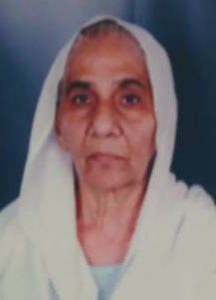
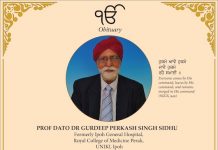
Path da bhog: 10am-12pm, 21 January 2018 (Sunday) at Gurdwara Sahib Klang, Selangor
Contact:
Khushwant Singh 012 5001137
Baghwan Singh 016 2160708
| Entry: 14 Jan 2018; Updated: 16 Jan 2018 | Source: Family
[ASIA SAMACHAR is an online newspaper for Sikhs in Southeast Asia and surrounding countries. We have a Facebook page, do give it a LIKE. Follow us on Twitter. Visit our website: www.asiasamachar.com] 17329
[The fastest way to reach Asia Samachar is by sending us a Facebook message. For obituary announcements, click here]
An inspiring and invigorating weekend of ultimate inspiration, fun and games like no other.
For Sikh youths age 17 & above ( University/ college students/ young working adults/SPM leavers)
Date: 16-18 FEBRUARY
Venue: Gurdwara Sahib Tanah Rata, Cameron Highlands.
Fees: RM50
Transport: Bus fees is RM 30.00 (Limited seats)
Departure: 15 Feb (thurs) from Titiwangsa Gurdwara, KL @ 7.30pm 18 Feb ( Sunday) from Tanah Rata Gurdwara @ 2pm
Activities: Group Dynamics, Inspirational Sessions, Camp Fire, Outdoor activities, Personal Development, Games
Closing Date: 11 February 2018
Feel free to share this message and bring as many friends as you can to experience an unforgettable weekend with us
Thank you
SNSM
[ASIA SAMACHAR is an online newspaper for Sikhs in Southeast Asia and surrounding countries. We have a Facebook page, do give it a LIKE. Follow us on Twitter. Visit our website: www.asiasamachar.com] 17325
[Fastest way to reach Asia Samachar: Facebook message or WhatsApp +6017-335-1399. Our email: editor@asiasamachar.com. For obituary announcements, click here]
Being the religious types, you visit the gurdwara daily. Religiously. As you reach, you park your car and you head towards the Darbar Sahib to pay your respects to Guru Granth Sahib. You leave an hour later feeling all religious.
Well and good for you. But let us ponder a few things.
What thoughts crossed your mind just as you were about to park your vehicle? What were the considerations for choosing the spot where you eventually parked? Perhaps the spot most convenient to you, one where you literally could jump out and mehta thek.
Question: Did you consider the convenience of other gurdwara goers and drivers? Did you park haphazardly? Did you occupy two spots? Are you denying parking spots to others just simply because of the way you have parked?
When you next go to the gurdwara or any other event, observe. Where there are properly drawn parking lots, chances are most people will park accordingly, though there will still be a few obstinate ones parking haphazardly.
If the compound does not have proper parking outlines, you will notice some people just don’t think. They park at the first convenient spot they get. No regards for others. They do not care if they may be blocking another vehicle. They are not bothered if there have denied a few others a parking spot. It’s they and them! It starts with them, and it ends with them.
And the person could leave feeling religious all around? That’s not being religious. That’s just his or her ego perked up with the thought that they have fulfilled some religious obligations. Nothing wrong wanting to be religious, but it has to filled to the brim with the right values.
Be it parking a car in a gurdwara compound or giving up a seat in the bus or sharing your knowledge, you are driven by your worldview. What is the Sikhi worldview here? How are the instructions from the shabad?
Guru Nanak is about care and concern, first and foremost, for the people around. I grew up listening to this story about Sikhs in the hills waging a guerrilla battles against the oppressors. As they are about to break bread, they would call out to check if anyone has not yet eaten. The person may only have a single piece of bread in hand, but his Guru-nurtured ethics compels him to share. His Guru-inspired living drives him to put the welfare of the others before him. So, one bread in hand and an empty stomach, yet he is still willing to share.
And, just to be sure, even the non-religious person can be equally guilty of haphazard parking.
The author says the note was whipped up in the Langgar Hall of a Kuala Lumpur gurdwara, overlooking the car park
* This is the opinion of the writer, organisation or publication and does not necessarily represent the views of Asia Samachar.
[ASIA SAMACHAR is an online newspaper for Sikhs in Southeast Asia and surrounding countries. We have a Facebook page, do give it a LIKE. Follow us on Twitter. Visit our website: www.asiasamachar.com] 17317
[Fastest way to reach Asia Samachar: Facebook message or WhatsApp +6017-335-1399. Our email: editor@asiasamachar.com. For obituary announcements, click here]
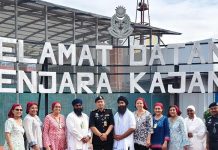
BREAK TIME: Kajang PEC students having a break prepared by Gurdwara Sahib Kajang volunteers – Photo / Asia Samachar
As the weekend comes around, some 2,000 students nationwide make their way to the 50-odd Punjabi Education Centres (PECs), many of them housed within gurdwara compounds. The learning of the mother tongue is earnestly at work.
Now, there is an effort to bump up the efforts, a push to get more students to take up the study of the Punjabi language.
Khalsa Diwan Malaysia (KDM), an Ipoh-headquartered national Sikh organisation that has been spearheading the task through its education wing Punjabi Education Trust Malaysia (PETM), is embarking on a campaign themed ‘My Language, My Identity’.
Set to be launched in early February, the campaign aims to promote the widespread use of Punjabi language and bump up PEC student enrolment.
“The success of this campaign is vital to meet the target requirement set by SEDIC,” PETM secretary Jaginder Singh Rahpatti tells Asia Samachar in a note on the campaign.
SEDIC is the Socio-Economic Development of the Indian Community (SEDIC), a special unit formed under the Malaysian Prime Minister’s Office (PMO). The unit manages a Federal government budget meant for Indian-based organisations to fund projects that will improve the position of the bottom half of the Indian community in Malaysia.
In November 2015, for example, four Sikh NGOs received a total of RM945,000 Federal funding for projects to improve the position of the bottom half of the Indian community in Malaysia. KDN received the lion’s share of RM600,000.
“Thus far, KDM has done a good job in promoting the use of Punjabi Language but more needs to be done… [It] needs further expansion, in terms of number of PECs and student enrolment,” Jaginder added.
ALL SMILES: PEC teachers from Selangor holding up the new Punjabi textbooks
The Punjabi Language programme is officially known as Program Pembangunan dan Perkembangan Bahasa Punjabi Dalam Sistem Pendidikan Malaysia
For 2018, SEDIC has set a target of 2,500 students for the programme. PETM records show that there were 2,136 students enrolled in almost 50 centres throughout Malaysia in 2017.
What is the end-result of the PETM efforts?
“The effort has produced the desired results. Over the years, the number of PECs and the number of students have steadily grown,” he said.
One yardstick is the number of students sitting for Government board examinations PT3 for students in year nine and SPM ()-level equivalent) for students in year 11.
“The number of candidates sitting for Punjabi Language paper for PT3 and SPM has also been encouraging lately, unlike the scenario in the late nineties when the number was so small that the Punjabi Language paper was in danger of being scrapped,” he said.
The funding received goes towards paying the part-time teachers and running of the centres. In the past, most of the funding came directly from the gurdwaras supporting each individual centres. Even today, many of the centres have to fork out funding over and above what is received from the PETM.
In the note, Jaginder said: “In terms of funding for this programme, although faced with numerous challenges and obstacles, with Waheguruji’s Grace, it has been well-managed.
“From heavy dependency on funds from KDM and well-wishers in the earlier years, of late KDM has been receiving grants from the Government through SEDIC, a unit in the Prime Minister’s Department which partly funds and fully supports the implementation of this programme. Today, we are able to help PECs by giving financial aid in the form of Per Capita Grant based on the number of students enrolled in each centre.”
Among others, PECs receive financial aid, curriculum/syllabus/scheme of work, textbooks / workbooks/ Sikhi books/ reading materials, continuous professional development courses for teachers, upgrading of teachers from non-diploma to diploma level and centralised exam papers.
They also receive past year exam papers for PT3 and SPM, report cards, educational and motivational seminars, an annual magazine Awaaz, calendars and specific financial aid upon written request.
On its part, KDM intends to use all avenues possible, including Gurdwara functions, Punjabi seminars and youth camps, to address the Sikh community on the importance of learning and speaking Punjabi.
“We have produced and sent bookmarks, flyers and posters for distribution and display in all Gurdwaras and PECs. We seek the cooperation and support of the administrators to meet people, make announcements, display posters and distribute flyers in the Gurdwaras and the PECs to encourage people to enrol their children in the nearest centre,” he said.
[ASIA SAMACHAR is an online newspaper for Sikhs in Southeast Asia and surrounding countries. We have a Facebook page, do give it a LIKE. Follow us on Twitter. Visit our website: www.asiasamachar.com] 17310
[Fastest way to reach Asia Samachar: Facebook message or WhatsApp +6017-335-1399. Our email: editor@asiasamachar.com. For obituary announcements, click here]
‘Singh In The Lion City’: A short documentary about a Singaporean Sikh man’s personal quest to decode his cultural identity. This sets him on a journey of self-discovery along a shared heritage trail – which he encapsulates and celebrates via the creation of an app. This documentary touches on wider themes of migration and diaspora. – Photo grab from video trailer
By Upneet Kaur-Nagpal
I saw Sikh guard statues with red turbans in an old Singaporean Chinese cemetery, and said, let’s make a film!
As a filmmaker, I ride on such outbursts of inspiration. It takes one flash of an image to strike the match and Vaidayaan! I am betrothed to the film. With my latest documentary, Singh In the Lion City, it was this very image of life-size Sikh statues, perched by an ornate tombstone in Bukit Brown, that brought this film to life.
I am a documentary filmmaker who happens to be Singaporean and Sikh as well. Driven by a fascination of people and their stories, I have travelled and lived across diverse places, and crave for a time when ‘one world fits all’. Through my films, and platform, Uptake Media, I hope to refresh tired perspectives by empowering niche communities to share their stories – in their own voices.
My stories have surrounded the gypsies, the homeless and poet migrant worker communities, and are all unified by a common theme – Home. Singh In The Lion City continues with this theme. In fact, it resonates further with me because it speaks directly to my roots. It’s not just Ishvinder (main character in the film) Singh’s story, it’s also my story. And yours, perhaps.
I have had my musings on the meaning of home – where is home, what is home? I often found myself in a similar dilemma to Ishvinder – not being able to identify with India in the same way as Indians do, and not always being able to connect with Singapore’s mainstream. Ishvinder’s dilemma led him on a quest in search for his identity. I tagged along, with curious eyes and a camera.
Singh In The Lion City is a short documentary about a Singaporean Sikh man’s personal quest to decode his cultural identity. This sets him on a journey of self-discovery along a shared heritage trail – which he encapsulates and celebrates via the creation of an app.
Ishvinder’s quest unravels the distinct relationship Sikhs had with the British military in the colonial days. The year 2019 marks the 200th anniversary of the British arrival on our sunny shores. It is believed that the British also brought with them Singapore’s first Sikh men – mostly as sepoys or convicts from Punjab. The Sikhs sported a prominent image, not only due to physical markers like the turban and beard but also because of their legacy of courage and loyalty as evidenced by their historical battles.
In Singapore and Malaysia, Sikhs were also conferred the protector image as jagas or security guards. During my research for the film, some people I spoke to recall Sikh jagas setting up their menjas or traditional rope beds along five foot ways at South Bridge Road or Shenton Way at night. When the shop shutters dropped, the jagas emerged to cast their watchful eyes on gold shop fronts and other businesses. This led to a close relationship with their Chinese towkays or business owners, that later evolved to a spiritual one as Sikh images were carried over to protect the afterlife.
The Sikhs have contributed significantly to the development of Singapore, and South East Asia. So Singh In The Lion City is an important story to tell. And told even better via the lens of the Sikh Heritage Trail app. Thanks to the efforts of our fellow Singaporeans, Ishvinder Singh and Vithya Subramaniam, the app preserves our old tales, empowering History to interact with current maps and trails, people and communities, in new and interesting ways.
The global Sikh diaspora, especially in South East Asia will connect with the film, and in particular, Malaysia, since we share numerous pages in our history books. Mostly, I hope for Singh In The Lion City to inspire all migrants embracing new homes worldwide.
The film has been screened in international festivals across Delhi, Toronto and Singapore, and will be screening in Seattle at the end of January.
ASIA SAMACHAR is an online newspaper for Sikhs / Punjabis in Southeast Asia and beyond.Facebook | WhatsApp +6017-335-1399 | Email: editor@asiasamachar.com | Twitter | Instagram | Obituary announcements, click here |
The Malaysian premiere of Eleven Days, a film by Australian-based Malaysian director Jaginder Singh, will on 26 Jan 2018.
The one-off screening at mmCineplexes at Damansara’s E-Curve is also a chance to meet and greet the director and some cast members.
This will be Eleven Days first international premiere following the Perth screening in December 2017.
Eleven Days follows the epic journey a 12-year boys quest to stop his brother from being trapped in the vicious cycle of terrorism.
To purchase tickets (RM38 each), send your name and the number of tickets required to +60178828760 (via WhatsApp).
[ASIA SAMACHAR is an online newspaper for Sikhs in Southeast Asia and surrounding countries. We have a Facebook page, do give it a LIKE. Follow us on Twitter. Visit our website: www.asiasamachar.com] 17301
[Fastest way to reach Asia Samachar: Facebook message or WhatsApp +6017-335-1399. Our email: editor@asiasamachar.com. For obituary announcements, click here]
TALENTED GRANDMOTHER: Jaswant Kaur who self-taught herself multiple languages – Photo grab from video shared by MP Murali Pillai
A 85-year old Punjabi grandmother in Singapore — who never went to formal schooling as her parents back then felt girls did not need education – could speak at least eight languages and dialects.
Jaswant Kaur, who lives in Bukit Batok, is said to be known to almost everyone in the neighbourhood. The amazing ability to speak so many languages and dialects must surely be the key to her charm.
She speaks her mother tongue Punjabi along with English, Chinese, Malay and a sprinkling of Tamil. She also speaks Chinese dialects like Hokkien, Teochew, Cantonese and Hainanese.
MP for Bukit Batok Murali Pillai shared her story on a Facebook posting.
Asked how she learnt Malay, she replied: “Saya takda belajar. Saya dengar, saya tahu.” Translation: I didn’t study them, I picked them up by listening.
In his Facebook entry, Murali writes:
When asked how she learnt them, she said “I did not go even to Primary 1. My grandmother told me girls should not go to school. I learnt ABC on my own. I also learnt the languages by listening to my colleagues. I used to work at “Ang Sua” washing sand before it was sold. I later worked in a sewing department of a Japanese clothing factory in Boon Keng.”
[ASIA SAMACHAR is an online newspaper for Sikhs in Southeast Asia and surrounding countries. We have a Facebook page, do give it a LIKE. Follow us on Twitter. Visit our website: www.asiasamachar.com] 17293
[Fastest way to reach Asia Samachar: Facebook message or WhatsApp +6017-335-1399. Our email: editor@asiasamachar.com. For obituary announcements, click here]
The opening ceremony of SKA's new building on 30 Dec 2017 - Photo / SKA
Singapore DPM Tharman Shanmugaratnam officiating SKA's new building on 30 Dec 2017 - Photo / SKA
Kuldip Singh explaining something to DPM Tharman at the exhibition - Photo / SKA
Sitting, L-R: Surjit Singh Wasan, Chairman Sikh Advisory Board; Pritam Singh, MP for Aljunied GRC; Mohinder Singh, President SKA; DPM Tharman; Inderjit Singh, Former MP for Ang Mo Kio GRC; Gurdip Singh Usma, Chairman, Sikh Welfare Council and Baljit Singh, Chairman, Central Sikh Gurdwara Board. Standing, L-R: 1. Deep Singh, President, Pardesi Khalsa Dharmak Diwan; Jaswant Singh, President, Sikh Sports Club; Malminderjit Singh, President, Young Sikh Association; LTC (Ret) Harpal Singh, Treasurer, Khalsa Dharmak Sabha; Gurdial Kaur, Chairperson, Singapore Sikh Education Foundation; Tirlok Singh Kler, President, Sri Guru Singh Sabha; Dalwinder Singh, President, Gurdwara Sahib Yishun; Jasmindar Singh Gholia, President, Sikh Missionary Society; Harpal Singh Bajaj, President Sri Guru Nanak Sat Sang Sabha, and Sarjit Singh Sona, Chairman, Sikh Businessmen Association - Photo SKA
Sitting, L-R: Gurrinder Singh Johal, Vice President SKA & Building fund Donor; Pritam Singh, MP for Aljunied GRC; Mohinder Singh, President SKA, Building fund Donor; DPM Tharman; Inderjit Singh, Former MP, Building fund Donor; LTC (Ret) Charanjit Singh, Immediate Past President, Chairman Organising Committee for the Opening & Building fund Donor; Gopal Singh, Vice President SKA & Building fund Donor. Standing, L-R: Sukhbir Singh, General Secretary SKA, Member of Building Committee & Building fund Donor; Manmohan Singh Malla, Building fund Donor on behalf of his father Late Ujagar Singh Malla; Jagjit Singh Sekhon, Past President SKA, Building fund Donor; Balbeer Singh Mangat, Past President SKA, Member of Building Committee; Surjit Singh Wasan, Chairman Sikh Advisory Board, Building fund Donor; Son of Gurcharan Singh Kesail, Building fund Donor
Good evening ladies and gentlemen.
DPM Tharman – Thank you for your presence with the Sikh community at SKA tonight.
Many thanks also to Member of Parliament for Jalan Besar GRC, Mr Pritam Singh of Aljunied GRC and former Member of Parliament Inderjit Singh. Heads of Sikh Institutions in Singapore. My colleagues at SKA, Patrons, Trustees, Management Committee, SKA members, friends, partners, well-wishers and donors.
A warm welcome to this evening’s celebration dinner to launch OUR new SKA building!
Thanks for bearing with us, New Building Key Features
I want to start by first expressing my gratitude to our members for bearing with us over the duration of the makeover of the building. I hope you are happy with the outcome, and that you will consider the SKA as a choice venue to host not only family celebrations such as birthdays, weddings and anniversaries but also talks and forums for your organisations. We hope the enhanced building provides the ambience to attract both young and old, families and friends from not only the Sikh community but the Singapore community which use the SKA for their events.
The new building’s key features are highlighted in the commemorative book. While we have used the words “makeover” and “refurbishment”, because of all changes and enhancements we made to the nearly half century old building, what we have is a new building. Besides this ballroom and another one on level 2, which has an enlarged floor space to cater for larger banquets, other features you would have noticed are the revamped ground floor to provide an attractive entrance ambience and new facilities, the new marbled lift lobbies with 3 new lifts instead of 2, a new service lift, new offices, and a gymnasium with large glass walls for users to view the sports and green fields. You would also have noticed our elderly and disabled friendly toilets and access ramps, all to make our building family friendly and inclusive to all people physically challenged. The building has also been enlarged with new semi-circular extensions to provide additional reception spaces outside the ballrooms.
The fourth storey has new function rooms including a dance studio, while the previous zinc roof has been reconstructed as a roof-top activity area. It has marvellous views over the adjoining landscape including Balestier Plain fields.
Rationale for Total Rebuild
Looking back many decades, the original 5 storey building was designed for modest practical purposes – as a meeting-point for the Sikh community to participate in social, educational, cultural and sporting activities. For the first two decades of SKA’s existence here until the early 1990’s, the building was mostly used for classes for young Singaporean Sikhs to learn the Punjabi language. On weekends, the SKA auditorium at the second floor hosted either Sikh or non-Sikh customary wedding ceremonies, with the level 1 hall used to host lunch or dinner receptions for wedding guests.
As our older Gurdwaras were rebuilt, their new prayer halls were purpose-built to host larger wedding ceremonies. Also, with the setting up of the Singapore Sikh Education Foundation (SSEF) and recognition of Punjabi as a mother-tongue language, the educational function in Punjabi was no longer as pressing for SKA to sustain. Given these developments by the late 1990’s, a major renovation was undertaken at SKA to air-condition the hall at the second floor as a conducive venue for social functions while the third floor was converted into a social space with a restaurant and lounge. In parallel, the building’s power supply was upgraded to meet such new requirements, which had not been factored into the1970 building design.
After more than 4 decades of high frequency usage as we staged countless cultural and social activities here, it became apparent that we needed to rebuild the aging SKA building to enhance its infrastructure and facilities to meet current and future needs. We faced two major challenges – (1) continuing to ensure a conducive, safe and accessible space for activities at the SKA, and (2) managing the escalating maintenance costs of our 45 year old building.
We organised a retreat to seek the Sikh community’s views in 2013 on the future role of the SKA and features for the new building. The feedback was used to engage our community leaders, members and building consultants to finalise the design brief before calling for tenders. Construction commenced in November 2014 and was completed in November 2016 at a cost of approximately $12 million.
The great support and encouragement by the community, and other well-wishers, motivated the Building Committee in completing the project, and overcoming many construction challenges along the way. Carrying out major additions and alterations especially to an old building presents quite different challenges from those of constructing a new building. Most of the engineering factors could be investigated upfront in the case of a new building. However, for an existing building, while some level of investigations could be done, many issues were often only discovered when construction commenced and demolition and stripping down began.
Strengthening works were required for the old building to comply with current building regulations and standards. All the columns of the building and practically all the beams needed to be strengthened. The floor slabs had to be redone to take higher loading. The foundations had also to be enlarged and numerous piles driven below the foundations to support the higher building loads. Doing these works below and within an existing building added to its complexity and lengthened the construction period.
The mechanical and electrical (M&E) infrastructure had basically to be completely redone, including providing sprinklers throughout the building for compliance with current fire safety regulations.
The building is compete – hurray! And thanks to all Sikh institutions for their tremendous support throughout the journey, the support of members and other well-wishers, as well as members of the Building Committee.
Significance of 30 Dec 2017 and Opening of New Building
In a book published to coincide with the SKA’s 75th Anniversary in 2006, Prof Tan Tai Yong wrote that the founding members of the SKA in 1931 could not have imagined that the SKA would evolve from their dream of a sports club to grow into a national Sikh institution playing a central role in the transmission of Sikh heritage and cultural traditions to its younger generations while developing members of the community to be active citizens of the larger Singapore nation.
I would like to take a moment to recall and salute the single-mindedness of the pioneering group of successful Sikh businessmen and civil servants who had formed a Building Committee in the 1960s, rallying the local Sikh community to fund-raise and construct the SKA premises here at Tessensohn Road by late 1969.
My team at SKA were inspired by the example set by these Sikh pioneers. They showed us what unity and steadfast belief in fulfilling a unified vision could achieve. They worked tirelessly to rally the community of Sikhs to support the effort with what little they could contribute. This was the spirit the present Building Committee aspired to match in our endeavor to construct a new SKA building that would fulfil the aspirations of current and future generations of the Sikh community.
The membership of Singapore Khalsa Association is not just individuals who are members of SKA but also the Sikh community at large. Our programmes ensure that the entire Sikh community has access to our activities. We bring together the various Sikh institutions and work cohesively with them to keep our rich Sikh cultural heritage and sporting activities vibrant to the Sikh community and the community at large. This, we believe, helps us to ensure strong community bonding. We also want to ensure that our next generation of Sikhs, like the pioneering generation, are imbued with the values and traditions of the community to take it forward to greater heights. We want to invite the younger people to join us to ensure vibrancy and continuity of the SKA brand well into the next 50 years.
Additionally, to foster greater interaction and engage the larger Singaporean community, we have over the years expanded the scope of our programmes to ensure that they do not just cater for the Sikh community but also to embrace and welcome non-Sikhs to share in our heritage. This is part of our efforts to foster and strengthen community bonding among the different races in Singapore.
In this regard, we are pleased with our close cooperation with the Central Singapore CDC in our larger community bonding efforts. This is manifested in the Vesakhi Mela where we invite locals, new citizens, foreign workers and the wider Singapore community to participate in the carnival and sporting activities by forming multi-racial teams. We also work with the Peoples Association on events such as the Chingay procession where SKA leads the Sikh community’s participation to show our cultural heritage and multi-racial Singapore society. And we also work with SINDA to improve educational prospects for the young through the SKA’s Khalsa Kindergarten.
The Balestier Plain Clubs, which include Ceylon Sports Club, Indian Association, Singapore Chinese Recreation Club and the SKA work together in sharing facilities as well as organising various events. This reflects the close bonds established among the Balestier Plain Clubs providing a hub for youth sporting and cultural clubs.
As we celebrate the formal opening of the SKA’s new building tonight, I wish to sincerely thank all donors and well-wishers, management committee members, SKA members and staff, for your unstinting dedication and commitment to this endeavour.
I would like specifically to highlight the support of all Sikh institution and individuals who will be honoured on stage later as well as the very significant contribution by the Lee Foundation of $1.2m. The Lee Foundation was also the major donor in the 1960s for the original building, and this time again donated generously. We have named the second storey hall “Lee Foundation Hall” to show the Sikh community’s gratitude to Lee Foundation for its substantial donations and unwavering over the years.
I look forward to working with you all to make the SKA’s next chapter its best yet! I wish you all an enjoyable and fun filled evening as well a great start to 2018! Happy New Year!
[A copy of the the speech was emailed to Asia Samachar]
[ASIA SAMACHAR is an online newspaper for Sikhs / Punjabis in Asia. How to reach us: Facebook message or WhatsApp +6017-335-1399. Our email: editor@asiasamachar.com. For obituary announcements, click here]
Great Grandchildren: Maahepreet Kaur, Akhil Poovan, Pavanraaj Singh
Path Da Bhog: 10am-12pm, 20 Jan 2018 (Saturday) at Gurdwara Sahib Petaling Jaya
Contact:
Rashvinder Singh 017 6860319
Harvinder Singh 014 9209626
| Entry: 7 Jan 2018 | Source: Family
[ASIA SAMACHAR is an online newspaper for Sikhs in Southeast Asia and surrounding countries. We have a Facebook page, do give it a LIKE. Follow us on Twitter. Visit our website: www.asiasamachar.com] 17273
[The fastest way to reach Asia Samachar is by sending us a Facebook message. For obituary announcements, click here]
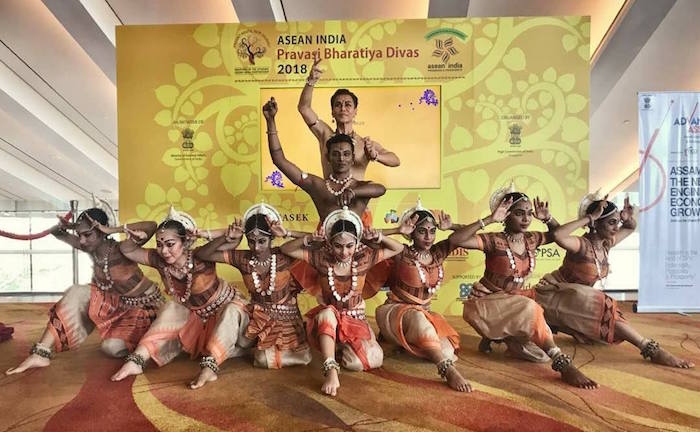
Sutra performing the Adithya Archana (salutation to the Sun) at the Asean-India Pravasi Bharatiya Divas at the Marina Sands Expo at Singapore – Photo: Sutra Dance Theatre
Some 3,000 delegates took part in the Asean India Pravasi Bharatiya Divas (PBD) in Singapore with External Affairs Minister Sushma Swaraj leading the Indian charge.
The two-day convention, which ended today, was held at Marina Bay Sands Singapore.
PBD is celebrated every year to strengthen the engagement of the overseas Indian community with the Government, reconnect them with their roots and celebrate their achievements and contributions, with 13 PBD conventions have been held in India so far, according to information at its website.
The conventions provide a platform to the overseas Indian community to engage with the Government on issues of concern to the Indian Diaspora and to explore opportunities for investment in India and contribution to the country of their origin. These conventions also provide an opportunity to the overseas Indians to network with other overseas Indians residing in various parts of the world.
During the PBD Convention, overseas Indians are honoured with the prestigious Pravasi Bharatiya Samman Award to recognise their contributions in various fields both in India and abroad, the website added.
Addressing the Indian diaspora at the ASEAN-India PBD, Sushma said India’s dialogue partnership with Asean has evolved into a strategic partnership and the Indian diaspora provides a platform for stronger ties with the grouping.
“We are here to reaffirm our commitment and to share the course of our journey ahead to the future of India and ASEAN in the world…Our diaspora provides a platform for a stronger relationship between India and ASEAN countries,” she said, according to PTI.
Elaborating on the 25 year partnership, PTI quoted her as saying: “Our dialogue partnership has evolved into a strategic partnership…India’s engagement with the ASEAN region lies in the clarity of the principles that we share. We believe that when all nations adhere to international rules and norms and when we conduct on the basis of sovereign equality and mutual respect, our nations feel secure and our economies prosper.”
[ASIA SAMACHAR is an online newspaper for Sikhs in Southeast Asia and surrounding countries. We have a Facebook page, do give it a LIKE. Follow us on Twitter. Visit our website: www.asiasamachar.com] 17269
[Fastest way to reach Asia Samachar: Facebook message or WhatsApp +6017-335-1399. Our email: editor@asiasamachar.com. For obituary announcements, click here]



















 FELLOWSHIP CAMP, CAMERON HIGHLANDS, FEBRUARY 2018
 By Hb Singh


 The Malaysian premiere of Eleven Days, a film by Australian-based Malaysian director Jaginder Singh, will on 26 Jan 2018.