ASIA SAMACHAR is an online newspaper for Sikhs / Punjabis in Southeast Asia and beyond. You can leave your comments at our website, Facebook, Twitter, and Instagram. We will delete comments we deem offensive or potentially libelous. You can reach us via WhatsApp +6017-335-1399 or email: asia.samachar@gmail.com. For obituary announcements, click here
Village: Desu Malkana; District: Sirsa, Haryana Bandar Sri Sendayan, Seremban
With the heaviest of hearts, we share the passing of our beloved Maa who has transitioned to her final resting haven. Maa, you were the epitome of resilience and embodiment of love. Whilst our hearts will never be whole again, we are reassured that you have found your eternal restful place in paradise. You will reside in the crevices of our hearts forevermore, redolent with the loving memories we have crafted during the joyous times of your life.
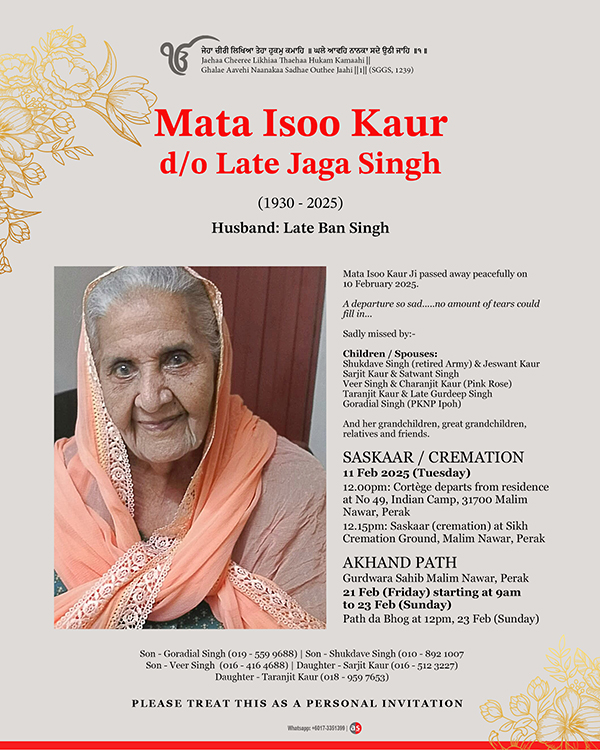
Mata Ji passed away peacefully on 10 February 2025, aged 94 years, leaving behind beloved:
Son / Daughter-In-Law Naginder Singh / Jessie Kung Oi Fah
Great Grandchildren, Nephews, Nieces and Relatives.
FINAL JOURNEY 11 Feb 2025 (Tuesday) 2.00pm: Cortège leaves residence at 1361, Jalan Nusari Bayu 5/1, Taman Nusari Bayu 2, Bandar Sri Sendayan 71950 Bandaraya Seremban, Negeri Sembilan 3.00pm: Saskaar (cremation) at Hindu Crematorium, Jalan Templer, Seremban
PATH DA BHOG & ANTIM ARDAAS 23 February 2025 (Sunday) 9.30am – 11.30am onwards Gurdwara Sahib Seremban
For those who wish to convey their condolences to the family, kindly contact the following numbers:-
ASIA SAMACHAR is an online newspaper for Sikhs / Punjabis in Southeast Asia and beyond. You can leave your comments at our website, Facebook, Twitter, and Instagram. We will delete comments we deem offensive or potentially libelous. You can reach us via WhatsApp +6017-335-1399 or email: asia.samachar@gmail.com. For obituary announcements, click here
And her grandchildren, great grandchildren, relatives and friends.
SASKAAR / CREMATION 11 Feb 2025 (Tuesday) 12.00pm: Cortège departs from residence at No 49, Indian Camp, 31700 Malim Nawar, Perak 12.15pm: Saskaar (cremation) at Sikh Cremation Ground, Malim Nawar, Perak
AKHAND PATH Gurdwara Sahib Malim Nawar, Perak 21 Feb (Friday) starting at 9am to 23 Feb (Sunday) Path da Bhog at 12pm, 23 Feb (Sunday)
ASIA SAMACHAR is an online newspaper for Sikhs / Punjabis in Southeast Asia and beyond. You can leave your comments at our website, Facebook, Twitter, and Instagram. We will delete comments we deem offensive or potentially libelous. You can reach us via WhatsApp +6017-335-1399 or email: asia.samachar@gmail.com. For obituary announcements, click here
The Vadda Ghalughara (the Great Holocaust), was a pivotal moment in Sikh history, marking both immense tragedy and unparalleled resilience. This article explores significant lessons from this historical event and their relevance in the modern world. It highlights themes of unity, sacrifice, political awareness, resilience, leadership, identity preservation, economic self-sufficiency, spirituality, strategic alliances, and historical awareness. By drawing insights from the past, Sikhs can navigate contemporary challenges such as globalization, discrimination, and political struggles. The article emphasizes the importance of community solidarity, active participation in governance, and fostering economic and social empowerment. Through education, advocacy, and strategic planning, Sikhs can ensure their legacy of strength and perseverance endures, safeguarding their identity and values for future generations.
Introduction
The Vadda Ghalughara (the Great Holocaust) stands as one of the darkest yet most defining moments in Sikh history. Occurring on February 5, 1762, this tragic massacre saw the brutal killing of tens of thousands of Sikhs at the hands of the Afghan ruler Ahmad Shah Abdali [1-6]. Though it was an unparalleled humanitarian catastrophe, the event did not break the Sikh spirit; instead, it strengthened their resolve, unity, and resilience. The Sikh community, despite facing existential threats, not only survived but later emerged as a formidable power under Maharaja Ranjit Singh [7-11].
The lessons from this tragedy remain deeply relevant today. Sikhs worldwide face challenges such as cultural assimilation, political marginalization, religious intolerance, and economic disparities. By reflecting on the sacrifices of their ancestors, modern Sikhs can draw inspiration to uphold their identity, stand for justice, and strengthen their communities. The Vadda Ghalughara teaches the importance of unity, strategic planning, leadership, economic self-sufficiency, and an unwavering commitment to faith and values.
In this article, we explore these lessons from a contemporary perspective, examining how the Sikh community can apply them to navigate modern socio-political and economic challenges. By doing so, Sikhs can ensure that the resilience demonstrated by their forebears continues to guide future generations toward strength, prosperity, and collective progress.
1. The Importance of Unity and Collective Strength
One of the primary lessons from the Vadda Ghalughara is the significance of unity. The Sikhs of the 18th century were divided into various misls (confederacies), which sometimes hindered their ability to counter external threats effectively [1-2]. Despite these divisions, the collective Sikh spirit eventually emerged potent and more resilient.
In today’s world, Sikhs are spread across the globe, facing challenges such as discrimination, identity issues, and political struggles. To navigate these, Sikhs must foster unity within the community, bridging differences between different sects and ideological factions. Whether addressing human rights violations, advocating for Sikh identity, or strengthening institutions like the Akal Takht, a unified Sikh response is essential.
2. The Value of Sacrifice and Martyrdom
The Vadda Ghalughara demonstrated the ultimate sacrifices made by Sikhs for their faith and freedom [12]. Thousands of men, women, and children gave up their lives rather than renounce their beliefs.
While martyrdom in the traditional sense may not be relevant today, Sikhs can learn to make sacrifices for the betterment of society. This includes standing against injustice, working for humanitarian causes, and contributing selflessly to global welfare. Sikhs in various fields, including business, politics, and social activism, can embody this spirit by upholding ethical values and serving as beacons of integrity.
3. The Need for Political Awareness and Strategy
A key factor in the Sikh losses during the Vadda Ghalughara was the lack of a well-coordinated political and military strategy at the time [13-14]. While Sikh warriors were brave, they were often forced into reactive strategies rather than proactive ones.
Sikhs today must be politically aware and actively participate in governance, policymaking, and leadership roles. Whether in Punjab, India, or globally, Sikhs should engage in political discourse, advocate for their rights, and ensure that their voices are heard. Effective lobbying, community representation, and strategic alliances are critical for addressing Sikh issues on national and international platforms.
4. The Power of Resilience and Adaptability
Despite the immense losses of the Vadda Ghalughara, the Sikh community did not perish. Instead, they regrouped, adapted to the circumstances, and eventually established the Sikh Empire under Maharaja Ranjit Singh [7-11].
Sikhs today face challenges such as economic uncertainties, cultural assimilation, and technological disruptions. By learning from their ancestors, Sikhs can embrace resilience and ensure their traditions, businesses, and values thrive in modern society. Educational advancements, professional networking, and adaptability to new technologies are ways Sikhs can safeguard their future.
5. The Role of Leadership in Crisis Management
One reason for Sikh survival post-Vadda Ghalughara was the presence of strong leaders like Baba Deep Singh [15], Jassa Singh Ahluwalia [16], and others who guided the community through turmoil.
Effective leadership remains a critical need for the Sikh community today. Strong and visionary leadership is essential in religious institutions, political arenas, or social organizations. Sikh leaders should be well-versed in history, grounded in ethics, and adept at navigating contemporary challenges, such as social justice, education, and economic development.
6. Preserving and Promoting Sikh Identity
During the persecution in the 18th century, Sikhs were forced to live in jungles and deserts, yet they never abandoned their distinct identity. The Khalsa remained steadfast in maintaining their articles of faith, which later helped in reviving Sikh sovereignty [17].
Today, Sikhs living in multicultural societies often face pressures to conform or hide their identity due to discrimination or convenience. The lesson from history is to take pride in Sikh heritage and ensure that cultural and religious traditions are preserved. Educational initiatives, media representation, and community-driven awareness programs can reinforce Sikh identity and values.
7. Self-Sufficiency and Economic Strength
The Sikh misls who survived the Vadda Ghalughara had strong economic backing [1-2]. Their ability to sustain themselves independently enabled them to regroup and fight back.
Economic empowerment is a crucial lesson for Sikhs today. Financial literacy, entrepreneurship, and investment in businesses can ensure that Sikhs remain self-sufficient. Supporting Sikh-owned enterprises and creating global economic networks can help strengthen the community economically and socially.
8. The Relevance of Faith and Spirituality
Faith played a crucial role in sustaining Sikhs during the genocide. Despite the massacres, Sikhs continued to draw strength from Gurbani and the teachings of the Gurus [18].
In an era dominated by materialism and stress, Sikhs can turn to their spiritual roots for inner peace and guidance. Regular engagement with Gurbani, meditation, and community prayers can provide mental and emotional resilience. Promoting Sikh values like Seva (selfless service), Simran (meditation), and Sarbat da Bhala (welfare for all) can contribute to both personal growth and societal well-being.
9. Strategic Alliances and Global Solidarity
The Sikhs of the 18th century learned to form alliances with like-minded groups to counter external threats. This strategy helped them survive and later thrive [19-20].
Sikhs should engage in global advocacy, forming alliances with human rights organizations, legal experts, and international policymakers. Solidarity with other minority groups and oppressed communities can help amplify Sikh voices on the global stage.
10. Learning from History to Avoid Repetition
Perhaps the most crucial lesson from the Vadda Ghalughara is the need to learn from history to prevent similar tragedies in the future. The Sikh community must remain vigilant against oppression, discrimination, and political maneuvering that can lead to marginalization.
Awareness of Sikh history can prevent the recurrence of past mistakes. Educational institutions should integrate Sikh history into curricula, and Sikh scholars should document and disseminate historical knowledge to empower future generations.
Conclusion
The Vadda Ghalughara is not just a tragic chapter in Sikh history; it is a beacon of lessons for resilience, unity, leadership, and identity. In the modern world, these lessons hold immense relevance as Sikhs navigate global challenges. By fostering unity, embracing political awareness, strengthening economic independence, and preserving cultural identity, the Sikh community can ensure a prosperous and secure future while staying true to their rich heritage.
The sacrifices made during the Vadda Ghalughara remind Sikhs of the importance of perseverance and faith. Just as the community rose from the ashes of devastation in the 18th century, Sikhs today must continue to build on their strengths to protect their rights, culture, and values. The commitment to self-sufficiency, active participation in governance, and adherence to the teachings of Guru Granth Sahib remain essential in facing contemporary struggles.
Ultimately, the Vadda Ghalughara teaches that adversity can serve as a catalyst for growth and transformation. The Sikh spirit, forged in hardship, continues to inspire generations to uphold justice, unity, and selfless service. By applying these lessons today, Sikhs can ensure that their legacy of resilience and courage endures, guiding future generations towards a stronger and more united community.
References
Singh, Khushwant. (2004). A History of the Sikhs, Volume 1: 1469-1839 (2nd ed.). Oxford University Press.
Dilgeer, Harjinder Singh. (1997). Sikh History in 10 Volumes. Sikh University Press
Singh, Harbans. (1999). The Heritage of the Sikhs. Manohar Publishers.
Singh, Patwant. (2000). The Sikhs. Random House.
Grewal, J.S. (1998). The Sikhs of the Punjab. Cambridge University Press.
McLeod, W.H. (2009). Exploring Sikhism: Aspects of Sikh Identity, Culture, and Thought. Oxford University Press.
Singh, Khushwant. (2017). Ranjit Singh: Maharajah of the Punjab. Random House Publishers India Pvt. Limited. ISBN: 9351181022, 9789351181026
Prinsep, H. T. (2017). Origin of the Sikh Power in the Punjab and Political Life of Muha-Raja Runjeet Singh: With an Account of the Present Condition, Religion, Laws and Customs of the Sikhs. United States: FB&C Limited.
Grewal, J. S. (1991). The Sikh Empire (1799-1849): In The Sikhs of the Punjab, pp. 99 – 127. Publisher: Cambridge University Press.
Singh, P., Rai, J.M. (2008). Empire of the Sikhs: The Life and Times of Maharaja Ranjit Singh. Publisher: Peter Owen.
Singh, Devinder Pal. (2024, Nov. 9). Exploring Various aspects of Sikh History and Sikhism. SikhNet.https://www.sikhnet.com/news/exploring-various-aspects-sikh-history-and-sikhism
Singh, Nirbhai (2006). The Sikh Vision of Heroic Life and Death. Singh Brothers. Amritsar. India. ISBN: 9788172053567, 8172053568
Grewal, J. S. (1996). Sikh Ideology, Polity and Social Order. Manohar Publications. ISBN: 8173041156, 9788173041150.
Grewal, J. S. (2009). The Sikhs: Ideology, Institutions, and Identity. Oxford University Press. ISBN: 0195694945, 9780195694949
Sidhu, D. S. (2021). Baba Deep Singh – The Great Sikh Martyr and Scholar. Gyan Khand Media. Punjab. India. ISBN 978-93-82887-49-2
Grewal, J.S. & Habib, Irfan. (2001). Guru Gobind Singh and the Sikh Response to the Mughal Empire. Manohar Publishers.
Kindersley, D. (2023). Sikhs: A Story of a People, Their Faith and Culture. DK Publishing. ISBN: 978-074-4077-520
Sachdev, S.S. (2015). Story of The Sikhs: The History of India, Sikh Religion, and the Rise, Persecution, Genocide, Resilience, and Survival of Sikhs. CreateSpace Independent Publishing Platform. ISBN-13: 978-1475275971
Fenech, Louis E. (2013). The Sikh Zafar-nama of Guru Gobind Singh: A Discursive Blade in the Heart of the Mughal Empire. Oxford University Press.
Dr. D. P. Singh, M.Sc., Ph.D. is Director, Center for Understanding Sikhism, Mississauga, Ontario, Canada. He is a physicist by training, a teacher by profession and a writer by choice. He specializes in writing on Science, Religion and Environmental topics. Currently, he is working as Director, CanBridge Learning & Educational Consultant to various educational institutions in Canada. Email: drdpsn@gmail.com
ASIA SAMACHAR is an online newspaper for Sikhs / Punjabis in Southeast Asia and beyond. You can leave your comments at our website, Facebook, Twitter, and Instagram. We will delete comments we deem offensive or potentially libelous. You can reach us via WhatsApp +6017-335-1399 or email: asia.samachar@gmail.com. For obituary announcements, click here
Manjinder Singh Sirsa shares a photo of him with Prime Minister Narendra Modi on his Facebook in February 2025 after winning the Delhi elections
By Jagmohan Singh | World Sikh News |
Bhartiya Janata Party leader, holier-than-thou party loyalist, known to toe only the party line, even if it means sacrificing Sikh community interests—Manjinder Singh Sirsa from Rajouri Garden, turncoat leaders Tarwinder Singh Marwah from Jangpura, and Arvinder Singh Lovely from Gandhi Nagar, alongwith third-time winner Jarnail Singh from Tilak Nagar and son of a former Congress leader – Pundardeep Singh Sawhney – from Chandni Chowk, representing the Aam Aadmi Party are the new Sikh faces in the 2025 Delhi Assembly. Their victories symbolize Sikh political engagement in the capital, but they also bring a set of expectations from the community that extend beyond party lines.
A Historic Political Engagement
This election witnessed an unprecedented level of Sikh electoral participation, with strong backing from DSGMC leaders. This proactive involvement, while leading to electoral success, has also sparked debates about the extent to which Sikh institutions should engage in mainstream politics. Historically, there has been resistance to the DSGMC’s role in elections, but the results suggest that this participation may be here to stay.
However, while Sikh voters have enabled these victories, an important question lingers: Will these elected representatives advocate for Sikh issues beyond their general constituency responsibilities? Sikh concerns, ranging from Gurdwara governance to the pending DSGMC elections, remain unresolved.
The entanglement of BJP and AAP in a long-standing power struggle in Delhi, particularly between the Chief Minister and the Lieutenant Governor, has already delayed the DSGMC elections. With the BJP at the helm, at the Centre and in Delhi, the community is watching closely to see if the DSGMC elections will be conducted fairly and transparently.
ASIA SAMACHAR is an online newspaper for Sikhs / Punjabis in Southeast Asia and beyond. You can leave your comments at our website, Facebook, Twitter, and Instagram. We will delete comments we deem offensive or potentially libelous. You can reach us via WhatsApp +6017-335-1399 or email: asia.samachar@gmail.com. For obituary announcements, click here
Baltej Singh Dhillon, a retired career police officer, a community leader and a lifelong advocate for diversity and inclusion, has been appointed as a senator.
Prime Minister Justin Trudeau announced that Governor General Mary Simon has appointed Baltej, a Malaysian-born who moved to Canada in 1983, and two others as independent senators.
In a social media entry, Baltej said: “My heartfelt appreciation goes out to everyone who has supported me on this journey. From a young boy who moved to Canada at 16 with my mother and two younger sisters, with limited means, and the steadfast support of my older brother and sister-in-law, we persevered through many challenges.”
“Their broad range of experience will be a great benefit to the Senate, and I am confident they will continue to be strong voices for their communities,” Trudeau, the outgoing PM, said in a statement.
The new senators were recommended by the Independent Advisory Board for Senate Appointments and chosen using a merit-based process open to all Canadians. Introduced in 2016, the process ensures senators are independent and able to tackle the broad range of challenges and opportunities facing the country, according to the statement.
Baltej Dhillon was appointed as senator for British Columbia while Martine Hébert was appointed for Quebec and Todd Lewis for Saskatchewan.
“In 1991, Mr. Dhillon made history as the first Royal Canadian Mounted Police (RCMP) officer to wear a turban. He went on to have a successful 30-year career with the RCMP, playing a key role in several high-profile investigations. Since 2019, he has worked with British Columbia’s anti-gang agency, while remaining active in his community as a youth leader,” according to the PM’s statement.
In his profile, it was noted that Baltej advocated for the right to practise his faith while serving Canada.
Baltej played a key role in several high-profile investigations, including the Air India Flight 182 tragedy and the Robert Pickton case. He also held various leadership roles, including overseeing the British Columbia RCMP Divisional Emergency Operations Centre and the federal Serious and Organized Crime’s Intelligence section, also in British Columbia, as well as establishing and managing intelligence operations at the Provincial Intelligence Centre of British Columbia (now the Real-Time Operations Centre of British Columbia), the first of its kind in Canada.
Baltej Singh Dhillon — Photo: DIVERSEcity Community Resources Society
In 2013, Baltej led the Sikh Leadership and Police Committee on Gang Violence to support youth prevention strategies within the Sikh Community. Since retiring from the RCMP in 2019, he has worked as Program Manager for the Crime Guns Intelligence and Investigations Group with the Combined Forces Special Enforcement Unit of British Columbia, the province’s anti-gang agency.
The statement noted that Baltej was also deeply involved in community service. He serves on various committees and has led youth camps. He has received numerous distinctions and awards, including the Lifetime Achievement Award from The Times of Canada, the Queen Elizabeth II Diamond Jubilee Medal, the Queen Elizabeth II Golden Jubilee Medal, and the RBC Top 25 Canadian Immigrant Award.
In addition to his extensive police education and training, it said he was the recipient of honorary Doctor of Laws degrees from McMaster University and Kwantlen Polytechnic University.
ASIA SAMACHAR is an online newspaper for Sikhs / Punjabis in Southeast Asia and beyond. You can leave your comments at our website, Facebook, Twitter, and Instagram. We will delete comments we deem offensive or potentially libelous. You can reach us via WhatsApp +6017-335-1399 or email: asia.samachar@gmail.com. For obituary announcements, click here
ASIA SAMACHAR is an online newspaper for Sikhs / Punjabis in Southeast Asia and beyond. You can leave your comments at our website, Facebook, Twitter, and Instagram. We will delete comments we deem offensive or potentially libelous. You can reach us via WhatsApp +6017-335-1399 or email: asia.samachar@gmail.com. For obituary announcements, click here
US military C-17 aircraft lands at the Shri Guru Ramdas Ji International Airport (ATQ), Amritsar in Punjab on February 5, 2025, to send back deported Indians
By Bhupinder ‘Bo’ Singh | Opinion |
The landing of US Army C-17 Globemaster aircraft carrying 104 expelled Indian nationals deported from US landed in Amritsar on February 5, garnering the headline news in India, gripping the nation. The deportees were primarily from Gujarat, Haryana and Punjab. There were 33 from Gujarat and Haryana each, 30 were from Punjab, and the remaining 8 were from Chandigarh, Uttar Pradesh, and Maharashtra. There were 72 men, 19 women and 13 children.
The family members waiting outside the air station in Amritsar shared accounts of how most of the deported left the country choosing the “Dunki route” in search of greener pastures. Many of those seeking green pastures had only recently entered the US illegally, by spending ₹40-50 lakhs (₹4-5 million, equivalent to US$45,000-57,000) to US to to fund their journey by liquidating their assets as property. Now they were returning with dashed hopes and a crushing debt that they incurred to fund the journey, along with an uncertain future. The news is not just causing dismay in the families of those returning, but also amongst the state governments and central government. There has been a criticism the way the illegal immigrants were returned handcuffed during the flight back home.
But what about the ordeals these illegal immigrants endured to make their perilous journey, full of hazards in their quest of their American dream? How much did they pay to the unscrupulous travel agents, and the long circuitous journey spanning many months and many countries that they undertook to get there.
Obviously, there is an allure of better job opportunities, higher quality and less stressful life, better educational standards, which they are unable to avail back home. The lack of suitable, stable, satisfying work environment, coupled with success opportunities are the fundamental drivers of this colossal human trafficking. The pull of economic upliftment with higher living standards is so high the perspective immigrants are willing to put their lives in danger. On top of it we add the “aping factor” or “keeping up with the Jones”, this trend is becoming explosive. Blaming the unscrupulous travel agents for this menace is not going to solve the problem.
The nation must face this reality and provide suitable alternatives back home so that this thought of leaving the country at any cost should not even come to mind. The underlying socio-political issues, high inflation, quality of education, and job opportunities must be addressed. The quality of education is in a serious need of upgrade, so that valueless education at high cost is not the norm.
Similarly, the elected government must create job opportunities keeping the aspirations of citizens in mind and a priority. At present the elected representatives are solely concerned with enriching themselves. The citizens do not see any hope or opportunity in the country, so the lure of “phoren” is very high.
If these fundamental and structural changes are incorporated the menace of leaving the country at any cost will not raise its ugly head. Let us hope that this tragic deportation acts as a wakeup call for the nation and its leaders to do some introspection and make some fundamental changes to the economy.
Bhupinder ‘Bo’ Singh, Houston. Born in Bhamo, Myanmar, he now lives in Houston, US, where he runs a manufacturing company formed with his son. A mechanical engineer by training, he has authored a number of books, including Connecting with the Master – A collection of essays on topics related to Sikhism (2006) and In Bully’s Eyes – An Illustrated Children’s book on Bullying (2019).
ASIA SAMACHAR is an online newspaper for Sikhs / Punjabis in Southeast Asia and beyond. You can leave your comments at our website, Facebook, Twitter, and Instagram. We will delete comments we deem offensive or potentially libelous. You can reach us via WhatsApp +6017-335-1399 or email: asia.samachar@gmail.com. For obituary announcements, click here
The tabla, a popular instrument used in kirtan _ Photo: Asia Samachar
By Akashdip Singh | Opinion |
Recently, I attended a Kirtan session at a Gurdwara, hoping to connect with the Creator through the soothing melodies of sacred Gurbani. However, the microphone volume was cranked up so high that instead of feeling closer to the Omnipresent, I found myself disconnected from the purpose. It was akin to trying to find peace in the eye of a storm.
My dear friend who was at the programme together with me remarked, “Looks like we are becoming a deaf society.” His words struck a chord, echoing the truth that sometimes, less is more. Why do we feel the need to blast the microphones in sacred spaces? It’s like trying to find a needle in a haystack when all we need is a gentle whisper to touch the soul.
Everyone has their own way of connecting to the Creator. Some find solace in Kirtan accompanied by the tabla, harmonium, or the tanpura, while others feel more connected with the vibrant sounds of hand cymbals and tambourines. It’s a personal choice, and there’s no one-size-fits-all approach.
Kirtanis, too, have their unique vocal techniques and varying volume preferences. For some, bliss is found in the higher decibels of Kirtan while for others it could be totally the opposite. As the saying goes, “You can’t please all of the people all of the time.” Instead of wanting to request the Kirtanis to lower their voices, perhaps we should focus on adjusting the microphone volume.
In the end, the beauty of Kirtan lies in its ability to touch the heart, and sometimes, a gentle breeze carries more meaning than a roaring wind. Let us strive to create an environment where everyone can find their own slice of peace amidst the sacred symphony.
Many thanks.
(Akashdip Singh, a consultant based in Kuala Lumpur, Malaysia, believes his extensive travels have profoundly enriched his life experience, adding depth and breadth to his understanding of the world.)
ASIA SAMACHAR is an online newspaper for Sikhs / Punjabis in Southeast Asia and beyond. You can leave your comments at our website, Facebook, Twitter, and Instagram. We will delete comments we deem offensive or potentially libelous. You can reach us via WhatsApp +6017-335-1399 or email: asia.samachar@gmail.com. For obituary announcements, click here
On December 2, 2024, the Akal Takht (AT) summoned two-time Punjab Deputy Chief Minister and President of Shromani Akali Dal (SAD), Sukhbir Singh Badal, along with all former ministers from the Akali Dal government that served from 2007 to 2017 at 1 pm. Badal was already declared a tankhaiya in August 2024. Also asked to attend were the core committee of the SAD from 2015.
To those un-initiated in the politics of Punjab and equally unaware of the shenanigans of the AT (caused largely by the former); the move appeared to be a one in which the master manipulators of AT, namely the Badal dominated SAD, were finally being brought to justice. For once, the political servant that was the AT was going to hold its political master that was the SAD to account.
Or was the entire episode just another chapter of political maneuvering by the Badal led SAD and just another act of subservience by the clergy of AT?
The Story of Scripted Dramas.
In a letter dated November 18, 2024, to AT Jathedar Giani Raghbir Singh, Sukhbir Singh Badal had appealed that he wants to appear before the Takht as a “humble Sikh”. In his letter he had stated, “The Akal Takht Sahib declaring me tankhaiya has left a big impact on my mind. The servant (Sukhbir) has now resigned from the presidency of SAD. The servant wants to appear at AT Sahib as a humble Sikh with respect and politeness. Since AT Sahib which was established by the sixth Guru Hargobind who always showers grace and forgives, please accept the request of the servant.”
The telltale signs of the drama are three. First, the AT had declared Badal a Takhayia three months prior to this letter. Why did it take this long for the resignation to be tendered? Was it because three months were required to plot, consult and put the plan in place? Second, the SAD working committee had met on November 18 to discuss Sukhbir Singh Badal’s resignation but ultimately decided to postpone the decision.
“The panel will consult with SGPC members and district-level SAD leaders before making a final decision,” said Balwinder Singh Bhundar, the party’s working president, who chaired the meeting at the party’s head office in Chandigarh. This meant that Badal was still President of AT the time of submitting the letter and hence still calling the political shots. Third, Badal’s resignation request came just three days after he approached AT, urging Jathedar Giani Raghbir Singh to convene a meeting of the Sikh clergy to pronounce his tankhah (religious punishment). This meant that when Badal spoke with the AT clergy, the political master-servant relationship was very much intact.
It was Badal who was calling the shots. The four targets of the shots that Badal called was clear: rehabilitate the Badals, rehabilitate the SAD, use the AT clergy for that purpose and use the episode to win back the confidence and support of the Sikhs of Punjab.
Rehabilitating The Badals and the SAD.
The SAD was defeated soundly by the people of Punjab in the Legislative Assembly elections that were held in February 2022 to elect the 117 members of the 16th Assembly. The defeat was so punishing that SAD decided to not contest any by-elections for four assembly seats in Punjab. Three of the seats were then won by AAP while one seat went to Congress.
Shiromani Akali Dal president Sukhbir Singh Badal submits his explanation letter over allegations levelled by rebel SAD leaders to Akal Takht jathedar Giani Raghbir Singh in the presence of SGPC president Harjinder Singh Dhami, party leaders Balwinder Singh Bhundar, Daljit Singh Cheema and Maheshinder Singh Grewal at the Takht secretariat in Amritsar on July 24, 2024 – Photo: Panjabi Tribune video grab
A political party that chooses not to contest elections is no different from, say, an airline that decides not to fly its planes or a restaurant that decides not to sell food. The political party may as well shut its doors – as would the airline and the restaurant. So, the SAD folks came up with dubious “reasons” why the party was “giving away free seats” to the opponent parties. They did so “in solidarity with Sukhbir Badal being declared a tankhaiya,” and to keep with the panthic interests and ‘maan-maryada’ of Sri AT Sahib, the SAD.”
The same “panthic interests” that the Badal led SAD trampled upon for decades that it was in power? The same “maan-maryada of the Sri AT Sahib” that the Badals had trodden upon and driven into dirt for decades?
The bitter truth was simply that having been routed so badly in the February 2022 elections, the SAD was certain it could not win any of the by-elections. It was also certain it could not win in the next elections. Unless the party was able to pull a rabbit out of its hat of tricks. Everything had to be done to bring the Badals and SAD back to power. Everything.
Weaponizing The AT.
Bringing the Badals and the SAD back to power required that the people’s confidence in SAD be restored – if necessary, by nefarious means even – means that involved using the AT for the party’s ends.
The December 2, 2024, meeting at was thus a full-scale charade towards this end. It was a pretentious act of a drama that is orchestrated by SAD itself to pull wool over the eyes of the people. The idea is to make it appear that the AT is going to punish the SAD for its past actions. Indeed, some laughable punishment of sitting as a door-guard for two days was handed down and some expendable people made out to be the scapegoats.
The charade would allow the AT Jathedars and SGPC to go about its business as usual – campaigning, threatening, scaring and fooling people to vote for SAD – the “party of the panth.” The Patna Jathedar is already campaigning for Badal to be re-elected president of AD. Badal, and his cohorts would go back to the people claiming that their past misdeeds should not be held against them because they had all paid their dues to the AT. Some people may be fooled, but the SAD situation is so bad that one doubts this drama alone will help.
The Supreme Court of India has stated that under Section 85(1) of the Sikh Gurdwaras Act 1925 the AT is like any other Gurdwara with no powers to meet out religious punishments. Section 85 provides that AT is under the control, supervision and management of SGPC and would do as SGPC allocates duties. The AT was thus expected to mete out the sort of “tap on the wrist” punishment it did. The Badals and SAD was well aware of this severe limitation of the AT and used it to their benefit – walking away with miniscule punishments in return for a huge expected reward of rehabilitation.
At the end of the day, the institution that has suffered the greatest damage is the AT. The Jathedars have allowed themselves to be used as an instrument in the political shenanigans of the Badals in their quest to get back into power. They have handed a clean chit to the Badals with this slapstick drama. In the process they have subjected the AT to ridicule and condemnation. The news is that the charges were selected by the Badals and the punishment drafted by the same group for the AT Jathedars to read out.
The Can of Worms That Got Opened: The Drama at The Takhats.
Badal wrote the script to re-deem himself. To make it real, he had to accord some “authority” to the Jathedars so that they could mete out the scripted punishment to fool the people into thinking the “episode was real.”
The Jathedars – knowingly or otherwise – thought that the scripted authority was real power; and that their position has finally been recognized. It went to the heads of some of them. With their master sitting with a broken leg holding a spear – some of the Jathedars thought they had finally become masters.
A 27-second video clip of arguments between SAD leader Virsa Singh Valtoha and Takht Damdama Sahib Jathedar Giani Harpreet Singh leaked during the former’s appearance before the five Sikh high priests at AT Secretariat in October.
In this 27-second video clip, Valtoha, in the presence of five high priests, is seen questioning Harpreet Singh if the clergyman shared allegiance with the BJP-led Centre and RSS. Triggered over this, Giani Harpreet Singh loses his cool and displays abusive behavior.
In his “can of worms styled defense” Harpreet Singh asserted that he had got all the recordings deleted from the cameras of the AT secretariat, SGPC and elsewhere, except a single recording of the whole conversation of a few hours that was transferred in a pen drive. He said he had handed over this pen drive to the AT Jathedar.
“I have no idea how and who got this clip leaked,” he said, clearly laying the blame on the AT Jathedar and laying bare the backstabbing element of the episode.
Akal Takht acting jathedar Giani Harpreet Singh in the UK – Photo: Sikh Channel videograb (January 2020)
Valtoha was subsequently expelled from SAD for ten years by the AT clergy for allegedly indulging in character assassination alleging that Harpreet Singh shared ‘allegiance with the BJP-RSS’.
Harpreet Singh’s Can of Worms
The Takht Damdama Sahib Jathedar’s brother-in-law Gurpreet Singh, a tabla player at Darbar Sahib under the employ of SGPC, alleged that Harpreet Singh had an illicit affair with his wife. Harpreet Singh was removed from his duty as Jathedar of Takhat Damdma Sahib, and replaced by Head Granthi Gyani Jagtar Singh as the interim Jathedar.
Dhammi’s Can of Worms – Abusive Drama of His Own:
SGPC chief Harjinder Singh Dhami found himself embroiled in controversy after using “highly offensive and demeaning language” against former SGPC chief Bibi Jagir Kaur during a telephonic conversation with a journalist.
The telephone conversation was about the December 2, 2024 meeting and the punishments that were meted out. It went viral for obvious reasons.
A group of women, including SGPC members Bibi Kiranjot Kaur and Bibi Paramjit Kaur Landran, filed a complaint at the AT, demanding strict action and his removal from the post. Jagir Kaur herself had sought action against Dhami for his alleged derogatory remarks against her. She made the move against Dhami after she was called by the Punjab State Women Commission to hear her side.
The commission chairperson Raj Lali Gill has said that necessary action will be taken in the matter. The remarks were not only personally defamatory but also disrespectful to women as a whole, the commission chairperson said. The commission then emphasized that as the head of a prestigious institution like the SGPC, Dhami is expected to uphold the highest standards of dignity and respect for all.
Speaking to journalists, Jagir Kaur slammed Dhami for using objectionable remarks against her.
“Sentiments of the Sikh community have been hurt by remarks of Dhami who has been occupying a position which has a glorious history. I am very sad that an insult has been caused to the position (SGPC president post). It is for the first time in the history that a SGPC chief appeared before the women commission for making derogatory remarks,” said Kaur.
Demanding action against Dhami, Jagir Kaur said: “A person who has insulted this chair cannot get off scot-free. I have requested the commission to take action according to the law. It is their responsibility to take legal action in the matter,” Kaur said.
The SGPC chief tendered a written apology for his remarks and subsequently appeared before the commission and apologized for his remarks against Jagir Kaur.
The Winners and Losers of It All.
The Badals and the SAD seem to come off as the winners of this self-scripted drama. They are tentative winners in the sense that the reality of their victory will only be known when the 2027 Punjab Legislative Assembly Elections results are announced. They are tentative winners because for now, as least some portion of the Sikh electorate has accepted the notion that the Badals and SAD have been held accountable, punished and exonerated sufficiently to be allowed into power once again. On their part, the Badals and SAD will feel that they have settled all debt to the Sikh community, have a clean slate, and are thus entitled to take power again.
The SGPC – at least its President, Dhami, has come off as a loser on two accounts. First that the SGPC, as the pay master of the clergy at AT was complicit in this drama. It was complicit because the Badals and SAD could not have pulled it off without the involvement of SGPC. Second, that Dhami’s inability to handle tough questions about the December 2 meeting and his resultant tirade of offensive and demeaning language that went viral has exposed Dhami’s and SGPC’s emotional investment in the episode – something that has undermined the credibility of both.
The AT has turned up as a loser on a number of counts. The primary count being that the clergy have shown that they are still beholden to the Badals and SAD to the extent of allowing the institution to be weaponized. The other count is that the clergy managed to open an ugly can of worms pertaining to at least one of its Jathedars. The allegations showed that the clergy are not above the backstabbing that is rife in other Sikh institutions, and that they were serious enough to warrant the dismissal of one of their kind.
The biggest losers are the people of Punjab and Sikhs at large. The people of Punjab have been denied the chance to consign a corrupt, inept and power-hungry political party to the dustbin for good. This drama has extended the shelf life of this party and given them another opportunity at power. Had such not happened, at least there was a remote chance that another political party could step in to fill the gap.
Sikhs at large are losers because the drama has proven, yet again, that Sikh religious and political leadership and their panthik institutions are self-serving, do not have panthik interests at heart, and are largely dysfunctional.
ASIA SAMACHAR is an online newspaper for Sikhs / Punjabis in Southeast Asia and beyond. You can leave your comments at our website, Facebook, Twitter, and Instagram. We will delete comments we deem offensive or potentially libelous. You can reach us via WhatsApp +6017-335-1399 or email: asia.samachar@gmail.com. For obituary announcements, click here