
























By Gurnam Singh | Opinion |
Eighteen years ago, a historic milestone was reached for the global Sikh community. The launch of Sikh Channel in the UK on the Sky platform, the world’s first Sikh terrestrial television channel, marked the beginning of a new era in Sikh broadcasting. Its mission was simple: “reaching millions of Sikhs!”
At the time, the need was clear. Authentic Sikh voices were largely absent from mainstream broadcasting. British television rarely covered Sikh issues with any real depth or understanding and, when it did, Sikh perspectives were often filtered through the interpretations of others.
The situation was arguably even more pronounced in India. For decades, much of the mainstream media portrayed Sikh aspirations for greater autonomy through a narrow political or security lens, frequently marginalising genuine Sikh concerns. Sikhs had limited opportunities to explain their own history, values and perspectives, either to themselves or to wider society.
Against this backdrop, Sikh Channel was far more than another television station. It was an independent Sikh voice. It provided a platform for kirtan, gurbani, Sikh history, current affairs and community debate, enabling Sikhs to tell their own story in their own words. The UK Sangat enthusiastically embraced the initiative, setting up direct debits and donating generously because they recognised the importance of a broadcaster rooted in Sikh values and perspectives.
The channel’s success inspired others. Today, the UK is home to five Sikh-focused terrestrial television channels: Sikh Channel, Akaal Channel, Sangat TV, Panjab Broadcasting Channel (PBC) and Politics Panjab. Together, they are estimated to cost well over £3.5 million annually to operate.
Each of these channels has made a valuable contribution. They have brought gurbani into people’s homes, covered major religious and political events, promoted Punjabi language and culture, and created spaces for discussion that might otherwise not exist. I make these observations not as an outside observer or TV critic, but as someone who has been part of that journey, presenting programmes on Sikh Channel for six years after it was established, then on Akaal Channel for nine years and now on Panjab Broadcasting Channel for the past three years.
Yet recognising these achievements should not prevent us from asking an important question: does the model that served the Panth so well eighteen years ago remain the right one for the future?
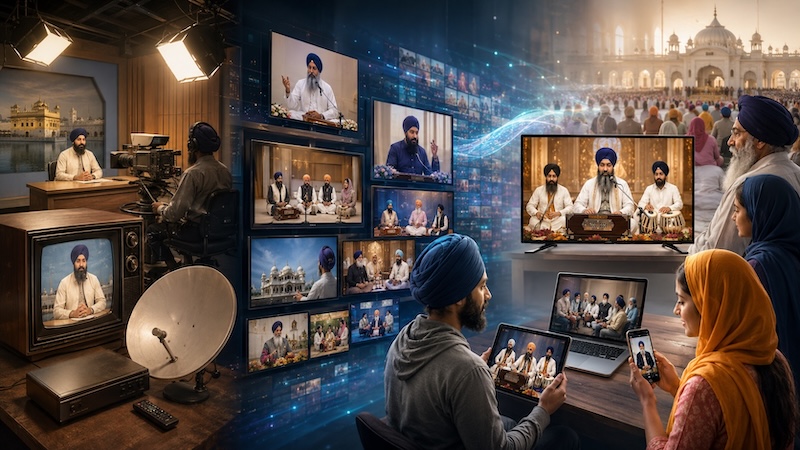
The media landscape has changed beyond recognition. Eighteen years ago, Sikh Channel was revolutionary because it provided something the Panth lacked: access to broadcasting and the ability to reach a mass audience. Today, that barrier has largely disappeared.
There are now hundreds of Sikh YouTube channels and digital platforms. With modest equipment and relatively little financial investment, Sikh organisations and individuals can create content capable of reaching audiences across the globe. Moreover, many Gurdwaras operate their own YouTube feeds almost 24/7. The issue is no longer access to broadcasting. It is how best to use our collective resources.
At the same time, terrestrial Sikh television faces existential financial pressures. Most channels rely mostly on volunteers and struggle to cover operating costs. They remain heavily dependent on donations from older Sikh families who continue to support them mostly out of loyalty and gratitude for the service they have provided. Their generosity deserves enormous respect. However, it also prompts a legitimate question: is this the most effective use of Panthic resources in 2026?
The real issue is not whether Sikh media is needed. It unquestionably is. The question is whether maintaining five expensive terrestrial television channels remains the most sustainable and effective way of reaching the audiences that matter most.
Younger Sikhs increasingly consume content through YouTube, podcasts, Instagram, TikTok and other digital platforms. Many rarely watch scheduled terrestrial television, let alone Sikh TV channels! If our objective is to educate, inspire and engage future generations, then our media strategy must reflect how they access information today, not how previous generations did. This presents two possible paths forward.
The first is consolidation. Rather than maintaining five separate terrestrial channels competing for the same audience and donor base, there could be a serious conversation about collaboration or even a merger. Pooling resources could enable Sikh broadcasters to invest in higher production standards, stronger journalism, better documentaries and original programming that genuinely stands out from independently produced online content.
The second, and perhaps more radical, option is a complete transition to digital broadcasting. Modern smart televisions provide direct access to YouTube and other streaming platforms at the touch of a button. Even many older viewers now access content this way. Such a move could dramatically reduce operating costs while maintaining, and potentially expanding, audience reach.
The potential savings would be transformative. Millions of pounds currently spent sustaining multiple television platforms could instead be invested in initiatives that strengthen the Panth for generations to come, such as developing Sikh educators, expanding digital educational resources, supporting youth leadership programmes, funding academic research, promoting mental health initiatives and strengthening community development projects.
The uncomfortable question is this: if terrestrial Sikh television did not already exist, and we had £3.5 million available today, would we choose to build five terrestrial television channels, or would we invest in a digital-first media strategy designed for the next generation? If the answer is the latter, then perhaps the debate is not about technology at all. It is about whether we are prepared to rethink old structures in pursuit of greater Panthic impact. History will not judge us by how faithfully we preserved a broadcasting model from 2008. It will judge us by whether we had the vision to recognise when it was time to build something better.
Join the conversation on this story on Asia Samachar’s Facebook and Instagram pages.

Gurnam Singh is an academic activist dedicated to human rights, liberty, equality, social and environmental justice. He is a Professor of Sociology at University of Warwick, UK. He can be contacted at Gurnam.singh.1@warwick.ac.uk
* This is the opinion of the writer and does not necessarily represent the views of Asia Samachar.
RELATED STORY:
Heaven, Hell and the Afterlife: What does Sikhi teach us? (Asia Samachar, 3 July 2026)
ASIA SAMACHAR is an online newspaper for Sikhs / Punjabis in Southeast Asia and beyond. You can leave your comments at our website, Facebook, Twitter, and Instagram. We will delete comments we deem offensive or potentially libelous. You can reach us via WhatsApp +6017-335-1399 or email: asia.samachar@gmail.com. For obituary announcements, click here





Dear Dr Ji, the simple answer is nobody can resist change. Sikhi was born, not out of a desire to preserve centuries old traditions and practices, but to offer a progressive vision of life, society and the future of humanity. In this regard, the project commenced by Guru Nanak continues and for sure, GenZ not only will, but are setting the future. In truth, what happens in our Gurdwaras has little bearing on this generation in so far as social media is, for them, a much more important space.
It is always enlightening to read your printed opinions, which are refreshing and courageous. I dare vouch that you have much more to say on many matters pertaining to Sikhi and the ‘religion’ behind it. Many of us look forward, to looking ‘forward’ along with you.
The germane question here will be, “are sikhs today ready to go along”?
Perhaps the GenZ will set the future! That change is inevitable.
Comments are closed.