





















By Kal Dosanjh | Opinion |
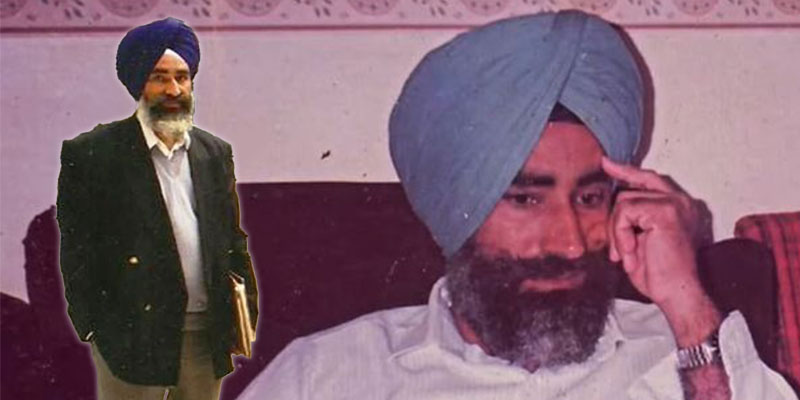
Jaswant Singh Khalra (1952–1995) was one of the most courageous human rights defenders to emerge from Punjab’s turbulent years of insurgency and counter-insurgency. In the midst of the chaos, many innocents were killed, their existence and memories washed away as the “cost of war”, leaving families empty handed with no answers or closure.
A bank employee by profession, he devoted himself to documenting the disappearances and alleged extrajudicial killings that occurred during the late 1980s and early 1990s.
Through meticulous examination of municipal cremation records and other official documents, Khalra uncovered evidence suggesting that thousands of unidentified bodies had been secretly cremated by the Punjab Police.
His findings drew national and international attention to allegations of enforced disappearances and illegal cremations.
The Indian Central Bureau of Investigation (CBI) later confirmed that 2,097 bodies had been unlawfully cremated in Tarn Taran district alone, while Khalra believed the practice was far more widespread across Punjab.
On 6 September 1995, Jaswant Singh Khalra was abducted outside his home in Amritsar while washing his car. He was never seen alive again.
Following years of investigation and legal proceedings, several Punjab Police officials were convicted for his abduction and murder, making the case one of India’s most significant human rights prosecutions.
Khalra’s legacy extends beyond Punjab. A recent biopic of Kalra’s story, meant for international audiences, was censored for many years preventing its release. It’s now finally out.
Kalra became a symbol of the principle that the pursuit of justice requires courage, even when it demands confronting powerful institutions. His life reminds us that human rights are not protected by silence, but by those willing to document the truth, preserve evidence, and speak for those who can no longer speak for themselves.
(Kal Dosanjh is a law enforcement officer, founder and CEO of KidsPlay Youth Foundation. This article was adapted from his LinkedIn article)
COMMENTS TO THE STORY HERE AND ELSEWHERE
(Here are some comments at his LinkedIn page as well as elsewhere on Khalra)
D K Grover: His is one of the stories I think about when I reflect on chardi kalan. He’s among the list of human beings who’ve inspired me. May we see many more people with his intellect, wisdom, commitment and courage.
N Sahota: Jaswinder Singh Kalra’s life’s work fighting for human rights deserves to be shared widely especially during these times when we are witnessing the stripping away of rights and repression on a global scale.
H Singh: Jaswant Singh Khalra—a man whose courage, integrity, and unwavering commitment to truth left an enduring mark on history. In the face of fear and uncertainty, he chose to stand for justice and human dignity, giving hope to countless families seeking answers. His determination reminds us that the pursuit of truth often demands extraordinary courage and sacrifice. His legacy continues to inspire people across the world to uphold justice, defend human rights, and speak for those whose voices have been silenced. May we never forget the importance of truth, accountability, and compassion in building a more just society. His courage will continue to inspire generations to come. Your legacy lives on.
C S Mattoo:
Well,
Godhra story is freedom of speech
Bhopal story is freedom of speech
Kashmir story is freedom of speech
Kerala story is freedom of speech
Bengal story is freedom of speech
Somehow, Punjab story isn’t!
K Burmy: My family and I watched the Satluj movie last night and found it very emotional to watch. His “Challenge the darkness” speech is incredibly inspiring as is his relentless pursuit of truth and justice.
M Singh: I believe it left Sikhs with the task of challenging a sanitised narrative that continues to reduce the mass abductions, extrajudicial killings and secret cremations of the 1980s and 1990s to the actions of a few “rogue police officers.” That was never the reality. The repression of Sikhs was not simply the work of bent coppers acting independently. It involved the wider machinery of the state. Policing, intelligence, political leadership, bureaucracy and the media all operated within a system that enabled abuses to occur with impunity. The “bad cop” narrative has long served as a convenient fig leaf, diverting accountability away from the institutions that created, sustained and protected that system. Other estimates are around 25,000 Sikhs were killed and cremated by the state. He was also an advocate for a separate Sikh nation which it appears the main actor and producer is not.
CHECK OUT MORE FEEDBACKS FOR THIS REPORT AT FACEBOOK AND INSTAGRAM
RELATED STORY:
Satluj takedown puts Khalra’s story back at centre of debate (Asia Samachar, 7 July 2026)
ASIA SAMACHAR is an online newspaper for Sikhs / Punjabis in Southeast Asia and beyond. You can leave your comments at our website, Facebook, Twitter, and Instagram. We will delete comments we deem offensive or potentially libelous. You can reach us via WhatsApp +6017-335-1399 or email: asia.samachar@gmail.com. For obituary announcements, click here


