





















By Karminder Singh Dhillon | Opinion |
Punjab is in crisis. Again. Hundreds of thousands of civil employees are engaged in an intense standoff with the state’s administration in their attempt to cripple the state by participating in the mass “Maha Hartal” strike. As expected and as always, the political parties have turned the event into a major political flashpoint – this time ahead of the 2027 polls.
It’s hard to dispute the fact that agitations in the form of strikes, hartals, morchas, dharnas, block the streets events, and shutdowns have been the defining feature of life in post-independence Punjab. Seven decades of having to fight for virtually everything from its border demarcations, linguistic rights, river waters, grain pricing, infrastructure funds, and the right to non-interference from Delhi; has fractured Punjab, robbed its people of solace and turned the state into one which remains in perpetual intricate and multi-dimensional crisis.
Once celebrated as the ultimate triumph of India’s Green Revolution and famously revered as the nation’s granary, Punjab is currently a hollow shell of its self. The vibrant prosperity that once characterized Punjab has gradually given way to profound structural issues.
The outcome is that Punjab has become trapped in a complex web of agricultural stagnation, severe ecological degradation, deep fiscal mismanagement, and an unprecedented youth exodus. Far from being sudden or accidental, these intertwined systemic failures have developed over decades, fundamentally threatening the socio-economic fabric of the state.
CRUMBLING AGRICULTURAL FRAMEWORK
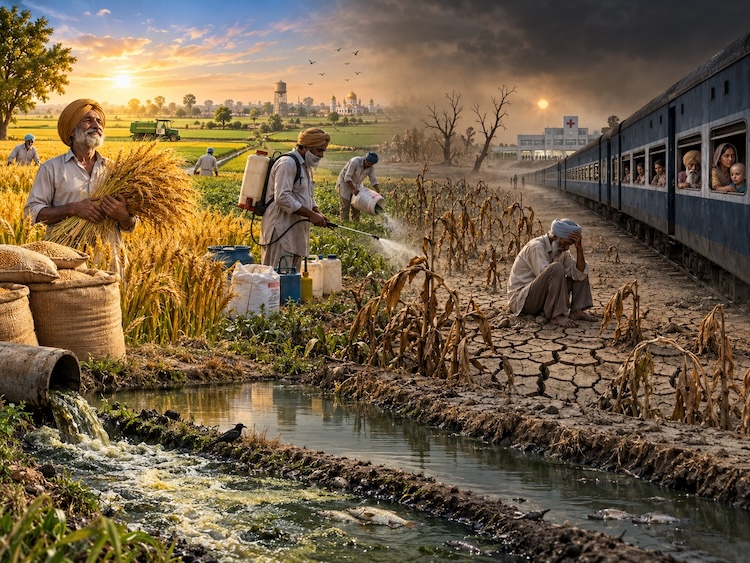
At the very core of Punjab’s contemporary struggle is its crumbling agricultural framework. The state is locked into a rigid, intensive wheat-rice crop cycle which is heavily dependent on massive state subsidies. Punjab’s farmers have over-extracted groundwater, resulting in the water table across central Punjab to drop to crisis levels.
The result is that the state now faces the real and terrifying prospect of exhausted soil leading to desertification. This has forced the farmers to rely more heavily on chemical fertilizers and pesticides to produce yield – both of which have degraded soil health and contaminated local water sources. The human cost of this ecological strain is tragically visible in the region’s soaring cancer rates, epitomized by the infamous “Cancer Train” that regularly transports affected patients from Punjab to specialized hospitals in Rajasthan.
There are other issues that multiply the destructive effects of the state’s agricultural woes. Punjab has recently been ravaged by its worst flooding in nearly four decades. Driven by intense rainfall and complicated upstream dam water releases, these devastating floods have submerged thousands of villages, claimed numerous lives, and destroyed hundreds of thousands of acres of vital crops. The frequent alternation between severe groundwater depletion and destructive flooding highlights the deep vulnerability of Punjab’s modern agricultural model.
Simultaneously, Punjab is struggling with fiscal distress and industrial stagnation. The state’s economy is currently expanding at a rate of roughly 6%, lagging visibly behind India’s national growth average of 7.5%. The state treasury stands drained on account of subsidies. Today, approximately 70% of Punjab’s total revenue expenditure is consumed entirely by fixed commitments: public salaries, pensions, debt interest payments, and free power subsidies. This leaves virtually no fiscal space for capital expenditure, infrastructure development, or industrial diversification. There is no denying that the state lacks a robust, modern manufacturing or IT sector.
This lack of economic diversification has triggered a profound social crisis among the state’s youth. With a struggling industrial sector, highly educated young people find themselves trapped in an economy that offers few high-value employment opportunities. This lack of opportunity has fueled a rampant substance abuse problem, which continues to devastate families across rural and urban communities alike. Desperate for a better future, Punjab’s youth are migrating abroad in massive numbers – going to just about any country that promises a better future than the hollow shell that is Punjab.
The consequence of it is that both human talent and financial wealth permanently leave the state. Rural families frequently sell or mortgage their remaining agricultural land simply to finance the steep immigration and visa fees for their children. Instead of being reinvested into local businesses or advanced agricultural technology, local capital is exiting the state entirely. This mass exodus of the younger generation has left behind aging rural communities, creating a severe demographic imbalance and diluting the vibrant local culture.
FRACTURED RELIGIOUS LANDSCAPE
The problems of Punjab extend to religion as well. The demographic fabric of Punjab is characterized by a Sikh majority alongside a substantial Hindu minority, supplemented by rapidly evolving Christian and Dalit communities. Beneath the outer veneer of shared cultural language and traditions, Punjab faces an intricate web of religious challenges – all of which are deeply entwined with persistent caste hierarchies, shifting demographic anxieties, friction between institutional orthodoxy and popular folk practices, and an underlying socio-economic crisis that fuels vulnerability.
Sikhism explicitly rejects the caste system, preaching absolute spiritual and social equality. Yet, in practice, structural caste divisions remain heavily entrenched across rural and urban landscapes. One third of Punjabis are Dalits (Scheduled Caste).
This dynamic has created a fractured religious landscape. Jat Sikhs dominate agrarian assets and the management of premier institutional bodies, such as the Shiromani Gurdwara Parbandhak Committee (SGPC). Conversely, Dalit communities—largely divided into Mazhabi Sikhs and Ravidassia groups—frequently experience social marginalization, restricted upward mobility, and limited representation in mainstream religious leadership.
The persistence of separate gurdwaras and burial grounds for different castes across thousands of Punjabi villages exposes the fractured religious realities.
This systemic exclusion of Dalits from mainstream socio-religious structures has directly fueled a highly charged debate surrounding religious conversions, particularly to Christianity. In recent years, Christian evangelical movements have experienced a notable surge across Punjab’s rural heartlands, notably within the border districts and the Doaba region.
Evangelical networks have effectively engaged marginalized segments through digital expansion, massive religious complexes, and promises of spiritual healing, dignity, and release from historical caste trauma.
However, the phenomenon of religious conversions has further fractured the religious divide that is grounded in caste distinctions. The resulting friction manifests in public disputes regarding anti-conversion laws, accusations of forced or fraudulent inducements, and localized instances of community conflicts.
Compounding this challenge is the bureaucratic “social limbo” experienced by Dalit Christian converts; under current legal frameworks, changing one’s religion can mean losing state welfare benefits earmarked for Scheduled Castes, forcing individuals to navigate a fragile existence divided between hidden faith and institutional identity.
It cannot be denied that Punjab’s religious vulnerabilities are intensified by a prolonged socio-economic crisis. As argued above, the economic legacy of the Green Revolution has plateaued, leaving the state struggling with severe groundwater depletion, agricultural stagnation, crushing farmer debt, and a stark deficit of non-farm employment opportunities. This prevailing environment of economic stagnation and youth disillusionment has historically created a fertile ground for religious radicalization and sectarian division.
When young people find themselves locked out of a modernizing economy, religious institutions often step in to fill the structural void, offering either a sense of purpose through revivalist movements or an escape through evangelical promises. Furthermore, the political exploitation of religious identities by various factions seeks to channel genuine economic grievances into communal or separatist narratives. This intersection of economic precarity with religious identity ensures that any destabilization in the economic sphere quickly reverberates as a theological or communal crisis.
The religious challenges facing contemporary Punjab are rooted in deep-seated structural issues. Punjab must confront the structural realities of caste discrimination that undermine its egalitarian spiritual traditions.
Addressing these religious tensions requires a comprehensive approach that combines social reform within religious bodies, institutional respect for minority rights, and targeted economic revitalization to address the root causes of vulnerability. Only by reconciling its high spiritual ideals with genuine social justice can Punjab navigate its current challenges and ensure lasting peace for its diverse population.
REMEDY FOR DOWNWARD SPIRAL
As for finding a remedy for Punjab’s overall downward spiral, the state urgently requires comprehensive, politically courageous reforms. Punjab must undertake a deliberate shift away from the traditional wheat-rice monoculture toward sustainable, high-value agriculture, paired with a gradual overhaul of the state’s unsustainable subsidy model.
Concurrently, the government must actively incentivize industrial growth in emerging sectors like technology, biotechnology, and renewable energy to create meaningful local jobs.
Punjab’s current reality serves as a stark warning of the long-term dangers of ecological neglect and fiscal complacency. Only through coordinated economic diversification, transparent governance, and targeted skill development can the state rebuild its economy, retain its youth, and restore its historic status as a symbol of progress and prosperity.
Failing which, Punjab will continue its downward spiral into a failing state; with a society that is fractured, and its youth walking out in disappointment.
Join the conversation on this story on Asia Samachar’s Facebook and Instagram pages.

Sikh thinker, writer and parcharak Karminder Singh Dhillon, PhD (Boston), is a retired Malaysian civil servant. He is the joint-editor of The Sikh Bulletin and author of The Hijacking of Sikhi. This article appeared in The Sikh Bulletin, Oct-Nov 2026, Volume 28 Number 24.
RELATED STORY:
Dual Vaisakhi observance reflects growing Panthic awareness (Asia Samachar, 12 May 2026)
ASIA SAMACHAR is an online newspaper for Sikhs / Punjabis in Southeast Asia and beyond. You can leave your comments at our website, Facebook, Twitter, and Instagram. We will delete comments we deem offensive or potentially libelous. You can reach us via WhatsApp +6017-335-1399 or email: asia.samachar@gmail.com. For obituary announcements, click here