

















By Gurnam Singh | Opinion |
It is often said that India is a land of paradoxes: a nation of extreme wealth and abject poverty, profound wisdom and shocking ignorance, boundless hospitality and brutal indifference. The India we know today is not the product of a linear or unified history, but a cocktail of empires, ideologies, and identities. Far from being a naturally cohesive nation, pre-colonial India was a tapestry of princely states, whose fragmentation was both a reflection and a consequence of the British Empire’s infamous ‘divide and rule’ strategy. By the time of independence in 1947, over 500 princely states operated under British rule, many of which were arbitrarily forced into the new nations Pakistan and India – and subsequently Bangladesh – continues to wrestle with questions of identity and belonging.
Yet, this subcontinent has not only given us tales of conquest and cruelty, but also some of the world’s most enduring stories of love. From the mythic bond of Rama and Sita to the tragic romance of Heer and Ranjha, immortalised in Waris Shah’s 18th-century epic, love has persisted as a counter-narrative to violence. These stories, steeped in symbolism, reflect a deeper longing: for justice, dignity, and human connection across seemingly irreconcilable divides.
But India’s dual legacies of love and violence are inseparable. The same land that produced the Dharma-embracing Emperor Ashoka also gave rise to his earlier persona, Chandashoka, the cruel, whose reign began with fratricide and ended with remorse. The Mughal emperor Aurangzeb, driven by a fanatical vision of Islamic dominance, not only imprisoned his father and murdered his brother but also presided over violent campaigns against dissenting religious communities. Among the countless casualties was Guru Tegh Bahadur Ji, beheaded in 1675 for defending the religious freedoms of Kashmiri Pandits, a moment forever seared into Sikh historical memory.
History, as the African proverb reminds us, is written by the victors. Yet, in South Asia, nearly every community, be it Hindu, Muslim, Sikh, Brahmin, Dalit, or tribal, claims its own status as a victim of history. What emerges is a complex, often competing tapestry of grievances. For every Kashmiri Pandit displaced from his ancestral homeland, there is a Kashmiri Muslim mourning a brother lost to enforced disappearance. For every Sikh who remembers the tanks at Darbar Sahib in June 1984, there is a Muslim who recalls the flames of Gujarat in February 2002 or the barbed wire of contemporary Kashmir.
What links these disparate tragedies is not ideology, but a shared, tragic grammar of violence; violence that is legitimised in the name of religion, security, or national interest and justice.
As a Sikh, for me the year 1984 is not simply a date in a history book; it is a wound still weeping. In June of that year, the Indian army launched ‘Operation Blue Star’, ostensibly to ‘flush out militants’ from the Golden Temple in Amritsar. What followed was a brutal military assault on the holiest site of the Sikh faith. Pilgrims were caught in the crossfire, the Akal Takht was reduced to rubble, and the collective spirit of a people was shattered. The trauma was compounded by the pogroms that followed the assassination of Indira Gandhi later that year in November 1984, in which thousands of Sikhs were murdered in broad daylight, many with the open complicity of state actors.
SEE ALSO: 1984: A dark chapter in Sikh history
SEE ALSO: Human rights lawyer HS Phoolka speaks about 1984, cover-ups and Sikh leadership
Fast forward to 2002. In Gujarat, following the burning of a train in Godhra, mobs led systematic attacks on Muslim communities. Over a thousand people were killed, many of them women and children. Mass rapes, public lynchings, and arson were not only tolerated but, in many instances, encouraged by the state machinery. The then Chief Minister of Gujarat, now the Prime Minister of India, Narendra Modi, remained silent. Justice was slow, selective, and often denied entirely.
And now, in 2025, we are confronted once again with carnage, this time in the picturesque valley of Pahalgam in Indian occupied Kashmir. Twenty-six Hindu pilgrims, along with a brave Muslim pony operator who tried to protect them, were murdered in an act of senseless brutality. The attackers, reportedly Islamist militants, sought to create not only fear but division, which reminds us once again that in the logic of hate, there are no innocents.
What connects Amritsar, Ahmedabad, and Pahalgam is not a singular religion or political ideology. What connects them is the dehumanisation of the ‘other’. A Sikh youth labelled a ‘terrorist’, a Muslim woman told her body must bear the burden of loyalty, a Hindu family killed for their faith. These are all victims of a deeper pathology that sees diversity not as a strength, but as a threat.
This logic of exclusion has been normalised by political dogma, amplified by sensationalist media, justified by fanatical religious preachers and sustained by our own silences. We hear it in the casual justifications for violence, in the tribal cheers for airstrikes, in the refusal to mourn those not from our ‘side’, and in the invocation of God. We may not all wield weapons, but many of us carry ideologies that reduce people to categories, identities, stereotypes or simply the ‘other’.
As a Sikh, I carry the legacy of 1984 in my bones. Those who experienced the violences first hand have whispered stories of disappearances, of midnight knocks on doors, and, as the great human rights activist – and victim of the very same state violence – Shahed Jaswant Singh Khalra documented, of mass cremations without names. But despite my pain cannot and must not blind me to the suffering of others. Just as Sikhs were scapegoated in 1984, Muslims are vilified today. Just as Hindus were once protected by the Guru from the tyranny of Aurangzeb, they are now victims of Islamist terrorist violence today in Kashmir.
SEE ALSO: Ensaaf releases must-watch documentary on human rights defender Jaswant Singh Khalra
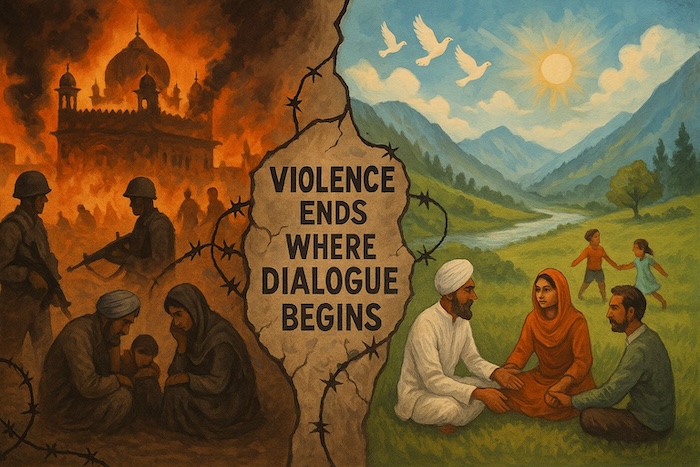
We must reject the idea of comparative victimhood. Trauma cannot be measured. Grief is not a competition. What we need is a politics of shared mourning, a recognition that our wounds, though inflicted differently, call us to the same conclusion: that love is the only force capable of breaking the cycle.
Let us remember not only the dead, but also the living who stood against hate: The Hindus who sheltered Sikhs during the Delhi riots of Nov 1984. The Hindus who stood in solidarity with Muslims in Gujarat, forming human shields. The Muslim man in Pahalgam who died protecting Hindu tourists.
These stories are not footnotes; they are beacons. They show us what is possible when we refuse to become what we despise. In a world increasingly seduced by militarism and hyper-nationalism, love is resistance. To love is to mourn the dead of all communities. To love is to hold the powerful accountable, not out of contempt for our nations, but from a desire to redeem them. To love is to teach our children the truth, not just the glory of our side, but the pain of the other.
We must begin again, not forgetting history, but by honouring it truthfully and learning from all our mistakes; The ghosts of Amritsar, Ahmedabad, and Pahalgam will not rest until we do. Let us ask ourselves, what kind of society do we wish to become: One fuelled by vengeance, or one grounded in compassion. One where memory is weaponised or one where history is a bridge toward healing and a better future for all. Let us heed the words of Guru Arjan (GGS, 1299)
ਕਾਨੜਾ ਮਹਲਾ ੫ ॥
Kaanraa, Fifth Mehla:
ਬਿਸਰਿ ਗਈ ਸਭ ਤਾਤਿ ਪਰਾਈ ॥
I have totally forgotten my jealousy of others,
ਜਬ ਤੇ ਸਾਧਸੰਗਤਿ ਮੋਹਿ ਪਾਈ ॥੧॥ ਰਹਾਉ ॥
since I found the Sangat of the virtuous. ||1||Pause||
ਨਾ ਕੋ ਬੈਰੀ ਨਹੀ ਬਿਗਾਨਾ ਸਗਲ ਸੰਗਿ ਹਮ ਕਉ ਬਨਿ ਆਈ ॥੧॥
No one is my enemy, and no one is a stranger. I get along with everyone. ||1||
ਜੋ ਪ੍ਰਭ ਕੀਨੋ ਸੋ ਭਲ ਮਾਨਿਓ ਏਹ ਸੁਮਤਿ ਸਾਧੂ ਤੇ ਪਾਈ ॥੨॥
Whatever the Divine does, I accept. This is the sublime wisdom I have obtained from the Divine beings. ||2||
ਸਭ ਮਹਿ ਰਵਿ ਰਹਿਆ ਪ੍ਰਭੁ ਏਕੈ ਪੇਖਿ ਪੇਖਿ ਨਾਨਕ ਬਿਗਸਾਈ ॥੩॥੮॥
The One Divine spirit is pervading in all. Gazing upon Him, beholding Him, Nanak blossoms forth in happiness. ||3||8||

Gurnam Singh is an academic activist dedicated to human rights, liberty, equality, social and environmental justice. He is an Associate Professor of Sociology at University of Warwick, UK. He can be contacted at Gurnam.singh.1@warwick.ac.uk
* This is the opinion of the writer and does not necessarily represent the views of Asia Samachar.
RELATED STORY:
The Demise of the Akali Dal and the Badal Dynasty: What Next for the Panth? (Asia Samachar, 5 Aug 2024)
ASIA SAMACHAR is an online newspaper for Sikhs / Punjabis in Southeast Asia and beyond. You can leave your comments at our website, Facebook, Twitter, and Instagram. We will delete comments we deem offensive or potentially libelous. You can reach us via WhatsApp +6017-335-1399 or email: asia.samachar@gmail.com. For obituary announcements, click here