Referee Sunny Singh Gill is set to make Premier League history this weekend when he takes charge of Crystal Palace v Luton.
Sunny, who comes from a family deeply connected with British soccer, will become the first British South Asian to referee a match in the competition.
Sunny will be the seventh referee outside of PGMOL’s (Professional Game Match Officials Limited) Select Group to take charge of a Premier League match this season, following Sam Allison, Sam Barrott, Bobby Madley, Josh Smith, Rebecca Welch and Lewis Smith, reported the Premier League website.
Soccer refereeing runs in the family of the 39-year-old who was scouted by Queens Park Rangers youth academy when he was 11-years-old but never made the cut.
In 2004, his father Jarnail Singh became the first Sikh referee to take charge of an English Football League (EFL) game, and to do so wearing the traditional turban. His brother
In 2019, his brother Bhupinder Singh Gill will become the first Sikh-Punjabi heritage match official in Premier League history when he served as an assistant referee.
Sunny took charge of his first Sunday League match aged only 17, and in April 2021 both he and Bhupinder became the first pair of British South Asians to officiate in the same Championship match.
Sunny told the EFL: “Football has always run in the family. Me and my brother grew up loving the game and like most young kids, we just wanted to play.
“But in our household it was a bit different because when we were going to primary school, we knew our dad was going out to referee on a weekend.
“There were times he was a fourth official in the Premier League and our friends would say they saw him on Match of the Day!”
ASIA SAMACHAR is an online newspaper for Sikhs / Punjabis in Southeast Asia and beyond. You can leave your comments at our website, Facebook, Twitter, and Instagram. We will delete comments we deem offensive or potentially libelous. You can reach us via WhatsApp +6017-335-1399 or email: asia.samachar@gmail.com. For obituary announcements, click here
ASIA SAMACHAR is an online newspaper for Sikhs / Punjabis in Southeast Asia and beyond. You can leave your comments at our website, Facebook, Twitter, and Instagram. We will delete comments we deem offensive or potentially libelous. You can reach us via WhatsApp +6017-335-1399 or email: asia.samachar@gmail.com. For obituary announcements, click here
With the Guru Nanak Darbar Gurdwara in the backdrop, players from both sides battle for the ball during the match – Photo: Kevin Quigley / Daily Mail
By Kevin Quigley | Daily Mail | Britain |
Welcome back to the Soul of Sport. For the latest episode of the series, KEVIN QUIGLEY travelled to Kent to watch Guru Nanak FC in action.
Founded in 1965, Guru Nanak FC are one of grassroots football’s greatest stories having become one of the first clubs to start running and hosting Asian tournaments in the mid-seventies.
After attracting non-Asian players in the mid-seventies, the club have since become entirely inclusive and welcome all players, regardless of ethnicity, into the teams and out onto the pitch in Gravesend, beneath Europe’s largest Gurdwara.
On this occasion, their veteran side held a fiery encounter that encapsulated all the splendours of grassroots football.
Our cameraman was on the ground to take in the best moments on a day to remember…
ASIA SAMACHAR is an online newspaper for Sikhs / Punjabis in Southeast Asia and beyond. You can leave your comments at our website, Facebook, Twitter, and Instagram. We will delete comments we deem offensive or potentially libelous. You can reach us via WhatsApp +6017-335-1399 or email: asia.samachar@gmail.com. For obituary announcements, click here
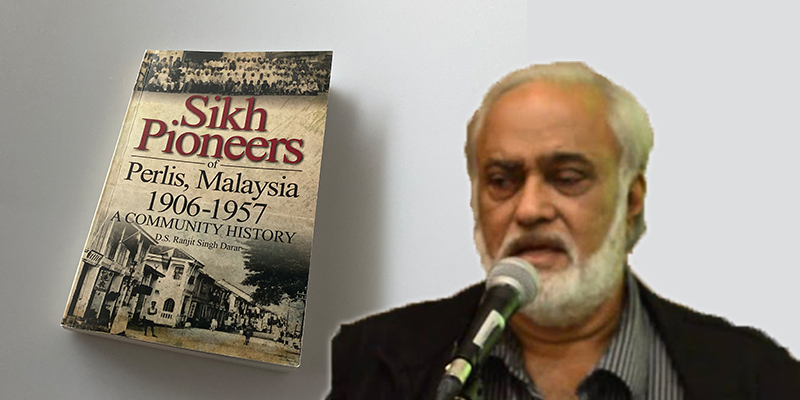
D.S. Ranjit Singh Darar author of ‘Sikh Pioneers of Perlis, Malaysia 1906-1957: A Community History’
Book: Sikh Pioneers of Perlis, Malaysia 1906-1957: A Community History Author: D.S. Ranjit Singh Darar
Introduction
Perlis is the smallest and northernmost state of the Federation of Malaysia which comprises of 13 states. From the remote past to 1839, Perlis was a jajahan (province/dependency) of the Malay kingdom of Kedah and from 1839 to 1843, a direct principality of Siam. Perlis was created as a sovereign kingdom by Siam in 1843 when it elevated the Governor of the principality, Syed Hussein Jamalullail to the position of a sovereign ruler. The circumstances that led to the transformation of Perlis from a jajahan of Kedah to that of a sovereign kingdom in its own right in 1843 are embedded in the developments that took place in Kedah from 1821 to 1842.
Kedah is probably the most ancient kingdom in Malaysia. It experienced a marked process of Indianization and was a great center of civilization from the first to the thirteenth centuries. After this period, its power began to wane and it was obliged to acknowledge Siam’s overlordship till 1909, Siam’s control over Kedah during this long period was, however not continuous as it was punctuated by the oscillations of Siamese power itself and the periodic attempts by Kedah to chart an independent course for itself.
The Beginnings of Modern Government in Perlis, 1905
The throne of Perlis passed on to Raja Syed Alwi in 1905. Perlis, like Kedah, was also facing serious financial problems. In 1905, the revenues of the state were too meagre to pay for the upkeep of the administration. As such, Raja Syed Alwi decided to ask for a loan from Siam. On 4 October 1905, a Loan Agreement was signed between the two parties whereby Siam agreed to provide a loan of $260,000 to Perlis at six percent interest per annum. One condition accompanying the Loan Agreement was that the state of Perlis had to accept a Financial Adviser of British nationality appointed by Siam. The Financial Adviser was to oversee the administration of the state, especially in matters relating to finance. Another condition imposed by Siam on Perlis (and Kedah) was that it was required to established a State Council where the British Financial Adviser appointed by Siam would act as the Secretary to the said body.
Administrative Changes Instituted by A.H. Duke, 1906
In 1906, A.H. Duke [appointed Financial Adviser by Siam in December 1905, under who’s supervision, from 1905 to 1909, the administration of Perlis underwent further changes] took measures to reorganise and upgrade the administrative system in Perlis. His immediate focus was to overhaul the revenue system of the state. An important reform he instituted was the abolition of the revenue farms, with the exception of the opium farm. This measure was undertaken to enable the government to collect its own customs duties.
Another matter that Duke had to deal with immediately was the high rate of crime in the state, mainly associated with cattle theft. A major export of Perlis at that time was cattle which was brought across from Singora, Siam, and shipped to Penang. However, due to the undefined border between Perlis and Setul, especially the long jungle frontier with Singora, cattle theft was rampant’. Duke, therefore, saw the urgent need to establish a well organised and well manned prison depdttment.
Another great need was a hospital or a dispensary to provide medical services to the general public, the civil servants, and the prisoners. At the same time, the state had to establish a police force to maintain law and order, Measures to fulfil these needs were commenced by Duke in 1906 and it resulted in the creation of a Prison Department and a State Dispensary.
The Arrival of The First Sikh in Perlis, 1906
It was in this setting in 1906 when Perlis, still under Siamese suzerainty, was in the process of setting up a modern administration under the direction of Duke, that the state began to look for suitable personnel to fill some of the posts that were created.
It was in this context that the earliest Sikh arrived in Kangar and made his entry into the Perlis Civil Service in 1906 as a hospital dresser in the State Dispensary that was newly set up. (There was as yet no hospital in Perlis). He was a young man of 25 years, named Jagat Singh. He had been brought from Punjab, India by a well-known family in Penang in 1906 and made his way to Perlis where he was put in charge of the State Dispensary’”. In 1909, he was also appointed as head of the Prison Department which had employed 27 Sikh jail warders by then.
(Extracted with permission from Sikh Pioneers of Perlis, Malaysia 1906-1957: A Community History)
ABOUT THE AUTHOR: Emeritus Professor Dr D.S. Ranjit Singh Darar is currently affiliated to the College of Law, Government and International Studies, Universiti Utara Malaysia, Sintok, Kedah. From 1973 to 2004, Ranjit served with the Department of History, Faculty of Arts and Social Science, University of Malaya in various positions, including as Tutor (1973–79), Lecturer (1979–90), Associate Professor (1991–97) and Professor (1998–2004). Since 2006, Ranjit has been attached to the School of International Studies (SoIS), Universiti Utara Malaysia. His areas of specialization include Malaysian History (Sabah and Sarawak); Political History of Southeast Asia, especially Brunei; International Relations; and Strategic Studies. Among his major publications are: Brunei 1838–1983: The Problems of Political Survival (Singapore: Oxford University Press, 1984; reprinted, 1991) and The Making of Sabah 1865–1941: The Dynamics of Indigenous Society (Kuala Lumpur: University of Malaya Press, 2000, 3rd ed., 2011, Government of Sabah).
ASIA SAMACHAR is an online newspaper for Sikhs / Punjabis in Southeast Asia and beyond. You can leave your comments at our website, Facebook, Twitter, and Instagram. We will delete comments we deem offensive or potentially libelous. You can reach us via WhatsApp +6017-335-1399 or email: asia.samachar@gmail.com. For obituary announcements, click here
Children / Spouses: Harbans Kaur (daughter) & Parminder Singh (son in law) Manjit Singh (son) & Mulkit Kaur (daughter in law) Ranjit Singh (son) & Narinder Kaur (daughter in law) Malkit Singh (son) & Gursharan Kaur (daughter in law) Jagjit Singh (son) & Lindajit Kaur (daughter in law)
Saskaar / Cremation: 4 pm, 4th March 2024 (Monday) at Shamshan Bhoomi Hall, Jalan Loke Yew Crematorium, KL (Lot 294, 295, Jalan Loke Yew Crematorium, Kuala Lumpur)
Cortège leaves from No. 41, Jalan Cuepacs 4, Taman Koperasi Cuepacs, Batu 12 Jalan Cheras, 43000, Kajang, Selangor at 2 pm to Shamshan Bhoomi Hall (Loke Yew Crematorium).
Path da Bhog: 10am-12pm on 10 March 2024 (Sunday) at Wadda Gurdwara Sahib Kampung Pandan, KL
ASIA SAMACHAR is an online newspaper for Sikhs / Punjabis in Southeast Asia and beyond. You can leave your comments at our website, Facebook, Twitter, and Instagram. We will delete comments we deem offensive or potentially libelous. You can reach us via WhatsApp +6017-335-1399 or email: asia.samachar@gmail.com. For obituary announcements, click here
Front page cover of the S. Tarlochan Singh: A Historic Journey
By Devinder Singh Chahal | Opinion |
I was glad to receive the book Sr. Tarlochan Singh _ A Historic Journey through Honorable Sr. Bajit Singh, a prominent Sikh in Canada. He lives across the river in Montreal, and I live in Laval.
The book’s front cover is very impressive, showing Sr Tarlochan Singh receiving the highest reward, Padam Bhushan, from the President of India, Shri Ram Nath Kovind. The picture on the back cover is of the 10 awardees with the President, Vice President, Prime Minister, and Home Minister. Sr. Tarlochan Singh is sitting second from the left.
We have some similarities. Sr. Tarlochan Singh was born in 1933 in Dhundial, now in Pakistan, while I was born a year before him in 1932 in Lyallpur (Faisalabad, Pakistan). We both migrated to India when India and Pakistan were declared independent countries. We both passed Matric in 1949, and he passed M. A., and I passed M.Sc. from Punjab University in 1955. He entered politics, and I entered science.
It is impossible to cover his achievements and awards received by him since there are so many. He was a Member of Parliament and chairman of the National Commission for Minorities and Human Rights. Besides, he has been involved in many organizations. He has resolved some Sikh issues because of his influence since he has been working with Presidents and Prime Ministers of India. He was very close to Atal Bihari Bajpayee, Prime Minister of India, and was able to bring together the Akali Party and BJP In 1996. He is the man who introduced the Anand Marriage Act in Parliament; it was passed in 2012.
BOOKS PUBLISHED
Sr Tarlochan Singh has published 12 books on different subjects. The title of each book is photographed on page 26.
There are many fans of Sr. Tarlochan Singh because of his intellectual personality and dedication to the work assigned to him. There are many messages and appreciation from dignitaries from all walks of life.
Messages: General J.J. Singh, Lord Rami Ranger CBE, Dr. P. S. Pasricha, Satgur Udhey Singh, and many more.
Appreciations: Singh Sahib Giani Joginder Singh, Jathedar of Akal Takht; Kuldeep Nayer, a Journalist; Kiran Kiki Kapany d/o Dr. Narinder Singh Kapany, and many more.
RASHTRAPATI BHAWAN UNTOLD STORIES
He was the Press Secretary of Giani Zail Singh, President of India, and was a witness to the unprecedented happening of Blue Star, the Genocides of Sikhs in Delhi, the becoming of Rajiv Gandhi as the Prime Minister of India, and the President and Prime Minister conflict.
Giani Zail Singh, President of India, was on a tour to Yemen when he received the news of the assassination of Indra Gandhi, Prime Minister of India. The journalists, traveling back to India with the President, advised Giani Zail Singh not to appoint Rajiv Gandhi as the Prime Minister of India, but he said to Sr. Tarlochan Singh that he would appoint Rajiv Gandhi as the Prime Minister. On arrival at Delhi, he rushed to the All-India Medical Institute, where Indra Grandhi’s body was kept. On his way, he met many people with mashals (sticks with burning flames). Since there was insufficient security, some people with mashals attacked Sr. Tarlochan Singh’s car. They broke the windows and threw a mashal inside his car. His driver was very clever; he threw the Mashal back at them and drove him home safely.
Soon Rajiv Gandhi was appointed as the Prime Minister of India. Strangely, Sr. Buta Singh, the Minister, was not invited to the oath ceremony. Giani Zail Singh was very much hurt to see the genocides going on in Delhi and other parts of India. He called Rajiv Gandhi, the Prime Minister, many times, but he did not return any calls. Giani Zail Singh, President of India, was not invited to address the condolence at the India Gate Lawns; instead, the Vice President, Sri R. Venkatraman, was invited to address the condolence.
Rajiv Gandhi asked Giani Ji to transfer Inderjit Bindra, Joint Secretary to the Rashtrapati Bhawan, back to Punjab. Inderjit Bindra was a close associate of Giani Ji since the time of the Punjab Government. Rajiv Gandhi also done away the tradition of PM calling on President to brief him after the foreign trips. Giani Ji’s foreign trips were also curtailed.
The journalist Kuldeep Nayar convinced Giani Ji not to sanction the Postal Bill, which was seen as an attempt to curb the freedom of speech. He kept the file pending. If he has sent it back for discussion thereafter, he must approve even if he did not like it. Since file remained pending the Postal Bill ultimately died of its own death.
The disrespect by Rajiv Gandhi against Giani Ji was becoming an open issue. Some Congressmen and media persons approached the President to remove Rajiv Gandhi from the post of Prime Minister. Mr. V. C. Shukla in collaboration with other Congress leaders and BJP Maharani Vijayraje Scindia played a significant role. Asok Sen, former Law Minister, was willing to take an oath of Prime Minister. However, one day Mr. Shukla told Giani Ji that Vice-President, Sri R. Venkataraman, is willing to be sworn in as the Prime Minister. When this news reached Rajiv Gandhi, he immediately appointed Vice-President Sri R. Venkataraman as President two months ahead of due time by ignoring all formalities. Media was publishing news about the conflict between Rajiv Gandhi and Giani Ji every day. Even some news about impeachment of President by some Congress leaders was also on front pages of newspapers. Rashtrapati Bhawan was kept under complete surveillance of the Intelligence Agencies.
VISIT TO AMRITSAR
After Blue Star, Giani Ji went to Amritsar. Sr Tarlochan Singh accompanied him. He was told not to take any press person or photographer with him. After they returned, Prem Bhatia, Editor, The Tribune, Chandigarh, and Sr. Khushwant Singh called Tarlochan Singh to find out about the situation in Amritsar. He told them that there was colossal damage to the Akal Takht, bullet marks on Darbar Sahib, and curfew in the city. Both Prem Bhatia and Khushwant Singh published this news. A day later Indra Gandhi met the president, Giani Zail Singh and played the recoding what Tarlochan Singh told Prem Bhatia and Khushwant Singh. Indra Gandhi blamed Tarlochan Singh for performing anti-national activities that harmed the interest of the country. She wanted strict criminal action and his immediate arrest. Giani Ji was able to persuade Indra Gandhi not to take such severe action. Finally, Tarlochan Singh was sent on leave and was told to stay at his residence.
GENOCIDES OF SIKHS
Sr. Tarlochan Singh said that Indra Gandhi was shot in her home on 31st October at 6:30 AM. There was no report of any protest in the city or elsewhere. Mohinder Singh Sathi, Mayor of Delhi, told Giani Ji that Arun Nehru called a meeting of Congress leaders and directed them to launch an anti-Sikh tirade to prove that there was so much resentment in the public on the death of Indra Gandhi. He further narrated the involvement of the Haryana Government and Delhi Police. Giani Ji was stunned to note that Sathi was hooted upon as Mayor of Delhi in the official rely on India Gate.
The Section on His Profile Action is full of letters from dignitaries from all walks of life, receiving awards and honors from various Sikhs Institutes in India and foreign countries.
KHUSHWANT SINGH REPORTS IN HINDUSTAN TIMES
In 1978 India Government decided to set up the National Commission of Minorities (NCM) under Minoo Masani (a Parsi), comprising a Muslim, a Christian and a Sikh. Thereafter, mostly it was Muslim Chairmen of NCM because of majority of Muslims who were being targeted by anti-Muslim gondas. Although they were retired Chief Justices, Judges, and Governors, they were unable to do any favor to Muslim for being branded communalists. For the first time, a Sikh Tarlochan Singh, hitherto Vice-Chairman looking after his own community’s interest, has been made Chairman of NCM.
During student life, Tarlochan Singh was very active in politics. He prevented Jawahar Lal Nehru from speaking in a Gurdwara. He was imprisoned in jail many times. Later he joined the government service. He served under the Punjab Chief Minister. He was Director of Publicity of Asian Games, Managing Director, and Chairman of Tourism of Delhi State. For four years, he has been Press Secretary of President, Giani Zail Singh. If there was one person who saved Giani Ji from being ostracized by the Sikh community by being Tankhaiya by the Jethadar, it was Sr. Tarlochan Singh.
Rest of the book is full his photographs various dignitaries of India and foreign countries. A separate section deals with his family.
The Historic Journey of Sr Tarlochan Singh is worth remembering by the Sikh Community.
Devinder Singh Chahal, PhD, a retired Professor of Microbiology, is the president of the Canada-based Institute for Understanding Sikhism. Relying on his long life as a Sikh, his training as a scientist and his love of the Guru, Prof Chahal has dedicated an enormous amount of energy trying to reform Sikhi by demonstrating the incorrect interpretations of the Aad Granth. Click here for his work. His most recent book is NANAK and His Philosophy.
ASIA SAMACHAR is an online newspaper for Sikhs / Punjabis in Southeast Asia and beyond. You can leave your comments at our website, Facebook, Twitter, and Instagram. We will delete comments we deem offensive or potentially libelous. You can reach us via WhatsApp +6017-335-1399 or email: asia.samachar@gmail.com. For obituary announcements, click here
ASIA SAMACHAR is an online newspaper for Sikhs / Punjabis in Southeast Asia and beyond. You can leave your comments at our website, Facebook, Twitter, and Instagram. We will delete comments we deem offensive or potentially libelous. You can reach us via WhatsApp +6017-335-1399 or email: asia.samachar@gmail.com. For obituary announcements, click here
L-R: Babri Masjid, Darbar Sahib in Amritsar and Ram Mandir in Ayodhya
By Karminder Singh Dhillon | The Sikh Bulletin |
No one would deny that the Mughals destroyed Temples during their reign in India, and in many cases constructed Mosques over the same site. This dastardly act was an exercise in naked power in favor of those who subscribed to the religion of the occupier, and a brutal attempt to subjugate those who did not. It was political sadism at its height hidden under the cover of spreading one’s religion – even if by the sword – while suppressing the other’s.
What can be said of the act of reversing such savagery in the form of destroying the same Mosques and re-building Mandirs – now that political power in India has found its way into the hands of people who subscribe to such designs? Nothing other than the fact that it is the same political savagery and religious supremacy hidden under the cover of appeasing one’s God and religion in the name of Hindutva.
It’s the same barbarity, violence, and heartlessness inflicted upon citizens – except that the victims and perpetrators have switched places – even if only in terms of the religion they profess.
What can be said, however, of the zeal and fanaticism of some subscribers of Hindutva that the religious institutions of those who never destroyed a single Mosque or Mandir, but help build and protect both when they did get to rule – be subjugated as well. The Sikhs did rule – under Banda Singh Bahadur first and Maharaja Ranjit Singh subsequently. There is no evidence of any destruction of any place of worship under either. In fact, there are numerous examples of the Maharaja constructing Mosques and Mandirs all over his empire during his reign.
The copper, marble and gold foils that form part of Darbar Sahib came from the coffers of Sikh Raj. Few are aware of the fact that Maharaja Ranjit Singh donated more gold to Hindu Mandirs in Benares than he did towards Darbar Sahib. In 1835, for instance, the Maharaja, at the behest of his wife, Maharani Datar Kaur, donated 1 tonne of gold for plating the dome of Kashi Vishwanath Mandir – a Hindu temple dedicated to Shiva and located in Vishwanath Gali, in Varanasi, Uttar Pradesh, India.
But none of this matters to those intoxicated in Hindutva and RSS ideology. What matters is that the claim be made that the Darbar Sahib is a Mandir devoted to Vishnu, and must revert as such. There was no Vishnu Mandir per se where Darbar Sahib stands today. So the Babri Masjid model will not be wholly applicable. But political sadism and religious savagery does not need to rely on one single model.
THE BABRI MASJID MODEL – DESTROY AND REPLACE
The Ayodhya saga goes back to 1992 when the Mosque was destroyed by a Hindu mob. The demolition sparked violence that killed some 2,000 people and paved the way for the political rise of the Hindu right-wing groups. In September of 2020, a court in India would acquit 32 of the 49 people charged with the destruction of the Masjid – the remaining 17 had died while the case was under way. One-time Deputy Prime Minister LK Advani, and Bharatiya Janata Party (BJP) leaders MM Joshi and Uma Bharti were among those freed of any wrongdoing in the destruction of the historic mosque. The BJP came to power in 2014 promising the construction of Ram Mandir at the site – an undertaking that saw Prime Minister Narendra Modi laying the foundation stone for a Hindu temple at the site in August 2021 which was completed in early 2024. (See also: The Ayodhya Gambit).
Ultimately, the Babri Masjid versus Ram Mandir issue was decided by the Supreme Court of India, which unanimously ruled in August 2019 that the disputed site of Ayodhya where the Babri Masjid stood be given to Hindus who want a temple built there; and the Mosque be rebuilt on a plot of land allocated for such. The deciding factor in the Supreme Court decision was a report by the Archaeological Survey of India which stated that the remains of a building “that was not Islamic” were found beneath the structure of the demolished Babri mosque – laying credence to the claim that a Mandir once stood at the site.
DARBAR SAHIB MODEL – CO-OPT AND CONVERT
How would the case against the Darbar Sahib score, in the event an Indian Court had to decide on a petition filed by any of the Hindu right wing groups – to decide that the Darbar Sahib was indeed a Vishnu Mandir?
The arguments of the other side will most likely rely on two issues: (i) The model of co-option and (ii) Classical Sikh Literature sources that point to the fact that Darbar Sahib was a Mandir in honor of Vishnu.
The Bhakti Bharat website (bhaktibharat.com) for instance – on its page titled “Golden Temple” has the following paragraph: The Harmandar Sahib is also spelled as Harimandar, Harimandir, or Harmandir Sahib. It is also called the Durbār Sahib, which means sacred audience, as well as the Golden Temple for its gold leaf-covered sanctum centre. The word Harmandir is composed of two words: Hari, which scholars translate as Bhagwan Vishnu, and mandir, which means house. The Sikh tradition has several Gurdwaras named Harmandir Sahib, such as those in Kiratpur and Patna. Of these, the one in Amritsar is most revered.
The principle of co-option is at work here. The suggestion is that all Sikh Gurdwaras that have the word “Harmandir” are actually “Mandirs in honor of Bhagwan Vishnu.” And if X number of Gurdwaras are Vishnu Mandirs, then the rest are fair game for co-option too. The accounts pertaining to Darbar Sahib contained within the pages of Classical Sikh Literature would be the equivalent of the Archaeological Survey of India Report in the Babri Masjid case. These accounts could well be the deciding factor as was the Survey report in the Masjid case.
The oldest and root source of Sikh Classical Literature is the Gurbilas Patshahi 6. This book is authored by Gyani Joginder Singh Vedanti, who was a Granthi at Darbar Sahib and later the Jathedar of Akal Takhat. It is co-authored by Dr. Amarjit Singh, the principal of Shaheed Sikh Missionary College, Amritsar. It is published by the Dharam Parchar Committee of the Shromani Gurdwara Parbandak Committee (SGPC).
There are 14 forwards praising the book “sky high”. The forwards are written by the “who’s who” of the Sikh religious leadership – personalities like Prof Manjit Singh Jathedar, Ranjit Singh Jathedar, Jathedar Gurcharan Singh Tohrra of SGPC, Gyani Sant Singh Maskeen, Gyani Jaswant Singh Parvana, Gyani Joginder Singh Talwarra etc. The account of the construction of Darbar Sahib is contained from page 122 onwards – of this book as follows:
Translation: Whence the work had gone on for some days and weeks, the great Lord Vishnu contemplated. He informed the great goddess Lakshmi of his contemplation. That Guru Ramdas was my form, there being no distinction between us both. His son, Guru Arjun, was the manifestation of my form. He has begun to construct my Mandir. And is constructing a blessed pool. Let’s go and bless the construction. And contribute our part. Lakshmi thus came with the lord. Singing the praises of the bountiful Vedas.
The narrative in Gurbilas continues; the gist of which is that Vishnu and his consort had come in the form of disguise as Sikhs to help in the construction of Darbar Sahib. Upon completion, both had revealed their true identities to Guru Arjun, who in recognition of their service named the place Hari Mandar meaning Vishnu’s Temple. It was named Harimandar, a Mandir of Hari; Hari being another name of Vishnu.
GURBILAS PATSHAHI 6 – THE EQUIVALENT OF THE ARCHEOLOGICAL REPORT OF BABRI MASJID
The Gurbilas Patshahi 6 is a gold mine of evidence for the Hindutva groups. It provides an open and shut case for any number of judges who may hear a case brought by any right wing Hindu groups before their courts. After all it is a book of classical Sikh literature that was first published in the 1800s. It is republished by none other than the highest religious body of the Sikhs, namely the SGPC. Its authors are renowned religionists who occupy the highest seats: Vedanti was a granthi at Darbar Sahib and later Jathedar of Akal Takhat. The co-writer is the head of the Sikh Missionary college. The language of the text is clear, direct and concise in favor of the structure being a Vishnu Mandir.
The finest evidence in any court case is always that which is presented in one’s favor by the opposing side. After all, the best evidence a prosecutor in a murder case can have is where the person who is charged provides proof that he committed the murder.
THE TRUTH OF GURBILAS PATSHAHI 6
The Gurbilas Patshahi 6 is a wholly blasphemous book about the first 6 Gurus that was written anonymously in the 1800s and subsequently attributed to one Kavi Sohan. There is no such person as “Kavi Sohan” in Indian or Sikh literature. Bhai Kahn Singh Nabha and Historian Dr Dilgeer exposed us to the fact that the real writers were Nirmlas Gurmukh Singh and Darbara Singh. It was written during the period of 1830 – 1840. The Nirmlas originated from Benares and were part of the larger designs to co-opt the Sikhi of Guru Nanak into Brahmanism. For all intent and purposes then, Nirmlas Gurmukh Singh and Darbara Singh were part of the conspiracy to Hijack Sikhi. (See also: How Nirmlas derailed Sikhi – Part 1).
The narrative on page 122 is of course fake. Coming from the Nirmlas as the hijackers of Sikhi, it is meant to suggest that Sikhi and everything connected to Sikhi (including the Darbar Sahib) has its roots in Snatan or Hindu beliefs.
Guru Arjun named the place “Darbar Sahib” meaning a court of learning. The Udasis renamed it Harimandir, and the Nirmlas popularized it as Harmandar Sahib. The British coined the term Golden Temple and the Indian media calls it “Swaran Mandir.” The original name Darbar Sahib has been virtually obliterated.
The history and background of the blasphemous book Gurbilas Patshahi 6 is provided in my book The Hijacking of Sikhi. This blasphemous text was banned by the Akal Takhat in the 1970s. But the deras and taksals defied the banning and continued to use it as a standard text for their discourses. It was then re-published by Joginder Singh Vedanti and Principal Dr Amarjit Singh in 1998.
When the Nirmlas controlled Darbar Sahib – they had installed statues of Vishnu and his 24 Avtars (reincarnations) in the parkarma of the pool. The narrative that the Nirmlas created was that these statues had “appeared mystically on their own,” and were thus a sign of “divine intervention.” The statues remained there for decades until Prof Gurmukh Singh and Gyani Ditt Singh of the Singh Sabha movement single handedly removed and delivered them to nearby Hindu Mandirs.
Despite it’ banning, Gurbilas Patshahi 6 was re-published by Joginder Singh Vedanti, Principal Dr Amarjit Singh and the SGPC. Gyani Gurbaksh Singh Kala Afgana wrote a para by para rebuttal to expose the blasphemy of Gurbilas Patshahi 6. By the time Afgana’s book got published, Vedanti became Jathedar of Akal Takht – so he used his position to ex-communicate Afghana. SGPC then banned the book a second time. Today, Gurbilas Patshahi 6 is used as a standard text book in deras, taksals and sampardas to train granthis, parcharaks and katha vachaks.
WHEN OUR LIES BECOME THE TRUTHS OF OTHERS
The Gurbilas Patshahi 6 is a complete lie. But it is our lie. We Sikhs consider it a “classical historical text” and a “source of classical Sikh literature.”
Here are some excerpts from the editorial. “The first thing our own lies did was to destruct our own truths….” “The second thing our own lies do is that they become the truths of others. In the hands of “others” who view Sikhs and Sikhi through the lens of antagonism – such “truths” come back to haunt us badly. The solution is to sieve out our lies, discard our falsehoods, and disown the untruths that fill our so called classical literature and pollute our psyches. These are the lies that fill the pages of our Janm Sakhis. These are the falsehoods that blacken the pages of Sooraj Parkash, Bhagat Maal, Gurbilas Patshahi 6, Bachitar Natak (Dasam Granth), Sarab Loh, some 35 other primary classical texts and hundreds more derivative ones.”
The subject matter of these problematic texts continue to create issues that are equally problematic. The issue in 2023 was that the word “Vaheguru” has its origins in Hindu deities. In 2022 the issue was that “Guru Gobind Singh ji sent 5 pyare to Benares to study the Snatan Dharma.” In 2021 it was that “Guru Gobind Singh wrote one version of the Ramayan.” The issue now is that “Harmandar Sahib was originally a Vishnu Mandir.”
The irrefutable “evidence” of all the above and many more lies is found in our so called classical literature.
The issues will keep changing. Fighting them will be like fighting bush fires endlessly. What needs to be done is a clean out of our so called “classical texts” and expunge the narratives that provide the basis and support for such lies. Which body, institution can or will do that is the question.
ASIA SAMACHAR is an online newspaper for Sikhs / Punjabis in Southeast Asia and beyond. You can leave your comments at our website, Facebook, Twitter, and Instagram. We will delete comments we deem offensive or potentially libelous. You can reach us via WhatsApp +6017-335-1399 or email: asia.samachar@gmail.com. For obituary announcements, click here
Satkirat Kaur wins the Young Entrepreneur Award at the Cassowary Coast Council Australia Day Awards.
By Asia Samachar | Australia |
First-generation Panjabi Sikh woman in Australia has bagged the Young Entrepreneur Award at the Cassowary Coast Council Australia Day Awards.
Satkirat Kaur had pursued a unique path for herself. After completing a Bachelor of Science at Macquarie University, Sydney, she then pursued a Master of Orthoptics.
However, it then dawned on her that orthoptics was not her calling. Aound this time, she pivoted to e-commerce by starting a stationery business.
Satkirat studied towards a Bachelor of Science at Macquarie University, Sydney, and began a Master of Orthoptics before shifting gears and starting her e-commerce business in Cairns.
“I always had a love for leadership, design (and) teamwork, so I pivoted to start my own business,” she told SBS Punjabi in an interview.
ASIA SAMACHAR is an online newspaper for Sikhs / Punjabis in Southeast Asia and beyond. You can leave your comments at our website, Facebook, Twitter, and Instagram. We will delete comments we deem offensive or potentially libelous. You can reach us via WhatsApp +6017-335-1399 or email: asia.samachar@gmail.com. For obituary announcements, click here
The two opposing side in the Panjab politics are trading barbs, with a resort at the heart of the matter.
On Thursday, Panjab Chief Minister Bhagwant Singh Mann alleged that former deputy chief minister Sukhbir Singh Badal’s Sukhvilas Resort in Palanpur village had caused a loss of Rs 108.7 crore to the state exchequer after the then SAD-BJP government gave tax exemptions to it.
Mann said that state GST and VAT, applicable at 75% each, were waived for the resort from May 2015 to May 2026. Besides both taxes amounting to Rs 85.84 crore, 100% electricity duty worth Rs 11.44 crore was also waived for 10 years. The chief minister said the road leading to the resort was constructed by the Greater Mohali Area Development Authority at a cost of Rs 4.13 crore, reported The Indian Express.
“This is people’s money. We will recover this amount. We have taken legal advice. The advocate-general is looking into it. I do not do anything without studying the legal aspects. We will ask the officials responsible also as to how these exemptions were given. All former ministers who were involved in giving permissions would also be investigated,” he said.
But the Badal side came back with a rebuke of their own.
In a press conference, Shiromani Akali Dal (SAD) general secretary Parambans Singh Romana on Friday said the CM will have to face a defamation suit in case he did not apologise.
“Bhagwant Mann’s claims that a tailor-made policy was made to extend tax incentives to Sukhvilas and that the same was revoked when the resort was completed is a lie,” he told a press conference, according to media reports.
Romana said the truth of the matter was that the incentives were given as part of the state’s investment policy, and this policy exists even today.
“The incentives for eco projects are still in force. The current incentives being offered by the AAP government are more than what Sukhvilas received,” Romana said, reported The Hindustan Times, sharing details of eight hotels and 56 industries that had received similar incentives under this policy in Mohali alone. He added that around 600 projects have benefited from the policy across the state.
Romana asserted that the incentives in the new Punjab Industrial and Business Development Policy framed by the AAP government had increased the SGST exemption from 75% for 10 years to 100% for 15 years. “The electricity duty exemption has also been increased from 100% for 10 years to 100% for 15 years. This shows the CM is completely ignorant about policies or is a habitual liar,” he added.
ASIA SAMACHAR is an online newspaper for Sikhs / Punjabis in Southeast Asia and beyond. You can leave your comments at our website, Facebook, Twitter, and Instagram. We will delete comments we deem offensive or potentially libelous. You can reach us via WhatsApp +6017-335-1399 or email: asia.samachar@gmail.com. For obituary announcements, click here