ASIA SAMACHAR is an online newspaper for Sikhs / Punjabis in Southeast Asia and beyond. You can leave your comments at our website, Facebook, Twitter, and Instagram. We will delete comments we deem offensive or potentially libelous. You can reach us via WhatsApp +6017-335-1399 or email: asia.samachar@gmail.com. For obituary announcements, click here
India’s toxic air crisis is spiralling toward a breaking point, with mounting public anger, economic costs and political inertia colliding in the world’s fastest-growing major economy.
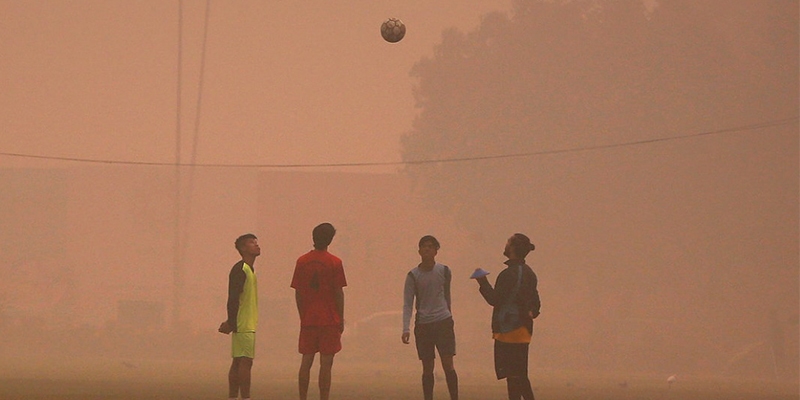
A recent Bloomberg report paints a stark picture of life in New Delhi, where winter smog has become an annual ordeal. Each year from November to February, a “gray, choking haze” engulfs the capital, exposing more than 30 million residents to hazardous air.
In December, New Delhi’s Air Quality Index averaged 349, and 307 in January — levels the US Environmental Protection Agency classifies as hazardous. On especially bad days, some neighbourhoods recorded readings approaching 1,800, according to Swiss air-quality firm IQAir.
This winter, however, frustration boiled over. Hundreds gathered at India Gate on Nov. 9 demanding action. Police detained more than a dozen protesters, and a later demonstration turned violent. After years of resignation, Strumpf writes, “at least some residents had had enough.”
The health toll is severe. Fine particulate matter, or PM2.5, penetrates deep into the lungs and bloodstream, increasing risks of heart disease, cancer, stroke and dementia. Nearly 1.7 million deaths in India in 2019 were attributable to air pollution, according to The Lancet.
Bhavreen Kandhari, co-founder of the advocacy group Warrior Moms, which organised the protest, said pharmacy surveys show rising demand for inhalers and nebulisers, many for children. “The findings clearly highlight that protecting the health and future of our children cannot wait,” she said.
The economic damage is also mounting. A 2023 World Bank report estimated that air pollution reduces India’s annual GDP growth by 0.56 percentage point. Former IMF official Gita Gopinath said in Davos that the crisis has inflicted more economic harm on India than tariffs.
Yet critics argue government responses amount to stopgap measures — from “smog guns” and “smog towers” to a failed cloud-seeding trial. In December, a senior environment minister told Parliament there was no conclusive data directly linking pollution and lung disease, drawing sharp criticism from doctors.
Author Manu Joseph was blunt: “All of India’s politicians are old men. They know the pollution is affecting them, but they don’t have the guts to solve it.”
Whether mounting public pressure will force decisive action remains uncertain. “It’s too soon to say,” Kandhari noted. “But at least they listened.”
ASIA SAMACHAR is an online newspaper for Sikhs / Punjabis in Southeast Asia and beyond. You can leave your comments at our website, Facebook, Twitter, and Instagram. We will delete comments we deem offensive or potentially libelous. You can reach us via WhatsApp +6017-335-1399 or email: asia.samachar@gmail.com. For obituary announcements, click here
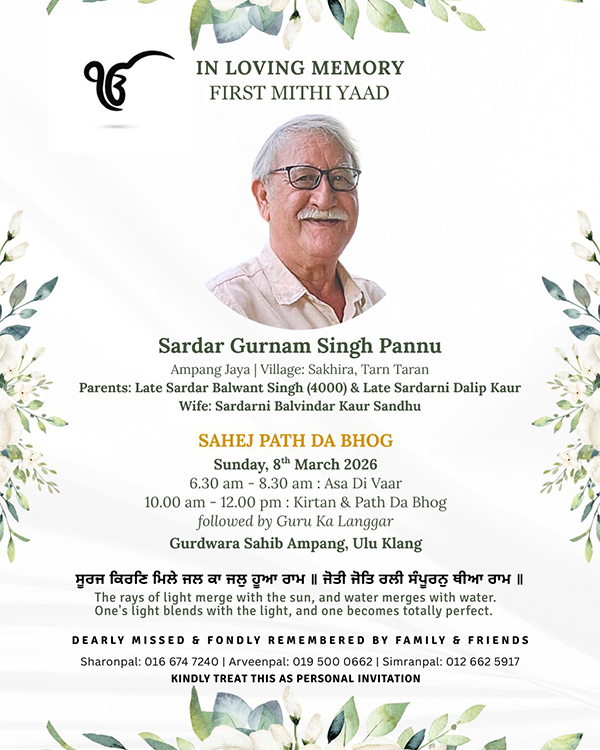
Parents: Late Sardar Balwant Singh (4000) & Late Sardarni Dalip Kaur
Wife: Sardarni Balvindar Kaur Sandhu
SAHEJ PATH DA BHOG Sunday, 8th March 2026 6.30 am – 8.30 am: Asa Di Vaar 10.00 am – 12.00 pm : Kirtan & Path Da Bhog followed by Guru Ka Langgar Gurdwara Sahib Ampang, Ulu Klang
DEARLY MISSED & FONDLY REMEMBERED BY FAMILY & FRIENDS
ASIA SAMACHAR is an online newspaper for Sikhs / Punjabis in Southeast Asia and beyond. You can leave your comments at our website, Facebook, Twitter, and Instagram. We will delete comments we deem offensive or potentially libelous. You can reach us via WhatsApp +6017-335-1399 or email: asia.samachar@gmail.com. For obituary announcements, click here
ASIA SAMACHAR is an online newspaper for Sikhs / Punjabis in Southeast Asia and beyond. You can leave your comments at our website, Facebook, Twitter, and Instagram. We will delete comments we deem offensive or potentially libelous. You can reach us via WhatsApp +6017-335-1399 or email: asia.samachar@gmail.com. For obituary announcements, click here
I am frequently asked for my perspective on Sikh sovereignty and the establishment of an independent homeland known as ‘Khalistan’ in present-day East Punjab. Though I have contributed several articles in Asia Samachar on this topic, this is the first time I am expressing my personal thoughts in such a direct and concise manner. For those who are motivated by emotion alone, I am usure anything I say will be of any relevance. I respect all of those who have a commitment to Sikh sovereignty, which may stem from any number of personal reasons, but if feel the more difficult task of delivering this requires careful reasoned argument based on Sikh ethics, historical insights and international protocols.
FOR MORE STORIES ON KHALISTAN, CLICK HERE
For decades, the discourse surrounding Sikh sovereignty and the establishment of Khalistan has been fuelled by deep-seated emotion and historical trauma, yet the gap between high-minded idealism and the “cold complexities” of nation-building remains wider than ever. History is littered with the shattered dreams of independence struggles and revolutions. Against the backdrop of decolonisation over the past 75 years, A cursory scan of newly established states previously colonised by European powers, reveals a sobering reality: for ordinary people, the promise of freedom can quickly degenerate into a nightmare of state repression, poverty and corruption.
The Arab Springs
In more recent times, for instance, we saw the optimism of the Arab Spring wave of uprisings that began in 2010 and spread across the Middle East and North Africa. One of its major highs was the overthrow of long-standing authoritarian leaders, which inspired hope for democracy, greater political participation, and human rights reforms. In some countries, particularly Tunisia, meaningful constitutional changes and competitive elections followed.
However, the movement also had significant lows. In Syria and Libya, protests escalated into prolonged civil wars, leading to immense human suffering, displacement and instability. In other states, democratic gains were reversed, and authoritarian rule reemerged or tightened.
Palestinian struggle for statehood
But perhaps the most well-known modern day national liberation cause is that of the Palestinian people. In 1948, following the creation of the state of Jewish state of Israel, hundreds of thousands of Palestinians were displaced from their homelands, shaping decades of conflict and statelessness. The formation of the Palestine Liberation Organization (PLO) in 1964 provided a unified political voice, and later milestones such as the 1993 Oslo Accords raised hopes for a two-state solution and limited Palestinian self-rule through the Palestinian Authority.
Yet these diplomatic gains were overshadowed by ongoing Israeli settlement expansion, internal political divisions, particularly between Fatah and Hamas, and recurring cycles of violence, especially in Gaza where we have witnessed a terrible war resulting in the deaths of some 70,000 innocent Palestinians as well as many Israeli Jews, albeit in much smaller numbers. While the struggle has sustained a strong sense of national identity and international solidarity, it has also endured prolonged occupation, humanitarian crises, and stalled peace efforts, leaving its ultimate aspirations for statehood and self-determination unresolved.
The Khalistan struggle
Similarities often drawn between the Khalistan movement and the Palestinian cause include themes of self-determination, claims of political marginalization, diaspora activism, and cycles of state repression and militant response. However, the historical contexts, territorial dynamics, religious dimensions and current political realities of the two movements differ significantly.
The present-day Khalistan movement emerged in the 1970s and 1980s among some Sikhs in the Indian state of Punjab as well as the wider diaspora, calling for an independent Sikh homeland called Khalistan. Tensions between Sikh political groups and the Indian government escalated over issues of autonomy for the State of Panjab, culminating in storming of the Golden Temple in Amritsar in 1984 and the military occupation of Panjab. This was followed by the assassination of Indira Gandhi in Oct 1984 and subsequent anti-Sikh pogroms, which deepened grievances and fuelled a Sikh insurgency in the 1990s and the deaths of many on all sides.
Whist the Khalistan case is still being made in Panjab and across the world, as I recently argued (https://asiasamachar.com/2026/01/26/the-khalistan-dream-and-present-reality-four-decades-after-the-1986-sarbat-khalsa-declaration/), an objective evaluation would suggest support for it is rapidly waning and there is little evidence of any progress towards achieving the end goal of a sovereign state.
A charter for establishing Sikh Sovereignty
My view is that if we are to progress the cause of Sikh sovereignty there is a need for a more practical yet principled strategy, which can offer a basis for both Khalistani Sikhs and the Indian State to claim a victory. The reality is that sooner or later, Sikhs and Indians will need to sit down to agree on a settlement. That is unless one is contemplating the destruction of the Indian State, which, in the short term, is extremely unlikely. Indeed, even if this were to happen, there is no guarantee that Sikhs will emerge from this with an independent state.
And so, as I am not a member of any political or religious group, I am offering the below charter as a path toward principled, democratic and pragmatic Sikh statehood. I accept, even if they agree with my sentiments in private, because of a whole range of other interests and factors, it is likely to be ignored or even denounced by the hardliners.
Section I: Philosophical Foundations
Universalist Framework: As an internationalist and universalist, I maintain a general scepticism toward traditional nationalism. My support for sovereignty is rooted in human liberty rather than majoritarianism or the politics of identity and I believe this is wholly consistent with Sikh teachings.
Universal Rights: I uphold the UN Universal Declaration of Human Rights as a foundational text, specifically the principles of freedom and sovereignty for all individuals and collectives.
Democratic Self-Determination: I affirm the right of all “peoples” to self-determination. This right must be exercised within a transparent, democratic framework that respects both individual and group liberties.
Section II: The Punjabi and Sikh Context
Cultural Distinctiveness: I recognise that the people of Punjab, and the Sikh community specifically, possess a unique history, culture and identity. Like all other peoples and nations in the world, the Punjabi’s have an inherent right to protect, preserve and propagate this heritage.
The Right to Statehood: I support the right of Punjabis and Sikhs to pursue self-determination, which includes the potential establishment of an independent sovereign state, provided it is achieved through non-violent, free and fair democratic processes. Sadly, as the plight of the Palestinians has demonstrated, unless one has overwhelming force, terrorism only invites more repression.
Rejection of Imperialism and Dictatorship: As a republican, I explicitly oppose the establishment of an imperial Sikh state, or any form of minority rule, as is advocated by some Khalistani ideologues. A sovereign Punjab must not be a vehicle for the dominance of one ruler, dictator or select group over others, but must be, as uttered by Abraham Lincoln in his famous Gettysburg Address off 1863, “of the people, by the people, for the people.”
Section III: Demographic and Ideological Realities
The Necessity of Consensus: A state modelled on the humanitarian principles of Sikhi can only be legitimate if it is inclusive. Therefore, the Sikh cause must successfully persuade non-Sikh residents of Punjab to support its vision.
The Demographic Challenge: Given the historical and current demographics of Punjab (both pre- and post-Partition), achieving a democratic majority for a sovereign state remains a monumental challenge.
Ideological Expansionism: If a Sikh state is built on universalist humanitarian ideology rather than based on ethnicity or religion, it makes no sense for its borders to be fixed by religion, as was the case with the establishment of Pakistan in 1947. Much like the spread of political movements in the 20th century, the Sikh state’s reach should be defined by the depth and breadth of popular support for humanitarian values. Following this logic, then there is an argument that the aim should be for the whole of India to become Khalistan!
Section IV: The Pragmatic Path Forward
The need for pragmatism: 40 years after the case for Khalistan was at its most potent following the massacre of Sikhs in India in June 1984 commencing with the army occupation of Panjab, and in November 1984 and the Sikh Genocide, today the dream is as distant as ever. To keep the flame burning it is important to adopt a more pragmatic principled stance and a justice and reconciliation mechanism in India.
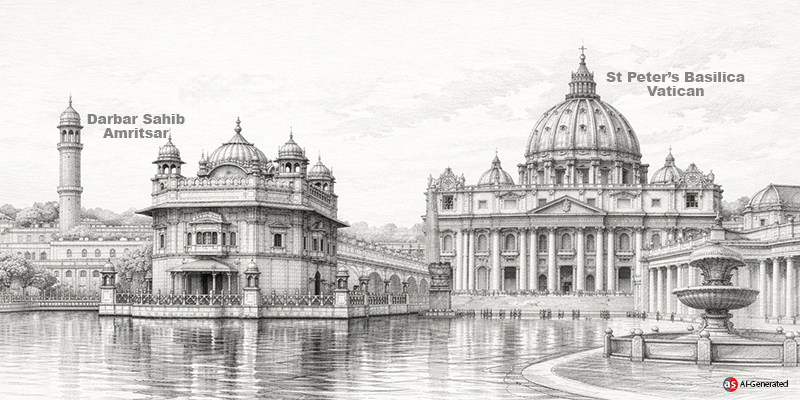
The “Vatican” Model: Recognising that in the short term, achieving full statehood is not a feasible project for the reasons set out above, I support the immediate, pragmatic goal of establishing a Sovereign City-State in Amritsar. Modeled after the Vatican, this entity would provide Sikhs with strong institutional representation within India and the international community and the ability to establish embassies and diplomatic missions and to advocate for Sikhs world-wide.
Gurnam Singh is an academic activist dedicated to human rights, liberty, equality, social and environmental justice. He is a Professor of Sociology at University of Warwick, UK. He can be contacted at Gurnam.singh.1@warwick.ac.uk
* This is the opinion of the writer and does not necessarily represent the views of Asia Samachar.
FOLLOW FOR MORE COMMENTS ON THIS STORY AT ASIA SAMACHAR FACEBOOK AND INSTAGRAM
ASIA SAMACHAR is an online newspaper for Sikhs / Punjabis in Southeast Asia and beyond. You can leave your comments at our website, Facebook, Twitter, and Instagram. We will delete comments we deem offensive or potentially libelous. You can reach us via WhatsApp +6017-335-1399 or email: asia.samachar@gmail.com. For obituary announcements, click here
The Government of Canada has announced the appointment of Rita Virk to the board of directors of the Canada Mortgage and Housing Corporation (CMHC), a key outfit in managing the national housing crisis.
Gregor Robertson, Minister of Housing and Infrastructure and Minister responsible for Pacific Economic Development Canada, made the announcement.
In a statement, the minister said Virk’s expertise would strengthen CMHC’s oversight and strategic direction as it advances its mandate to improve housing affordability and stability.
Virk is a Chartered Professional Accountant with extensive experience in finance, risk management and governance across both public and private sectors. Her background includes senior leadership and board roles focused on financial oversight, internal audit, system modernization and Environmental, Social and Governance (ESG) strategy.
She currently serves on the Departmental Audit Committee for Innovation, Science and Economic Development Canada. Virk holds a Master of Professional Accounting degree and the Institute of Corporate Directors designation. She was selected through an open, competency-based process.
“Rita Virk brings valuable experience in finance, risk management, and governance. Her depth of expertise and strategic insight will be a strong asset to CMHC’s Board of Directors as it advances its mandate and supports the federal government’s efforts to strengthen Canada’s housing system,” Robertson said.
CMHC, a federal Crown corporation, plays a central role in Canada’s housing finance system. Through research, program development and commercial operations, it works with industry and all levels of government to promote housing affordability, facilitate access to housing finance and contribute to the overall stability of the national housing sector.
The federal government said the appointment reflects its broader efforts to build resilient, connected communities and expand affordable housing options for Canadians.
RELATED STORY:
(Asia Samachar, x 2024)
ASIA SAMACHAR is an online newspaper for Sikhs / Punjabis in Southeast Asia and beyond. You can leave your comments at our website, Facebook, Twitter, and Instagram. We will delete comments we deem offensive or potentially libelous. You can reach us via WhatsApp +6017-335-1399 or email: asia.samachar@gmail.com. For obituary announcements, click here
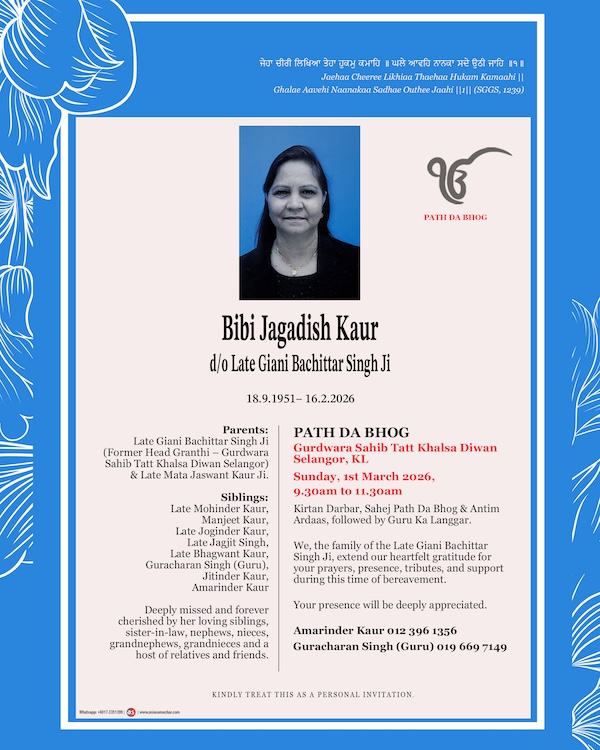
Bibi Jagadish Kaur d/o Late Giani Bachittar Singh Ji
18.9.1951– 16.2.2026
Parents: Late Giani Bachittar Singh Ji (Former Head Granthi – Gurdwara Sahib Tatt Khalsa Diwan Selangor) & Late Mata Jaswant Kaur Ji.
Siblings: Late Mohinder Kaur, Manjeet Kaur, Late Joginder Kaur, Late Jagjit Singh, Late Bhagwant Kaur, Guracharan Singh (Guru), Jitinder Kaur, Amarinder Kaur
Deeply missed and forever cherished by her loving siblings, sister-in-law, nephews, nieces, grandnephews, grandnieces and a host of relatives and friends.
PATH DA BHOG Gurdwara Sahib Tatt Khalsa Diwan Selangor Sunday, 1st March 2026, 9.30am to 11.30am Kirtan Darbar, Sahej Path Da Bhog & Antim Ardaas, followed by Guru Ka Langgar.
We, the family of the Late Giani Bachittar Singh Ji, extend our heartfelt gratitude for your prayers, presence, tributes, and support during this time of bereavement.
ASIA SAMACHAR is an online newspaper for Sikhs / Punjabis in Southeast Asia and beyond. You can leave your comments at our website, Facebook, Twitter, and Instagram. We will delete comments we deem offensive or potentially libelous. You can reach us via WhatsApp +6017-335-1399 or email: asia.samachar@gmail.com. For obituary announcements, click here
A Chinese New Year greeting — featuring a Sikh boy all decked out in vibrant red, radiating joy, prosperity and festive cheer. Yes, it’s AI-generated. And yes, it’s obvious. But it’s also a delightful reminder of how cultures can be celebrated side by side.
Red for good fortune. Smiles for new beginnings. And a playful nod to the season of renewal.
Wishing everyone celebrating a year filled with abundance, happiness and bold new opportunities. Gong Xi Fa Cai!
ASIA SAMACHAR is an online newspaper for Sikhs / Punjabis in Southeast Asia and beyond. You can leave your comments at our website, Facebook, Twitter, and Instagram. We will delete comments we deem offensive or potentially libelous. You can reach us via WhatsApp +6017-335-1399 or email: asia.samachar@gmail.com. For obituary announcements, click here
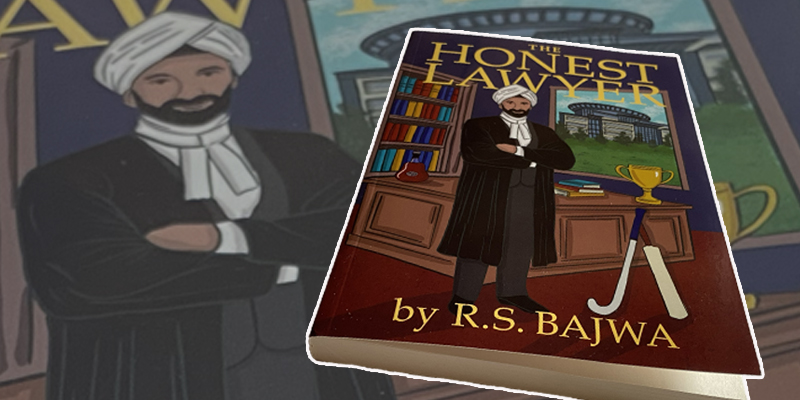
The Honest Lawyer by Singapore senior lawyer R. S. Bajwa
By Jasrinder Kaur | Malaysia |
Reading The Honest Lawyer feels like stepping into a courtroom where the judge could just as easily be a film director and every witness seems to be auditioning for a role.
R. S. Bajwa, a Singapore lawyer with nearly five decades of experience, presents stories that move with the rhythm of a Hindi film—complete with drama, comedy and the occasional sting of pathos. One moment you are laughing at the absurdity of an argument; the next, you are pausing at the quiet sadness that slips between the lines.
Bajwa’s intellect is both incisive and playful. His reasoning twists and pivots in ways that make you wonder whether lawyers secretly train in stand-up comedy. Cases that ought to feel weighty are enlivened with wit, and when you realise these are not fictional scripts but real courtroom battles, the effect is irresistible.
The graphics scattered throughout the book heighten the experience. They amplify the drama, sharpen the punchlines and give certain scenes the energy of a live cartoon strip. At times, the illustrations are so cheeky that they prompt laughter before the text even lands.
What ultimately distinguishes the book is its candour. Bajwa avoids impenetrable legal jargon and unnecessary solemnity. Instead, he reveals the human dimension of law, where justice is shaped not only by statutes but by the quirks, flaws and contradictions of people. The result is a reminder that truth in court can be stranger—and often funnier—than fiction.
Educated at the prestigious Anglo-Chinese School, Bajwa received the gold medal as the best all-round student in 1969. He later read law at the University of Singapore on a government merit scholarship.
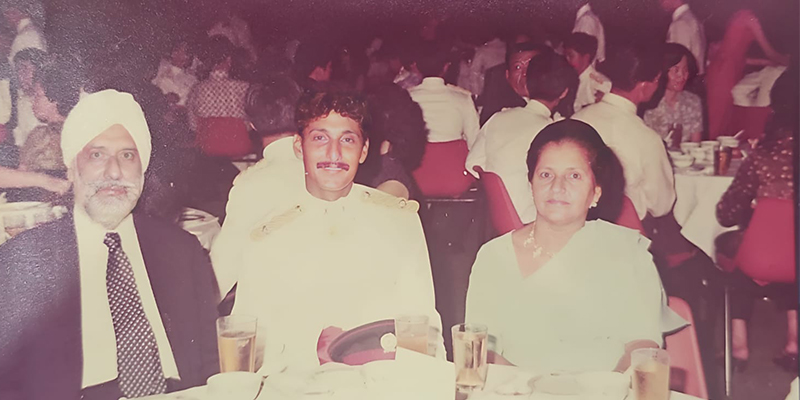
R.S. Bajwa with his parents at the National Service commissioning ceremony in the Istana in 1975 – Photo: Author
Over the years, he built a formidable litigation practice spanning both civil and criminal law. Among the notable civil matters he handled was the widely publicised Novena Church exorcism case.
Beyond the courtroom, Bajwa proved himself an all-rounder. A keen sportsman, he played cricket and hockey, representing the national under-23 hockey team. In 1972, he captained the University of Singapore hockey team to a memorable victory over a highly rated Malaysian side. Commissioned as an officer during National Service in 1975, he later served as a special investigation officer in the military police.
The first part of the book revisits several headline-making and landmark cases, alongside others that, in Bajwa’s words, reveal the “human face of the judicial process”. Chapter titles such as The Bearded Accused, Murder of the Twin Babies, Three Honeymoon Couples, Underage Commercial Sex, Saved by CCTV Cameras and Complaint Against a Lawyer by a Judge hint at the range and unpredictability of the stories within.
Verdict:The Honest Lawyer will appeal to readers curious about the legal profession, as well as to anyone who appreciates storytelling that provokes laughter, reflection and recognition. It demonstrates that the most compelling courtroom drama is often not on screen, but unfolding in real life—and it is far more entertaining than we might expect.
ASIA SAMACHAR is an online newspaper for Sikhs / Punjabis in Southeast Asia and beyond. You can leave your comments at our website, Facebook, Twitter, and Instagram. We will delete comments we deem offensive or potentially libelous. You can reach us via WhatsApp +6017-335-1399 or email: asia.samachar@gmail.com. For obituary announcements, click here
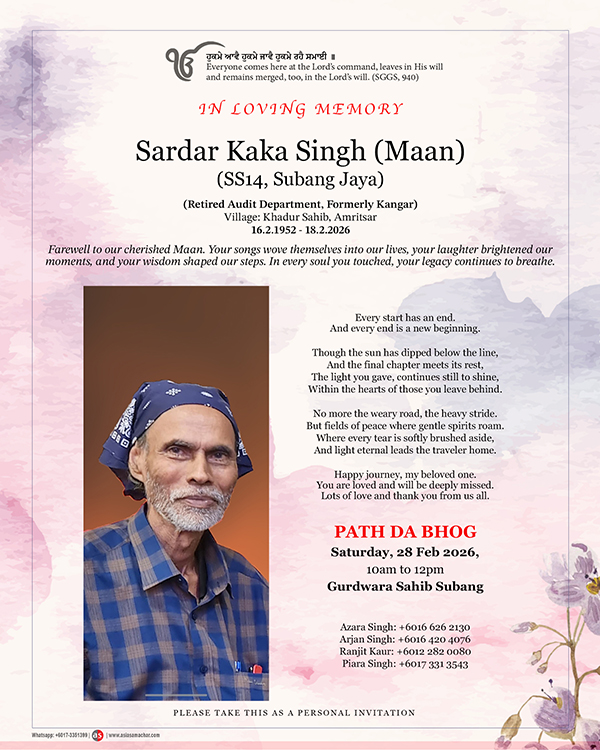
Farewell to our beloved Maan, whose soulful songs became our memories, his laughter our light and his wisdom our guide. You live on in every heart you touched.
Parents: Late Bishen Singh & Late Prem Kour (Tronoh, Perak)
Sibling & Spouses: Piara Singh & Harbans Kaur Bibi Kaur & Late Sohan Singh Pargash Kaur & Late Hari Singh Azara Singh & Late Gurmit Kaur Arjan Singh Late Charan Kaur & Late Major Jagjeet Singh Bhattal Late Santokh Singh & Nirmal Kaur Ranjit Kaur & Amajit Singh Late Ranjit Singh & Harjit Kaur
Lovingly remembered by family and friends; adored by his nephews and nieces.
FINAL RITES Thursday, 19 February 2026 9am to 12pm: Wake at Gurdwara Sahib Petaling Jaya 12pm: Cortege leaves PJ Gurdwara 2pm: Saskaar (cremation) at Nirvana Memorial Park Shah Alam (Add: Taman Perkuburan, Jalan Pusaka 21/1, Off Persiaran Jubli Perak, Section 21, 40300 Shah Alam, Selangor)
Link to posting at Facebook and Instagram; Updated Facebook and Instagram
| Entry: 18 February 2026; Updated 24 February 2026 | Source: Family
ASIA SAMACHAR is an online newspaper for Sikhs / Punjabis in Southeast Asia and beyond. You can leave your comments at our website, Facebook, Twitter, and Instagram. We will delete comments we deem offensive or potentially libelous. You can reach us via WhatsApp +6017-335-1399 or email: asia.samachar@gmail.com. For obituary announcements, click here