Eylül Kandemir as Füsun and Selahattin Paşalı as Kemal in ‘The Museum of Innocence’
By Asia Samachar | Movie Review |
Love begins as a whisper — an accidental glance, a fleeting impression. From that fragile spark, entire lives are shaped.
Set in 1970s Istanbul, amid the weight of tradition and reputation, The Museum of Innocence follows Kemal (Selahattin Paşalı) and Füsun (Eylül Kandemir) as they stumble into a love that becomes both salvation and ruin. This nine-episode Turkish Netflix drama, released on February 13, 2026, is not a tale of triumph but of hesitant, broken and irreversible choices.
Kemal, the son of a wealthy family, exists in tension between cowardice and courage. He can be seen as possessive and obsessive — even monstrous — yet also as a man unravelled by regret. Füsun, young yet resolute, carries a quiet strength. Though naïve, she makes her decisions with clarity, seeking to be seen and loved without conditions. One act born of Kemal’s fear fractures her spirit and damages the very love he seeks to preserve.
Produced by Zeynep Günay Tan and based on the acclaimed novel by Nobel Prize-winning author Orhan Pamuk, the series translates Pamuk’s meditation on obsession and memory into a restrained visual language. Silences speak louder than dialogue; pauses carry the weight of longing. The audience is invited to inhabit the emotional gaps and draw its own conclusions.
At its core lies a troubling question: does memory bring happiness, or does it imprison us in sorrow? Kemal builds a museum of objects touched by Füsun, each item a relic of fixation. The series asks whether clinging to fragments redeems love or corrodes it.
In the end, love is measured not by possession but by release. The museum stands as both shrine and prison — a reminder that to hold too tightly is to lose, and that acceptance, however painful, may be the only path to peace.
ASIA SAMACHAR is an online newspaper for Sikhs / Punjabis in Southeast Asia and beyond. You can leave your comments at our website, Facebook, Twitter, and Instagram. We will delete comments we deem offensive or potentially libelous. You can reach us via WhatsApp +6017-335-1399 or email: asia.samachar@gmail.com. For obituary announcements, click here
Dumalla elegance reimagined in anime style — bold, graceful, and timeless.
By Gurnam Singh | Opinion |
I have always been curious about the origin of the Dumalla or double decorated turban mostly associated with the Nihang Sect within the Sikh family. Actually, following some quick research, what I found is that the Dumalla has much deeper cultural and historical significance.
In the literal sense Dumalla can be broken down into Du (Two) and Malla (Cloth/Level). It refers to the “Double Turban” method—an inner base (Keski) and an outer wrap. In some dialects, Maala refers to a floor or level of a building. A Dumalla was figuratively a “two-story” turban, referencing its distinctive height and layered volume.
The Nihang Association
Perhap more than any other association, the Dumalla is a hallmark of the Nihang Sikhs, the traditional warrior order of the Sikh Panth. Its origin is a blend of spiritual significance, battlefield utility – both practical and psychological – and a direct link to the lineage of the Sikh Gurus.
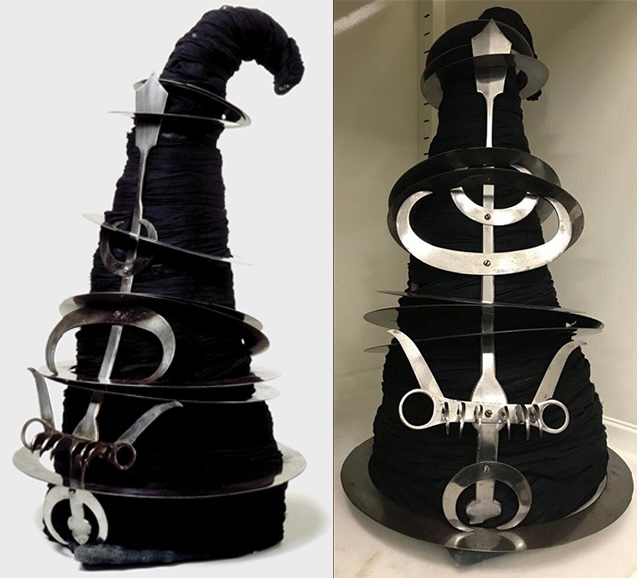
One of the most distinctive forms of the Dumalla is that worn by the Akali Nihang, often shaped like a bunga or ‘tower’, rising in some cases over eighteen inches in height. A notable example can be seen on display in the collection of the Victoria and Albert Museum in London. According to popular tradition, such imposing turbans were not merely symbolic but strategic: when viewed from a distance, they would have made Sikh warriors appear extraordinarily tall — perhaps seven or eight feet in stature — thereby conferring a psychological advantage on the battlefield. The dramatic silhouette could intimidate opponents, unsettle their ranks, and diminish morale even before physical engagement began.
Quoit turban: Akali turban, with steel quoits; Sikh, Punjab, mid 19th century (Transferred from the India Museum to South Kensington Museum in 1879). A tall conical turban made of black cotton over a cane base, to which is attached a vertical spike to which are attached scimitar-shaped horns. Around this structure are slung nine quoits – ring-shaped, sharp-edges steel weapons of varying sizes. — Source: Victoria and Albert Museum
British colonial observers, despite frequently resorting to pejorative terms such as “fanatics” or “zealots”, were nonetheless captivated by the imposing presence of the Akali Nihangs and their towering Dastar Bunga. In The Court and Camp of Runjeet Sing, Osborn described the Akalis as “armed to the teeth”, noting that multiple pairs of steel quoits (chakrams) were fastened around their turbans, effectively transforming the Dumalla into a mobile armoury. Similarly, Cunningham in A History of the Sikhs referred to their “tall blue turbans” and steel bracelets, recognising that this distinctive attire was not mere ornamentation.
Other British records provide technical and visual corroboration of the Dumalla’s dramatic structure and symbolism. In Notes on the Religion of the Sikhs, Major Robert Leech detailed how the turban’s height was achieved by inserting a knife at the centre and winding an iron chain around it—evidence of an internal framework designed to maintain its formidable stature. Earlier still, John Malcolm in Sketch of the Sikhs observed the Akalis’ “high-peaked turbans” and unwavering commitment to their blue dress, demonstrating that the style was firmly established by the early nineteenth century. Complementing these textual sources, Emily Eden in Portraits of the Princes and People of India visually captured the dramatic height, deep blue hue and steel quoits of the “Akalees”, reinforcing the psychological impact and intimidating silhouette that so struck British observers.
The most cherished tradition amongst the Nihangs regarding the Dumalla’s origin dates back to the time of Guru Gobind Singh Ji, the tenth Guru. According to Sikh history, the Guru’s youngest son, Baba Fateh Singh Ji (then a small child), once appeared before his father wearing a very large, high-peaked blue turban with a Farla (a loose piece of cloth fluttering from the top).
When asked why he was dressed this way, the young Sahibzada explained he wanted to look like a formidable warrior. Guru Gobind Singh Ji was so pleased by his son’s warrior spirit that he declared this style would become the distinct identity of the Akali Nihangs, the “Army of the Immortal.”
Secular context
Before and during the early Sikh period, the “double-wrap” or peaked turban also appear in several secular and non-Sikh religious contexts. The “Victory Turban” of Wrestlers in traditional Punjabi culture, the word Malla is also related to wrestlers (Mal).
When a wrestler won a major competition, the prize money (the Maalee) was often tied into a cloth. The winner would tie this prize cloth over their existing turban as a trophy. If the prize was large, it became a Dumaalee or Dumalla (a double-prize/double-turban), serving as a visible badge of victory.
Persian Roots
Though the Dumalla is today almost exclusively associated with Sikh, its roots, like much of Punjabi and Sikh culture, can be found in Persia or modern day Iran.
The word Dumalla (or Dumaala) has two primary linguistic paths, both pointing to its structure and style rather than a specific religious identity Early references used the term to describe any turban with this specific “tail” feature, common among Afghan and Persian nobility.
Historically, the word is linked to the Persian word Dumbaalah (or Dum), which means “tail.” In the context of headwear, this referred to the Shamla, which is the loose, flowing end of a turban that hangs down the back like a tail.
Mughal and Rajput Influence
While the Sikh Dumalla evolved into a specific warrior shape, the concept of a high, conical, or layered turban was a mark of sovereignty across the Mughal Empire and Rajput kingdoms.
Because Islamic law often restricted the wearing of crowns to the Emperor, noblemen used elaborate, high-peaked turbans to signal high rank.
The Peaked Cap (Kulah): Many Persian and Afghan styles involved wrapping long cloths around a hard, conical cap. The silhouette of the Nihang Dumalla mirrors this ancient Central Asian warrior aesthetic, though the Nihangs replaced the hard cap with a “base” of hair and cloth.
Dumalla elegance reimagined in anime style — bold, graceful, and timeless.
The Vedic Sanskrit tradition
Ancient Sanskrit texts refer to a voluminous headdress called the Ushnisha. While not a “Dumalla” by name, it was a complex, multi-layered wrap used by royalty and spiritually enlightened figures to protect the “tenth gate” (the crown of the head).
Reference in Gurbani Interestingly, the word Dumalla appears in the Guru Granth Sahib (the Sikh scripture) in a context that reflects the “wrestler” etymology mentioned above.
“I am a wrestler of the the Divne; having met the Guru, I have tied a tall Dumalla (Victory Turban).” — Guru Arjan Dev Ji (Page 73)
The “wrestler” here symbolises disciplined engagement in the inner struggle against ego and vice, while the Dumalla functions metaphorically as a sign of elevated consciousness and moral responsibility bestowed through encounter with the Guru. The Dumalla hence becomes a visible emblem of inner victory and disciplined identity.
The implication for anybody who chooses to wear the Dumalla is clear; you will start out and be judged for your actions and behaviour. For this reason, the right to wear a Dumalla comes with immense responsibility to be in control of one’s base emotions and be totally committed to ethical actions.
REFERENCE
Scriptural & Theological Sources
Sri Guru Granth Sahib: Page 73, Raag Sri Raag. Author: Guru Arjan Dev Ji. (Primary source for the “Wrestler/Victory Turban” metaphor).
Mahan Kosh (Encyclopedia of Sikh Literature): Bhai Kanh Singh Nabha (1930). (The definitive source for the etymology of Du-Malla and the Persian Dumbālah connection).
Dasam Granth Sahib: Guru Gobind Singh Ji. (Context for the martial identity and the “Army of the Immortal”). Historical & Martial Records
Prachin Panth Prakash: Rattan Singh Bhangu (early 19th Century). (Details the origin of the Nihang sect and their unique dress code).
Bansavalinama Dasan Patshahian Ka: Kesar Singh Chhibber (1769). (Early record of the Khalsa’s physical appearance and lineage).
Gur Bilas Patshahi 10: Kuier Singh (1751). (Early historical account of Guru Gobind Singh Ji’s life and the traditions of his court). Academic & Museum References
Victoria and Albert Museum, London: Accession Number 112-1852. Description: “Turban (Dastar Bungga) of a Sikh Akali.” (Evidence for the 18-inch height and the “Tower” structure).
Warrior Saints: Three Centuries of the Sikh Military Tradition: Amandeep Singh Madra & Parmjit Singh (1999). (Visual and historical analysis of Nihang attire vs. Mughal/Rajput styles).
The Sikhs: Patwant Singh (1999). (Explores the psychological impact of the Sikh warrior silhouette on the battlefield). Linguistic & Cultural Sources
A Comprehensive Persian-English Dictionary: Francis Joseph Steingass (1892). (Definitions of Dumbālah as the “tail” or “after-part” of a garment).
Ancient Indian Costume: Roshen Alkazi (1983). (Historical background on the Ushnisha and early Indian headwraps).
A Dictionary of the Panjabi Language: Ludhiana Mission (1854). (Archival definitions of Malla and Maalee in the context of Punjabi wrestling/prizes). Osborne, W.G. (1840). The Court and Camp of Runjeet Sing. London: Henry Colburn.
Cunningham, J.D. (1849). A History of the Sikhs. London: John Murray.
Leech, R. (1845). Notes on the Religion of the Sikhs. (Journal of the Asiatic Society of Bengal).
Malcolm, J. (1812). Sketch of the Sikhs. London: John Murray.
Eden, E. (1844). Portraits of the Princes and People of India. (Visual record).
Gurnam Singh is an academic activist dedicated to human rights, liberty, equality, social and environmental justice. He is a Professor of Sociology at University of Warwick, UK. He can be contacted at Gurnam.singh.1@warwick.ac.uk
* This is the opinion of the writer and does not necessarily represent the views of Asia Samachar.
ASIA SAMACHAR is an online newspaper for Sikhs / Punjabis in Southeast Asia and beyond. You can leave your comments at our website, Facebook, Twitter, and Instagram. We will delete comments we deem offensive or potentially libelous. You can reach us via WhatsApp +6017-335-1399 or email: asia.samachar@gmail.com. For obituary announcements, click here
Time may move, but love stays still, woven deep within my soul. A mother’s touch, a mother’s care-your love still makes me whole. Today I honor all you gave, your gentle heart, so pure, so brave.
Mata Balbir Kaur w/o Late Sardar Jenal Singh
26.9.1951-23.4.2025
Deeply missed and fondly remembered by her loving kids, grandchildren, in laws, family & friends
PATH DA BHOG & KIRTAN SUNDAY 8th March 2026 10.00am-12.00pm GURDWARA SAHIB PORT DICKSON
Your kind presence is much appreciated
For further information please contact, Sarjeet Singh (Ladi): +60 19-931 4861 Ranjeet Singh(Chin): 012-2057970
Link to posting at Facebook and Instagram
| Entry: 25 February 2026 | Source: Family
ASIA SAMACHAR is an online newspaper for Sikhs / Punjabis in Southeast Asia and beyond. You can leave your comments at our website, Facebook, Twitter, and Instagram. We will delete comments we deem offensive or potentially libelous. You can reach us via WhatsApp +6017-335-1399 or email: asia.samachar@gmail.com. For obituary announcements, click here
London/New Delhi — Artificial intelligence (AI) has moved far beyond research labs. It now enters spaces once reserved for moral and spiritual counsel.
During the recent India AI Impact Summit in New Delhi, OpenAI CEO Sam Altman, widely credited with bringing AI into everyday use, reframed concerns about the massive energy demands of AI by comparing them to the resources required to raise a human being.
“People talk about how much energy it takes to train an AI model. But it also takes a lot of energy to train a human. It takes about 20 years of life — and all the food you consume during that time — before you become smart,” Altman told a media event.
The comparison places AI in the category of long-term societal investment.
The Danger of Concentrated Power
Altman has also cautioned against limiting advanced AI to a single company or nation. Wider access, he argues, allows individuals and institutions to question, test and refine these systems.
OpenAI’s approach releases evolving models in stages so societies learn through interaction as the technology grows.
For religious traditions, this openness presents a complex dilemma.
Expanded access supports creative communication. It also accelerates the production of persuasive content that appears authoritative without grounding in authentic sources.
In a tradition where the sanctity of the revealed word holds central importance, fabricated texts carry serious implications for theological understanding.
On behalf of UNITED SIKHS (UK), I brought these examples to the Sikh religious leadership. The Shiromani Gurdwara Parbandhak Committee (SGPC), headquartered in Amritsar, subsequently constituted a dedicated AI panel to examine the implications of emerging technologies for Sikh practice. I serve as a member of that panel.
Machine-Generated Spirituality
Generative AI now produces devotional reflections and engages with ethical dilemmas in seconds. It can draw upon religious literature to tailor responses to individual emotional needs.
A grieving individual may seek comfort from a chatbot trained on scriptural commentaries. A student exploring purpose might receive guidance from an app combining behavioural insights with sacred phrasing. Congregations could encounter AI-drafted sermons styled after historical traditions.
The Vatican’s January 2025 note, Antiqua et Nova, addresses this frontier directly. It observes that AI may simulate aspects of human reasoning while lacking the relational depth that defines human intelligence.
The distinction between imitation and genuine encounter carries importance for faith communities navigating technological change.
A Challenge for Faith Communities
AI advances through continuous iteration and integration across governance, finance and healthcare. Spiritual institutions now stand at a similar crossroads.
India’s position as an AI frontrunner lends urgency to this dialogue.
Home to diverse religious and cultural traditions stretching back centuries, the world’s most populous country faces a critical moment. The encounter between tradition and adaptive computation will influence global conversations on the role of technology in shaping belief and practice.
AI will remain a permanent feature of modern life. Religious communities that engage with foresight may preserve doctrinal coherence in an era of machine-generated guidance.
Ignore this shift, and the next sermon, the next katha or the next kirtan may come from a system that has already learned how to speak in the language of your faith — where, without guardrails, revealed word gives way to generated content, and the most sublime of creations, the human being, disappears from the act of guidance.
Harmeet Shah Singh is a career journalist currently serving as Communications and Advocacy Director at UNITED SIKHS (UK), a charity registered in England and Wales.
* This is the opinion of the writer and does not necessarily represent the views of Asia Samachar.
ASIA SAMACHAR is an online newspaper for Sikhs / Punjabis in Southeast Asia and beyond. You can leave your comments at our website, Facebook, Twitter, and Instagram. We will delete comments we deem offensive or potentially libelous. You can reach us via WhatsApp +6017-335-1399 or email: asia.samachar@gmail.com. For obituary announcements, click here
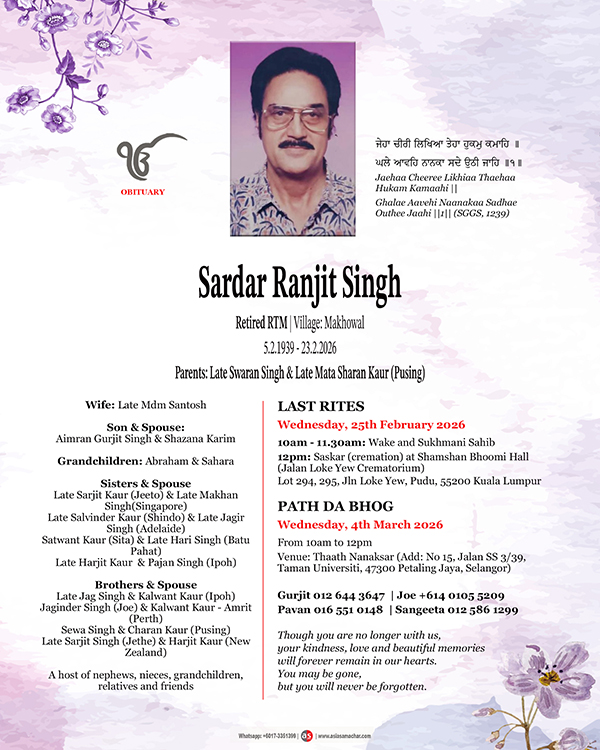
A host of nephews, nieces, grandchildren, relatives and friends
LAST RITES Wednesday, 25th February 2026 10am – 11.30am: Wake and Sukhmani Sahib 12pm: Saskar (cremation) at Shamshan Bhoomi Hall (Jalan Loke Yew Crematorium) Lot 294, 295, Jln Loke Yew, Pudu, 55200 Kuala Lumpur
PATH DA BHOG Wednesday, 4th March 2026 From 10am to 12pm Venue: Thaath Nanaksar (Add: No 15, Jalan SS 3/39, Taman Universiti, 47300 Petaling Jaya, Selangor)
For more information, please contact: Gurjit 012 644 3647 Joe +614 0105 5209 Pavan 016 551 0148 Sangeeta 012 586 1299
Though you are no longer with us, your kindness, love and beautiful memories will forever remain in our hearts. You may be gone, but you will never be forgotten.
ASIA SAMACHAR is an online newspaper for Sikhs / Punjabis in Southeast Asia and beyond. You can leave your comments at our website, Facebook, Twitter, and Instagram. We will delete comments we deem offensive or potentially libelous. You can reach us via WhatsApp +6017-335-1399 or email: asia.samachar@gmail.com. For obituary announcements, click here
Businessman Ranjeet Singh Sidhu was charged in the Sessions Court with bribery and document forgery in connection with a RM400 million loan application for a telecommunications infrastructure project dating back to 2012.
The 56-year-old pleaded not guilty before judge Rosli Ahmad yesterday (Feb 23) to allegedly giving RM8 million to a former bank chief to secure approval for the financing, according to local media reports.
According to the charge, the payment was intended to induce Mohd Zafer Mohd Hashim, then head of Bank Pembangunan Malaysia Berhad (BPMB), to approve a loan sought by V Telecoms Bhd. The funds were meant to support the rollout of a fibre optic network encircling Peninsular Malaysia.
The bribery charge, under Section 16(b)(A) of the MACC Act 2009 and punishable under Section 24(1), provides for imprisonment of up to 20 years and a substantial fine upon conviction.
Ranjeet also faces a separate count under Section 471 of the Penal Code for allegedly using as genuine a forged “Joint Completion Guarantee” document dated June 21, 2012, purportedly between V Telecoms Bhd and Huawei Technologies Co Ltd, to satisfy loan conditions.
The court fixed bail at RM150,000 with one surety. Additional conditions require Ranjeet to surrender his passport and report once a month to the MACC headquarters until the case is concluded.
Deputy public prosecutor Farah Ezlin Yusop Khan requested the bail amount and additional conditions, while defence counsel Gobinath Mohanna sought a lower sum, informing the court that the accused’s passport was already with the MACC.
The matter has been scheduled for mention on March 30.
Ranjeet was also the MD of Vascory Bhd, according to his LinkedIn profile. It stated that in 1999, he ventured into the field of micro financing and expanded to a wide range of businesses including real estate, properties, lifestyle and leisure, ICT and telecommunications.
ASIA SAMACHAR is an online newspaper for Sikhs / Punjabis in Southeast Asia and beyond. You can leave your comments at our website, Facebook, Twitter, and Instagram. We will delete comments we deem offensive or potentially libelous. You can reach us via WhatsApp +6017-335-1399 or email: asia.samachar@gmail.com. For obituary announcements, click here
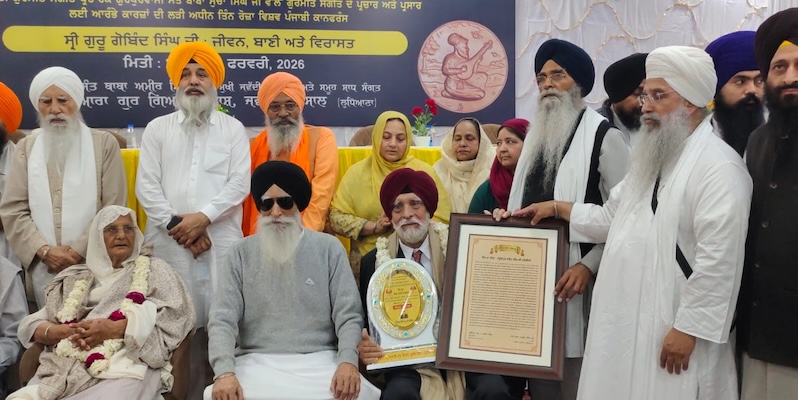
Santokh Randhawa (seated, 3rd from left) honored at an international conference organised by Jawaddi Taksaal in Ludhiana, Panjab
By Asia Samachar | Panjab |
Santokh Singh Randhawa, a long-standing advocate for the promotion of the Panjabi language in Malaysia, has been honoured at an international conference in Panjab, where he was the only overseas recipient among five awardees.
He received the recognition at a three-day international conference organised by Jawaddi Taksaal in Ludhiana, which concluded on Feb 22. This year’s conference was themed ‘Sri Guru Gobind Singh Ji: Life, Bani and Legacy’.
“Among the five Sikhs honoured, I was the only overseas person chosen for the revival of the Panjabi language in Malaysia. I feel it is a recognition of Malaysian Sikhs as a whole, and the honour belongs to the entire community,” Santokh said in a message to Asia Samachar.
Santokh previously served as president of Khalsa Diwan Malaysia (KDM), the Ipoh-based body that spearheaded structured Panjabi language education in the country. Under its leadership, more than four dozen Punjabi Education Centres (PECs) were established nationwide, forming the backbone of community-based language instruction.
In an earlier Asia Samachar article, Santokh recounted how a 1988 seminar in Malaysia sparked his lifelong commitment to revitalising Panjabi language teaching and learning. That turning point eventually led to the creation of a national Panjabi language programme under KDM, laying the foundation for the PEC network.
The initiative marked its 25th anniversary in 2025, underscoring a quarter-century of sustained efforts to preserve and strengthen Panjabi literacy among Malaysian Sikhs.
ASIA SAMACHAR is an online newspaper for Sikhs / Punjabis in Southeast Asia and beyond. You can leave your comments at our website, Facebook, Twitter, and Instagram. We will delete comments we deem offensive or potentially libelous. You can reach us via WhatsApp +6017-335-1399 or email: asia.samachar@gmail.com. For obituary announcements, click here
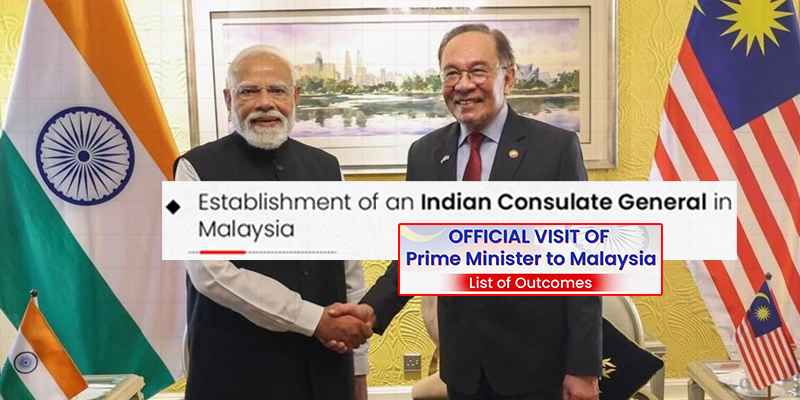
Establishment of an Indian Consulate General in Malaysia. This was one of the listed outcomes released by India’s Ministry of Information and Broadcasting, and shared by the social medial platforms of the High Commission of India in Kuala Lumpur – Photo: Asia Samachar
By Asia Samachar | Malaysia |
A proposal to establish an Indian consulate in Sabah — floated during Indian Prime Minister Narendra Modi’s recent visit to Malaysia — has set off a wider conversation in the state about diplomacy, economic opportunity and immigration safeguards, even as federal and state authorities say no decision has been made.
The suggestion, raised during Modi’s two-day visit earlier this month, is currently being examined by both the Sabah government and Malaysia’s Ministry of Foreign Affairs. While the idea has been framed as a potential boost to tourism and bilateral engagement, it has also prompted questions locally about its long-term implications.
Minister in the Prime Minister’s Department (Sabah and Sarawak Affairs) Mustapha Sakmud said the matter was discussed at Cabinet level following a request from India.
“What happened is that this came following a request during engagements with India. As a sign of respect, we said we would consider it. There is no decision yet,” Mustapha told reporters in Sepanggar, Sabah, yesterday (Feb 23), as reported by The Borneo Times.
Mustapha, a Sabah MP, said the proposal could be assessed against expectations of increased tourist arrivals from India and whether there is sufficient justification to facilitate visitors through a local diplomatic presence.
The establishment of an Indian Consulate General in Malaysia was one of the outcomes from the Modi visit, according to a release by India’s Ministry of Information and Broadcasting which was shared by the social medial platforms of the High Commission of India in Kuala Lumpur.
Under the terms of the Malaysia Agreement 1963, Sabah retains special safeguards and greater autonomy than states in Peninsular Malaysia, particularly in matters relating to immigration control — a factor that has heightened sensitivity around any proposal involving foreign representation.
India currently maintains a High Commission in Kuala Lumpur and a consulate in Penang. Sabah and Sarawak, however, are geographically separated from Peninsular Malaysia by the South China Sea, making access to consular services more distant for those based in East Malaysia.
If established, a consulate in Kota Kinabalu would provide passport, visa and emergency services locally, while supporting Indian professionals in sectors such as oil and gas, education and construction. It could also facilitate trade promotion, business matchmaking and regulatory coordination for companies operating in Sabah.
For now, Mustapha reiterated that the proposal remains under study, with any eventual decision to take into account Sabah’s interests as well as broader diplomatic considerations.
The suggestion has drawn mixed reactions. Warisan Sepanggar deputy division chief Norazmi Alimat urged the federal government to clarify the scope and implications of the proposal before proceeding.
“To date, Sabah continues to face serious challenges such as illegal immigration, Esszone security concerns, and social and economic pressures on local communities. Sabah youths in particular fear that any decision made without careful planning could affect job opportunities, social security and the future of coming generations.
“I would like the federal government to explain to the state the scope, function and implications of this suggestion, and to hold a public forum involving youths and Sabahans before any decision is made,” he was quoted as saying by the Malay Mail.
ASIA SAMACHAR is an online newspaper for Sikhs / Punjabis in Southeast Asia and beyond. You can leave your comments at our website, Facebook, Twitter, and Instagram. We will delete comments we deem offensive or potentially libelous. You can reach us via WhatsApp +6017-335-1399 or email: asia.samachar@gmail.com. For obituary announcements, click here
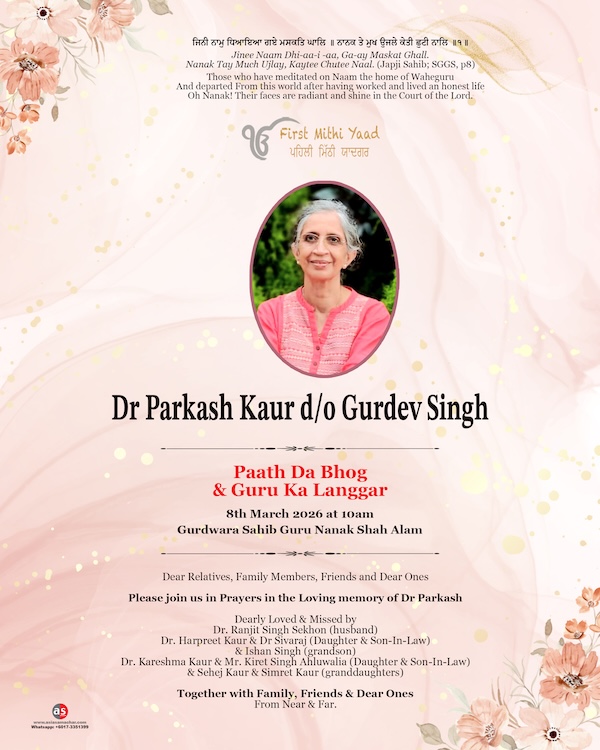
Paath Da Bhog & Guru Ka Langgar 8th March 2026 at 10am Gurdwara Sahib Guru Nanak Shah Alam
Dear Relatives, Family Members, Friends and Dear Ones
Please join us in Prayers in the Loving memory of Dr Parkash
Dearly Loved & Missed by Dr. Ranjit Singh Sekhon (husband) Dr. Harpreet Kaur & Dr Sivaraj (Daughter & Son-In-Law) & Ishan Singh (grandson) Dr. Kareshma Kaur & Mr. Kiret Singh Ahluwalia (Daughter & Son-In-Law) & Sehej Kaur & Simret Kaur (granddaughters)
Together with Family, Friends & Dear Ones From Near & Far.
Link to posting at Facebook and Instagram
| Entry: 23 February 2026 | Source: Family
ASIA SAMACHAR is an online newspaper for Sikhs / Punjabis in Southeast Asia and beyond. You can leave your comments at our website, Facebook, Twitter, and Instagram. We will delete comments we deem offensive or potentially libelous. You can reach us via WhatsApp +6017-335-1399 or email: asia.samachar@gmail.com. For obituary announcements, click here
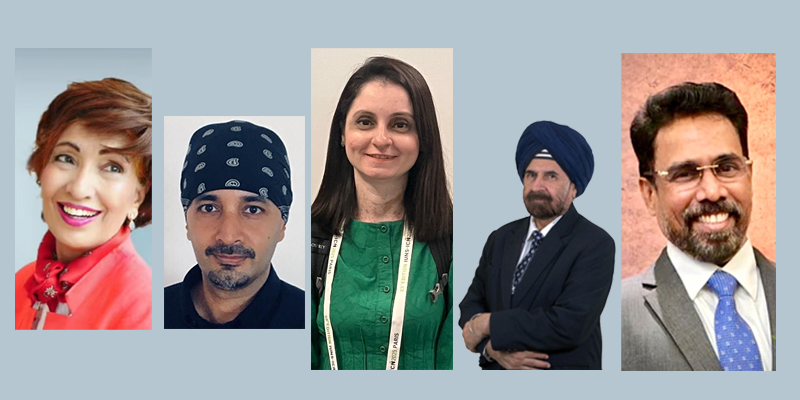
SWAN’s Women’s Day seminar speakers, left to right: Jagjeet, Jespuvan. Dr Satvinder, Dr Pall Singh and Dr Siby
By Asia Samachar | Malaysia |
Participants at this year’s International Women’s Day seminar can expect practical insights on nutrition, mobility, mental resilience, preventive health and age-related conditions — all aimed at helping women take charge of their well-being in a structured and sustainable way.
The half-day programme, organised by the Sikh Women’s Awareness Network Malaysia (SWAN), will be held on March 8 (Sunday) from 8.00am to 1.00pm at the THONEH Auditorium in Petaling Jaya. Asia Samachar is the media partner for the event.
Themed “Wellness, Strength & Balance: Empowering Women for a Healthier Life”, the event marks the International Women’s Day 2026.
Registration begins at 8.00am, with the first session at 8.20am featuring Mrs Jagjeet Singh, who will speak on healthy lifestyle choices and practical steps women can adopt to maintain balance amid daily demands.
In the opening session, Dr Satvinder Kaur will address “Hidden Malnutrition: The Silent Threat to Healthy Aging”, highlighting nutritional gaps that often go undetected but can significantly affect long-term health. (Time: 9.10am)
Fitness advocate Jespuvan Singh will follow with “Just Walk: One Step at a Time!”, focusing on accessible movement and the benefits of walking as a simple yet powerful exercise. (Time: 10am).
After a short break, Dr CD Siby will present “The Ayurvedic Secret to Physical Strength, Mental Stability & Immunity”, offering perspectives rooted in traditional healing practices and holistic health. (Time: 11.10am).
The final talk will be delivered by Dr Pall Singh on common eye conditions among women, drawing attention to vision health and preventive care. (Time: 12.00pm).
Organisers said the seminar is designed as a reflective and educational space where women can pause, learn and reconnect with their physical, mental and emotional health. The objective is to encourage women to prioritise their well-being while balancing personal, professional and social responsibilities.
SWAN emphasised that when women thrive, families and communities flourish — reinforcing the message that empowerment begins with health.
SWAN SEMINAR IN CONJUNCTION WITH INTERNATIONAL WOMEN’S DAY:
Date: 8th March 2026 (Sunday) Time: 8.00 am to 1.00 pm 1.00-4.00pm Eye Check up Venue: THONEH Auditorium, PJ
ASIA SAMACHAR is an online newspaper for Sikhs / Punjabis in Southeast Asia and beyond. You can leave your comments at our website, Facebook, Twitter, and Instagram. We will delete comments we deem offensive or potentially libelous. You can reach us via WhatsApp +6017-335-1399 or email: asia.samachar@gmail.com. For obituary announcements, click here