The Malaysian Indian Transformation Unit (Mitra) which was allocated RM100 million to implement socio-economic development programmes for the Indian community, particularly the B40 group, has distributed RM62 million to more than 100,000 recipients so far, reports Bernama.
Mitra’s Special Task Force Committee chairman Datuk R. Ramanan said the aid was also given out to the B40 group under its Micro, Small, and Medium Enterprises Assistance programme.
“We will empower Mitra next year. To date, we have distributed RM62 million and the rest will be paid out in phases,” he told reporters in Sungai Buloh yesterday (Nov 19).
Ramanan, who is also Sungai Buloh assemblyman, said there will be a special year-end retreat organised for the officers, directors, and committee members of Mitra to discuss the initiatives for 2024, toward empowering and strengthening Malaysia’s Indian community, focusing on the B40 group.
Most of the initiatives in the approved RM62 million were for education, higher education, kindergartens, schools, and healthcare, he added.
“As long as I am Mitra Chairman, priority will be given to education because this is our legacy, our future. We must invest in our students and their future. Education is the most powerful weapon,” he was quoted in the report.
ASIA SAMACHAR is an online newspaper for Sikhs / Punjabis in Southeast Asia and beyond. When you leave a comment at the bottom of this article, it takes time to appear as it is moderated by human being. Unless it is offensive or libelous, it should appear. You can also comment at Facebook, Twitter, and Instagram. You can reach us via WhatsApp +6017-335-1399 or email: asia.samachar@gmail.com. For obituary announcements, click here
The term, who is a SIKH, and the differences between SIKHI and SIKHISM are not well understood in their intrinsic meanings by many Sikh scientists, theologians, and Sikh and Non-Sikh writers. Most Sikh theologians and writers consider Nanak (1469-1539) as the founder of a Sikh Religion that has been anglicized as SIKHISM. Recently, Sikhi has become very common among Sikh and non-Sikh writers in place of Sikhism. They think that Sikhi and Sikhism are interchangeable. The fact is that Nanak founded SIKHI, which is quite different from Sikhism. The term, Sikhi, is defined by Guru Nanak in one phrase as follows:
ਸਿਖੀ1 ਸਿਖਿਆ2 ਗੁਰ3 ਵੀਚਾਰਿ4 ॥ Sikẖī sikẖi▫ā gur vīcẖār.
ਅਗਗਸ, ਮ: 1, ਪੰਨਾ 465.
Sikhi1 is the teachings2 which are based on the enlightening3 philosophy4.
AGGS, M 1, p 465.
Notes:
ਸਿਖੀ (Sikhi): This word is understood as a verb to “learn” by many theologians; thus, they go far away from the actual theme of defining “Sikhi” as a noun.
ਸਿਖਿਆ (Sikhia / Teachings): something that is taught: philosophy.
ਵੀਚਾਰਿ (Vichar / Philosophy): the branch of knowledge or academic study devoted to the systematic examination of basic concepts such as truth, existence, reality, causality, and freedom; a particular system of thought or doctrine.
It is evident from the above definition that Sikhi is the philosophy of Nanak embodied in his Bani. This philosophy has been termed “Nanakian Philosophy,” as discussed in Chapter 6.
SIKHI AND SIKHISM
It becomes evident from the above definition that Sikhi is a philosophy of Nanak, which has been slowly and steadily converted into a highly institutionalized religion, Sikhism. Therefore, the simple difference is that Sikhi is the philosophy of Nanak, and Sikhism is a religion developed by his followers. I have noticed that some traditional Sikh theologians do not use the academic term “philosophy”; instead, they prefer to use ‘Gurmat’ while teaching or writing about Sikhi or Sikhism. It is unknown who the Guru is of this ‘mat’ (philosophy). Nevertheless, the term philosophy is commonly used by many contemporary Sikh writers while writing about Sikhi and Sikhism.
Gur upḏes javāhar māṇak seve sikẖ so kẖoj lahai. ||1||
ਅਗਗਸ, ਮ: 1, ਪੰਨਾ 1328.
The enlightening9 philosophy/teachings10 are like gems11 and jewels12, and the one who can research/discover15 that fact is a Sikh14 and practises13 it.
AGGS, M 1, p 1328.
It is evident from the above phrase that the concise and precise definition of a SIKH is:
The one who discovers the enlightening philosophy (fact/truth) and practices it.
According to this definition of a Sikh by Nanak, all philosophers, scientists, and researchers of the world who are discovering the enlightening philosophy (fact/truth) and practicing it are the SIKHS.
The word, ਸਿਖੀ (Sikhi) has been used as the plural of ਸਿਖੁ (Sikh) by Guru Ram Das:
Sabẖ ṯe vadā saṯgur Nānak jin kal rākẖī merī. ||4||10||57||
ਅਗਗਸ, ਮ: 5, ਪੰਨਾ 750.
Nanak, the truly enlightened (Guru)3, is the greatest2 of all1 the Gurus who has made me capable5 to understand6 myself7.
AGGS, M 5, p 750.
But if we investigate the SGGS Gurmukhi-Gurmukhi Dictionary (Thind, n.d.), which defines “ਕਲ” (kal) as ਸ਼ਕਤੀ (shakti), ਸਮਰਥਾ (samartha), ਤਾਕਤ (takat), ਸੱਤਿਆ (satya), ਧਰਮ-ਸਤਾ (dharma satta) (in English: Energy, capability, power, truth, religious status). If the meaning of “ਕਲ” (kal) is “capability,” then its interpretation as given above becomes justified.
On the other hand, G. Singh (1987), S. Singh (1972), Talib (1988), and many others have interpreted it as follows:
ਸਭ ਤੇ ਵਡਾ ਸਤਿਗੁਰੁ ਨਾਨਕੁ ਜਿਨਿ ਕਲ ਰਾਖੀ ਮੇਰੀ।
Sab te vadda Satgu Nanak jin kal raakhi meri
Guru Nanak is the greatest of all who protected my honor.
When ‘kaka’ of Nanak is with ‘ounkar’’ it is generally considered Nanak as a person, Guru, or Sat Guru but not as the pen name. However, in some verses, kaka is without ounkar; still, Nanak is interpreted as a person, not a pen name. However, it is not a common law of the Grammar of Gurbani. Therefore, one must be careful to interpret the name ‘Nanak,’ keeping in view the theme of the verse.
Nevertheless, some theologians put a comma after Satguru and interpret it as follows:
Nanak (pen name of Guru Arjun) says:
God (Satguru) is the greatest of all, who protected my honour.
However, at some places of Bani of some Gurus, Satguru is considered the Eternal Entity (ੴ – God). For example,
Guru Ram Das believes ‘Sat Guru’ is the Eternal Entity (ੴ – God):
ਸਤਿਗੁਰੁ1 ਮੇਰਾ ਸਦਾ ਸਦਾ2 ਨਾ ਆਵੈ3 ਨਾ ਜਾਇ4 ॥
Saṯgur merā saḏā saḏā nā āvai na jā▫e.
ਓਹੁ5 ਅਬਿਨਾਸੀ6 ਪੁਰਖੁ7 ਹੈ ਸਭ8 ਮਹਿ ਰਹਿਆ9 ਸਮਾਇ10 ॥੧੩॥
Oh abẖināsī purakẖ hai sabẖ mėh rahi▫ā samā▫e. ||13||
ਅਗਗਸ, ਮ: 4, ਪੰਨਾ 759.
My True Guru1 exists forever2, and neither takes birth3 nor dies4.
That5 is imperishable6Entity7and pervades9,10 in everything8.
AGGS, M 4, p 759.
In two places, Guru Ram Das and Guru Arjun used Satguru as an enlightened person, but in the last phrase Guru Ram Das says that Satguru means God, Who exists forever. Does it mean Satguru has two meanings or do the statements of Guru Ram Das and Guru Arjun contradict with each other.
DEVELOPMENT OF A RELIGION, SIKHISM
A Sikh in Sikhism
A Sikh, defined by Guru Ram Das, is as follows:
The first example of converting Sikhi into Sikhism was by Guru Ram Das, who assigned several duties to perform to be called a Sikh of Satguru:
Jan Nānak ḏẖūṛ mangai ṯis gursikẖ kī jo āp japai avrah nām japāvai. ||2||
ਅਗਗਸ, ਮ: 4, ਪੰਨਾ 305-306.
Servant Nanak begs for the dust of the feet of that Gursikh, who himself chants the Naam, and inspires others to chant it. ||2||
(Interpretation by Dr. Sant Singh Khalsa. (Thind, n.d.)
AGGS, M 4, p 305-306.
It becomes evident that the Sikh defined by Guru Ram Das is quite different from that Sikh defined by Nanak. The Sikh of Guru Ram Das must perform specific duties, while the Sikh of Nanak is to discover the truth. Guru Ram Das recommends to his Sikh to meditate and repeat Hari, Hari,…
Moreover, a Sikh defined by various Sikh organizations differs from that described by Nanak and Guru Ram Das. For example, A Sikh in Sikh Gurdwara Act 1925 (The Sikh Gurdwara Act, 1925).
The Sikh Gurdwara Act 1925 (Part I, Chapter 1, Section 1) defines a Sikh as follows:
(9) Sikh – ‘Sikh’ means a person who professes the Sikh religion, or in the case of a deceased person, who professed the Sikh religion or was known to be Sikh during his lifetime. If any question arises as to whether any living person is or is not a Sikh, he shall be deemed respectively to be or not to be a Sikh if he makes or refuses to make the following declaration to the (State)1 government: page 9
1Sikh: “I solemnly affirm that I am a Sikh, that I believe in the Guru Granth Sahib, that I believe in the Ten Gurus, and that I have no other religion.”
2(10) “Amritdhari Sikh: “means and includes every person who has taken Khande-ka-Amrit or Khanda de paul prepared and administered according to the tenets of Sikh religion and rites at the hands of five payaras/ beloved ones.”
This Act also describes other types of Sikhs as follows:
3(10-A) “Sehjdhari Sikh” means a person – who performs ceremonies according to Sikh rites; who does not use tobacco or kutha (Halal meat) in any form; who is not a Patit; and who can recite Mul Manter.
4(11)“Patit” means a person who, being a Keshadhari (uncut hair) Sikh, trims or shaves his beard or keshas (hair) or who, after taking Amrit, commits any or more of the four kurahits (act against code of conduct)
A Sikh in Sikh Rehit Maryada (Sikh Rehit Maryada, 1945)
Finally, the Sikh Rehit Maryada (Sikh Code of Conduct) Published by the SGPC in 1945, has introduced another definition of a Sikh as follows:
“A woman or a man, who believes in one Almighty, ten Guru Sahibans (from Sri Guru Nanak Dev Ji to Sri Guru Gobind Singh Sahib), Sri Guru Granth Sahib and Bani and advice of ten Guru Sahibans and the Amrit of Dasmesh Ji and does not accept any other religion, is a Sikh.”
A Sikh in the Delhi Sikh Gurdwara Act 1971 (Delhi Sikh Gurdwara Act – Central Government Act, 1971)
“A Sikh means a person who professes the Sikh religion, believes and follows the teachings of Guru Granth Sahib and the ten Gurus only, keeps unshorn hair, and has no other religion.”
He shall be deemed respectively to be or not to be a Sikh if he makes or refuses to make in the manner prescribed by rules the following declaration: “I solemnly affirm that I am a Keshadhari (uncut hair) Sikh, that I believe in and follow the teachings of Sri Guru Granth Sahib and the ten Gurus only and that I have no other religion.”
Keshadhari Sikh
“Keshadhari (uncut hair) Sikh” is another term that has not been defined anywhere, but it is commonly used for a Sikh who has uncut hair.
The above discussion indicates that a Sikh defined by Nanak differs from that formulated by Guru Ramdas and other Sikh organizations. All the definitions of a Sikh other than that of Nanak are inconsistent and do not meet the definition of a TERM (a SIKH).
.
SABD TO BANI TO POTHI TO GURU GRANTH
In Sikhi Sabd is Guru
During the Siddh Gost, (discourse between Siddhas and Nanak) the Siddhas, the most learned persons of that time, questioned Nanak, who is your Guru?
ਕਵਣ ਮੂਲੁ1 ਕਵਣ ਮਤਿ2 ਵੇਲਾ3 ॥
ਤੇਰਾ ਕਵਣੁ ਗੁਰੂ4 ਜਿਸ ਕਾ ਤੂ ਚੇਲਾ5 ॥
Kavaṇ mūl kavaṇ maṯ velā.
Ŧerā kavaṇ gurū jis kā ṯū cẖelā.
ਅਗਗਸ, ਮ: 1, ਪੰਨਾ 942.
What is the source of the beginning1, and which type of philosophy2 is of this Age3(Kali Yuga)?
Who is the ‘guru’4 of whom you are his disciple5?
AGGS, M 1, p 942.
Guru Nanak replied about his ‘guru’ and the ‘Age of Enlightenment’ as follows:
ਪਵਨ1 ਅਰੰਭੁ2ਸਤਿ3ਗੁਰ4 ਮਤਿ5 ਵੇਲਾ6 ॥
ਸਬਦੁ7 ਗੁਰੂ8 ਸੁਰਤਿ9 ਧੁਨਿ10 ਚੇਲਾ11 ॥
Pavan arambẖ saṯgur maṯ velā.
Sabaḏ gurū suraṯ ḏẖun cẖelā.
ਅਗਗਸ, ਮ: 1, ਪੰਨਾ 943.
The air1 is the beginning2 of every life, and this is the Age6 of Enlightenment5 known through the Truly3 Enlightened4 person.
Who is the Guru? It is explained in the second sentence:
The sabd7 is the guru8(enlightener), and my keen10 conscience9 is its disciple11.
AGGS, M 1, p 943.
What is the ‘Sabd’ that is the ‘Guru’ of Nanak?
That ‘sabd’ is described by Nanak himself in pauri (stanza) # 38 of JAP Bani as follows:
Self-control1 should be the furnace2, and patience3 of the goldsmith4.
Wisdom6 should be the anvil5 and knowledge7 should be the tools8.
ਭਉ9 ਖਲਾ10 ਅਗਨਿ11 ਤਪ ਤਾਉ ॥
ਭਾਂਡਾ12 ਭਾਉ13 ਅੰਮ੍ਰਿਤੁ14 ਤਿਤੁ15 ਢਾਲਿ16 ॥
ਘੜੀਐ17 ਸਬਦੁ18 ਸਚੀ ਟਕਸਾਲ19 ॥
Bẖa▫o kẖalā agan ṯap ṯā▫o.
Bẖāʼndā bẖā▫o amriṯ ṯiṯ dẖāl.
Gẖaṛī▫ai sabaḏ sacẖī taksāl.
Love9 for the Eternal Entity (God) should be the bellows10 to blow air into fire11 to make it super-hot.
The body (mind), full of love13, is the melting pot12 where the self-control, patience, knowledge, and wisdom as matter15 to be melted16 together to construct17 the sabd (idea/philosophy)18 as an Amrit (elixir)14 in the mint19 of truth.
ਜਿਨ ਕਉ ਨਦਰਿ20 ਕਰਮੁ21 ਤਿਨ ਕਾਰ22 ॥
ਨਾਨਕ ਨਦਰੀ23 ਨਦਰਿ24 ਨਿਹਾਲ25 ॥੩੮॥
Jin ka▫o naḏar karam ṯin kār.
Nānak naḏrī naḏar nihāl. ||38||
ਅਗਗਸ, ਜਪੁ # 38, ਪੰਨਾ 8.
Such work22 to construct sabd (idea/philosophy) can only be done by those with the capability21 of vision20.
Nanak says:
The Eternal Entity (God) is happy25 for people with this type of vision23, 24. 38.
AGGS, Jap # 38, p 8.
The Pauri (stanza) # 38 of JAP Bani indicates that the ‘sabd’ is constructed using self-control, patience, knowledge, and wisdom without involving any deity. The word ‘said’ means the ‘idea’ or ‘philosophy’ that enlightens people to discover the right path in life. Therefore, ‘sabd’ is interpreted as an ‘enlightening idea/philosophy.’
Char Patharath (Four Characteristics)
Nanak further explains that humans inherit four characteristics: (Seeing, hearing, sensation, and thinking/capability to analyze the data collected.) I interpret the following stanza keeping in view human Physiology and Neurosciences:
The human was born4 into this world3 with four1 characteristics2.
All these characteristics of humans6 are based7 on Universal Energy5.
If one8 forgets9 about these four characteristics, then that foolish (human)12 loses11 all his capabilty10, and forgets14 how to use the Laws of Nature/Universe13 for the betterment of one’s life.
AGGS, M 1, p 1027.
Note: ਚਾਰਿ1 ਪਦਾਰਥ2 (Char Patharath):Nanak has not named the Char Patharath in this stanza, but the author (Chahal) considers that according to human physiology and neurosciences, the Char Patharath could be seeing, hearing, sensation, and thinking/capability to analyze the data collected.
ਸਿਵ ਸਕਤੀ (siv shakti) has been used by Nanak as the ‘Universal Energy’ but not the mythical energy of Shiva.
ਨਾਮੁ (Naam) here means Laws of Nature/Universe.
Although Nanak has not mentioned the names of Char Pataraths in his above stanza but Prof. Sahib Singh, 1972b) explains Chaar Padarath as follows:
English: 1. Dharam (good deeds), Arath (various things), Kaam (lust, desire), Mokh (liberation or salvation from the cycle of reincarnation).
On the other hand, in Sikhiwiki.org, Char Patharath are different that that of Nanak and Prof. Sahib Singh are discussed as follows: (Char Patharath, 2020)
Gyan Padarath: (Treasure of Spiritual Knowledge),
Mukat Padarath: (Treasure of Salvation),
Naam Padarath: (Treasure of Divine Wisdom), and
Janam Padarath: (Treasure of Spiritual Birth).
These Padaraths are based upon Vedas and Vedanta philosophies.
In stanza #38 of JAP Bani, Nanak explains how a sabd (idea/philosophy) is constructed (formulated) as Amrit (life-giving elixir – the way of life), which will mold a person to be highly moral and progressive. Besides, a Sikh of Nanak inherits four patharaths: Seeing, hearing, sensation, and thinking/capability to analyze the data collected, but not that of Eastern philosophy, as explained by Prof. Sahib Singh and Sikhiwiki.org.
Despite the above teachings of Guru Nanak, some Sikhs continue to follow Eastern philosophy to have a personal Guru instead of a Sabd Guru for guidance to achieve a moral life, to meet God, and to achieve Mukti (salvation). That is why many Sants/ Babas have appeared in Punjab and are brainwashing their followers to depend on their advice rather than using their intellect to construct the sabd taught by Nanak. Of course, some people may need a Guru (teacher) to teach the qualities required to build that ‘sabd.’ Nevertheless, Nanak further explains that the body and brain have the four faculties (seeing, hearing, sensation, thinking/capability to analyze the data collected) needed to resolve problems and cross the so-called “dreadful sea of life.”
Lineage of Guru-Ship
According to the hagiographies, Nanak bestowed Guru-ship upon Lehna Ji and named him Angad as a limb of Nanak. It is also said that Nanak kept a notebook (pothi) which he used to write down his Bani. Nanak handed over his pothi to Guru Angad. However, we do not find evidence in his Bani that Nanak favors passing on the Guru-ship to his follower. For example, he writes in his Bani as follows:
ਕੁਲਹਾਂ1 ਦੇਂਦੇ2 ਬਾਵਲੇ3 ਲੈਂਦੇ4 ਵਡੇ5 ਨਿਲਜ6 ॥
Kulhāʼn ḏeʼnḏe bāvle laiʼnḏe vade nilaj.
Those, who bestow2 ceremonial hat1 (passing on Guru-ship) onto their followers, are fools3, and those, who accept4 such Guru-ship, are very5 disgraceful6 followers.
ਚੂਹਾ7 ਖਡ8 ਨ ਮਾਵਈ9 ਤਿਕਲਿ10 ਬੰਨ੍ਹ੍ਹੈ11 ਛਜ12 ॥
Cẖūhā kẖad na māv▫ī ṯikal banĥai cẖẖaj.
ਅਗਗਸ, ਮ: 1, ਪੰਨਾ 1286.
It is comparable to as if a mouse7 having tied11 a winnowing basket12 on his back10, cannot enter9 into his hole8.
AGGS, M 1, p 1286.
It is evident from this phrase that Nanak is not in favor of bestowing Guru-ship onto any of his followers, not even to any of his sons. However, Satta and Balwand, Bhatts in the court of Guru Arjun, wrote a Vaar (poetic diction in which the hero is eulogized) about 65 years after the demise of Nanak, indicating that Guru-Ship was bestowed upon Lehna Ji, the most obedient follower (disciple) of Nanak as follows:
ਨਾਨਕਿ ਰਾਜੁ ਚਲਾਇਆ ਸਚੁ ਕੋਟੁ ਸਤਾਣੀ ਨੀਵ ਦੈ ॥
Nānak rāj cẖalā▫i▫ā sacẖ kot saṯāṇī nīv ḏai.
Nanak established the kingdom and built the fortress on the most vital foundations.
ਲਹਣੇ ਧਰਿਓਨੁ ਛਤੁ ਸਿਰਿ ਕਰਿ ਸਿਫਤੀ ਅੰਮ੍ਰਿਤੁ ਪੀਵਦੈ ॥
Lahṇe ḏẖari▫on cẖẖaṯ sir kar sifṯī amriṯ pīvḏai.
He installed the royal canopy over Lehna’s head; chanting the Lord’s Praises, He drank in the Ambrosial Nectar.
ਮਤਿ ਗੁਰ ਆਤਮ ਦੇਵ ਦੀ ਖੜਗਿ ਜੋਰਿ ਪਰਾਕੁਇ ਜੀਅ ਦੈ ॥
Maṯ gur āṯam ḏev ḏī kẖaṛag jor purāku▫e jī▫a ḏai.
The Guru implanted the almighty sword of the Teachings to illuminate his soul.
ਗੁਰਿ ਚੇਲੇ ਰਹਰਾਸਿ ਕੀਈ ਨਾਨਕਿ ਸਲਾਮਤਿ ਥੀਵਦੈ ॥
Gur cẖele rahrās kī▫ī Nānak salāmaṯ thīvḏai.
The Guru bowed down to His disciple, while Nanak was still alive.
ਸਹਿ ਟਿਕਾ ਦਿਤੋਸੁ ਜੀਵਦੈ ॥੧॥
Sėh tikā ḏiṯos jīvḏai. ||1||
While still alive, the King applied the ceremonial mark to his forehead. ||1||
AGGS, Satta and Balwand, p 966. The English translation is by Dr. Sant Singh Khalsa. (Thind, n.d.)
On the other hand, Satta and Balwand also indicate in the same Vaar that Nanak rejected his sons because they were most disobedient to Nanak as follows:
ਪੁਤ੍ਰੀ ਕਉਲੁ ਨ ਪਾਲਿਓ ਕਰਿ ਪੀਰਹੁ ਕੰਨ੍ਹ੍ਹ ਮੁਰਟੀਐ ॥
Puṯrī ka▫ul na pāli▫o kar pīrahu kanĥ murtī▫ai.
His sons did not obey His Word; they turned their backs on Him as Guru.
These evil-hearted ones became rebellious; they carried loads of sin on their backs.
ਜਿਨਿ ਆਖੀ ਸੋਈ ਕਰੇ ਜਿਨਿ ਕੀਤੀ ਤਿਨੈ ਥਟੀਐ ॥
Jin ākẖī so▫ī kare jin kīṯī ṯinai thatī▫ai.
Whatever the Guru said, Lehna did, and so he was installed on the throne.
ਕਉਣੁ ਹਾਰੇ ਕਿਨਿ ਉਵਟੀਐ ॥੨॥
Ka▫uṇ hāre kin uvtī▫ai. ||2||
Who has lost, and who has won? ||2||
AGGS, Satta and Balwand, p 967. The English translation is by Dr. Sant Singh Khalsa (Thind, n.d.)
Whatever the case, Lehna ji as Guru Angad succeeded to the House of Nanak. Guru Angad left Kartarpur and went back to his village Khadur Sahib. Bhai Bala Janam Sakhi indicates that Nanak gave his Pothi to Guru Angad when he bestowed Guru-ship onto him. Therefore, he was supposed to preach and teach Sikhi of Nanak from that Pothi; instead, he started to write his own Bani. Now we know that the Original Pothi of Nanak has been lost. Is it not strange that Nanak’s Kharavan (wooden sandals) and Chola (robe) are preserved but not the most valuable article, Original Pothi of Nanak? Discovering what happened to the Original Pothi of Nanak isn’t easy.
This practice of bestowing Guru-ship continued to the next Guru Amar Das, Guru Ram Das, Guru Arjun, Guru Har Gobind, Guru Har Rai, Guru Har Krishan, Guru Teg Bahadur, and the tenth Guru, Guru Gobind Singh. Now the Sikhs have ten Gurus instead of one Prophet as Buddha in Buddhism, Jesus in Christianity, and Mohammad in Islam.
Bani Guru, Guru Hai Bani
Now the Bani has been declared as Guru instead of Sabd by Guru Ram Das as follows:
Gur baṇī kahai sevak jan mānai parṯakẖ gurū nisṯāre. ||5||
Guru7 says Bani8 and human10 servant9 accepts11 it and Guru13 will obviously12 emancipate14 him (from sin).
AGGS, M 4, p 982.
Guru Ram Das took a second step toward developing Sikhism by declaring “Bani is Guru” and “Guru is Bani,” ignoring the Sabd described by Nanak in pauri 38 of JAP Bani is the Guru. Moreover, Guru Ram Das does not indicate the name of the Guru, who says, Bani in his above stanza. Is it Guru Nanak, Guru Angad, Guru Amar Das, or Guru Ram Das himself the Guru?
Guru Ramdas founded the Sarovar (Holy Pool).
In 1574 Guru Ram Das made his home by the side of the pool, which was regarded as blessed with miraculous healing powers. In 1577, Guru Ram Das, finding the air and water of his abode health-giving, purchased the pool and some surrounding land from its owners, the neighboring Jats (farmers). One of the first acts of Guru Ram Das was to excavate the pool further to construct a shrine at the center (Sri Hari Mandir). (The Pool of Nectar, n.d.)
There are a couple of phrases about this Pool of Nectar (Ram Das Sarovar) by the next Guru Arjun as follows:
(English: Hey, Saints! The Holy Pool of Ram Das, which is in Amritsar, is magnificent. Whosoever bathes therein his lineage is saved, and bathing in it, he is also getting blessed. Pause.
Manmohan Singh, SGPC, Amritsar:
O saints, the sublime is the tank of Ram Dass. Who-so-ever bathes therein, his lineage is saved, and his soul is blessed too. Pause.
Dr Sant Singh Khalsa:
O Saints, the purifying pool of Ram Das is sublime.
Whoever bathes in it, his family and ancestry are saved, and his soul is also saved. ||1||Pause||
(English: Hey, Saints! The Congregation of saints is a beautiful place. Whosoever takes a spiritual bath in this congregation, his sins are washed away, and the sins of his lineage are also washed away.
Guru Arjun again repeats the same concept about Ram Das Sarovar as follows:
(English: Hey, Brothers! Those persons, who bathe in the pond of servants of Ram (with Naam Amrit in Sadh Sangat), their sins committed in the previous life are washed away.
Note: Interpretation/translation of the two above phrases by Faridkot Vala Teeka, Manmohan Singh, Sant Singh, and Prof Sahib Singh is from the website, srigranth.org, of Dr. Thind ( n.d.)
Comments: In both phrases, the translations in the Faridkot Vala Teeka, by Manmohan Singh, SGPC, Amritsar, and that of Dr. Sant Singh Khalsa are similar, where the Holy Pond is, which was dug by Guru Ram Das. However, Prof. Sahib Singh is trying to camouflage the truth by converting the Holy Pond of Guru Ram Das as the place of congregation of the servants of Ram (God).
Here are two questions:
Whose interpretation is correct?
Who is an expert who can decide which interpretation is correct?
Guru Arjun constructedHari Mandir (Fig. 1)
According to Bhupinder (Bo) Singh (2021), Guru Amar Das (1479 – 1574), after having acquired a piece of land, assigned the work of construction of Sarovar (pool of Sacred Water) to the fourth Guru Ram Das (1534-1581). The excavation of Sarovar was started in 1570 and completed in 1577. The fifth Guru Arjun (1563 -1606) completed the brick lining of the Sarovar. This Sarovar was called Amrit Sarovar by Guru Arjun, meaning the lake of immortality.
He continues to say that most historical records and verbal traditions confirm that the foundation brick of Hari Mandir was laid by Hazrat Mian Mir (1550 –1635) of Lahore in 1588. His full name was Baba Sain Mir Mohammed Sahib, and he was a leader of the Qadiri Sufi order of Islam faith. On the other hand, some believe that Guru Arjun himself laid the actual foundation brick. The construction work of Hari Mandir was started in 1589 and completed in 1601. The Temple is described by Ian Kerr and other scholars as a mixture of Indo-Islamic Mughal and Hindu Rajput architecture.
The Name of the Temple, Hari Mandir, indicates it is dedicated to Hari. According to Google Research, Hari means: Hari (Sanskrit: हरि) is among the primary epithets of the Hindu preserver deity Vishnu, meaning ‘the one who takes away‘ (sins). It refers to the one who removes darkness and illusions and removes all obstacles to spiritual progress. Some steps go down into the Sarover called Har ki Pauri (Hari Ki Pauri). Usually, Hari Mandar is called Darbar Sahib by the Sikhs and is generally known as Golden Temple by others.
Compilation of Aad (Adi) Granth
The Hari Mandir (Darbar Sahib or Golden Temple) is ready amid the Sacred Pool; now there is a need for a sacred book containing the Bani of Guru Nanak, Guru Angad, Guru Ramdas, and Guru Arjun. There was a copy of the ‘Pothi Sahib‘ in two volumes with Baba Mohan, son of Guru Amar Das. In one book, there was the Bani of the Gurus. In the other volume was the Bani from the Bhagats (saints). From Baba Mohan, Guru Arjun procured these volumes after much persuasion.
On the other hand, Prof. Sahib Singh has refuted all the fictitious stories reported in Gur Partap Suraj Parkash by Kavi Santokh Singh, Gur Bilas Patshahi Chhevain (author unknown), and Twarikh Guru Khalsa by Giani Gian Singh, about procuring of pothi from Baba Mohan. He thinks Guru Nanak passed his pothi to the next Guru, Angad. He wrote his Bani in this pothi and passed it on to Guru Amar Das, who added his Bani and passed it on to Guru Ram Das. finally, this pothi with all the Bani was received by Guru Arjun.) (S. Singh, 1972) It is generally said that when Guru Arjun found this inherited treasure, he exclaimed with astonishment as follows:
ਪੀਊ1 ਦਾਦੇ2 ਕਾ ਖੋਲਿ3 ਡਿਠਾ4 ਖਜਾਨਾ5 ॥
Pī▫ū ḏāḏe kā kẖol diṯẖā kẖajānā.
When I (Guru Arjun) opened3 and looked4 into the inherited1,2 treasure5 (Bani of Guru Nanak).
ਤਾ6 ਮੇਰੈ7 ਮਨਿ8 ਭਇਆ9 ਨਿਧਾਨਾ10 ॥੧॥
Ŧā merai man bẖa▫i▫ā niḏẖānā. ||1||
Then6 my7 mind8 understood9 the value of this treasure10. 1.
ਰਤਨ11 ਲਾਲ12 ਜਾ ਕਾ ਕਛੂ13 ਨ ਮੋਲੁ14 ॥
Raṯan lāl jā kā kacẖẖū na mol.
This treasure is like jewels11 and rubies12, whose price14 cannot be evaluated13.
ਭਰੇ15 ਭੰਡਾਰ16 ਅਖੂਟ17 ਅਤੋਲ18 ॥੨॥
This store16 of treasure is full15, inexhaustible17, and immeasurable18. 2.
ਖਾਵਹਿ19 ਖਰਚਹਿ20 ਰਲਿ21 ਮਿਲਿ22 ਭਾਈ23 ॥
Kẖāvėh kẖarcẖėh ral mil bẖā▫ī.
Oh Brothers23!
Understand19 and disseminate20 by meeting22 together21.
ਤੋਟਿ24 ਨ ਆਵੈ ਵਧਦੋ25 ਜਾਈ ॥੩॥
Ŧot na āvai vaḏẖ▫ḏo jā▫ī. ||3||
By using this treasure, it does not diminish24 instead, it continues to increase25. 3.
ਕਹੁ26 ਨਾਨਕ ਜਿਸੁ ਮਸਤਕਿ27 ਲੇਖੁ28 ਲਿਖਾਇ29 ॥
Kaho Nānak jis masṯak lekẖ likẖā▫e.
ਸੁ30 ਏਤੁ ਖਜਾਨੈ31 ਲਇਆ ਰਲਾਇ32 ॥੪॥੩੧॥੧੦੦॥
So eṯ kẖajānai la▫i▫ā ralā▫e. ||4||31||100||
AGGS, M 5, p 186.
Nanak says26:
The one with such destiny28 written29 on one’s forehead27 that one30 is the partner32 of this treasure31. 4. 31. 100.
On the other hand, to be recognized as Guru, Prithi Chand, elder brother of Guru Arjun, started to compile a ‘pothi’ (sacred book) wherein there were hymns of the first four Gurus, saints (Bhagats) and his Bani. He composed Bani under the name of Nanak. Prithi Chand’s son Meharvan also started to write Bani under the pen name of Nanak. So, the number of hymns under the name of Nanak was increasing.
But the situation quickly became so confusing that an undiscerning individual needed help to discriminate between the genuine and the false Bani.
This situation has been observed by Guru Amar Das as follows:
ਸਤਿਗੁਰੂ1 ਬਿਨਾ2 ਹੋਰ3 ਕਚੀ4 ਹੈ ਬਾਣੀ5 ॥
Saṯgurū binā hor kacẖī hai baṇī.
The Bani (huymns)5 other3 than2 of the truly enlightened person1 is false4.
ਬਾਣੀ6 ਤ ਕਚੀ7 ਸਤਿਗੁਰੂ8 ਬਾਝਹੁ9 ਹੋਰ10 ਕਚੀ11 ਬਾਣੀ12 ॥
aṇī ṯa kacẖī saṯgurū bājẖahu hor kacẖī baṇī.
All other Bani (hymns)12 other than9 of the truly enlightened person8 are false7,11 Bani (hymns)6.
ਕਹਦੇ13 ਕਚੇ14 ਸੁਣਦੇ15 ਕਚੇ16 ਕਚੀ17 ਆਖਿ18 ਵਖਾਣੀ19 ॥
Kahḏe kacẖe suṇḏe kacẖe kacẖīʼn ākẖ vakẖāṇī.
Those who recite13 the Bani (hymns) are false14, those who listen15 to it are false16, and those who deliberate18,19 on such Bani (hymns) are also false17.
AGGS, M 3, 920.
Therefore, Guru Arjun told Bhai Gurdas that genuine hymns should be separated from false ones because the Meenas (Prithi Chand and his companion) were mixing them up. This led Guru Arjun to prepare and preserve the Bani of the preceding Sikh Gurus and other saints in their original form. (“Compilation The Adi Granth,” 2009) This is my gut feeling that there seem to be still many Bani under the pen name of Nanak may not be the Bani of Nanak.
There is a question:
How difficult it could be to distinguish the false and genuine Bani written under the pen name of Nanak. Moreover, there is another problem distinguishing Nanak, the composer of Bani, from that of Nanak, used by Angad, Amar Das, Ram Das, and Arjun. The Harmandir Sahib and Aad (Adi) Granth remained in the custody of Meenas for a long time. Guru Hargobind left Sri Harmandir Sahib in 1634 and settled at Kiratpur. After that, no succeeding Guru, even Guru Gobind Singh, ever visited Sri Harmandir Sahib for about 65 years. It was 1699 when Guru Gobind Singh assigned the duty of Bhai Mani Sikh to take over Sri Harminder Sahib. It means the custody of Sri Harminder Sahib and the Aad (Adi) Granth remained with the meenas for 65 years. The possibility of interpolation in the Bani in the Aad (Adi) Granth during that time must be addressed. (Kochhar, 2020)
After all the selection was made, Guru Arjun started dictating the Bani to Bhai Gurdas. Bhai Gurdas wrote it into Gurmukhi script. Guru Arjun often instructed Bhai Gurdas to revise and correct the portion of Aad (Adi) Granth that he had written during the day. The use of words such as ‘Sudh keechay‘ (Correct them) was added in some places in Aad (Adi) Granth. The Aad (Adi) Granth was completed in 1604. (Chahal, 2004)
Guru Nanak declared that sabd is his Guru during discourse with the Siddhas as follows:
ਸਬਦ1 ਗੁਰੂ2 ਸੁਰਤਿ3 ਧੁਨਿ4 ਚੇਲਾ5॥
Sabaḏ gurū suraṯ ḏẖun cẖelā.
The sabd1 is the guru2(enlightener), and my keen4 conscience3 is its disciple5.
Nanak has further described sabd in stanza (iiiii) # 38 of JAP Bani. (For details, go back to Chapter 3.) The Pothi, in which the Bani of five Sikh Gurus, Bhagats, and Bhatts was incorporated, was equated to Parmeshar (Eternal Entity) by Guru Arjun sometime before its compilation in 1604, as is indicated in his following stanza:
This phrase is invariably interpreted by many scholars as follows:
This Holy Book is the home of the Transcendent Lord God.
Whoever sings the Glorious Praises of the Lord of the Universe in the Saadh Sangat, the Company of the Holy people, has the perfect knowledge of God. ||1||Pause|| (Sant Singh Khalsa from Web site of Dr. Thind (n.d.).
My critical analysis of this phrase indicated the logical and scientific interpretation of this phrase is as follows:
To sit in the company of noble people4 and try to comprehend5 the attributes6 of the god of Universe7 and great knowledge9 about the Universe8.
AGGS, M 5, p 1226.
The day in 1604, the Granth was compiled, equated to the Supreme god (Pothi Parmesar). Thus, the Sabd Guru of Nanak lost its identity. Since the compilation of Pothi in 1604, the teaching of Sikhism was done from this Pothi for about 104 years. Around 1705, Guru Gobind Singh added the Bani of his father, Guru Tegh Bahadur. During the last day of Guru Gobind Singh in 1708 on this Earth, he declared this Pothi a Granth Guru.
Is it not strange that the same Pothi from which teaching of Sikhism was done for 104 was not Guru but became Guru in 1708?
Concept in History
A new controversy on the declaration of Granth as Guru was started by McLeod in 1975. Since the ‘Granth Guru’ had become a fact in the old Sikh literature, Prof Madanjit Kaur (1988) wrote a detailed article entitled, “The Guru-ship and Succession of Guru Granth” to justify that Granth is Guru and Guru-ship was bestowed by Guru Gobind Singh in 1708. She stated that this article was written to refute the following statement of McLeod “…tradition which conferred his (Guru Gobind Singh’s) personal authority upon the sacred scripture and the corporate Panth may perhaps be a retrospective interpretation, a tradition which owes its origin not to an actual pronouncement of the Guru but to an insistent need for maintaining the Panth’s cohesion during the later period.”
Grewal (1998) also pointed out about the contention of McLeod as follows: “He (Justice Gurdev Singh) thinks it is unfair on McLeod to suggest that Granth Sahib was installed as Guru to serve as a cohesive force for the leaderless community after the execution of Banda Bahadur and not because of the injunction of Guru Gobind Singh.”
In both contentions above, it appears that McLeod refused to accept that Guru Gobind Singh declared the Granth as Guru in 1708. He believes that it was a later addition after the execution of Banda Bahadur, the Granth was proclaimed as Guru as a cohesive force for the leaderless community.
In response to the above contention of McLeod Justice Gurdev Singh, Harbans Singh and Ganda Singh (cited from Grewal (1998), and Madanjit Kaur (1988) and Ganda Singh (1986) have proven historically that it was Guru Gobind Singh who bestowed Guru-ship on to the Granth in 1708 at the time of his demise.
Prof Piara Singh Padam (1997) – p 24) also supported that it is a historical fact that Guru-ship was bestowed onto the Granth by Guru Gobind Singh, not by Singh Sabha as is heard from some mischievous persons.
Nevertheless, when I examined the information (data) given in Sri Gur Sobha (Ganda Singh (ed.), 1967),Gurbilas Patshahi 6 (Vedanti & Singh, 1998), Rahit Namay (Pyara Singh Padam, 1984), other historical evidence, and Gurbani a new picture appeared that originally ‘Sabd’ was accepted as ‘Guru’ but later ‘Sabd Guru’ was changed to ‘Granth Guru.’ It is explained as follows:
i) Sri Gur Sobha
Ganda Singh (ed.), 1967 – p 52 quoted a part of the following phrase from Sainapat’s Sri Gur Sobha to show that Guru-ship was bestowed onto the Granth:
From this phrase, he had interpreted only a portion, ਅਪਰ ਅਪਾਰਾ ਸ਼ਬਦ ਬਿਚਾਰਾ,as follows:
“Guru-ship was bestowed onto the Sabd, Eternal and limitless.”
The above translation indicates that Guru-ship was bestowed onto the sabd, but Ganda Singh used this phrase to justify that Guru-ship was bestowed onto the Granth. Madanjit Kaur also followed Ganda Singh’s interpretation to support her thesis. Moreover, a critical analysis of this phrase shows that Ganda Singh has not paid any attention to the previous stanzas of the above phrase to interpret it correctly. If we investigate the last stanza of the above phrase, # 808, an accurate interpretation will emerge. The previous stanza is as follows:
Khalis (pure) is that who has no superstitions in his/her mind.
And that Khalis, who remains free from superstitions and religious garb, is my Satguru.
This indicates that the ‘Khalis,’ free from superstitions and religious garbs, was declared the ‘Satguru.’ Then the interpretation of the second part, ਸਤਿਗੁਰ ਹਮਾਰਾ ਅਪਰ ਅਪਾਰਾ ਸ਼ਬਦ ਬਿਚਾਰਾ ਅਜਰ ਜਰੰ । would be different from that given by Ganda Singh:
Its accurate interpretation is as follows:
The Satguru (Khalis, the pure one free from superstitions and religious garbs as discussed above) is above all limits (ਅਪਰ ਅਪਾਰਾ), who contemplates/deliberates on the Sabd (ਸ਼ਬਦ ਬਿਚਾਰਾ), and who can bear (face) the severe difficulties (ਅਜਰ ਜਰੰ).
The next stanza, ਹਿਰਦੇ ਧਰ ਧਿਆਨੀ ਉਚਰੀ ਬਾਨੀ ਪਦ ਨਿਰਬਾਨੀ ਅਪਰ ਪਰੰ ।, also explains the characteristics of the Khalis:
“{Khalis is that} who imbibes the Bani in mind and recites the Bani with full concentration. Consequently, he attains the status (of that Satguru), which cannot be described.”
Here in this phrase, it is crystal clear that the ‘Khalis’ (the pure one) is the ‘Satguru’’ who contemplates on Sabd. Nothing supports that ‘Granth is Guru’ in the above phrase # 808 as interpreted by Ganda Singh. Misinterpretation and misrepresentation of statements and Gurbani are common among Sikh scholars to support their concepts and views about Gurbani and Sikhism. This is called eisegesis, meaning an interpretation, especially of Scripture, that expresses the interpreter’s ideas, bias, or the like rather than the meaning of the text.
Although Ganda Singh failed to interpret phrase # 808 entirely and adequately, one can still easily find out from Sainapat’s phrase # 808 an essential message of Nanak that has been ignored by many scholars, which is as follows:
The Khalis, who is free from superstitions and religious garb, and when they contemplate/deliberate on Sabd, becomes Satguru (Truly Enlightened person).
ii) Rehit Nama of Bhai Nand Lal
Ganda Singh also mentioned that Bhai Nand Lal tells us in his Rehit Nama (written in Magar Sudi 9 Samat 1752 (1695 CE)) about 13 years before his demise Guru Gobind Singh made him understand that the Sabd is the Eternal:
“Made him (Nand Lal) understand that the Transcendent and Immanent Guru is the Sabd.”
Here it is clear that Guru Gobind Singh was preaching that the Sabd is the Eternal Guru.
iii) Rehitnama Bhai Prahlad Singh (Jatha Nihang Singh, n.d.) (Date of writing about 1720)
Despite the above information available in Sri Gur Sobha and Gurbilas Patshahi 6 that ‘Sabd’ was the ‘Guru,’ Madanjit Kaur and Ganda Singh have accepted the following statement ofBhai Prahlad Singh as accurate without testing its authenticity with the Nanakian philosophy:
ਅਕਾਲ ਪੁਰਖ ਕੇ ਬਚਨ ਸਿਓਂ, ਪ੍ਰਗਟ ਚਲਾਯੋ ਪੰਥ ।
ਸਬ ਸਿਖਨ ਕੋ ਬਚਨ ਹੈ, ਗੁਰੂ ਮਾਨੀਅਹੁ ਗ੍ਰਥ । 30 ।
With the order of the Eternal Lord, Panth has been established.
All the Sikhs are at this moment ordained to obey the Granth as the Guru.
(Interpretation cited from (Ganda Singh, 1986) and (Kaur, 1988)
In the same Rehit Nama Bhai Prahlad Singh has declared ‘Khalsa as Guru’, and ‘Khalsa as the Body of the Guru’ in the following phrase:
ਗੁਰੁ ਖਾਲਸਾ ਮਾਨੀਅਹਿ ਪਰਗਟ ਗੁਰੂ ਕੀ ਦੇਹ ।
ਝੋ ਸਿਖ ਮੋ ਮਿਲਬੈ ਚਹਿਹ ਖੋਜ ਇਨਹੁ ਮਹਿ ਲੇਹੁ । 21 ।
“Accept the Khalsa as Guru andKhalsa as the body of the Guru.
Those who want to meet me search in the Khalsa.”
According to Bhai Prahlad Singh, there are two Gurus:
‘Khalsa Guru’ and ‘Granth Guru’.
It is essential to know the differences between ‘Khalis’ used by Sainapat in Sri Gur Bilas and ‘Khalsa’ used by Bhai Prahlad Singh:
Bhagat Kabir in his Bani has used ‘Khalsay’ in the context of ‘Pure’ as follows:
ਕਹੁ ਕਬੀਰ ਜਨ ਭਏ ਖਾਲਸੇ ਪ੍ਰੇਮ ਭਗਤਿ ਜਿਹ ਜਾਨੀ ॥੪॥੩॥
Kaho Kabīr jan bẖa▫e kẖālseh parem bẖagaṯ jih jānī. ||4||3||
AGGS, Kabir, p 654-655. (Thind, n.d.)
Kabir says Those who have realized their devotion to God become Khalsay (Pure ones).
It appears that Sainapat has used ‘Khalis’ in the same context as ‘Pure’ in his book, Sri Gur Sobha (in phrase # 808), as used by Bhagat Kabir. But the word ‘Khalsa’ used by Bhai Prahlad Singh differs from that of ‘Khalis’ and its other form, Khalis and Khalsay, used by Sainapat and Bhagat Kabir, respectively.
The word ‘Khalsa’ has its roots in Persian and Arabic, meaning the land or property belonging to the king. In some, Hukm Namay Guru Hargobind and Guru Gobind Singh have used ‘Khalsa’ for their Sangat (congregation). (Ganda Singh, 1985) It means the Sangat (congregation) belongs to the Guru. This Sangat was composed of Amritdhari Sikhs and non-Amritdhari Sikhs, and Hindus and Muslims who accepted Guru Gobind Singh as their Guru.
iv) Bansawalinama (Chibber, 1769)
Another work we may refer to here is the Bansavalinama of Kesar Singh Chhibbar (completed in 1770 CE, i.e., 62 years after the demise of Guru Gobind Singh). Kesar Singh’s ancestors had been in the service of Guru Gobind Singh as diwan. He claims to have seen and consulted. The tenth chapter of Bansavalinama deals with the life of Guru Gobind Singh. In stanzas 678-683, the author mentions the death of the Guru and his last commandment in reply to the question of the Sikhs: The Granth is the guru, you hold the garment (seek the protection) of the Timeless God (ਗ੍ਰੰਥ ਹੈ ਗੁਰੁ ਲੜ ਪਕੜਹੁ ਅਕਾਲ – 679). As stated by Madanjit Kaur and Ganda Singh.
The irony is that both these scholars, Madanjit Kaur and Ganda Singh, have ignored to mention that Kesar Singh Chhibbar also reported that “The Guru is Khalsa, the Khalsa is Guru” (ਗੁਰੁ ਹੈ ਖਾਲਸਾ, ਖਾਲਸਾ ਹੈ ਗੁਰੁ) And “Accept the command of Granth Sahib but discover the value of the command by researching the Sabd.” (ਆਗਿਆ ਗ੍ਰੰਥ ਦੀ, ਕਰਨੀ ਸਬਦ ਦੀ ਖੋਜਨਾ । 680 ।)
Here many scholars have ignored the critical message in it. The command of the Granth is to research the value of the Sabd.
Although Ganda Singh had explained in his earlier discussion that the ‘Sabd’ is the ‘Guru’ even then, he rode the bandwagon of other Sikh scholars who have accepted the ‘Granth as the Guru’ instead of ‘Sabd as the Guru.’
Ritualism Introduced
As soon as the ‘Sabd Guru’ was changed to the ‘Granth Guru, ritualism was introduced. Koer Singh, the author of Gurbilas Patshahi 10 (written in 1751, 48 years of the demise of Guru Gobind Singh), tells in explicit terms that Guru Gobind Singh discontinued the lineage of family or personal Guru-ship and did not appoint anyone to succeed him as Guru. The author records that the Guru addressed his Sikhs before his demise and instructed them that there would be no successor to him, the Sarbat Sangat (the whole congregation), and the Khalsa should deem Sri Guru Granth Sahib as Supreme. Koer Singh further states that with five paise and coconut in his hand, the Guru paid homage to the Holy Granth and declared his succession as the Guru.
The latest discovery
Dr. Joginder Singh Ahluwalia (personal discussion) says that the following modified form of that phrase is as follows:
Aagiya bhaee Akal kee tabhai chalaaio panth.
Sabh Sikhan ko hukam hai Guru maanio Granth.
Guru Granth ko maanio pragat guran ki deh.
Jo Prabh ko milbo chahe khoj sabad mein leh. (G. G. Singh, 1987)
Dr. Ahluwalia further adds as follows:
“The troubling line is Guru Granth ko maanio pragat guran ki deh. Although the next line clearly says: Jo Prabh ko milbo chahe khoj sabd mein leh, the notion of “deh” still persists.We treat the Granth like a living person, in flesh and blood, sensitive to heat and cold, who must be put to bed for rest, etc.”
As early as Guru Amar Das emphasized that one does not get salvation just by seeing the Satguru/Guru:
ਤਿਗੁਰ ਨੋ ਸਭੁ ਕੋ ਵੇਖਦਾ ਜੇਤਾ ਜਗਤੁ ਸੰਸਾਰੁ ॥
Saṯgur no sabẖ ko vekẖ▫ḏā jeṯā jagaṯ sansār.
ਡਿਠੈ ਮੁਕਤਿ ਨ ਹੋਵਈ ਜਿਚਰੁ ਸਬਦਿ ਨ ਕਰੇ ਵੀਚਾਰੁ ॥
Diṯẖai mukaṯ na hova▫ī jicẖar sabaḏ na kare vīcẖār.
AGGS. M 3, p 594.
All the humans of the world desire to behold the True Guru.
One does not get salvation by merely seeing (the True Guru),
Unless one deliberates/contemplates on Its Sabd (Word).
From this verse, it appears that Guru Amar Das must have noticed that some Sikhs might be coming to his Dabar (court) to see him rather than listening to the Sabd of the Gurus. The same situation is seen these days that Sikhs visit the Gurdwara just at the time of Bhog and pay their respect to the Aad Guru Granth Sahib, then go to Langar Hall.
Since the Granth has been declared as Guru, more and more attention is being paid to treating it as an idol and having its Darshan (seeing). Whenever it is recited as Akhand Paath, it is repeated as a mantram, as Gopal Singh (1987) pointed out, or as a fashion to entertain relatives and friends but never for deliberation of Sabd to understand the wisdom given in the Sabd Guru.
Let us resolve today to deliberate/contemplate the Sabd and stop treating the Granth Guru as an idol for Darshan and a mere recitation of Akhand Paaths.
CONCLUSIONS
The terms Sikh, Sikhi, and Sikhism, being misunderstood in Sikh literature, have been appropriately defined based on the Bani of Nanak and other Gurus incorporated in the Aad Guru Granth Sahib (AGGS). The Sikhi (enlightening philosophy) founded by Nanak has been converted by his follower Gurus, who succeeded to the House of Nanak, to a highly institutionalized religion, Sikhism. The definition of Sikh by Nanak was changed to a Sikh who was assigned various religious rituals by Guru Ram Das. Guru Ram Das dug a sacred pool. Guru Arjun constructed the Harimandir. Then the Sabd of Guru Nanak was changed to Bani Guru, and pothi (a Granth compiled by Guru Arjun) was declared an abode of Parmeshwar (God). After that Guru Gobind Singh declared this pothi as the Guru after adding the Bani of his father, Guru Teg Bahadur. Thus, Sikhi, founded by Guru Nanak, became a highly institutionalized religion – Sikhism.
Kaur, M. (1988). The Guruship and Succession of Guru Granth Sahib. In J. S. and S. Mann H. S. (Ed.), Advanced Studies in Sikhism. Sikh Community of N America.
Kochhar, A. (2020). Sri Harmandir Sahib: A History of Struggle and Devotion. https://www.livehistoryindia.com/story/monuments/harmandir-sahib
Padam, Piara Singh. (1997). Bansawalinama Dasan Patshaahian ka (Punjabi) By Kesar Singh Chhibber (1769). Singh Brothers.
Padam, Pyara Singh. (1984). Rehit Namai (Punjabi). Kalam Manda.
Singh, B. (Bo). (2021). Hands that laid foundation brick of Sri Harmandir Sahib. https://www.sikhnet.com/news/hands-laid-foundation-brick-sri-harmandir-sahib
Singh, G. G. (1987). Panth Prakash. Bhasha Vibhag Punjab.
Singh, Ganda. (1985). Hukmnamay (in Punjabi). Punjabi University.
Singh, Ganda. (1986). Guru Gobind Singh designated Guru Granth Sahib to be the Guru. In Gurdev Singh (Ed.), Perspectives on the Sikh Tradition. Sidharth Publication for Academy of the Sikh Religion and Culture.
Singh, Gopal. (1987). Sri Guru Granth Sahib (English Version). Vols 4 . World Sikh Centre Inc.
Singh, S. (1972). Sri Guru Granth Sahib Darpan (Punjabi). Vols 10. Raj Publishers.
Talib, G. S. (1988). Sri Guru Granth Sahib (English Version ). Punjabi University.
The Pool of Nectar. (n.d.). ateh.sikhnet.com/sikhnet/register.nsf/c30b7ff6c365f7db87256431006abaf2/7b183fd257f56509872566410080ae1b!OpenDocument
The Sikh Gurdwara Act. (1925). http://www.lawsofindia.org/pdf/haryana/1925/1925HR8.pdf
Thind, K. S. (n.d.). Sri Granth. http://www.srigranth.org/servlet/gurbani.gurbani?S=y
Vedanti, J. S. & Singh, A. (1998). Gur Bilas Patshahi 6 (in Punjabi). Dharam Parchar Committee, Shiromani Gurdwara Parbandhak Committee.
*Reproduced with permission from Chahal, Devinder Singh. 2023. NANAK and his PHILOSOPHY. Singh Brothers, Amritsar.
Devinder Singh Chahal, PhD, a retired Professor of Microbiology, is the president of the Canada-based Institute for Understanding Sikhism. Relying on his long life as a Sikh, his training as a scientist and his love of the Guru, Prof Chahal has dedicated an enormous amount of energy trying to reform Sikhi by demonstrating the incorrect interpretations of the Aad Granth. Click here for his work. This article is a chapter from his soon-to-be published book NANAK and His Philosophy.
ASIA SAMACHAR is an online newspaper for Sikhs / Punjabis in Southeast Asia and beyond. When you leave a comment at the bottom of this article, it takes time to appear as it is moderated by human being. Unless it is offensive or libelous, it should appear. You can also comment at Facebook, Twitter, and Instagram. You can reach us via WhatsApp +6017-335-1399 or email: asia.samachar@gmail.com. For obituary announcements, click here
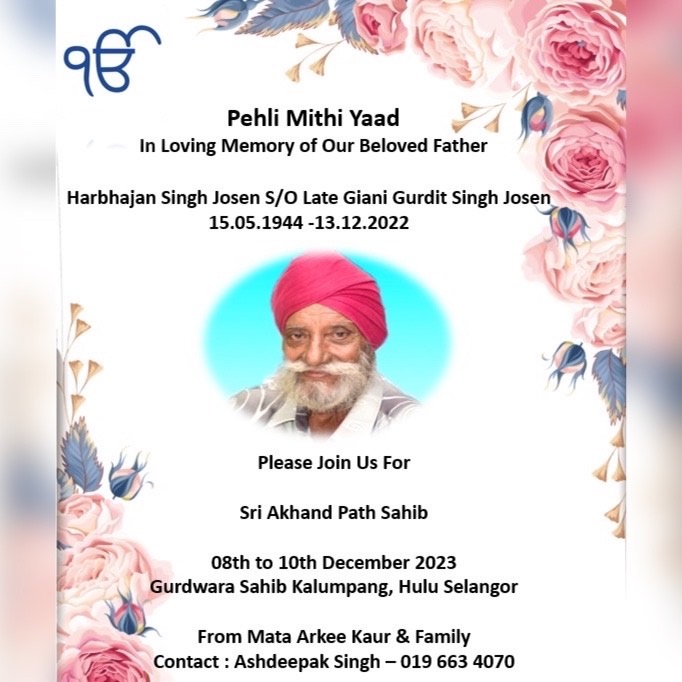
8 to 10 December 2023 Gurdwara Sahib Kalumpang, Hulu Selangor
FROM MATA ARKEE KAUR & FAMILY
Contact: Ashdeepak Singh – 019 663 4070
| Entry: 18 Nov 2023 | Source: Family
ASIA SAMACHAR is an online newspaper for Sikhs / Punjabis in Southeast Asia and beyond. When you leave a comment at the bottom of this article, it takes time to appear as it is moderated by human being. Unless it is offensive or libelous, it should appear. You can also comment at Facebook, Twitter, and Instagram. You can reach us via WhatsApp +6017-335-1399 or email: asia.samachar@gmail.com. For obituary announcements, click here
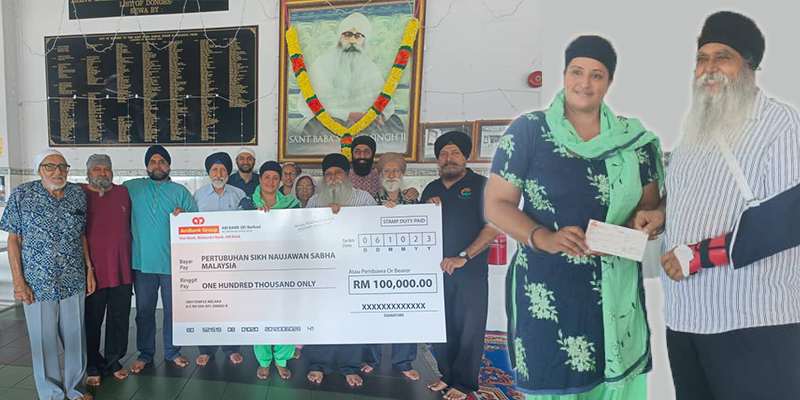
Gurdwara Sahib Melaka (GSM) committee president Dalvinder Kaur presenting RM100,000 cheque to SNSM jathedar Paramjeet Singh in Malacca on Nov 18, 2023
By Asia Samachar | Malaysia |
Gurdwara Sahib Melaka (GSM) has released the first payment of RM100,000 for the development of the Khalsa Land, a Sikh campsite being developed in Kuala Kubu Baru, Selangor.
At its AGM in 2018, GSM under the chairmanship of Karam Singh had approved a RM500,000 donation for the project.
GSM committee president Dalvinder Kaur presented the cheque to SNSM Jathedar Paramjeet Singh at a ceremony in Malacca today (Nov 18). Also present from the SNSM exco Harvinder Singh and Khalsa Land Development committee represented by its chairman Amarjit Singh and member Satvindar Singh.
Also present at the briefing was Dr Mahinder Singh under whose leadership GMS gave a RM160,000 donation 20 years ago when the 20 acres of land was purchased. Also present were the gurdwara committee principal office bearers, trustees and members of the Sanggat.
In 2001, Sikh Naujawan Sabha Malaysia (SNSM) had with the Sanggat’s generous contributions acquired 20 acres of freehold land at a cost of RM1.60 million. Khalsa Land is located in Ampang Pecah in KKB.
In May 2022, they kick-started the Phase 1 of its developments with the construction of two units of accommodation building (single storey semi-D units) at a contract sum of RM683,000, which has been fully completed.
The team has now moved into its next development stage.
ASIA SAMACHAR is an online newspaper for Sikhs / Punjabis in Southeast Asia and beyond. When you leave a comment at the bottom of this article, it takes time to appear as it is moderated by human being. Unless it is offensive or libelous, it should appear. You can also comment at Facebook, Twitter, and Instagram. You can reach us via WhatsApp +6017-335-1399 or email: asia.samachar@gmail.com. For obituary announcements, click here
ASIA SAMACHAR is an online newspaper for Sikhs / Punjabis in Southeast Asia and beyond. When you leave a comment at the bottom of this article, it takes time to appear as it is moderated by human being. Unless it is offensive or libelous, it should appear. You can also comment at Facebook, Twitter, and Instagram. You can reach us via WhatsApp +6017-335-1399 or email: asia.samachar@gmail.com. For obituary announcements, click here
Manvin Kaur Khera has been crowned the Miss Globe 2023 in the pageant’s finals in Durress, Albania, today (Nov 18). The Malaysian-born 21-year-old is a model and commercial talent.
Manvin Kaur Khera wins Miss Globe 2023 in Albania
ASIA SAMACHAR is an online newspaper for Sikhs / Punjabis in Southeast Asia and beyond. When you leave a comment at the bottom of this article, it takes time to appear as it is moderated by human being. Unless it is offensive or libelous, it should appear. You can also comment at Facebook, Twitter, and Instagram. You can reach us via WhatsApp +6017-335-1399 or email: asia.samachar@gmail.com. For obituary announcements, click here
Sikh Panjabi Scholars Project: Dr Sunny Dhillon interviews Dr Gurnam Singh
The Sikh Punjabi Scholars Project has been undertaken and edited by Dr. Sunny Dhillon, and consists of a series of interviews with Sikh Panjabi Scholars working in the Arts, Humanities and Social Sciences from September 2022 – March 2023. The aim was to capture the career pathways and lived experiences of Sikh Punjabi Scholars in the UK. This collection contains lightly edited transcripts of interviews with fourteen such participants. The following transcript is of an interview with Dr Gurnam Singh.
Dr. Sunny Dhillon, Senior Lecturer in Education Studies at Bishop Grosseteste University, Lincoln, UK. (E-mail: sunny.dhillon@bishopg.ac.uk)
Before joining the Education Studies team in November 2021, Dr Sunny Dhillon spent five years as a learning developer at the University of Leeds, as well as at BGU, where he also worked as a Visiting Tutor in the Theology, Ethics and Society department. Sunny conducted his doctoral research through the Philosophy department at Cardiff University, focusing upon the concept of utopia. Owing to his background in Philosophy, combined with Academic Literacies, he is well-placed to help students critically investigate the ostensibly virtuous practice(s) of formal education.
Sunny’s research interests include Critical Theory (The Frankfurt School), Nietzsche, Jiddu Krishnamurti, Utopia, Philosophy of Education and Academic Literacies. His current research projects include two main strands. Firstly, the role of satirical humour, gameplay, and the mythical archetype of the Trickster within Higher Education practices. Secondly, explorations of identity concerning Sikh Scholars working in the Arts, Humanities or Social Sciences in the anglosphere.
Dr. Gurnam Singh, Associate Professor of Sociology, University of Warwick, Coventry, UK. (E-mail: gurnam.singh.1@warwick.ac.uk)
Dr. Gurnam Singh is an activist researcher, writer, educator, columnist, and broadcast journalist, and has spent much of his adult life fighting against systems of power and oppression. He holds several academic posts, as Associate Professor of Sociology at the University of Warwick, Fellow in Race and Education at the University of Arts, London and Visiting Professor of Social Work, Liverpool Hope University. Previously, he was an Associate Professor of Higher Education at Coventry University. He writes a column in the online magazine Asia Samachar and also contributes to community broadcasting as a presenter on the Panjab Broadcasting Channel (PBC). He has previously presented news and current affairs shows on the Sikh Channel and Akaal Channel.
Dr Singh completed a PhD at the University of Warwick in 2005, focusing on anti-racist social work. In recognition of his work in critical pedagogy and higher education, he received a National Teaching Fellowship (NTF) in 2009 and became a Fellow of the Royal Society of the Arts (FRSA) in 2018. Dr. Singh’s extensive publication record encompasses four books, over 40 peer-reviewed papers, chapters, and review articles, and numerous keynote conference presentations across the world. His work covers a wide range of topics, including race, racism, anti-racism, diversity, decolonization, ethics, higher education, social work and Sikh and Punjab studies.
SD: So, who is Gurnam Singh?
GS: It’s a difficult one to answer. I could start right back to the 1960s growing up as a child on the streets of Bradford, a hilly, windy, cold and bleak industrial city that, because of the vast networks of mills and associated industries was a magnet for migrant labour from across the globe. But I think in the context of our conversation, the question is, when did I discover that I was an educator and how did I end up becoming a career academic? I suppose it was when I was very young, I was a bit of a black sheep in the family. I was the youngest of four brothers who were all born in Panjab, though being just 3 years old when we came to the UK, unlike my brothers, I had no memories of Panjab. I very much saw myself as British, though at the same time, due to racism, I also felt like an outsider. This somewhat schizophrenic relationship with Britishness, a sense of belonging and un-belonging has formed the backdrop for much of my scholarly work and continues to this very day.
During those early years, life was a constant struggle, a battle for survival and I think much of my education was disrupted by that. I’m not sure if ‘disruption’ is the right word, because, in some sense, I got a different kind of education. I think that experience also defined me and who I have become in profound ways. Much of my early childhood school experience/education was about learning how to fight back both literally and metaphorically and trying to make sense of the violence of race and education that I was experiencing daily.
It was through this experience that I started to become conscious of the history of coloniality, especially because I was growing up in Bradford; a very multicultural community where Muslims, Hindus, Sikhs, Caribbeans, Eastern Europeans and white working-class British people were living cheek by jowl. So, a mix of race, class, gender, religion and ethnicity was everywhere, and much of my time was spent on making sense of my lived experience; If I am honest, those early years were quite alienating.
Because my family valued the importance of getting an education — my dad used to say the only reason he came to the UK was to enable us to get a decent education — even though it was alienating, my attendance was good. Though I struggled to achieve good grades, I used to be quite interested in all the subjects, especially the hard sciences, history and religious education.
Although I’ve never been a believer in the popular conception of ‘God’ as a white-bearded old man living above the clouds, as far back as I can remember, I was always interested in questions related to religious identity, faith and belief. I think this was possible because it enabled me to think about the big questions in life, such as, what is the nature of being? what/who is God? Why are many drawn to him? and what is the purpose of human life? And so, whilst I didn’t have much time for organised religion, I was always keen to fight against injustice and do moral good. I think I was a Marxist before I even knew who Marx was, but it was his ideas about capitalism, the exploitation of people and the role of religion, which I began to explore in my mid-teens, that enabled me to make sense of life as I was experiencing it.
Being surrounded by all kinds of violence and oppression, especially racism, meant that each day was a painful learning experience. From home to street to school, there were no safe spaces. Even when we were not being subject to direct violence, the fear of racist attacks was ever-present. As for school, the tirade of racist abuse had deep psychological effects to the point where I began resenting my identity, including taking solace when I was given the honorary status of being white when my white ‘friends’ would say that ‘I was not like the others’!
But it was the question of immigration and state racism and a specific experience of the deportation of a close family member in 1976 that had a life-changing impact on me. The person in question was my cousin from Punjab who had entered the UK illegally and had been living with and working in a local factory for a year. We were of a similar age and very close; I was 16 years old, and he was 17, though his illegally procured passport had him as over 20. One day there was a raid at a local mill in Bradford where we had been working and, along with many others, he was arrested.
It was normal for migrants in such a situation to destroy their papers to avoid summary deportation, and this is what we did for my cousin. This resulted in him ending up in prison pending deportation. The issue of migrant workers being held in prison had become a political issue and the local branch of the Socialist Workers Party (SWP) started a campaign and planned a protest outside Armley Prison, Leeds, where a significant number of migrants were being detained without trial. I am unsure how, but the SWP found out that my cousin was one of the detainees, so they came to my mum’s shop on Leeds Road and asked me to join the protest that was going to take place outside the prison, so I went along.
This was my first ever such protest and I was both excited and nervous, especially as everybody else seemed so much older and bigger than me! My anxiety turned into shock when one of the activists, who was aware that my cousin was one of the detainees, asked me to ‘make a speech’! I responded: ‘What’s a speech’? Then before I knew it, a burly white activist pulled out an empty milk crate, picked me up onto the temporary platform and thrust a microphone into my hands. It must all have happened in a matter of seconds and without thinking about my words, proceeded to make my first-ever speech, which consisted of a two-minute rant laced with many expletives about the racist British authorities; it was a surreal experience.
In hindsight, I believe this experience had a transformative effect. I guess that was the first time that I realised that there was something locked up inside that needed to be released and that I had agency, I had power, I could resist and in this sense, was my first real exposure to political activism. Well, you could argue that my disruptive activities in school were acts of resistance, but they were more reactive rather than a self-conscious and organised political act; I think the protest speech was the first one.
So, then I started to hang about with socialists, reading and hanging about in left-wing book shops and organising all kinds of anti-racist protests. The ironic thing is that, though I spent a considerable part of my secondary education truanting from school, along with hanging about on the streets, I would spend most of the time in the Bradford Central Library reading about history, politics and philosophy, something that was denied at school where the curriculum was very UK/Eurocentric! Though I didn’t know this at the time, I now realise that I had become an autodidact, that is I was largely self-taught.
Though I was struggling at school, in a strange twist, despite my discomfort with the concept, without knowing it, I think I was assimilating the identity of a particular kind of intellectual. I am not talking about the notion of a traditional Oxbridge-educated white male intellectual, but an amalgam of what the Italian critical theorist, Antonio Gramsci, termed an ‘organic intellectual’, and the Canadian educationalist, Henry Giroux’s conception of a ‘transformative intellectual.’ I gradually began to see my vocation in life as one of enabling lives to be transformed through critical pedagogy. Indeed, I think I was practising ‘critical pedagogy’ before I ever came across the work of Paulo Freire and his seminal text ‘Pedagogy of the Oppressed’. Indeed, my passion for critical pedagogy resulted in establishing the Midlands Critical Pedagogy Group and also co-editing a book in 2013 entitled Acts of Knowing: Critical Pedagogy in, against and beyond the University published by Bloomsbury.
And so, despite struggling at school I managed to get a clutch of GCSE’s and A Levels and went off to university in 1978 to do a degree in Applied Chemistry. Like many other Sikh parents, mine had dreamt about me going off to medical school, hence I did science A levels, but, like many others of my generation, I simply didn’t have the grades and chemistry became my fall-back position. To be honest, at a time when only 6% of the population, mostly from white middle-class backgrounds, went to university, just getting into university was an achievement. In those days, going to university was less about the subject one was studying and more about an opportunity to ‘find yourself’, which for me meant moving 200 miles from Bradford to London. Though I occasionally went back home at the end of term, the next 3 years of my life were mostly spent furthering my anti-racist activism in London, but also in building a deeper connection to my Sikh roots. I spent most of my time between University in Uxbridge, Southall, Shephard Bush and Central London.
1981 was a pivotal point in my life and indeed many others from my generation when the UK went up in flames. From Brixton in South London and Southall in West London, and eventually across the country, in 1981 we saw a wave of protest and riots against racist violence and police brutality. I was still in London and was in Southall when on 23rd April 1981 we saw the streets going up in flames following the National Front march and the counter-protest by the Anti-Nazi League. As well as the riots this event is also remembered because of the death of Blair Peach, a teacher and anti-fascist activist who most believe was killed by a blow to the head by notorious Special Patrol Group branch of the Met Police; his death remains an unsolved crime. Because Southall Broadway had been cordoned off, I was not part of the main protest, those events deeply impacted both my activism and academic career in ways that I could never have imagined.
As I recalled earlier, after the protest outside Armely Prison, I started to become active. This activism led to the establishment of the Bradford Asian Youth Movement in 1976 (https://www.tandana.org/data/pg/aym/aym_02.htm). I was one of the founders of the Bradford chapter, which was the first of many such groups in most major UK cities. Under the slogan, ‘self-defence is no offence’, we were fighting racism on various fronts, from resisting police brutality and racist immigration laws to defending the community against Far-Right groups from racist hate attacks, which were a daily occurrence. Unlike many of my fellow activists, I was lucky I escaped becoming criminalised. That was I believe a pivotal moment for me as I am convinced that had I been convicted of any criminal offences, my career trajectory would have been quite different.
So, it was and remains a precarious life for me, a life on the edge, on the boundary. But in some sense, because it’s lived on the edge, it gives you clarity and a perspective that you wouldn’t otherwise have as an ‘insider’. And I suppose I have taken that perspective through into my academic and professional work. For example, having the audacity to contact academics and scholars whom you would have been frightened to approach; just emailing them and realising they’re just ordinary people was a revelation to me in that it disrupted the sense of othering I had felt as being ‘other’ to clever intelligent people! If I am honest, though less so, I still carry the scars of being an outsider, and imposter if you like, and this continues to inform much of my academic work.
I suppose although I never consciously wanted or planned to become an academic or writer, I have come to think of ‘writing’ as ‘walking’. Unless one has a significant disability, then everybody is can walk, is a walker and the challenge is to walk a bit longer, a bit faster. Likewise, to be a writer at the basic level is to write, which most can do, so the challenge is to develop one’s capacity to write. So, whilst I have come to value my ability to write, I’ve always had an uncomfortable, you could say ambivalent, relationship with the label academic or intellectual. As a status symbol, I see it as part of the problem, but on the other hand, as a kind of necessary evil that goes with working in Higher Education. And so, my writing and research about education and universities is informed by the idea of being against a type of exclusivist intellectuality that we tend to see especially within the elite institutions, but still respecting intellectual pursuits. So that’s where I am difficult to pin down. I guess I am a reluctant intellectual who, following Gramsci, also believes that all human beings or homo sapiens, by virtue that they are thinking animals, are ‘intellectuals’, or at least have the potential to be so.
SD: That was some answer! The first way you described yourself was as an educator, and you’re from Bradford. Shifting gears, what does your Panjabi heritage mean to you?
GS: It’s a great question because I was brought up in a very secular home and my parents were preoccupied with providing us with our basic needs, there were few discussions about religion and identity. That said, my dad was adamant that I go to the gurdwara and Panjabi classes at the weekend. So, whilst my father had cut his hair, and adopted the typical work white working-class male lifestyle drinking and smoking and adopting an anglicised name, somewhat paradoxically, I think he was also concerned about the transmission of cultural identity. My mum was quite religious; I recall her reciting Gurbani and refraining from meat and alcohol, but she had to just do what was culturally required of her as a woman. On Sunday mornings I played football, initially for my school team and then for a local Punjabi team called Albion Sports. So, whilst my parents would insist on me attending the Gurdwara, and Panjabi class, I wanted to play football. The fact that the teachers were violent, like, properly violent didn’t help! These teachers were everything that teaching and pedagogy, should not be. I guess they were just acting out colonial pedagogies really; the way that they learned things. So, I rebelled, against everything and never progressed further than learning the Gurmukhi alphabet.
Gurnam Singh (standing, left) with the Albion Sports (Bradford) football team in early 1980s- Photo: Supplied
It was around the age of 17 when my life began to take on a different direction. From fighting my Punjabi tradition and history, I began to develop a thirst for it. This began with reading books on British colonial history and the few books that were present on the Sikhs at the Bradford Central Library. I began to learn about the Indian independence movement, and the Gadar party and I started to think quite differently about my sense of identity and my uncritical adoption of Western cultural forms. Reading about the struggles of freedom fighters against British Rule led me to reconnect with my family history, of the struggles of my parents, grandparents and ancestors from the days of the Moguls through to the partition in 1947 and the painful migration stories, was quite transformative. This led me to keep my hair and, given he had removed his turban on arrival in the UK, with a sense of irony (for him), I asked my dad to tie me a turban; ‘Pagh bandho’!
He was taken aback and expressed some doubts. He thought I might get involved in a cult or something. I said ‘No, I just want to put a pagh on’, and so I did, and felt OK about it. I never really became religious. Two years later, when I went to university in London, in 1979 I took Amrit (‘nectar’ signifying baptism as a Khalsa Sikh). This gave me a renewed sense of purpose and identity. I had always been keen on fitness sport, and a healthy lifestyle and it seemed like Amrit was a good thing as not only did it encourage me to look after my body, but it also helped to nourish my mind and desire to reclaim my lost identity. I also liked it because I could attach myself to a martial tradition, a tradition of revolution, which aligned with my growing interest in left politics. I went back to reading Sikh history, and I realised that true Sikhi was a far cry from those violent priests and teachers that I experienced in the Gurdwara. I discovered that Sikhi was about resistance to priestly classes, imperialists and landlords. So, that allowed me to bring my Marxism and materialism together with this discovery of heritage, culture and identity.
Gurnam Singh in 1981 in Southall during his university days in West London.
But it was also a ‘secular spirituality’, which may sound like an oxymoron. Let me explain; It’s a spirituality without a traditional external God, one that lives in the sky and a strange place called Heaven! I later realized somewhat ironically that many of the ideas I had internalised about God and religion more generally were imported from Christian models. So, in realising I had inadvertently rejected my tradition, I began on something of a journey of discovery. My starting point was realising that Sikhi was about ‘learning’ and to be a Sikh in a very literal sense was to be a learner. As I had always felt that I was a learner/student, embracing Sikhi felt compatible with my educational identity, as a lifelong learner. I’m a lifelong Sikh! So, Sikhi and University happened around the same time, and then 1984 happened and, like many other Sikh youth at the time, I became involved in the Khalistan movement. However, as I would later realise, my activism was more about opposing India and its oppressive actions than fighting for an independent state of Khalistan. I gave some talks on Khalistan and attended many demonstrations, but to be honest, I have never felt that this was compatible with my universalist, non-sectarian socialist outlook.
SD: So, when I asked about your Panjabi heritage, from the response it seems as though a Panjabi-ness and Sikhi are almost the same for you? How would you divorce the two? Or can that even be done?
GS: Well, it’s interesting because I grew up in a very multicultural community with a significant Panjabi population. Some of my best friends were (and still are) Muslims. I did not know about partition and sense of the politics of division and as far as I was concerned we were all one. I know my Dad would always say, ‘Don’t trust these Muslims’, which left me puzzled as some of his best friends were Muslim! It was only later that I got to know about the horrors of partition and that my parents had first-hand experience of the violence. They were there in the thick of it and they survived! I guess it was this traumatic experience that had left an indelible mark on their psyche, hence their ongoing mistrust of Muslims.
Though we lived cheek-by-jowl with many minority communities, and though none of my extended family members wore turbans, I did have a sense of my separate Punjabi Sikh identity; I recall the kara (steel bracelet) being recognised as a marker of Sikh identity in those days. But it wasn’t until much later when I began to think about the struggles and the history of Panjab, that I began to realize that Panjab was a much bigger space, and much more cosmopolitan than I’d imagined previously. In more recent times, especially since the opening of the border crossing border at Kartarpur, between Indian and Pakistan Punjab, I’ve been much more aware of the common heritage of Sikh, Muslim and Hindu Punjabis and through the Panjabi research group was set up in 1984 and the advent of the internet, despite having lived in the UK for practically all my life, I feel much closer to my fellow Punjabis in Panjab and across the world.
SD: You described yourself as a secular spiritualist, that your route to Sikhi was informed by your Marxist ideology and members of the Gadar party, including self-identifying atheists such as Bhagat Singh, to what extent do you ‘practise’ Sikhi today, and what does it mean to you now?
GS: I suppose my conception of what practising Sikhi means and how it manifests in my daily life has been changing over the years. From a point where I had rejected Sikhi as another religious ideology, during my late teens I began to see it much more as an identity. Hence, from my decision to keep my hair, tie my turban and eventually take Amrit at the age of 18 I was very much focused on the external and performative aspects of Sikhi. You know, focussing on my appearance, becoming better at reading bani, bathing in the ‘correct’ way, waking early in the morning and performing morning prayers, making sure I don’t eat certain things that may be ‘impure’ and so on. I did all that, yet at the same time, in all honesty, it all felt a bit superficial; it felt a bit antithetical to what I felt were Sikh values, such as opposing ritualism, irrationality and exclusivity. So, I began to develop a self-critique, which led me to conclude that contrary to the basic teachings of Sikhi, of equality, inclusivity and spirituality, as an Amritdhri (baptised Khalsa Sikh) I was thinking and acting as if I were superior to non-Amridharis. To some extent, I am still struggling with this issue insofar as I realise that the root cause was ego which in Sikhi philosophy is identified as the greatest challenge human beings have to face in their lives.
The anand karaj of Manjit Kaur and Gurnam Singh in Birmingham on 20 Jan 1985 – Photo: Supplied
So, I began digging deeper into Sikh teaching and history and found that some of the struggles I was encountering in my own life around ‘authentic’ Sikhi were reflected in Sikh literature. For example, I learnt that ever since its beginning in the Fifteenth Century, Brahmanical hegemony has had and continues to cast a large shadow on Sikh practices. I realised there were different ways, different wings, to Sikhi and that this was no different to other great world faith traditions. Yet, at the same time, I was immensely proud of and motivated by the Sikh traditions associated with anti-racism/castism, gender quality and anti-imperialism. I was always interested in South American Liberation Theology, from the work of Paulo Freire, and for me, this resonated, deeply in Sikhi. So, faith and spirituality were very important, but less so in terms of personal salvation. I was always motivated by the need to engage with an unjust world. For me, Sikhi was a progressive ideology, a social and political movement, if you like, that very much mirrored European enlightenment traditions that were taking shape roughly parallel to the evolution of Sikhi from the 15th to the 19th Century.
So, inspired by Liberation Theology and the revolutionary ideology of Marxism, I began to widen the canvas of what Sikhi meant to me, such that some of the religious practices became much less important to me. For some people, they are important, and that is fine; I have never been one to condemn people for that. The outward manifestation of Sikhi remains important culturally for me, but my conception of Sikh identity is now much more concerned with actions, what I do in the world, and how I engage in the struggles in the world.
SD: In the connection, you made between Liberation Theology and Sikhi, would it be fair to say that you ascribe to the notion of miri-piri (temporal power and spiritual authority)? To be a Sikh, for you, requires both spirituality and that sense of militant struggle or resistance.
GS: Yes! I think the way I would see it is that the spiritual dimension allows you to nurture your mind. We can think about the mind in lots of different ways, such as being disturbed, troubled, unbalanced, and unfulfilled, and for me, the spiritual aspects of Sikhi are essentially about training the mind to achieve a state of ‘sehaj’ or equipoise. Though I was able to avoid such matters other than a short period in my mid/late teens, I began to consume alcohol, I had seen lots of activists around me whose ‘heads’ had gone somewhere else completely; be it through drugs, alcohol or the pressure of life. Sikhi felt like a really good way to mitigate that risk. So, in that sense, I suppose for me, spirituality was about developing that clarity of thought and mind, ethical reflexivity, emotional awareness and inner strength. I felt Sikhi was good for reflection, and that listening to Katha (sermons) and reading bani (Sikh scripture) was very relaxing. It was very empowering in that sense. Partly, when I started to understand Gurbani (Sikh scripture), it wasn’t giving me a list of dos and don’ts. It was asking me to reflect and think. So, I felt it was very conducive to the kind of life I wanted to live. Of course, it also instilled discipline. I think that was important. That kept me very kind of committed to the family. Ethical living was important.
All those things have been my guiding principles, rather than looking for God somewhere in the sky, in a building, or some other place or person, for me, spirituality it’s very much a personal affair, a search for the divine within, but also in nature. That’s how I relate to Sikhi today, and I know this may be troubling for some people who invest heavily in a religiousness that I don’t. I understand why some people might feel like that, and I don’t hold anything against them, I have found that the best way to deal with people who radically dissent from my perspective is to engage in constructive dialogue.
SD: It’s a fine line to tread, isn’t it?
GS: Well, it is, especially given my public profile. Guru Nanak faced the same kind of challenges, didn’t he? So, I’m happy to follow in his footsteps and teachings.
SD: In terms of being a visible Sikh in the spaces you occupy, such as the University of Warwick, Coventry, and in your discipline of social work and so on, what does it mean that you’re in those spaces, being who you are, and looking the way that you do [Dr. Singh keeps his hair and wears a turban], not only for yourself but the people that have a stake in your being there? For example, your students, colleagues, etc.?
GS: To what extent does my Sikh identity impact or influence or inform my teaching? I’ve never hidden away from my Panjabi identity. When we go into most social spaces, especially, universities, there is a sense that people feel compelled to conform to a particular kind of white Western culture and performativity. And the students do that as well. One of these markers of conformity in the spaces is that you speak English and adopt a particular dress code. Things have changed since I entered Higher Education as an undergraduate over 40 years ago, but because of internationalisation and widening participation, university spaces are much more diverse and multilingual. Today, I feel much more comfortable in my Sikh identity, both within university spaces and in the wider society; I guess this is a sign of progress!
By wearing a turban and beard, my Sikh identity is highly visible, and unlike some, perhaps many South Asians, I refuse to apologise for being different. I’ve always used Panjabi [the language] as well in white spaces. It’s interesting because if I meet Panjabi students on campus, and it doesn’t have to be Sikhs, it could be Muslims or Hindus, I always try to speak to them in Panjabi, and often they get taken aback by that! I’ve even started using Panjabi words and phrases in lectures, partly because I find it to be a powerful pedagogical tool, but also to try and show some kind of authenticity. It’s interesting to watch the reaction of the Panjab-speaking students. Because I think they feel like they’re being exposed because when I speak in Panjabi, they can be defensive, but often they do come up to me after class to say, that they found it to be both ‘disruptive’ and ‘liberating’.
So, I’ve always been proud, but not in an egotistical sense, of being Panjabi. For me reclaiming my rich linguistic tradition has been a powerful way to resist the ongoing impacts of racism and whiteness; how do you struggle against the dehumanising effects of this kind of oppression if you haven’t got a strong alternative? Even if it’s an imagined alternative, one needs an alternative narrative to the one that is constantly fed to you. In some senses, and I know this is far from reality, I have developed a romantic view of the lives of the Sikh Gurus, the Sikh Raj of Ranjit Singh, and even village life in Punjab. I recall something that the historian Benedict Anderson observes in his book Imagined Communities: Reflections on the Origin and Spread of Nationalism which explores the concept of nationalism by arguing that nations are socially constructed entities created through shared cultural symbols, language, and a sense of belonging. In this sense, the role of the nation-state in shaping people’s identities and the idea that nationalism has been an important tool has allowed me to develop a counternarrative to white European supremacy, even if that narrative itself is itself in part constructed through the imagination.
SD: In the 1980s, the term ‘politically Black’ was a lot more popular. 40 years on, the term ‘BAME’ (Black and Asian Minority Ethnic) has put a wrench into that, and there are also further subdivisions. Sikhs I speak with are very often keen to point out that they don’t want to be seen as Indian; they want to be seen as Panjabi, Sikh, or Khalistani. Do words like Indian, or South Asian, mean much to you?
GS: I think if somebody asks, ‘Where are you from?’ my instant reaction is that I’m from Bradford because that’s where I grew up and entered adulthood, where my two children were born and where both my parents were cremated. I’ve been to Panjab a few times, but it’s only felt like home for a very short period, and I quickly have the yearning to return home to the UK. Ironically, in Punjab, I am referred to as the ‘Blighty’, which is from the Urdu word vilayati which means foreign, British, English or European! In Punjab, because it doesn’t quite fit into the kind of romantic sense of the imagined home, my romantic version becomes quickly exposed, not least as I am reminded by resident Punjabis that I belong somewhere else, in England!
For me, Bradford and Yorkshire more generally are probably the closest I get to calling home, although I left 30 years ago. I continue to feel an affinity with people who have a Yorkshire or even Northern accent. Interestingly, though it’s mellowed and rounded off at the edges nowadays, people are still curious about my accent and will often say, are you from the North and sometimes even ask if I am from Bradford! And so, though politically I have little time for any form of aggressive ethnonationalism, and see myself as a traveller, I would say that Bradford provides a kind of geographical rootedness, and Panjab is a kind of imaginary homeland. But amongst South Asians, wherever I go in the world, I tend to be identified as ‘Sardar ji!’, so I guess, because of my outward appearance, my Sikh identity travels with me everywhere.
SD: Going back to the start, you mentioned you’re the youngest of four brothers. How do you think that your loved ones and family consider your professional choices, achievements, and your direction of travel?
GS: Well, my dad wanted me to be a medical doctor, which was the stereotypical profession that most South Asians aspired to, so, I was pushed to pursue the sciences at school and ended up doing Maths, Physics, Chemistry and Biology for A levels. Needless to say, I didn’t get into medical school and I ended up doing Chemistry at University. At one point I wanted to join the Air Force and complete the entry exams, but, somewhat ironically, my dad said ‘No, you can’t go!’ I argued that he served in the border security force, my grandfather was a military man, and so were my uncles, so why couldn’t I? He was against it, fearing my death, particularly as the conflict in Northern Ireland was at its height, and joining the services didn’t seem like a simple career choice. My Dad, because of his service background, was quite a disciplinarian and the fact that I was underperforming in my schooling exams meant that received regular beatings. So, it was kind of crazy: him beating me into being a doctor, and there was me doing everything to resist. The irony was, though I never became a medical doctor, he passed away 6 months before I received my PhD.
It was only much later in life that I realised why he felt education was such a bulwark against racism and the like. Coming from India, he and his co-workers had to take race a lot of racism. His motivation for me getting an education was to not have to experience that. He always said, ‘We came to this country for education’ and I know he had dreams of returning having become financially secure.
So those days growing up in Bradford are full of mixed memories and emotions. Against the backdrop of all kinds of violence, both within the family and outside, I do realise the value of living in strong, cohesive families and communities that can protect you both from direct racial violence and from some of the structural impacts of racism. For example, despite deep levels of poverty, we never went hungry, and we never went without a roof over our heads. We felt secure in the community, even though we were under attack. And I think for that reason, despite the many contradictions, community has always been very important to me.
Coming back to identity and my academic work, in some of my earlier writings, I was staunchly defending political blackness, but I think Stuart Hall blew political blackness out of the water with his writing on ‘New Ethnicities’, which provided legitimation for ethnic identification, particularly on the Left. However, I have been and continue to be heavily influenced by the work of the Sri Lankan Marxist and anti-racist activist, Ambalavaner Sivanandan, who was opposed to the turn towards ethnic identification which he correctly predicted would lead to a divisive politics of identity, a strategy that the British imperialists in India widely deployed.
So, I have always been very wary of cultural relativism and the politics of identity. For instance, we see some very worrying trends linked to a violent kind of identity politics. A prime example of this trend is the BJP in India which deploys Hindutva ethnonationalism to justify its colonial attitudes towards minorities, poor people and women. I am also disturbed by white supremacist and Islamist groups, who play a similar game. These are highly organised groups who are willing to use violence for political ends and it takes considerable courage to call them out. More recently, I have been much troubled by some Sikh nationalists, whose tactics and politics seem to mirror those of the Hindutva.
SD: We’ve come to the last question. Is there anything that you wish I’d have asked that I didn’t?
GS: Well, what you didn’t ask me is maybe what kind of racism I have experienced within academia, which will probably require a new interview. But in summary, in my 40 years in HE, both as a lecturer and student, I have come across some wonderful people, staff and students, black, brown and white. But, mainly to do with subtle racism and widespread nepotism, I feel like much of what I have achieved has been despite, not because of the institutions I have worked in. I’ve always felt that I had to work twice as hard for half the rewards. But the key to my survival and success has been to build strong networks inside and outside of the institution and to never forget my historical roots. I’ve always tried to use my experience to support other black and Asian colleagues and students along the way and, through my writing, I have tried to articulate their voices and experience.
ASIA SAMACHAR is an online newspaper for Sikhs / Punjabis in Southeast Asia and beyond. When you leave a comment at the bottom of this article, it takes time to appear as it is moderated by human being. Unless it is offensive or libelous, it should appear. You can also comment at Facebook, Twitter, and Instagram. You can reach us via WhatsApp +6017-335-1399 or email: asia.samachar@gmail.com. For obituary announcements, click he
King Charles III at the Inter Faith Week on Nov 16, 2023 – Photo: Lambeth Palace Library, London
By Asia Samachar | Britain |
King Charles has joined more than 30 faith leaders at the Lambeth Palace Library to mark Inter Faith Week.
Here, he viewed an exhibition of interfaith items from its historic collection.
“These are challenging times for faith communities in the UK, particularly with the ongoing war in the Middle East. The King’s visit was a wonderful encouragement to remain united in partnership and friendship – as many people of faith are doing across the country,” said Archbishop of Canterbury Justin Welby in a social media entry.
ASIA SAMACHAR is an online newspaper for Sikhs / Punjabis in Southeast Asia and beyond. When you leave a comment at the bottom of this article, it takes time to appear as it is moderated by human being. Unless it is offensive or libelous, it should appear. You can also comment at Facebook, Twitter, and Instagram. You can reach us via WhatsApp +6017-335-1399 or email: asia.samachar@gmail.com. For obituary announcements, click here
A second-generation textile businessman with 16 outlets in Peninsular Malaysia was charged at the Sessions Court here with abetting in causing grievous hurt to a former judge last month.
The 54-year old businessman who owns Gulati’s Silk House pleaded not guilty when the charge was read to him before judge Siti Aminah Ghazali today (Nov 17), according to local media reports.
The businessman, with his hands cuffed, arrived at the courtroom at about 10.45am accompanied by his wife and son, reported the New Straits Times.
The accused had allegedly abetted two men to cause serious injuries to Jagjit Singh Bant Singh using a screwdriver at about 12.50pm near Solaris Dutamas on Oct 19 this year, according to the report.
The offence falls under Section 109 read together with Section 326 of the Penal Code which is punishable by a prison sentence of up to 20 years and subject to a fine or whipping as well, upon conviction.
Deputy Public Prosecutor Noorhani Muhmmed Ayub while prosecuting asked no bail be offered to the accused as the offence is a non-bailable one. However, she said if the court wanted to offer bail, it should be RM100,000.
The newspaper reported that Counsel Jeremy Vinesh Anthony who appeared for the accused, pleaded for minimum bail by stating that his client is the sole breadwinner for his family, adding: “My client is also a chairman of a gurdwara sahib in Titiwangsa… so he is not a flight risk….This is also his first time being brought to court to face criminal charges.” The court set RM25,000 with one surety and fixed Dec 5 for next mention.
In an earlier report, the NST reported that a tycoon has been arrested after a family dispute he was involved in took a violent turn. The businessman allegedly masterminded a brutal attack on two lawyers at their office on Oct 19.
The attack, believed to have stemmed from the family feud, saw the lawyers being ambushed by two assailants, who had entered the law office at Publika shopping centre here on the pretext of seeking legal representation. The two assailants allegedly attacked the former judge and his associate with screwdrivers, stabbing their victims and causing one of them to suffer a shoulder fracture, the report added.
ASIA SAMACHAR is an online newspaper for Sikhs / Punjabis in Southeast Asia and beyond. When you leave a comment at the bottom of this article, it takes time to appear as it is moderated by human being. Unless it is offensive or libelous, it should appear. You can also comment at Facebook, Twitter, and Instagram. You can reach us via WhatsApp +6017-335-1399 or email: asia.samachar@gmail.com. For obituary announcements, click here
When life threw me lemons two decades, a marriage, and two young children after I had completed my secondary school education, I knew it instantly: I was in a do-or-die situation. Being a career woman right up till when I married, I decided to leave my job and become a full-time homemaker. Never in my wildest dreams would I have thought that not only were lemons thrown at me, but the lemons thrown were frozen beforehand. Thus, the impact was much greater and there I was, crippled!
Instantly I knew a drastic situation warrants drastic actions! I could have sat back and cried out blood but yet nothing would have changed. Losing one’s financial security and independence is indeed scary when you have a young family to feed and care for. But for a fighter I was and still am, enough of tears shed and pain endured. Drastic and unthinkable measures were required. I got up with such force and there was really no turning back. My family’s survival was of paramount importance. I needed to reach the stars.
Acknowledging that being armed with only a secondary school certificate was insufficient for ensuring my family’s survival, I did the unthinkable, but yet necessary. Already in my mid-thirties and with a young family in tow, I mustered up all my courage and registered myself for a professional diploma in early childhood education at University of Malaya (UM). As my younger child was barely a year old, my elderly mother was naturally very concerned. She asked: “How are you going to do it?” Not knowing it myself, all I could say was “Look ma, I myself don’t know how I am going to do it but one thing for certain is that I am going to do it”.
I recall to date two decades ago when my husband drove me from Taiping to Ipoh to board the earliest interstate bus to Kuala Lumpur for my first class at UM. I boarded the bus teary-eyed while my husband took our crying children to my mother’s house in Ipoh. I couldn’t stop my tears from flowing that day. That was the first day I was separated from my children. The pain and heartbreak were with me throughout my almost 3 hours journey. I still think of that fateful but necessary day that trajected my journey. Understanding that my journey was necessary to ensure my family’s financial security, my parents-in-law provided financial support by covering part of my tuition fee.
Immediately upon completion of my professional diploma, I registered for my bachelor in education programme. As a mature student, I was given the leeway to charter my own course structure. Studying alongside students almost half my age did not deter me. I’d register for 5 courses back-to-back to minimize my commuting from Ipoh to Kuala Lumpur thus reducing my expenditures. However, in some semesters I was not as fortunate. I have had to commute to and from Kuala Lumpur thrice a week! I could not stay there as my children needed me. Yes, that caused a huge hole in my pocket but a three-year programme was completed in two years instead, with half a year practical done in a small college in Ipoh. I was slowly but surely on the road to financial independence.
Moving on, never once turning back, I registered as a part-time student for my master’s in education while in full-time employment at a university college. Back to UM. My circumstances did not even allow me to stop and breathe. I had to just do it. For the sake of my family, and with the moral support from my husband and parents’-in-law, I ventured on. My pillar and epitome of strength, my mother, was alongside me with every step I took. I somehow knew that I would pursue my doctorate too.
Joining one of the top private universities in the country, I registered for my PhD as a fulfillment of requirements set by my varsity. Lady luck with me, this time around, I secured a scholarship in the form of MyBrain2015. Halfway through my journey, my pillar could not hold on anymore. She succumbed. My mother left for her heavenly abode. Devastated. I could not move on anymore. Drained of all my strength, I was on the verge of giving up. I recalled that my mother had bought me a dress earlier on. “This, you must wear for your graduation”, she had said then.
I mustered all my remaining strength once again and with the support from my supervisors, I moved on and finally graduated. This one is purely for you, mom. I dedicate my doctorate to my pillar of strength. Without her, I would never have succeeded in changing the circumstances surrounding me. Yes, the heat could have either softened the carrot or hardened the egg, but indeed the oolong tea became better because the very circumstances surrounding it were changed. Indeed, I am the oolong tea, the product of my very own circumstances.
To those who know me and the journey I embarked on, I’d like to thank you from the bottom of my heart for all your ardaas (prayers) and well wishes for the past two decades. Today, I am self-reliant once again. My late mother, late Bapoo Ji (father-in-law), and late Maa Ji (mother-in-law), thank you. I am truly blessed.
To those who caused me to undertake this journey, I would like to also thank you. Without you, I would never have embarked on this journey and realized my full potential. What doesn’t break you will certainly make you grow stronger. I just did!
To those who happen to know me and general readers, I’d pray all can get together to educate our children, both boys and girls. Bring them up well so that they’d emulate the oolong tea. Education is yours and yours only. No one will ever be able to take it away from you.
Surindar Kaur Gurmukh Singh (Phd), is an Assistant Professor at the Faculty of Arts and Social Science, Universiti Tunku Abdul Rahman (UTAR), Kampar Campus. The writer may be reached at surindar@utar.edu.my
RELATED STORY:
(Asia Samachar, x 2023)
ASIA SAMACHAR is an online newspaper for Sikhs / Punjabis in Southeast Asia and beyond. When you leave a comment at the bottom of this article, it takes time to appear as it is moderated by human being. Unless it is offensive or libelous, it should appear. You can also comment at Facebook, Twitter, and Instagram. You can reach us via WhatsApp +6017-335-1399 or email: asia.samachar@gmail.com. For obituary announcements, click here