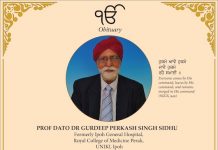
Last Respects & Cremation: 12 October 2023 (Thursday), from 10 am to 12 noon, at the Shamshan Bhoomi Hall (Jalan Loke Yew Crematorium) Lot 294, 295, Jalan Loke Yew, Kuala Lumpur.
PATH DA BHOG
Path Da Bhog will be held at the Gurdwara Sahib Petaling Jaya on Sunday, 22 October 2023 from 10 am to 12 noon.
So here’s to our papa, a remarkable man, a guiding light, a pillar of strength, and the best dad a daughter could ever hope for. As we say goodbye, we promise to keep your memory alive, to live by the values you taught us, and to make you proud. We love you, and will miss you more than words can express.
ASIA SAMACHAR is an online newspaper for Sikhs / Punjabis in Southeast Asia and beyond. When you leave a comment at the bottom of this article, it takes time to appear as it is moderated by human being. Unless it is offensive or libelous, it should appear. You can also comment at Facebook, Twitter, and Instagram. You can reach us via WhatsApp +6017-335-1399 or email: asia.samachar@gmail.com. For obituary announcements, click here
Path da Bhog will be held at the Gurdwara Sahib Petaling Jaya on 20th October 2023 (Friday), from 5pm to 7pm. Followed by Guru ka Langar .
For further enquiries please contact: Ravinder Singh – 012 – 377 0769 Jasminder Kaur Kirkham – 010 – 968 9649
| Entry: 11 Oct 2023; Updated: 15 Oct 2023 | Source: Family
ASIA SAMACHAR is an online newspaper for Sikhs / Punjabis in Southeast Asia and beyond. When you leave a comment at the bottom of this article, it takes time to appear as it is moderated by human being. Unless it is offensive or libelous, it should appear. You can also comment at Facebook, Twitter, and Instagram. You can reach us via WhatsApp +6017-335-1399 or email: asia.samachar@gmail.com. For obituary announcements, click here
Taj (left) and members of the Sikh Empowerment Voluntary Association (SEVA) gather to offer free food during Langar Week in Ilford, East London
By Unzela Khan | MyLondon | Britain |
A group of Londoners have been feeding the city for free since the last eight years – as Langar week approaches, the Sikh community is out in full force to get meals ready for anyone and everyone.
Langar week is a time dedicated to raising awareness about the Sikh concept of ‘seva’ – to help. The week is a way to highlight to others that there is free food available to anyone who is in need.
Speaking to MyLondon, organiser Taj Ghatoura, 40, from East London explained that he and his friends created the Sikh Empowerment Voluntary Association team eight years ago to help the less fortunate.
He said: “Seva means to serve and to help, so we do weekly feeds in Ilford and have been doing that for the last eight years. We feed the homeless and vulnerable and it’s especially important these days with the cost of living crisis.
“On Tuesdays from 7:30pm to 8:30pm we serve hot meals, snacks, donuts and pastries from donations sponsors. It’s all vegetarian food so anyone open to it.
“We’ll have pizza one day and noodles the next, we like to keep a variety. Langar is for anyone, like people in hardship.
“Langar has been around for 500 years, when Guru Nanak was a child he went to the market and saw hungry people, he thought the greatest profit was to feed them – this is what we been taught.”
Langar week (Oct 2-8) is a global campaign that feeds millions to raise awareness of the service. It takes part around the world and in Ilford alone 2,000 meals are served in one day.
ASIA SAMACHAR is an online newspaper for Sikhs / Punjabis in Southeast Asia and beyond. When you leave a comment at the bottom of this article, it takes time to appear as it is moderated by human being. Unless it is offensive or libelous, it should appear. You can also comment at Facebook, Twitter, and Instagram. You can reach us via WhatsApp +6017-335-1399 or email: asia.samachar@gmail.com. For obituary announcements, click here
Watching news of Justin Trudeau’s explosive statement about intelligence indicating Indian involvement in the assassination of Hardeep Singh Nijjar did not shock those familiar with India’s security and intelligence operations. Friends and family of Sikh activists regularly express concern about our wellbeing due to a fear of being surveilled by Indian agents, and ultimately being subject to some form of violent reprisal.
The statements made in Canada’s parliament were finally an acknowledgement of the reality that young Sikhs like me have lived through for decades: Sikh dissidents expressing their support for an independent state may face the risk of imminent harm, even in the diaspora.
India’s aggressive response to Sikh activism – and the consistently rocky relationship between India and Canada – is tied to their common colonial legacy under the British. Nearly a century after the fall of the Sikh confederacy and the colonization of Punjab, British administrators drew a line in the sand in 1947, cleaving Punjab in two. Movements to reassert Sikh sovereignty have since taken a variety of forms, including calls to secede from the Indian state and establish an independent Khalistan.
As the conflict evolved into an armed insurgency, the Indian establishment rejected political settlement on self-determination in any form. Instead, security forces proceeded to repress Sikh dissent militarily, using torture, extrajudicial killings and enforced disappearances in a manner that has been well-documented by human rights groups. Hardeep Singh was himself a survivor of this persecution when he left India to come to Canada in 1997.
Since then, the global Sikh diaspora has been a source of considerable dread for Indian officials as the country steadily creeps closer towards officially declaring itself a Hindu rashtra (nation). While portraying itself as a “vishwaguru” on the global stage, the country has been formalizing its institutions of autocratic power domestically. India’s antagonism with members of the Sikh diaspora in particular, stems from the fact that diaspora Sikh activists puncture India’s grand narrative that attempts to obscure intolerance against minorities under the guise of portraying itself as the ancient “mother of democracy”.
In the diplomatic realm, Indian officials have expressed frustration with their inability to forcibly shut down avenues of diasporic Sikh dissent with the same heavy hand used domestically. By conflating any form of Sikh advocacy for Khalistan with “extremism”, Indian officials have often poured their diplomatic resources into pressuring international partners to criminalize Sikh activists on their behalf. A 2018 report by Canada’s parliamentary committee on national security documented the process in which a misleading public narrative was crafted in Canada by elements within Indian intelligence. Using “strategically released” media articles, Indian agents further intensified diplomatic pressure to “clamp down” on Sikh activists in Canada.
Other intelligence operations include the infiltration of Sikh institutions, as well as surveilling and intimidating Sikh activists. This is what leads to the environment of heightened tension and fear that discourages young Sikhs in Canada – and elsewhere – from getting involved politically or voicing their opinions “too loud”. Hardeep Singh’s murder appears to be the reprehensible climax of these activities: the premeditated murder of a Sikh dissident due to his political beliefs. With the suspicion of foul play and calls for an inquest into the death of Avtar Singh Khanda in the UK, this concern is one that is shared around the world.
India’s combative response to the bombshell allegations demonstrate once again that it is not a responsible global actor. It is imperative that the international community responds to this allegation without any shade of ambiguity. Strategic interests in the Indo-Pacific region cannot come at the cost of basic democratic freedoms or granting impunity to an increasingly authoritarian regime responsible for systematic violence against minorities. Economic development, stability, and security in south Asia can only be guaranteed by ensuring meaningful democratic freedoms, basic principles of self-determination and public accountability are at the heart of foreign policy initiatives.
If Canada’s intelligence is proven to be true, the response must unequivocally demonstrate that the international community will not tolerate such a crime: targeting a vulnerable activist who survived persecution and came to Canada because of violence in the very country that appears to have ultimately orchestrated his murder.
ASIA SAMACHAR is an online newspaper for Sikhs / Punjabis in Southeast Asia and beyond. When you leave a comment at the bottom of this article, it takes time to appear as it is moderated by human being. Unless it is offensive or libelous, it should appear. You can also comment at Facebook, Twitter, and Instagram. You can reach us via WhatsApp +6017-335-1399 or email: asia.samachar@gmail.com. For obituary announcements, click here
Milkha Singh (right) barely edging out Abdul Khaliq in the 200-meter finals of the 1958 Asian Games in Tokyo.
By Prabhjot Singh | Opinion |
Looking at the results of the just concluded Asian Games in Hangzhou, one may not agree that the South Asia has been losing its edge in sports. India, the undisputed leader of the subcontinent, attained an all-time high by crossing the century mark in the medals tally. But other member nations of the sub-continent – Pakistan, Sri Lanka, Afghanistan, Bangladesh, Nepal and Bhutan – had very little to cheer about the performance of their athletes in the Hangzhou games. Intriguingly, all the medals won by the entire South Asian subcontinent fall far short of the third placed Korea.
Korea won 190 medals, including 42 gold. Compared to it South Asian nations aggregated 124 medals, including 29 gold, 28 of which were won by India alone. Only other gold medal won by the subcontinent was a gold in 800 m for women which went to Tharushi of Sri Lanka. And coming to Japan, that finished second in the games, had 188 medals, including 52 gold. China, the undisputed leader aggregated 383 medals that included 201 gold medals. Interestingly, gold medals won by the next eight nations that finished behind China also totalled 200 gold medals. They include Japan, Korea, India, Uzbekistan, Chinese Taipei, Iran, Thailand and Bahrain. The gap is huge and growing.
In the 72-year history of the Asian Games, the gap between sporting powerful and those at the bottom of the ladder, has grown manifold. Some of the nations, especially, the South Asians have slipped down the ladder significatly. Pakistan, for example, ended the Hangzhou Games without a gold medal as it had in its kitty only a silver and two bronze medals while Sri Lanka with a gold in athletics finished with a total of five medals with two silvers and as many bonze medals. Bangladesh had just two bronze medals and Afghanistan with a silver in cricket won four bronze medals to end with a tally of five.
India is the only nation from the subcontinent that has been trying to provide a silver lining.
Though South Asia may not boast of likes of Flying Sikh Milkha Singh, Balbir Singh Senior, flying horse Abdul Khaliq, World Squash champions Jahangir Khan and Jansher Khan, sprint queen PT Usha, or Asian badminton champion Dinesh Khanna, anymore, yet it can take pride in producing likes of Neeraj Chopra, Tejinderpal Singh Toor, Avinash Sable, drag flicker Harmanpreet Singh and grand old man of tennis Rohan Bopanna besides the strong pair of Rankireddy and Shetty in badminton.
South Asia has once again regained its glory in men’s hockey and kabaddi, both men and women, after losing its supremacy in both the sports during the 2018 Jakarta Asian Games where both Japan (hockey men and women) and Iran (kabaddi men and women) had snatched the dominance.
The region’s diminishing dominance in some popular common man sports has been discerning. Last year when the World Bank came out with its twice-a-year update, it did highlight the socio-politico issues that are dwarfing the activities that had made the region stand out. Growth in the region is dampening, it says underscoring the need for countries to build resilience.
Though that World Report may be referring to the current situation in the region, decline in sporting trends has been continuing unabated for the past couple of decades. Though an effort was made to keep the sports activity and international competitions free from the tumultuous socio-political environment prevailing in the region, the downward trend could not be arrested. The worst hit had been Pakistan, Sri Lanka and Bangladesh.
Since the partition of India in 1947, the region has been repeatedly tormented by conflicts, including Indo-Pak wars in 1965 and 1971, and the bogey of cold war through cross-border terrorism.
Sporting relations between member nations of South Asia were the first and foremost casualty of these conflicts. Holding of Dual and Triangular Sports Meets mainly involving India and Pakistan have become a thing of the past. Efforts were made to revive the dual sports meets, including exchange of visits by hockey, cricket, athletic, and kabaddi meets but toughening of political stands had frustrated those attempts.
Some rays of hopes started becoming visible when teams from Pakistan – hockey and now cricket – were allowed to compete on Indian soil. A couple of months ago, Pakistan hockey team came via Wagah border in Punjab before it flew to Chennai to play in the Asian Hockey Champions Trophy for men. Now, Pakistan cricket team is in India to play in the ICC World Cup Cricket Tournament. The visiting cricket team has been overwhelmed by the warm welcome it has received on arrival in Hyderabad.
As of today, participation of teams from across the geographical borders between India and Pakistan are permitted only when the sporting events are conducted by the International Sports Federations themselves.
As a result, the standard of sports has suffered adversely. Sportsmen and women of the region have lost their superiority to other nations in the continent.
Attempts to hold bilateral series at neutral venues, including UAE, have met with limited success.
Hostilities of partition notwithstanding, sports relations between India and unified Pakistan continued with holding of dual and triangular sports meets. Besides India and Pakistan, Afghanistan remained one of the participants in these meets that provided a high standard of competitions and very healthy rivalry.
Many would still recall the fight for supremacy between Abdul Khaliq, Asia’s fastest man in late 50s and early 60s, and Flying Sikh Milkha Singh. It was at Lahore triangular athletic meet that Martial Law Administrator Ayub Khan had conferred Flying Sikh title upon Milkha Singh after he defeated “Flying Horse” Abdul Khaliq in Lahore. Before the Lahore meet, Abdul Khaliq was the undisputed sprint king of Asia having won both 100 m and 200 m titles in Asian Games.
After Abdul Khaliq and Milkha Singh’s era, both India and Pakistan could never regain hold of the “Fastest man of Asia” title. It was not only limited to athletics.
There were regular exchanges of hockey, cricket, kabaddi, wrestling and football teams. Indo-Pak encounters always remained big crowd pulls. If India and Pakistan continued dominance of World hockey for a long time, it was because of good bilateral relations. So much so that when India organized the World Cup for the first time in Bombay – now Mumbai – Pakistan led by center half Akhtar Rasul was the winner in January 1981. And a year later when India organized the Asian Games for the second time, Pakistan again won the gold medal defeating India in the final.
Other than hockey, cricket has been another game that had the two neighbors enjoy a love-hate relationship. They even jointly organized the 1987 and 1996 World Cup Cricket Tournaments. Cricket and hockey rivalries between India and Pakistan have always been with strong political overtones. While on one hand the sporting events between the two traditional rivals and neighbors are highly emotive, they also help the national sports federations in their financial rejuvenation.
Now for a long time, there has been no exchange of visits between Indian and Pakistan hockey and cricket teams. If Pakistan sports is in doldrums, it has been because of diminishing support, both from the State and the corporate sector. India may not have that problem but in the absence of good and healthy competition it used to get from across the border has certainly dented its international standing.
After Independence, India had a phenomenal rise in the world of sports. In 1948 it won the Olympic hockey gold. That was for the first time that a truncated Indian hockey team, minus players from Pakistan and the erstwhile British regime, won the crown in London. It retained the title in subsequent editions of the Olympic Games at Helsinki (1952), and Melbourne (1956) before losing its supremacy to Pakistan in 1956.
All these years, Pakistan was proving to be a strong rival and claimant of top position. It succeeded in Rome (1960) to displace India from the top but could not hold on to its top position at Tokyo (1964) where India regained its glory. Between 1947 and 1964, both India and Pakistan had a good exchange of visits and played each other regularly. This helped them to dominate the world hockey scene jointly. The worsening of hockey relations that started after the 1971 conflict climaxed to a breaking point in the 1992 World Cup in Lahore where the Indian team was under constant attack from a hostile section of the crowd. Even the Indian flag was burnt at the venue of the World. Cup and India had its second worst World Cup after London where it had finished last. Pakistan, too, suffered. In London while India took the wooden spoon, Pakistan finished a step better.
After touching a new low in London and then Lahore, India has gradually climbed back the hockey ladder to win a bronze at the 2020 Tokyo Olympic games while Pakistan had been missing out on the Olympic Games. Because of deterioration of relations between the two countries, hockey has suffered immensely. Still India-Pakistan encounters are big crowd pullers and provide a glimpse of vintage hockey that had made this continent known as cradle of hockey.
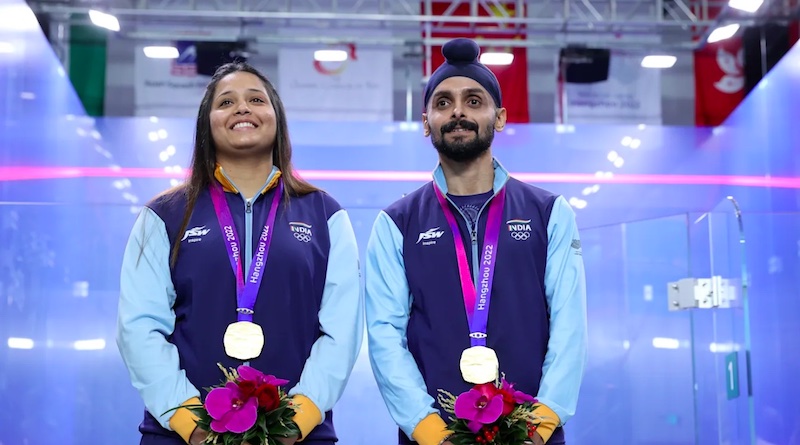
In the Hangzhou Asian Games, India recorded its biggest ever win in hockey defeating its arch rival 10-2. The previous best was 7-1. And in Hangzhou, except for volleyball where Pakistan men beat India 3-0 to take the fifth position, India was victorious in all other contests, including kabaddi for men. Indian women beat Pakistan in squash and also in individual contests in singles and mixed doubles, Indians were victorious.
Squash at the Asian Games 2023: Dipika Pallikal and Harinder Pal Sandhu (photo) won a gold in the mixed doubles event, while India also picked up a gold in the men’s team event after beating rivals Pakistan in the final – Photo: Hangzhou2022.cn
The most recent healthy rivalry has been in athletics where the new World and Olympic champion Neeraj Chopra has been scoring over his Pakistani rival Arshad Nadeem. Unfortunately, an injury kept Arshad Nadeem out of the Hangzhou Asian Games.
Pakistan had its share of dominance in Squash. Jahangir Khan and then Jansher Khan dominated the global scene together for more than two decades. They were unbeatable. This is one sport other than hockey that Pakistan dominated at the global level. Sri Lanka had produced some good runners, especially sprinters, other than cricket players.
Bangladesh has inherited its strengths from undivided Pakistan and has built a good will on the cricket front by quickly ascending to the status of a Test playing nation. It has done well in soccer also.
Internal strife, deteriorating fiscal health and vendetta politics have brought Pakistan sports to a piquant situation. The congenial and healthy atmosphere needed for development of sports has almost disappeared from the horizon. The only hope of its revival can be revival of sporting relations with neighbours in general and India in particular. But as of now, this seems to be a distant possibility. Historically, undivided India was a cradle of sports. Before and after partition, sports men and women from the northern part of this region – East and West Punjab – had an excellent crop of sportsmen and women. Some of the greats of Asian sports like sprinters, middle and long distance runners, hurdlers, throwers and jumpers – all came from this region.
If Pakistan Punjab had Abdul Khaliq as the fastest man of Asia, India had Flying Sikh Milkha Singh, and strong quarter mile in Makhan Singh, besides sprinter Ajmer Singh. India at that stage dominated all throwing events through men like Parveen Kuma, Bahadur Singh, Gurdeep Singh and Parduman Singh besides ace hurdler GS Randhawa, middle distance runner Sriram Singh and long distance runners like Hari Chand and Shivnath Singh. PT Usha, TC Yohannan and Suresh Babu came from South to put India on Asian dominance. One reason for the emergence of Indian athletes was their regular competitions with athletes from Pakistan in dual, triangular and invitation meets.
Of all South Asian nations, India has made rapid strides in sports. Now its athletes are doing well not only at the level of Asian Games or Commonwealth Games but also in Olympic Games. Medals in the Olympic Games have given a major boost. After Abhinav Bindra won the country’s first individual gold in shooting in Beijing, Neeraj Chopra has taken it a step forward with Olympic gold in javelin in the Tokyo 2020 Olympic games. He added another feather to his cap when he won the World championship title in Budapest weeks before the Asian Games.
Leander Paes put India on the Olympic tennis map with a bronze at Atlanta in 1996. Saina Nehwal and then PV Sindhu have taken badminton to a new level with medals in the London, Rio and Tokyo Olympic Games. Boxers, wrestlers, shooters are not far behind and India has asserted itself as a sports leader of South Asia as well. It needs to play a role in helping the other member nations of the region to come up to a level that they also become contenders for Olympic medals than remain in “also ran category”.
Limits on resources notwithstanding, holding frequent sporting events among member nations of the region with athletes from across the borders shall not only provide qualitative competitions but also help build the finance-starved associations. Interestingly, these competitions, especially those involving India and Pakistan, always drew overwhelming public response. The growing opposition to holding of bilateral sports meets is only a recent phenomenon that started growing in dimensions after the terror strikes in Mumbai. Besides, the Kashmir controversy added fuel to the fire and the sports rift started widening. It has now reached a level where only a bold decision, a strong political statement by both the nations, can revive the bilateral relations.
Besides athletics, hockey and cricket were other sports that benefited from these bilateral sports events.
Afghanistan has been no better. Devastated by internal strife, the country completely lost out on the sports front. Its strength was in some individual sports, including wrestling, besides football as a team game. Of late it has shown some promise in shorter versions of cricket. Again, it will need support and competition from neighbours, especially India, to continue its march forward in cricket.
Bangladesh and Nepal have limited resources but have a good base for the development of sports. The South Asian Federation (SAF) Games have been a great help not only in building sports infrastructure but also in raising the standard of games and sports.
What the region needs is better cooperation and sharing of resources for a healthier and stronger sports environment. They all look towards their bigger brother, India, who has quickly assumed the role of a new leader not only of South Asia but Asia as well.
(Prabhjot Singh is a veteran journalist with over three decades of experience of 14 years with Reuters News and 30 years with The Tribune Group, covering a wide spectrum of subjects and stories. He has covered Punjab and Sikh affairs for more than three decades besides covering seven Olympics and several major sporting events and hosting TV shows.)
ASIA SAMACHAR is an online newspaper for Sikhs / Punjabis in Southeast Asia and beyond. When you leave a comment at the bottom of this article, it takes time to appear as it is moderated by human being. Unless it is offensive or libelous, it should appear. You can also comment at Facebook, Twitter, and Instagram. You can reach us via WhatsApp +6017-335-1399 or email: asia.samachar@gmail.com. For obituary announcements, click here.
ASIA SAMACHAR is an online newspaper for Sikhs / Punjabis in Southeast Asia and beyond. When you leave a comment at the bottom of this article, it takes time to appear as it is moderated by human being. Unless it is offensive or libelous, it should appear. You can also comment at Facebook, Twitter, and Instagram. You can reach us via WhatsApp +6017-335-1399 or email: asia.samachar@gmail.com. For obituary announcements, click here
Sikh Welfare Council (SIWEC) confronts funding and manpower challenges amid a bleak economic environment even as the social service agency strives to provide services to a growing pool of beneficiaries.
These are the immediate priorities identified by the newly appointed management committee (MC) after its annual general meeting in July. The MC led by Manmohan Singh will serve for a two-year period until 2025.
As a comparatively small social service agency in Singapore, SIWEC’s operating annual budget will increase significantly, impacted by rising inflation and cost of living.
“There are three aspects to how we view our challenges. On one hand there are more charities being set up in Singapore, all competing to attract increasingly scarce charity dollars,” Manmohan told Asia Samachar.
“Each of these agencies are competing to attract the limited pool of qualified and experienced social workers, counsellors, therapists and support staff to join them. Consequently, we need to redouble our fund-raising efforts. My team will co-opt talented volunteers with appropriate skill-sets to bolster our fund-raising drives in creative ways.”
Singapore’s GDP growth is projected to moderate significantly this year, in line with the global downturn. The resulting domestic economic slowdown could be deeper than anticipated, according to a recent statement by the Singapore Monetary Authority (MAS).
Manmohan, a long time volunteer with SIWEC, was its vice chairman over the last eight years. He takes over from Harmit Singh, also a long-serving volunteer who had served as chairman since 2021. Harmit continues to serve in the present committee as member in charge of bereavement support.
Launched in 1995, SIWEC is one of the key Sikh institutions in Singapore.
Over the past two and a half decades, it has evolved from providing basic assistance to needy Sikh families to offering a wide range of social, financial, educational and mental health support services, to assist the wider Singapore community as well.
2022 IN ACTION: (Clockwise, from left). 1. Then Senior Minister Tharman Shanmugaratnam visiting SIWEC booths at Naam Ras 2022. 2. Team Theek Thak launching Are We Listening? mental health resource kit at Naam Ras 2022 proudly. 3. SIWEC hosted Singapore lawmaker Rahayu Mahzam and officials from the Health Promotion Board (HPB) on Aug 30, 2022. 4. SIWEC logo
Manmohan said that SIWEC needs to continue to match social-service sector salaries in order to attract and retain qualified staff to join and to serve with the council.
“In parallel, our standards of governance and programme delivery will need to be continually strengthened,” he added.
In 2022, SIWEC saw a two-fold increase in the total number of supported families in 2021 – with a total amount of S$205,850 disbursed, according to its 2022 annual report.
Manmohan added, “In mid-2023, SIWEC is assisting even more families with financial assistance and family support than we did at the same point in 2022. We are providing more funds monthly to each family in view of the increased costs of living. Hence, we feel the urgency to increase our donor outreach and raise more funds to ensure that our support to affected families can be sustained without disruption.“
Education Support: Reflecting its belief that that education is key to progress in life for youth, SIWEC provides educational support in the form of subsidised books, tuition, bursaries and scholarships. They seek to empower young minds from vulnerable families to motivate them to strive to achieve their fullest potential.
Active Ageing & Healthcare: One of the best subscribed programmes in SIWEC are the centre-based activities for active seniors, to ensure their holistic mental and physical well-being.
For the less mobile and active seniors, fortnightly befriending visits are organised to engage those residing at home or in long-term care institutions.
Social Support Programs: A range of programs including financial assistance, family mediation, counselling and psycho-social / mental health support, information and referral – all reflect how the diverse needs of individuals and families facing challenging circumstances are met.
SIWEC operates a one stop drop-in centre and a 24/7 hotline to provide timely assistance to help-seekers, including referring clients to appropriate specialised services and agencies, whilst providing logistics, grief support and advice during Sikh family bereavements.
Community Engagement Initiatives: SIWEC organises outreach activities to bring people from different walks of life and backgrounds closer, nurturing a spirit of unity and inclusive support for the less fortunate.
Two such initiatives are the highly successful Ride2Serve fund-raising annual rides from Malaysia to Singapore.
The other is a movement called Theek Thak which promotes awareness and support to seek help for those experiencing mental health issues.
ASIA SAMACHAR is an online newspaper for Sikhs / Punjabis in Southeast Asia and beyond. When you leave a comment at the bottom of this article, it takes time to appear as it is moderated by human being. Unless it is offensive or libelous, it should appear. You can also comment at Facebook, Twitter, and Instagram. You can reach us via WhatsApp +6017-335-1399 or email: asia.samachar@gmail.com. For obituary announcements, click here
There are no goodbyes for us. Wherever you are, you will always be in our hearts. Deeply missed and forever cherished.
Husband: Major (Rtd) Ranjit Singh
FIRST BARSI PRAYERS
Sukhmani Sahib Prayers : 14th October 2023, 2 – 4p.m., at Gurdwara Sahib Seremban, Jalan Yam Tuan, Bandar Seremban, 70000 N.S. Guru ka Langgar will be served.
ASIA SAMACHAR is an online newspaper for Sikhs / Punjabis in Southeast Asia and beyond. When you leave a comment at the bottom of this article, it takes time to appear as it is moderated by human being. Unless it is offensive or libelous, it should appear. You can also comment at Facebook, Twitter, and Instagram. You can reach us via WhatsApp +6017-335-1399 or email: asia.samachar@gmail.com. For obituary announcements, click here
ASIA SAMACHAR is an online newspaper for Sikhs / Punjabis in Southeast Asia and beyond. When you leave a comment at the bottom of this article, it takes time to appear as it is moderated by human being. Unless it is offensive or libelous, it should appear. You can also comment at Facebook, Twitter, and Instagram. You can reach us via WhatsApp +6017-335-1399 or email: asia.samachar@gmail.com. For obituary announcements, click here
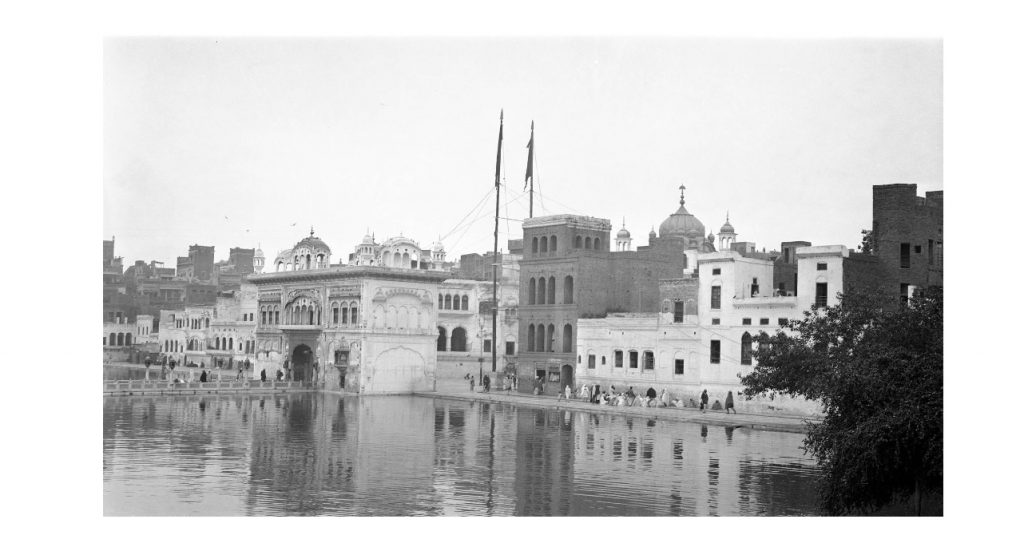
The view of the pool and buildings surrounding Darbar Sahib, Amritsar, in a photograph dated Jan 16, 1938 by Frederick G Clapp. Photo repository: American Geographical Society Library, University of Wisconsin-Milwaukee Libraries
ASIA SAMACHAR is an online newspaper for Sikhs / Punjabis in Southeast Asia and beyond. When you leave a comment at the bottom of this article, it takes time to appear as it is moderated by human being. Unless it is offensive or libelous, it should appear. You can also comment at Facebook, Twitter, and Instagram. You can reach us via WhatsApp +6017-335-1399 or email: asia.samachar@gmail.com. For obituary announcements, click here