












UA-56202873-1
Page 238

Nepali Literature on Sikhism

0
Cover pages of books in Nepali. Top row, L-R: Guru Nanak Ra Char Mahapurush Ko Charitra, Sikh Dharma Ko Roop Rekha, Hindu Dharma Ra Sikh Itihas and Niyamit Niyam. Botton, L-R: Ik Onkar Sukhmani Sahib, Ek Parmeshwar Pravartak – Shri Jagadguru Guru Nanak, Sikh Dharma Ra Jiwan, Mahan Guru – Guru Nanak Dev Ji and Mahan Sant Sipahi – Guru Gobind Singh Ji

By Santokh Singh Bains | Opinion |

Nepali (also known as Nepalese, Gorkhali, Gurkhali, and Khas Kura) actually belongs to the Indo-European language family. It originated from the group of Pahari languages. The written form of Nepali was recognized in the 12th century AD; that was in the Devanagari alphabet derived from the Brahmi script (11th century AD).

Nepali became the national language of Nepal after a royal proclamation by King Mahendra. In fact a week before the Himalayan country’s parliamentary elections in 1959, King Mahendra unilaterally proclaimed a new constitution for the country. One of the last and short articles was as follows: “ The national language of Nepal shall be Nepali in the Devanagari script.”

Now Nepali is the mother tongue of almost two third of the Himalayan country’s population. The central government as well as the provincial governments of the country use Nepali as a day-to-day language.

In India, West Bengal has the maximum number of Nepali-speaking people; they are concentrated in Darjeeling district. Sikkim, however, has the highest density as 63% people of this state speak Nepali. As regards Assam, there are more than 5 lakh Nepali-speaking people in this North Eastern province. Also, there are many Nepali speakers in Arunachal Pradesh, Himachal Pradesh, Manipur, Meghalaya, Mizoram, and Uttarakhand.

In 1992, Nepali language was included in the Eighth Schedule of the Indian constitution. Hence, National Book Trust, which is an Indian publishing house functioning as an autonomous body under the Indian Government’s Ministry of Education, has been publishing Nepali books for almost three decades. The NBT had published excellent English books on Guru Nanak and Guru Gobind Singh which were authored by Dr. Gopal Singh. In spite of repeated requests, the NBT did not agree to publish Nepali versions of these two outstanding books.

Amongst India’s neighbouring countries, Nepali is widely spoken in Bhutan as well as in some parts of Myanmar (Burma).

Among the early Sikh writers in Nepali language, the name of Hardayal Singh (1936-2006), who was an engineer in Nepal’s Roads Department, is quite significant. He was also known as Hardayal Singh Gupta, Hardayal Singh Nepali, and Engineer Hardayal Singh.

His first Nepali book titled Guru Nanak Ra Char Mahapurush Ko Charitra (22 pages) was published in 1975. This interesting book provided brief descriptions of five religious leaders – Guru Nanak, Guru Gobind Singh, Guru Tegh Bahadur, Shri Krishna, and Gautam Buddha.

His next Nepali book titled Sikh Dharma Ko Roop Rekha (61 pages) was brought out in 1994; it was a suitable introduction to the Sikh religion for Nepali readers.

Hardayal Singh’s third book titled Hindu Dharma Ra Sikh Itihas (78 pages) was published in 1999; it threw light on the Sikh history from a Hindu religious perspective.

Trying his hand at translation from Punjabi to Nepali, Hardayal Singh came forward to translate the entire Nitnem into Nepali; this Nepali book titled Niyamit Niyam (194 pages) was published in 2002.

Thereafter, the Sikh writer translated Sukhmani Sahib into Nepali; this book of 168 pages was published in 2004. These two translations were quite important because they provided a great opportunity to Nepalese people to read the Sikh scriptures in their own language.

Besides authoring the above-mentioned five unique books in Nepali language, Hardayal Singh used to frequently write Nepali articles on the Sikh Gurus and the Sikh religion. His first Nepali article titled Hindu Dharma Ka Sanrakshak — Guru Nanak was published in Gorkha Patra, a prestigious Nepali daily newspaper published from Kathmandu, on 15 January 1968. Another significant Nepali article on Guru Nanak penned by him was published in Bharat Samachar on 10 November 1971; it was titled Yug Purush Guru Nanak. A brief introduction to the Sikh religion was provided by Hardayal Singh in his article titled Sikh Dharma Kay Ho; this informative Nepali article was published in Gorkha Patra in its issue dated 28 August 2002. Nepal Samachar Patra published his article captioned Guru Nanak Ko Sewa Ra Samarpan Bhav on 20 September 2004.

Hardayal Singh’s numerous articles were published from time to time in Nepali newspapers and magazines like Gorkha Patra, Kantipur, Bharat Samachar, Nepal Samachar Patra and Yuwa Manch. At the time of Gurpurabs (particularly the birth anniversary of Guru Nanak and Baisakhi), his appropriate Nepali articles on Guru Nanak and Guru Gobind Singh were usually published in in Kathmandu-based Nepali newspapers.

Before Hardayal Singh passed away on 12 November 2006, he wrote scores of Nepali articles on the Sikh Gurus as well as on the Sikh religion and the Sikh history. It may be mentioned here that Nepal was a Hindu kingdom at that time. Hence, many of Hardayal Singh’s Nepali articles were written in such a way that they would appeal to devout Hindu Nepalis of the Himalayan country.

Way back in 1975, Kathmandu Gurdwara Committee had published an informative Nepali book on the founder of Sikhism. This 55-page book titled Ek Parmeshwar Pravartak – Shri Jagatguru Guru Nanak was authored by Prakash Gauchan.

In 1986, a small Nepali book titled Sikh Dharma Ra Jiwan was published by Sri Guru Singh Sabha, Siliguri (Siliguri Gurdwara). This appealing book, which was written by Prof. Haren Ghosh, briefly explained the basic aspects of Sikhism for Nepali readers.

Dr. Mahesh Raj Pant, a Kathmandu-based scholar, has been writing outstanding Nepali articles on diverse topics from time to time for various Nepali publications. His unique article titled Us Jamana Ko Sikh Dharma was published on 24 November 2018 in Annapurna, a daily Nepali newspaper published from Kathmandu. Dr. Pant’s new Nepali book provides authentic information on lands donated by different kings for spreading Guru Nanak’s mission in the Himalayan country.

Jaspal Singh, a Birgunj-based enthusiastic activist and prolific writer who is also the President of Shree Guru Nanak Service Foundation, has been writing captivating Nepali articles on the Sikh Gurus and the Sikh faith. Through his effective writings, he has also been highlighting genuine problems being faced by the country’s minority communities like the Sikhs. From time to time, his numerous articles have appeared in Nepali publications like Prateek, Nagrik, and Sarokar Today.

In 2022, an illustrated Nepali book titled Mahan Guru – Guru Nanak Dev Ji was published by New Delhi-based Sikh Foundation. Originally published in English, Punjabi and Hindi, the book was rendered into Nepali by Matrika Prasad Lamsal who is a Kathmandu-based teacher and writer.

In the present year, the Sikh Foundation published another gripping illustrated book in Nepali language; this excellent book is titled Mahan Sant Sipahi – Guru Gobind Singh Ji. The Foundation is now planning to publish an illustrated Nepali book on Guru Tegh Bahadur in near future.

It is quite possible that there may be some old Nepali records concerning the Sikh Gurus (particularly Guru Nanak), Maharaja Ranjit Singh, Rani Jind Kaur, and earliest Sikh settlers in Nepal. Some dedicated researcher(s) need to come forward to dig into the archives in Nepal. Also, it is possible that some very old Nepali books lying in Kathmandu’s oldest library can throw light on the above-mentioned topics. Some eminent university of Punjab like Patiala-based Punjabi University or Amritsar-based Guru Nanak Dev University should undertake the much needed research as soon as possible. Otherwise some Nepal-based scholar should be persuaded and financially supported to undertake such a worthy project.

Santokh Singh Bains is a Chicago based writer and free lance journalist. His debut book titled Sikhs, Sikhism and the World was published in 2019. He can be reached at santokhbains713@gmail.com

* This is the opinion of the writers, organisation or publication and does not necessarily represent the views of Asia Samachar.

RELATED STORY:

Christian Invasion of Punjab: A Major Demographic Change in Offing (Asia Samachar, 9 Nov 2021)

ASIA SAMACHAR is an online newspaper for Sikhs / Punjabis in Southeast Asia and beyond. When you leave a comment at the bottom of this article, it takes time to appear as it is moderated by human being. Unless it is offensive or libelous, it should appear. You can also comment at FacebookTwitter, and Instagram. You can reach us via WhatsApp +6017-335-1399 or email: asia.samachar@gmail.com. For obituary announcements, click here.

Personal Ode to Guru Amar Das

0

By: Bhupinder ‘Bo’ Singh | Sikh History |

Introduction

A few months back I just turned 73 and now that Guru Amar Das Ji’ Parkash Purab (DOB 5 May 1479) is approaching, it reminded me that he became Guru in 1552 when he was 73. I was surely in awe with Guru Ji’s spiritual accomplishments after he embarked on this path at age of 62. This was the time he visited Second Guru Angad Ji and decided to dedicate himself to service. By the dint of his sheer selfless service, he had endeared himself to the Guru, who before his departure from this world had anointed him as his successor the third Guru. While admiring the spiritual accomplishments of Guru Amar Das Ji, I was thinking about his excellent physical condition that enabled him to undertake such a rigorous and physically demanding daily routine. Every morning, He used to carry water from the river for Guru Angad’s bath. He couldn’t bear giving his back to the Guru, so he would walk backwards on his way to the river. He was already in his 70s!

He got up very early every morning in Goindwal and walked to river Beas and brought a pitcher of water to Khadur Sahib about 5km away for Guru Angad’s bath. After giving Guru Ji a bath, he would join the congregation to listen to the singing of hymns and spiritual discourses. This routine continued uninterrupted for 12 years without a break for any inclement weather, being tired out of stamina, or personal health issues. Then he would work in the langar or free kitchen bringing well water for drinking and firewood. Then he would clean and wash the utensils. It can be unhesitatingly said that his commitment and dedication were legendary. His untiring daily regimen truly reflected his words that Guru oriented never get physically old:

“ਗੁਰਮੁਖਿ ਬੁਢੇ ਕਦੇ ਨਾਹੀ ਜਿਨ੍ਹ੍ਹਾ ਅੰਤਰਿ ਸੁਰਤਿ ਗਿਆਨੁ ॥”

Gurmukh budde kadhe naahee jin(h)aa antar surat giaan.” (SGGS, Pg. No. 1418)

Translation: The Gurmukhs never grow old; within they are attuned to the remembrance of Almighty, along with spiritual understanding and wisdom.

His composition “Anand” consisting of 40 stanzas is the epitome of the human spiritual flight of bliss. No Sikh religious service is complete without recitation of this composition. The opening lines reveal how this eternal bliss is obtained through the Guru via Guru’s shabad. Elsewhere Guru Amar Das Ji has again revealed that he experienced this bliss through Guru’s Shabad as: 

“ਇਸੁ ਗੁਫਾ ਮਹਿ ਅਖੁਟ ਭੰਡਾਰਾ ॥
ਤਿਸੁ ਵਿਚਿ ਵਸੈ ਹਰਿ ਅਲਖ ਅਪਾਰਾ ॥
ਆਪੇ ਗੁਪਤੁ ਪਰਗਟੁ ਹੈ ਆਪੇ ਗੁਰ ਸਬਦੀ ਆਪੁ ਵੰਞਾਵਣਿਆ ॥੧॥”

“Eis gufaa meh akhuT bhanddaaraa.
Tis vich vasai har alakh apaaraa.
Aape gupat paragaT hai aape gur sabadhee aap va(n)n(j)aavaniaa. 1.”
  (SGGS, Pg. No. 124)

Translation: Within this (body) cave, there is an inexhaustible treasure.
Within this (body) cave, the Invisible and Infinite Lord abides.
He Himself is hidden, and He Himself is revealed; through the Word of the Guru’s Shabad, those who give up their selfishness (ego) see Him everywhere. ||1||

In this way Guru Ji has shared with us that the ultimate goal of human life is to experience bliss of Anand. Anand is the only experience for which there is no opposite counterpart exists like all other worldly experiences as happiness has sadness, good has bad etc. He has also shared with us what is preventing us from experiencing it. Guru Ji says:

“ਜਨਮ ਜਨਮ ਕੀ ਇਸੁ ਮਨ ਕਉ ਮਲੁ ਲਾਗੀ ਕਾਲਾ ਹੋਆ ਸਿਆਹੁ ॥
ਖੰਨਲੀ ਧੋਤੀ ਉਜਲੀ ਨ ਹੋਵਈ ਜੇ ਸਉ ਧੋਵਣਿ ਪਾਹੁ ॥”

“Janam janam kee is man kau mal laagee kaalaa hoaa siaahu.
Kha(n)nalee dhotee ujalee na hoviee je sau dhovan paahu.”
(SGGS, Pg. No. 651)

Translation: The filth of countless incarnations sticks to this mind; making it pitch black. The oily rag (used by oilman to extract oil from seeds) like mind cannot be cleaned by merely washing it, even if it is washed a hundred times.    

He organized and provided a structure to the growing Sikh community by setting up manji systems. He founded the city of Goindwal and the visionary of the holy city which we now know as Amritsar the holiest Sikh shrine. He continued to lead an active life discharging all of his responsibilities till the ripe age of 95 years, departing from this world on September 01, 1574. The scene of his departure was captured by his grandson Baba Sundar Ji, which is preserved in Sri Guru Granth Sahib. The last command of Guru Ji has been captured as:

“ਅੰਤੇ ਸਤਿਗੁਰੁ ਬੋਲਿਆ ਮੈ ਪਿਛੈ ਕੀਰਤਨੁ ਕਰਿਅਹੁ ਨਿਰਬਾਣੁ ਜੀਉ ॥
ਕੇਸੋ ਗੋਪਾਲ ਪੰਡਿਤ ਸਦਿਅਹੁ ਹਰਿ ਹਰਿ ਕਥਾ ਪੜਹਿ ਪੁਰਾਣੁ ਜੀਉ ॥
ਹਰਿ ਕਥਾ ਪੜੀਐ ਹਰਿ ਨਾਮੁ ਸੁਣੀਐ ਬੇਬਾਣੁ ਹਰਿ ਰੰਗੁ ਗੁਰ ਭਾਵਏ ॥”

“A(n)te satigur boliaa mai pichhai keeratan kariahu nirabaan jeeau.
Keso gopaal pa(n)ddit Saddiahu har har kathaa paReh puraan jeeau.
Har kathaa paReeaai har naam suneeaai bebaan har ra(n)g gur bhaave.”
(SGGS, Pg. No. 924)

Translation: Finally, the True Guru said, “When I am gone, sing only Kirtan in Praise of the Lord.” Call in the long-haired scholarly Saints of the Lord, to read the sermon of the Lord, Har, Har. Read the sermon of the Lord and listen to the Lord’s Naam; the Guru is pleased with love for the Lord.

I was pondering that this is the age bracket when people retire from work and start taking life easy. Besides on entering this age bracket, one is also beset with health-related issues termed as geriatric decline. While just counting my own health blessings, I started wondering about my own spiritual journey remaining to be completed. I have been blessed with multiple cultural, social, and religious exposures. I have had experience of living in the poorest countries and the richest countries. I had been privileged with the opportunity to study Guru Granth Sahib, the universal Holy Scripture. Some of my own understanding of it, I have tried to share with others. I am thankful that I am relatively healthy, fully capable of fending for myself. I have seen many reduced to a fraction of their previous self, because of dementia, Alzheimer, arthritis, stroke, heart disease, diabetes, or other health issues.

I have had my own share of health issues, but it is all part of the life package and growing old. While thinking about them my heart started reminiscing about them:

Shoulder Problem

How can I forget that Friday? It was the day when the official declaration of Covid-19 pandemic had been made and everything was shut down. We took our 4-year-old triplet grandkids to the neighborhood park. On reaching the park the triplets started playing on the parallel bars. The oldest of the triplets by less than 5 minutes asked me to lift her up so that she could grab the bars. I picked her up, while trying to raise her above my shoulders; suddenly I heard a loud popping sound from the right shoulder. I was in a severe pain which forced me to land her back on the ground. The kids continued playing and having a good time in the park, while I started agonizing in pain.

After sunset we all came back home. Still in pain, reluctant to schedule a visit to the Doctor because of Covid-19, I was hoping for pain to slowly go away on its own. But the pain did not show any sign of abating. It started feeling like it had become my constant companion and a reminder of the fragility of life. After living with the pain for over 2 months, I decided that a visit to the doctor’s office will be in order. I had now realized that it was something more than a muscle cramp, started wondering if it could be something more serious like shoulder dislocation. Every movement of the hand over shoulder was greeted with the ratcheting sound of the socket joint and a shooting pain. It was in a way triggering a reminder of the bonus life span that I was enjoying after turning 70. The pain, though not agonizing yet, was more of an annoyance, even making the combing of hair very challenging. Finally, I secured an appointment. The doctor’s office visit turned out to be an altogether new experience with the Covid-19 driven regimen right from the lobby, till walking out of the building at the completion of the visit.

This visit acted as a refresher of our changed world reality due to the Covid virus. After the examination of the shoulder followed by a set of X-Rays, the doctor presented his report to me. The doctor said that I had Acromioclavicular osteoarthritis (AC). I inquired how long it will take for the pain to go away. I was told that it will not abate. I asked what my options were? Doctor said:

  • Live with it if I can handle the pain.
  • Apply ice pack to the joint as it will decrease the pain and the inflammation at the joint.
  • Steroid (Cortisone) injections for treatment of moderate to severe pain.
  • The final and the last option was shoulder surgery.

While I am thankful that this AC joint issue is not life threatening, but a new life reality. No! No! It was not a Covid-19 induced life reality, but actually an old age reality providing a constant reminder that ‘expiry date’ is approaching. The thing about expiry date is we check on products before we buy them at stores. But what about our own expiry date? It is neither outside visible to others; nor it is inside visible to us alone. Suddenly a thought came that when the conditions from Covid-19 become normal again, and I was going to fly somewhere, I will have to ask for help to stow my handbag in the overhead compartment.

Knee problem

In 2016 I had pain in my left knee joint. I had been to the doctor who told me that this was a normal age-related wear and tear of the cartilage in the knee joint. He recommended physiotherapy, exercises and wearing a knee-brace to support the joint. Fortunately for me these things worked, and I am able to continue with my normal life. When I go to gym, I can see many folks in my age group wearing braces on knees and ankles during games or workout. So, this age-related deterioration is not uncommon. Luckily for me I still manage to have my mobility without a brace or continued joint strengthening exercises.

Nocturia

Besides the issues mentioned I also have enlarged prostrate that necessitates making frequent terms to restroom at night to void my bladder. The medical term for this condition is nocturia and its cause is again age related. Sure enough, after returning from the trip to the restroom, it is not easy to go back to sleep thus disturbing the sound sleep and makes getting up early morning a challenge as body is not fully rested.

Conclusion

So, the point that I am trying to make is that even without any serious debilitating health issues, we all will face age related deterioration to functioning of this wonderful creation called human body. What Guru Amar Das did was extremely admirable, as he was able to commit to serving the Guru along with the sangat at the age when we see that people in this age bracket are being served or taken care of. His dedication and his enthusiasm was legendary while his physical stamina was untiring, his mental strength was like a mountain peak. He was ever willing and ready to render service to everyone. Bhatt Bhall salutes Guru Ji in these words:

“ਭਲੇ ਅਮਰਦਾਸ ਗੁਣ ਤੇਰੇ ਤੇਰੀ ਉਪਮਾ ਤੋਹਿ ਬਨਿ ਆਵੈ ॥੧॥੨੨॥”

“Bhallae amardas gun tere teree upamaa toh ban aavai. 1.22.” (SGGS, Pg. No. 1396)

Translation: O Guru Amar Das, Your Glorious Virtues are so sublime that they are beyond description; Your Praises are really deserving only to You and no one else. ||1||22||

What he achieved in 12 years we cannot even hope to achieve in whole life. May we all pray that he blesses us with physical and mental strength even in our old age, so that we can dedicate that time to meditation, prayers and understanding Gurbani and attempt to become enlightened.

References:

  1. Singh, Taran. Guru Amar Das – Jeewan, Rachna tae Sikhia. Publications Bureau, Punjabi University, Patiala.
  2. Singh, Prof. Sahib. Sri Guru Granth Sahib Darpan. Volume 10. Raj Publishers, Jalandhar.
  3. www.Sikhitothemax.com
  4. www.Srigranth.org

Bhupinder ‘Bo’ Singh, Houston. Born in Bhamo, Myanmar, he now lives in Houston, US, where he runs a manufacturing company formed with his son. A mechanical engineer by training, he has authored a number of books, including Connecting with the Master – A collection of essays on topics related to Sikhism (2006) and In Bully’s Eyes – An Illustrated Children’s book on Bullying (2019).

RELATED STORY:

Inspiring Life of Guru Gobind Singh Ji (Asia Samachar, 17 Jan 2023)

ASIA SAMACHAR is an online newspaper for Sikhs / Punjabis in Southeast Asia and beyond. When you leave a comment at the bottom of this article, it takes time to appear as it is moderated by human being. Unless it is offensive or libelous, it should appear. You can also comment at FacebookTwitter, and Instagram. You can reach us via WhatsApp +6017-335-1399 or email: asia.samachar@gmail.com. For obituary announcements, click here.

Sardar Narpal Singh Mangat (1943 – 2023), Air Panas, Setapak

SARDAR NARPAL SINGH MANGAT S/O LATE PURAN SINGH MANGAT

Air Panas, Setapak

Village: Abhipur; District: Ropar

Leaving Behind:

Wife: Mahinder Kaur (Mindy)

Children / Spouse:
Manjit Singh / Harwin Kaur
Gurdev Singh

Grandchild: Gurveer Singh

Akhand Path will commence on 12th May 2023 (Friday) at 4:00 pm to 14th May 2023 (Sunday) at the Small Darbar, Gurdwara Sahib Titiwangsa.

Path Da Bhog: 14th May 2023 (Sunday), from 5:00 pm to 7:00 pm at the Main Darbar, Gurdwara Sahib Titiwangsa.

For further details please contact:
Manjit Singh – 012-9253392
Gurdev Singh – 019-6974520
Sarjit Singh – 012-2050240

We sincerely thank everyone for their condolences, prayers, assistance, love and support during this period of bereavement.

| Entry: 3 May 2023; Updated: 10 May 2023 | Source: Family

ASIA SAMACHAR is an online newspaper for Sikhs / Punjabis in Southeast Asia and beyond. When you leave a comment at the bottom of this article, it takes time to appear as it is moderated by human being. Unless it is offensive or libelous, it should appear. You can also comment at FacebookTwitter, and Instagram. You can reach us via WhatsApp +6017-335-1399 or email: asia.samachar@gmail.com. For obituary announcements, click here

Port Dickson gurdwara to undergo renovations after 49 years

Front view of GS Port Dickson in a 2022 photograph. Inset: Post rennovation, south elevation

By Asia Samachar | Malaysia |

It is now close to five decades that the Port Dickson gurdwara building last underwent any significant renovations.

The gurdwara on the beach front in the Malaysian state of Negeri Sembilan is in need of long overdue renovation, left in the hands of the 30-odd Sikh families living there.

Some 11 years ago, they had resolved to kick start the work, including repairing the termite-infested first floor wooden flooring and other structural issues. But lack of funds held them back.

On April 24, 2023, the local community took the plunge to forge ahead with the renovation work estimated to cost RM3 million. At this point, they have collectively raised RM1.5 million.

“The condition of our wash rooms are very bad. We need to replace the old gas pipes and gas stoves in the kitchen. The roof is leaking and the first floor wooden flooring needs changing,” Gurdwara Sahib Port Dickson management committee secretary Ravinder Singh told Asia Samachar. “We seek the support of Sanggat in Malaysia and elsewhere.”

Many Sikh families have visited the gurdwara when making trips to the beaches in Port Dickson. Now, that is just one reason why we should keep this gurdwara up and running.

Contact details: GSPD management committee president Sarjeet Singh, +6019-9314861

Banking Details — Account Name: GSPD Building Fund; Account Number: 8004 4868 13; Bank: CIMB

Darbar Sahib of Gurdwara Sahib Port Dickson captured in October 2022 – Photo: Asia Samachar
The entrance to Gurdwara Sahib Port Dickson captured in October 2022. At the top end is the beach and the Straits of Malacca - Photo: Asia Samachar
The entrance to Gurdwara Sahib Port Dickson captured in October 2022. At the top end is the beach and the Straits of Malacca – Photo: Asia Samachar

RELATED STORY:

Spanking new darbar sahib for Johor Bahru gurdwara (Asia Samachar, 12 April 2023)

ASIA SAMACHAR is an online newspaper for Sikhs / Punjabis in Southeast Asia and beyond. When you leave a comment at the bottom of this article, it takes time to appear as it is moderated by human being. Unless it is offensive or libelous, it should appear. You can also comment at FacebookTwitter, and Instagram. You can reach us via WhatsApp +6017-335-1399 or email: asia.samachar@gmail.com. For obituary announcements, click here.

NUS tells us more about Visiting Chair for Sikh Studies programme

By Asia Samachar | Singapore |

The National University of Singapore (NUS) hopes that the Visiting Chair for the Sikh Studies programme will provide the expertise for its students to undertake courses on Sikhism regularly and bolster research in the field of Sikh Studies.

“Through public lectures and interaction, we also hope that the visiting professors will facilitate NUS’s wider aim of community engagement,” the university tells Asia Samachar in an interview.

NUS, one of the world’s top universities, is expected to introduce the first module of its Sikh Studies programme in the semester starting August 2023, as part of the introduction of the visiting chair.

Dr Jasjit Singh from the University of Leeds has been appointed as the first Visiting Chair for the Sikh Studies programme at the National University of Singapore (NUS).

The appointment is a major milestone in the introduction of the Sikh studies mooted by the Central Sikh Gurdwara Board (CSGB).

The appointment was announced at the conclusion of a recent akhand path in conjunction with the Vaisakhi celebration at the Central Sikh Temple Singapore.

In April 2022, NUS Faculty of Arts and Social Sciences (FASS) and the CSGB signed a Memorandum of Understanding (MoU) to formalise the visiting professorship expected to commence in 2023. It is expected to promote academic scholarship in Sikh studies both in Singapore and globally.

Jasjit is an associate professor in the School of Philosophy, Religion and the History of Science at the University of Leeds.

He completed his PhD titled ‘Keeping the Faith: The Transmission of Sikhism among young British Sikhs’ in 2012 and was awarded ‘Research Excellence’ status by his examiners. His research examines religious identity and processes of religious transmission among Sikhs in Diaspora.

EXCERPTS FROM THE INTERVIEW

How did the idea of setting up the Visiting Professorship in Sikh Studies come about?

The establishment of the Visiting Professorship in Sikh Studies (Professorship) was mooted by the Central Sikh Gurdwara Board (CSGB) Singapore. The leadership of CSGB was keen that students – both Sikhs and those from other communities – at the National University of Singapore should have options to study key aspects of the Sikh Way of Life.

How long has it taken for NUS to decide to move forward with this project? What was the timeline?The South Asian Studies Programme (SASP) at NUS was keen to move forward with this project as soon as it was introduced. SASP has long held considerable expertise in the study of South Asian religions although, due to a lack of expertise, the programme has not been able to offer specialised courses in Sikhism for some time. This initiative will bolster the strength of the programme in this field. The fundraising for the professorship started approximately two years and the timeline has been extended due to the Covid-19 pandemic, which affected the fundraising efforts. An MOU between NUS and CSGB was signed in April 2022 to solidify the terms of the Professorship and renew the fundraising efforts. We are expecting for the first Visiting Professor to arrive in August 2023.

What is the existing closest model to what NUS has in mind for the Visiting Professorship in Sikh Studies?

The Visiting Professorship in Sikh Studies is a unique proposition that brings together the strengths of the University and the South Asian Studies Programme.

Is multi religion comparative studies part of the offerings to undergrad students?

The study of religion from a sociological, philosophical and historical standpoint has long been part of the NUS curriculum. Consequently, there are several modules offered that study a variety of traditions including Buddhism, Islam and Hinduism amongst others. Indeed, there is a Minor in Religious studies that is offered to students at the Faculty of Arts and Social Sciences. The focus is on introducing students to different religious traditions, rather than adopting a comparative lens.

HISTORY IN THE MAKING: NUS FASS dean Professor Lionel Wee (left) and CSGB president Dilbagh Singh signing the MOU on the Visiting Professorship in Sikh Studies at Central Sikh Gurdwara on 14 April 2022, witnessed by Senior Minister of State, Ministry of Defence Heng Chee How – Photo: NUS

PARTNERS

What is the role of the NUS’ Faculty of Arts and Social Sciences (FASS) in this project?

The Visiting Professorship is housed at SASP of the Faculty of Arts and Social Sciences (FASS). FASS will be central in the selection of the candidates based on their scholarly accomplishments and the modules offered by the visiting professor when hosted at FASS. Aside from assuming stewardship for enhancing research from an academic perspective, the appointed Visiting Professor will teach elective modules open to students in NUS FASS as well as other faculties in the University. The Visiting Professor will also conduct public seminars for the Sikh community,

What was the initial response of FASS to the idea of a Visiting professorship in Sikh Studies?

FASS was positive on establishing the Visiting professorship and keen to draw reputed scholars who would be best placed to educate students in various aspects of the Sikh way of life.

What is the role of the Central Sikh Gurdwara Board (CSGB) in the endeavor?

CSGB was central in initiating the establishment of the endowment and rallying the community for the fundraising efforts that followed.

OUTCOME

What do you hope to achieve with the setting up of the Visiting Professorship in Sikh Studies?

We hope that the visiting professors will provide the expertise for students at NUS to undertake courses on Sikhism regularly and bolster research in the field of Sikh Studies. Through public lectures and interaction, we also hope that the visiting professors will facilitate NUS’s wider aim of community engagement.

Currently, research in the field of Sikh studies is rather limited and often does not apply academic research standards. How do you think FASS can contribute in this area?

Over the past few decades, FASS at NUS has established a global reputation for its excellent contribution to research in the humanities and social sciences. Drawing reputed scholars to helm the Chair in Sikh Studies is expected to bolster this standing further.

What are the key gains of setting-up such a position in a multi-racial and multi- religious nation/society?

Students from a diversity of racial and religious backgrounds will be able to develop a keen and nuanced understanding of different religious traditions in a multicultural setting. Such an understanding is central in strengthening Singapore’s multi-racial and multi-religious society.

How will this contribute to NUS and the population at large?

The Professorship will draw experts in the field of Sikh Studies to NUS and help to strengthen NUS’s position in the field of religious studies through increased research and teaching

THE BIGGER PICTURE

Are there Visiting Professorships in other religions at FASS?

CSGB Visiting Professorship in Sikh Studies is the first in FASS and we are hoping for more as we are currently in discussion with other religious groups.

If there aren’t, do you plan to invite other communities to set up a Visiting Professorship?

We certainly hope that more communities will recognise the value of such initiatives and join us to offer deep research and diversity in such areas.

Will you focus only be on minority religions?

No. We are open to studies in various religions.

CANDIDATE SEARCH

What is the status of the search for the candidate?

The search committee for the position was established in 2022. A rigorous selection process has yielded success in identifying distinguished scholars in this field. We are confident that the first Chair will be in place by August 2023. In the longer term, there will be continued efforts to identify and select reputed visiting scholars to bring their expertise to FASS.

What are the key criteria when shortlisting candidates?

We are looking out for the strength of their scholarship in this field and their credentials as good educators.

Would the candidate have to be present for the whole semester?

We expect the candidate to offer a module in Sikh Studies and as well offer guest lectures in the broader modules relating to the study of religion or South Asian communities. The ability to have a chair for the entire semester is dependent on a wide variety of factors: the availability of the Chair for the duration; the extent to which the home institute is willing to release the scholar for the purposes amongst others.

Would NUS accept from Visiting Prof part physical presence on campus and part online lessons for the delivery of Sikh studies?

Realistically, yes. The number of reputed scholars in this field is not very large. They have commitments to their home institutes who may not be able to release them fully for the entire semester. We fully expect that in some cases, scholars, while adhering to the high standards of teaching required at NUS, will provide a number of classes physically, but as well hold some online. [Editor’s Note: This interview was conducted before the recent announcement of the successful candidate.]

TIMELINE

When will the first teaching be introduced?

We expect the teaching of the first module to be introduced in the semester starting August 2023.

Will the post be permanent or will it cease should the funds stop coming?

As this is an endowed fund, we are expecting it to continue in perpetuity once the full targeted amount is raised as the Professorship will be financed by an annual payout amount.

NEXT STEP

As a research university, are there future plans to elevate this to a Full Chair?

Yes. Though this will depends on the extent raised by the endowment and the agreement between CSGB and NUS for the purposes.

What will be the criteria to convert the visiting chair to a permanent chair?

There are currently no plans to this effect that the moment.

RELATED STORY:

Jasjit Singh appointed inaugural visiting chair of Singapore Sikh studies (Asia Samachar, 22 April 2023)

ASIA SAMACHAR is an online newspaper for Sikhs / Punjabis in Southeast Asia and beyond. When you leave a comment at the bottom of this article, it takes time to appear as it is moderated by human being. Unless it is offensive or libelous, it should appear. You can also comment at FacebookTwitter, and Instagram. You can reach us via WhatsApp +6017-335-1399 or email: asia.samachar@gmail.com. For obituary announcements, click here.

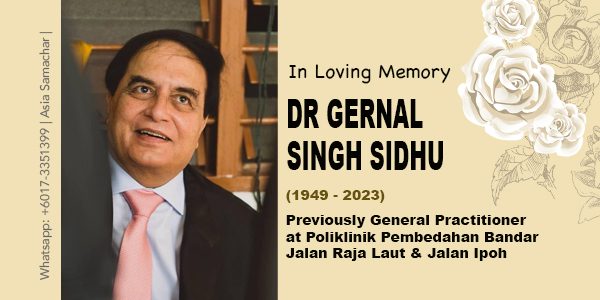
Dr Gernal Singh Sidhu (1949 – 2023), Previously General Practitioner at Poliklinik Pembedahan Bandar Jalan Raja Laut & Jalan Ipoh

Khale Aave Nanka Sade Uth Jaye 
ਘਲੇ ਆਵਹਿ ਨਾਨਕਾ ਸਦੇ ਉਠੀ ਜਾਹਿ ॥੧॥

DR GERNAL SINGH SIDHU

3.11.1949 – 1.5.2023

Village: Bhathal

Passed away peacefully on 1st May 2023

Wife: Nermal Kaur Sandhu

Son of Late Mr Kundan Singh and Late Madam Amarjeet Kaur (Nibong Tebal, Penang)

Son-In-Law of Late Mr Bhajnik Singh (Batu Gajah) and Late Madam Amar Kaur

Children / Spouses:
Dr Jasmin Kaur Sidhu / Dr Sathvinder Singh Sidhu (Hospital Serdang)

Grandchildren: Saira Kaur Sidhu

Path da Bhog: 13 May 2023 (Saturday), from 5pm to 7pm, at Gurdwara Sahib Sentul

Contact:
Dr Sathvinder (012 590 6132)
Dr Jasmin (012 518 8663)

A simple, humble and very hardworking father & husband who has left his family behind with wonderful memories to cherish forever. Special thanks to the caretakers.

| Entry: 2 May 2023: Updated: 7 May 2023 | Source: Family

ASIA SAMACHAR is an online newspaper for Sikhs / Punjabis in Southeast Asia and beyond. When you leave a comment at the bottom of this article, it takes time to appear as it is moderated by human being. Unless it is offensive or libelous, it should appear. You can also comment at FacebookTwitter, and Instagram. You can reach us via WhatsApp +6017-335-1399 or email: asia.samachar@gmail.com. For obituary announcements, click here

In Loving Memory: Harvir Singh Panesar (1991 – 2022)

FIRST BARSI

HARVIR SINGH PANESAR

(1991 – 2022)

Grandson of Late Surjit Singh Panesar & Late Sardar Jeswant Singh Dhaunsi

Father: Updesh Singh
Mother: Harjit Kaur
Brother: Hardish Singh
Sister: Prishveen Kaur

Dearly loved & deeply missed by Grandmother, uncles, aunties, relatives and friends.

Akhand Path from 5 May (Friday) to 7 May 2023 (Sunday) at Gurdwara Sahib Subang

Program

5 May (Friday): 8.30am Kirtan; 9am: Akhand Path Arambh

6 May (Saturday): Akhand Path continues

7 May 2023 (Sunday): 8.30am Akhand Path Semapti, Ardas & Breakfast. 10am-12noon Kirtan & Katha Darbar

Kindly treat this as a personal invitation from the Panesar Family.

Contact:

Gurmit 016 215 4336

Hardish 012 359 3130

| Entry: 1 May 2023 | Source: Family

ASIA SAMACHAR is an online newspaper for Sikhs / Punjabis in Southeast Asia and beyond. When you leave a comment at the bottom of this article, it takes time to appear as it is moderated by human being. Unless it is offensive or libelous, it should appear. You can also comment at FacebookTwitter, and Instagram. You can reach us via WhatsApp +6017-335-1399 or email: asia.samachar@gmail.com. For obituary announcements, click here

My Mister: My pick for best Korean drama

0

By Asia Samachar | Movie Review |

From the dozen or so Korean dramas I’ve watched in the past year, My Mister ranks among the best.

This 2018 South Korean television series is well scripted (even though we’re relying on the English subtitles). Some dialogues are worth a pause to ponder.

The series begins with the hustle and bustle of an engineering firm. The movie revolves around a middle-aged structural engineer and temporary clerk. The twist and turns weaved in the 16-series drama will keep you glued to the end.

The acting among the main casts is simply top of the class. You are bound to be drawn by the intensity that Lee Sun Gyun (who plays engineer Park Dong Hoon) and singer-songwriter Lee Ji An (also known by her stage name IU) who plays the temporary clerk named Lee Ji An.

The drama theme sound track grows on you. And the song track from the series, Grown Ups by Sondia, is absolutely heartbreaking.

Here’s a brief on the story line (adapted from an online source):

It’s not easy, admitting to yourself that your life is not a happy one, but that’s exactly what Park Dong Hoon has been forced to do. The middle-aged engineer working at a company where his college junior, Do Joon Yeon (Kim Young Min), is his boss, Dong Hoon is anything but happy. But that’s the least of his problems. With his two unemployed brothers living at him with his mother, he has to do what he can to help his struggling family, while trying to hold his own life together. Meanwhile, his wife and Joon Yeon are secretly having an affair.

As if life couldn’t get any more complicated or miserable, Dong Hoon soon finds himself entangled in a messy situation when one of his co-workers, Lee Ji An (IU) sees him accepting an unexpected bribe at work. Living with an invalid grandmother and drowning in debt, Ji An is drowning in her own miserable life so when the opportunity presents itself, she does what she can to try to make things better. Exploiting Dong Hoon in his moment of weakness, Ji An does what she can to make her life better but things don’t go the way she planned.

Caught up in a tangled web of personal struggles and internal corporate rivalry, Dong Hoon and Ji An find themselves fighting for the chance to make life better as they struggle to free themselves from their current misery and find a way to heal the wounds they each carry.

The series is on Netflix. Enjoy!

RELATED STORY:

Shadow and Bone, a dream show for fantasy lovers (Asia Samachar, 8 April2023)

ASIA SAMACHAR is an online newspaper for Sikhs / Punjabis in Southeast Asia and beyond. When you leave a comment at the bottom of this article, it takes time to appear as it is moderated by human being. Unless it is offensive or libelous, it should appear. You can also comment at FacebookTwitter, and Instagram. You can reach us via WhatsApp +6017-335-1399 or email: asia.samachar@gmail.com. For obituary announcements, click here.

Paramjit Singh (1985 -2023), Ipoh

With heartfelt sadness we would like to inform the passing on of our beloved

PARAMJIT SINGH S/O LATE JASWANT SINGH

27.1.1985 – 25.4.2023.

Age 38. Passed away suddenly on 25th April 2023.

He will be deeply missed & his memories will stay in our hearts forever

Grandson of Late Pola Singh & Late Nanjo Kaur (Paternal); Late Hemat Singh & Late Pargas Kaur (Maternal).

Mother: Charan Kaur
Brother: Jagjit Singh I Sister-in-law: Melinder Rani
Sister: Jaspreeth Kaur | Brother-in-Law: Nirmal Singh
Nieces: Kanishkka Kaur, Samryinaa Kaur, Khushleen Kaur.

Uncles, Aunties, Cousins, Relatives & Friends

Path da Bhog: 6th May 2023 (Saturday), from 6 pm – 8pm, at Gurdwara Sahib Tanjung Rambutan, Ipoh.

Please contact: Jaggy: 019-3818910, Jiteh : 018-6695220 for any further information required.

| Entry: 1 May 2023 | Source: Family

ASIA SAMACHAR is an online newspaper for Sikhs / Punjabis in Southeast Asia and beyond. When you leave a comment at the bottom of this article, it takes time to appear as it is moderated by human being. Unless it is offensive or libelous, it should appear. You can also comment at FacebookTwitter, and Instagram. You can reach us via WhatsApp +6017-335-1399 or email: asia.samachar@gmail.com. For obituary announcements, click here

Onslaught of the modern day Masand

2

By Darshan Singh | Opinion |

Guru Nanak Sahib started a faith called Sikh. Why did Guru Sahib thought it necessary to establish something new when there were already other religions in existence at the time? It was because they were all distorted from the ONE – EK ONGKAR, heavily influenced by rituals and controlled by the Pujari class. Guru Nanak Sahib’s mission therefore was to reconnect us with the ONE – Ek Ongkar. He went on his travels to share this message with the world, emphasizing on simple and straightforward 3 core principles; Naam Japna (always remembering the ONE creator), Kirt Karni (earning an honest living) and Wand Shakna (sharing a portion of honest earning with the needy).

The work started by Guru Nanak Sahib was carried on by the subsequent Guru Sahibs until Guru Arjan Sahib collected and compiled all Bani’s available, giving us the Adi Granth which originally was called Pothi Sahib and said “Pio Dadey Da Khol Ditta Khejana“. It contained the Bani’s of the 5 Guru Sahibs, Bhagats and others. Upon completion, Pothi Sahib was installed at Harmandir Sahib. So much respect was bestowed onto Pothi Sahib that Guru Arjan Sahib placed it on a Manji and himself sat below.

Time began to change for the worse and to respond accordingly, the 6th Guru, Guru Hargobind Sahib adopted the concept of Miri Piri (temporal power and spiritual authority) to uphold righteousness. Guru Sahib militarized Sikhi in order to protect Sikhs and Sikhi. Followed by the 7th and 8th Guru Sahib (no Bani of 6th, 7th, 8th and 10th Guru Sahib), 9th Guru Sahib’s Bani was included by Guru Gobind Singh Sahib and Guru Sahib bestowed Guruship upon Sri Guru Granth Sahib Ji as eternal living Guru, to whom we bow in reverence today.

Of course, there are groups like Naamdharis and Nirankaris who continue to believe that Guruship lineage continued in human form, while there is another group which believes that there are Granths other than Sri Guru Granth Sahib Ji (SGGS) in existance. This group, most dangerous to me, believes that SGGS is incomplete. It is not a “pura guru”. Only when read together with some other Granths will make it complete. How unfortunate!

Guru Gobind Singh Ji had to fight 3 very powerful enemies during his time, namely:

The Masands
The Hindu Hill Rajas
The Moguls

and amongst all, the most powerful and destructive were the Masand. Why? because they looked like us, behaved like us, worked within us but spread “cancer” to destroy us. These Masand are still in existence today and as a matter of fact coated with political power have become stronger, more influential and destructive.

Then came a period of bloody prosecution of Sikhs when Sikhs had to hide in jungles until the Moguls were defeated of cause upon the sacrifices of Guru Sahib, his family and his Sikhs but the Masand continued to flourish. During this period when the Gurdwaras fell into the hands of Udasis, Dogras, Nirmalas etc, Sikhi got massively corrupted pushing it back into the hands of the Pujaris and ritualism. I am sure you will know that there were idols of Hindu Devi Devtas places at Darbar Sahib until they were removed? I am convinced that given a chance, today’s Masand would not have removed them justifying that some Guru Sahib had actually worshipped these Devi Devtas.

Then came Maharaja Ranjit Singh who although was a Amritdhari Sikhs, did not do much justice to Sikhi as he fully subscribed and adopted the secular nation concept and many of his decisions were influenced by advisors other than Sikhs, like changing Guru Nanak Sahibs Parkash Purab to November from April, adopting Hindu Kesari color, changing the Nishan Sahib etc. Probably the only good thing Maharaja Ranjit Singh did for the Sikhs was to place gold on Darbar Sahib making it an international attraction.

Moving on, came the British and upon annexing the Punjab they immediately took control of key Gurdwaras because they knew that Sikhs generated energy from their primary spiritual source which is the Guru Granth Sahib Ji. Point to note that the British did not control any Masjid or Mandir. Guru Sahib thought Sikhs to fight for righteousness and the Gurdwara is a place where revolutions started. The British knew that separating Sikhs from their source of their energy, they will self-destruct. Many methods were adopted including introducing rival books.

This was also the time when the Rasṭriya Svayaṃsevak Sangh (RSS) a Hindu Nationalist Organization came into existence, to unite the Hindu community and create a Hindu Rashtra. This fascist RSS has never accepted Sikhi as a separate religion. For them Sikhs are a warrior sect of Hindus, established to protect the Hindus and their religion. To support their claim is the Bachittar Natak, Sarbloh Granth and all likes. Members of the RSS ideology has infiltrated all Sikh institutions in India, be it sosio-religious, political and educational. We cannot completely trust or rely on these institutional leaders anymore. Delhi Sikh Gurdwara Management Committee (DSGMC) is an example of a Sikh institution which is completely under the influence and control of the RSS. DSGMC, prefers to summon Chandi Di Var katha rather than that of Guru Nanak’s Japji Sahib, and their objective is crystal clear. Let’s not go to Nanded and Patna!

Supported by RSS and its political arm the BJP, today’s Masand have a suffocating strong hold on Sikhi and Sikhs. There was a former Masand in the form of a Jathedar from Patna, probably the most shamelessly revered Masand by groups in Malaysia, claimed that Sikh Gurus were the incarnation of Hindu Gods, Sikhs were the children of “Luv and Kush” and the even bigger and more influential Masand sitting at Akal Takht Sahib had refused to act. All 5 masands of the day had even decided to pardon the Sauda Sadh Ram Rahim. Do we need to say more!

So, we can safely conclude that it is almost a gone case in Punjab but fortunately we now have strong group of Sikh intellectuals operating from within and outside of Punjab/India challenging these Masand by educating Sikhs on the authentic message of Guru Nanak Sahib. This is our beacon of hope!

We must get back to the basics of Guru Nanak Sahibs teachings and take control of it back from the clutches of the Masand. We must unite to achieve this goal as it an onslaught of the powerful modern day Masand which we are facing.

Note:
The Nanakshahi calendar was rightfully adopted and accepted by all and it was in use until abruptly dropped without overwriting earlier acceptance. The Masand won the battle but we must win the war and this can only be achieved if we stay united.

Darshan Singh hails from Kampar, Perak and is actively involved in Gurdwara activities.

* This is the opinion of the writer and does not necessarily represent the views of Asia Samachar.

RELATED STORY:

Disunited, we all fail! (Asia Samachar, 3 June 2017)


ASIA SAMACHAR is an online newspaper for Sikhs / Punjabis in Southeast Asia and beyond. When you leave a comment at the bottom of this article, it takes time to appear as it is moderated by human being. Unless it is offensive or libelous, it should appear. You can also comment at FacebookTwitter, and Instagram. You can reach us via WhatsApp +6017-335-1399 or email: asia.samachar@gmail.com. For obituary announcements, click here.